AI Agent API Abuse Penetration Testing: Prove Budgets Hold
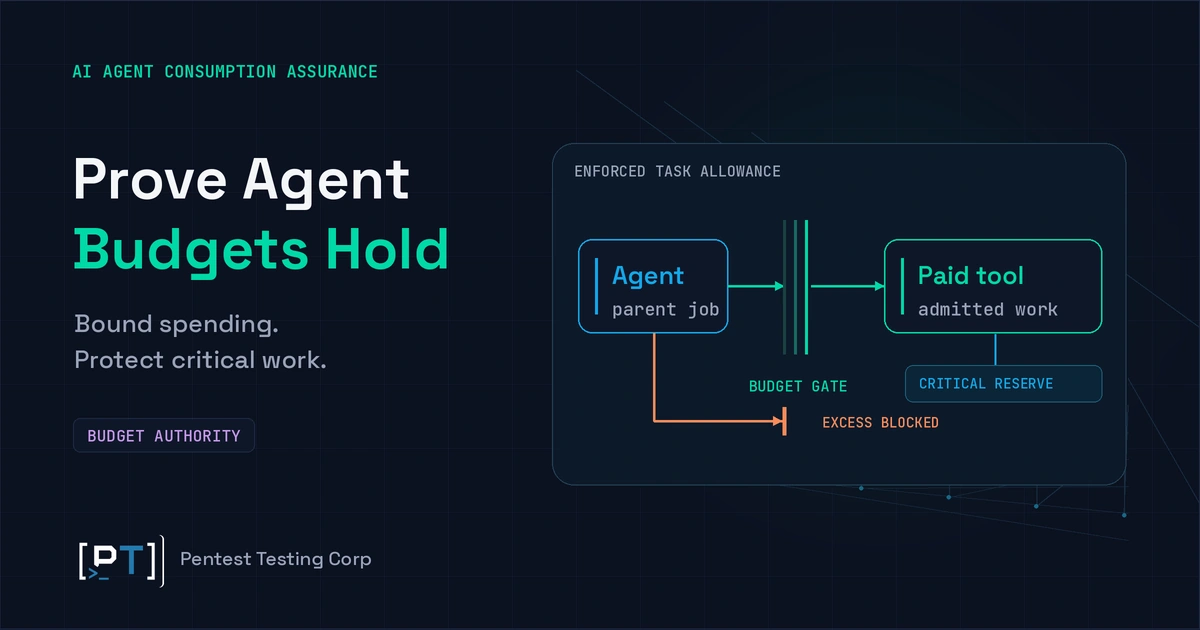
AI agent API abuse penetration testing establishes whether a permitted task can exceed its approved spending or capacity allowance. Before expanding an agent rollout, the CTO, CISO, and finance owner need evidence that task budgets, tenant quotas, and paid tool limits remain effective when work branches, fails, or moves between suppliers.
The release question is concrete: can you identify who authorized the spending, enforce the limit before further work starts, and preserve the workloads the business depends on? Use the acceptance matrix below to turn that question into a bounded assessment and a documented launch decision.
Where agentic API abuse becomes a business exposure
A public endpoint can admit a valid request that later initiates expensive internal activity. The initiating caller may be a human, a script, or another agent. The relevant exposure is the billable authority attached to the resulting workflow.
Build the assessment around the commercial promise: what each plan permits, which organization pays, and which service commitments must survive exhaustion. Data isolation needs its own evidence through multi-tenant SaaS authorization testing; permitted access can still create excessive consumption.
Independent incident evidence supports reviewing credentials as spending authority. In its August 31, 2026 security update, METR described stolen public-model API credentials used to consume credits with an approximate face value of $600,000. Those credits had been granted free; this was not a disclosed $600,000 cash loss. METR attributed the access path to an exposed orchestration application and reported no evidence that evaluation agents had hacked third parties. The lesson for this assessment is to include directly usable supplier credentials wherever they can bypass application controls.
What the October token guidance adds to release approval
The joint Managing AI token consumption for operational resilience guidance, published October 23, 2026, recommends allocating resources by operational importance, maintaining contingency arrangements, and assessing providers’ quota limitations. It distinguishes mission-critical, operational, and productivity uses.
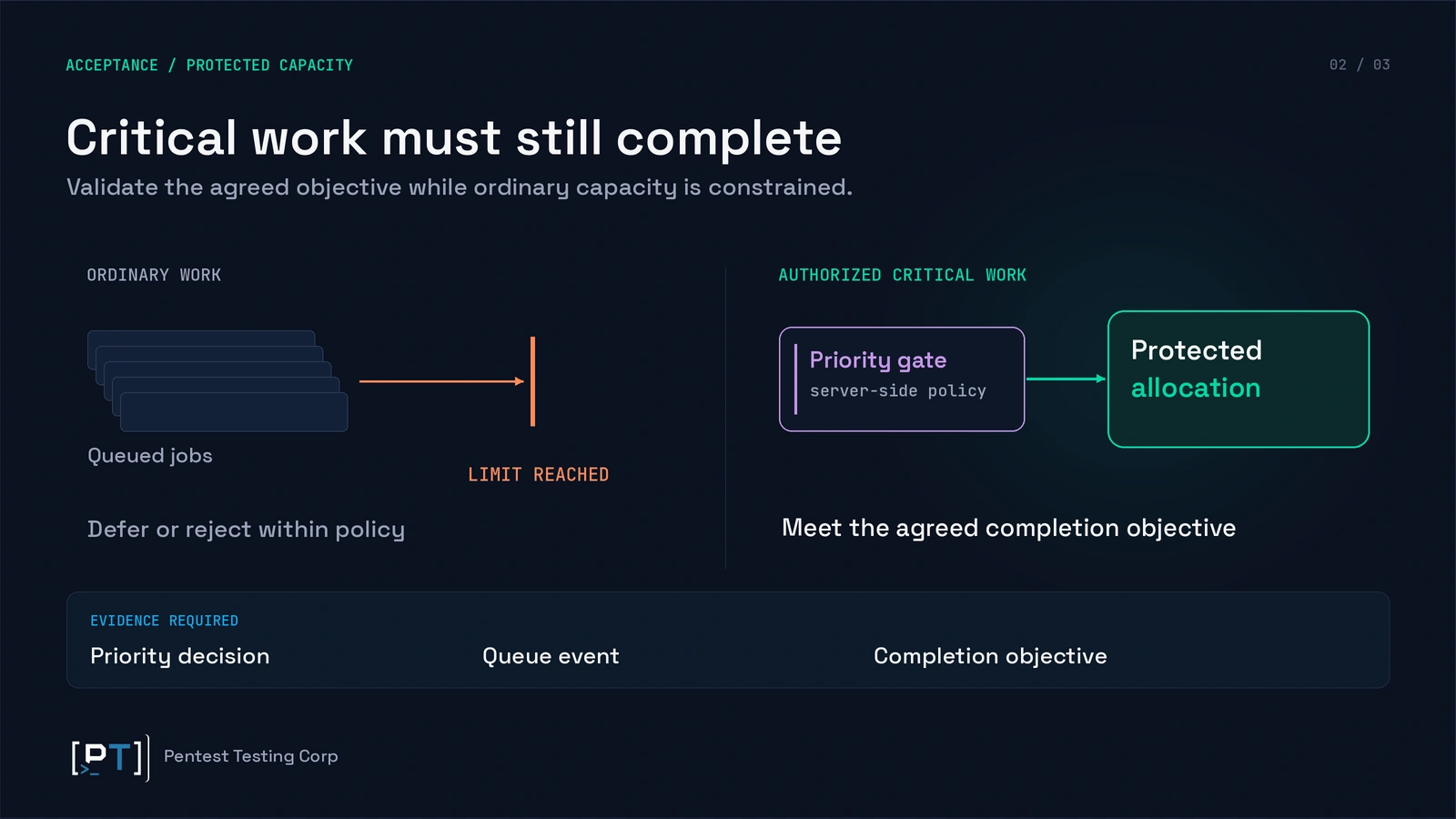
Our proposed acceptance test translates that guidance into an observable outcome: a lower-priority workload reaches its allowance while an agreed critical workflow still completes within its approved service objective. This is an assessment design recommendation, not a prescribed agency certification test.
Agree who may classify a job as critical. A priority field supplied by the caller must not grant access to reserved capacity. Also define acceptable waiting time for ordinary work: protecting critical jobs should not silently create indefinite starvation elsewhere. Test the exhaustion response and the return to normal scheduling.
Why request limits and billing alerts can leave gaps
A request counter measures admission at one interface. A financial boundary must account for the operations that follow. Document the unit, identity, time window, enforcement point, and exhaustion behavior for every limit.
| Control | Question to resolve |
|---|---|
| Request and concurrency limits | Which entry points and active jobs share the counter? |
| Model operation limits | Which input, output, execution, and supported reasoning settings bound one operation? |
| Task budget | Do delegated work and paid tools consume the same parent allowance? |
| Tenant quota | Do all users, keys, and workers debit the intended customer allocation? |
| Budget notification | Who receives it, and what enforced action follows? |
| Provider limit | Does it constrain throughput, accumulated usage, or spending, and at which account boundary? |
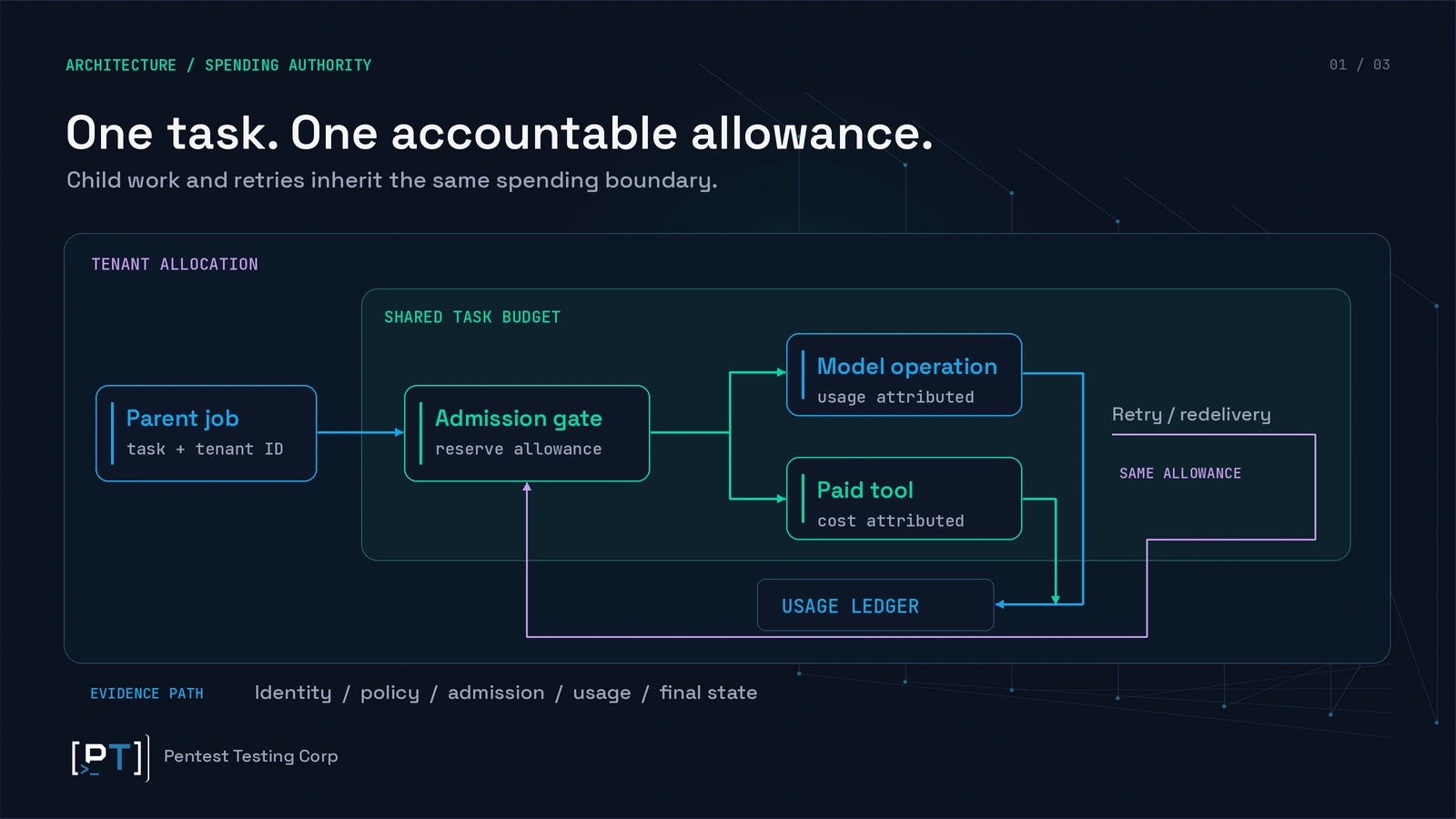
Separate the customer’s product credits from supplier billing units. A search, document conversion, or external transaction may cost money without consuming model tokens. Record the conversion policy and its assumptions, including discounts, cached usage, and delayed reports. Avoid treating a token ceiling as a complete monetary ceiling.
AI agent API abuse penetration testing acceptance matrix
Set numerical thresholds with the business before testing. Each row needs an owner, a defined environment, and a pass, fail, or untested result. A configuration screenshot alone cannot establish the outcome.
| Boundary | Acceptance outcome | Evidence to retain |
|---|---|---|
| Task and paid tools | Every admitted operation fits the remaining approved allowance. | Parent and child IDs, admission decisions, cost reservations, tool usage. |
| Concurrent tenant work | Simultaneous jobs cannot each claim the same remaining credit. | Ledger transitions and controlled concurrent admission records. |
| Retries and redelivery | Recovery stays within the retry policy and duplicate-cost tolerance. | Attempt IDs, accounting entries, duplicate handling, completion state. |
| Critical capacity | Approved priority work meets its agreed objective while ordinary capacity is constrained. | Priority authorization, queue events, completion times, allocation policy. |
| Supplier quota | Exhaustion produces the approved degraded response without uncontrolled rerouting. | Quota scope, response records, bounded retries, destination routing. |
| Fallback | Alternative models and tools preserve budget and data-policy constraints. | Route choice, applicable rate assumptions, fresh admission decisions. |
| Stop and recovery | New spending stops; accepted work stays within an agreed residual bound. | Stop time, downstream acknowledgments, residual usage, restart results. |
A pass applies to the tested configuration and observed conditions. Record exclusions beside the result, including unavailable billing telemetry or production-only provider limits. Where enforcement depends on an untested supplier behavior, keep that dependency open in the release decision.
Supplier-quota evidence the buyer should request
Prepare a dependency register for each billable route: supplier, account or project, credential owner, model or tool, quota type, reset behavior, and critical workflows sharing the allocation. Confirm the deployed contract and settings; provider terminology is not consistent enough to infer enforcement from a label.
Obtain evidence for the actual boundary. A limit on one credential may leave another route available; different models may share an organizational allowance. Separate accounts may isolate accounting while still depending on the same supplier availability. Establish what your architecture actually protects.
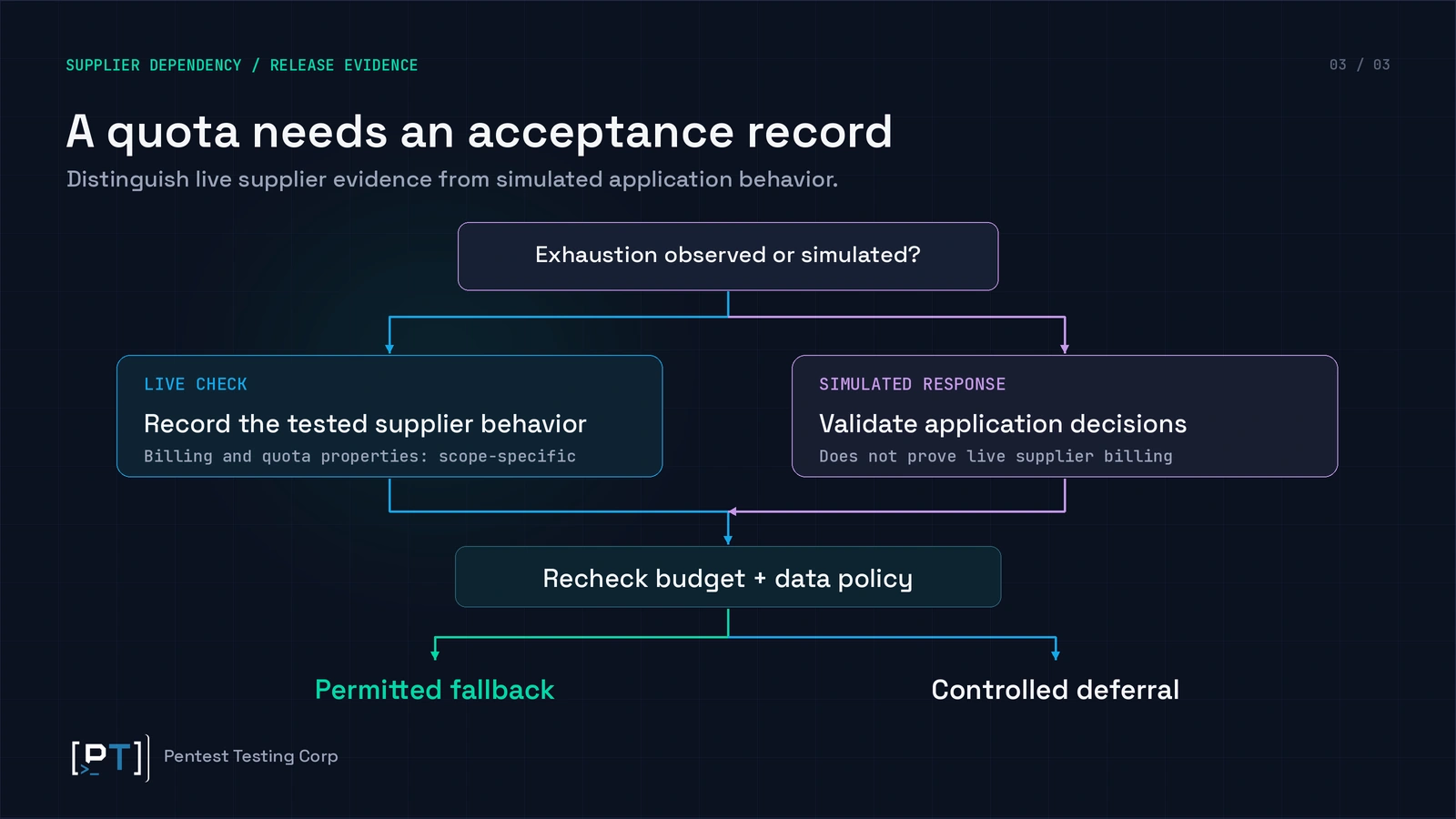
Exercise exhaustion with a reduced application allowance or a controlled supplier response where possible. Label simulated outcomes clearly. They can validate orchestration decisions but cannot demonstrate live supplier billing, quota isolation, reserved availability, or cancellation semantics. Use a permitted, limited live check when those properties are essential to acceptance.
Fallback deserves a new admission decision. A more expensive model, a second search service, or a retry through another region must still fit the approved policy. If no permitted route remains, return the agreed partial result, deferral, or rejection and alert the responsible operator.
Budget eligibility is one condition for switching; the alternative must also meet the workflow's data and action restrictions. Review security acceptance before switching AI providers for a broader decision covering approved destinations, approval parity, and return to primary.
Define budget authority before measuring enforcement
Assign a business owner to the limits and an engineering owner to each enforcement point. Specify who can approve exceptions, their maximum authority, and when an exception expires. The agent’s own explanation that a task is important should not authorize more spending.
For asynchronous work, decide how capacity or credit is reserved before dispatch and reconciled afterward. The assessor should trace failure cases such as a worker crash between a paid operation and a ledger update. The design needs a stated tolerance for uncertainty and a recovery policy that does not repeatedly release the same allowance.
Review credentials separately through token lifecycle and revocation testing. If a supplier key is usable outside your gateway, application quota evidence does not establish a limit on that direct path. Scope credential permissions and supplier-side controls accordingly.
Review model access and administrative authority separately from spending limits. A credential may be permitted to call a model while still holding unnecessary rights to issue keys or change connected resources.
Agree on a bounded test and a useful illustrative scenario
Illustrative scenario, not a client finding: a SaaS agent creates research summaries and also supports urgent incident triage. Both workflows share a provider allocation. The proposed assessment uses synthetic tenants, a small test allowance, and approved concurrency to check whether summary jobs can consume capacity reserved for triage.
The tester records the normal triage baseline, starts the agreed summary workload, and observes the admission and scheduling decisions near the reduced allowance. The expected result is a bounded summary response and successful authorized triage within the agreed objective. A caller attempting to relabel a summary as urgent should remain in its permitted class.
If triage fails, the report identifies the observed bottleneck and affected dependency. It does not extrapolate a staging delay into a production outage claim. Remediation might involve separate allocations, verified queue priorities, or a non-AI continuity route; retesting must establish the chosen design’s behavior.
Rules of engagement should name the environment, identities, expenditure ceiling, operation limits, emergency contact, and stop triggers. Coordinate with performance testing when a capacity claim requires a representative workload. Testing your application does not authorize disruptive activity against its suppliers.
Evidence, framework editions, and financial impact
OWASP LLM10:2025 Unbounded Consumption remains a useful reference for contracts using the 2025 edition. The OWASP 2026 guide lists Unbounded Consumption as LLM06:2026. Name the risk and edition together; an unqualified “LLM06” can refer to a different risk in older material.
API4:2023 Unrestricted Resource Consumption provides complementary coverage for resource limits and paid integrations. For governance, NIST CSF 2.0 offers a way to organize responsibilities and risk treatment. Using it to connect budget ownership, monitoring, containment, and recovery is an editorial application of the framework, not an official control equivalence or compliance determination.
Retain enough correlated evidence to explain the result: identity, tenant, parent job, policy version, admitted operations, usage source, timestamps, and final state. Redact secrets and unnecessary prompt content. Distinguish observed test cost, modeled exposure, and the finance-approved operating ceiling.
Where downstream actions also affect data or customers, use AI agent shutdown testing for the broader cessation and recovery scope. Cost containment is one part of that decision.
Scope the engagement around the release decision
Start with the highest-consequence workflow and expand according to its dependencies. Supply the assessor with the workflow diagram, API specification, role and tenant accounts, entitlements, provider inventory, budget policy, and redacted usage records. Include the critical-workload owner and the finance contact who can interpret billing evidence.
Pentest Testing Corp’s AI penetration testing service is the primary route for this agentic assessment. Include API penetration testing where admission and accounting controls sit in exposed or downstream APIs. Agree combined coverage in the statement of work.
Allow engineering time for remediation before setting the expansion date. Changing an existing setting can be contained; introducing shared reservations, priority enforcement, or reliable worker cancellation can require architecture work. Agree the quote and schedule after tracing the paid operations.
Keep adjacent scope explicit: MCP security testing addresses tool trust; RAG security testing addresses retrieval; agent sandbox testing addresses runtime containment. The AI pentest scope checklist helps coordinate those boundaries.
What leadership should decide before launch
Approve expansion only against a written acceptance record. Finance signs off on spending authority and residual-cost tolerance; engineering confirms enforcement and recovery; security assesses bypass paths; the critical-service owner accepts the measured availability outcome. Record unresolved gaps, compensating controls, owners, and deadlines.
Retest after changes to routing, suppliers, entitlements, tool pricing, priority policy, worker behavior, or retry logic. A successful earlier test does not automatically cover a newly introduced paid route.
Frequently asked questions
Does a budget alert prove that spending stops?
No. Verify what enforces the allowance, when it takes effect, and which in-flight operations can still incur charges.
Can one provider quota protect every tenant?
A shared quota may constrain aggregate use while allowing one tenant to consume capacity needed by others. Test tenant allocation and critical-workload protection separately.
Does bring-your-own-key remove our exposure?
It may shift model charges to the customer. Your workers, retrieval, storage, and paid tools can still incur costs, and the agent still needs bounded authority over the customer’s key.
Can consumption testing replace load testing?
No. Consumption testing evaluates enforcement and bypass paths. Load testing evaluates capacity and performance under an agreed workload; coordinate both when acceptance depends on production demand.
What should happen after a task is cancelled?
New spending should stop at the defined enforcement boundary. Record already accepted work, its maximum residual exposure, and the recovery process that prevents cancelled jobs from restarting.
Scope a bounded AI consumption assessment with your workflow map, budget authority, supplier dependencies, critical services, and release decision. Request evidence that the approved limits hold and essential work remains available before scaling.