AI Inference Control Plane Security Testing: Admin Access
A CTO is preparing to approve a self-hosted model-serving platform. The chat application requires sign-in, the model answers correctly, and a reverse proxy handles incoming traffic. Then the security team asks who can change models, create privileged keys, or administer the machines running inference. The release checklist has no evidence for those decisions.
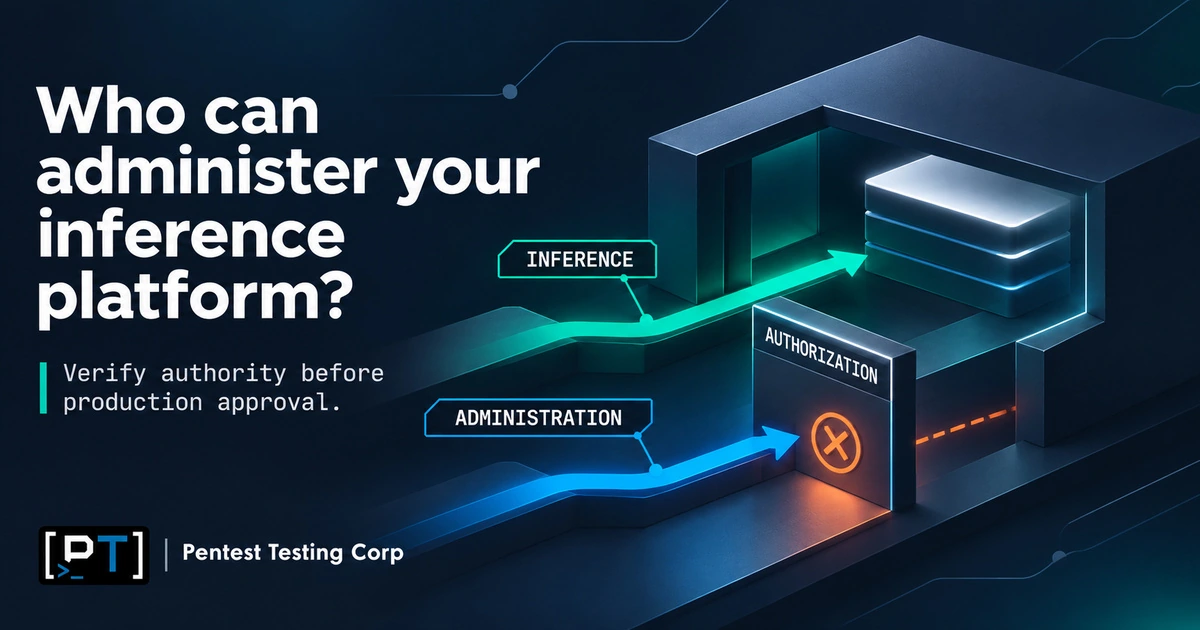
AI inference control plane security testing addresses that gap. It verifies which people, services, and network paths can acquire administrative authority over model serving, including paths that bypass the customer-facing application.
The timing matters. On 9 November 2026, CISA added GPUStack CVE-2026-102895 to its Known Exploited Vulnerabilities catalog. The buyer question is immediate: does an affected deployment need urgent containment, and what evidence would justify reopening it? For a new deployment, require named administrative paths and demonstrated denial everywhere else before approving production.
Why inference administration needs its own approval gate
The serving layer processes model requests. The administrative control plane determines how that service operates: which models are deployed, which workers are trusted, which identities exist, and which integrations carry credentials. Products may place these functions behind overlapping routes, gateways, or interfaces. A shared hostname does not mean they should share authority.
A customer allowed to request a prediction should not automatically be allowed to register workers or change deployment settings. Likewise, a platform operator responsible for model availability may not need access to every provider secret. Those distinctions protect customer confidentiality, production integrity, and the ability to explain who approved a change.
A successful chatbot evaluation gives little evidence about these boundaries. Content filters evaluate model interactions; administrative authorization determines whether a caller may change the infrastructure. Both can matter, but they answer different release questions. Procurement should ask which management interfaces, worker services, and machine identities were actually included in the assessment.
Place this work explicitly within the infrastructure scope of an AI penetration testing engagement. Name the management APIs, ingress routes, worker connections, and credential lifecycle in the statement of work. Otherwise, a test centered on prompts and application behavior can leave the operational authority behind the model unexamined.
Assign an accountable platform owner before testing begins. Security can validate the controls, but the business must define who should be able to administer the deployment and which actions require separate approval. Without that policy, a report can describe observed access without establishing whether the access is acceptable.
What the GPUStack advisories change for buyers
The GPUStack maintainer advisory, published on 31 July 2026, identifies versions before 2.2.0 as affected by an authentication bypass involving implicit trust in a local request source. Certain proxy arrangements or untrusted source information could cause a remote caller to receive administrator authority. Version 2.2.0 fixes this specific issue.
The documented consequences include administrative changes, creation of persistent privileged API keys, access to worker and provider credentials, and potential code execution through administrative functionality. These are reported capabilities of the affected product configuration, not a claim that every self-hosted inference platform exposes them.
CISA's November catalog addition supplies evidence of active exploitation and raises remediation priority. It does not prove that a particular organization has been compromised. Establish the affected version, actual exposure, and available activity records before making that determination. Emergency access restrictions and evidence preservation can proceed while the incident owner investigates.
A separate worker-management advisory published on 26 October 2026 describes inference-only API keys being accepted through a delegated authorization path for management operations when the affected worker API is reachable and the delegated check succeeds. It lists versions through 2.2.3 as affected and 2.3.0 as patched; affected workers need the fix, including embedded workers. Updating a separate server alone is insufficient. This reinforces a separate acceptance question: does permission to use a model remain confined to inference?
Do not turn the first fix number into a general upgrade recommendation. The SAML authentication advisory, originally published on 30 September and updated on 10 November, identifies another authentication issue with a different affected range and fix. Review applicable current advisories and release guidance together. Closing one CVE is narrower than establishing a secure deployment baseline.
For leadership, the trigger is an affected installation, an uncertain deployment inventory, or a planned production rollout. Fund immediate remediation where applicable, then commission verification against the deployed architecture. An emergency patch should not wait for a broader assessment to start.
AI inference control plane security testing scope and acceptance matrix
Start with the real route inventory. Include public gateways, administrative hostnames, direct backend listeners, worker-facing services, private networks, support access, and emergency accounts. Record whether each route is intentionally reachable and which identity should authorize the business operation.
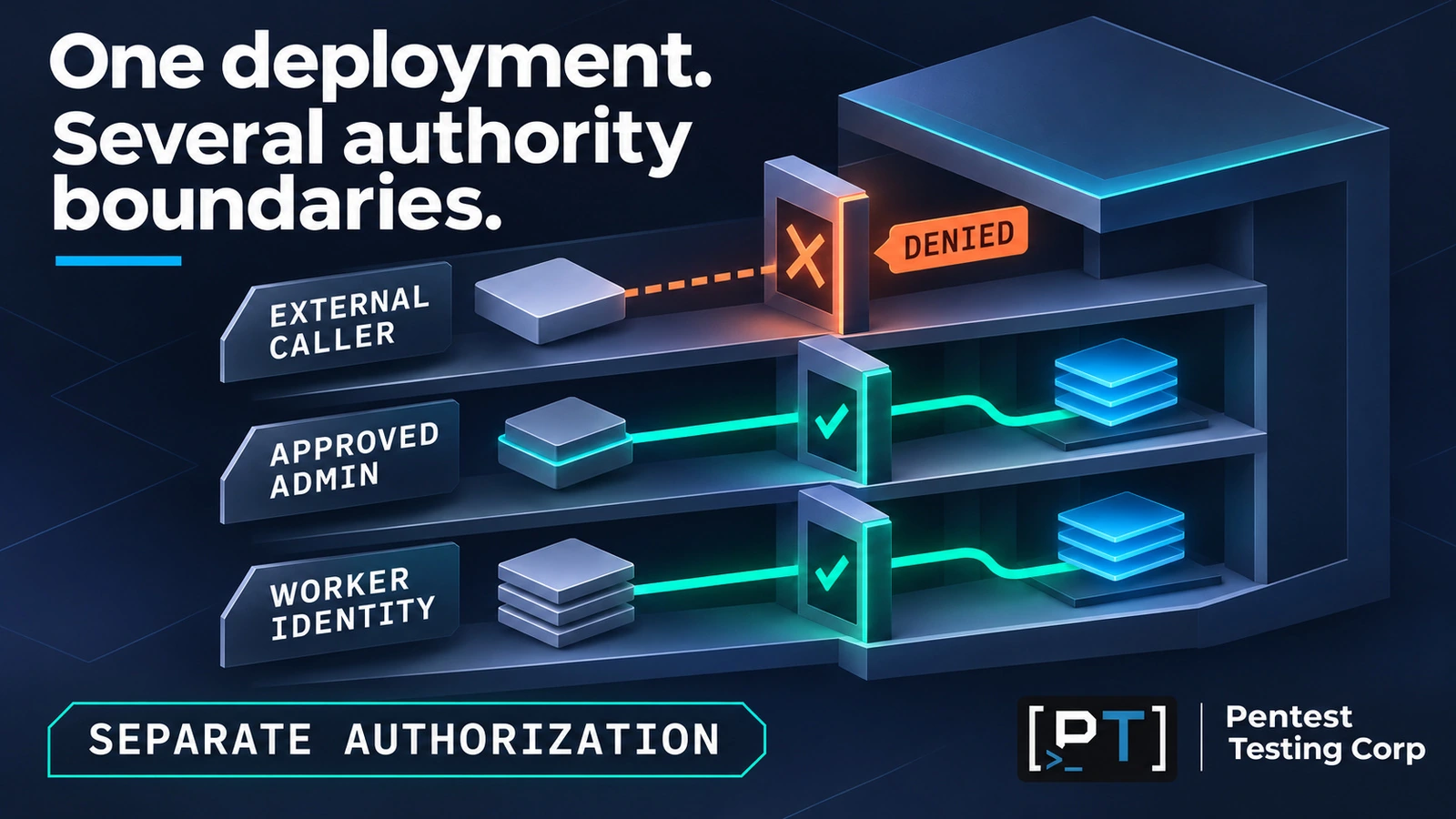
Then define positive and negative expectations. An approved operator should complete the permitted change through the approved path. An anonymous caller, ordinary application user, inference-only key, or unrelated worker should fail when attempting that same administrative function. Neither a login screenshot nor a network diagram proves both outcomes.
| Starting identity or path | Required boundary | Evidence for approval |
|---|---|---|
| External caller without credentials | No administrative authority through public or alternate ingress. | Named routes, observed denials, and correlated application records. |
| Inference-only API key | Model usage remains separate from users, workers, secrets, and deployment administration. | Allowed inference and denied management actions for the same test identity. |
| Request crossing a reverse proxy | Proxy origin or forwarded source information cannot substitute for caller authentication. | Observed identity and authorization decisions across approved ingress and permitted bypass checks. |
| Authenticated worker | Worker identity stays within its assigned operations and cluster scope. | Permitted worker activity plus denied peer or unrelated management access. |
| Approved administrator | Authority matches the approved role and produces attributable changes. | Controlled change, actor attribution, and verified cleanup. |
| Revoked privileged credential | Administrative access ends across every included route. | Revocation timing, denied reuse, and documented residual sessions or exclusions. |
Treat this as a scoping baseline, not a universal pass certificate. Expand it for tenants, clusters, external providers, and deployment methods that create different trust decisions. Where a product cannot express the required separation, record the limitation and assess compensating architecture before accepting the risk.
A focused test should use synthetic identities and reversible changes agreed in advance. It should not require downloading customer prompts or exposing live secrets to demonstrate a permissions failure. Define stop conditions for any operation that could restart workers, replace models, or affect available capacity.
The surrounding network matters too. Our guide to segmentation testing for AI workloads examines whether an AI-related foothold can reach management systems and other sensitive zones. This article adds the administrative question after reachability: what authority does the destination actually grant?
Test proxy trust, worker identities, and persistent credentials
A protected gateway needs a protected backend
Single sign-on and gateway authentication can protect an intended route while leaving another listener reachable. Ask the assessor to identify which component makes the final authorization decision and whether every included path reaches that enforcement point. A control that operates only on the preferred route leaves the architecture dependent on routing assumptions.
Proxy trust needs its own evidence. Intermediaries can alter the network source visible to a backend or convey caller information in headers. The assessment should establish whether trusted assertions come only from approved intermediaries and whether their meaning remains distinct from authenticated user identity. Leadership needs the resulting access decision, not a header manipulation tutorial.
For private deployments, include representative internal starting positions. A system can be unreachable from the internet and still reachable from a development runner, support network, or compromised adjacent workload. Choose starting positions based on credible business access, then state those assumptions in the report.
Workers and callers must retain different authority
Workers need enough access to perform their assigned role. That requirement does not justify unrestricted control of other workers, administrative users, or unrelated clusters. Verify both the platform's documented permission model and the effective permissions observed in the deployed version.
Do not assume a label such as inference-only proves restriction. Require evidence from the management interfaces that would matter if the key were stolen. Where the worker and serving paths share an authorization service, verify that the service preserves the distinction between requesting inference and administering infrastructure.
Closing an entry path does not settle credential exposure
When administrative access could create credentials or expose connected secrets, remediation needs a credential decision as well as a software decision. Establish which keys existed, who created them, their effective permissions, and what records support their provenance. Investigate unexplained credentials through the incident process rather than assuming they belong to legitimate automation.
The related MLflow SSRF and cloud-credential assessment addresses a different entry mechanism. Here, the central question is whether inference administration grants or reveals authority that remains usable after the original access path closes. Where provider permissions extend the impact, include the affected resources in scope through explicit authorization.
Credential treatment should identify dependent services and a recovery owner. Removing a suspect key without understanding its legitimate consumers can interrupt production; retaining it indefinitely preserves uncertainty. Plan replacement, revocation verification, monitoring, and service recovery together, with decisions recorded by the responsible incident or platform owner.
AI inference control plane security testing evidence
A defensible report connects identity, route, attempted operation, observed result, and business consequence. Each finding should distinguish a proven capability from an inferred possibility. If the assessor proves unauthorized configuration access without executing code on a worker, the report should say so and explain any untested downstream impact.
Require a dated record of the product version, deployment topology, proxy configuration, and credential policy examined. Capture enough configuration context to repeat the test after remediation. A result from staging applies to production only to the extent that relevant routes, identities, enforcement, and settings match.
The evidence package should also show successful authorized operations. An interface that rejects everyone may satisfy a narrow denial test while breaking the service. Approval requires both the intended operational capability and demonstrable restrictions on callers who should not possess it.
Useful reporting separates confirmed failure, observed pass, and untested coverage. Inaccessible worker routes, unavailable identity types, or excluded third-party administration should appear as explicit limitations. Buyers should not interpret silence as assurance.
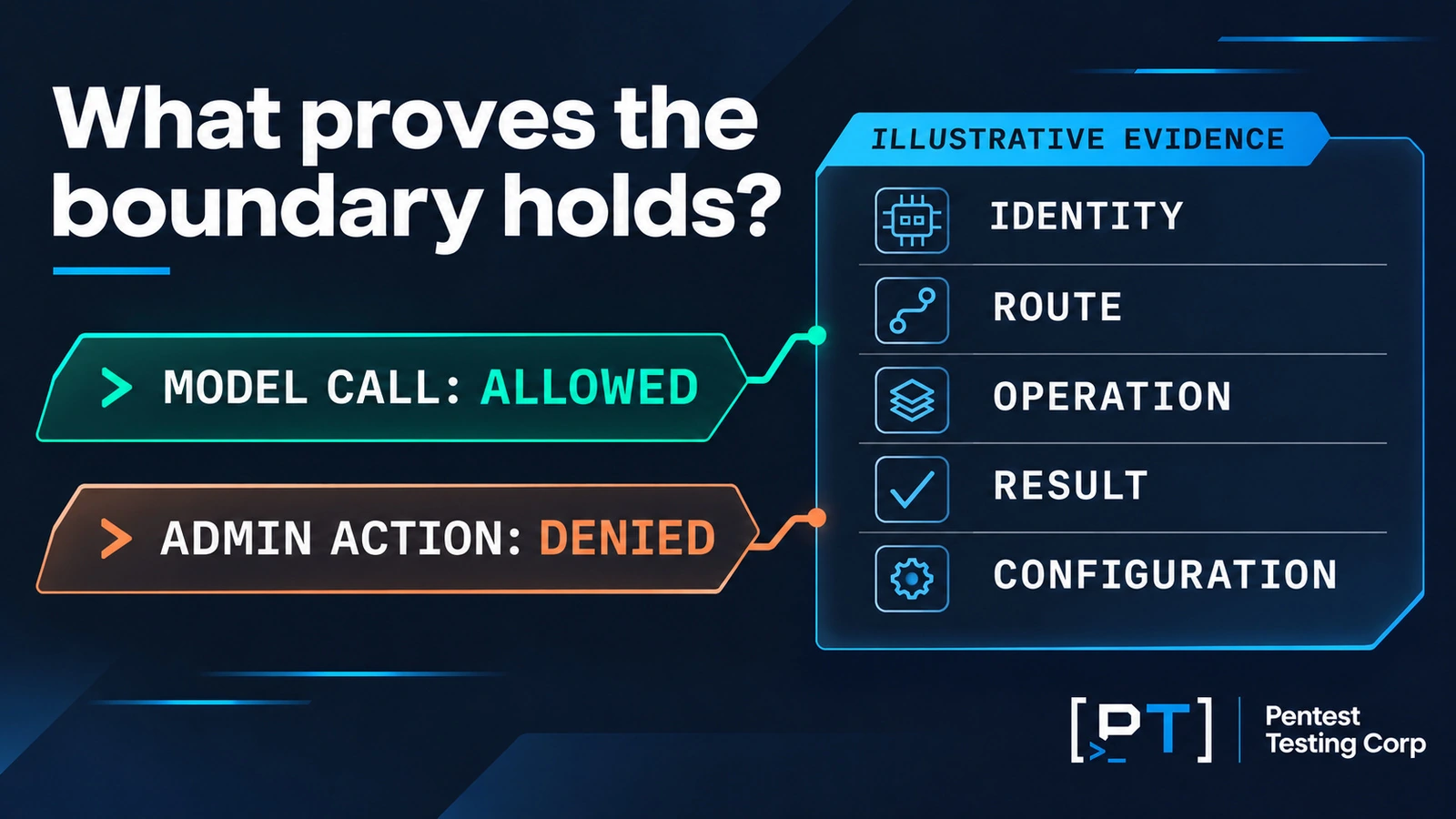
Ask how the evidence will reach its intended audience. Engineering needs enough detail to reproduce and correct the issue within authorized systems. Leadership needs the affected business capability, release implication, and remaining uncertainty. A customer reviewing assurance may need a carefully scoped summary rather than administrative routes or sensitive configuration. Agree on those deliverables before testing, with access controls appropriate to the contents.
Retest evidence should name the original finding and the changed control, then record the relevant permitted and prohibited outcomes again. A deployment receipt establishes that software was installed; a retest establishes what the assessed boundary did afterward. Keep both records because they support different parts of the acceptance decision.
Use framework references to organize evidence. OWASP API2:2023 Broken Authentication fits failures in establishing caller identity. API5:2023 Broken Function Level Authorization addresses callers reaching administrative functions beyond their role. These are the direct mappings for the access-control problem.
The LLM02:2025 Sensitive Information Disclosure mapping is relevant where the observed chain exposes sensitive information in the AI system. LLM10:2025 Unbounded Consumption is relevant where unauthorized use or weakened limits permit excessive inference resource consumption. These are conditional impact mappings, not substitutes for the underlying API finding or claims that every administrative flaw demonstrates an LLM failure.
Under NIST CSF 2.0, connect asset inventory, authenticated identities, least privilege, monitoring, and incident decisions to the corresponding evidence. Under NIST AI RMF 1.0, use GOVERN for accountability, MAP for deployment context, MEASURE for validation, and MANAGE for treatment. Framework mapping supports governance; it does not establish certification or guarantee compliance.
Before commissioning work, compare the expected evidence with a professional penetration testing report example. The acceptance decision should be traceable to findings, limitations, remediation ownership, and retest status.
What leadership should decide and fund
Make a specific decision about the named deployment. Approve the administrative paths supported by evidence, restrict unresolved paths where a defensible operating model exists, or hold the affected rollout. An unidentified administrator or untested alternative route is an unresolved question, not an implicit approval.
Hypothetical scenario: the chat release passes, administration does not
Consider a fictional SaaS provider moving customer support inference onto its own GPU infrastructure. The application passes sign-in and content-safety checks. During an authorized assessment, a synthetic inference-only identity is found to reach a worker-management operation outside its approved role. The team stops at a reversible proof and records the result without changing production models.
The business consequence is an uncertain boundary around the infrastructure supporting customer responses. It could affect service integrity or availability, depending on the demonstrated permissions. There is no evidence in this scenario that customer information was accessed, and the report does not claim a breach.
Leadership delays expansion, limits access to the affected management path, and funds correction and independent retesting. Operations retains a documented recovery route. Once the permitted serving action succeeds and the prohibited administrative action fails through the relevant paths, the owner can reassess release approval using evidence.
Budget for the boundaries that drive effort
Scope is driven by distinct trust decisions, not simply the number of GPUs. Multiple gateways, worker types, identity providers, clusters, tenants, and connected secrets increase the combinations that need validation. Legacy access routes or an unclear credential inventory can add investigation and coordination before testing is safe or conclusive.
Separate emergency containment, patch implementation, independent verification, and historical incident investigation in the engagement plan. Each needs an owner and deliverable. If cloud identity or provider access becomes part of the demonstrated chain, add cloud penetration testing scope; the cloud assessment guide explains the surrounding infrastructure coverage.
Agree on delivery gates: inventory and permissions approved; access and safeguards ready; validation completed; remediation implemented; retest concluded. Set dates after reviewing topology, operating windows, and access readiness. An arbitrary deadline agreed before those dependencies are known can produce exclusions precisely where the buyer needs confidence.
Require every material exception to name the affected path, business impact, temporary restriction, accountable owner, and expiry or review date. Repeat focused validation when ingress, worker registration, identity integration, or administrative credential behavior changes. Evidence should follow the deployed boundary.
Operational ownership must continue after approval. Assign responsibility for watching applicable advisories, reconciling administrative accounts and keys, and identifying configuration drift. Decide who can suspend an exposed management route without waiting for a routine change meeting. That authority should be balanced with a tested recovery arrangement so urgent containment does not depend on improvising access to the same platform under investigation.
Before approving your next model-serving rollout, scope an inference-administration security assessment with Pentest Testing Corp. Bring the topology, software inventory, identity roles, and exposure history so the assessment can answer who has administrative authority and whether the business should accept it.
Frequently asked questions
Should we wait for a penetration test before fixing an affected deployment?
No. Apply the maintainer's applicable remediation and restrict exposure promptly. Coordinate evidence preservation and investigation where compromise is plausible. Independent verification can then confirm the corrected boundary without delaying urgent treatment.
Can a managed inference provider remove this assessment requirement?
It changes the responsibility boundary. Ask for provider assurance covering its administration, then test your own organization roles, integrations, gateways, and credentials. Confirm which infrastructure is provider-controlled and excluded from your authorization to test.
What if the platform offers only a single administrator role?
Evaluate whether that role matches the business requirement. Restricted management access, separate environments, approval workflows, and monitored emergency access may reduce exposure. Record remaining limitations and decide whether the product's permission model is acceptable.
How should procurement compare assessment proposals?
Compare named entry paths, identity types, administrative actions, worker coverage, credential lifecycle checks, and retest deliverables. Require explicit exclusions and operational safeguards. Two proposals using the phrase AI pentest may cover very different infrastructure.
Can testing proceed without sending customer prompts to the assessor?
Often, administrative authorization can be evaluated using synthetic accounts, representative models, and controlled records. Agree on the evidence needed for each claim and disclose limitations when production-specific behavior cannot be safely reproduced.
Does a passing result apply to every future deployment?
No. The result applies to the documented version, configuration, paths, and identities tested. Treat material architecture or authorization changes as triggers for focused reassessment, and keep the acceptance record aligned with production.