AI Provider Failover Security Testing Before Switching
A CTO approves a second AI supplier so the customer-support platform can keep working during an outage. In the demonstration, the router detects a failed request, selects the fallback model, and returns an answer. The resilience dashboard turns green. Procurement then asks whether customer attachments can reach that supplier, while security asks whether the fallback still requires approval before sending a message. Neither question was part of the demonstration.
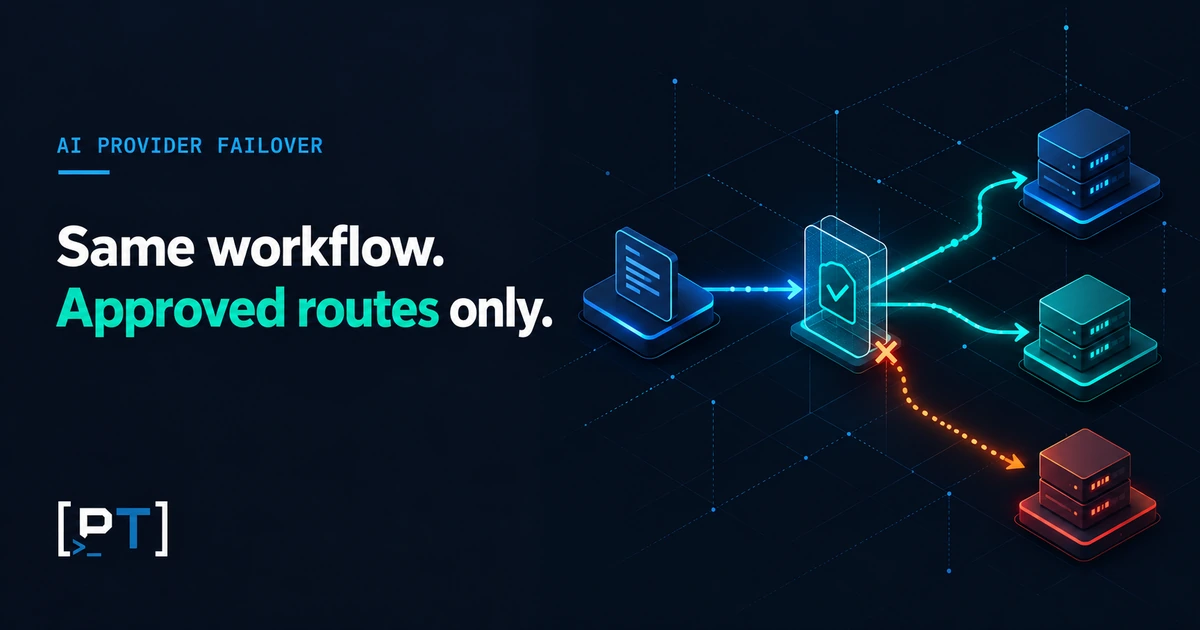
AI provider failover security testing examines whether switching routes preserves the data, tool, and approval restrictions already agreed for the business workflow. A response from the secondary proves availability for that attempt. Leadership also needs evidence that the response came through an approved destination and could not create a broader business action.
The acceptance decision should name the permitted routes, eligible operations, required restrictions, and safe outcome when no supplier qualifies. Approve only the combinations supported by evidence.
Why provider failover changes the approval decision
The immediate trigger is usually practical: a team adds another supplier, enables automatic LLM routing, or replaces a manual outage procedure. That change can alter who processes information, which credentials are used, what features are available, and how an interrupted task resumes. A continuity improvement can therefore require security, privacy, procurement, and operational decisions together.
Recent guidance supports reviewing that boundary. The joint publication Managing AI token consumption for operational resilience, published by ASD ACSC on 23 October 2026, recommends multi-provider architecture and routing workloads to available providers during disruption. It also emphasizes governance and human authorization for consequential actions. Our acceptance recommendation follows from applying those considerations together: resilience routes need their own security evidence.
The CSA Singapore outcome statement published on 15 October 2026 discusses independent verification, model diversity, and safeguards outside the model. Model diversity may reduce certain dependencies, but it does not establish that two suppliers have independent infrastructure or equivalent data controls. The buyer must validate the actual arrangement.
Separate three changes in the proposal. Model fallback selects another model, potentially within one supplier. Provider failover changes the service route or supplier relationship. Agent delegation transfers work between agents. A single release may combine them, but each changes a different boundary. A familiar model name or compatible interface cannot establish that the destination, permissions, and recovery behavior remain acceptable.
AI provider failover security testing starts with approved routes
Start with a route register for each named workflow. Record the primary and secondary supplier, contracting entity, account or project, model, endpoint, permitted regions, credential owner, and enabled capabilities. Include any gateway or intermediary that receives request content. An approved supplier list is insufficient if developers can select an unreviewed account, region, or hosted feature within that supplier.
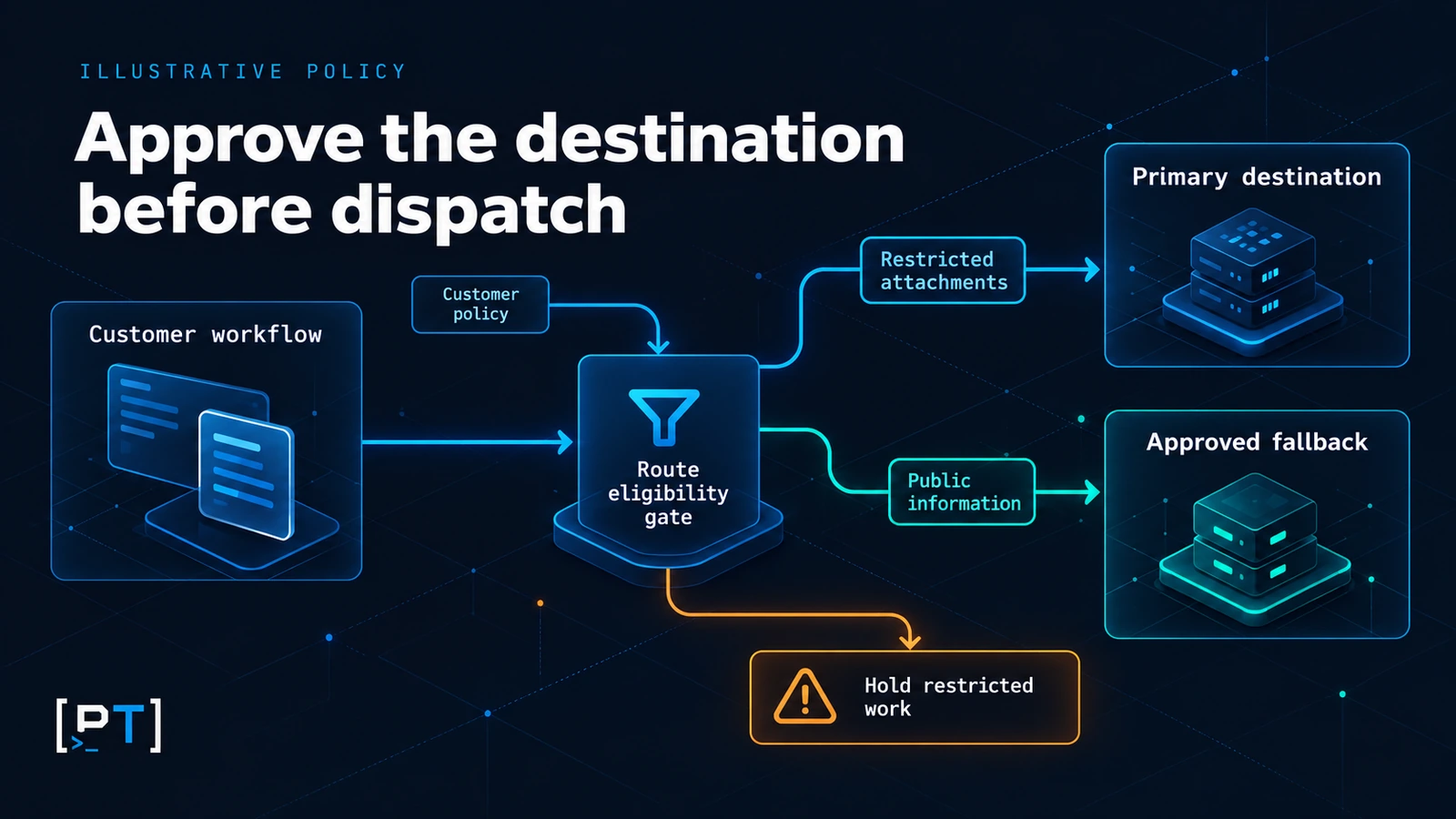
Give every route an explicit status: approved for specified use, restricted to a narrower purpose, disabled pending evidence, or prohibited. Tie approval to the data classes and business operations it covers. A secondary might be suitable for public documentation while remaining unavailable for confidential customer attachments. That distinction should be enforced before content leaves the application.
An AI penetration testing assessment can examine these workflow boundaries alongside the application controls that enforce them. Supply the proposed register and acceptance rules during scoping. Otherwise, the assessor may discover a route without knowing whether it is an intended feature, an emergency exception, or an unauthorized destination.
Technical testing and supplier review answer different questions. Controlled observations can show which endpoint receives a synthetic request and which application restrictions operate. Contracts and relevant service documentation are needed to assess processing, retention, training use, access, deletion, and applicable customer commitments. A network trace cannot establish every internal supplier practice; a contract cannot demonstrate that the application routes correctly.
Ask privacy and procurement owners to compare the fallback arrangement with existing commitments before activation. Record unanswered questions as approval dependencies. Private connectivity, encryption in transit, or a regional endpoint can be useful controls, but none independently settles the complete processing scope. Where contract or privacy requirements remain unresolved, keep the affected workload off that route.
Define what must survive the switch
Data destinations and customer boundaries
Define which information may move, for what purpose, and through which approved destinations. Cover prompts, attachments, retrieved records, tool results, conversation summaries, caches, diagnostic traces, and output storage where relevant. The request body is only one part of the data flow. A fallback adapter might also introduce different logging or persistence behavior.
Tenant isolation must remain effective before retrieval, during routing, and when results return. A route available to one customer does not automatically become available to another customer with stricter commitments. If redaction is an acceptance condition, assess representative synthetic examples and record its limitations. Do not treat a masking setting as permission to send every category of source material.
Tool permissions and approval parity
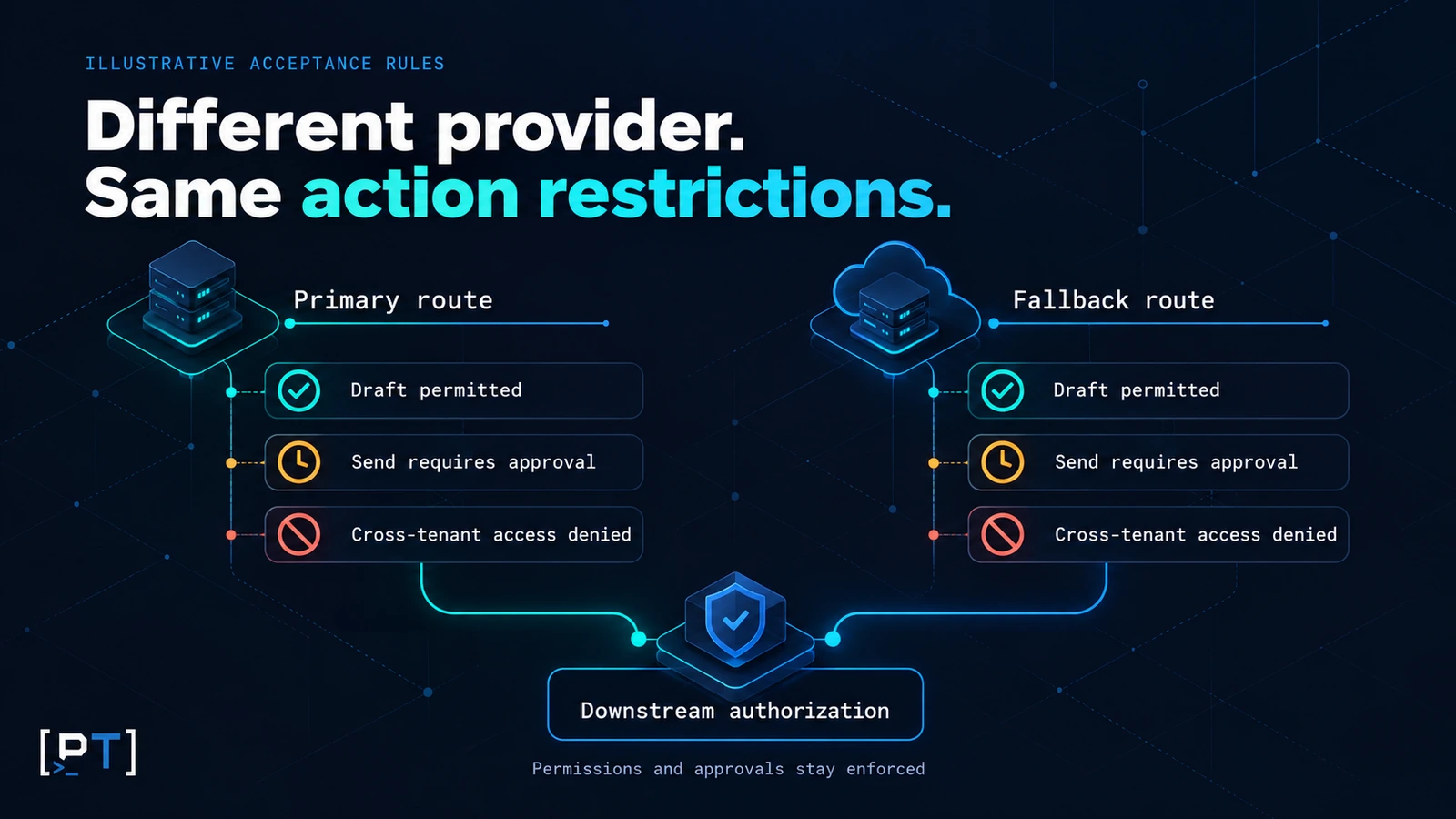
Approval parity means the same business restriction holds across eligible routes. It does not require identical model answers. An assistant permitted to draft a message should still need the required approval before sending it. A workflow permitted to read an account should not gain write access because the secondary uses a broader integration credential.
Use the existing guide to effective agent identity and resource authority when deciding which downstream identities require evidence. Compare permitted tools, operations, resources, tenant context, and approval requirements. Verify enforcement at the application, tool, or final resource boundary as appropriate. A model's refusal is not sufficient evidence that the downstream operation is inaccessible.
Approvals should remain bound to the action the person actually reviewed. If switching changes the recipient, transaction details, source evidence, or material business effect, determine whether fresh approval is required. Missing context must produce the agreed restricted outcome. It should not be reconstructed from a model's unsupported statement that permission was previously granted.
Output handling and interrupted state
A fallback may represent tool requests, structured fields, uncertainty, or incomplete output differently. Downstream systems must continue validating the result before displaying it or acting on it. An accepted response format does not by itself establish that the proposed business action is authorized. Include the rendered output and final resource outcome in the evidence where they matter.
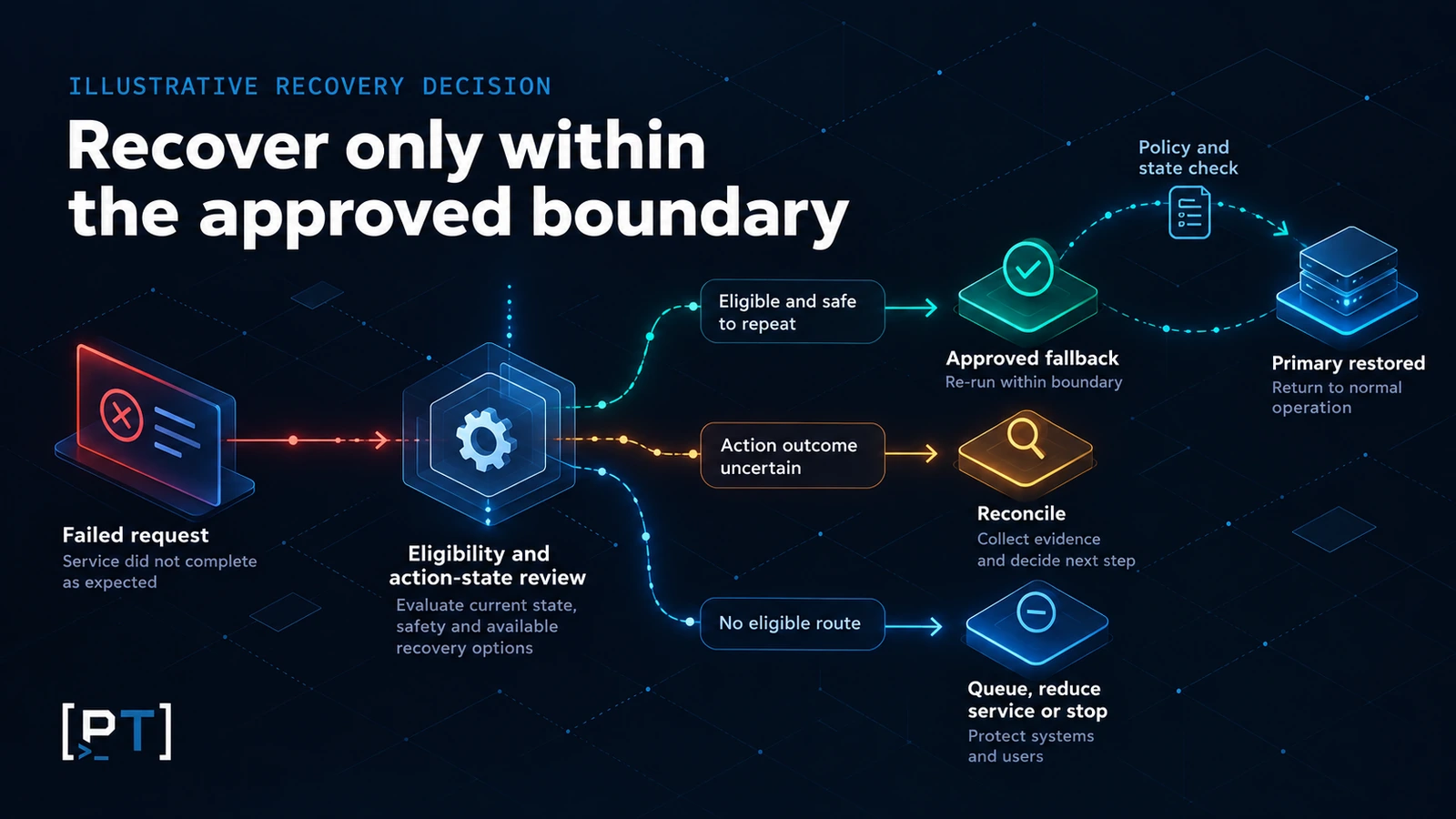
Separate a failed inference from an uncertain action. If a request times out after an external system may have accepted a change, repeating the workflow could duplicate it. Establish whether recovery restarts a safe step, reconciles an existing action, or requires an operator. Where specialist agents also participate, assess agent-to-agent delegation boundaries separately from the supplier switch.
AI provider failover security testing acceptance matrix
The following matrix is a proposed buyer acceptance framework, not a mandatory standard or a completed assessment. Replace its conditions with your architecture, risk tolerance, and customer commitments. Each selected route needs a recorded result, evidence reference, responsible owner, and any limitation that could change the decision.
| Boundary | Required outcome | Evidence to request |
|---|---|---|
| Destination eligibility | Only approved supplier, account, endpoint, and region combinations receive eligible work. | Route inventory, policy version, observed destinations, and blocked-route results. |
| Data restrictions | Customer and data-class restrictions apply before each dispatch. | Synthetic data-flow records, tenant checks, and applicable supplier review. |
| Tools and approvals | Permitted work succeeds; prohibited actions and missing approvals remain blocked. | Paired allowed and denied cases, acting identity, approval record, and resource outcome. |
| Failure classification | Only agreed availability failures qualify; policy denials do not open another route. | Classified failure cases and proof that blocked cases caused no fallback dispatch. |
| Partial completion | Uncertain or completed actions are reconciled before recovery proceeds. | Logical task history, action status, duplicate prevention, and restart decision. |
| Capacity and spending | Recovery fits approved workload priorities, deadlines, and shared allowances. | Bounded capacity observations, retry accounting, and measured completion outcomes. |
| No eligible supplier | The workflow queues, reduces functionality, hands off, or stops as approved. | Both-routes-unavailable result, user message, alert, and operator response. |
| Return to primary | Restoration preserves current restrictions and avoids duplicate or conflicting work. | Controlled recovery record, late-result handling, reconciliation, and disable control. |
Agree failure classification explicitly. A transient connection failure is different from denied access, a safety refusal, an invalid request, or an exhausted business allowance. Automatic switching should not become a way around a restriction. Where an error is ambiguous, require classification or the agreed safe outcome rather than assuming another supplier is permitted.
Cost and availability remain acceptance conditions. A fallback can use a different price basis, lose cache benefits, or share a constrained dependency with the primary. The companion guide to testing AI consumption controls covers allowance enforcement in more depth. Here, the buyer needs proof that recovery stays inside the workflow's approved spending and service conditions.
Assess relevant shared dependencies: gateway, identity service, retrieval, tool integrations, and network paths. Supplier diversity does not remove a shared point of failure elsewhere. If a capacity claim is part of acceptance, coordinate a permitted performance exercise. A small security test can validate routing restrictions without proving that the secondary will absorb production demand.
Illustrative scenario when continuity changes business authority
Hypothetical planning scenario, not a client finding: a B2B platform uses an assistant to prepare customer renewal correspondence. The primary workflow can read the relevant account, draft a response, and request a commercial manager's approval before sending. Customer contract attachments may be processed only through the primary route. The proposed fallback is approved for public product information.
In a controlled staging assessment, a simulated primary outage triggers the fallback. The test asks whether the original attachment stays excluded and whether an unapproved send remains blocked. A hypothetical failed result would be the fallback receiving the attachment or an adapter treating a generated completion message as sufficient authority to send. Neither outcome follows inevitably from changing models; both depend on the implemented controls.
The business exposure would be specific. An attachment crossing the approved destination boundary could require contractual and privacy assessment. An unauthorized message could create a commercial dispute or customer correction exercise. The evidence should distinguish attempted processing, observed receipt, proposed action, and actual delivery. A generated claim that a message was sent does not prove a delivery occurred.
Remediation would follow the failing boundary. Destination eligibility may need to be checked before dispatch. The send operation may need independent authorization and an action-bound approval record. A narrower fallback could offer public information or save a draft without processing attachments or sending correspondence. Retesting should confirm that the restricted route works and the prohibited paths fail.
Use synthetic documents, test recipients, and reversible proof points. Agree the expenditure ceiling, downstream effects, stop conditions, and supplier permissions before execution. A simulated outage can establish how the application responds to that condition. It cannot establish the real supplier's outage behavior, contractual practices, or production capacity.
Scope the work and retain decision-grade evidence
Scope by business workflow and route, then expand according to consequences. Provide the architecture diagram, route register, approved data classes, role and tenant accounts, tool inventory, approval policy, and recovery procedure. Include relevant deployment and adapter versions. A statement of work should identify which application, gateway, cloud, and downstream controls the assessor can test.
Separate document review from observed validation. The route register and supplier terms describe the intended arrangement. Configuration review identifies enforcement settings. Controlled workflow tests show behavior under selected conditions. Limited live checks may address properties that simulation cannot establish, subject to authorization. Report each evidence type accurately so procurement does not mistake a planned control for an observed result.
For each important case, retain the logical task identifier, requester and tenant, selected route, model or deployment reference, policy version, failure reason, approval decision, and final action outcome. Record whether the outcome was allowed, denied, failed, or untested. Keep secrets and unnecessary customer content out of shared reports while preserving enough correlation for investigation.
Test permitted work alongside restricted cases. A design that blocks everything may prevent an unauthorized action but fail the continuity objective. Conversely, a successful demonstration may conceal an untested denial path. Leadership needs evidence that useful service survives within the approved boundary and that the system visibly reduces capability when that boundary cannot be maintained.
Use OWASP LLM02:2025 Sensitive Information Disclosure to organize disclosure risks, including restricted information in output. Supplier destination eligibility also requires separate routing and governance review. Map downstream response validation to LLM05:2025 Improper Output Handling, and excessive tool permissions or autonomy to LLM06:2025 Excessive Agency. These mappings use the OWASP 2025 edition; retain the year when recording category IDs.
The NIST AI RMF Core helps organize responsibilities through Govern, Map, Measure, and Manage. Its third-party contingency considerations are relevant to supplier failure. Applying those functions to route ownership, workflow context, test results, and recovery decisions is an editorial mapping, not a certification or proof of compliance.
Effort grows with the number of materially different workflows, supplier arrangements, data classes, roles, tools, and recovery states. A read-only route with settled supplier review is narrower than a stateful agent with financial actions and multiple regional commitments. Quote against that inventory. Do not multiply a generic endpoint count or assume one model evaluation covers every business path.
Plan scope agreement, configuration review, controlled testing, remediation, and retesting before setting activation dates. Supplier contract questions and architectural fixes can become schedule dependencies. No universal duration or price follows from the word failover. A release-based AI testing program can keep route evidence current when models, adapters, permissions, or supplier settings change.
What leadership should decide
Approve a bounded operating policy. The platform owner should identify who can enable or disable each route and operate recovery. The business owner should define eligible operations and acceptable reduced service. Security should assess boundary enforcement; privacy and procurement should resolve supplier and customer commitments. Name the person authorized to accept residual risk.
Use three decision outcomes. Approve a route for the tested workload where the required evidence is complete. Restrict it to a narrower mode where only that mode has been validated. Keep it disabled where a required destination, authority, or recovery condition remains unresolved. An emergency exception should state its permitted data, actions, owner, expiry, and monitoring requirements.
Require an operational exercise covering both suppliers being unavailable and the return to primary. Operators should know how to pause new dispatches, identify uncertain actions, communicate reduced service, and reconcile outstanding work. Restoring the primary should not erase exceptions, apply an outdated policy, or allow late results to trigger a second action.
The final approval record should connect the permitted route to tested versions, evidence references, unresolved limitations, remediation owners, and retest triggers. Revisit it when supplier terms, destinations, models, tools, or approval behavior materially change. That record makes the resilience claim specific enough for engineering, procurement, and incident teams to use.
To prepare that decision, scope primary and fallback AI workflow testing with your route inventory, sensitive data classes, consequential actions, and proposed recovery rules. Ask for evidence that each approved route preserves the restrictions the business depends on.
Frequently asked questions
Can we approve fallback for selected customers only?
Yes, if customer eligibility is reliably enforced before dispatch. The scope should include eligible and ineligible test tenants, configuration changes, and queued work. Customer-specific restrictions need to survive routing rather than depend on an operator remembering them during an outage.
Does a provider assurance report replace application testing?
No. It can support supplier due diligence within its stated scope, but it does not demonstrate your router's destination selection, tool restrictions, or approval handling. Combine appropriate supplier evidence with validation of your deployed workflow.
Should security and answer-quality evaluations be purchased together?
They should have coordinated acceptance criteria, even if different teams deliver them. A secure route may produce unsuitable business answers, while a high-scoring model may sit behind weak authorization. Define ownership and evidence for both before activation.
How should we handle a fallback that lacks a required feature?
Decide whether a narrower workflow remains useful and safe. Approve that reduced mode explicitly, with clear user communication. If the missing feature is essential to a security or business condition, leave failover disabled for that operation.
Can a staging-only result support launch approval?
It can support the properties tested in a representative environment. List production differences, especially supplier accounts, network paths, credentials, and enabled features. Complete the necessary authorized production checks or document why the remaining uncertainty is acceptable.
What should we request when a third party operates the router?
Request the approved destination inventory, change permissions, relevant logging and retention settings, workflow test evidence, incident responsibilities, and a way to disable affected routes. Agree on how you learn about material changes and how customer restrictions are enforced.