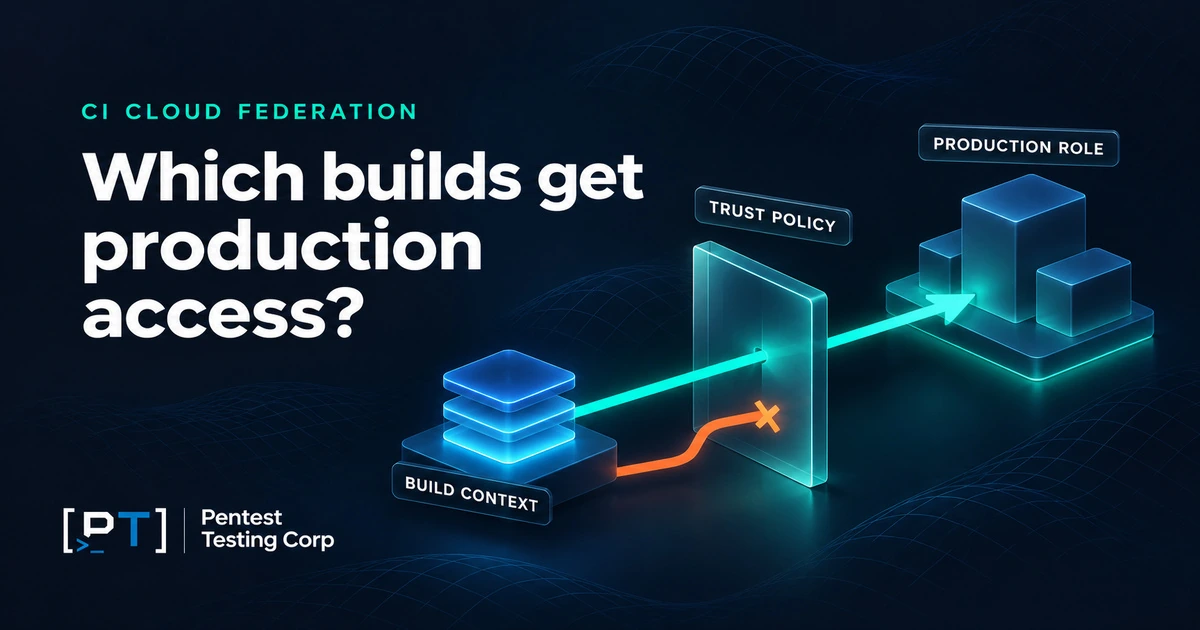
CI Cloud Federation Security Testing: Which Builds Get Production Access?
A CTO is preparing to approve a migration from stored deployment keys to federated cloud access. The platform team demonstrates a successful release, the secret scanner reports fewer credentials, and the change ticket looks ready to close. One question remains unanswered: could another repository, an unapproved branch, or a different job obtain the same production authority?
CI cloud federation security testing turns that question into evidence. It examines which build identities the cloud accepts, what their resulting permissions allow, and whether deployment approval survives the journey from repository to production. Removing a reusable key is a worthwhile improvement, but leadership still needs an approved definition of who may deploy.
This guide helps CTOs, CISOs, and platform owners commission that assessment without turning a production pipeline into an uncontrolled experiment. The immediate trigger is an OIDC rollout, repository migration, or trust-policy change. The outcome should be a defensible production acceptance decision.
What federation changes about production authorization
Continuous integration systems can use OpenID Connect, or OIDC, to present a signed statement about a workload to a cloud identity service. The destination evaluates its configured trust before granting access. Federation shifts an important security decision from possession of a stored credential to acceptance of a workload identity and its context.
For a business owner, there are two approvals to examine: which workloads may receive authority, and which business resources that authority can affect. A narrowly approved deployment identity can still have excessive permissions. Conversely, a modest role can be available to more builds than the organization intended. Both conditions matter when production availability or customer information is involved.
The acceptance standard should therefore describe the permitted release path in business terms: the named product repository, approved release source, controlled deployment job, required approval, and intended production resources. Engineering translates that statement into provider-specific controls. Security verifies whether the deployed configuration implements it.
Our cloud penetration testing guide for AWS and Azure provides the wider IAM, infrastructure, and data-exposure context. This article concentrates on the CI-issued identity that crosses into the cloud. It does not assume a broad cloud review has exercised every deployment context.
Commission cloud penetration testing scoped to CI-to-cloud trust when the acceptance decision depends on proving this boundary. The scope should explicitly name the repositories, identity integrations, production roles, and representative workloads. A generic request to check cloud security can leave the decisive CI controls outside the engagement.
The migration is complete only when the replacement path is validated and retired credentials are addressed. Keeping the previous production key as an undocumented fallback can preserve an alternative route around the new restrictions. Assign that retirement decision an owner and verify the dependencies before disabling access needed for recovery.
CI cloud federation security testing starts with permitted contexts
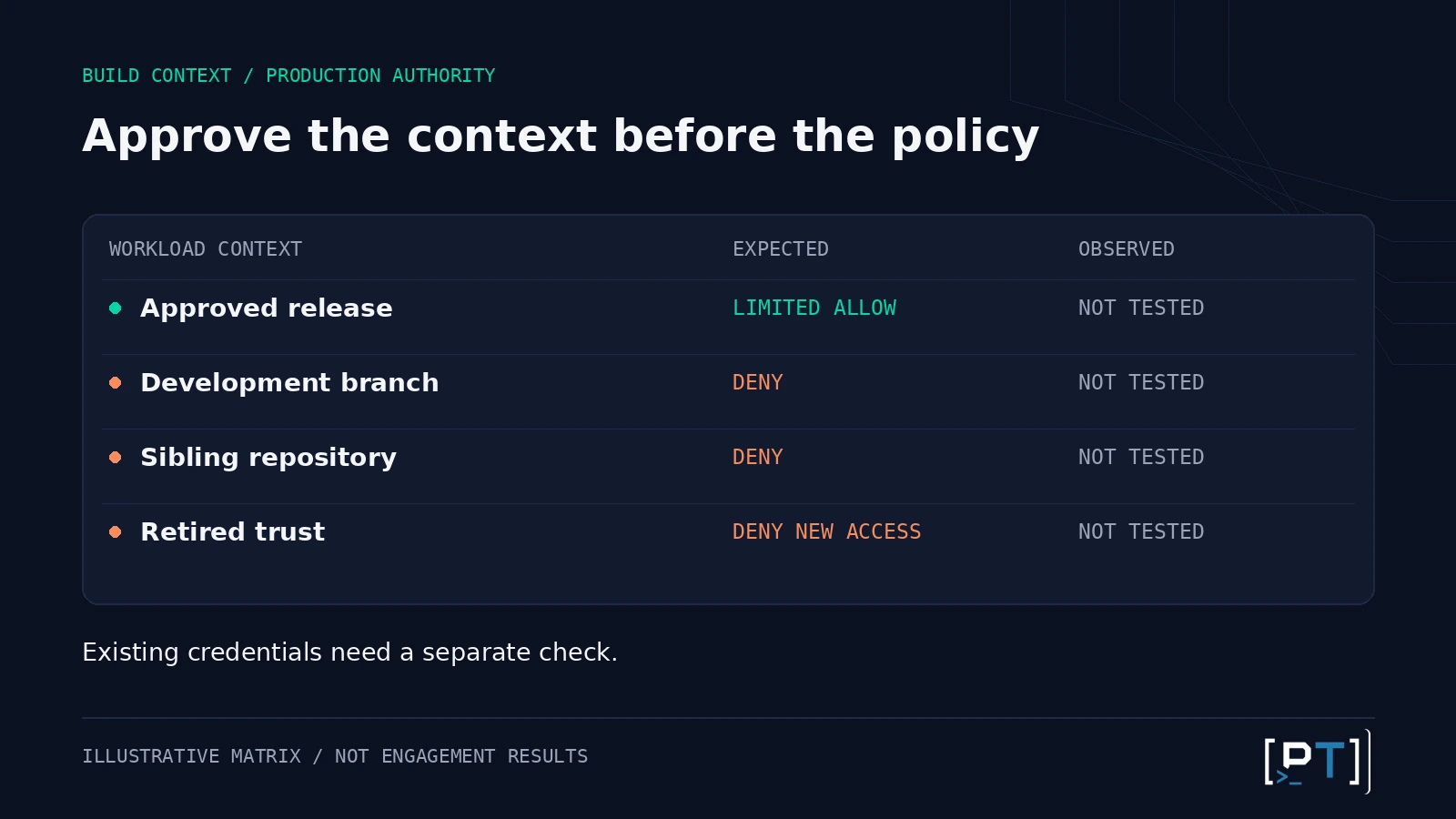
Before anyone evaluates policy, create a small authorization matrix that the product and platform owners can approve. Describe the contexts that should succeed alongside nearby contexts that should fail. Testing only the successful release proves functionality; the negative cases establish whether the organization has drawn the intended boundary.
The following matrix is illustrative. It describes expected outcomes for a hypothetical product, not observed findings or universal provider defaults. Actual results remain untested until recorded against the deployed configuration.
| Workload context | Expected production authority | Evidence required | Business decision |
|---|---|---|---|
| Approved product repository, permitted release source, approved deployment job | Allow only the designated release operation | Correlated approval, identity acceptance, and safe permission check | Accept the defined release path |
| Same repository, unapproved development branch | Deny production access | Attributable rejection at the intended control | Keep development changes outside release authority |
| Sibling repository within the same organization | Deny unless separately approved | Repository boundary result | Avoid granting organization-wide deployment rights by accident |
| Pull-request validation or other untrusted contribution context | Deny production access | CI execution restrictions and destination trust result | Separate contribution review from production authorization |
| Approved repository using an unapproved deployment workflow | Deny under this illustrative release policy | Workflow identity and policy evaluation | Preserve the approved release process |
| Previously approved workload after trust removal | Deny new access; evaluate existing credentials separately | Fresh-access rejection and documented session outcome | Accept a measured containment window |
Repository names, branch labels, environments, and reusable workflows are different inputs to a trust decision. They should not be treated as interchangeable evidence of approval. GitHub's OIDC reference documents context-dependent subject formats: environment-associated jobs do not simply carry the same default subject as branch-associated jobs. Review the actual identity presented by each approved context rather than relying on a familiar-looking policy example.
Names also have a lifecycle. Google Cloud's deployment-pipeline federation guidance recommends numeric GitHub identifiers to reduce exposure from reused names. A repository transfer should trigger review of both the stable identity and its current owner. A permanent identifier alone does not express your business decision about a new owner.
For shared release workflows, record both the approved caller and the trusted workflow dependency. A central deployment process may serve several products, but that does not mean every caller deserves every product's production role. Leadership should approve the intended product boundary before engineering decides how to encode it.
An illustrative migration that passes deployment and fails acceptance
Hypothetical scenario, not a client finding: A subscription software company moves its deployment pipeline to federation. Its platform team confirms that the product's approved release succeeds. The change is reported as complete because the old deployment secret no longer appears in the main workflow.
During an authorized assessment, representative checks show that a second repository also satisfies the configured trust conditions. Assume that repository belongs to an internal documentation service whose contributors were never approved to deploy the customer application. The release works as designed, but the set of workloads eligible for its authority is too broad.
The assessors stop at an agreed, harmless proof point. They do not change production code or open customer records. They record the accepted workload identity, the destination role, and the policy evidence supporting the permission conclusion. Any downstream impact that has not been safely validated remains a qualified exposure statement.
The immediate business issue is release integrity. If the granted role can change the production service, unintended build authority could enable unauthorized application changes. Whether customer data could also be reached depends on the role's effective permissions, the runtime identities it can influence, and other controls. Production access does not automatically establish unrestricted data access.
The company pauses further federation onboarding, narrows the permitted contexts, and checks for equivalent trust elsewhere. The platform owner estimates the engineering work; the service owner decides whether the current release path can continue under temporary restrictions. Security retests the legitimate release and the previously accepted unauthorized context.
Closure requires more than a corrected policy screenshot. The second repository must fail at the intended boundary, the approved release must still work, and the remaining production authority must match the signed acceptance matrix. This converts a technical observation into a specific release decision with measurable conditions.
Scope the complete path from CI identity to production role
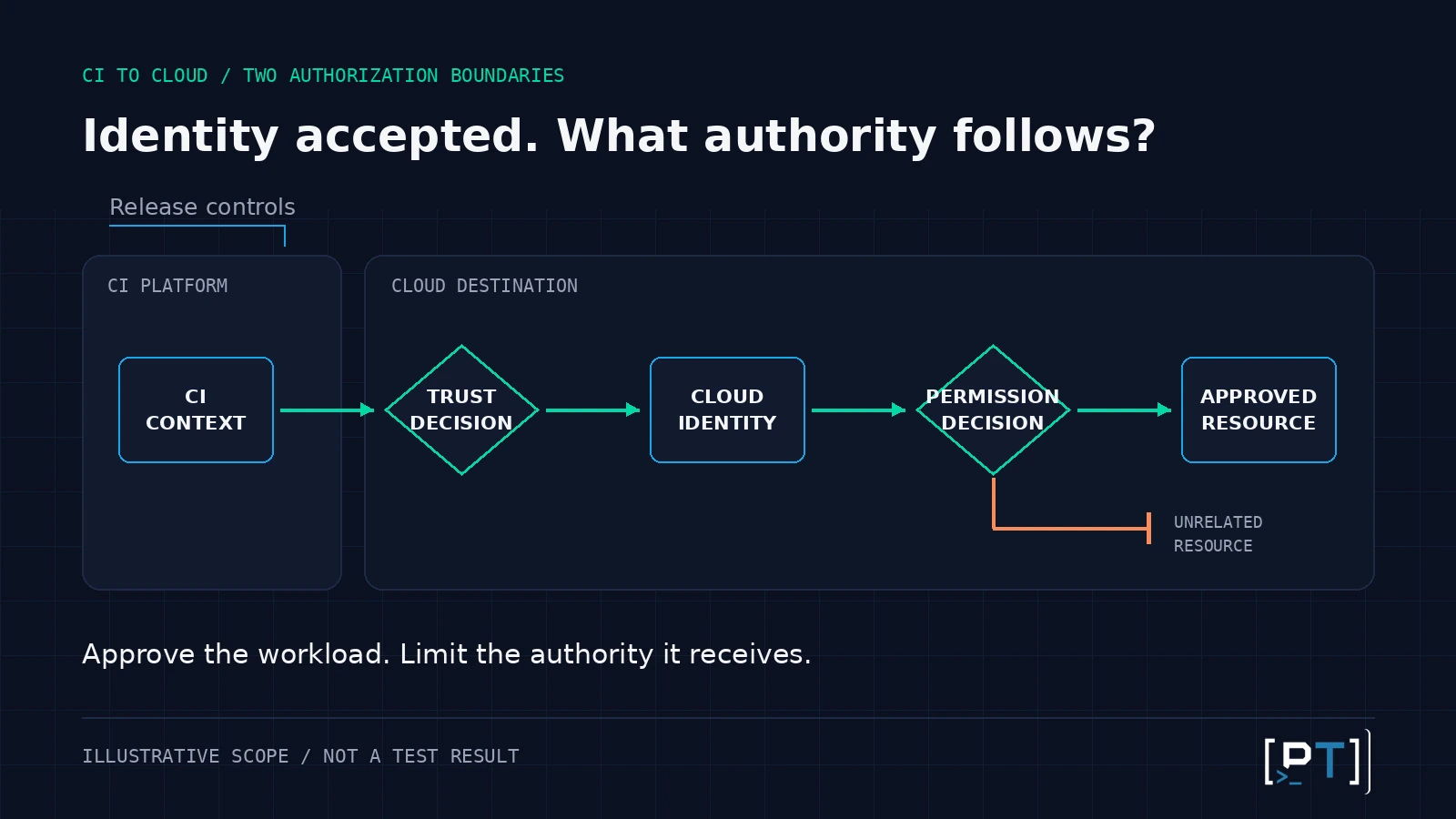
A useful scope follows authority across the CI platform and cloud destination. Read access to cloud policy is valuable, but it cannot establish whether repository administrators can change the conditions that make a job trusted. Access to CI settings alone cannot establish the effective permissions of the resulting cloud identity.
Request representative repository and workflow configuration, deployment-environment controls, relevant administration rights, trust policies, permission assignments, organization-level restrictions, and audit records. Agree how sensitive material will be shared. Raw tokens and usable credentials do not belong in routine reports, tickets, or screenshots.
Separate identity acceptance from deployment permission
The first boundary is whether the destination accepts the intended issuer, audience, subject, and supported workload attributes. The next is what the resulting principal can do. The assessment should identify whether it can deploy only the intended service, change unrelated resources, alter identity controls, or delegate broader authority.
Production deployment itself may create indirect influence over sensitive systems. A role without direct database-read permission could still change application code that runs under another identity. State this dependency explicitly and agree how far the assessment may validate it. A safe review can document effective authority without extracting data or executing a disruptive deployment.
Include the controls that preserve release approval
Review who can modify the trusted workflow, its dependencies, deployment-environment settings, and cloud trust configuration. A policy tied to an approved workflow offers limited assurance if an unintended group can change what that workflow executes. Identify approval bypass privileges and emergency paths rather than assuming every run receives the same review.
Untrusted contribution checks, release jobs, and privileged runners should be assessed as distinct contexts. Runner compromise and dependency integrity may require additional testing depth; a federation assessment does not automatically validate every executable component in the delivery system. Record those limits before leadership interprets the result as end-to-end supply-chain assurance.
If the assessment includes a developer workstation or CI host as an assumed starting position, use the scoping discipline described in our internal pentest methodology to agree authorization, permitted movement, and stop conditions. Internal network access is an extension of scope, not an automatic requirement for testing federation.
Use provider-specific acceptance criteria
Do not copy an attribute checklist between providers without checking support. The current AWS IAM and STS condition-key reference lists supported GitHub attributes, including repository identifiers and reusable-workflow references. Confirm which keys apply to the trust decision and which remain available in the issued session; these are separate questions.
For Google Cloud, examine attribute mapping, provider conditions, and the chosen direct-access or service-account path. For Microsoft Entra, use its workload identity federation documentation to assess the configured federation and the destination permissions. Provider capability is a design input, not proof that the deployed integration uses it correctly.
Evidence that makes CI cloud federation security testing reviewable
The assessment report should connect each conclusion to an approved expectation, an observed result, and an identifiable configuration version. A list of policy concerns cannot replace execution evidence. Equally, a successful test without its configuration context becomes difficult to interpret after the next release-system change.
For each representative context, record the expected outcome, actual outcome, relevant repository and workflow identity, target role, test time, configuration reference, and evidence location. Use outcome labels such as allowed, denied, inconclusive, and not tested. A timeout or missing log is not evidence that the cloud denied access.
For an allowed release, connect CI execution, approval where required, cloud identity issuance, and the safe destination operation. For a denied context, identify which control rejected it. If the CI system prevented the job from running, record that protection accurately; do not claim the destination trust policy independently rejected a request it never received.
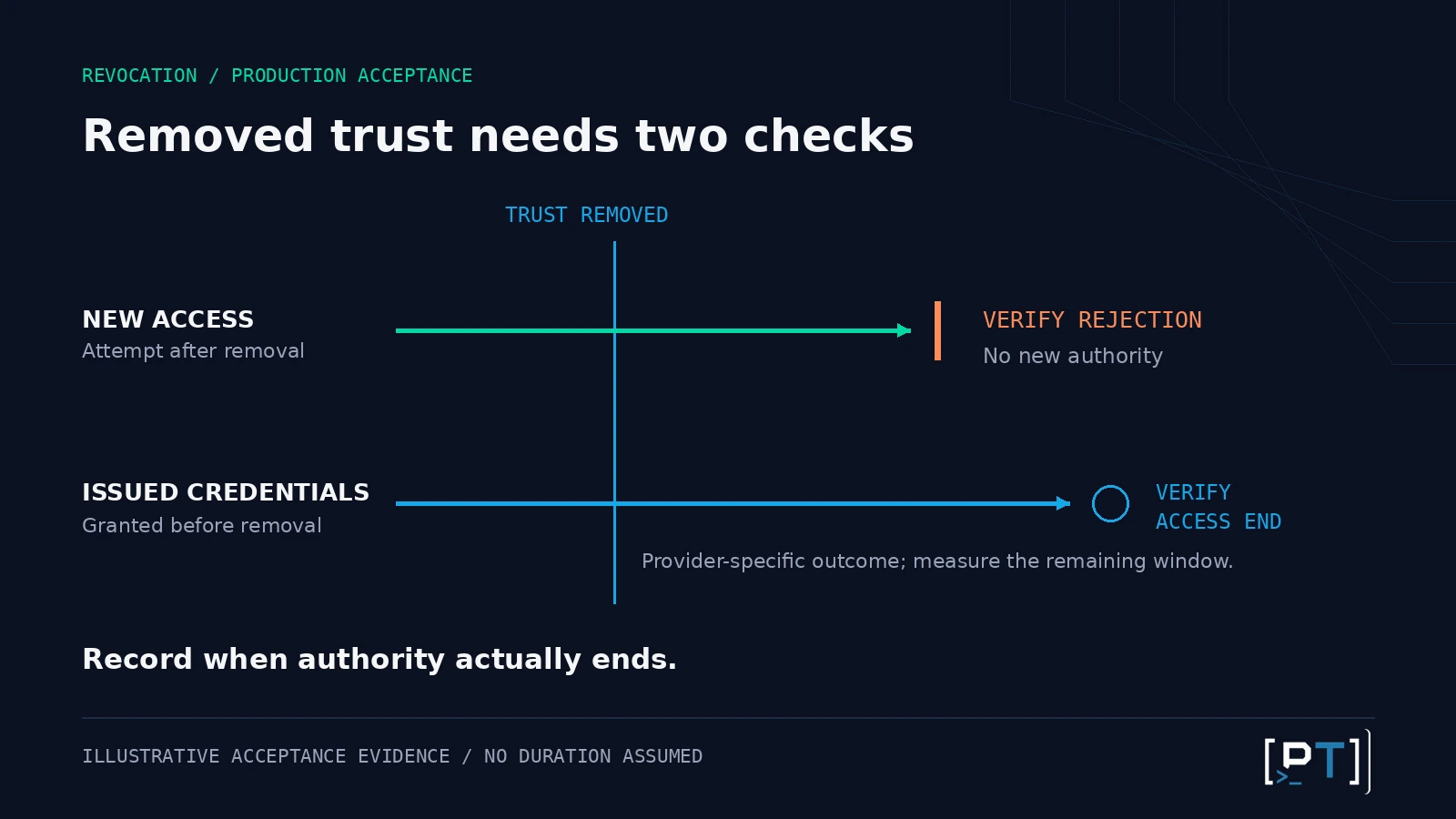
Revocation evidence needs particular care. Test whether removed trust prevents new access and separately establish what happens to credentials already issued. Use provider documentation and authorized observations to describe the remaining access window. Disabling a job, removing federation trust, and terminating an existing session should never be treated as the same event without evidence.
Apply the OWASP authorization principles of least privilege and denial by default to acceptance criteria. For this boundary, that means an unapproved context should receive no production authority, and an approved deployment should receive only the authority its business function requires.
The report should distinguish validated impact from policy-based inference. For example, a harmless operation may confirm role access while policy analysis indicates potential deployment authority. Record both, including any production action excluded from testing. Buyers can then decide whether the confidence level is sufficient for acceptance.
Use frameworks to organize this evidence. NIST CSF 2.0 provides outcome categories for governance, access, and monitoring; NIST SP 800-115 supports a planned assessment with understood limitations. The mapping below is an editorial application to this scope, not a certification claim.
| Reference | Application to this assessment | Evidence for the decision owner |
|---|---|---|
| NIST CSF 2.0 GV.RR | Assign release authority and risk ownership | Named approvers, policy owners, and exception authority |
| NIST CSF 2.0 PR.AA | Evaluate workload identity and access boundaries | Approved contexts and representative authorization results |
| NIST CSF 2.0 DE.CM | Check visibility of relevant identity and access activity | Correlated CI and cloud records with documented gaps |
| NIST SP 800-115 | Plan, conduct, and report an authorized assessment | Rules of engagement, safe proof points, findings, and limitations |
For an auditor or procurement reviewer, provide the applicable scope, test period, results, unresolved exceptions, and remediation status. A federation pentest supports evidence about defined controls; it does not certify the entire delivery system or establish compliance with every customer contract.
Plan remediation effort around trust diversity
Keep this scope distinct from agent credential brokerage. Our GCP agent identity security testing guide addresses that separate runtime credential boundary. Include it only when the production architecture actually contains that additional dependency.
Repository count alone is a weak basis for estimating effort. A group of repositories using one controlled deployment pattern may be easier to assess than a small estate with several CI products, custom identity claims, multiple clouds, and inconsistent approval rules. Ask for pricing against the distinct trust patterns and representative contexts.
Other effort drivers include the number of production roles, inherited permission layers, reusable-workflow dependencies, runner isolation, evidence availability, and required production validation. Administrative access delays can consume more calendar time than policy review. Confirm who can provide the configuration and authorize safe test runs before reserving an assessment window.
Remediation may involve tightening a trust condition, separating deployment roles, changing workflow governance, or removing an obsolete access path. The change itself can be small while the coordination is substantial: product owners must confirm release continuity, platform engineers must update shared components, and responders must understand emergency access.
Sequence the work around acceptance gates: approve the matrix, validate representative contexts, correct unexpected authority, retest, and accept the remaining risk. Agree dates after the access dependencies and release windows are known. An estimate should separate assessment effort, engineering remediation, coordination delays, and retest availability rather than implying one fixed delivery time.
Preserve a legitimate deployment check during retesting. An overly restrictive change that blocks the product's release path can create pressure for an unreviewed workaround. Closure should show both reduced unauthorized authority and continued operation of the approved process.
What leadership should decide before production acceptance
Ask the accountable service owner to approve the exact contexts allowed for production access. Record which repositories and owners are trusted, which release sources qualify, which workflow and environment controls are required, and which cloud resources the deployment may affect. Avoid acceptance language as broad as “OIDC enabled.”
The platform owner should own the technical policy, the engineering plan, and the release-continuity check. Security should own the assessment conclusions and limitations. A named executive or delegated risk owner should accept any exception with a reason, an expiry, and a compensating-control owner.
For each unexpected allowance, decide whether to restrict the context immediately, pause onboarding, or permit time-limited operation while a correction is validated. The choice depends on effective production authority and business criticality, not simply whether the workload belongs to your organization.
Repository migrations during an acquisition deserve a separate acceptance checkpoint. Our guide to SaaS acquisition penetration testing scope explains why inherited evidence may not cover integration changes. A previous seller's release approval does not automatically describe the buyer's intended trust boundary.
Retain the approved matrix as a change-control artifact. Review it after material trust-policy changes, repository transfers, deployment-workflow changes, and production-role expansion. Schedule an annual scope review as a backstop, while using actual architecture changes to trigger focused validation sooner.
Before approving the migration, require a clear answer: which build contexts were allowed, which were denied, what production authority was validated, and what remains unknown? To commission that evidence, book a CI-to-cloud trust scoping call with the release architecture and proposed authorization matrix.
Frequently asked questions
Can testing begin before federation reaches production?
Yes. Review the proposed trust model and validate representative contexts in an authorized test environment first. Identify which production-specific policies, approvals, and logging still need confirmation before rollout. Staging results should not be presented as proof of unexamined production configuration.
Can the assessment cover GitLab or another CI provider?
Yes, when the identity integration, claims, administrative controls, and cloud destination are included in scope. Define expectations from that provider's actual workload model. GitHub-specific context assumptions should not be copied into another platform's acceptance criteria.
Must a tester receive permission to deploy to production?
No. Agree on the least disruptive evidence needed for the decision. Configuration analysis and harmless authorized operations may establish important conclusions. If actual deployment is excluded, state the resulting assurance limit instead of implying a full production release was tested.
Does artifact signing prove a build should receive cloud access?
Signing provides evidence about an artifact under its verification model. The decision to grant cloud authority concerns the requesting workload and destination policy. Review artifact acceptance and workload authorization together when release integrity depends on both.
What if an emergency release needs broader access?
Document a separately approved emergency path with accountable activation, logging, limited duration, and review after use. Include it in the assessment inventory. A hidden fallback can undermine the production boundary leadership believes it has approved.
Can one sample represent every repository?
Only where the selection has a defensible basis, such as demonstrably shared controls and equivalent trust configuration. Record the sampled patterns, exceptions, and exclusions. A successful result for one independently managed repository does not establish coverage of the rest.
Who should receive the detailed assessment evidence?
Give detailed identity and configuration evidence to authorized engineering and security owners through restricted channels. Procurement and leadership usually need a scoped summary, material exposure, remediation status, and acceptance decision. Exclude usable credentials from every distribution version.