Multi-Tenant SaaS Authorization Testing Before Enterprise Review
An enterprise prospect is ready to sign. Procurement has your SOC 2 report, security questionnaire, architecture diagram, and latest penetration test. Then its security team asks a harder question: did the assessment actually prove that one customer cannot reach another customer's data, that a standard user cannot invoke an administrative function, and that exports, background jobs, support tools, and APIs enforce the same boundaries?
This is where multi-tenant SaaS authorization testing becomes materially different from a generic vulnerability scan or a pentest that only confirms authentication works. For a multi-tenant product, the security claim is not simply "users must log in." The claim is that every sensitive object and function remains constrained by the correct tenant, role, ownership rule, and business workflow after login.
Before an enterprise review, leadership needs evidence that those boundaries were tested deliberately, not an assumption based on architecture diagrams or application functionality.
Why enterprise reviews focus on authorization proof
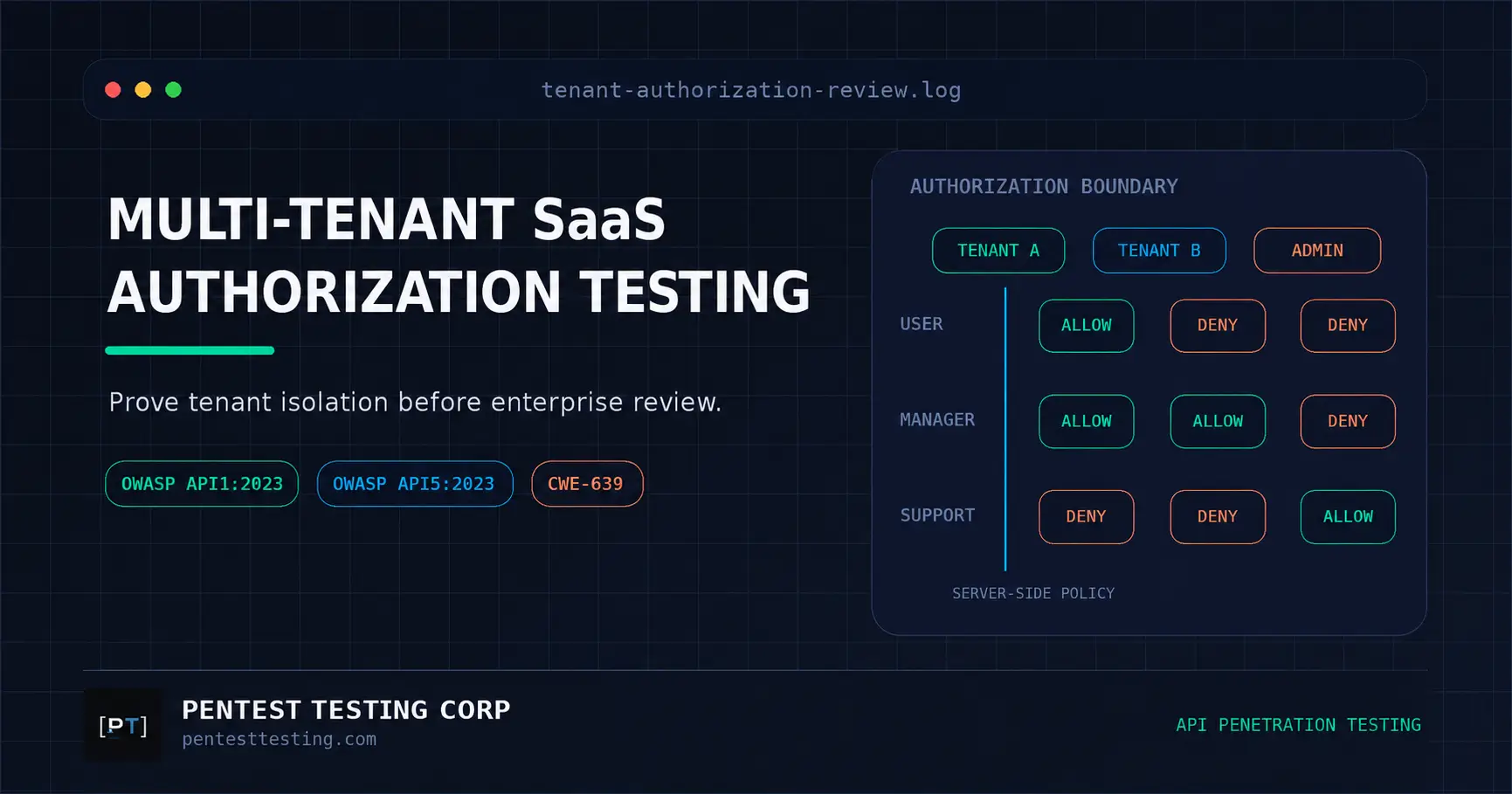
Authentication answers who the user is. Authorization decides what that authenticated user is allowed to read, change, export, approve, administer, or trigger.
That distinction matters much more in multi-tenant SaaS. A valid account is often all an attacker needs to reach the part of the application where tenant and role boundaries become relevant. The user does not need to bypass MFA if the application accepts the user's identity but applies the wrong authorization decision to a customer record, project, invoice, file, conversation, administrative action, or export.
OWASP classifies this problem directly. API1:2023 Broken Object Level Authorization covers failures to enforce authorization for individual objects. API5:2023 Broken Function Level Authorization addresses situations where users can reach functions that should be restricted by role, group, or privilege.
For a SaaS buyer, both categories collapse into a practical question: can our data or privileged operations escape the boundary your product promises?
That is also why an enterprise security review may scrutinize the scope of the test rather than accept "penetration test completed" as sufficient evidence. If only one role was tested, only public endpoints were assessed, or the report never discusses tenant isolation, the buyer still does not know whether the highest-value authorization controls were exercised.
Tenant authorization and network segmentation should be tested as separate controls. A backend may correctly reject another tenant’s object while the AI runtime still has unnecessary access to management, data, or deployment services. See how to test internal segmentation after an AI rollout.
What multi-tenant SaaS authorization testing must prove
A buyer-grade authorization assessment should test the product as a system of trust boundaries rather than a collection of URLs.
For multi-role SaaS environments, that normally requires credentialed accounts representing more than one tenant and enough roles to exercise meaningful privilege differences. Pentest Testing Corp's API penetration testing for multi-role SaaS environments is scoped around endpoint count, authorization depth, authenticated roles, and integration complexity rather than assuming that one account can represent the entire product.
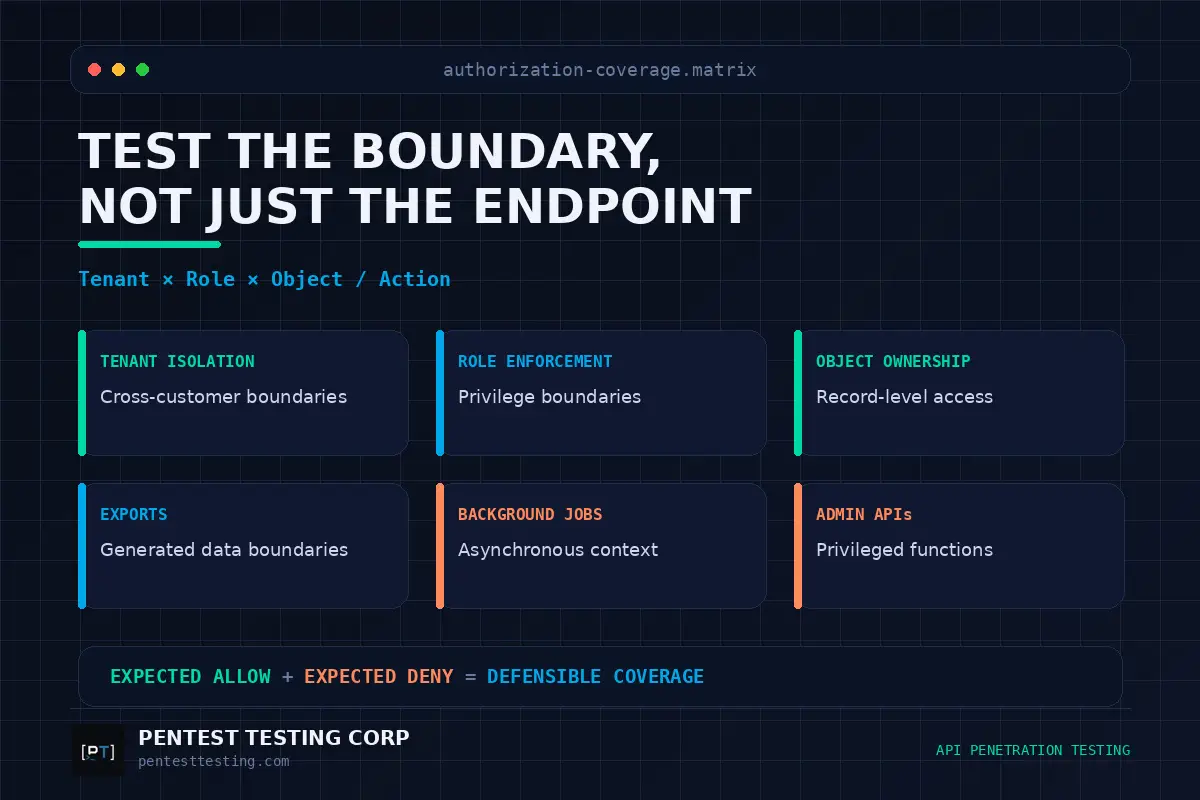
The assessment should prove at least six things.
- Tenant isolation: a valid user from Tenant B cannot read, modify, delete, export, or create data in Tenant A's context.
- Role enforcement: a lower-privilege user cannot invoke administrative, billing, support, approval, configuration, or other privileged functions.
- Object ownership: access decisions are enforced for individual records and resources, not merely at the page or endpoint level.
- Action-level authorization: read, update, delete, approve, export, invite, publish, and similar actions are tested independently where permissions differ.
- Indirect workflows: exports, reports, queues, scheduled jobs, notifications, search, storage, and integrations do not silently bypass the tenant boundary.
- Authorization lifecycle: logout, account deactivation, privilege changes, tenant switching, and other identity-state changes do not leave access that should have been removed.
This complements, rather than replaces, architecture controls such as tenant-aware queries, row-level policies, centralized RBAC, and strict ownership enforcement. Teams designing or remediating those controls can use our separate tenant-isolation hardening and containment guide.
There is also useful real engagement evidence behind this distinction. In a redacted SaaS/API assessment approved for external reference, Pentest Testing Corp tested three credentialed account roles and weighted approximately 75-80% of the engagement toward authorization logic. The assessment identified a critical cross-tenant object access and modification issue as well as a critical function-level authorization failure exposing privileged functions to lower-privilege roles. The important lesson is not the individual endpoint. It is that these failures were only visible when authorization was tested across identities, privileges, and tenant boundaries rather than treated as a generic API scan.
Authorization testing proves tenant and role boundaries hold. A companion token theft penetration test proves those boundaries survive a stolen credential, not just a valid login.
Tenant permissions and tenant consumption are separate controls. Our AI agent API abuse penetration testing guide explains how to validate spending boundaries and shared capacity when an authorized agent can initiate repeated API work.
Use a tenant-role-object matrix instead of an endpoint checklist
An endpoint inventory is useful for coverage, but it is not sufficient evidence of authorization testing.
The more useful planning model is a matrix that connects tenant, role, object, and action. It forces the scope to answer both positive and negative access questions: what should this identity be able to do, and what must it be prevented from doing?
| Test dimension | Expected allowed case | Required negative case | Buyer evidence |
|---|---|---|---|
| Tenant boundary | Tenant A user reads Tenant A record | Tenant B user cannot read or change Tenant A record | Validated isolation result for representative object types |
| Role boundary | Administrator performs privileged action | Standard/support role cannot perform the same action | Role-to-function coverage and denial evidence |
| Object ownership | Owner accesses permitted object | Peer user cannot access another user's restricted object | Object-level authorization result |
| Write operations | Authorized user updates permitted fields | Unauthorized tenant or role cannot modify protected data | Integrity-control evidence |
| Exports/reports | Report contains permitted tenant data | Export does not include another tenant's records | Generated-output boundary validation |
| Background processing | Job processes correct tenant context | Queued or scheduled process cannot cross tenant context | Workflow-level authorization result |
| Admin/support APIs | Authorized operational role reaches function | Ordinary user is denied server-side | BFLA test evidence |
The principle is simple: every high-value authorization rule should have an expected success path and at least one meaningful expected-denial path.
That approach aligns with OWASP's Web Security Testing Guide, which treats horizontal and vertical privilege testing as explicit authorization work rather than assuming the interface represents the server-side security model. It also extends naturally into web application penetration testing when browser sessions, account switching, support workflows, or UI-driven business logic participate in the same authorization model.
A strong assessment does not need to test every possible mathematical combination when many paths share the same authorization mechanism. It does need a defensible sampling strategy covering each materially different role, tenant boundary, sensitive object class, privilege transition, and high-impact workflow.
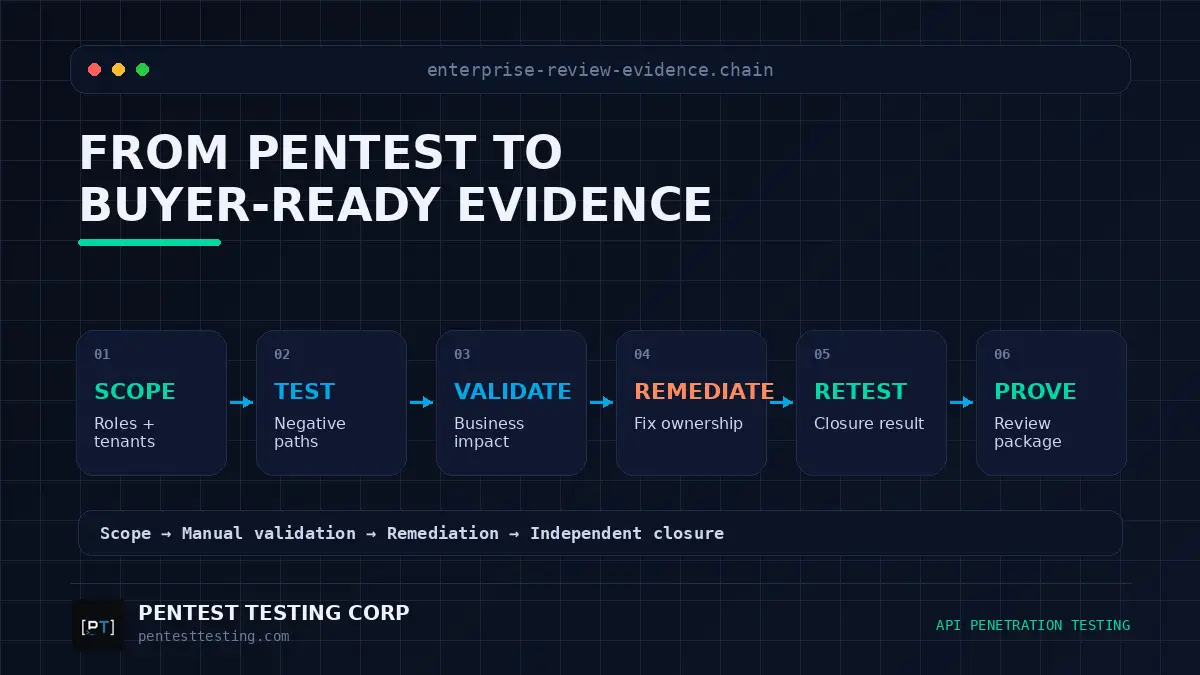
What evidence should exist before you send the report to a buyer?
The penetration test report is often the only part of the engagement an enterprise customer will see. A line that says "authorization tested" is therefore weak evidence.
A buyer-grade report should allow a reviewer to understand what was in scope, which trust boundaries were exercised, what failed, how material the failure was, and whether remediation was independently validated.
When an agency delivers that report under its own brand, the agreement also needs to say who may hold raw authorization evidence, approve report edits, and identify the actual tester. See the agency agreement checklist before committing to the enterprise buyer.
| Evidence component | Question it answers |
|---|---|
| Scope and tested environments | Did the assessment cover the application and API surface relevant to our data? |
| Roles and authorization model | Were meaningful privilege differences actually tested? |
| Tenant-isolation coverage | Was cross-tenant access deliberately tested? |
| Finding severity and business impact | What could an unauthorized user realistically access or change? |
| Sanitized reproducibility evidence | Was the issue manually verified rather than inferred from scanner output? |
| OWASP/CWE mapping | Can security and compliance teams classify the control failure consistently? |
| Remediation guidance | Does engineering know which authorization decision needs to change? |
| Retest status | Was the original failure actually closed after remediation? |
| Known exclusions or untested paths | What risk remains outside the evidence presented? |
NIST SP 800-115 frames technical security assessment around planning tests, conducting them, analyzing findings, and developing mitigation strategies. That is a useful reminder that a pentest is not complete merely because requests were sent to the application. The reporting and remediation loop are part of the assurance process.
For organizations evaluating reporting quality before selecting a provider, our sample penetration testing reports show the expected structure: executive context, technical findings, severity, evidence, remediation, framework mapping, and closure information.
Retest evidence is particularly valuable during procurement. A buyer reading an old critical finding does not only need to know that engineering says it was fixed. They need a clear distinction between reported fixed and independently revalidated.
If the product is in a cardholder data environment, place these tenant and role tests within the broader PCI DSS Requirement 11.4 evidence plan. Validate network segmentation separately if it is used to reduce PCI scope.
Authorization depth changes scope, effort, and testing cost
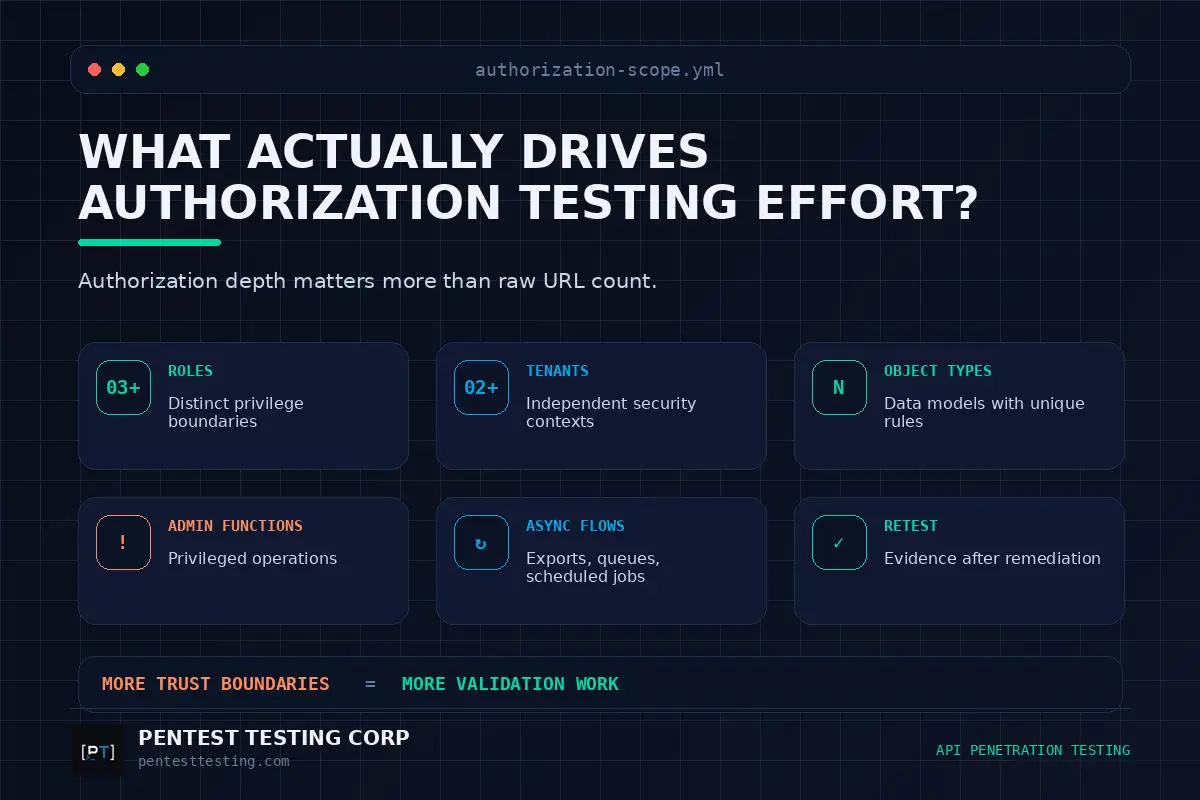
Multi-tenant authorization testing is not priced or scheduled accurately by counting URLs alone. The main effort comes from the number of distinct security decisions the tester must evaluate.
| Scope driver | Why effort increases | Leadership decision |
|---|---|---|
| Authenticated roles | Each role introduces additional permitted and prohibited functions | Provide every role that represents a material privilege boundary |
| Independent tenants/accounts | Cross-tenant validation needs identities and objects from separate security domains | Provision at least two representative tenant contexts |
| Sensitive object types | Invoices, files, conversations, users, projects, health records, and similar resources may use different authorization paths | Prioritize objects by data sensitivity and business impact |
| Admin and support functions | Privileged APIs may exist outside normal customer workflows | Include operational interfaces that can affect customer data |
| Exports and background jobs | Authorization can be lost after the synchronous request hands work to another service | Include high-value asynchronous data flows |
| Multiple environments | Staging and production may differ in identity, configuration, integrations, and data handling | Choose the environment that produces defensible evidence without unacceptable operational risk |
| Retesting | Closure requires replaying the original authorization condition after remediation | Reserve engineering capacity and a retest window before the review deadline |
This is why a single-role assessment may be perfectly appropriate for a simple API but insufficient for a SaaS platform whose commercial promise depends on several tenant and privilege boundaries.
During scoping, leadership should resist the temptation to remove roles merely to reduce the engagement size if those roles are exactly where enterprise customers place trust. A support account that can view customer records, a finance role that can export invoices, or a tenant administrator that manages users may be more important to test than dozens of low-impact public endpoints.
The practical objective is not maximum request volume. It is enough coverage to support a defensible statement about the authorization model that matters to the business.
Framework mapping: OWASP, CWE, SOC 2, HIPAA, and ISO 27001
Framework mappings make a report easier to consume, but they should not turn the engagement into checkbox testing.
| Framework/reference | Authorization relevance | How to use the evidence |
|---|---|---|
| OWASP API1:2023 BOLA | Object-level authorization and ownership failures | Classify cross-user and cross-tenant object access findings |
| OWASP API5:2023 BFLA | Role/function authorization failures | Classify access to administrative or privileged functions |
| CWE-639 | Authorization bypass through a user-controlled key | Provide a weakness taxonomy for IDOR-style findings |
| OWASP WSTG Authorization Testing | Horizontal and vertical authorization verification | Support structured web/application test coverage |
| SOC 2 Trust Services Criteria | Logical access and broader security-control assurance | Use the pentest as supporting control-effectiveness evidence where it matches the organization's control design |
| HIPAA Security Rule | Role-appropriate access, confidentiality, integrity, and risk management for ePHI | Use relevant findings and retests as technical risk-management evidence for regulated environments |
| ISO/IEC 27001:2022 | Risk-based information security management and protection of confidentiality, integrity, and availability | Connect authorization findings to the organization's risk treatment and security-control program |
SOC 2 deserves careful wording. The AICPA Trust Services Criteria define criteria for evaluating controls relevant to security and related trust categories. They do not create a universal rule that every SOC 2 engagement must contain the same penetration test. The value of a multi-tenant authorization test is that it can provide concrete technical evidence for controls your organization has actually designed around logical access and protection of customer information.
For a deeper treatment of that distinction, see our guide to SOC 2 penetration testing evidence.
The same caution applies to HIPAA. The current Security Rule requires regulated entities to protect ePHI through reasonable and appropriate safeguards, perform risk analysis, and authorize access appropriately according to role. A penetration test can help validate relevant technical safeguards, but the test by itself does not establish HIPAA compliance.
What leadership should decide before the enterprise review
The most expensive time to discover that authorization scope was inadequate is after the customer has already opened the security review.
Leadership should make five decisions before the test begins.
- Define the claim you need to prove. If the sales promise is "customer data is isolated between tenants," the scope must directly test that statement.
- Provide representative roles and tenants. Do not ask the tester to infer a multi-role model from one administrator account.
- Identify business-critical objects and workflows. Tell the assessor which data, exports, approvals, integrations, and administrative operations would create the largest commercial or regulatory consequence if authorization failed.
- Set the evidence requirement. Decide whether the deliverable needs framework mappings, sanitized proof, a role/tenant coverage summary, remediation priorities, and retest confirmation for enterprise due diligence.
- Make closure a gate. A critical cross-tenant finding should not become "closed" merely because a ticket was merged. Require targeted retesting of the original security condition.
Illustrative pre-review scenario
Consider a B2B SaaS provider preparing for a large enterprise contract. The product has two customer tenants, standard users, tenant administrators, and an internal support role. Routine scanning reports no critical exposure, and authentication is protected with MFA.
The enterprise prospect asks whether tenant isolation was manually tested.
A focused authorization assessment validates ordinary customer records successfully but discovers that one asynchronous export workflow applies the user's role correctly while failing to preserve the same tenant context when generating the final file. No authentication bypass is required. The problem is a trust-boundary failure after authentication.
For engineering, that is a workflow defect. For the CISO, it is a confidentiality-control failure. For sales, it is a potential procurement blocker. For leadership, the correct decision is to remediate the tenant-context propagation, retest the export path, check other background workflows using the same mechanism, and provide closure evidence before submitting the report.
That is the value of buyer-grade authorization testing: one technical observation is converted into a clear business decision and defensible evidence.
Frequently asked questions about multi-tenant SaaS authorization testing
What is multi-tenant SaaS authorization testing?
It is credentialed security testing designed to verify that authenticated users remain restricted to the correct tenant, objects, functions, roles, and workflows. It focuses on authorization after login rather than treating successful authentication as proof that access control is secure.
How is tenant isolation testing different from BOLA testing?
BOLA testing focuses on whether a user can access an object they are not authorized to access. Tenant isolation testing uses that concept across an entire SaaS trust model, including multiple object types, roles, exports, administrative functions, background jobs, storage paths, and other places where tenant context may be lost.
How many accounts are needed for authorization testing?
The correct number depends on the product's authorization model. At minimum, testing needs enough independent identities to exercise the tenant and role boundaries being claimed. A SaaS product with multiple privilege levels normally requires more than one role and more than one tenant context for meaningful isolation testing.
Can automated scanners prove tenant isolation?
Automated tools can help discover endpoints and identify certain security weaknesses, but tenant isolation usually depends on business context: which user owns an object, which tenant it belongs to, which role should reach a function, and what should happen after a state change. Those decisions generally require credentialed, context-aware validation.
Should background jobs and exports be included?
Yes when they handle sensitive or tenant-scoped data. Authorization can be correct at the initiating API request and still fail later if a queue worker, reporting service, export process, or integration does not preserve the same tenant and permission context.
What should an enterprise-ready authorization report show?
It should clearly document scope, tested roles and tenant contexts, material authorization findings, business impact, sanitized validation evidence, remediation guidance, relevant OWASP/CWE mappings, exclusions, and the status of remediation retesting.
Is authorization testing required for SOC 2 or HIPAA?
Neither should be reduced to a universal statement that one particular authorization pentest is always mandatory. SOC 2 evaluates controls relevant to defined Trust Services Criteria, while HIPAA requires appropriate safeguards and risk management for ePHI. A focused authorization pentest can provide strong technical evidence when those controls and risks are relevant to the system in scope.
Before you submit a penetration test report to an enterprise buyer, make sure it proves the security boundary your contract depends on. If your SaaS platform has multiple tenants, roles, administrative functions, APIs, exports, or sensitive workflows, scope the assessment around those authorization decisions rather than asking for a generic scan.
Review Pentest Testing Corp's API penetration testing service to scope a credentialed multi-role authorization assessment, or schedule a 30-minute scoping consultation before your enterprise security review.