AI Semantic Cache Tenant Isolation Testing Before Release
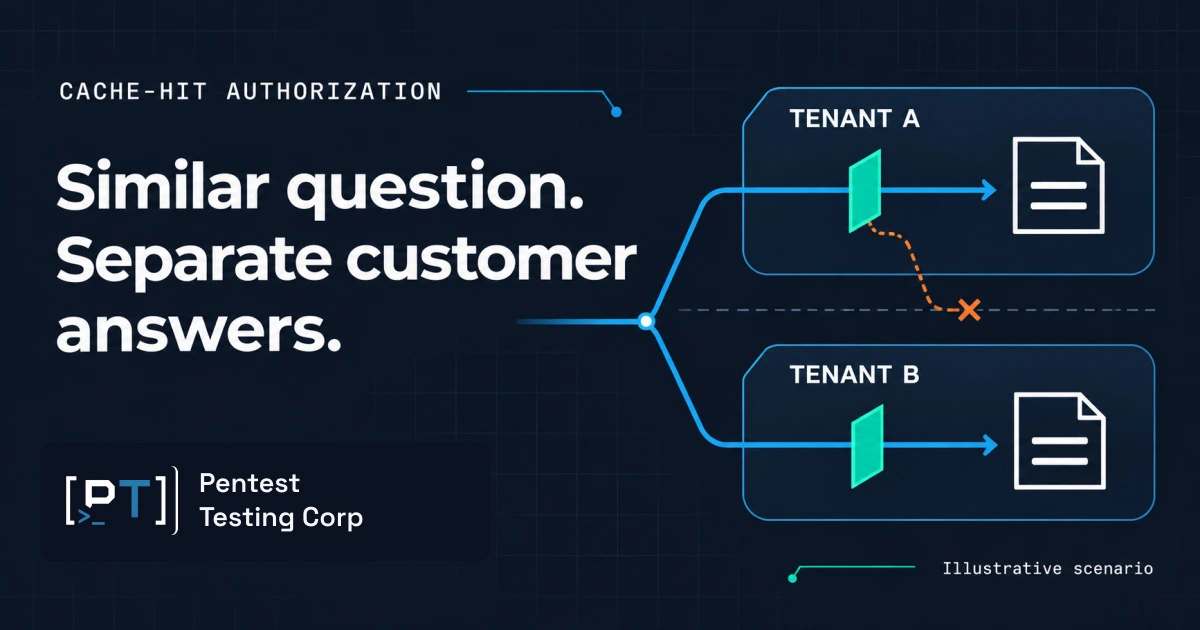
A CTO approves a cache pilot to reduce the delay in a customer-support assistant. The application already checks access to customer documents, and the pilot produces faster answers. Before rollout, the security lead asks a different question: when the assistant reuses an earlier answer, does it still check who is asking? AI semantic cache tenant isolation testing addresses that release decision. A previously authorized answer can contain confidential account terms, internal notes, or restricted project information. Its original creation does not establish permission for every later recipient.
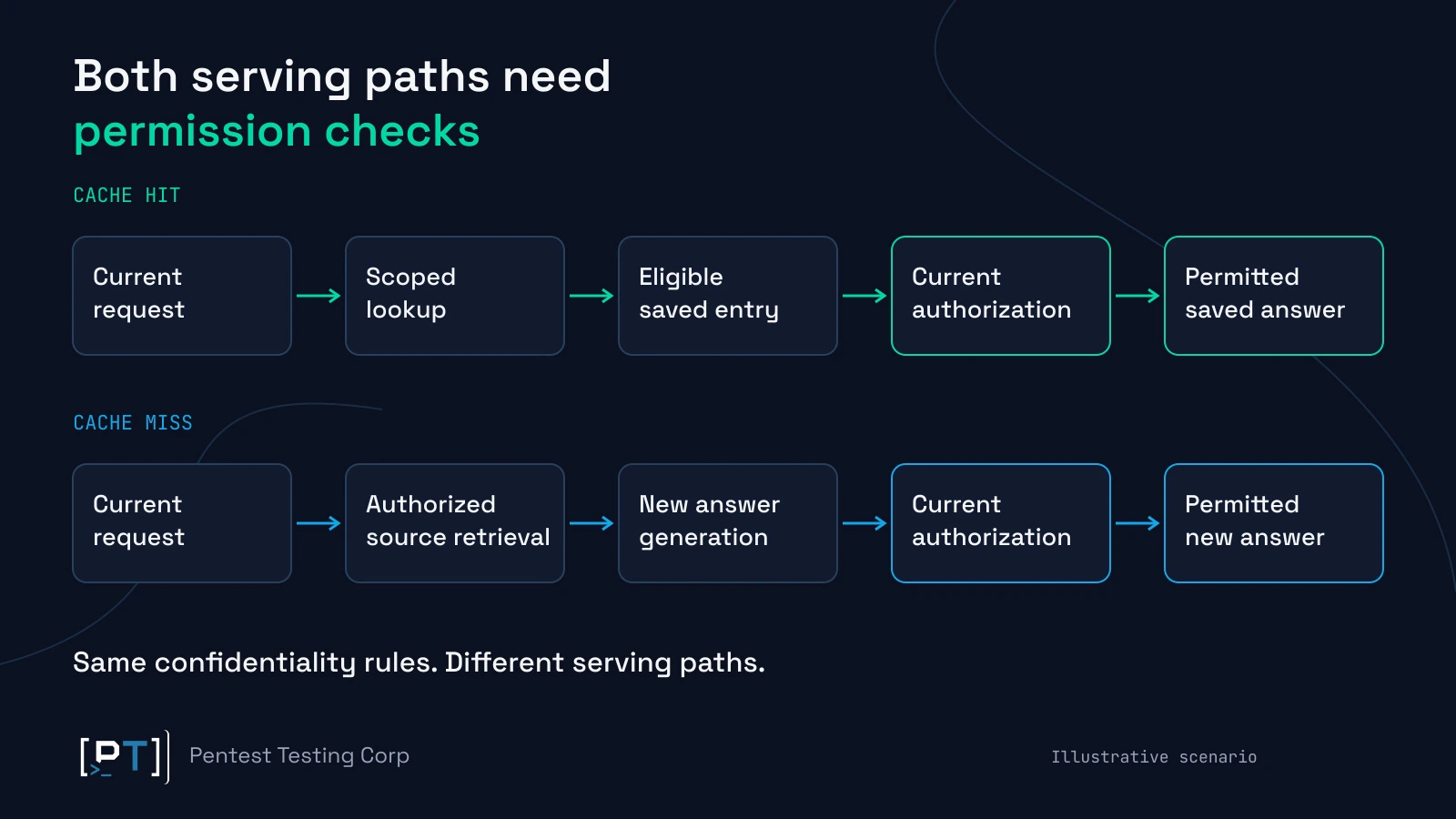
The relevant change is in the serving path. A cache hit may return saved content without running the document retrieval and generation controls used on a cache miss. Leadership needs evidence that both paths respect current permissions. This article scopes application-managed response caches, uses synthetic examples, and explains the evidence needed to approve, restrict, or postpone deployment.
Why reused answers change the release decision
A semantic cache looks for a previously answered request with a similar meaning. An exact response cache looks for an exact match under its chosen key. Both can reuse completed answers. That creates a second distribution point for information already assembled from potentially restricted sources. The engineering benefit is reduced work; the security question is whether the reuse decision preserves the original data boundary.
Consider two customers asking about their renewal conditions. Similar wording does not mean their contract terms are interchangeable. The same concern applies inside one customer account: a manager and a contractor may ask identical questions while holding different document permissions. A cached summary can reveal sensitive information even if it omits the original document or its download link.
Microsoft’s semantic-cache policy reference explains that matching uses vector proximity and warns that similarity-based reuse can return incorrect, outdated, or unsafe responses. That supports a practical approval condition: relevance must be evaluated separately from permission. A stronger similarity threshold cannot establish that the recipient may read an answer.
The exposure depends on the application. A cache containing only approved public help content presents a different confidentiality risk from one storing customer-specific financial explanations. Before approving latency savings, establish what can be cached, who can receive it, and how a permission change affects existing entries. Procurement statements about tenant separation should cover this serving path explicitly.
Include that boundary in the scope of AI penetration testing for cached-answer authorization. The assessment should identify which deployed cache components and business workflows were examined. A broad AI assessment label does not establish that response reuse was tested.
Define the cache and its authorization boundary
Start with a short inventory of the caches the product actually uses. Record where each sits, what it retains, which component writes entries, and what happens when an entry is selected. A gateway, application service, and response-delivery layer may each reuse content. Fixing one layer leaves uncertainty if another can still serve an older answer.
| Mechanism | What is reused | Decision-relevant test |
|---|---|---|
| Application response cache | A completed answer under an exact key | Does the key and serving decision preserve the current authorized audience? |
| Application semantic cache | A completed answer selected by meaning or similarity | Is candidate selection constrained to an eligible audience, followed by current authorization before release? |
| Provider prompt caching | Provider-managed processing state for repeated input prefixes, depending on the service | Which provider controls and contractual boundaries apply? Assess separately from application answer reuse. |
| Retrieval store or agent memory | Source material or retained context used to produce an answer | Are retrieval and persistence controls assessed in their own scope? |
For example, OpenAI’s prompt-caching documentation describes reuse of intermediate key-value states associated with input processing. That is a different mechanism from your application returning a saved answer. Do not infer provider behavior from an application-cache test, or treat provider caching as evidence that your own response cache enforces customer permissions.
The inventory needs an explicit audience classification: public, tenant-wide, group-restricted, or individual. Tenant identity alone may be insufficient. Two people with the same role can have different project memberships or record-level entitlements. The design must reflect whichever attributes actually determine access, without assuming that every application needs the same key structure.
The existing RAG retrieval-layer security guide covers access to the material used to generate an answer. This article adds a later boundary: permission to distribute the retained answer after generation. Ask engineering to show where that permission is enforced when retrieval does not run.
Cache ownership also needs a named operational owner. Someone must maintain eligibility rules, handle revocation events, and disable unsafe reuse. Assigning the database team to operate the cache does not automatically assign responsibility for application authorization policy. Record those responsibilities before the pilot becomes a supported production dependency.
Scope AI semantic cache tenant isolation testing
Agree the expected policy before execution. The useful question is whether the current requester is entitled to the information in the reused answer. Require server-verified tenant and membership context, appropriate separation during lookup, and a release decision that remains effective for individual restrictions. A tenant value supplied in request content is a selector to validate, rather than proof of authority.
OWASP’s Multi Tenant Security Cheat Sheet recommends scoped cache keys and authorization before protected cache reads. Those principles support the assessment; the matrix below is a proposed application acceptance model. Tailor its cases to the actual entitlement rules and record exclusions.
| Boundary | Synthetic comparison | Required outcome | Evidence |
|---|---|---|---|
| Tenant | Equivalent questions in two test customers | No customer receives the other’s restricted answer | Verified identity, cache route, entry ownership, returned-content markers |
| Role and object access | Same tenant, different access to a test project | Restricted content remains unavailable to the lower-entitlement identity | Entitlement snapshot and allowed/denied results |
| Hit and miss parity | Same policy evaluated with and without reuse | Both serving paths preserve confidentiality rules | Confirmed hit/miss classification and authorization result |
| Permission change | Previously permitted identity loses access | Old answers cannot preserve withdrawn authority beyond the approved enforcement window | Change time, enforcement time, invalidation or revalidation result |
| Mixed-source answer | A saved answer combines public and restricted synthetic sources | Reuse respects all restrictions relevant to the disclosed content | Source references and effective audience decision |
| Dependency failure | Authorization or invalidation service becomes unavailable in a controlled test | Protected content is withheld; fallback does not bypass policy | Error handling, safe fallback, operational alert |
Use harmless, distinctive markers in fabricated records so the assessor can recognize an inappropriate disclosure without handling customer information. Include an allowed comparison as well as denied cases. A system that never returns a cache hit may avoid disclosure while failing the product requirement. Security evidence should demonstrate useful authorized reuse and effective refusal of unauthorized reuse.
Answer similarity alone cannot establish which component returned the content. Require observable hit/miss evidence through approved traces or test instrumentation. If that visibility is unavailable, report the limitation and avoid claiming that repeated answers prove cache isolation. The team may need a small instrumentation change before a reliable assessment can proceed.
The tenant, role, and object authorization assessment provides the broader SaaS context. For this cache scope, select representative combinations that challenge the reuse policy. Document which roles, object classes, entry types, and serving routes remain untested so the release owner can judge coverage.
Permission changes must reach retained answers
An entry can be safe at creation and unsafe later. A project becomes confidential, a user leaves a team, a customer disables an integration, or a source document’s sharing policy changes. The cache then holds information whose original access decision no longer describes the current requester. A successful initial isolation test does not resolve that lifecycle risk.
Define when withdrawn access must take effect. The business owner should approve a concrete enforcement requirement appropriate to the data and contractual commitments. A short time-to-live limits how long some entries remain, but expiry alone does not prove that revocation meets that requirement. If access must end immediately, a remaining cache lifetime creates an unresolved gap.
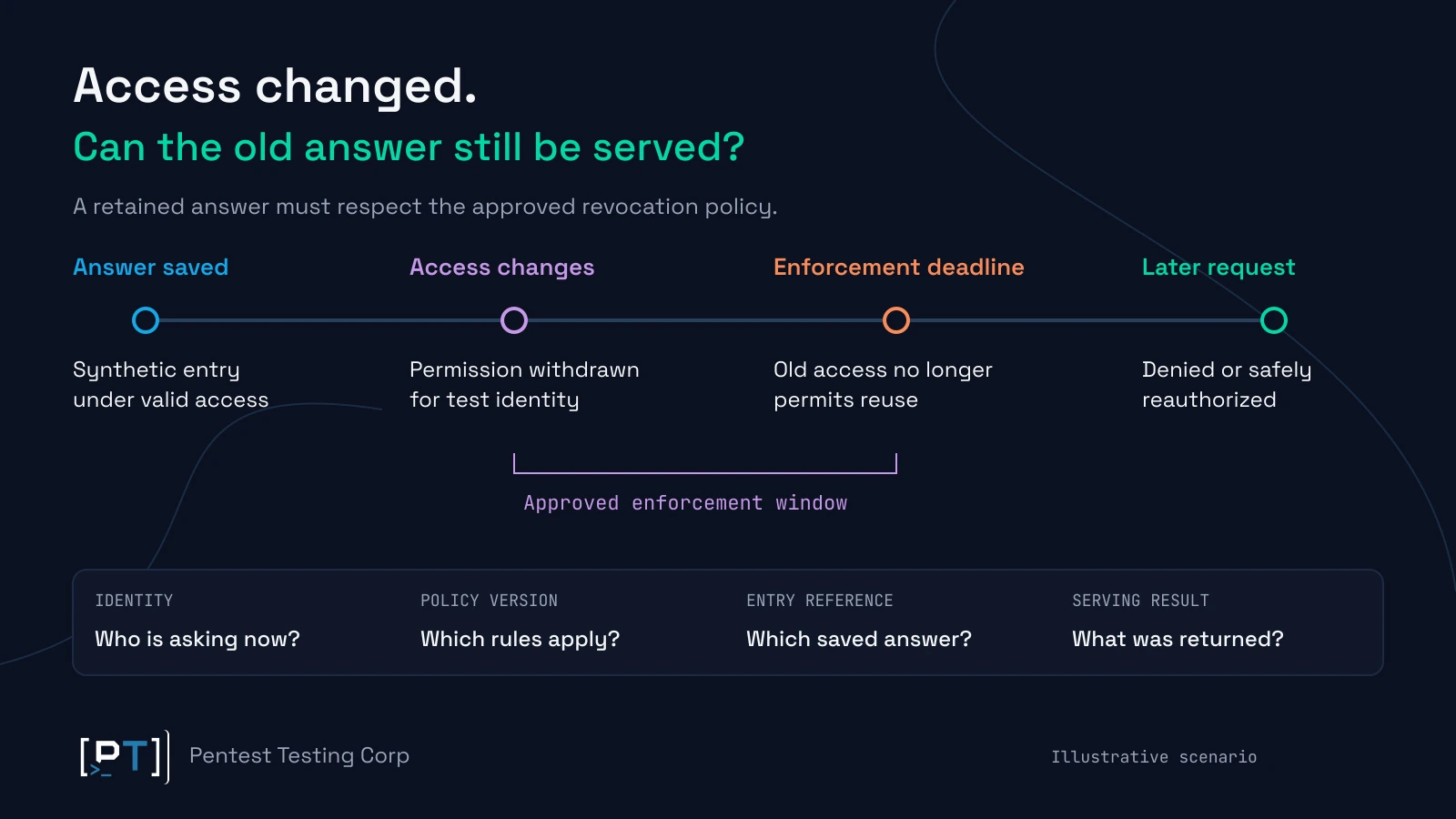
Engineering may use request-time authorization, permission-version binding, targeted invalidation, audience-specific entries, or exclusion of sensitive answer classes. Each approach has dependencies. Version binding works only if relevant changes update the version and the serving path enforces it. Invalidation requires reliable identification of affected entries, including derived answers and relevant replicas.
For answers assembled from several sources, retain enough lineage to establish the permitted audience or safely invalidate the answer when a source changes. A summary does not become unrestricted because its source references were discarded. Where the product cannot establish current eligibility, bypassing reuse and generating a newly authorized answer may be the more defensible release restriction.
Also distinguish confidentiality from factual freshness. A changed price may make an answer outdated even when its audience remains correct. A revoked project permission can make an otherwise accurate answer unauthorized. These need different acceptance criteria and may have different owners. Reporting both as “stale cache” obscures the treatment decision.
Persistent influence requires another assessment. Cross-session memory poisoning testing examines how retained content changes later behavior. Here, the concern is distribution of a saved response, even when its content is entirely legitimate.
Hypothetical scenario involving two customer accounts
Illustrative scenario only. This is not a client finding or a claim about a particular vendor. A B2B support platform uses two synthetic customer accounts during a cache pilot. The first account has a restricted renewal note containing a fabricated commercial concession. An authorized account manager receives a summary, which becomes eligible for response caching.
A user in the second test account later asks a similarly phrased renewal question. The cache selects the earlier answer because the lookup considers semantic proximity without an effective customer boundary. The answer reaches the second user without the access check that would have constrained a fresh document search. The synthetic concession appears in the response.
The demonstrated impact is unauthorized disclosure of a fabricated customer-specific fact through the cache-hit path. It does not establish compromise of the underlying database, access to every customer, or successful modification of a contract. In a comparable production design, an actual disclosure could undermine confidentiality commitments and require an investigation of affected serving events.
The release owner pauses caching for restricted account answers while engineering repairs eligibility and serving authorization. The retest covers both customers, different project permissions within one customer, and a previously permitted user whose access has been withdrawn. An allowed user still receives an appropriate cached answer. Recovery also addresses old entries and the deployed policy version, rather than testing only newly created entries.
The leadership lesson is specific: approve the optimization only for answer classes whose audience can be enforced and demonstrated. A narrowed release for public help content may remain feasible while sensitive workflows wait for stronger controls. That decision preserves a measurable benefit without claiming untested confidentiality assurance.
Evidence from AI semantic cache tenant isolation testing
Request a bounded evidence package that connects each result to the deployed design. It should identify the application build, cache policy, authorization configuration, representative identities, synthetic dataset, and observation window. Record entry ownership, relevant source references, the current permission decision, and whether the content came from a hit, miss, or fallback path.
Retain enough information to reproduce the conclusion without copying confidential answer bodies into general logs. Access-controlled test artifacts and synthetic markers are preferable to unrestricted transcript collection. The monitoring design should help distinguish operational events such as invalidation failures from content disclosure, while preserving the information needed for an authorized investigation.
Approved deletion introduces a further obligation addressed in AI data erasure evidence across retained copies. Cache authorization results do not establish that an erasure request was completed.
Map results to frameworks according to the demonstrated mechanism. OWASP LLM02:2025 Sensitive Information Disclosure is relevant when retained answers expose protected information. LLM08:2025 Vector and Embedding Weaknesses is additionally relevant where vector-based cache lookup has isolation or access-control weaknesses. Do not assign the vector category to an exact-key cache solely because it serves an AI feature.
OWASP API1:2023 Broken Object Level Authorization can describe failures where an API does not enforce the requester’s permission to a protected object. Apply it when that mechanism fits the finding, rather than treating every cache defect as an object-identifier vulnerability. Framework labels organize evidence; they do not replace a demonstrated impact statement.
The NIST AI RMF 1.0 offers Govern, Map, Measure, and Manage functions. Applied to this release, assign responsibility, identify sensitive answer flows, evaluate isolation, and track treatment and deployment restrictions. This is a practical mapping to risk management, not a claim that a cache test certifies compliance with a law or an entire framework.
Assessment effort depends on authorization complexity and observability. A single cache with clear ownership metadata is easier to examine than several gateways, regional replicas, mixed-source summaries, and asynchronous invalidation paths. Missing test identities or reliable hit traces can consume effort before meaningful validation begins. Ask for separate estimates for assessment, engineering remediation, and retesting.
Scope the schedule around readiness and acceptance events: architecture confirmation, controlled validation, remediation, and retest on the release candidate. Avoid accepting a fixed calendar promise before the team understands permission propagation and access requirements. Define who will provide the environment, interpret policy exceptions, implement fixes, and approve closure.
What leadership should decide before deployment
The CTO should approve eligible answer classes, the required permission-enforcement window, and the evidence needed for release. The security owner should identify material failures and unresolved scope limitations. Product and operations should confirm the behavior users receive when caching is unavailable or an answer is ineligible for reuse.
| Observed condition | Recommended decision | Required follow-through |
|---|---|---|
| Unauthorized customer or user receives protected synthetic content | Hold the affected caching path | Repair authorization, address retained entries, and retest |
| Isolation holds, but revocation exceeds the approved window | Restrict affected answer classes | Improve revalidation or invalidation and verify timing |
| Hit/miss behavior or deployed policy cannot be established | Defer confidentiality approval | Add observability and repeat bounded validation |
| Representative isolation and lifecycle cases pass with documented limits | Consider a controlled rollout | Retain monitoring, a disable control, and change-triggered retesting |
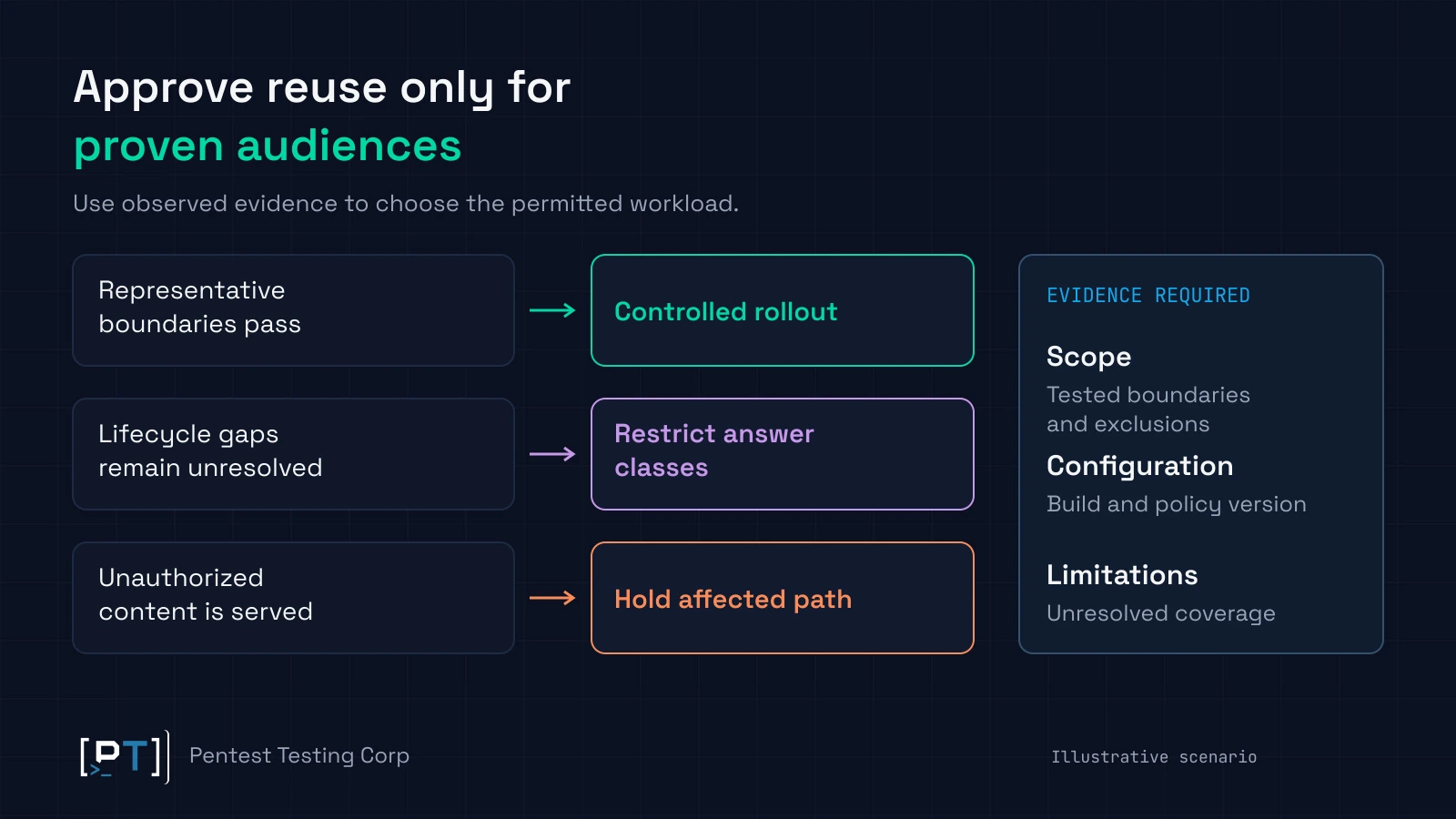
A disable control must also be tested: turning off semantic lookup should not leave another layer serving the same protected entries. Plan capacity and user experience for a higher miss rate or a temporary suspension of caching. Otherwise, operational pressure may encourage the team to restore unsafe reuse during an outage.
Evaluate the financial case using the permitted workload. Savings measured with unrestricted cross-customer reuse may disappear once proper separation is enforced. Compare latency, model consumption, cache infrastructure, and support effort after the security constraints are applied. Leadership can then judge the real tradeoff rather than approving a performance figure that depends on unsafe sharing.
Retest when cache keys, tenant routing, permission rules, lookup filters, source lineage, or serving architecture change. Review this scope annually as a baseline, while treating material architecture changes as earlier triggers. A test supports the observed configuration and cases, not a permanent guarantee about every future answer.
Before enabling confidential answer reuse, scope a focused assessment of cache-hit permissions and AI data boundaries with Pentest Testing Corp. Bring the cache inventory, entitlement model, synthetic test accounts, and release criteria. The useful outcome is evidence for a concrete deployment decision.
Frequently asked questions
Can a public knowledge-base cache be shared across tenants?
Potentially, if every stored answer is genuinely approved for the same public audience. Verify that personalization, hidden account context, and restricted sources cannot enter that namespace. Record who approves the public classification and how changes are reviewed.
Does encryption of the cache prevent cross-tenant disclosure?
Encryption protects data under its access and key-management assumptions. It does not establish whether an application may return a decrypted answer to a particular requester. Assess storage protection and serving authorization as separate controls.
Should every user have a physically separate cache?
Physical separation is one option, but it is not a universal requirement. The appropriate boundary depends on data sensitivity, contractual commitments, permission complexity, and available enforcement. Evaluate logical separation with evidence, and use stronger isolation where the risk requires it.
Can the model redact an answer after the cache selects it?
Model-based redaction may provide an additional content check, but it should not be the sole permission control. Restrict access before protected content reaches an unauthorized context and verify that prohibited information is withheld independently of model instructions.
Does a passed cache assessment cover response accuracy?
Only if accuracy was included explicitly. Confidentiality testing establishes whether the recipient may receive the content. A separate quality evaluation should assess whether semantically similar requests receive answers appropriate to their facts, dates, and business purpose.
What should an enterprise customer receive as assurance?
Provide an approved scope summary, tested boundary classes, assessment date and configuration, remediation status, and relevant limitations. Share sensitive technical evidence only under appropriate access restrictions. Avoid sending raw cache content or implying that a sampled assessment proves universal isolation.