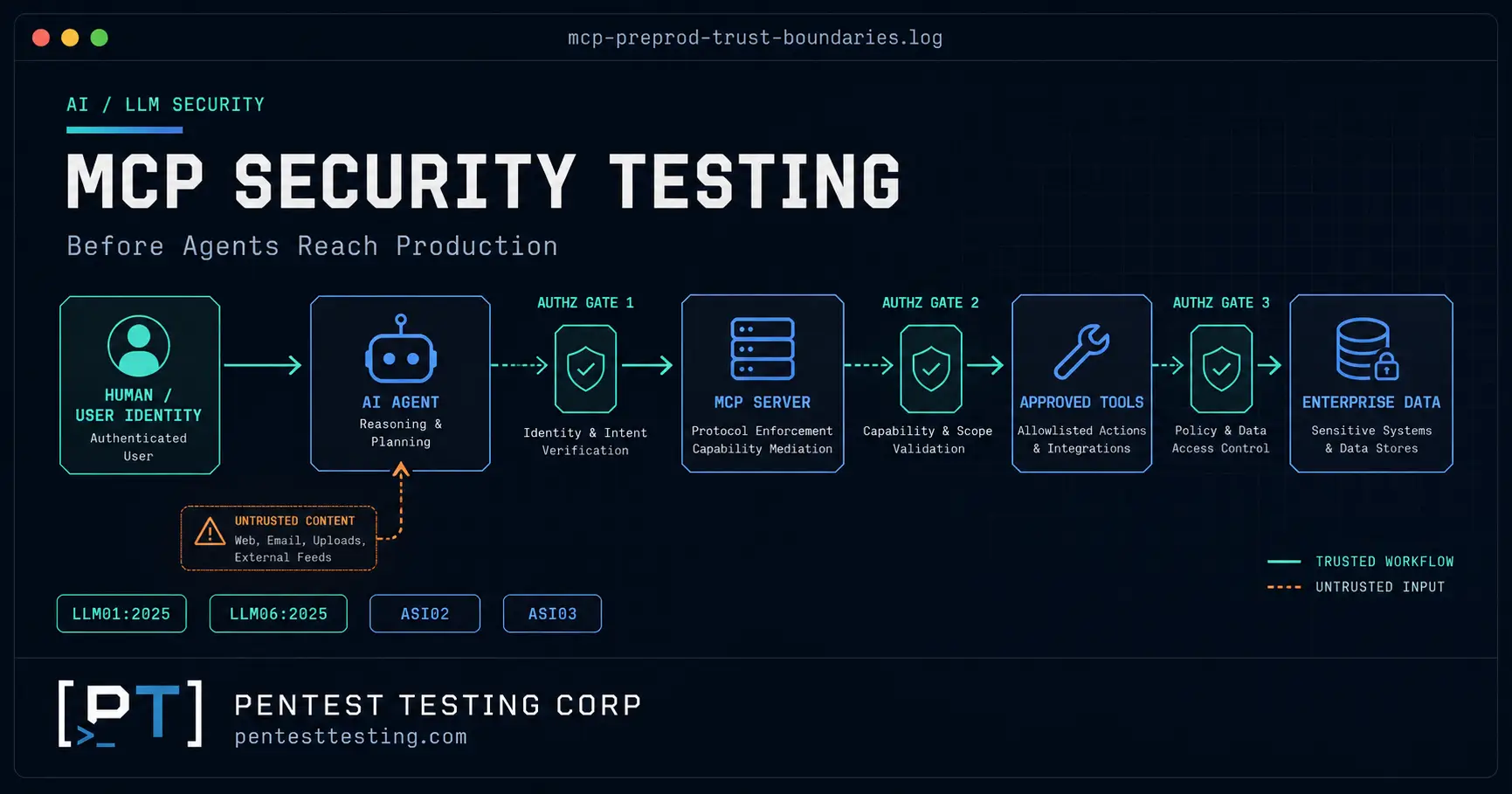
MCP Security Testing Before Agents Reach Production
A product team is days from connecting an AI agent to customer records, ticketing, cloud resources, or internal workflows through Model Context Protocol. The integration works. Authentication succeeds. The agent discovers tools and completes expected tasks. Then the security review asks the harder questions: under whose identity does each action run, which tool calls are authorized, what data can cross the MCP boundary, and what evidence will exist if the agent takes the wrong action?
That is the purpose of MCP security testing. It validates the deployed trust model before a convenient integration becomes a production access path. The assessment is not a prompt-only review or a tutorial on attacking an MCP server. It examines identity, authorization, data separation, indirect prompt injection, tool behavior, credential handling, logging, and the business consequences of failure.
Leadership should not approve an MCP-enabled agent because the demo worked. Approval should depend on evidence that the agent can perform permitted tasks, cannot complete prohibited ones, and leaves a defensible audit trail for both outcomes.
Why MCP Security Testing Is Now a Launch-Gate Issue
MCP standardizes how AI applications connect to tools, data sources, and services. That reduces integration friction, but it also creates a standardized path from model reasoning to enterprise authority. An MCP server may expose read-only knowledge, or it may expose functions that modify records, send messages, deploy infrastructure, retrieve regulated data, or initiate financial and operational workflows.
MCP security covers the connection and tool boundary, but many agents add a separate execution layer through reusable skills. These packages can define how multiple tools are selected and sequenced, introduce external instructions, and change after initial approval. Our OWASP Agentic Skills Top 10 buyer test plan explains how to scope provenance, permissions, runtime isolation, updates, and revocation without duplicating the MCP assessment.
Recent platform changes make this an immediate buyer issue. On June 30, 2026, Google Cloud described a fully managed remote MCP server for connecting external agents to Google Cloud resources. Google also introduced VPC Service Controls conditions based on MCP attributes, including tool name, method, and read-only status. On July 9, AWS announced OAuth support for the AWS MCP Server, with IAM integration, token introspection and revocation, OAuth condition keys, and CloudTrail elements. The MCP project has also scheduled its 2026-07-28 specification for final release on July 28 after a release-candidate period.
These developments show that MCP is moving into governed enterprise environments under real identities and policies. They do not prove that a particular implementation is secure. OAuth can authenticate a token with the wrong scope. IAM can enforce permissions that are still too broad. A server allowlist can approve tools that exceed the agent's business need. Logs can record an action without proving the originating user was entitled to request it.
Pentest Testing Corp's AI penetration testing service evaluates the deployed workflow across prompts, tools, APIs, identity, data boundaries, and downstream effects. For MCP-enabled systems, the scope should follow the complete trust path rather than stop at the server endpoint.
Where MCP Changes the Trust Model
Traditional application security assumes that a user or service calls an API through a defined interface. MCP adds a decision-making layer. The model interprets natural-language context, selects or is offered tools, constructs parameters, and may act through a client holding delegated credentials. Conventional controls still matter, but they must now survive a model-mediated workflow.
Leadership should view the architecture as five connected trust decisions:
- Who is asking? The system should distinguish the human user, AI client, agent or workload identity, MCP server, and downstream service. Shared integration accounts can erase accountability and enlarge the blast radius.
- What is requested? Tool discovery and tool invocation are separate privileges. Seeing a tool should not authorize every operation or sensitive parameter it exposes.
- Which data is in scope? Customer, tenant, project, region, environment, and classification boundaries must survive the full path from request to tool execution and response.
- What can influence the agent? User prompts, files, retrieved documents, tool descriptions, prior outputs, and server content can all affect the next decision.
- What happens next? A response may be displayed, stored, passed to another agent, or used to trigger a write action. Each downstream use is another control point.
An MCP review therefore cannot stop at “we use OAuth” or “only approved servers are allowed.” Authentication establishes identity. Authorization decides what that identity can do in context. Business rules determine whether an otherwise permitted action is appropriate for this user, tenant, record, amount, environment, or workflow stage.
The MCP authorization guidance uses OAuth 2.1 for remote-server authorization and highlights the need to protect sensitive resources and audit who performed actions. MCP's security guidance also emphasizes user consent, access control, input and output handling, confirmations, and caution around tools and their descriptions. A pre-production assessment verifies whether these principles hold in the implementation that will ship.
What MCP Security Testing Should Cover
A useful test plan is architecture-specific and evidence-driven. It should focus on outcomes a buyer, auditor, and engineering leader can act on, not a superficial count of unusual prompts.
Identity, authentication, and delegation
Testing should identify the principal at every hop: user to agent, agent to client, client to MCP server, and server to downstream API. It should verify token audience, scope, expiry, refresh, revocation, redirect controls, workload identity, and separation between interactive and headless access where applicable.
The buyer question is whether the organization can prove which user authorized an action, restrict a delegated token to the intended resource, and terminate access after logout, role change, employee departure, device loss, or incident response. A shared privileged service credential may simplify deployment, but it can undermine least privilege and forensic attribution.
MCP authorization is only one layer of the deployed identity path. Cloud IAM, resource policies, data perimeters, agent-to-agent delegation, and downstream tenant checks must also hold. See what cloud pentests should prove about AI agent identity security.
Where a GCP-hosted agent uses Agent Identity auth manager to reach an MCP server, see what the August 2026 auth manager GA changes for cloud pentest scope before testing the MCP layer alone.
Tool inventory and least-privilege authorization
Every tool should have an owner, purpose, allowed callers, data classification, parameter limits, and action tier. Read-only, low-impact write, high-impact write, administrative, and irreversible functions should not share one approval model.
Authorization must be enforced server-side for each tool and sensitive parameter. Instructions such as “never change production” or “ask before sending” are behavior guidance, not security boundaries. The server and downstream API must reject unauthorized operations even when the model creates a plausible request.
This maps directly to OWASP LLM06:2025 Excessive Agency and the OWASP Agentic categories ASI02 Tool Misuse and ASI03 Identity & Privilege Abuse. Broad tool access can turn a prompt-control failure into a data, financial, operational, or compliance incident.
Data, tenant, and environment boundaries
MCP can expose several systems through one interface, but those systems may enforce identity and ownership differently. Testing must verify the boundary where data is accessed, not only in the chat interface.
For multi-tenant SaaS, the current tenant should be derived from trusted identity context and enforced by the MCP server or downstream API. A tenant or record identifier selected by the model is not proof of ownership. The same principle applies to production versus staging, business unit, geographic residency, contract scope, and regulated-data classification.
This is where an API penetration testing assessment may overlap with MCP testing. The agent is a new interface, but broken object-level or function-level authorization may still exist in the API behind the tool.
Direct and indirect prompt injection
MCP systems often process tickets, documents, email, web pages, repositories, knowledge bases, and prior tool responses. Untrusted instructions inside that content can influence tool selection or parameters. That is the core relevance of OWASP LLM01:2025 Prompt Injection.
Testing should determine whether untrusted content is separated from control instructions and whether manipulated content or tool output can produce unauthorized access, disclosure, workflow changes, or misleading evidence. The goal is not a dramatic model response. It is a verified business impact.
The distinction between ordinary prompt testing and security-impact validation is explained in Does a Standard Pentest Catch Prompt Injection?. MCP raises the stakes because manipulated reasoning may reach legitimate tools using legitimate credentials.
Tool descriptions, input validation, output handling, and secrets
Tool descriptions and server metadata influence the agent's decisions and should be governed as security-relevant configuration. Testing should assess whether descriptions can be altered without review, whether a new tool silently expands authority, and whether prompts or metadata contain secrets, sensitive logic, or restricted endpoints.
This relates to OWASP LLM07:2025 System Prompt Leakage, but severity depends on impact. Generic instructions are not automatically critical. Exposure becomes material when it reveals credentials, protected data, sensitive control logic, or information that enables a more consequential action.
The server should also validate record identifiers, file paths, amounts, destinations, environment names, query filters, and destructive flags independently of the model. Outputs should be sanitized and labeled before they are returned to the model or passed to another system. For high-impact actions, the user should see the exact target, amount, destination, environment, and data scope before approval.
Supply chain, logging, and response
MCP servers, packages, connectors, registries, and tool definitions create a supply-chain and change-control surface. The review should verify approval, ownership, version control, integrity checks, update processes, and emergency disablement. An approved server can expose a materially different capability after an update.
An audit trail should connect the originating user, agent identity, MCP server, tool, material parameters, authorization decision, downstream target, response status, and human approval where required. Logging only the final chatbot answer is insufficient. Testing should also confirm that teams can revoke a token, disable a server or tool, quarantine the agent, and identify affected actions without waiting for a normal code release.
The final report should translate results into executive risk, engineering remediation, ownership, and retest criteria. Pentest Testing Corp's sample reports illustrate the evidence-backed structure buyers should expect, while an MCP engagement adds architecture-specific identity and tool-call evidence.
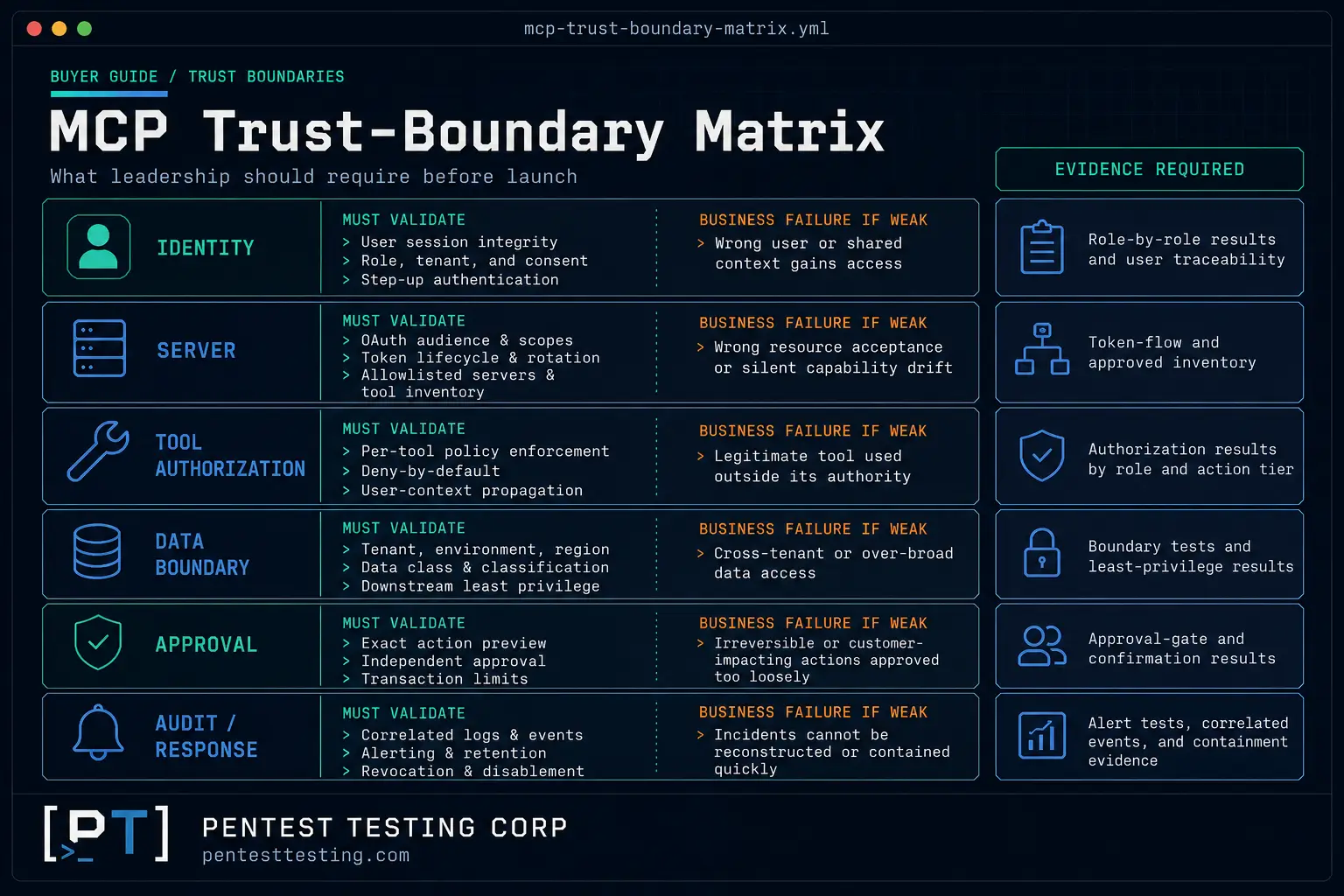
MCP Trust-Boundary Matrix for Buyers
The following matrix helps leadership confirm that the statement of work covers the boundaries most likely to create material exposure.
| Trust boundary | What must be tested | Business failure if weak | Evidence leadership should receive |
|---|---|---|---|
| Human user to agent | Session identity, role, tenant, consent, step-up requirements | Actions occur under the wrong user or shared context | Role-by-role results and originating-user traceability |
| Agent/client to MCP server | OAuth audience, scopes, token storage, expiry, refresh, revocation, redirects | Tokens are accepted by the wrong resource or remain usable too long | Token-flow diagram, negative tests, revocation results |
| MCP server to tool catalog | Server allowlist, tool inventory, description integrity, change approval | Unapproved or altered tools enter production unnoticed | Approved inventory, version, owner, and change evidence |
| Tool selection to authorization | Per-tool policy, deny-by-default rules, user-context propagation | A legitimate tool runs outside the user's authority | Authorization evidence for each role and action tier |
| Tool parameters to business rules | Ownership, tenant, amount, destination, environment, rate and workflow limits | A permitted tool performs an inappropriate or over-broad action | Boundary tests and server-side rejection evidence |
| External content to model context | Files, tickets, email, web, RAG, and prior outputs | Indirect instructions redirect the agent or expose data | Sanitized injection paths tied to real impact |
| Agent to downstream system | Service-account privileges, API authorization, data minimization | Shared credentials bypass user and tenant controls | Downstream authorization and least-privilege results |
| High-impact action to approval | Exact action preview, independent approval, transaction limits | Vague approvals enable irreversible or customer-impacting actions | Confirmation and approval-gate results |
| Runtime to audit and response | Correlated logs, alerting, retention, disablement, revocation | The incident cannot be reconstructed or contained quickly | Alert tests, correlated events, and containment evidence |
A scope does not need every row at maximum depth, but it should make an explicit decision for each applicable boundary: included, excluded with rationale, or covered by another assessment.
Why Existing Controls May Still Be Insufficient
Organizations often assume that an identity provider, cloud IAM, API gateway, WAF, code review, or standard pentest already covers MCP risk. Each control remains valuable, but none automatically validates the complete agent-to-tool trust path.
| Existing control | What it does well | What may remain untested in MCP |
|---|---|---|
| Identity provider and OAuth | Authenticates users and issues tokens | Whether audience, scopes, delegation, refresh, revocation, and user context match each tool |
| Cloud IAM | Enforces configured permissions | Whether those permissions exceed the agent's task or the originating user's authority |
| API gateway | Centralizes routing, rate limits, and policy | Whether model-selected parameters, tenant context, and workflow rules are authorized correctly |
| WAF or scanner | Detects known web patterns and exposed weaknesses | Indirect prompt injection, multi-turn tool misuse, and context-dependent authorization |
| Functional QA | Confirms expected tasks succeed | Whether prohibited actions fail across roles, tenants, tools, and untrusted content |
| Standard web/API pentest | Tests application and API weaknesses | Model-mediated tool choice, tool-description trust, and approval behavior unless explicitly scoped |
| Server allowlist or vendor review | Reduces use of unapproved components | Whether an approved server is appropriate for your data, roles, tools, and downstream systems |
The answer is layered assurance. Keep identity, API, cloud, secure-development, and supply-chain controls. Add MCP-specific testing where the model influences tool selection, parameters, approvals, or multi-step actions. What Does an AI Penetration Test Cover? explains how this fits into a broader AI assessment rather than replacing traditional testing.
MCP is one tool-execution path, but an agent may also operate applications directly through a browser or desktop session. Where computer use is enabled, the production gate should additionally test browser identity, session state, high-impact approvals and rollback; our computer-use AI agent security testing guide covers that separate execution surface.
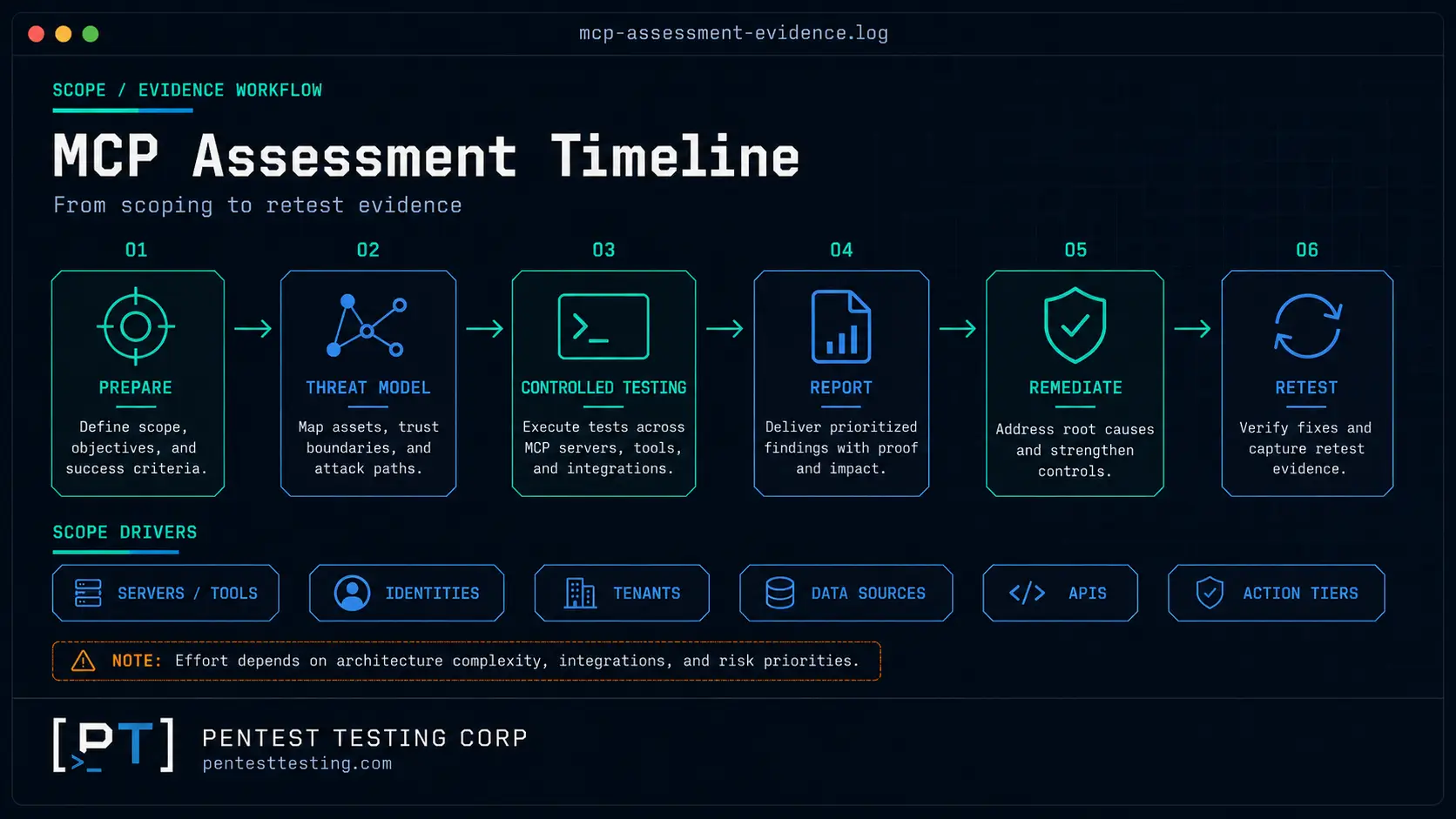
How to Scope the Test, Timeline, and Evidence
MCP security testing should begin when the architecture and tool set are stable enough to assess but before customers, auditors, or production operations depend on them. The most important fixes often affect user-context propagation, least privilege, approval gates, and logging. Those are harder to change after launch than a prompt template.
Information to prepare
A concise scoping package should include:
- The agents, clients, MCP servers, tools, APIs, data stores, and environments in scope.
- A data-flow diagram with user, workload, service, and delegated identities.
- Tool owners and read, write, administrative, irreversible, and customer-impact classifications.
- User roles, tenant boundaries, sensitive data classes, and residency requirements.
- OAuth and credential lifecycle, including refresh, revocation, and headless access where used.
- Tool schemas, material parameter limits, confirmation rules, rate limits, and emergency-disable paths.
- Logging, alerting, retention, approved test accounts, safe data, prohibited actions, and stop conditions.
- The business deadline: production launch, enterprise review, audit evidence, questionnaire, or board approval.
Practical effort ranges
Pentest Testing Corp's published planning ranges place a small chatbot or limited LLM integration at roughly 5–8 business days, integrated or RAG-enabled features commonly around 8–15 business days, and complex agentic or enterprise systems around 15–25+ business days after access is ready. These are planning ranges, not guarantees.
For MCP, the main effort drivers are the number of servers and tools, role and tenant combinations, action tiers, external content sources, identities, and downstream APIs. The AI penetration test timeline guide provides broader scheduling detail.
What the report should contain
A decision-ready assessment should provide:
- Architecture and trust-boundary summary.
- Tested inventory of clients, servers, tools, roles, identities, environments, and data sources.
- Findings with business impact, severity rationale, affected component, sanitized evidence, and remediation.
- Mapping to LLM01, LLM06, LLM07 and relevant Agentic categories such as ASI02 and ASI03.
- Clear exclusions, ownership, prioritized remediation, and full-control-class retest criteria.
- Evidence suitable for governance, customer review, and applicable NIST AI RMF activities.
The AI pentest and NIST AI RMF mapping guide helps buyers organize technical findings into governance, mapping, measurement, and treatment evidence. NIST describes the AI RMF as voluntary guidance for incorporating trustworthiness into the design, development, use, and evaluation of AI systems. A pentest supplies technical evidence; it does not replace governance or provide compliance certification.
When an enterprise questionnaire or security review explicitly references the OWASP MCP Top 10, the assessment can go one level deeper. Our OWASP MCP Top 10 testing guide translates MCP01–MCP10 into test objectives, evidence requirements, remediation priorities, and leadership decisions for the protocol layer.
Illustrative scenario: approved servers, weak trust path
A hypothetical SaaS company connects a support agent to customer lookup, ticket update, and account-credit tools. The deployment uses OAuth and approved MCP servers. However, the server runs under a shared support identity, the model selects the customer identifier, and the downstream credit API does not enforce the limit described to the model. An untrusted knowledge article can also influence the sequence of tools selected.
The problem is not that “MCP was hacked.” Several reasonable-looking choices combine into a weak trust path: shared identity, model-controlled object selection, a soft limit instead of server-side enforcement, and untrusted content influencing tool use. The consequences could include cross-customer disclosure, unauthorized credits, failed enterprise security review, and an investigation that cannot attribute actions to a specific user.
The remediation is concrete: propagate and validate user context, enforce ownership and limits in the API, reduce tool permissions, label untrusted context, require meaningful approval for financial actions, and correlate tool calls with the originating user and authorization result.
This scenario is illustrative only. It is not a client case or a working exploit sequence.
Frequently Asked Questions About MCP Security Testing
Is MCP itself insecure?
No. MCP is a protocol for connecting AI applications to tools and data. Risk comes from the implementation of identity, authorization, tool design, content trust, credentials, data boundaries, and downstream actions.
Does OAuth make an MCP server secure?
OAuth provides authentication and delegation, but it does not prove that scopes are least privilege, the correct audience accepts the token, user context reaches the downstream API, or each action is authorized for the current user and resource.
What is the difference between an MCP server pentest and an AI agent pentest?
An MCP server pentest emphasizes server authorization, tool interfaces, credentials, input/output handling, and connected services. An AI agent pentest also examines model behavior, prompt injection, memory, RAG, tool selection, multi-step reasoning, and approval behavior. Production systems often need a combined scope.
Should every MCP tool require human approval?
No. Strongly authorized, low-risk read actions may not need approval. Financial actions, privilege changes, external communications, production modifications, and irreversible operations should have explicit policy controls and, where appropriate, independent human approval.
Can MCP security testing be performed safely before launch?
Yes. Use approved test accounts, safe data, staging or production-safe paths, transaction limits, prohibited-action rules, stop conditions, and named emergency contacts. Sensitive writes can be validated through controlled simulations or dedicated test resources.
How often should MCP-enabled agents be retested?
Retest after remediation and after material changes to servers, tools, permissions, identities, models, orchestration, retrieval sources, approval rules, APIs, or environments. A quarterly architecture review is reasonable for fast-changing deployments, with targeted testing when a change expands access or agency.
What evidence will enterprise customers or auditors expect?
Expect requests for a defined scope, architecture and data-flow summary, tool and identity inventory, authorization and tenant-boundary evidence, prioritized findings, remediation status, retest results, and framework mapping. Exact requirements vary, so agree the reporting format during scoping.
What Leadership Should Decide Before Production
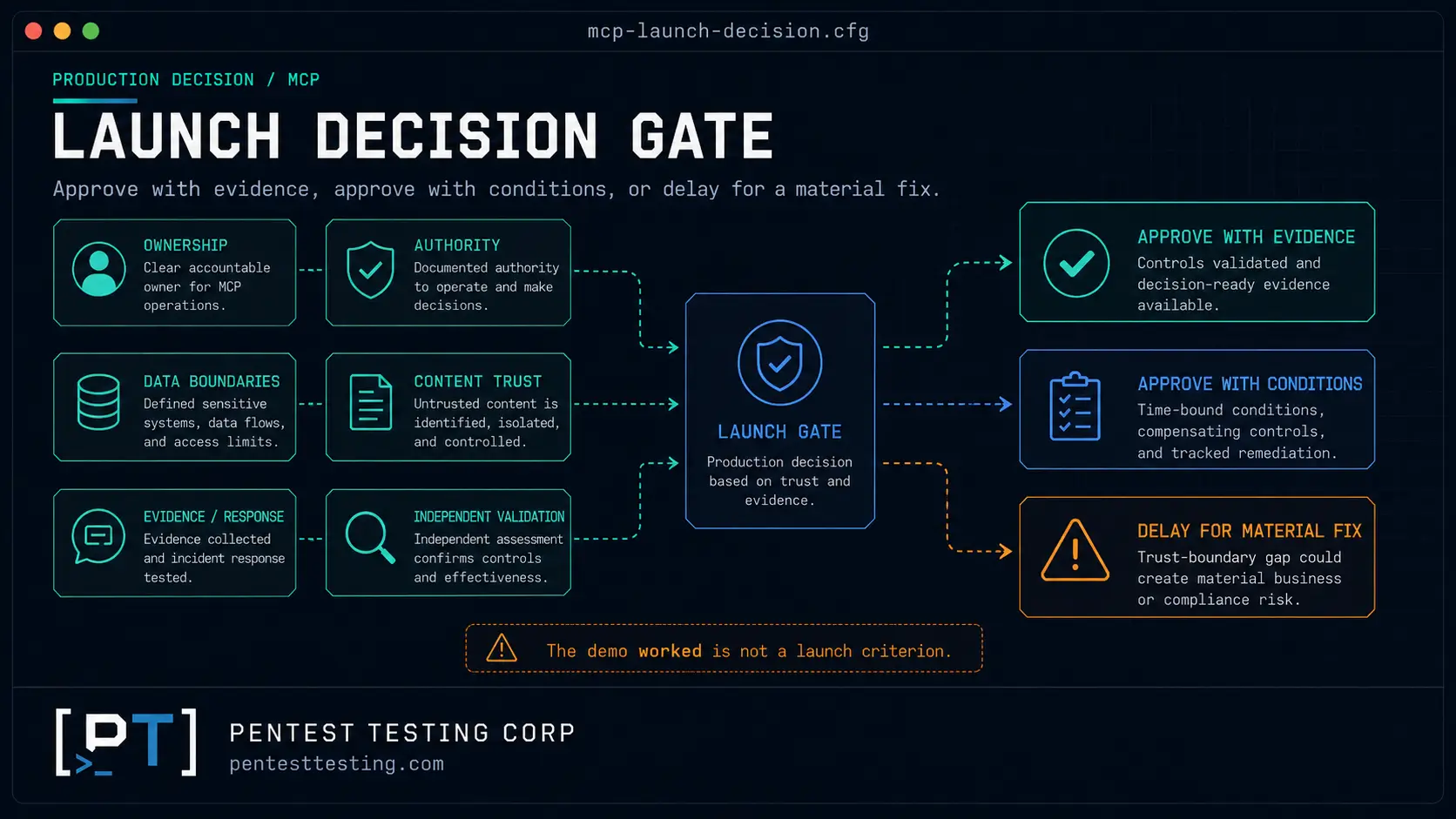
Before approving an MCP-enabled agent, leadership should require written answers to six questions:
- Ownership: Who owns each server, tool, agent policy, and the final production-risk decision?
- Authority: What is the maximum action the agent can take, under whose identity, and which control enforces the limit outside the model?
- Data boundaries: Which tenants, environments, regions, and data classes can each tool reach, and where is that boundary enforced?
- Content trust: Which external sources can influence the agent, and what prevents untrusted content from becoming control instructions?
- Evidence and response: Can the organization reconstruct, alert on, revoke, and contain sensitive actions quickly enough?
- Independent validation: Has a controlled assessment tested prohibited paths, not only confirmed expected workflows?
The launch decision should be one of three outcomes: approve with evidence, approve with time-bound conditions and compensating controls, or delay until a material trust-boundary gap is fixed. “The demo worked” and “the vendor supports OAuth” are not sufficient approval criteria.
MCP security testing gives CTOs, CISOs, engineering leaders, product owners, and compliance teams a common evidence base. It shows which agent actions are technically possible, which are authorized, where business rules fail, and what must change before production exposure grows.
To define a safe test boundary for your MCP servers, agents, tools, identities, and data, book an AI/LLM penetration testing scoping call. Pentest Testing Corp can help determine whether you need a focused MCP assessment, a broader agent pentest, or combined AI and API coverage before launch.