Pentest Report Redaction for Customer Review: What to Share
An agency owner receives a message from a client's enterprise prospect: “Please upload the latest penetration test report so we can finish procurement.” The agency has a branded PDF, but it includes internal architecture, screenshots, unresolved findings, and references to other customer accounts. Sales needs the review completed. The client's security lead needs to know who will receive the document and what the prospect actually needs to decide.
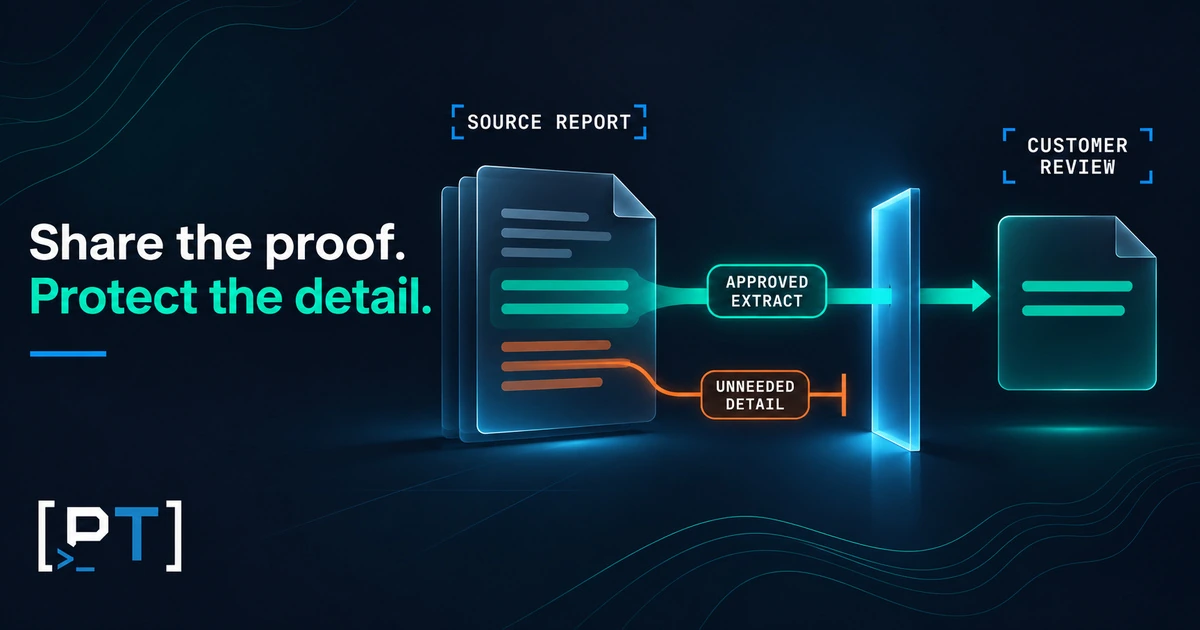
This is where pentest report redaction for customer review becomes a business decision. A report can demonstrate testing depth while exposing information that the recipient does not need. Remove too much, however, and the remaining document may conceal limitations or leave the buyer unable to assess a material risk.
The objective is a truthful evidence package for a defined recipient and purpose. That requires sharing authority, useful scope information, accurate remediation status, controlled access, and a route for questions that need deeper review.
Start pentest report redaction for customer review with the decision
Ask the requesting team what decision the evidence must support. “Complete the security review” is a process description. “Confirm that the customer-facing API was tested with multiple roles and that the material findings were independently retested” identifies an evidence need. The second request allows a security owner to select relevant material without circulating the entire technical record.
Record the requesting organization, named reviewers or approved group, product under review, intended use, required assurance, and review deadline. Clarify whether an external consultant will receive access and whether the document will enter a procurement platform operated by another provider. These details affect permission and handling even when the original customer contact is familiar.
An NDA can establish confidentiality obligations, but it does not itself prove that every proposed disclosure is authorized. Check the agreement's parties, permitted purposes, covered recipients, onward-disclosure provisions, and any relevant restrictions in the testing engagement. If authority is unclear, route the request to the person empowered to resolve it before releasing restricted evidence.
Agencies should align their reporting and testing-partner needs before promising a branded extract, assessor call, or customer-specific confirmation. Presentation under an agency brand does not justify an inaccurate answer about who performed the work.
A report-quality review asks whether findings and recommendations are useful. A release decision asks which parts a particular recipient may receive. Our guide to what a professional report should contain addresses the first question. For distribution, add a separate release record tied to the approved source version.
Choose recipients and disclosure tiers together
Use the following matrix as a starting point for discussion, not an automatic entitlement or refusal policy. The recipient's role helps identify likely needs, but an applicable obligation or a specific high-risk decision may require more detail. Agree on acceptable evidence with the buyer instead of assuming that a short letter will always suffice.
| Recipient and decision | Starting evidence package | Assurance to preserve | Release condition or escalation |
|---|---|---|---|
| Procurement coordinator checking whether testing occurred | Approved assessment confirmation or scoped executive statement | Product, test period, assessment boundary, provider attribution where required, and qualified status | Confirm that this format satisfies the request; route technical questions to security reviewers |
| Customer security reviewer evaluating supplier exposure | Redacted scope, limitations, findings summary, and remediation/retest schedule | Material unresolved risks, coverage relevant to the purchased service, and status dates | Named or approved-group access; specialist follow-up for a specific unanswered risk |
| Customer engineer assessing a sensitive integration | Relevant finding extract or focused assessor discussion | Integration boundary, business impact, preconditions, and validation limits | Approve the technical detail needed for that integration; exclude unrelated customer material |
| Agency account team coordinating the review | Approved response pack and escalation contacts | Exact statements the agency may make, report version, and outstanding questions | Client authorization; additional technical evidence only for an identified task |
| Auditor, regulator, or insurer requesting evidence | Package matched to the actual request and applicable duties | Evidence required for the review, including traceability and relevant limitations | Authorized owner and appropriate advisers confirm handling; commercial tiering cannot override obligations |
| Internal remediation owner fixing a finding | Detailed assigned findings and necessary technical evidence | Reproduction context, affected components, remediation guidance, and closure criteria | Internal need-to-know access; protect raw evidence separately where appropriate |
| Public website visitor or broad sales audience | Separately approved public statement or publication-safe sample | Clear distinction between example reporting and assurance about the current product | Explicit publication approval; never reuse a confidential customer pack by default |
Three practical tiers help organize the work: an assessment confirmation, a customer-review extract, and a restricted technical review. A fourth category, public material, needs its own publication decision. It should not be created simply by stripping the recipient watermark from a confidential package.
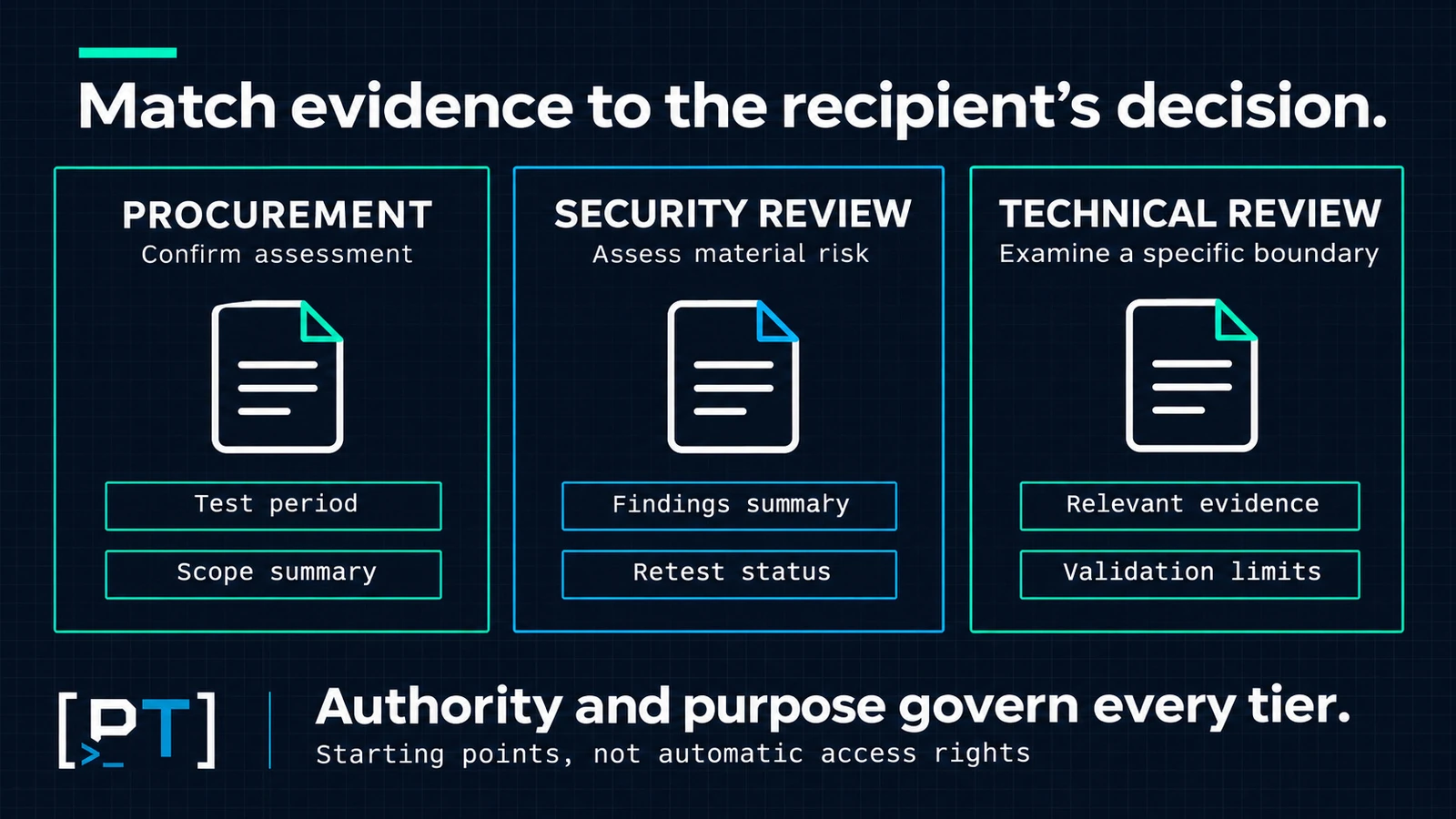
The tiers should be able to expand. If the buyer cannot establish whether a critical integration was covered, offer a focused scope discussion or relevant appendix after approval. Repeatedly sending the same thin letter can prolong procurement and make an otherwise credible assessment appear evasive.
For an agency, permission may involve the end client, the agency, and the testing provider. Resolve uncertain redistribution or attribution rights through the relevant agreement and approval process. The white-label agreement guidance explains the contract questions; the release matrix applies those decisions to an actual recipient.
Pentest report redaction for customer review must preserve meaning
Redaction should remove unnecessary exposure while retaining the facts that could change the buyer's decision. A document that hides an unresolved material finding, excluded environment, or blocked test is misleading even if no sensitive identifier remains.
Keep the evidence boundary understandable
Identify the product or service clearly enough to connect the assessment to the purchase. Retain the testing period, environment, relevant release or build reference where available, assessment approach, roles or access levels, significant exclusions, and constraints. State when an extract is incomplete and identify its source report and version.
For example, “authenticated API testing with standard and administrative roles” conveys more assurance than “application pentest.” If a support interface was excluded or a role was unavailable, preserve that limitation. An executive reader does not need account names to understand that a consequential business boundary remains untested.
When a buyer asks about tenant-isolation testing coverage, the shared document should establish whether the assessment actually examined the relevant separation. Renaming customer accounts is reasonable. Removing the fact that only one tenant was available would change the apparent strength of the evidence.
Remove details that do not serve that decision
Review credentials, tokens, personal information, customer records, internal addresses, unnecessary endpoint detail, storage locations, and sensitive architecture. Screenshots need particular attention because browser tabs, account menus, filenames, and background text can disclose more than the finding itself. A screenshot proving business impact may be replaceable with an approved descriptive summary.
The supplied Pentest Testing Corp SaaS/API sample provides a specific reporting example. Its redaction notice explains that client identifiers were removed or replaced and screenshots were withheld because they contained identifying references. It describes a live review route under mutual NDA. Those are choices documented for that sample, not a promise that every report has identical access conditions or redistribution rights.
Use consistent placeholders where relationships matter. “Customer tenant A” and “customer tenant B” can preserve the significance of an isolation issue without identifying either organization. A separate internal mapping may be necessary for traceability, but the external recipient does not automatically need it.
Check the released file, not just its appearance
Covering text with a visible rectangle is not sufficient if the underlying content remains recoverable. The release check should examine selectable text, searchable content, comments, attachments, document properties, links, and any retained layers. Have a reviewer examine the actual exported file rather than relying on the editor preview.
Keep the original assessment record protected and unchanged. Create a separately identified derivative with a short notice explaining its purpose, omitted content categories, and access route for further questions. A technical reviewer should compare its conclusions with the source; a confidentiality review should check the details being released. Assign both responsibilities even if one qualified person performs them.
Show retest status without rewriting the original result
A customer needs to distinguish what the assessment found from what happened afterward. Do not make the historical report look clean by deleting findings that were later fixed. Preserve an intelligible relationship between the original observation, corrective action, validation, and remaining risk.
A useful customer-facing status schedule can retain a stable reference, original severity, concise business impact, current status, status date, and basis for that status. Where titles themselves expose sensitive architecture, use an approved generalized description while preserving traceability inside the controlled record.
| Status | What the buyer can infer | Qualification to include |
|---|---|---|
| Open | The issue has not been demonstrated to be resolved | Relevant business exposure, accountable owner, and planned response |
| Reported fixed, awaiting retest | The implementing team reports a change | Independent validation has not yet occurred |
| Retested: original condition not reproduced | A documented retest supported closure within its boundary | Date, environment or build, included cases, and limitations |
| Mitigated | A measure is intended to reduce exposure | What was verified and what underlying weakness remains |
| Risk accepted | An authorized owner accepted the remaining risk | Acceptance is not a technical fix; record applicability and review point |
| Not retested or unable to validate | No reliable closure conclusion is available | Reason, missing prerequisite, and proposed next action |
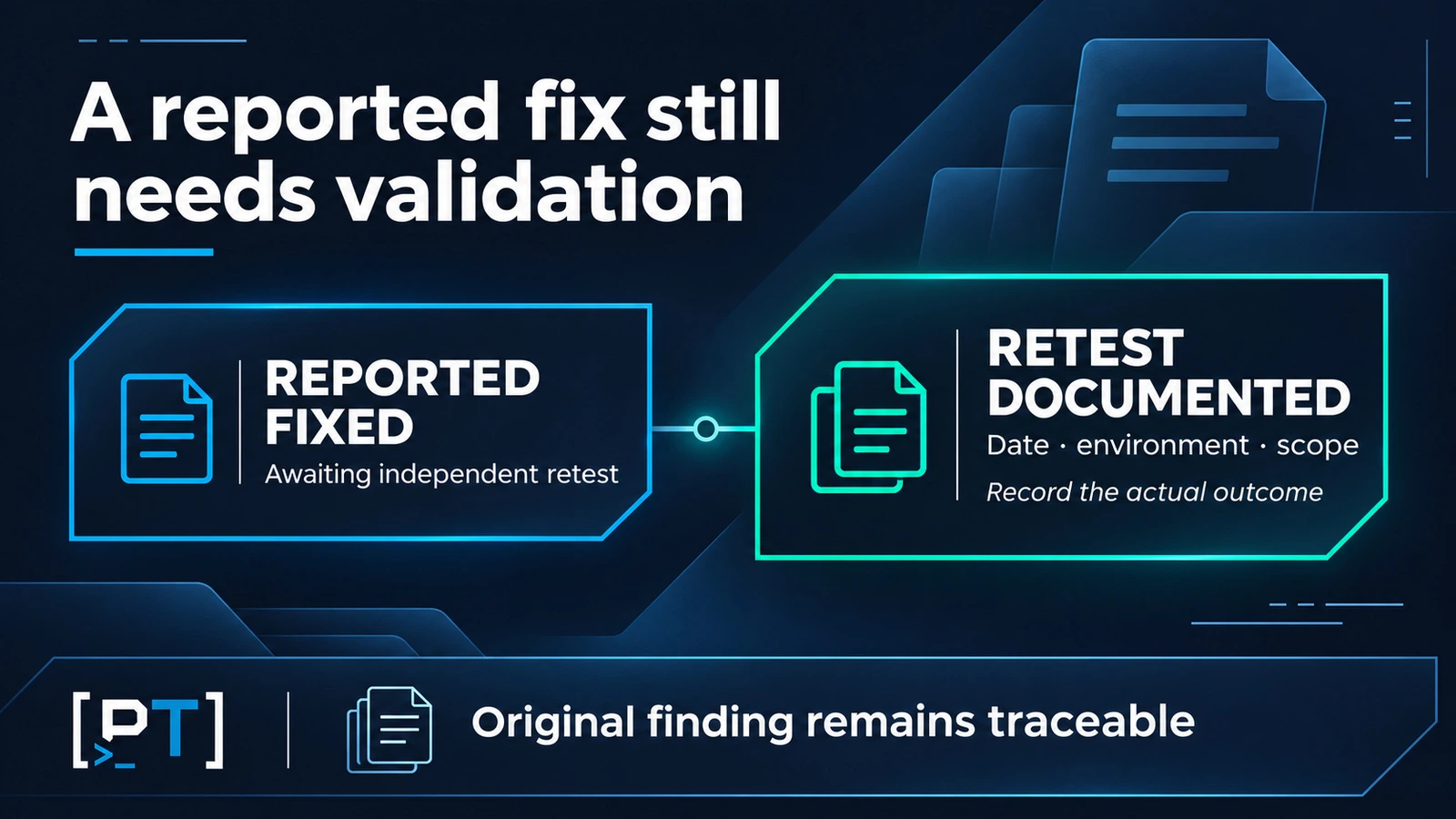
A targeted retest does not automatically reassess the whole product. If the tester revisited an authorization finding in one environment, do not summarize that work as confirmation that all production systems are secure. Similarly, a code merge, internal ticket closure, or changed configuration is evidence of implementation, not necessarily evidence that the original exposure is gone.
Where the status cannot be substantiated, obtain the underlying records before drafting a stronger claim. The remediation ownership plan helps teams organize responsibility and closure evidence. The distribution owner should then ensure that the customer extract accurately reflects those records.
Relevance also depends on change. A report can remain useful as historical evidence while failing to cover a newly introduced module, identity provider, or hosting arrangement. Explain consequential changes since testing and identify any additional validation needed. Avoid assigning a universal expiry date or presenting an old scope as current coverage simply because procurement accepts its calendar age.
Control access through the full distribution lifecycle
Approval to release a document should identify the specific version, recipients, purpose, channel, access period, download permissions, and onward-sharing conditions. A confidential label is useful context, but it does not control who opens the file or prevent forwarding.
Select a delivery method proportionate to the contents. A named-account portal may offer authentication, permissions, expiry, and access records. A controlled live review may suit a narrow question involving sensitive evidence. Confirm the chosen system actually provides the controls promised; viewing restrictions, logging, and revocation behave differently across services.
Restrict access to the intended reviewers and confirm whether contractors or another business unit require separate approval. An organization-wide email domain is not always an adequate boundary. Where a procurement platform requires upload, review who operates it, who can access submissions, applicable handling terms, and whether the upload matches the client's sharing permission.
A recipient watermark can identify the approved audience and discourage casual forwarding. It cannot stop screenshots, copying, or an authorized download being redistributed. Expiring a portal link removes future access through that link; it does not recall copies already obtained. Set expectations accordingly rather than promising technical control the channel cannot deliver.
Maintain a distribution register with the package identifier, source version, approver, recipients, release date, channel, expiry or review date, and subsequent corrections. If a material status changes, determine who needs an updated package. Mark superseded versions clearly and use the same contact route to communicate the correction.
Keep retention and preservation decisions separate from routine link expiry. Follow applicable obligations and agreed handling requirements when retaining or disposing of copies. If a disclosure error occurs, restrict further access where possible, preserve the relevant records, and escalate to the responsible security and privacy owners for assessment.
What leadership should decide before release
Leadership should approve an operating rule that makes routine reviews manageable and exceptional requests visible. The minimum sufficient package is the one that answers the buyer's legitimate question accurately, within the authority available. Sometimes that will be a summary. Sometimes it will require a restricted technical review.
Use an approval checklist with accountable owners
- Purpose: The review owner records the decision, requested assurance, deadline, and acceptable evidence format.
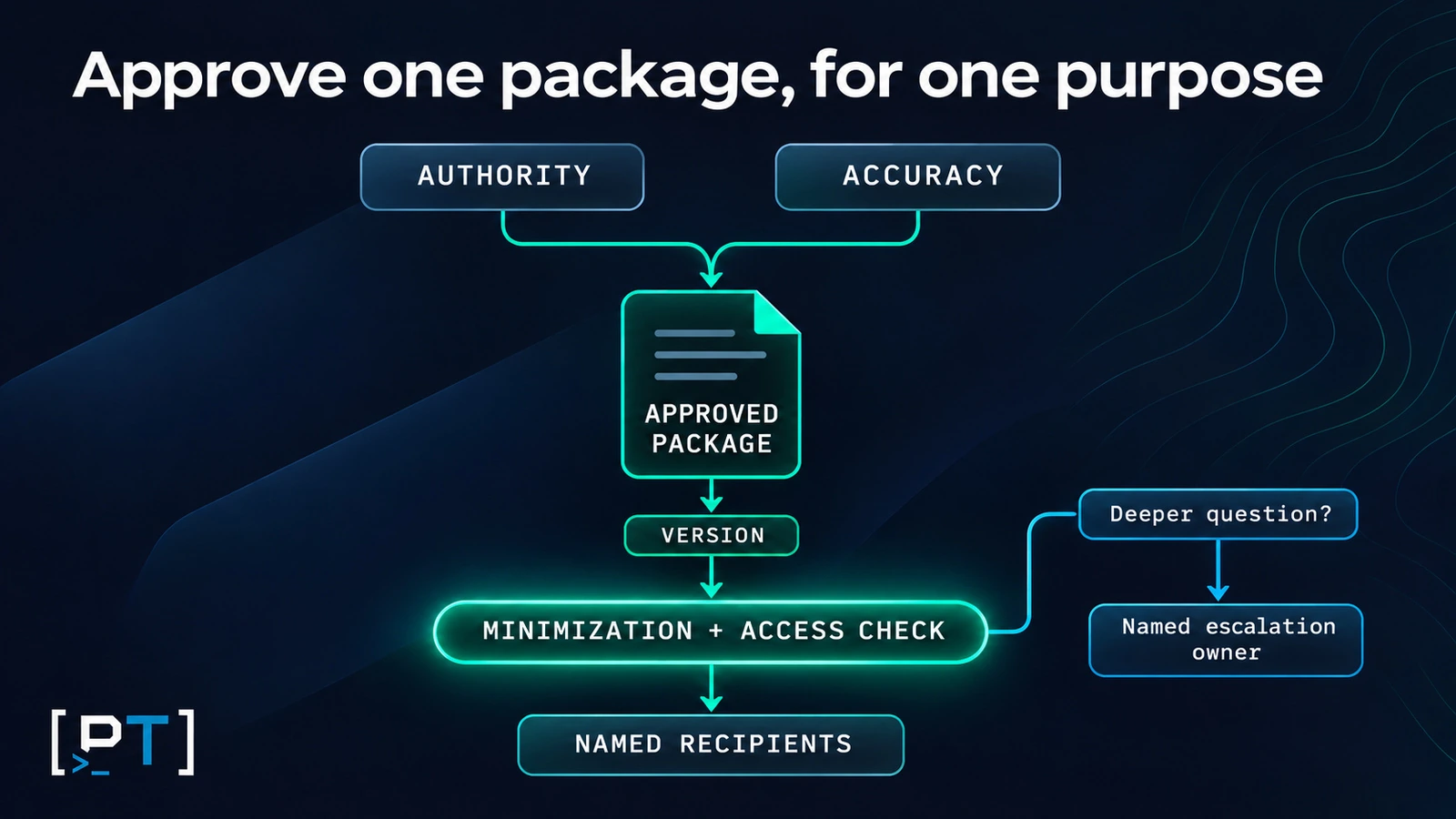
- Authority: The authorized client or report owner confirms the proposed recipients, use, and redistribution rights, with adviser input where needed.
- Accuracy: The technical reviewer confirms source version, scope, exclusions, material findings, current status, and retest limitations.
- Minimization: The confidentiality reviewer checks identifiers, screenshots, hidden content, and third-party information in the release file.
- Access: The distribution owner verifies the destination, permissions, handling conditions, expiry, and correction route.
- Escalation: A named decision-maker can authorize a focused appendix, assessor discussion, additional testing, or a documented refusal with an alternative.
Record the completed checks against a package version, rather than treating the checklist as blanket permission for future edits. The approval record should let another authorized colleague establish exactly what was released and why. It need not reproduce sensitive evidence in a second system.
Hypothetical scenario: the branded report request
An agency supports a SaaS client's enterprise sale. Procurement requests the full branded report; its security reviewer specifically needs evidence about privileged access and the status of a previously identified authorization issue. The source PDF also contains unrelated account references and infrastructure detail.
The client authorizes a customer-specific extract. It retains the role coverage, excluded support interface, original issue summary, and a status of reported fixed but awaiting independent retest. The agency removes unrelated identifiers and provides named access. A focused assessor discussion is offered for the privileged-access question.
The buyer then makes retest confirmation a condition of onboarding. That creates a concrete leadership choice: fund and schedule the required validation, negotiate an explicit conditional acceptance, or revise the onboarding date. Redaction has protected unnecessary detail without disguising an outstanding assurance gap. This is an illustrative scenario, not a claim about a completed engagement.
Connect the process to governance and budget
As an editorial application of NIST CSF 2.0, assigning release authority supports GV.RR-02, and defining a sharing policy supports GV.PO-01. Protecting stored packages and transfers aligns with PR.DS-01 and PR.DS-02. These are useful governance connections, not a prescribed report-sharing template.
NIST SP 800-115 provides an assessment-planning and data-handling reference. The official ISO/IEC 27001:2022 overview places information protection within risk-based management. Apply those themes to classification, handling, transfer, and ownership through your own policies. This matrix does not establish certification or resolve legal disclosure duties.
Budget separately for preparing evidence, investigating missing records, specialist review, and new validation. A standardized approved summary may reduce repeated handling, while a tailored extract takes additional review effort. Missing coverage or an unverified fix can require testing work rather than editing. Confirm ownership and scheduling with the provider before sales promises a customer deadline.
For the next enterprise review, approve the audience, claim, evidence boundary, and deeper-review route together. If you need a delivery partner to support those decisions, review white-label reporting and evidence-sharing needs with Pentest Testing Corp before committing the customer-facing package.
Frequently asked questions
What if procurement's upload form only accepts a full report?
Ask the review owner whether an approved extract or restricted review can meet the underlying requirement. Document any exception. If the full report is genuinely required, obtain authorization for that destination and audience before uploading it.
Can a customer send our extract to its external security consultant?
Check whether the consultant falls within the approved recipients and applicable confidentiality terms. If not, resolve that access request explicitly. Approval for the customer's employees should not be assumed to cover every external adviser.
Can we translate a redacted report for an overseas buyer?
Use an authorized translation process that protects the source material. Have a qualified reviewer check severity language, limitations, and status meanings. Identify the translated version and specify which source controls if wording differs.
Can we quote a conclusion from the extract in a sales presentation?
Obtain approval for the new audience and context. A sentence suitable for a confidential review may be misleading when separated from its scope or date. Public marketing use requires a separate publication decision.
Should the buyer be allowed to rely on an agency-branded report?
Reliance rights depend on the engagement terms and any agreed limitations. Branding alone does not create them. Route requests for a reliance letter or expanded permitted use to the authorized parties and appropriate advisers.
What should we do if two approved extracts show different statuses?
Compare both with the authoritative assessment and validation records. Issue a corrected, clearly versioned package through the approved channel and notify affected recipients. Record the discrepancy and correction rather than silently replacing the file.