AI Agent API Abuse Penetration Testing: Rate Limits and Cost Controls
A CTO is preparing to launch an agent that researches customer requests, queries internal APIs, and generates a finished report. The demonstration looks efficient. Finance asks what one customer can spend; engineering points to the API gateway's request limit. No one has established whether a single accepted request can trigger repeated model calls, parallel tool jobs, and retries that continue after the customer closes the browser. AI agent API abuse penetration testing should answer that question before the feature reaches production.
The exposure is practical: a workflow can remain within its visible request allowance while consuming more paid resources than the business intended. The trigger might be deliberate abuse, an external automated caller, or an agent handling an ordinary failure badly. For leadership, the decision is whether the product has enforceable spending and availability boundaries, supported by test evidence across the complete workflow. A cost dashboard alone cannot answer it.
Where agentic API abuse becomes a business exposure
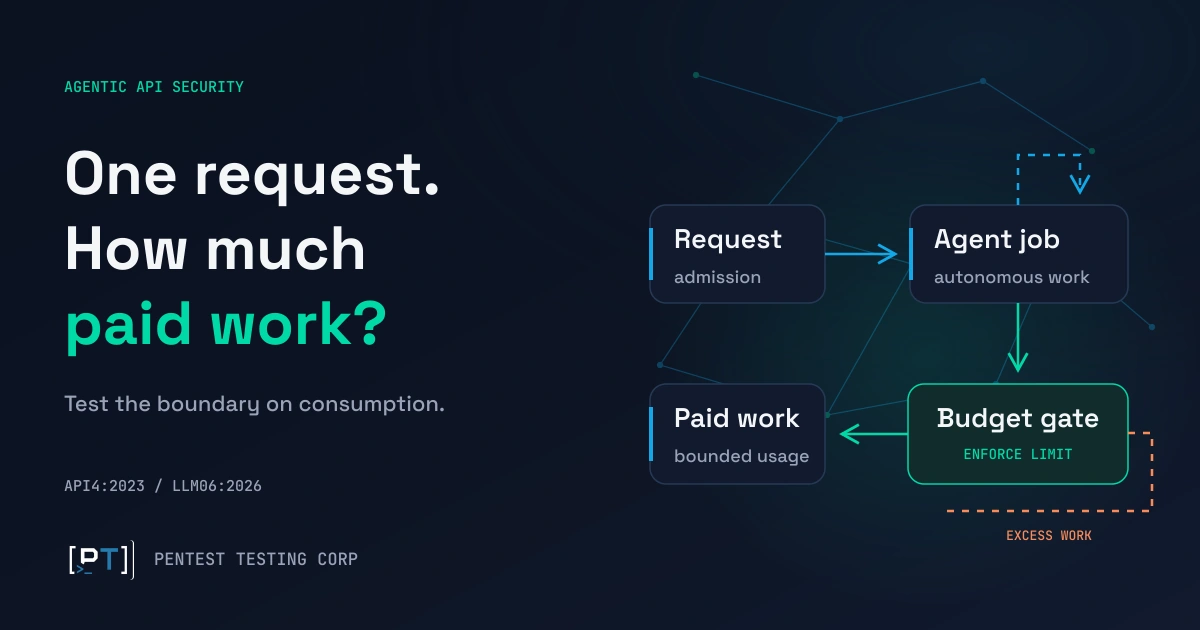
Agentic systems introduce two related consumption paths. First, your own agent can repeatedly call models, application APIs, and paid tools on a customer's behalf. Second, an external caller can automate requests against your exposed API, including an LLM-backed endpoint. The caller doesn't need an AI agent to create this risk; an agent just provides another way to automate activity. The controls must work regardless of the client's implementation.
The business consequence depends on who pays for each operation. A customer may consume prepaid credits while your company absorbs model inference, search, document processing, or infrastructure costs. If these meters use different units or update at different times, the customer's allowance may appear intact while your supplier bill grows.
Availability matters alongside spending. An expensive workflow can occupy workers, fill queues, or consume shared provider capacity needed by other customers. A tenant can remain inside its data permissions and still degrade service for everyone else. That is why multi-tenant SaaS authorization testing and consumption testing answer different buyer questions: who can access a resource, and how much work that permitted access can initiate.
OWASP's LLM10:2025 Unbounded Consumption identifies excessive inference as a source of financial loss and service disruption. Its API4:2023 Unrestricted Resource Consumption guidance also covers missing limits on execution, batches, and paid integrations. These are useful scope references, rather than proof that every AI product is vulnerable.
The purchase trigger is usually concrete: an agentic feature launch, an unexplained spend increase, a free-trial redesign, or a FinOps review that cannot attribute costly jobs. Leadership should commission testing when those questions cannot be resolved with existing evidence.
Why request limits and billing alerts can leave gaps
A request limit controls a defined unit at a defined boundary. It may count incoming HTTP requests, authenticated users, API keys, or network sources. It does not automatically measure the work created after admission. One accepted job can generate several model calls, retrieval operations, or paid tool actions without another request reaching the public gateway.
Cost-aware protection therefore needs several layers. Request limits control admission; resource limits constrain individual operations; workflow budgets bound the entire task; tenant quotas separate customers; concurrency controls protect shared capacity. Each layer needs an owner and a clear enforcement point.
| Control | What it helps establish | What testing must still prove |
|---|---|---|
| Gateway request limit | Incoming traffic is bounded for the chosen identity | Alternate application paths and accepted jobs cannot escape the intended allowance |
| Token or input/output cap | A model operation has a bounded size | Repeated operations, supported reasoning budgets, and tool work remain within a task budget |
| Tenant allowance | Consumption is assigned to a customer | Parallel jobs and multiple credentials share the same authoritative allowance |
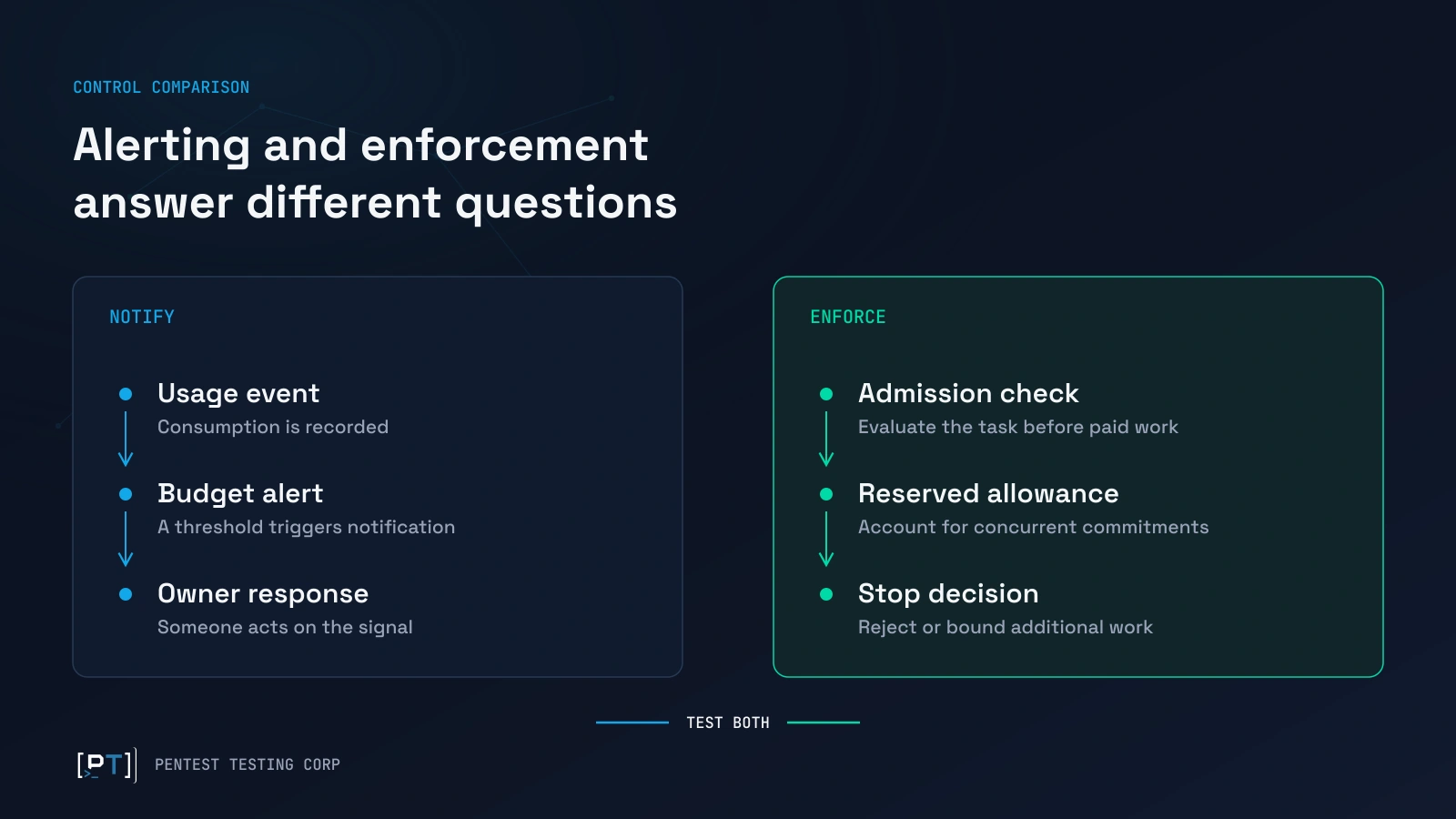
| Budget alert | An owner learns about a spending threshold | Notification arrives in time and has a tested response; any hard stop is separately verified |
| Cancellation or timeout | The visible task ends | Queued children, workers, retries, and provider operations stop or remain explicitly bounded |
| Provider quota | A supplier constrains some usage | One customer cannot exhaust shared capacity or shift work to another paid route |
Do not assume that a setting called a budget is a hard spending cap. Its behavior must be checked against the deployed provider, account configuration, and application enforcement. An alert, a rate quota, and a billing stop are different controls.
The identity used for metering also deserves scrutiny. Creating another key should not silently create another tenant allowance unless that is the deliberate commercial policy. Where credentials may be compromised, pair consumption testing with token lifecycle and revocation testing. A valid credential can carry both access rights and spending authority.
What AI agent API abuse penetration testing should cover
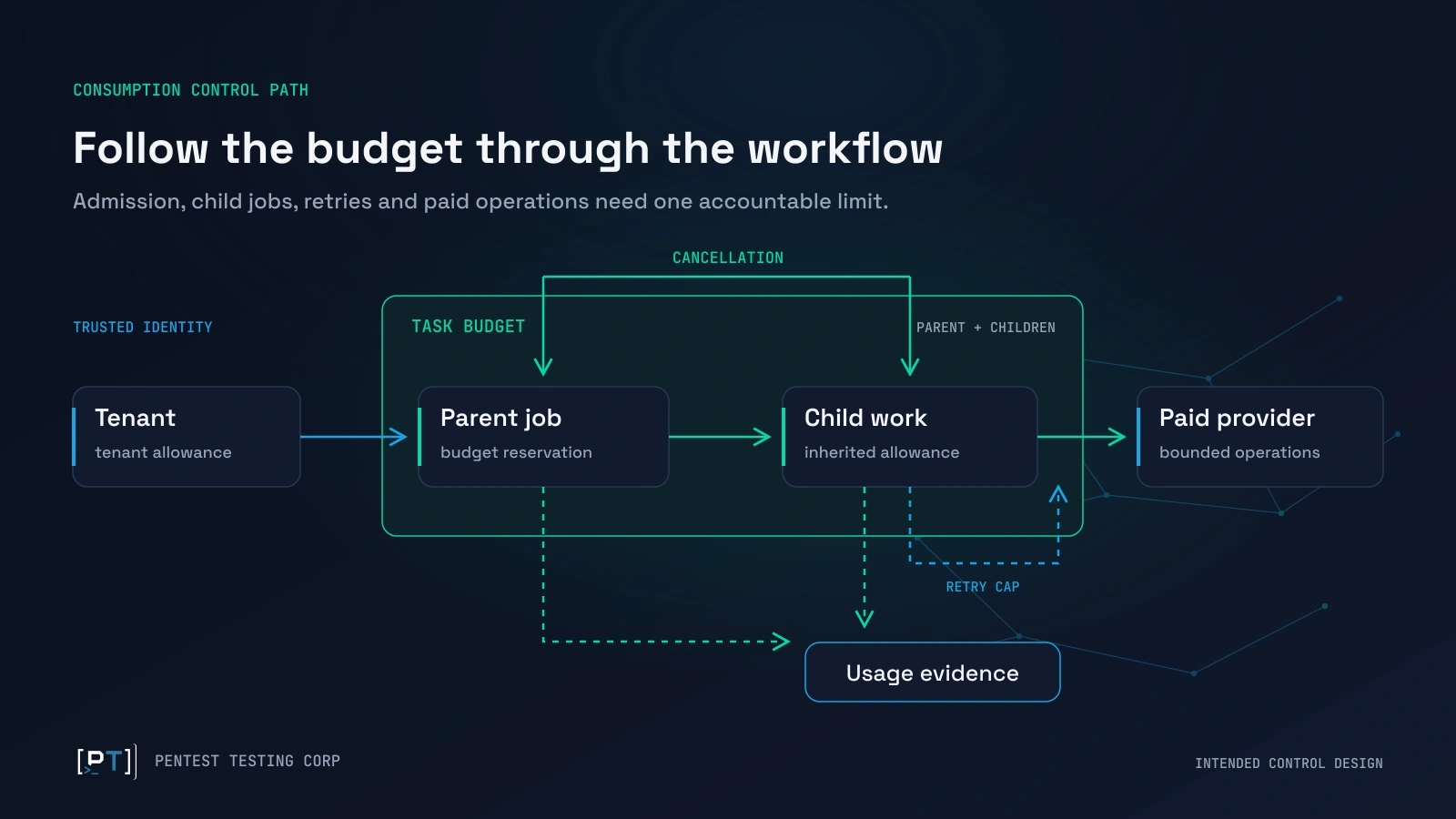
Start with a map from the user's initiating action to every material billable operation. Include model routing, orchestration, queues, workers, retrieval, connected tools, and the usage ledger. Record which identity owns each job, which budget applies, and where the system decides whether more work is allowed.
Pentest Testing Corp's API penetration testing services provide the primary engagement route for exposed APIs and abuse controls. Where model-mediated loops or tool choices materially affect consumption, explicitly include the relevant workflow through the AI penetration testing service. The statement of work should identify the overlap.
Scope the costly outcomes, not only the endpoint count
Prioritize jobs with variable input size, long generation, repeated retrieval, parallel actions, or paid external effects. Endpoint count remains useful for inventory, but a single orchestration entry point may carry more financial exposure than many simple read endpoints. The buyer should ask for coverage of distinct consumption decisions.
| Sanitized test scenario | Buyer question | Expected evidence |
|---|---|---|
| One request creates repeated agent iterations | Can one task continue spending beyond its approved scope? | Iteration, time, tool-call, and budget boundaries linked to the parent job |
| Several jobs start against the same allowance | Can concurrent admissions exceed remaining credit? | Reservation and reconciliation behavior under controlled concurrency |
| An expensive job is retried or redelivered | Does recovery duplicate paid work or business actions? | Retry accounting, duplicate suppression, and bounded completion records |
| A task is cancelled while children remain active | Does cancellation stop new spending? | Parent/child termination records and a measured residual-work bound |
| Fallback selects another model or provider | Does resilience preserve the original budget? | Routing decisions and allowance enforcement across the permitted alternatives |
| A free-tier tenant starts a costly workflow | Is entitlement enforced before paid work begins? | Server-side plan validation and resource-accounting decisions |
| One tenant approaches shared capacity limits | Can another tenant still complete normal work? | Controlled isolation checks and agreed availability measurements |
These scenarios define outcomes to validate, rather than instructions for overwhelming a system. The assessment should prove a control weakness with the smallest authorized workload that supports a defensible finding.
Where agents reach tools through MCP, use MCP security testing before production to establish the identity and tool boundary. Add consumption checks to that path: permission to invoke a tool does not establish how often it can run or how much its downstream action can cost.
Agree on a bounded test and a useful illustrative scenario
Resource-consumption testing requires precise rules of engagement. Approve the environment, accounts, permitted components, maximum concurrency, total test expenditure, operation counts, and stop conditions before active work. Identify the engineering contact who can stop processing and the finance contact who can confirm usage.
Prefer representative staging for most validation. Use reduced test budgets to exercise boundary conditions without purchasing a large amount of computation. Where necessary, combine controlled real calls with simulated provider responses, but report which results came from each method. A simulation cannot establish a provider's actual billing or cancellation behavior.
Third-party boundaries need separate attention. Authorization to test your application does not automatically authorize disruptive testing of a supplier. Exercise your own admission, orchestration, and accounting controls within agreed limits. Record untested provider behavior and production configuration differences as coverage limitations.
For retrieval-heavy workflows, RAG chatbot security testing addresses the retrieval layer's security. The cost-abuse extension should establish whether ingestion, retrieval breadth, reranking, and repeated generation remain within the customer's intended resource allowance.
Hypothetical scenario: the report that keeps generating
Consider a fictional SaaS research assistant. A customer's report request passes the gateway limit and starts a background job. The worker repeats searches and model calls when its output does not meet an internal completeness check. The customer sees a timeout and starts another report. The first job continues because browser cancellation never reaches the worker.
The consequence is duplicated paid work and delayed reports for other customers sharing the queue. There is no assumed data breach or unauthorized account access. The control failure is that approved user activity creates spending and processing beyond the intended task boundary.
A bounded assessment could demonstrate continued child-job activity after cancellation using a small test allowance and correlated records. The report would distinguish observed extra operations from any projected financial exposure. It would not claim a large production loss based on a short staging test.
Remediation may require a shared task budget, capped retries, cancellation propagation, and duplicate-job handling. Retesting should verify both that excess work stops and that legitimate customers can still complete normal reports. A fix that blocks all useful work is not an acceptable launch outcome.
Evidence, framework mapping, and financial impact
A buyer needs more than a screenshot of a rejected request. The evidence should show the initiating identity, tenant, parent job, relevant child operations, applied policy, and actual stopping point. Include configuration versions and timing so engineering can explain why the observed result occurred.
Use the framework edition consistently. OWASP now provides a 2026 LLM Top 10 guide. The 2025 references remain useful for existing procurement requirements, but their category numbers have changed in the 2026 edition. A report should name both the risk and the edition.
| Reference | Relevant scope | Buyer use |
|---|---|---|
| LLM10:2025 Unbounded Consumption; LLM06:2026 Unbounded Consumption | Excessive inference, cost amplification, and resource exhaustion | Track consumption findings against the edition in the assessment agreement |
| LLM06:2025 Excessive Agency; LLM03:2026 Excessive Agency | Excessive tool capability, permissions, or autonomous action | Assess whether delegated authority expands the consequences of uncontrolled work |
| API4:2023 Unrestricted Resource Consumption | Unbounded execution, operations, request sizes, and paid integrations | Connect agent workflows to established API abuse controls |
| NIST AI RMF 1.0 | GOVERN, MAP, MEASURE, and MANAGE | Assign ownership, map exposure, evaluate controls, and track treatment decisions |
The agency mapping applies where a workflow grants excessive capability or autonomy; an accounting defect alone should not automatically receive that classification. Likewise, prompt injection should be recorded only when instruction manipulation contributes to the demonstrated path. Cost abuse can occur without it.
The NIST AI RMF Core supplies a voluntary risk-management structure. Applying its functions here is a practical governance interpretation: security and finance agree on acceptable exposure, engineering maps billable paths, testing measures enforcement, and leadership records remediation or residual-risk acceptance. This does not establish certification or universal regulatory compliance.
Separate three financial quantities in the report: observed test consumption, estimated exposure under stated assumptions, and the business's accepted operating limit. Use actual contract rates supplied by the buyer, including applicable model units and paid tools. Clearly identify unknowns such as discounts, delayed billing, cached work, or provider-specific cancellation charges.
Ask for the pre-fix condition, remediation owner, residual exposure, and retest result alongside severity scoring. Pentest Testing Corp's sample penetration test reports help buyers inspect reporting structure. A sample illustrates report quality; it does not establish that this particular agentic cost-abuse scope was tested.
Scope, remediation effort, and engagement planning
The engagement effort follows architecture complexity and evidence access. A single synchronous model-backed endpoint with one tenant policy is easier to evaluate than a system with background workers, several providers, delegated agents, and shared paid integrations. A quote based only on the public URL can miss those differences.
Provide the assessor with the API specification, representative user and machine identities, plan entitlements, workflow map, configured limits, and redacted usage records. Supply at least two tenant contexts when shared capacity or allowance separation is in scope. Include the cancellation and incident procedures that operations actually uses.
Access to orchestration configuration and usage records can reduce ambiguity. A black-box assessment may identify suspicious amplification while being unable to establish exact supplier charges or internal stop behavior. Agree which evidence the buyer will provide, and describe any remaining uncertainty in the report.
Schedule around readiness milestones: scope approval, safe-environment preparation, baseline confirmation, controlled validation, reporting, remediation, and retest. Confirm calendar dates after the architecture review. Do not treat a general API testing timeline as a promise for a combined API, agent, billing, and queue assessment.
Remediation effort varies by control location. Adjusting an existing enforced limit may be relatively contained. Introducing shared budget reservations, cancellation across workers, or tenant-aware accounting can require broader engineering changes. Reserve capacity for that work before committing to a launch date.
The wider AI pentest scope checklist helps identify adjacent surfaces that may need separate coverage. Keep the consumption objective explicit so broader AI security work does not displace the financial and availability questions that triggered the engagement.
What leadership should decide before launch?
Security, engineering, product, and FinOps should approve one shared policy. Define acceptable consumption per operation, workflow, tenant, and organization; decide what happens when each boundary is reached. The policy must also explain whether high-value customer jobs receive reserved capacity or require approval for additional spending.
Decide the user experience at exhaustion. A partial result, a queued request, a controlled upgrade offer, or a clean rejection may be appropriate. Silent retries and unexplained timeouts obscure both customer expectations and operational response. Finance should understand which costs can remain after a stop and who accepts them.
AI agent API abuse penetration testing acceptance criteria
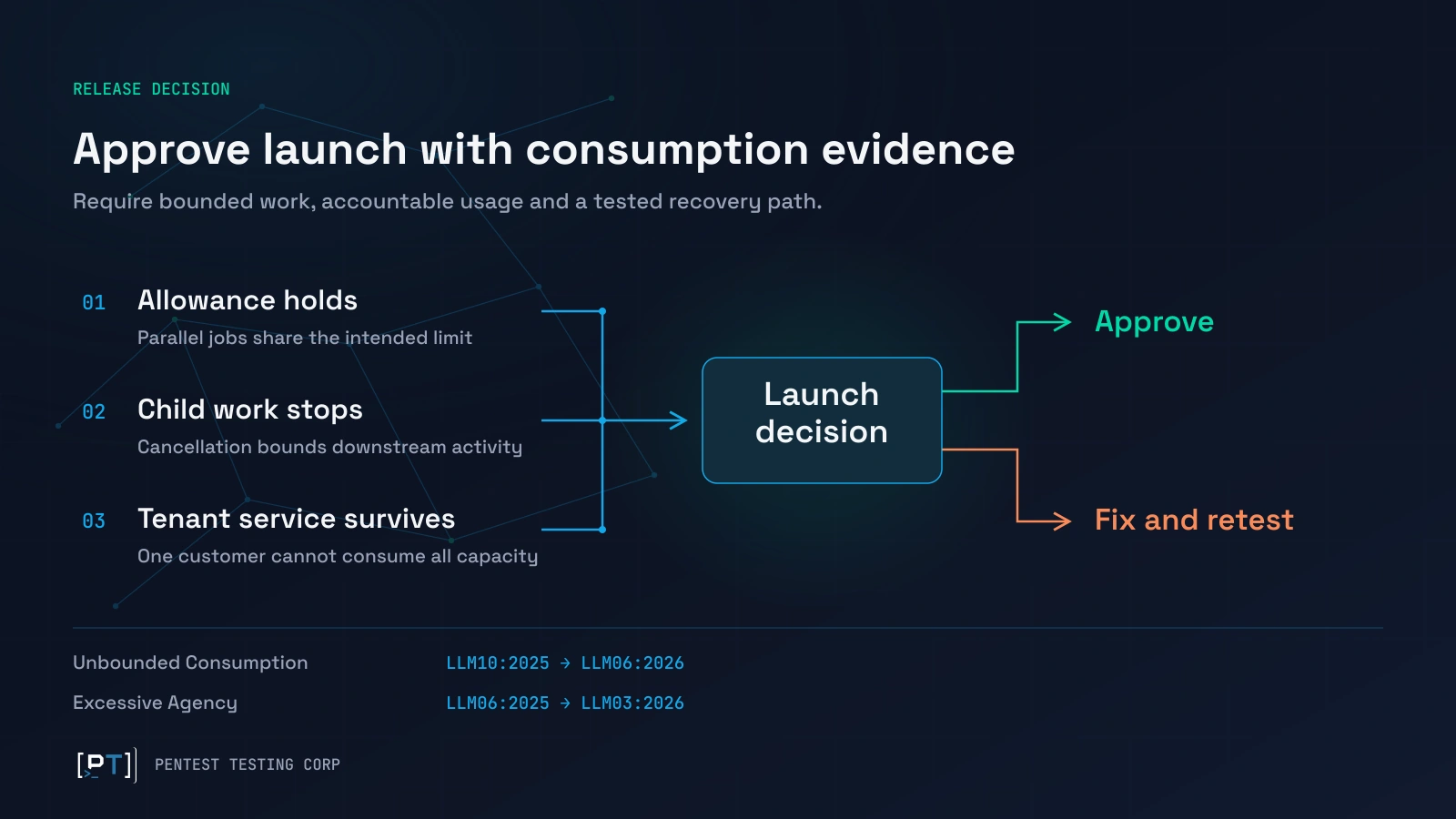
Make release approval depend on observable outcomes: tenant allowances survive parallel activity; task budgets follow child work; expensive operations require valid entitlement; and cancellation or failure cannot create unbounded new work. Document the configuration and environment to which that evidence applies.
AI agent API abuse penetration testing stop and recovery gates
Require a tested operator stop, an identified alert recipient, and a recovery path that restores legitimate service without replaying cancelled jobs. Where in-flight provider work cannot be cancelled, define a measured residual bound and record it in the risk decision. Assign a retest owner and deadline to every unresolved release-blocking finding.
Repeat focused validation when model routing, reasoning settings, tool access, retry policy, entitlements, or worker behavior changes. Those changes can alter consumption without changing the public API. Release evidence should follow the deployed workflow and control version.
Frequently asked questions
Should a small startup test cost abuse before it has enterprise customers?
Yes, when public or trial access can initiate paid work that exceeds the startup's acceptable loss. A focused assessment of the highest-cost workflow can support an early launch decision; a large enterprise-style scope is not automatically necessary.
Does bring-your-own-key remove our financial exposure?
It can shift some model charges to the customer, but your workers, storage, retrieval, and paid integrations may still incur costs. Customers also need clear expectations about the spending authority your agent receives over their key.
Can this assessment replace load testing?
No. Security testing examines whether controls can be bypassed or fail to bound work. Load testing measures expected capacity and performance under an agreed workload. Coordinate the two when shared-capacity behavior needs deeper validation.
What if our billing ledger updates after a job finishes?
Ask how the system prevents additional work from being admitted against an allowance already being consumed. Reservations or another enforceable admission mechanism may be needed. The assessment should evaluate the implemented design and its stated tolerance.
Should every cost-abuse finding receive a critical severity?
No. Severity depends on prerequisites, attainable consumption, enforceable boundaries, tenant impact, and recovery. A finding can have meaningful financial impact without supporting a critical technical rating. Record monetary assumptions separately from the scoring rationale.
Do we need to retain full prompts to prove consumption?
Not always. Correlation IDs, identity, policy decisions, model usage, and task events may supply the necessary evidence. Retain sensitive prompt content only where justified, with appropriate redaction, access controls, and retention limits.
Who should approve additional spending after a tenant reaches its limit?
Assign that authority to a defined product or account policy, with finance-approved ceilings and server-side enforcement. An agent should not grant itself a budget extension. Material overrides should leave an attributable decision record.