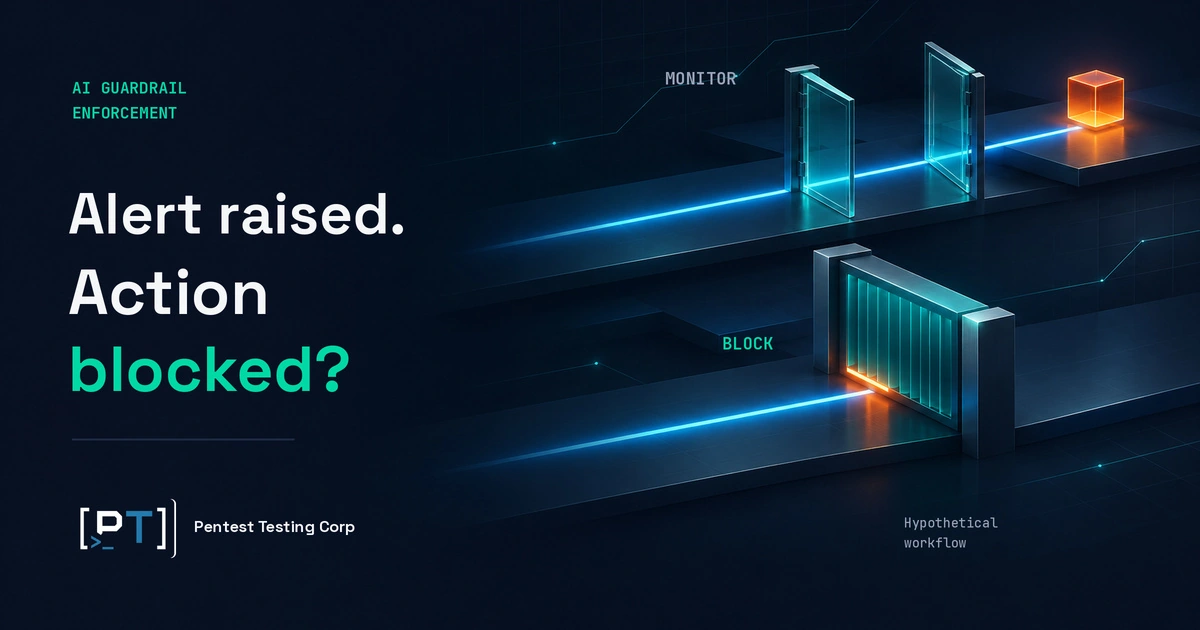
AI Guardrail Enforcement Testing: Prove What Blocks
In a hypothetical launch, a CTO is preparing to let a support agent export customer records and send follow-up messages. The guardrail dashboard shows a security violation during the acceptance demonstration. Procurement records the control as working. Later, operations checks the destination system and finds that the synthetic export completed. The detector recognized the test condition, but the selected policy allowed execution to continue.
AI guardrail enforcement testing establishes whether the configured runtime policy prevents the business effects your organization has agreed to prohibit. It connects the detector result, selected enforcement action, and downstream outcome before leadership approves a purchase or launch.
This distinction matters when a policy leaves monitor mode, a team adds autonomous tools, or a vendor demonstrates detection without proving prevention. The acceptance question is concrete: which operations must be denied, where must that denial occur, and what evidence will show that the sensitive action never occurred?
Why alert mode changes the launch decision
Monitor mode can serve a legitimate purpose. Teams can observe expected traffic, investigate false positives, and understand operational disruption before enabling blocking. The risk appears when stakeholders treat observation as prevention or leave consequential actions dependent on a future policy change that nobody owns.
Palo Alto Networks' November 2026 Prisma AIRS feature notes make the distinction explicit. Alert mode permits traffic while logging a violation; block mode stops traffic. The documented scan response can combine a malicious verdict with an allow action in alert mode. The page gives a month rather than an exact release day. These are product-specific semantics, so buyers should verify the equivalent behavior in their selected product and integration.
Separately, Microsoft's October 19, 2026 discussion of agent supervision emphasizes controls over agent actions before they happen and protection across multiple infrastructure layers. That announcement describes an approach to control; it does not prove operating effectiveness for your deployment.
The buyer implication is an acceptance requirement: establish what your deployed policy actually stops. Put detector decisions, application handling, tool permissions, and destination records into the AI penetration testing scope. A purchasing specification that requests only prompt detection can leave the execution boundary outside the assessment.
A delayed alert may support investigation after a sensitive action. It cannot provide preventive assurance for an action already completed. Leadership should therefore decide where monitoring is acceptable and where independent authorization or a pre-execution block is required before expanding autonomy.
Define the action policy for AI guardrail enforcement testing
Start with business effects rather than a list of detector names. An assistant that drafts text, one that sends messages, and one that changes financial records need different acceptance rules even if they share a model and guardrail supplier. The operating policy should name the action, eligible requester, permitted resource, approval requirement, and forbidden consequence.
For example, an internal support assistant may summarize approved documentation, prepare a customer reply, and propose an account change. Sending that reply or committing the change may require separate authority. A content filter can help identify concerning material, but it cannot substitute for checking who is permitted to operate on the particular customer account.
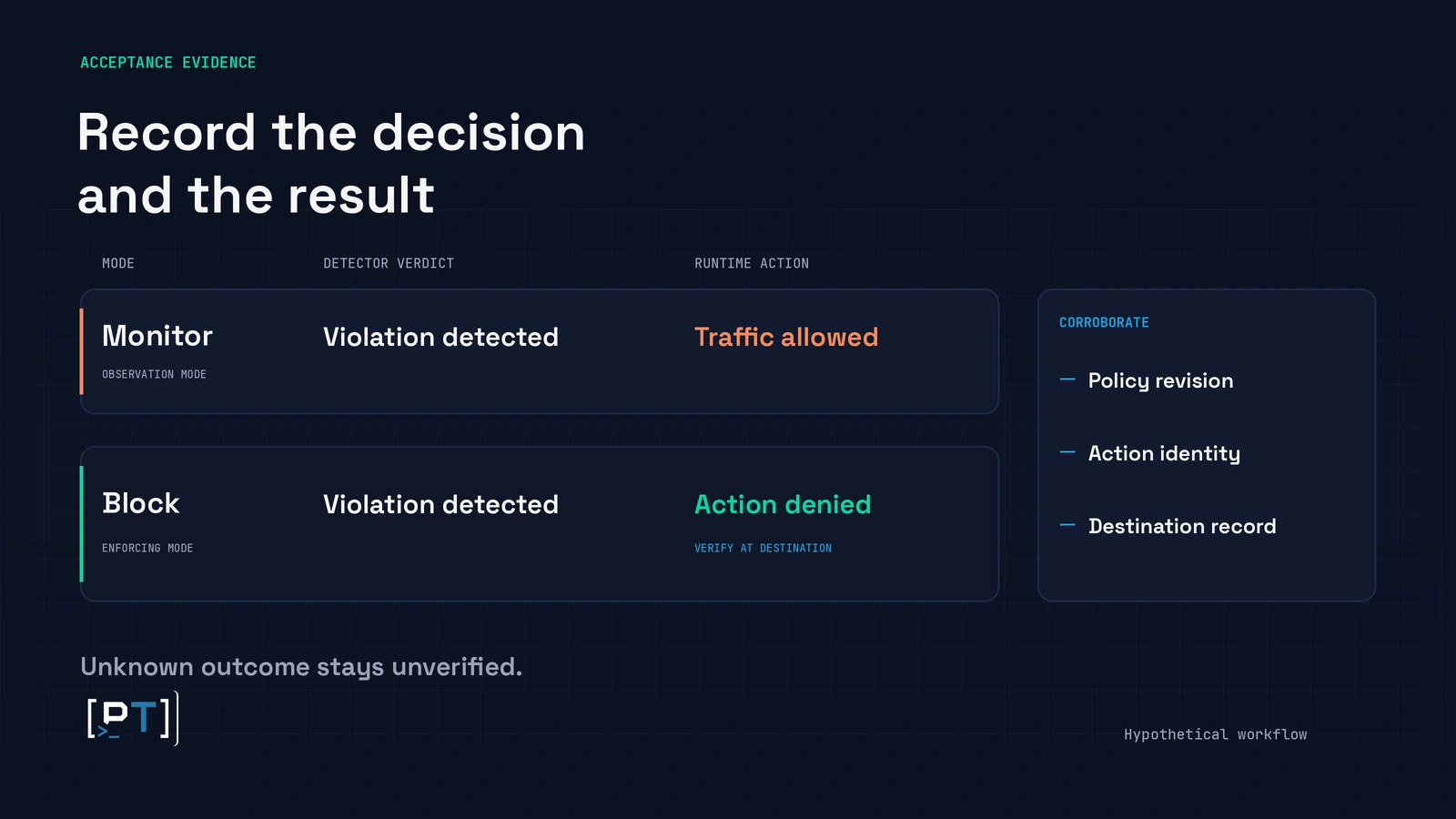
Separate three records in every material test result. The verdict describes what a detector classified. The configured action describes what the selected policy instructs the system to do. The observed outcome describes what happened in the application and destination system. A correct verdict with the wrong configured action needs different remediation from an ignored block response.
Be precise about policy language. “Block sensitive output” might mean preventing model generation, withholding the response from the user, preventing an external send, or stopping a record export. These are different boundaries. Define the protected effect and the latest point at which intervention remains useful. Once information reaches an unauthorized recipient, suppressing a later answer cannot undo that disclosure.
Also distinguish detection coverage from enforcement coverage. A controlled case that reliably triggers a detector can help establish whether its block decision is honored. It does not establish that the detector recognizes every harmful input. Both questions matter, but they need separate evidence and conclusions. Our guide to what AI-specific prompt-injection testing covers explains the broader behavioral assessment.
Ask procurement to put these distinctions into the acceptance wording. Require a named deployment, effective policy revision, supported integration mode, and evidence for the agreed action classes. A demonstration in the supplier's environment may establish capability. Your acceptance decision should address the customer configuration and dependencies you will operate.
Build an AI guardrail enforcement testing acceptance matrix
An alert-to-block acceptance matrix turns policy intent into reviewable outcomes. Agree on it before testing so teams do not redefine success when a release deadline approaches. The examples below are suggested criteria for a synthetic assessment, not results from a client engagement or universal vendor behavior.
| Action class | Approved policy | Required observation | Acceptance evidence |
|---|---|---|---|
| Low-impact classification | Monitor permitted for a bounded pilot | Test traffic continues and the alert reaches its owner | Effective mode, correlated event, triage record, pilot restrictions |
| Restricted data export | Deny before transfer to an unapproved destination | Transfer is prevented at the protected boundary | Policy decision, gateway or tool denial, controlled destination evidence |
| Customer-record modification | Require resource authorization and any specified approval | Unapproved change cannot commit; authorized comparison succeeds | Requester and resource context, approval status, destination audit result |
| Outbound customer message | Permit drafting; gate sending | Draft remains available; unapproved dispatch is denied | Draft state, send decision, controlled recipient and dispatch records |
| Fallback or queued execution | Maintain the same action restriction | Alternate route or later worker cannot complete the prohibited effect | Route, worker, policy revision, final job disposition, destination result |
| Legitimate business operation | Allow within the approved boundary | Representative authorized work completes under the enforced policy | Successful control case, business-quality review, measured service impact |
Record results as demonstrated pass, demonstrated failure, or unverified, with accepted exceptions tracked separately. Missing destination access is an evidence limitation. A timeout, empty screen, or absent alert does not establish that an operation was denied. Where the final state remains unknown, keep the approval claim correspondingly narrow.
There are also two kinds of success to distinguish. The guardrail may correctly enforce its own policy, while the overall workflow still lacks necessary authorization. Conversely, downstream permissions may stop an operation even though the guardrail integration ignores a block. Record which control caused the denial so remediation and supplier acceptance remain accurate.
A runtime boundary can reduce reachable resources while leaving approved tools powerful enough to create an unacceptable effect. The companion guide to agent runtime containment boundaries addresses that infrastructure scope. Use both assessments where relevant, with distinct acceptance claims.
Follow enforcement through tools, queues, and fallback routes
Enforcement coverage depends on the paths capable of creating the protected effect. Include the ordinary agent workflow, direct tool dispatch, background workers, supported retries, and alternative model routes where they exist. The objective is to identify material differences in authority and policy handling, rather than count every prompt as a separate business boundary.
An asynchronous scan deserves particular attention. If work is allowed to continue before the verdict arrives, a later malicious classification may have no preventive effect on that operation. Ask the supplier whether the integration waits for a decision, which actions are held, and what a blocked result cancels. Measure the actual sequence against the point of commitment.
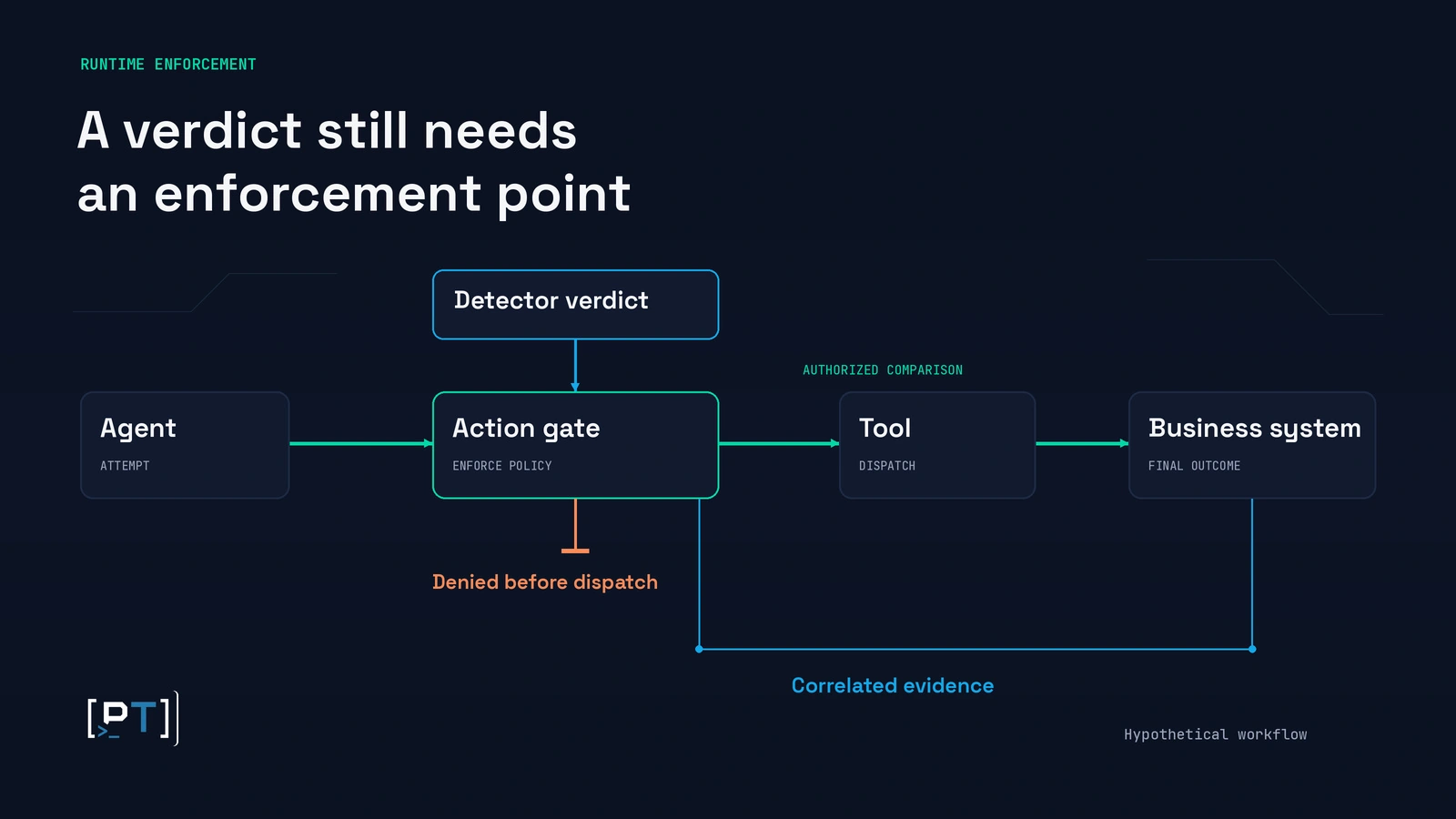
Streaming creates a similar distinction. A final block can stop remaining output while earlier content has already reached a user or another component. Define whether the requirement concerns complete responses, partial disclosure, tool execution, or all three. Procurement should avoid accepting “response blocked” as proof of a stronger disclosure claim than the integration can support.
Approval gates must cover the actual operation. A person approving a draft does not necessarily authorize a different recipient, a larger export, or a subsequent account change. The assessment should establish whether the approved action and resource remain the same when execution occurs. If they change, the workflow needs the required fresh authorization.
Policy changes also create a transition question. Decide which revision governs work accepted under an earlier configuration and executed after blocking is enabled. High-impact pending operations may need renewed eligibility checks. Record the cutover rule explicitly instead of assuming that changing the visible setting updates every worker and queued task immediately.
Where another provider or model can take over, confirm that the protected effect remains gated through that route. Use security acceptance for AI provider failover for the wider supplier, destination, and recovery decision. This article focuses on whether the selected enforcement policy survives those execution differences.
Finally, specify behavior when a guardrail decision is unavailable. A service error is different from a valid alert-mode allow result. Keep failure-state acceptance as a separate matrix condition, with explicit handling for consequential actions. Neither availability pressure nor the word “guardrail” determines the correct business policy.
Hypothetical scenario: the alert fires and the export completes
Hypothetical scenario, not a client case study. A SaaS company introduces an agent that prepares customer-success reports. Its pilot permits internal analysis, while external exports require approval. The team enables a detector for restricted content and chooses monitor mode to evaluate disruption before changing the production policy.
During an authorized rehearsal using synthetic records and a controlled destination, a test condition generates a violation. The agent still submits an export through an approved integration. The destination receives the synthetic file. The dashboard contains an accurate detection event, but it does not establish prevention.
The first finding concerns operating intent: the team wanted to observe traffic but had not agreed whether autonomous export was acceptable during that observation period. The second concerns action authority: the export integration did not independently require the approval specified by the business. These need separate owners and corrective actions.
The company restricts the pilot to internal drafting while engineering adds enforceable export approval. Security then validates the selected blocking configuration and the downstream gate, including a permitted export for comparison. Acceptance requires correlated policy and destination evidence. A changed setting or a model refusal alone cannot close both findings.
The release decision can now be specific. Internal drafting may proceed under the approved pilot restrictions; autonomous external export remains disabled until the necessary controls pass. If urgent cessation is part of the operating plan, separately assess verifying agent shutdown across connected systems. Stopping future execution and investigating an export already completed are different responsibilities.
Scope evidence, remediation effort, and framework mapping
A useful scope inventory identifies business workflows, action classes, roles, tenants, tools, routing options, guardrail placement, and available evidence. Provide the selected product and integration versions, effective policies, exception list, and policy-change permissions. Include the owners of connected applications so the assessor can distinguish a guardrail decision from a destination authorization result.
Evidence should connect the attempted effect to the deployed control. Retain a test identifier, effective requester or service identity, relevant resource context, route, policy revision, detector verdict, configured action, enforcement response, and final business outcome. Use synchronized timestamps and stable correlation where available. Preserve representative allowed operations alongside denied cases.
Do not use a single missing log entry as proof of non-execution. Establish visibility, expected recording behavior, and the observation window. Stronger evidence can combine a specific denial with a controlled destination record and checks for delayed work. Report exactly which systems were observed and which supplier internals remained inaccessible.
Protect the evidence itself. Synthetic records can demonstrate enforcement without distributing customer content. Where operational logs contain prompts, identifiers, or confidential output, agree on access, redaction, retention, and deletion. A procurement report usually needs enough detail to assess the control and remediation, rather than unrestricted copies of every conversation.
Assessment effort grows with materially different policies and execution paths, the number of consequential integrations, and the difficulty of observing final outcomes. A single synchronous integration is narrower than delegated workers with multiple routes and custom approval logic. Group truly equivalent paths only where the shared enforcement and configuration can be demonstrated.
Remediation may be a policy correction, an integration fix, or application redesign. Selecting block instead of alert can be straightforward, but honoring block decisions across workers may require engineering and regression testing. An excessive service-account permission may require a narrower identity or destination-side authorization. Obtain a scope-based estimate after those dependencies are understood.
Schedule scope agreement, environment readiness, baseline observation, controlled validation, reporting, remediation, and retest. These are planning phases, not a fixed delivery promise. Evidence access and supplier support can govern the calendar as much as test execution. Include business owners when assessing false positives and interrupted legitimate work.
OWASP LLM01:2025 Prompt Injection applies where untrusted input influences behavior. LLM06:2025 Excessive Agency applies where excessive functionality, permissions, or autonomy enables harmful actions. The mapping depends on demonstrated causes and consequences; an intentional monitor setting alone is not automatically either vulnerability. These mappings use the 2025 edition, with the year retained for report comparisons. OWASP also publishes a 2026 LLM Top 10 resource; retain edition labels when comparing reports.
The NIST AI RMF Core provides a voluntary structure. MEASURE 2.3 supports evaluation under deployment-like conditions; MEASURE 2.7 addresses security and resilience evaluation. MANAGE 1.1 concerns whether deployment should proceed, while MANAGE 4.1 addresses monitoring and change management. Applying those outcomes here means recording evidence, limitations, treatment owners, and launch decisions.
The OWASP Agent Control Standard is supplemental implementation guidance for runtime action control and auditability. Its terminology can help frame supplier questions about where decisions are enforced. Neither a framework mapping nor support for a control specification demonstrates that a particular deployment passed acceptance.
What leadership should decide before rollout
Approve the operating policy by action class. State which operations may remain in monitor mode, which require observed blocking, and which must retain independent authorization or human approval. Give each exception a business owner, permitted use, expiry, and measurable exit condition. A general statement that “security approved the guardrail” is too broad to operate.
Use three release outcomes. Approve the tested workflow where required controls and legitimate work meet acceptance criteria. Restrict deployment to a narrower, demonstrably supported capability where unresolved issues remain. Hold consequential automation where prohibited effects are possible or material evidence is unavailable. The business risk owner should accept residual exposure explicitly.
Assign practical responsibilities. Security owns the assessment conclusion and evidence gaps; platform engineering owns policy deployment and enforcement integration; application owners own destination permissions and action gates. Procurement secures relevant supplier commitments and evidence access. The workflow owner decides whether reduced functionality remains commercially useful.
Set focused retest triggers: changed detector actions or exceptions, a different integration mode, new tools, broader identities, altered routing, worker changes, or a revised approval gate. Retain the tested revision with the release record. A passing assessment describes the tested configuration and conditions, and needs review when those conditions materially change.
Before enabling high-impact automation, scope a guardrail and downstream enforcement assessment around your action inventory, proposed alert-to-block matrix, and available destination records. Ask for an acceptance conclusion that states what was blocked, what remained permitted, and what leadership still needs to resolve.
Frequently asked questions
Can we compare two guardrail suppliers using the same assessment?
Yes, if both face the same business acceptance criteria and representative integrations. Record differences in deployment mode, supported controls, evidence access, and required application work. Compare the achievable operating outcome and total implementation effort, rather than detector scores alone.
Who should approve temporary monitor-mode exceptions?
The accountable business risk owner should approve the exposure, informed by security and the workflow owner. Operations should confirm that restrictions and alert handling are workable. An administrator's ability to change a setting does not by itself establish authority to accept the resulting risk.
What should we do if the supplier will not expose detailed logs?
Agree on alternative evidence, such as redacted event exports, witnessed validation, controlled destination records, or an appropriate independent assessment. Describe the remaining visibility limit. Where the missing evidence is essential to a consequential action, narrow the deployment or defer that capability.
Should multilingual customer workflows be included?
Include representative languages and document formats when they are material to the deployed workflow. They can affect detection performance and legitimate service quality. Retain separate conclusions for recognition coverage and enforcement handling so one successful language case does not imply universal protection.
Does every policy adjustment require a full penetration test?
No. Use a change-impact review to select focused regression and enforcement checks. Broader changes to authority, routing, integrations, or architecture may justify a larger assessment. Document why the selected scope remains representative and identify the earlier evidence it relies on.
How should customer security questionnaires describe the result?
State the assessed workflows, deployment and policy revisions, date, material limitations, and remediation status. Distinguish detection evaluation from verified prevention. Avoid claiming that all AI risks are covered or that a guardrail guarantees compliance because a bounded acceptance exercise passed.