RAG Permission Sync Security Testing After Role Changes
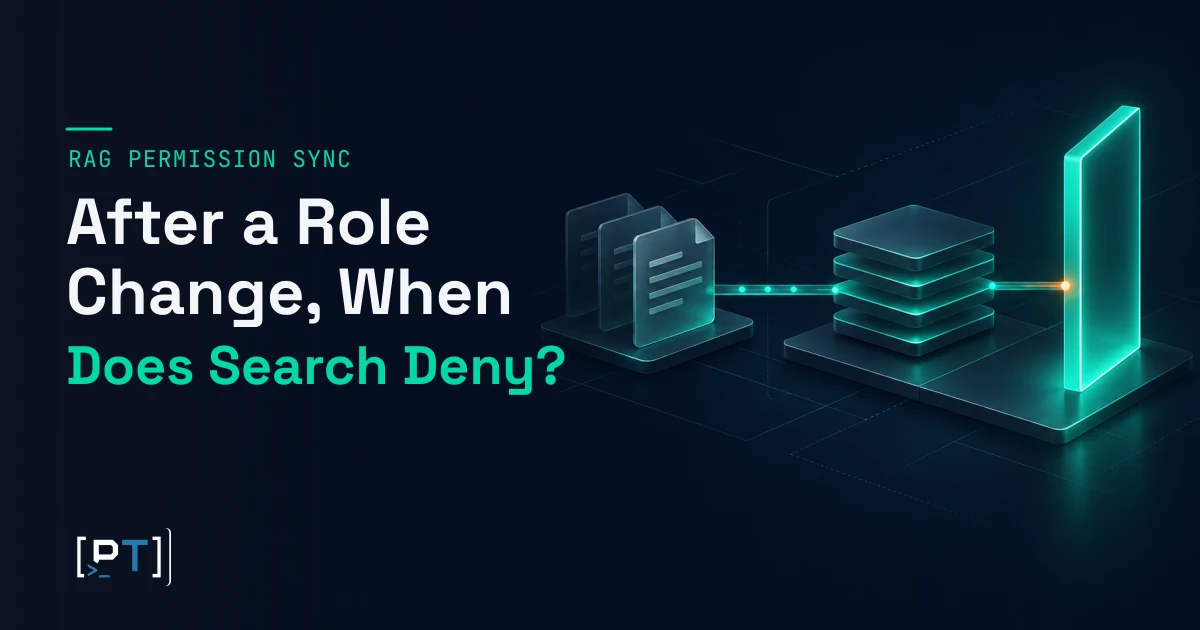
On Monday morning, an enterprise search owner removes a project lead from a group that can read commercial forecasts. The repository now denies access. Minutes later, the search assistant still cites a forecast excerpt in a newly generated answer. In this hypothetical rollout, the release owner needs to know whether the connector missed the change, the index is still using an old access rule, or retrieval evaluated outdated group membership.
RAG permission sync security testing measures when a permission change takes effect across the deployed retrieval system. It gives leadership a basis for approving a maximum access revocation window, deciding what the assistant should do during a sync failure, and asking for evidence that the user who lost access is denied while an authorized colleague can still work. This matters whenever a launch adds a knowledge source, moves documents, or changes how groups and roles are synchronized.
Scope RAG permission sync security testing
Retrieval-augmented generation (RAG) lets an assistant draw on material from connected repositories. A connector may copy document text and access-control lists (ACLs), which describe who can open the documents, into a search index. Some designs consult an identity service at request time. Others rely on permission data already written to the index. The source system determines access under the policy you intended to preserve. Your release decision depends on when that policy is enforced wherever the assistant actually reads.
A document-level ACL change and a group membership change can take different routes. If a document stops granting access to a group, the affected permission record may need to reach each active index or search path. If a user leaves an authorized group, the document ACL may stay the same. The decision then depends on when the retriever receives current membership, including any relevant session or token state. An inherited change can involve many records at once. A connector that reliably refreshes one directly edited document may behave differently when a folder’s audience narrows.
Ask the platform owner to identify the authoritative source for each event, the components that copy or resolve permissions, and the query paths that use them. Include index replicas, alternate routes and an index being swapped into production where those paths can serve users. A green sync indicator reports whatever that job is configured to track. Find out whether it tracks permission updates, which records it covered and whether the updated state was available to the production query path.
Microsoft documents permission ingestion and query-time enforcement separately for Azure AI Search. Its SharePoint guidance also identifies scenarios with different permission refresh requirements. Treat this as a reason to check the actual connector, deployment version and ACL change types in your rollout. A feature description gives you a supported configuration to verify, while your own evidence establishes how long revocation takes in that configuration. See Microsoft’s SharePoint permission ingestion guide and query-time enforcement documentation.
When a new integration moves sensitive repositories into scope, include the source-to-retrieval boundary in the AI penetration testing services engagement brief. The broader RAG chatbot security testing guide covers related retrieval and ingestion risks that can be scoped alongside permission changes.
Define the access revocation window
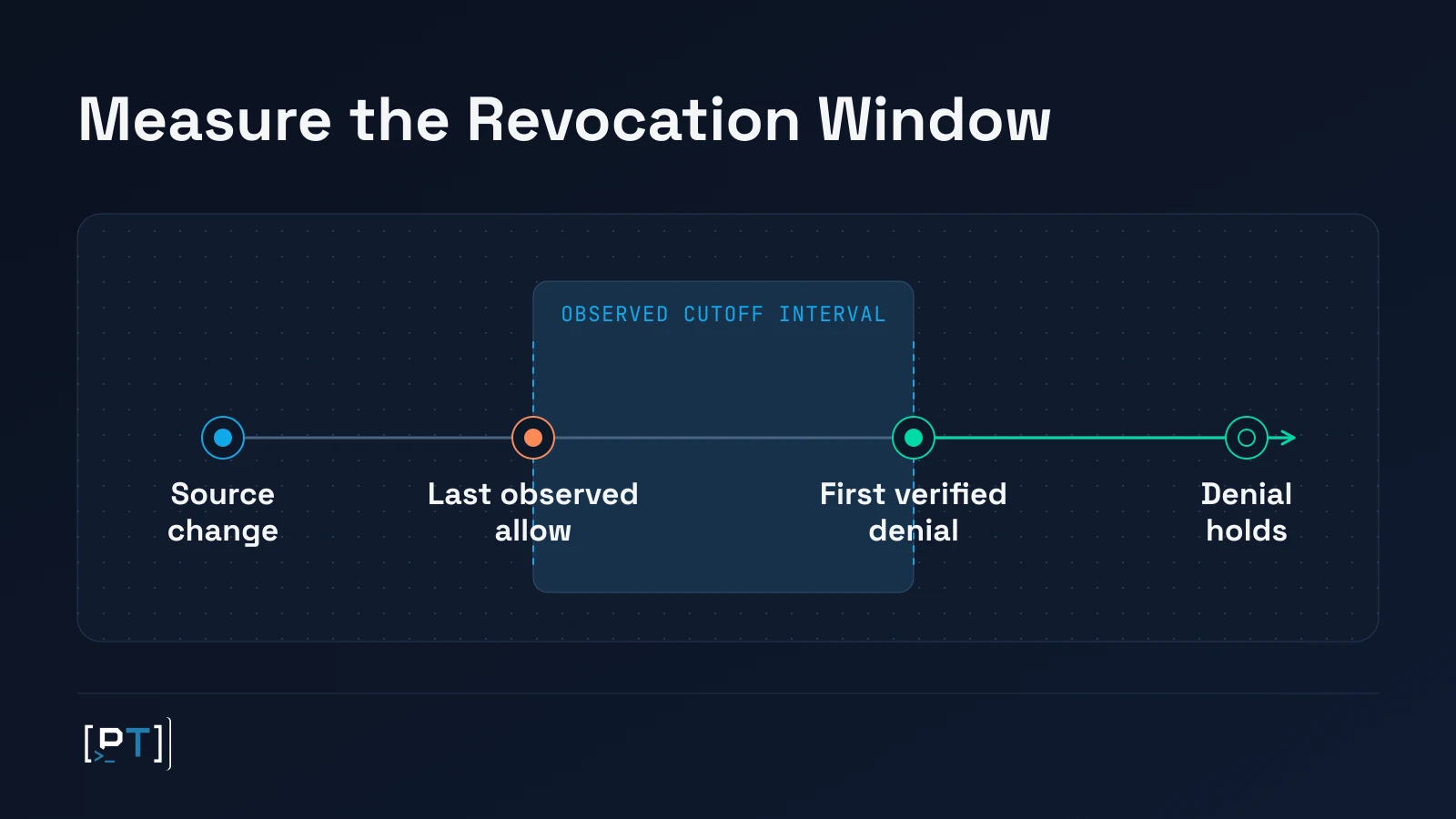
Start the clock when the authoritative permission or membership change takes effect. Use the source event or an equivalent timestamped record and confirm the expected denial at the source for the affected identity. A ticket creation time, a sync job’s scheduled start and the time an administrator clicked Save may describe different events. Agree on the authoritative timestamp before testing so the business can compare results across connectors and releases.
End the measured interval when fresh retrieval has demonstrably excluded the protected material on every agreed serving path for that identity. The last observed allow and first verified denial bound the observed cutoff. Continued denial through the agreed observation period and relevant recovery events shows whether the change held. Record the last observed allow, the first observed denial and the observation cadence for each path. If several routes are in scope, use the latest observed cutoff among them when evaluating the tested window. Correlate timestamps and state versions so the team can interpret the sequence confidently.
For example, suppose a source change took effect at 10:00. The last recorded allow on a serving path was 10:06 and the first verified denial was 10:09, with denial sustained for the agreed observation period. Report that cutoff as observed between 10:06 and 10:09. If the approved deadline was 10:07, the test leaves a gap around the deadline. A documented denial by 10:07 or a tighter observation interval would resolve it. The sample times illustrate measurement uncertainty. Choose actual thresholds by data class and workflow.
Agree whether restricted requests may continue for any interval after the source change. A project wiki may tolerate a brief delay while a sensitive transaction room may need immediate containment through a current authority check or temporary suspension of affected retrieval. Include emergency revocation if customers or internal policy expect a faster path than routine role changes. Confirm that operations can use that path outside a planned release window and can demonstrate when it took effect.
RAG permission sync security testing evidence
Use representative synthetic documents and approved test identities whose access history is known. Keep a previously authorized identity that loses access, an identity that remains authorized, and a never-authorized comparison where useful. First establish that the permitted identity can retrieve the selected material and that the affected identity’s initial access matches the test setup. After the change, the still-authorized identity provides a check that search continues to work and that a missing result for the affected identity is meaningful.
Ask for route evidence that the request performed fresh retrieval and proceeded through the new generation path. Useful records include a correlated request ID, the caller’s effective permission state, the serving path and index or policy version, and a sanitized record of what the retriever admitted or denied. Verify which document references reached model context and what the application returned, including excerpts and citations. Where possible, record decisions and document markers in place of sensitive content. A bland answer, a different wording or an empty result alone leaves the cause unclear.
Use a new conversation where context carryover could influence the result. Require evidence that the application didn’t reuse a completed answer and that the active retrieval route used the intended identity. A new chat window alone cannot establish either condition. If a tool performs retrieval on behalf of the assistant, confirm that the user’s effective permissions govern its read. Where visual or text responses include preview cards, links, counts or metadata that reveal restricted material, include the relevant surfaces in the acceptance criteria.
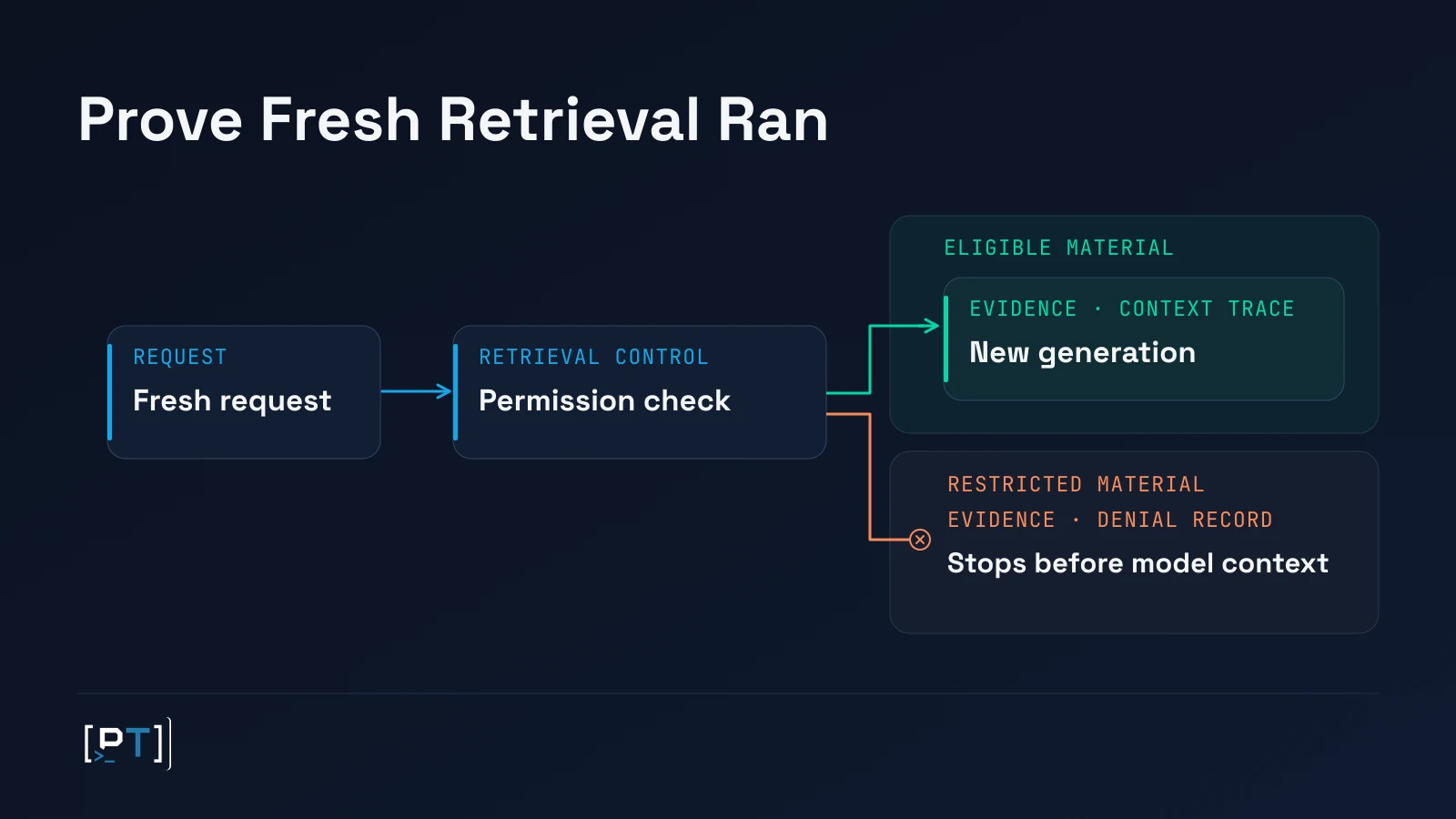
If the team can only see the final response, report that as an output observation and record the uncertainty about what entered model context. A targeted observability change may be needed before the release owner can verify the enforcement boundary. Answers retained and served through application caching need their own assurance, covered in semantic cache tenant isolation testing.
Connector change acceptance matrix
Use this matrix to set acceptance criteria before approving connector rollout. Select cases that reflect the live source types, inheritance rules and data sensitivity. Give each row a named owner, an approved time limit and a place to retain evidence. Apply a case to each meaningfully different permission path instead of assuming a result from one connector applies to the rest.
| Change or condition | Required outcome | Evidence to retain |
|---|---|---|
| Direct document grant withdrawn | The affected identity loses fresh retrieval access by the deadline. A still-authorized identity can retrieve the same document. | Source ACL change and denial, serving route, timestamps, and allow and deny evidence. |
| Group or role membership removed | Retrieval reflects the new effective membership within the approved window, including any supported nested groups or active session paths in scope. | Authoritative membership event, whether session state mattered, effective identity at retrieval, and observed cutoff. |
| Inherited permission narrowed or document moved | Applicable child records and indexed representations reflect the new access rules on active serving paths. | Parent or move event, affected record scope, sample coverage, and current serving state. |
| Index rebuild, route switch or recovery | Previously revoked access remains denied when the system resumes service or changes serving paths. | Build or recovery version, relevant permission state, and post-switch denial evidence. |
| Sync delayed or permission state uncertain | The application follows the approved restrictive behavior for affected material and alerts the responsible owner. | Freshness or dependency signal, user-visible behavior, alert and owner acknowledgement. |
| Access legitimately restored | The permitted identity regains retrieval within the agreed grant window while other restricted identities remain denied. | Approved grant event, verified retrieval for the eligible identity, and independently denied comparison. |
Record results as met, missed or inconclusive, and list exclusions explicitly. An inherited-permission result on a single child offers limited evidence for a migration of thousands of items. Agree a representative sample across distinct inheritance or indexing behaviors, then reconcile the affected population when the change is broader than the sample can support. If broader API role, tenant and object boundaries also need coverage, add the relevant cases from multi-tenant SaaS authorization testing to the assessment.
Choose what retrieval does during a sync failure
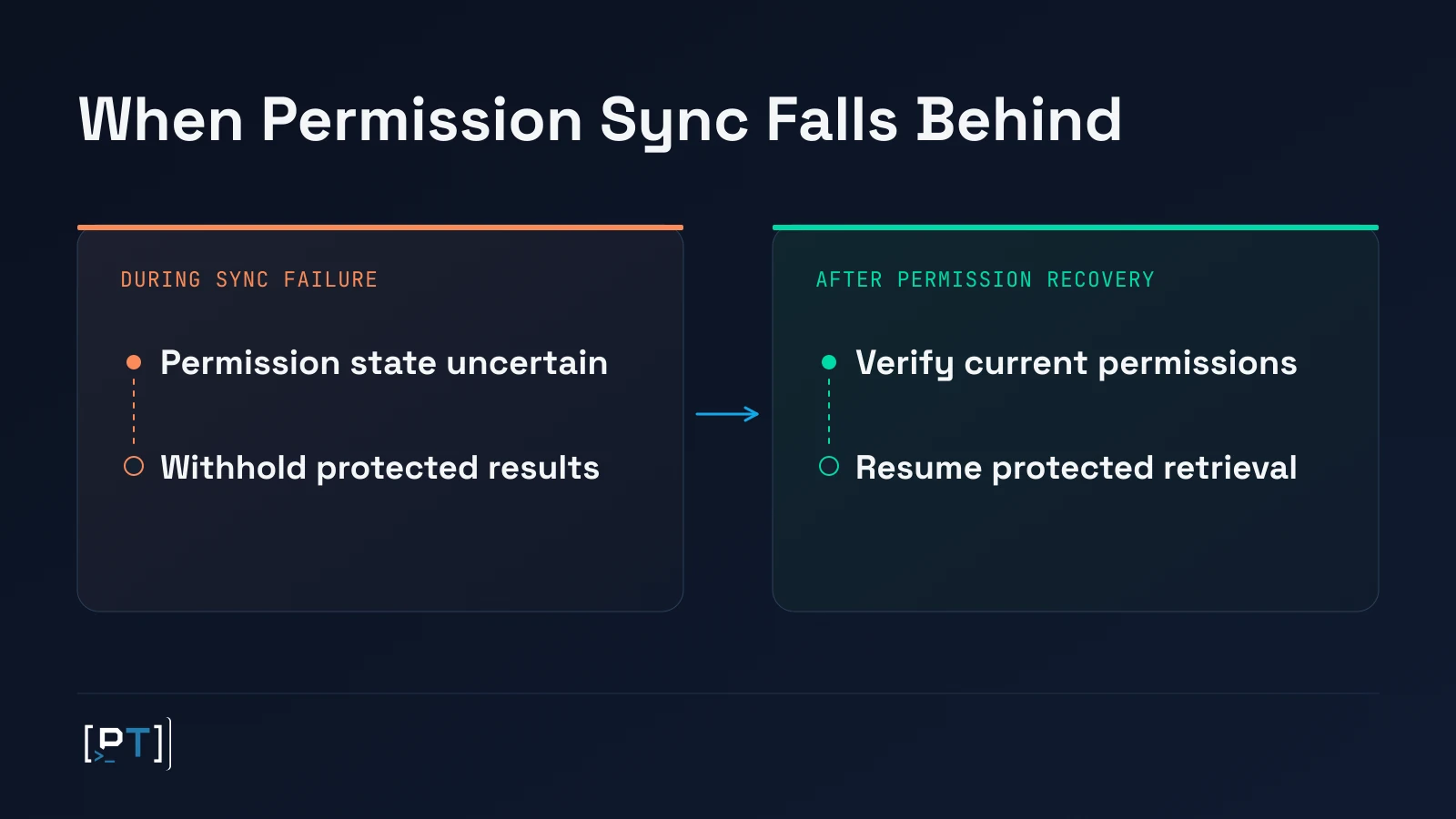
A connector can fall behind because upstream access is interrupted, an update is rejected, or a rebuild is still processing. Define what the product does when it can no longer establish that the permission state meets the approved freshness policy. The decision connects availability, confidentiality and support readiness. A safe design might suppress results from the affected source, require a current authorization decision before protected content is admitted, or temporarily limit retrieval to an independently verified public collection.
Assign a threshold and owner for each supported behavior. Include what users will see, how operations learns that access is degraded, who can restore the connector, and how recovery is verified. Where stale permissions affect one source, selective suspension can retain useful results elsewhere. If the system can’t establish which records are affected, broader suspension may be needed. The release owner should know how each choice affects ordinary workflows before agreeing to the policy.
In the hypothetical forecast scenario, suppose the index shows a successful content refresh but the permissions feed is delayed. The source has already denied the former lead. The product’s approved degraded behavior could suppress forecast material before it enters the model’s context while returning verified public guidance. The operations record would capture when degradation started and who handled it. That evidence helps a security lead decide whether to contain a potential disclosure and a support lead explain why some answers are temporarily unavailable.
Ask for recovery evidence as well. A healthy status signal can precede full reconciliation, and a backup or rebuilding index can contain an older permission state. Require evidence that current access decisions hold across the affected retrieval paths before re-enabling protected sources. If access appeared to persist beyond the approved window, preserve relevant decision and request records and use the organization’s incident process to assess the exposure and any obligations.
What leadership should decide before release
Approve the maximum elapsed time for ordinary and emergency revocation, the point where retrieval must restrict affected results, and the criteria for resuming service. Name the source and identity owners, the search platform owner and the person authorized to accept release risk. Agree which events require retesting, such as a connector upgrade, an identity migration, a new source with different inheritance, or an index rebuild that changes the serving path.
A focused assessment starts with one connector, one sensitive collection and the access changes that matter for that rollout. A broader estate with nested groups, multiple serving routes or regional indexes requires more combinations and may need extra observation across scheduled jobs and recovery events. Scope and effort also depend on whether the team can provision representative access states and correlate authoritative changes with retrieval decisions. Request estimates after the assessor sees those dependencies and the evidence already available.
The remediation decision follows the observed cause. Shortening a healthy sync interval may help when scheduling drives the delay. Missing inherited permission updates, stale membership evaluation or uneven deployment across index copies need different fixes. Give each committed fix an owner, a deadline and a retest that reproduces the approved access transition using synthetic data. If leadership approves a time-limited exception, record the affected collections, temporary restrictions and the condition that ends the exception.
Map stale permissions on indexed material to OWASP LLM08:2025 Vector and Embedding Weaknesses. Map unauthorized exposure of restricted information to OWASP LLM02:2025 Sensitive Information Disclosure. Apply OWASP API1:2023 Broken Object Level Authorization when a retrieval API handles document or record objects and must verify the caller’s authority for each object. These references help label the control failure and explain its impact to a buyer.
Use NIST AI RMF Measure and Manage to frame how you gather and act on the evidence. Measure supports documenting the observation method, uncertainty and limitations. Manage supports prioritizing remediation, assigning owners and deciding what residual risk is acceptable. Keep one evidence summary for procurement or audit requests, showing the tested deployment, supported change types, approved thresholds, observed outcomes and open items. If the actual request concerns deletion of personal data across retained copies, see GDPR AI data erasure testing.
Frequently asked questions
Can an existing single sign-on test cover this release gate?
Reuse any trustworthy evidence it produced about identity changes and session state. To close the connector release gate, add evidence that links the identity change to the effective retrieval decision for the relevant document on the serving paths. The two evidence sets can share the same test identity and source timestamp.
What should we ask a managed connector vendor to supply?
Request documentation or test evidence for the connector version you deploy, including permission-change coverage, expected refresh behavior, known exceptions and event visibility. Ask who owns delays that cross the vendor boundary and which customer-side controls remain configurable in your edition.
What if the vendor only publishes average sync time?
Use the average for planning and request evidence for slow or interrupted refreshes. An average leaves the longest periods of continued access unclear. Your acceptance criteria should specify the maximum approved window, the observations needed to evaluate it and what happens when the window is missed.
Can a pilot support a narrower rollout decision?
Yes. Limit the decision to the tested connector, user population, source settings and data classifications. Make the next expansion contingent on checking the new permission behaviors it introduces. For example, a pilot on directly shared documents may need additional evidence before the rollout includes inherited permissions.
Does the same timing target apply when we grant access?
Set grant and revocation targets separately. A delayed grant can slow work, while a delayed revocation can preserve exposure to sensitive information. Where restoration is part of the workflow, document who can approve it and which checks establish that the intended audience was restored.
Who should sign off if the source and search platforms have different owners?
Have each owner validate the part of the evidence their system produces, then assign one release approver to make the end-to-end decision. Involve the data owner when the proposed window changes how a sensitive collection is protected or when it conflicts with an existing customer commitment.
Scope your next connector release
Bring the connector and index inventory, the source access policy and one representative role-change workflow to the scoping discussion. Those inputs support a defined test scope and a release decision based on the observed time to durable denial. Discuss permission propagation and retrieval-boundary testing with Pentest Testing Corp before adding restricted knowledge sources to production.