GDPR AI Data Erasure Testing: What Evidence Can You Produce?
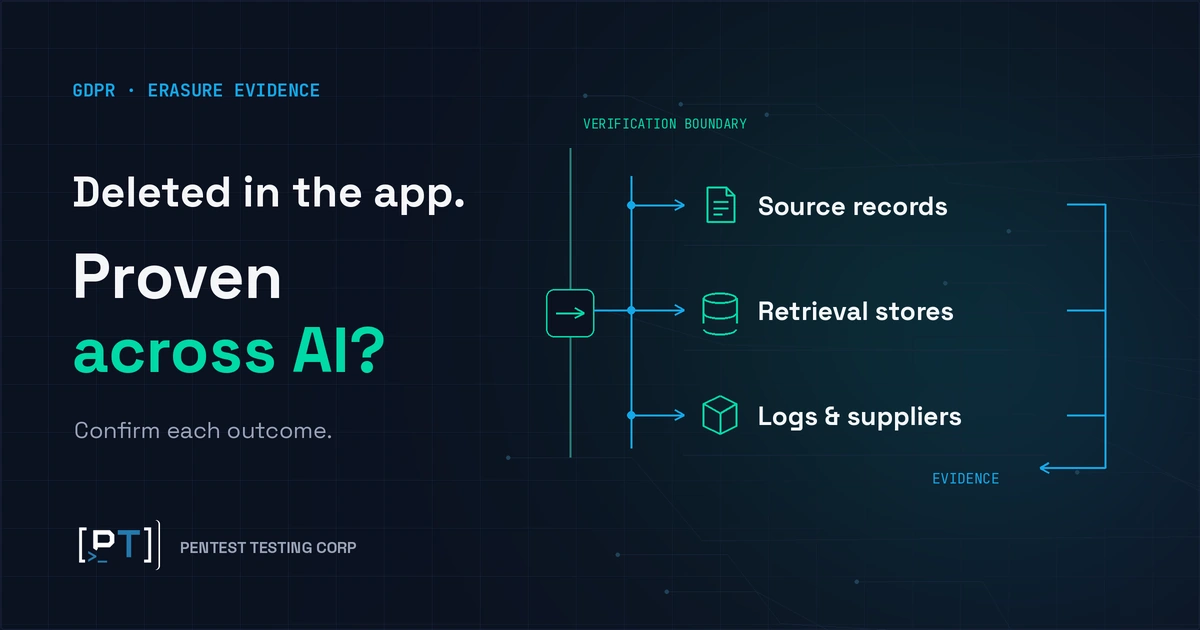
A DPO receives an erasure request from a former customer whose support records were available to an AI assistant. Engineering deletes the customer profile and closes the ticket. During a procurement review, another customer asks whether deletion also reached the assistant’s retrieval store, conversation history, monitoring platform and model supplier. The team has a successful deletion response from the application, but no evidence covering those destinations.
GDPR AI data erasure testing turns that gap into a bounded validation task. It follows an approved request through the systems that held or derived personal data, checks the agreed outcome at each destination, and records justified retention and supplier limitations.
The leadership question is practical: can your organization support the deletion statement it makes to the individual and the buyer? Adding AI can change where information persists. A defensible answer requires an updated data map, observable deletion results and a clear account of what remains.
Set the outcome for GDPR AI data erasure testing
Start with a privacy decision that engineering can implement. The authorized privacy or legal owner should establish the applicable erasure grounds, affected processing, identity checks and exceptions. The technical assessor verifies the resulting control requirements. A test report should not decide an individual’s legal rights or certify organization-wide GDPR compliance.
The official GDPR text provides the baseline: Article 5 addresses principles and accountability; Article 17 governs erasure and its exceptions; Article 32 concerns risk-appropriate security measures and effectiveness testing. These obligations have different roles in the assessment.
| Baseline | Buyer-facing question | Useful assessment output |
|---|---|---|
| Article 5 | Can we explain purposes, necessary retention and accountability? | Approved data map and retention decisions. |
| Article 17 | What must be erased, and what exception applies? | Request-specific disposition and verification results. |
| Article 32 | Are security controls appropriate and effective? | Authorization, access restriction and control-test evidence. |
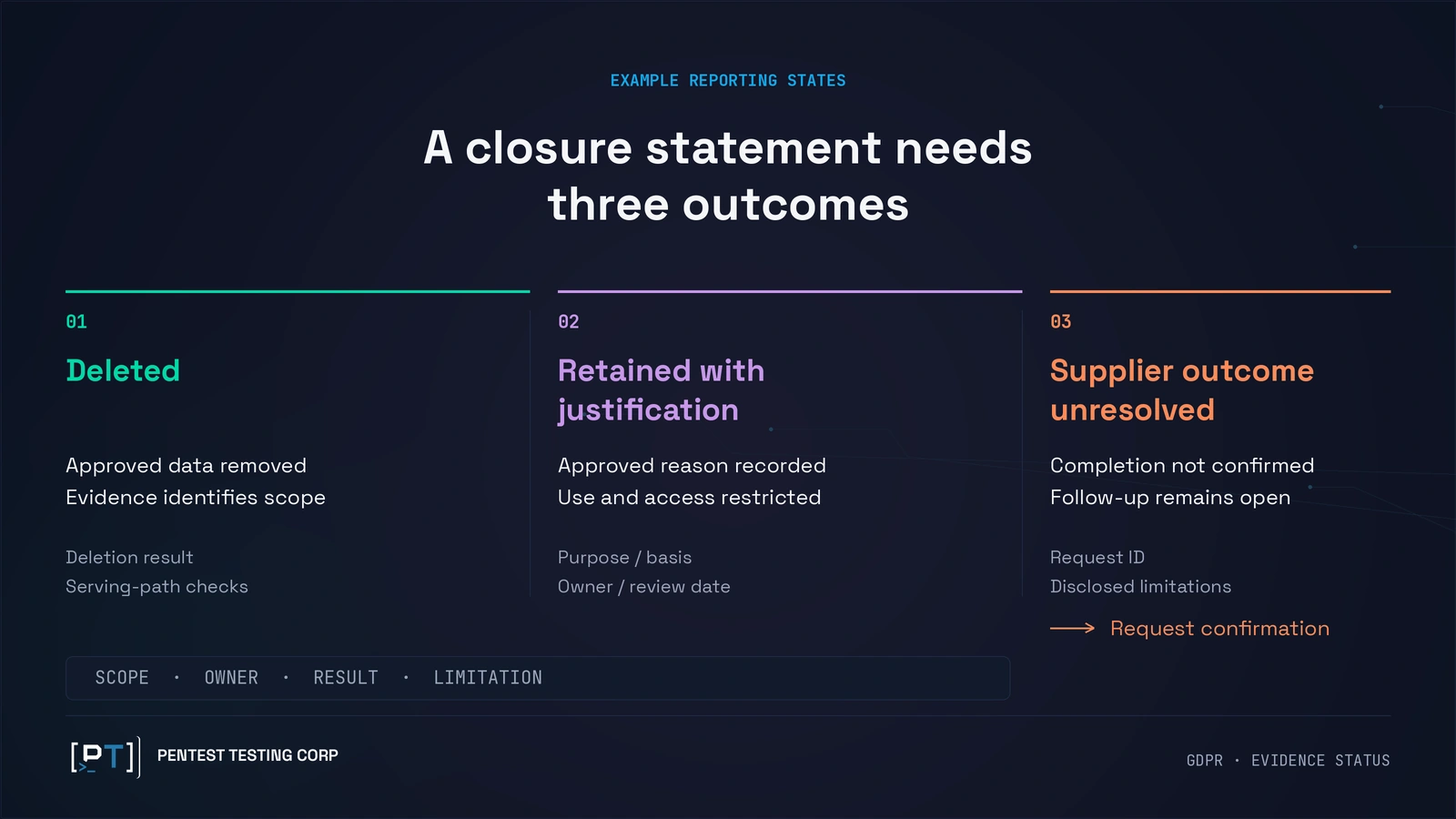
A deletion test needs an explicit acceptance statement. For example: remove the approved synthetic subject’s source records and derived retrieval content; invalidate serving caches; apply the approved disposition to conversation and telemetry records; and confirm the supplier request reaches a terminal outcome. Where a record must remain, document its purpose, access restrictions, review date and permitted use.
Do not accept “retain for compliance” as a complete explanation. Ask which record category, which obligation or exception, and which duration the decision covers. An obligation affecting an invoice does not automatically justify retaining every associated prompt or retrieved document. A technical team’s difficulty removing data is an implementation gap to escalate, rather than an automatic legal exemption.
The EDPB’s 2026 coordinated erasure report identifies challenges involving procedures, retention and exceptions. Its recommendations include written justification and involvement of compliance or legal teams. For an AI feature, translate that governance into destination-specific acceptance criteria before assessing deletion.
When the existing workflow needs repair, GDPR remediation support for DSR workflows and evidence provides the relevant service path. Scope the specific workflow, required changes and validation outputs instead of buying an undefined promise of “complete AI erasure.”
Map personal data beyond the source record
Use one representative business workflow as the starting point: customer support, document search or an internal assistant. Trace the information from collection to each destination that can store, transform or reuse it. Record system owners, supplier roles, environments and processing purposes. An architecture slide showing the main database and model API is rarely detailed enough to support a request-specific closure decision.
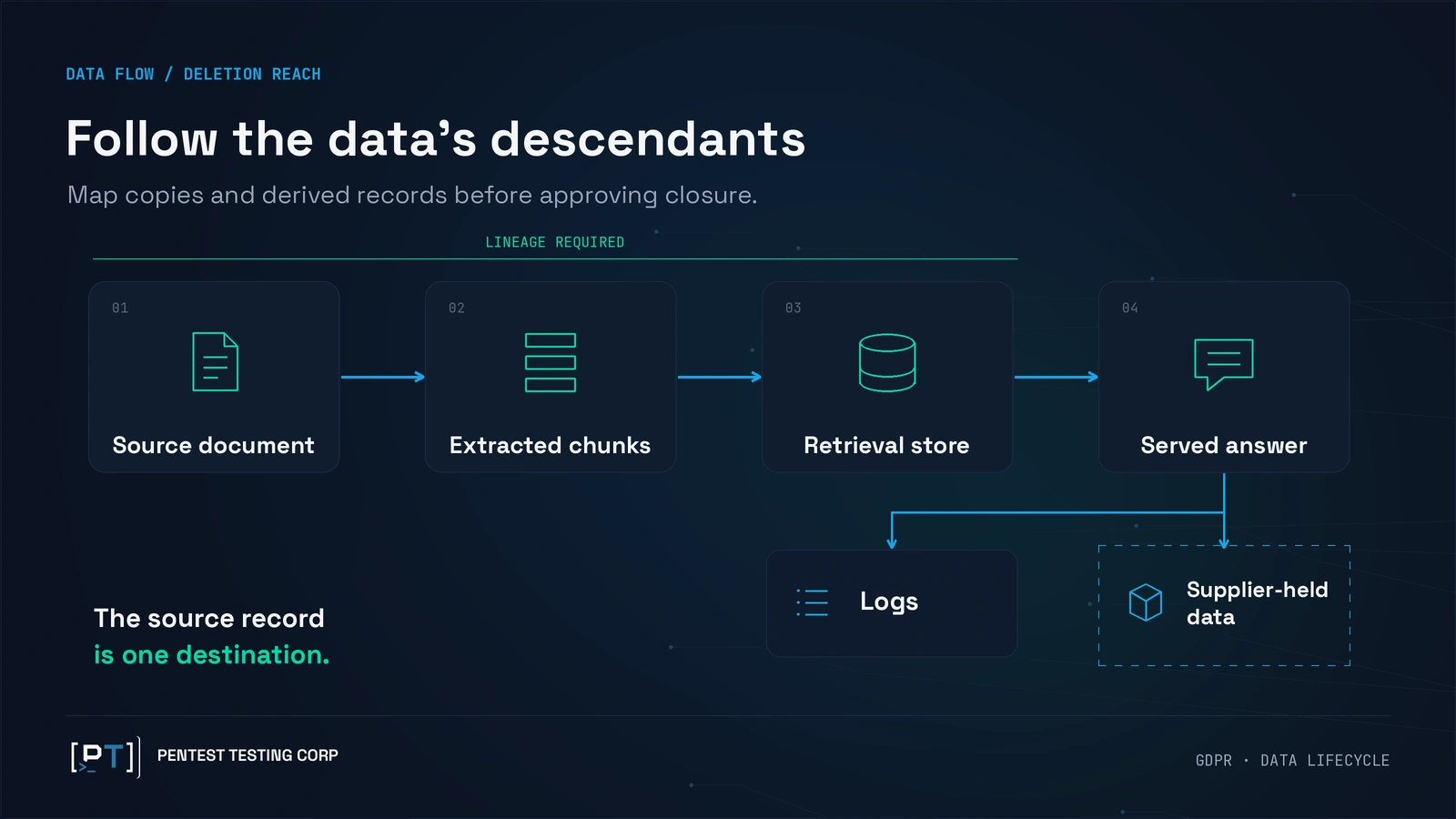
The map should distinguish the original document from its extracted text, chunks, vectors, metadata, saved answers and summaries. Depending on the design, different components may use different identifiers. The request handler therefore needs a reliable way to locate the subject’s relevant records without confusing account deletion with deletion of all personal data associated with that individual.
An account can contain information about several people. A subject’s information can also appear in several accounts. Removing an entire customer workspace may be excessive for one request, while deleting only the subject’s user profile may miss documents uploaded by colleagues. Ask whether the system can identify the right scope and preserve unrelated records where appropriate.
For retrieval architectures, our guide to security coverage for RAG retrieval stores explains why the serving pipeline deserves explicit assessment. The erasure question adds a lifecycle requirement: after approved deletion, can the pipeline still select, expose or regenerate the affected content?
Do not classify a vector as anonymous simply because it is not readable prose. Its relationship to an identifiable person, associated metadata and realistic recovery or disclosure paths require assessment. Equally, a vector associated only with genuinely anonymous material should not automatically be described as personal data. The classification needs evidence appropriate to the particular system.
Include less visible destinations: failed-ingestion queues, temporary file storage, analytics exports, evaluation datasets, support tooling and non-production copies. A rejected upload may have produced a diagnostic trace before the application rejected it. A staging environment may hold a production-derived dataset. These are discovery questions, not assumptions that every AI product creates every copy.
Give every destination an owner and a disposition. “Unknown” is a valid discovery result, but it should remain an open item. Without that discipline, the procurement answer becomes broader than the actual inventory.
Build a GDPR AI data erasure testing matrix
The matrix connects each destination to an observable outcome. Agree it with privacy, engineering, security and vendor management before execution. Use synthetic or otherwise specifically authorized records in a representative environment, with a known pre-deletion state. That baseline matters: a negative search after deletion proves little if the record never reached the store being assessed.
| Destination | Required check | Evidence to request | Closure condition |
|---|---|---|---|
| Source records and files | Approved records removed across scoped stores and replicas. | Record inventory, completion events, post-deletion read checks. | Relevant records absent; approved exceptions itemized. |
| Retrieval and vector stores | Associated chunks, vectors and metadata addressed. | Lineage mapping, deletion results, authorized retrieval checks. | Affected content no longer served through tested paths. |
| Conversation and agent memory | Saved content and derived summaries included where applicable. | Memory inventory, disposition results, later-session checks. | Approved content removed without deleting unrelated records. |
| Caches and background jobs | Serving copies invalidated; pending work cannot recreate deleted content. | Cache state, job outcomes, repeat checks after relevant cycles. | No reappearance in tested propagation windows. |
| Logs, traces and analytics | Personal content deleted or retained under an approved decision. | Field inventory, retention configuration, access and expiry checks. | Actual handling matches each approved disposition. |
| Backups and recovery | Retention, access and restoration handling evaluated. | Backup schedule, expiry evidence, controlled restore results. | Approved handling documented; restored data not improperly reactivated. |
| Suppliers and subprocessors | Instructions, retained categories and completion boundaries established. | Request IDs, category-specific confirmations, contract and exception records. | Confirmed outcomes separated from unverified claims. |
Verify the request’s authorization as well as its completion. The requester, operator and affected subject may be different identities. Confirm that only the approved role can initiate the scoped deletion, that tenant boundaries are enforced, and that an altered subject reference cannot erase someone else’s records. Record the authorization decision alongside the deletion result. A workflow that deletes thoroughly but selects the wrong person is not an effective privacy control.
A successful deletion API response may indicate only that a request was accepted. Ask what event demonstrates completion, which downstream stores were covered, and what happens when one destination fails. A workflow should surface partial failure for follow-up rather than reporting success because the primary database operation completed.
Combine destination records with application checks. Inspect the approved identifiers and related content, then exercise representative retrieval and serving paths. An assistant declining to answer is evidence of response behavior; it does not establish that underlying records were erased. Conversely, a missing exact phrase does not establish that a summary or alternate representation is absent.
Assess delayed behavior when the architecture makes it relevant. Re-indexing, queued ingestion, replication and cache refresh can change the result after an initial check. Agree observation points around those mechanisms. A report should identify the checked interval and dependencies rather than claiming permanent absence from a single moment’s observation.
Include control records that should remain unaffected. If deletion removes another subject’s document or breaks an unrelated workflow, the privacy control has created a separate integrity or availability problem. Successful scope selection is part of the acceptance decision.
Persistent memory needs its own inventory because it may hold derived content across sessions. Cross-session memory integrity and repair testing covers a different objective. Here, the question is whether approved personal data is removed or appropriately retained, even when the saved memory is accurate and benign.
Document retention exceptions and supplier boundaries
Keep an exception register alongside the matrix. Each entry should identify the record category, approved justification, destination, owner, access restrictions and review or expiry trigger. The privacy decision should determine what remains; technical verification should establish whether the implemented restrictions match that decision.
Article 17(3) includes exceptions such as necessary processing for specified legal obligations or legal claims. Their applicability needs assessment. Avoid treating an incident, a contract or a security label as a blanket reason to retain all associated content.
If an investigation or legal hold affects relevant records, coordinate with the authorized privacy, legal and incident owners before routine cleanup. Preserve required evidence through controlled handling and document the basis for retention. Our guide to evidence preservation across an AI supplier boundary addresses the separate investigation problem.
Separate security metadata from personal content
A useful deletion record need not contain the information being erased. Consider whether a correlation identifier, destination, authorized action, timestamp and outcome are sufficient. Full prompts, retrieved passages and tool responses can recreate the sensitive dataset inside the proof-of-deletion folder.
Review whether identifiers themselves remain personal data in context. Hashing an email address or replacing a name with an account number does not automatically establish anonymization. Limit access to the evidence pack, record its purpose and apply an approved retention period. The proof process should reduce unnecessary collection while still supporting a reviewable conclusion.
Evaluate backups and restoration explicitly
Ask what the backup architecture permits, what it retains, and how the approved privacy decision will be implemented. If immediate selective removal is unavailable, document that limitation and obtain a privacy-approved handling plan. Access restriction, defined expiry and restoration controls may be relevant safeguards, but none should be presented as a universal legal safe harbor.
In a controlled recovery exercise, establish whether previously erased records can become active again. Determine whether the recovery procedure applies the relevant deletion state before normal processing resumes. A backup schedule alone does not answer that operational question. Any temporary retained copy needs an identified owner and a tracked follow-up outcome.
Define what supplier confirmation actually proves
Ask each supplier which service features hold personal data, which settings apply to your account, what deletion interface or process is available, and which subprocessors receive the information. Distinguish inference processing, application storage, diagnostic retention, evaluation and training use. A generic statement about “no training” does not answer the other categories.
Under Article 28, processor arrangements include assistance with data-subject rights. Article 19 addresses notification to recipients, subject to its stated conditions. Map those duties with the privacy owner to the actual supplier relationships.
For each supplier request, retain the instruction date, scoped data categories, completion statement and disclosed exceptions. Label the assurance source: directly observed, independently assessed, supplier-confirmed or unresolved. A ticket receipt proves submission. A supplier’s category-specific completion confirmation supports a different conclusion. Neither automatically proves erasure from every subprocessor or every storage layer.
Keep model-training deletion as a separate feasibility question
First establish whether the affected information was used for training or fine-tuning at all. An AI application may retrieve a document or send it during inference without updating model weights. Source-store deletion, retrieval cleanup and removal from a training dataset are therefore distinct workstreams with different evidence requirements.
EDPB Opinion 28/2024, adopted on 17 December 2024, rejects a blanket assumption that models trained with personal data are anonymous. Assessment is case-specific and considers the likelihood of extracting or obtaining personal data using reasonably likely means. The opinion is not a universal method for proving model-level erasure.
If training use is confirmed, request the provider’s account of the affected datasets, model versions, downstream artifacts and available remediation methods. Establish who can perform and evaluate those methods. Removing an example from the next training run does not, by itself, establish its removal from an already deployed model.
Unlearning, retraining or model replacement may require a separate technical and legal feasibility assessment. Define the claim being evaluated and the supporting evidence before promising a result. A response filter can change what a user sees without establishing that information was removed from model parameters.
The practical procurement decision may be to narrow permitted inputs, disable a processing feature or choose another supplier while the limitation is resolved. Record that decision separately from the deletion-workflow results. Do not issue a broad completion statement while a material training-related question remains unknown.
Agree evidence, effort and remediation scope
The assessment should produce a request-level evidence pack: approved disposition, data map, destination matrix, test observations, exception register, supplier results and remediation backlog. Tie each observation to the environment, workflow version, configuration, collection time and assessed identity. This lets a reviewer understand both the result and its limits.
Use framework mappings to organize relevant risks. OWASP LLM02:2025 Sensitive Information Disclosure is relevant where retained content can appear in outputs. LLM08:2025 Vector and Embedding Weaknesses helps structure retrieval-store exposure questions. These are security mappings, not standalone GDPR erasure requirements.
The voluntary NIST AI Risk Management Framework supports the governance connection. Apply GOVERN to ownership and policies, MAP to data flows and supplier dependencies, MEASURE to observed outcomes, and MANAGE to treatment and follow-up. This application of the framework is an assessment design choice, not a claim of certification.
Effort depends on the number of destinations, reliability of record lineage, available access, propagation behavior and supplier responsiveness. A narrow workflow with reliable identifiers is easier to assess than several assistants sharing stores and logging platforms. Rebuilding the data map or adding missing deletion capabilities may cost more engineering time than executing the validation itself.
Set milestones around dependencies: scope approval, evidence access, initial validation, remediation, supplier follow-up and retest. Agree a calendar estimate after discovery. Do not substitute a generic AI pentest duration for an erasure workflow that depends on a provider or backup lifecycle.
A focused validation exercise can be paired with AI penetration testing for retrieval and disclosure controls when unauthorized access is also a concern. Keep the acceptance criteria distinct. Security testing examines reachable failure paths; erasure validation examines the approved data disposition across the mapped lifecycle.
For smaller teams, the guide to scoping an AI assessment for a startup offers a complementary way to prioritize consequential workflows. Define the bounded coverage without treating a small sample as proof that every subject and destination is covered.
What leadership should decide from the results
Hypothetical scenario, not a client case: a B2B support platform validates a synthetic erasure request before an EU customer review. The source record disappears. A derived support summary remains retrievable, and an observability export still contains the original conversation. The model supplier confirms receipt of the deletion instruction but has not confirmed completion for its diagnostic records.
The company cannot yet support its proposed “erased everywhere” answer. The CTO assigns the missing lineage and export handling to engineering. The privacy owner determines the disposition of diagnostic content. Vendor management requests category-specific completion evidence. Procurement uses a narrower statement describing completed checks and open dependencies.
Retesting should cover the failed destinations and their return paths, including the relevant background processing cycle. Closure follows evidence, not the number of completed tickets. Put unresolved items into a risk register with owners and dates; the guide to organizing remediation in a unified risk register explains that governance structure.
Leadership should approve the scope of any assurance statement, fund material workflow repairs, and decide whether unresolved supplier capabilities require product restrictions or procurement changes. An internal risk acceptance does not make a legal obligation optional. Escalate uncertainty to the responsible privacy or legal owner.
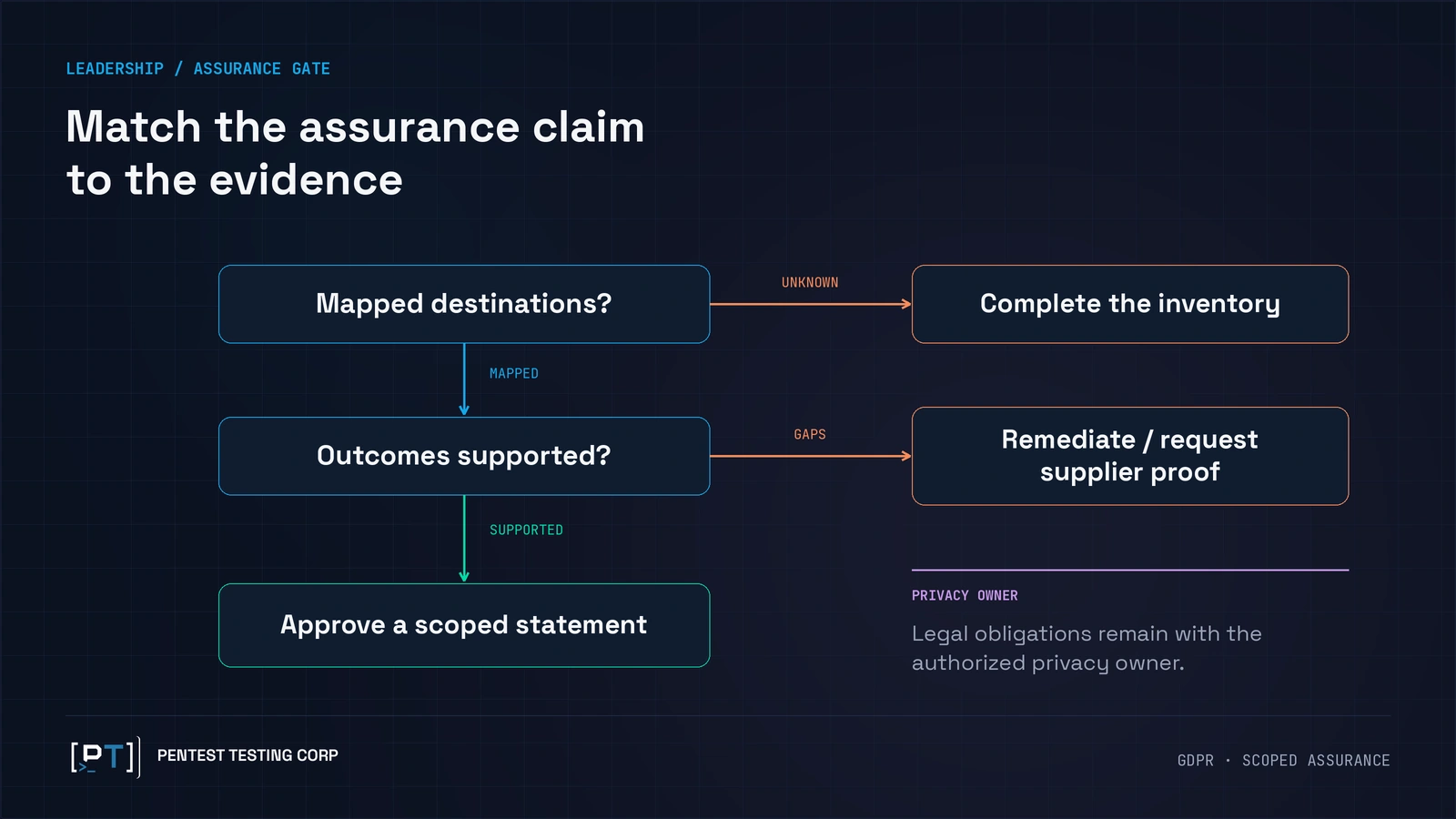
Revalidate after changes to retrieval stores, memory, observability, suppliers or recovery procedures. The evidence remains useful only while it describes the operating system. Annual review provides a baseline, but a material data-flow change can justify earlier reassessment.
For the next privacy review, ask one concrete question: can each destination’s owner show the approved disposition and its result? Start with a representative workflow, close the gaps, and expand coverage where the data map requires it. Scope GDPR remediation and AI deletion-workflow validation around the evidence your organization needs to produce.
Frequently asked questions
Can we begin before our data map is complete?
Yes. Begin with discovery and readiness review, then validate the destinations you can identify and access. Label unknown destinations as coverage gaps. A partial inventory supports a remediation plan, but it cannot support an unrestricted completion claim.
What response deadline should our workflow track?
Article 12 generally requires information on action taken within one month of receipt, with a possible two-month extension where necessary because of complexity and number of requests. The individual must be informed of the extension and reasons within the first month. Article 17 requires erasure without undue delay. Have the privacy owner apply the rules to the request.
Should we test using a real customer’s erasure request?
Prefer synthetic records for initial validation. A real request may require approved production checks, but separate fulfillment from experimentation. Agree on access, confidentiality, evidence collection and business-impact limits before handling the individual’s data.
What if the same document contains several people’s data?
Define the request-specific outcome with the privacy owner. The implementation may require selective removal or another approved disposition rather than deleting the whole document. Verify that unrelated records remain correct and that the affected information does not persist in derived copies.
Is a supplier deletion certificate enough for procurement?
It can support the answer if it identifies the relevant service, data categories, scope, outcome and exceptions. Check whether it covers the actual configuration and subprocessors. Present it as supplier-provided evidence and disclose material limits rather than implying independent verification.
Who should receive the final evidence pack?
Give detailed evidence to authorized privacy, security and engineering owners. Procurement or customers may need a minimized summary covering scope, outcomes and unresolved limitations. Remove unnecessary personal content and confidential architecture detail before external distribution.
Do we need another check after a model-provider change?
Review the changed data flow, retention settings and supplier commitments. Revalidate affected destinations when processing or evidence access changes. A previous report does not automatically cover a new provider, service feature or account configuration, even when the assistant’s user interface stays the same.