SaaS Acquisition Penetration Testing Scope: What to Verify Before Close
A founder has agreed to terms to buy a profitable SaaS product. The target has paying customers, an established API, a recent security questionnaire, and a penetration test report from last year. The letter of intent is signed. Integration planning has already begun, including a proposal to connect the acquired platform to the buyer’s single sign-on and customer data environment.
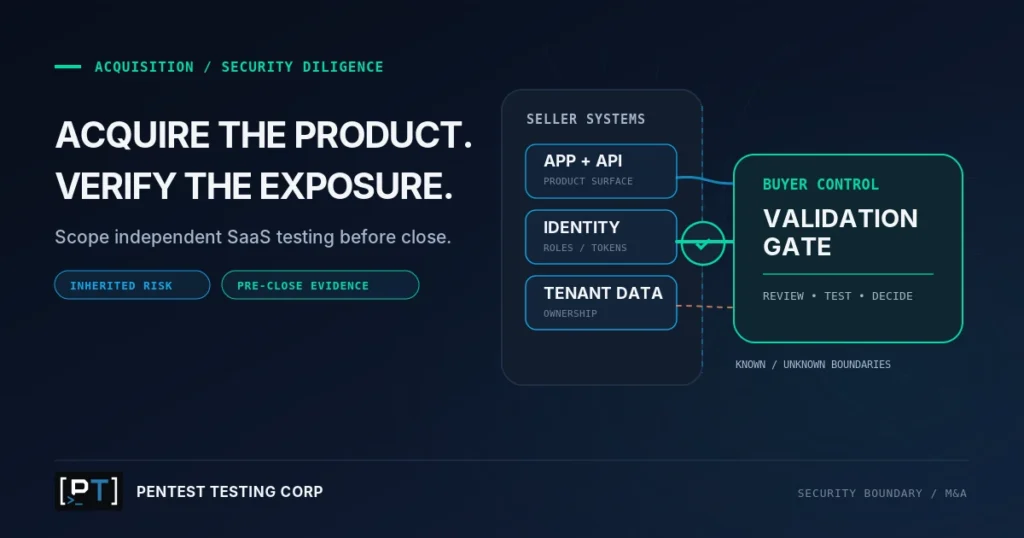
The remaining question is not simply whether the seller has ever commissioned a security test. It is whether the buyer understands the security exposure it will inherit, the technical boundaries it intends to change, and which unknowns could alter the transaction decision. A practical SaaS acquisition penetration testing scope should answer those questions before the ownership or integration plan becomes difficult to reverse.
This guide helps founders, CTOs, deal teams, and security-review owners distinguish evidence requests from independent validation, set a proportionate pre-close testing scope, and turn findings into explicit commercial and engineering decisions. It is a security decision guide, not legal or transaction-valuation advice.
Why acquisition changes the security question
Ordinary supplier due diligence asks whether a third party can be trusted to deliver a service under a continuing contract. Buying the underlying SaaS business raises another question: what software, identities, infrastructure, obligations, and unresolved vulnerabilities will the buyer inherit? An asset purchase, a share purchase, and a product-code acquisition can transfer different rights and liabilities. The legal structure must be resolved with counsel, but the technical investigation should follow the actual operational control and exposure the buyer expects to assume.
The acquisition perimeter may include more than the polished customer-facing application. Source repositories, deployment pipelines, administrator accounts, cloud subscriptions, support consoles, backups, object storage, private APIs, integration secrets, and customer support tooling can be integral to operating the product. A buyer may inherit those directly, depend on continued access from the seller, or need to migrate them on a tightly controlled schedule. Each arrangement changes who can authorize tests and who must fix any resulting issue.
Security reports useful for enterprise procurement can still be valuable, but they answer a different question. Our guide to what enterprise buyers expect in a vendor security assessment focuses on a supplier proving its controls to a prospective customer. In an acquisition, the buyer also needs an inventory of inherited liabilities and a plan to operate or integrate the product safely. Do not assume the existing procurement package covers that ownership transition.
For a target with an accessible web product and API, begin with a documented boundary review and use independent penetration testing services to validate the highest-consequence attack paths. That does not mean testing every device, repository, and vendor within a short exclusivity period. It means tying each selected test to a specific uncertainty that affects price, timing, transition design, contractual protections, or post-close engineering workload.
There are three acquisition-specific failure modes worth keeping distinct. First, the system being purchased may contain exploitable weaknesses even though a previous report showed satisfactory controls. Second, the buyer’s intended integration may create new access paths that did not exist during that earlier test. Third, evidence may simply be unavailable, making the risk unknown rather than demonstrably low. Labeling these separately prevents a missing report from being treated like a passed test, and a passed historical test from being treated like a guarantee.
Build the SaaS acquisition penetration testing scope around what transfers
Start with the transaction inventory, not a generic list of scanning tools. Request a high-level architecture map, current production and staging environments, corporate and cloud identity ownership, an asset and API inventory, material service-provider dependencies, product change history, and the planned Day 1 operating model. Ask the target’s technical owner to explain which systems remain with the seller, which transfer, and which are shared until migration completes.
The scope should include enough representative user and administrator accounts to validate authorization boundaries, especially when the acquired product is multi-tenant. It should also distinguish customer-facing functions from support staff, billing operations, background jobs, and service-to-service access. The key buyer question is what data or business action an improperly authorized identity could reach, not merely how many endpoints can be counted.
| Boundary | Validate before close | Decision affected | Useful evidence |
|---|---|---|---|
| Customer application and APIs | Authentication, authorization, tenant isolation, privileged workflows, data exports | Exposure to customer-data access or integrity loss | Role/tenant test matrix and validated findings |
| Identity and administration | SSO dependencies, recovery paths, privileged access, service identities, token lifecycle | Day 1 account takeover and access-transition risk | Identity diagram, account inventory, test conclusions |
| Cloud, storage, and deployment | Production control plane, exposed services, access boundaries, secrets ownership, CI/CD permissions | Migration feasibility and urgent hardening work | Scoped configuration review and ownership register |
| Integrations and data movement | OAuth grants, webhooks, partner APIs, synchronization jobs, customer data flows | Risk created by buyer integration or inherited partners | Integration map, consent boundaries, revocation plan |
| Historical incidents and remediation | Open findings, retest status, disclosed incidents, security exceptions | Holdback, remediation covenant, or risk acceptance | Dated reports, tickets, closure evidence, incident summaries |
| Transition and offboarding | Seller’s retained access, backups, domains, keys, monitors, third-party administrators | Operational continuity and seller access after close | Cutover checklist, owner, validation and rollback criteria |
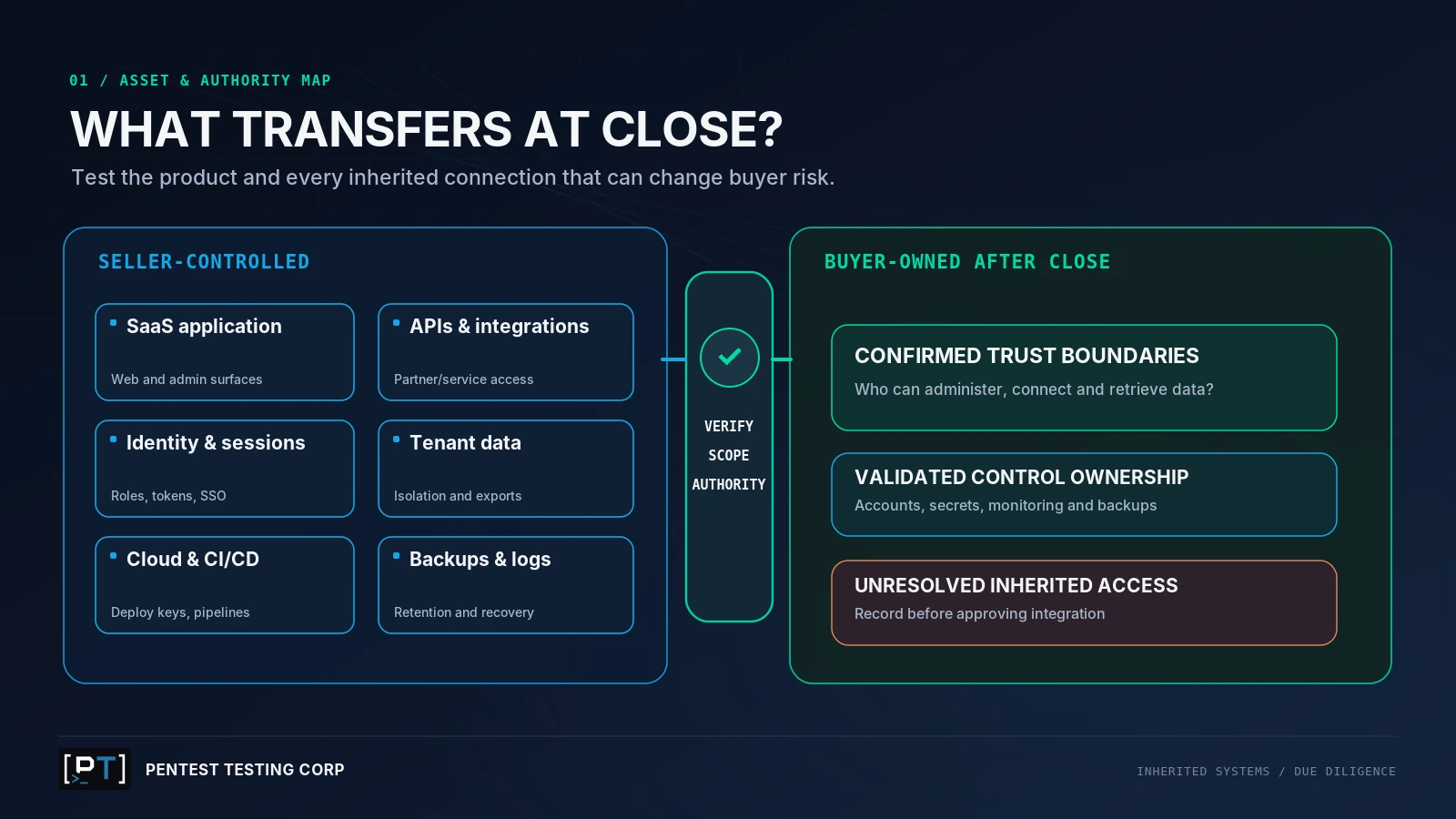
Illustrative scope choice: if the purchase is a standalone vertical SaaS product with no immediate system integration, prioritize tenant isolation, identity, production administration, and unresolved critical findings. If the buyer plans to connect the acquired product to its parent identity provider and analytics stack on Day 1, testing must also address the new trust paths and data movement. Those are different engagements, even if the target’s existing website is identical.
For products serving multiple customer organizations, our guide to multi-tenant SaaS authorization testing explains why representative roles, tenants, privileged functions, and exports matter more than a surface-level login check. Where API exposure dominates the acquisition, a separately defined API penetration testing scope can identify authorization depth, role coverage, and integration boundaries without assuming an API scan is a full product review.
Set exclusions just as carefully. An external payment processor, customer-managed deployment, reseller-controlled integration, or third-party infrastructure may sit outside the seller’s testing authority. Document the dependency and its business importance, then seek appropriate authorization or evidence from the responsible party. Never treat a buyer’s commercial interest in the company as permission to actively test every connected environment.
Evaluate inherited security evidence before deciding which tests to repeat
A historical assessment can narrow the independent testing needed. It cannot replace a comparison between what was examined then and what the buyer will operate now. Request the complete scope statement, report date, testing methodology, environments, authenticated roles, exclusions, findings, remediation records, and retest confirmations. Review material architecture or feature changes since the test rather than assuming a clean summary page means nothing relevant has changed.
The most useful question for each security artifact is, “What risk does this actually reduce uncertainty about?” A penetration test focused on anonymous perimeter exposure offers limited assurance about cross-tenant authorization. A cloud posture review does not automatically validate account recovery. A SOC 2 report may support the evaluation of defined controls over a specified period, but it is not a substitute for targeted testing of new integrations or application logic. These artifacts complement one another when their scope and dates are understood.
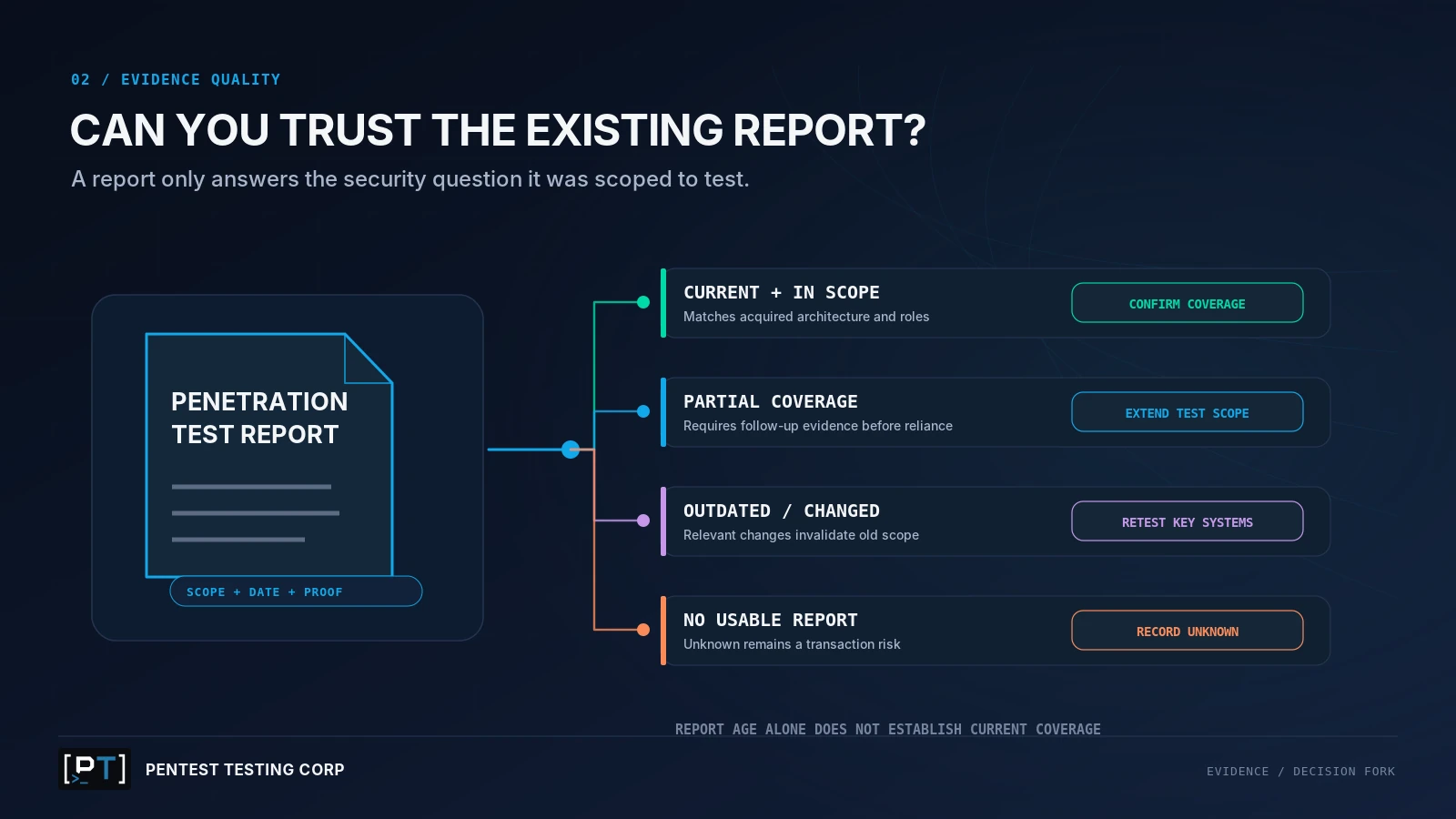
Use the following evidence triage as a practical acquisition gate:
- Current and relevant: the asset and configuration are materially unchanged, testing had appropriate access and depth, and severe findings have defensible closure evidence. Consider focused validation rather than automatic duplication.
- Current but partial: the assessment covered only external or low-privilege access while the transaction includes administrative functions, APIs, or cloud identities. Extend the missing boundaries.
- Old or superseded: material product, identity, infrastructure, or integration changes mean the prior conclusions may not transfer. Reassess affected pathways.
- Unverified closure: a ticket says “fixed,” but the retest or deployment evidence is missing. Mark it unresolved for the buyer’s risk decision pending validation.
- Unavailable: a report, credential inventory, or incident history cannot be produced. Record a diligence limitation and decide whether to obtain access, impose a commercial protection, or defer integration.
Our article on what a professional penetration testing report should contain is a useful benchmark when comparing scope statements and evidence quality. The redacted report library can also help a buyer frame reporting expectations without seeking confidential evidence from another organization.
Look for proof of tests that could affect customer confidentiality and revenue: cross-tenant access, administrative authorization, session invalidation, recovery controls, export permissions, and externally reachable management functions. Inherited findings should remain tied to their original evidence and dates. If there is a suspected active incident, preserve relevant evidence and engage an authorized response process; a routine acquisition pentest must not overwrite incident history or become an unmanaged investigation.
The frameworks provide a shared vocabulary, not an automatic deal pass. NIST CSF 2.0 places strategy, risk appetite, roles, and supply-chain relationships in the Govern function. Its supplier due diligence guidance is useful by analogy for reviewing technology dependencies, while a business acquisition additionally requires transaction-specific counsel and operational ownership analysis. OWASP ASVS 5.0.0 provides stable application verification requirements, and the OWASP Web Security Testing Guide helps define meaningful testing categories. Use OWASP API Security Top 10 (2023) for risks such as API1 broken object-level authorization, API2 broken authentication, API5 broken function-level authorization, and API10 unsafe consumption of APIs. These mappings strengthen scope clarity; they do not establish that the target is certified or that every risk has been tested.
Choose testing depth and timing within the deal window
The best diligence plan separates evidence collection from intrusive validation. Before the tester begins, the target and buyer should agree in writing on authority, scope, confidentiality, permitted environments, safety controls, designated contacts, report recipients, and escalation procedures. If ownership has not transferred, active testing normally requires permission from the party with current authority over the affected systems. NIST SP 800-115 is a useful reference for planning assessments, documenting findings, and establishing rules of engagement.
With a short transaction window, sequence the work by how much it could change the deal decision:
| Workstream | Recommended point | Deliverable | What may delay it |
|---|---|---|---|
| Document and asset review | Immediately after confidentiality and diligence access approval | Scope map, evidence gaps, material uncertainties | Missing asset owners, incomplete architecture |
| Permission and account readiness | Before any active testing | Signed rules of engagement, approved accounts, safe window | Customer or third-party permissions |
| Focused manual validation | Before the go/no-go security meeting when feasible | Validated high-consequence findings and limitations | Role coverage, production-safety constraints |
| Commercial and technical disposition | Before final approval or integration commitment | Risk register, owner, fix-versus-accept decision | Engineering estimates and contractual review |
| Repair, retest, and integration gates | Pre-close where essential; otherwise explicitly post-close | Verified closure and controlled cutover plan | Release freezes, migration dependencies |
Do not promise a universal turnaround. A product with one environment, a handful of roles, and available documentation is materially different from a portfolio with multiple mobile clients, microservices, inherited cloud accounts, and seller-operated back-office systems. A fixed date is only credible after asset discovery, account provisioning, safe testing windows, and report-review expectations have been agreed.
Cost follows coverage. Work involving more authenticated roles, tenants, integrations, environments, sensitive workflows, and validation of previously reported findings requires more assessor time and coordination. A short external-only test may have a lower fee, but it cannot answer an acquisition committee’s questions about administrative access or future identity integration. Ask assessors to price the decision-critical scope and document the tests deferred for a later phase instead of silently removing them from the report.
Buying a running service is also different from releasing a new product. The timing principles in our guide to security testing before a product launch are relevant to planned releases and feature cutovers, but acquisition diligence also examines historical evidence, inherited identities, seller access, and commercial risk allocation. A pre-close assessment may validate current-state exposure; a second, narrower review may be needed after identity federation, cloud migration, or data consolidation changes the architecture.
For production systems, use approved representative accounts and controlled test data wherever feasible. Pause or modify tests that could affect availability, billing, customer communications, or data integrity. Where an accurate staging environment is substituted, the report should explain what cannot be inferred about production configuration. Confidentiality and customer commitments may limit what the target can share; those limits belong in the diligence record rather than being glossed over.
What leadership should decide before close
Leadership does not need every finding memorized. It needs a defensible record of which risks affect the transaction and who is authorized to accept them. Use a small set of disposition categories that can be understood by the deal sponsor, CTO, security owner, and counsel.
| Finding or gap | Example consequence | Possible disposition | Required owner and evidence |
|---|---|---|---|
| Confirmed cross-tenant exposure | Customer-data confidentiality or integrity risk | Remediate and validate before close or restrict operation; escalate for legal review | Target engineering owner and independent retest |
| Privileged seller access with no cutover plan | Uncontrolled post-close access | Condition access transfer and revocation on an approved cutover | Identity owner, access inventory, tested revocation |
| Outdated assessment after major platform changes | Unknown present-day exposure | Focused independent testing or explicitly documented residual uncertainty | Buyer security owner and current-scope report |
| Medium-risk hardening backlog | Engineering capacity and future audit effort | Priced post-close remediation with a dated owner | Integration lead and verified backlog estimate |
| Unclear rights to test a critical integration | Unassessed dependency and transition delay | Obtain permission, alternative evidence, or postpone connection | Commercial/legal owner and technical approver |
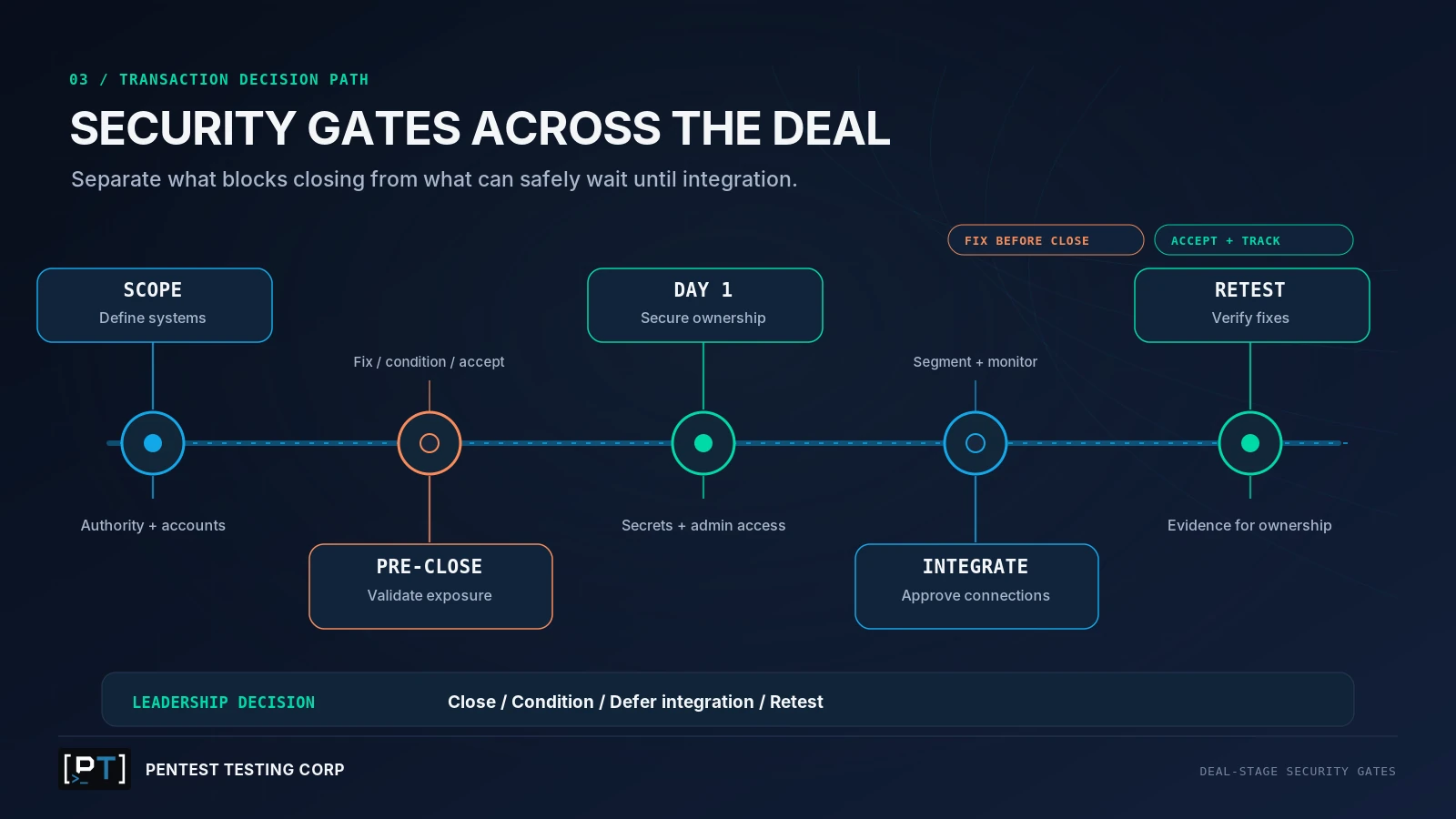
Escalation should be proportional to consequence and confidence, not solely a CVSS label. A confirmed high-impact flaw in a core customer-data pathway may warrant a pre-close remediation condition or delay; a low-impact configuration finding with a compensating control may fit a measured post-close plan. A severe unknown is not identical to a validated severe flaw, but both may justify safeguards. Counsel and deal advisers should determine the appropriate contractual response, such as representations, warranties, covenants, price adjustments, retention amounts, or closing conditions. Security assessors should describe the technical risk and evidence, not prescribe legal outcomes.
Hypothetical scenario, not a client case study: A buyer acquires a subscription analytics platform used by several business customers. The seller provides a nine-month-old external-only pentest showing no critical issues. The integration team plans to reuse the buyer’s identity system and combine reporting data during the first month. Diligence discovers that the historical report did not cover cross-tenant API access, support-user exports, or the planned identity federation.
The buyer requests a limited authorized assessment of those pathways and pauses the shared-data integration pending evidence. Assume the review validates a high-impact tenant-separation weakness and identifies a privileged account whose owner is unclear. The consequences are concrete: an engineering fix must be estimated, customer access exposure must be assessed, an identity inventory must be completed, and the board must decide whether the issues are conditions to closing, reasons to defer integration, or risks to accept with controls. No particular transaction outcome follows automatically from the technical finding. The value of the assessment is that leadership can now decide with evidence instead of inference.
Document the meeting outcome in a one-page security decision record: the material issue, what was tested, the evidence confidence, affected assets and customers, proposed treatment, accountable owner, expected validation, dependency on seller cooperation, and approval authority. Include a “not tested / unknown” section. A short, candid limitation statement is more useful than a long report that leaves readers believing all systems were examined.
Turn findings into a post-close risk and integration plan
The testing report should become an operating handover, not an attachment that disappears after signature. Before Day 1, name the buyer-side owner for production access, repositories, DNS, cloud subscriptions, code-signing material, keys, customer support tooling, backups, logging, and monitoring. Identify vendor access that will continue temporarily under a transitional services arrangement. Record when it expires, how it is restricted, and how revocation will be verified.
Separate three queues. The immediate protection queue contains active or high-consequence risks requiring containment or verified remediation before exposing customers to the new environment. The integration gate queue contains tests needed because the buyer will change identities, data flows, networks, code, or administrators. The technical debt queue contains justified lower-priority work that can be scheduled, costed, and monitored without misrepresenting it as resolved.
Each issue needs an owner, acceptance authority, due date, agreed evidence of completion, and trigger for retesting. Our pentest remediation ownership plan provides a useful handoff model for moving from findings to validated closure. The acquisition plan should add seller/buyer responsibility, transitional-service dependencies, and a clear distinction between a fix required for closing and a fix required before integration.
Consider the transition as a controlled change, even where no technical vulnerability was found. Revoke or rotate inherited credentials under an approved process; confirm who controls domains and certificates; verify that backups can be restored by the new operator; make sure security logs remain accessible and legally retained as appropriate; and rehearse rollback for critical migration steps. Validate that monitoring and incident contacts work after the control transfer. These are management outcomes to verify, not instructions to make unapproved changes in the target environment.
Finally, plan a change-triggered retest. A pre-close report can describe the acquired product as it existed during diligence. It does not automatically assure a post-close architecture with new SSO trust, migrated object storage, consolidated tenant data, or new partner integrations. Assess the boundaries actually changed and retain the before-and-after evidence. This protects the buyer’s customers and gives management a clearer way to show which risks have been treated.
Next step: if you have a letter of intent, a target asset list, or a proposed integration plan, share the non-confidential scope boundaries first. Pentest Testing Corp can help define an authorized, risk-based penetration testing engagement with a written statement of scope, reporting expectations, and remediation decisions. You can also book a 30-minute scoping discussion before disclosing sensitive target details.
Frequently asked questions
Can a buyer commission a penetration test before owning the target?
Yes, where the current authorized system owner has agreed in writing to the precise assessment and rules of engagement. A signed letter of intent or commercial interest alone is not universal permission to test production systems or third-party integrations.
Is a clean SOC 2 report enough to approve the acquisition?
Not by itself. It may be useful evidence about specified controls and a defined review period, but it does not necessarily cover all software components, vulnerabilities, new features, or the buyer’s planned identity and data integrations.
What if the seller will not provide production credentials?
Agree whether representative staging accounts, supervised demonstrations, a prior authenticated report, or a third-party attestation can reduce uncertainty. Record any material limitations and decide whether they require a closing condition or a post-close control before integration.
Should an acquired SaaS application be tested again immediately after integration?
Test the trust paths materially changed by integration. New SSO, data synchronization, cloud permissions, administrator roles, or connected APIs can create exposure that the pre-close assessment could not evaluate. An unchanged, adequately tested area need not automatically be duplicated.
How should an acquirer handle a critical issue found days before close?
Confirm the finding and business impact, protect affected systems, estimate the repair and validation work, and escalate to the transaction decision-makers and counsel. The outcome may be a verified pre-close fix, operational restriction, revised agreement, delayed integration, or another documented decision.
Can the buyer rely on a vulnerability scan instead of manual testing?
A scan is useful for rapid coverage and known patterns, especially early in discovery. It is not a reliable substitute for contextual verification of multi-tenant authorization, administrative privileges, business workflows, and identity transitions when those boundaries drive acquisition risk.
Who should own security findings after an asset purchase?
Assign named technical and business owners based on the systems and obligations that actually transfer. Transitional seller responsibilities should be written down separately, with access-expiry dates and evidence required for handover, remediation, and retesting.