Post-Patch External Penetration Testing: Prove Your Exposure Is Closed
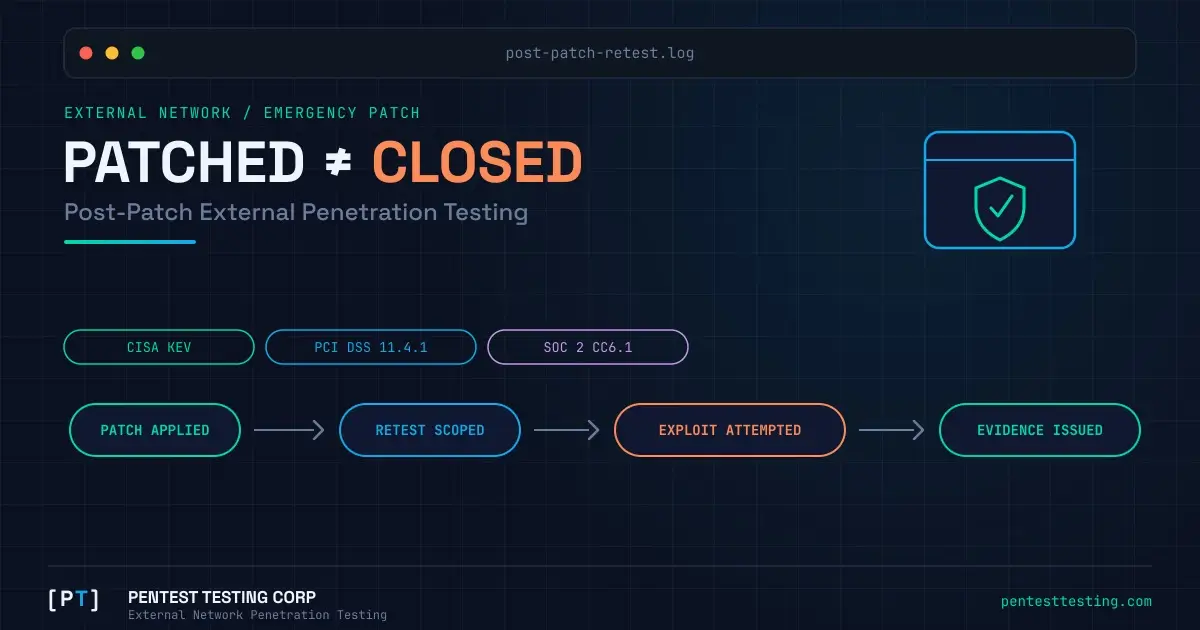
A CISO at a mid-market SaaS company gets the CISA KEV alert at 7 a.m. A vendor advisory, a CVE number, a due date. By that afternoon, the infrastructure team has applied the patch and closed the ticket. By the next morning, the board wants to know one thing: is the exposure actually gone?
That question is harder to answer than it sounds. A closed ticket confirms a patch was applied. It doesn't confirm the vulnerable behavior is unreachable, that no compensating misconfiguration survived the change, or that nothing else on the same host is now exposed in a new way. CISA has added new entries to the Known Exploited Vulnerabilities catalog several times in the past month alone, and each one starts the same cycle: patch fast, then prove it. For internet-facing infrastructure, that gap between "patched" and "proven closed" is exactly where boards, auditors, and cyber insurers are now asking harder questions than they used to.
This guide covers what a targeted external retest actually validates after emergency remediation, how it differs from a rescan or a routine annual pentest, what it costs in time and effort, and what leadership needs to decide before the next KEV alert lands.
Why a Patch Ticket Isn't Evidence Your Perimeter Is Closed
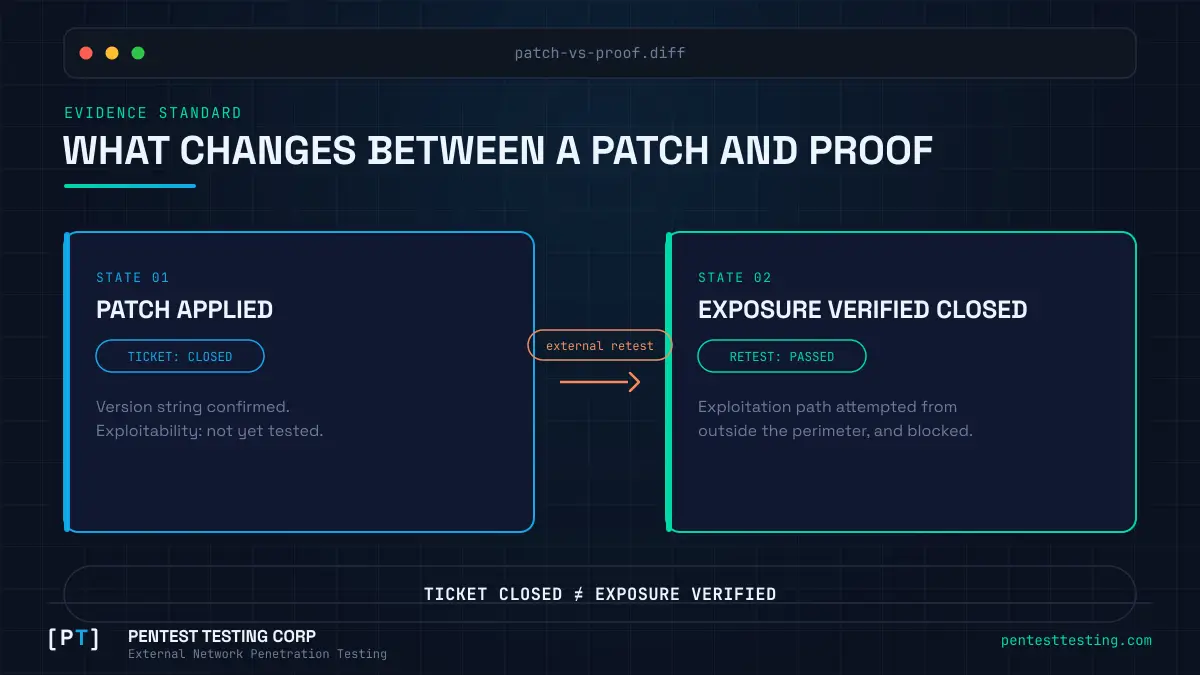
"Patched" is a state change on an asset. "Closed" is a claim about exploitability, and those are not the same thing. When a team races to remediate a KEV-listed CVE under deadline pressure, three things commonly go wrong that a ticket status will never surface.
First, partial remediation. A patch lands on the primary node but not on a secondary appliance, a failover instance, or a legacy management interface that was never inventoried. Second, compensating misconfiguration. The underlying software gets updated, but an authentication bypass on an adjacent admin port, a default credential on a management panel, or a permissive firewall rule that predates the incident stays exactly as exposed as before. Third, scope drift. The emergency change itself, a new firewall rule, a temporary access exception, a fast reconfiguration, introduces a new external exposure that nobody scoped or reviewed because the whole point was speed.
A targeted external penetration test is built to catch exactly these gaps. Instead of confirming a version string changed, it attempts the exploitation path the way an attacker would, against the specific asset, port, and configuration that triggered the emergency response in the first place. That's a materially different question than "did the patch install," and it's the question your board, your auditor, and your cyber insurer are actually asking.
Why This Matters Right Now
CISA's KEV catalog has kept a steady, fast cadence through the summer of 2026. On July 22, CISA added a Check Point SmartConsole authentication bypass and a Microsoft SharePoint deserialization vulnerability to the catalog on the same day, both with a federal remediation window measured in days, not weeks. Two more SharePoint-adjacent KEV entries had already landed earlier that same month, and CISA added further entries in early August covering a Cisco firewall flaw, a Windows kernel driver issue, and a business intelligence platform vulnerability. For teams running any of these products externally, that's not one emergency patch cycle. It's a rolling sequence of them, each with its own remediation deadline and its own unanswered question about closure.
The practical effect on security and compliance teams is a backlog of "we patched it" claims with no consistent way to prove any of them. Boards that used to ask about patch cadence are now asking about validated closure. Cyber insurers and enterprise customers running vendor security questionnaires are asking the same thing after any KEV-listed exposure, and the questionnaire language has shifted too: "describe your patch process" has increasingly become "provide evidence the exposure was independently validated as closed." A rescan can confirm a version number. It can't confirm the door is actually shut, and it's rarely the document that satisfies the party asking the question.
What a Post-Patch External Retest Validates That a Rescan Doesn't
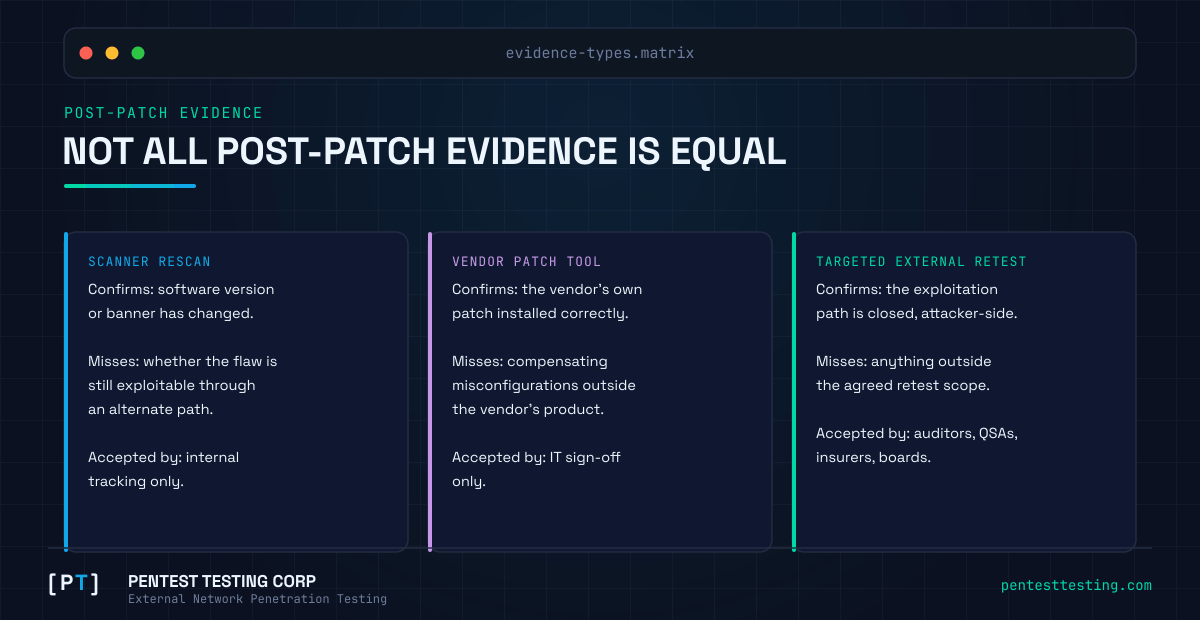
Different forms of post-patch evidence answer different questions, and QSAs, boards, and customers don't all accept the same one.
| Evidence Type | What It Confirms | What It Typically Misses | Who Tends to Accept It |
|---|---|---|---|
| Automated scanner rescan | Software version or banner has changed | Whether the underlying vulnerability is still exploitable through an alternate path; logic flaws; auth bypasses on adjacent services | Internal tracking only; rarely satisfies a QSA or enterprise customer alone |
| Vendor patch-verification tool | The vendor's own patch installed correctly | Anything outside the vendor's own product; compensating misconfigurations; exposure on other externally reachable services | IT operations sign-off; not independent third-party evidence |
| Targeted external penetration retest | Whether the specific exploitation path is closed, from an attacker's vantage point, including adjacent misconfigurations uncovered during testing | Nothing outside the agreed scope; broader posture issues need a fuller assessment | Auditors (PCI DSS, SOC 2), cyber insurers, enterprise security reviews, boards |
The gap between the first two rows and the third is where most "we thought it was fixed" incidents live. A scanner sees a version string. A retest sees whether the thing that made the CVE dangerous in the first place still works.
| This distinction is especially important when a software flaw crosses into cloud identity. The MLflow SSRF cloud credential testing guide shows why teams must validate metadata access, effective IAM, credential use, logging, and revocation after the vulnerable entry point is patched. |
Scope: What's In, What's Out, and How Fast It Runs
A post-patch external retest is deliberately narrower than an annual external network pentest, and that's what makes it fast. Scope typically includes the specific IP, hostname, or service tied to the emergency advisory, the exploitation technique described in the CVE or vendor advisory, any adjacent services on the same host or subnet that share exposure, and the specific change made during remediation (new firewall rule, config change, patch version).
It typically excludes a full re-enumeration of your entire external attack surface, unrelated internal systems, and social engineering or physical testing, unless you deliberately choose to expand scope into a fuller external assessment.
| Engagement Type | Typical Scope | Typical Timeline | Best Fit |
|---|---|---|---|
| Targeted post-patch retest | One CVE/advisory, the affected asset(s), and directly adjacent exposure | 1 to 3 business days from scoping | KEV alert, emergency appliance patch, single high-severity finding |
| Full external network pentest | Entire external attack surface: all IPs, subdomains, VPN endpoints, mail config, cloud perimeter | 3 to 5 business days | Annual compliance cycle, new environment, first-time engagement |
| Free retest after a prior engagement | Findings previously reported in a full pentest | Included at no charge within the agreed retest window | Closing out an existing report before an audit |
Most organizations that reach out after a KEV alert need the first row. If you don't yet have a documented external attack surface inventory, that gap itself is worth flagging to leadership, because it's the reason "which other assets does this affect" is often the hardest question to answer under time pressure.
Illustrative Scenario
The following is a labeled hypothetical, not a specific client engagement. A mid-market financial services firm ran a VPN concentrator that shipped with a KEV-listed authentication bypass. The infrastructure team applied the vendor patch within 48 hours and closed the internal ticket. An automated scanner rescan showed the patched version string and reported the finding as resolved.
A targeted external retest against the same concentrator found that a secondary management interface, exposed on a non-standard port and left out of the original patch scope, still accepted the same authentication bypass technique described in the CVE. The primary path was closed. A parallel path to the same privileged access was not. The finding was remediated within the retest window, and the firm had documented, third-party evidence of closure ready before its cyber insurer's post-incident questionnaire arrived. That's the difference between a patched ticket and a closed exposure: the second path only surfaces when someone tests it the way an attacker would.
Compliance and Evidence: What This Buys You
Emergency patching sits inside a broader evidence obligation that most frameworks now spell out explicitly rather than leaving to interpretation.
PCI DSS v4.0.1 Requirement 11.4.1 requires that exploitable vulnerabilities and security weaknesses found during penetration testing be corrected, and that penetration testing be repeated to verify the corrections. A closed ticket and a rescan don't satisfy that bar on their own for a QSA reviewing evidence tied to a prior finding.
SOC 2 Common Criteria CC6.1 and CC6.6 address logical access controls and boundary protection. Auditors reviewing a Type II period frequently ask how an organization responded to a known exploited vulnerability affecting an internet-facing system, and a documented, dated retest is the cleanest evidence to produce.
HIPAA §164.308(a)(8) requires periodic technical evaluation of security safeguards, which extends to internet-facing systems handling ePHI after a significant change, including an emergency patch.
None of this requires treating every routine patch as a retest event. It does mean that KEV-listed, internet-facing exposures are the category where "we patched it" is the weakest form of evidence you can hand an auditor, a customer's security team, or your own board.
What the Retest Report Should Give You
A post-patch retest is only as useful as the evidence package that comes out of it. Before you scope one, confirm the deliverable will include:
- A direct statement of the original exploitation path and its current status, closed, partially closed, or unresolved, written in plain language a non-technical stakeholder can act on.
- Reproduction detail for anything still exploitable, with enough specificity for your engineering team to fix it without a follow-up call.
- Confirmation of what was in scope and what wasn't, so an auditor or customer can't mistake a narrow retest for a full external assessment.
- A dated, signed attestation suitable for a QSA, SOC 2 auditor, or enterprise procurement questionnaire.
- A free retest window once any remaining finding is fixed, so closure doesn't require a brand-new engagement.
If a report can't produce those five items, it's closer to a scan summary than evidence a board or auditor will accept.
What Leadership Should Decide
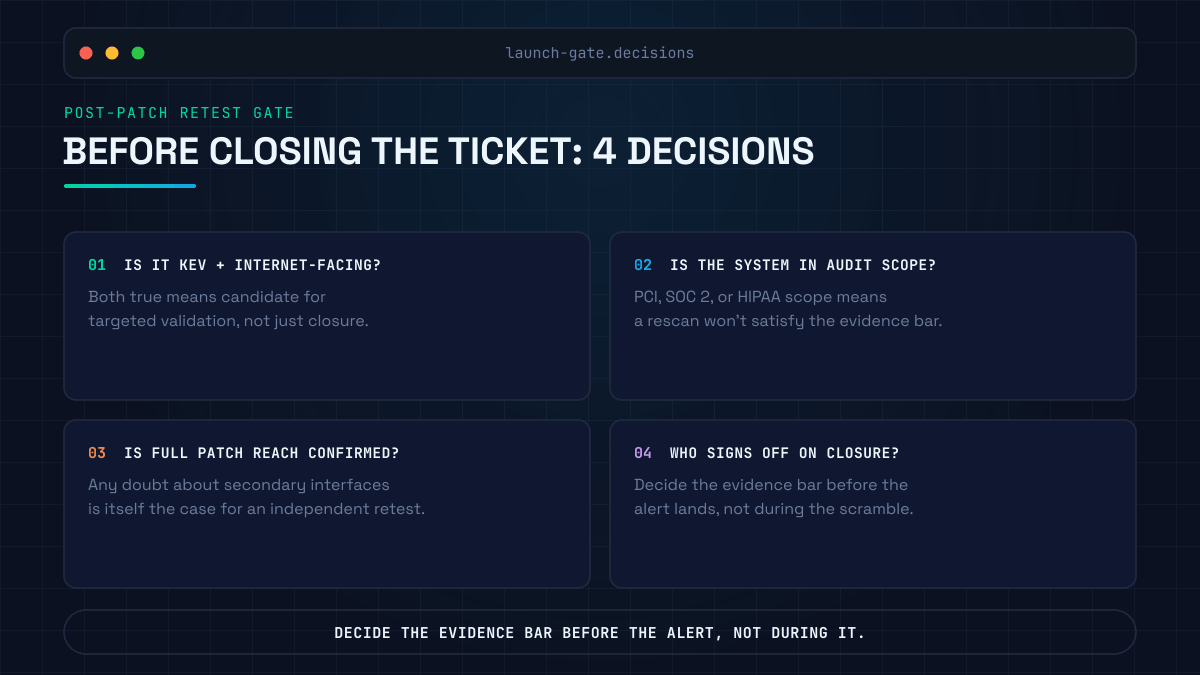
Not every patch needs a dedicated retest. The decision comes down to four questions a CISO, IT director, or compliance lead should be able to answer quickly when a KEV alert lands.
- Is the affected asset internet-facing, and is the CVE on the CISA KEV catalog? If both are true, treat this as a candidate for targeted validation, not just ticket closure.
- Does the emergency change touch a system in scope for PCI DSS, SOC 2, HIPAA, or a customer security addendum? If yes, a scanner rescan is very unlikely to satisfy the evidence bar an auditor or customer will apply later.
- Can the internal team confirm, with confidence, every asset and adjacent service the patch actually touched? If there's any uncertainty about secondary interfaces, failover nodes, or legacy configurations, that uncertainty is itself the argument for an independent retest.
- Who signs off that the exposure is closed, and what evidence do they need in hand to do it? Decide this before the next alert, not during it. A pre-agreed evidence bar turns a chaotic patch cycle into a repeatable one.
Answering these four questions in advance, as a standing policy rather than a one-off scramble, is what separates organizations that produce audit-ready evidence from organizations still explaining to a QSA why last quarter's KEV finding has no retest on file.
Building This Into Your Remediation Workflow
A targeted post-patch retest works best as one stage in a broader remediation cadence, not a standalone reaction. If your team already runs a structured CISA KEV remediation sprint or a weekly KEV-driven vulnerability management cadence, a targeted external retest is the validation step that closes the loop those workflows already assume is happening. It answers the "how did we validate" question that shows up in every audit-acceptable evidence pack.
For incidents where the emergency isn't just a patch but a potential compromise, such as the recent CVE-2026-20963 SharePoint response window, evidence preservation and DFIR triage need to happen before or alongside remediation, not after. A targeted retest complements that work once containment and patching are done; it doesn't replace the forensic question of whether the vulnerability was exploited before you closed it.
It's also worth distinguishing this from device-level forensic validation. A rapid DFIR checklist proves an endpoint or mobile device is clean after a patch cycle by hunting for persistence and validating telemetry on the device itself. A post-patch external retest proves something different: that the network-reachable exploitation path an attacker would use from outside your perimeter is actually closed. Most organizations dealing with a KEV-listed, internet-facing CVE need both, aimed at different layers of the same incident.
If the emergency patch came out of a full pentest report rather than a single KEV alert, our 30-day pentest remediation ownership plan lays out who signs off before that retest gets scheduled.
If remediation on your side needs structural work beyond the emergency patch, documented change control, compensating controls, or a formal exception process, our remediation services team builds that alongside the technical fix so the evidence pack holds up under audit.
Frequently asked questions about Post-Patch External Penetration Testing
What does a post-patch external penetration test check that a rescan does not?
A rescan confirms a version or banner changed. A targeted retest attempts the actual exploitation technique described in the CVE or advisory, against the live environment, and checks adjacent services on the same host for the same or related weaknesses that the patch didn't touch.
How is this different from our annual external pentest?
An annual external pentest covers your full internet-facing attack surface on a fixed schedule. A post-patch retest is scoped narrowly to one advisory, one asset, and its directly adjacent exposure, and it runs on an emergency timeline rather than a calendar one.
How fast can this be scoped after a KEV alert?
Most targeted retests can be scoped and completed within one to three business days once you provide the affected IP, hostname, or service and confirm the patch or mitigation has been applied. Rush timelines can often be accommodated depending on availability.
Does this count as evidence for PCI DSS or SOC 2?
Yes, when performed and documented by an independent, qualified tester. PCI DSS Requirement 11.4.1 explicitly expects correction to be followed by retesting, and SOC 2 auditors reviewing CC6.1/CC6.6 commonly request evidence of how a known exploited vulnerability was validated as closed.
We already ran the vendor's own patch verification tool. Isn't that enough?
A vendor tool confirms its own patch installed correctly. It won't tell you about a compensating misconfiguration on an adjacent port, a secondary management interface outside the patch's reach, or an exposure the emergency change itself introduced. For KEV-listed, internet-facing findings, auditors and enterprise customers generally want independent validation, not a vendor's self-check.
Do you need production access, or can this run against a staging mirror?
Testing the actual production, internet-facing asset is what produces valid evidence, since that's what an attacker would reach. Rules of engagement, safe-testing controls, and a confirmed testing window are agreed in writing before any testing begins to minimize operational risk.
How is this different from a KEV remediation sprint or a DFIR response?
A KEV remediation sprint is the operational cadence for triaging, patching, and tracking exploited vulnerabilities across your environment. DFIR response addresses whether a vulnerability was already exploited before you patched it. A post-patch external retest sits after both: it independently validates, from outside your perimeter, that the specific exposure is now closed.
What happens if the retest finds the exposure isn't fully closed?
You get a documented finding with reproduction steps and remediation guidance, scoped to close the gap quickly, plus a free retest of that specific item once it's fixed. That's a far better position than discovering the gap during an audit or after an incident.
Need to prove a recent emergency patch actually closed the exposure? Book a targeted external validation scoping call or review our external network penetration testing service for full scope and pricing details.