Local AI Agent Security Assessment Scope: Close the Inventory Gap
Your IT director approves a desktop assistant for a small operations team. Procurement has the supplier questionnaire, devices have endpoint protection, and employees sign in through company accounts. During rollout, one user adds a local Model Context Protocol (MCP) server to read project files. Another enables an extension that can update customer records. A third connects a personal account. The approved application now represents several different access arrangements.
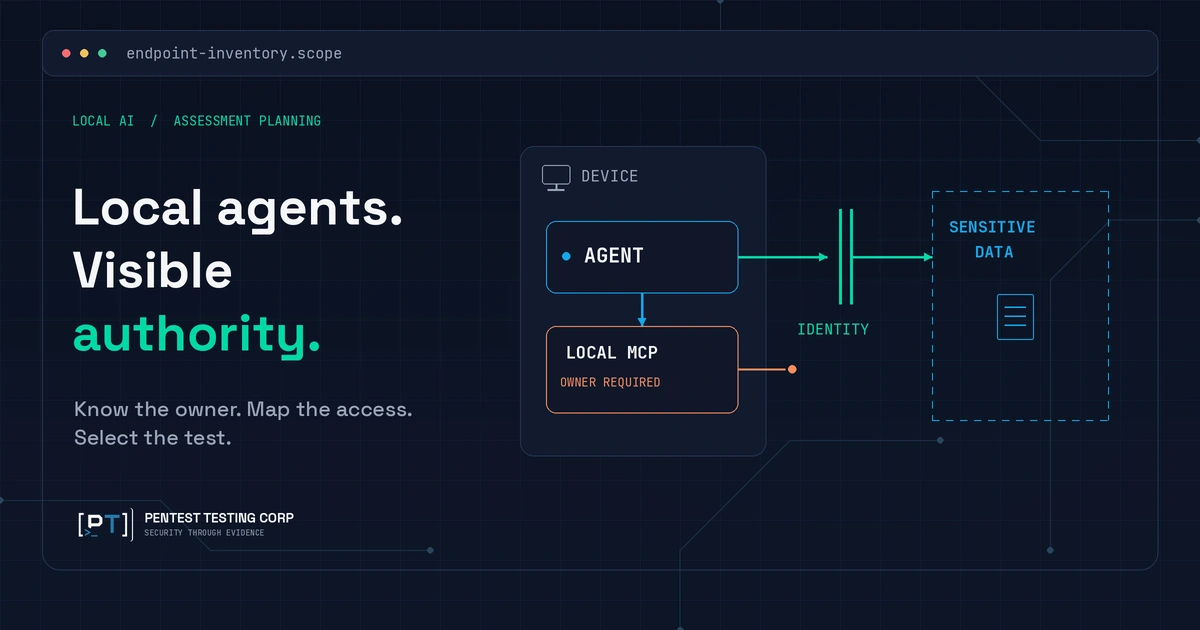
A useful local AI agent security assessment scope starts by identifying those arrangements. The decision is which deployed combinations of software, identity, data and business authority need validation before access expands. An application count cannot answer that question.
Leadership needs an owned inventory that connects each deployment to its business purpose, effective permissions and evidence gaps. That inventory becomes the basis for targeted testing, remediation funding and rollout approval. It also gives endpoint and security teams a shared record to maintain when users, integrations or policies change.
Define a local AI agent security assessment scope around authority
For this assessment, a local agent is software operating on an endpoint that uses an AI model to select or perform tasks through files, applications or connected tools. The model may run locally or remotely. Record those locations separately: endpoint execution, model inference, tool execution and data storage can sit in different places.
“Local” therefore does not establish an offline workflow or a privacy guarantee. The assessment must establish where information can travel and which controls govern that movement. A local interface may call a cloud model, use a remote connector, retain local task history or operate an authenticated browser. Each path changes the evidence needed for approval.
The inventory unit should be a deployed configuration with a defined authority boundary. Two employees using the same product may need different scope entries if one has a restricted project workspace and the other has a finance session, shared drive or production credential. Grouping them by application name hides the distinction that determines business impact.
Once those boundaries are visible, AI penetration testing for agent integrations can be scoped against selected workflows. Name endpoint discovery and configuration review explicitly in the statement of work; an AI application test should not be assumed to include fleet discovery.
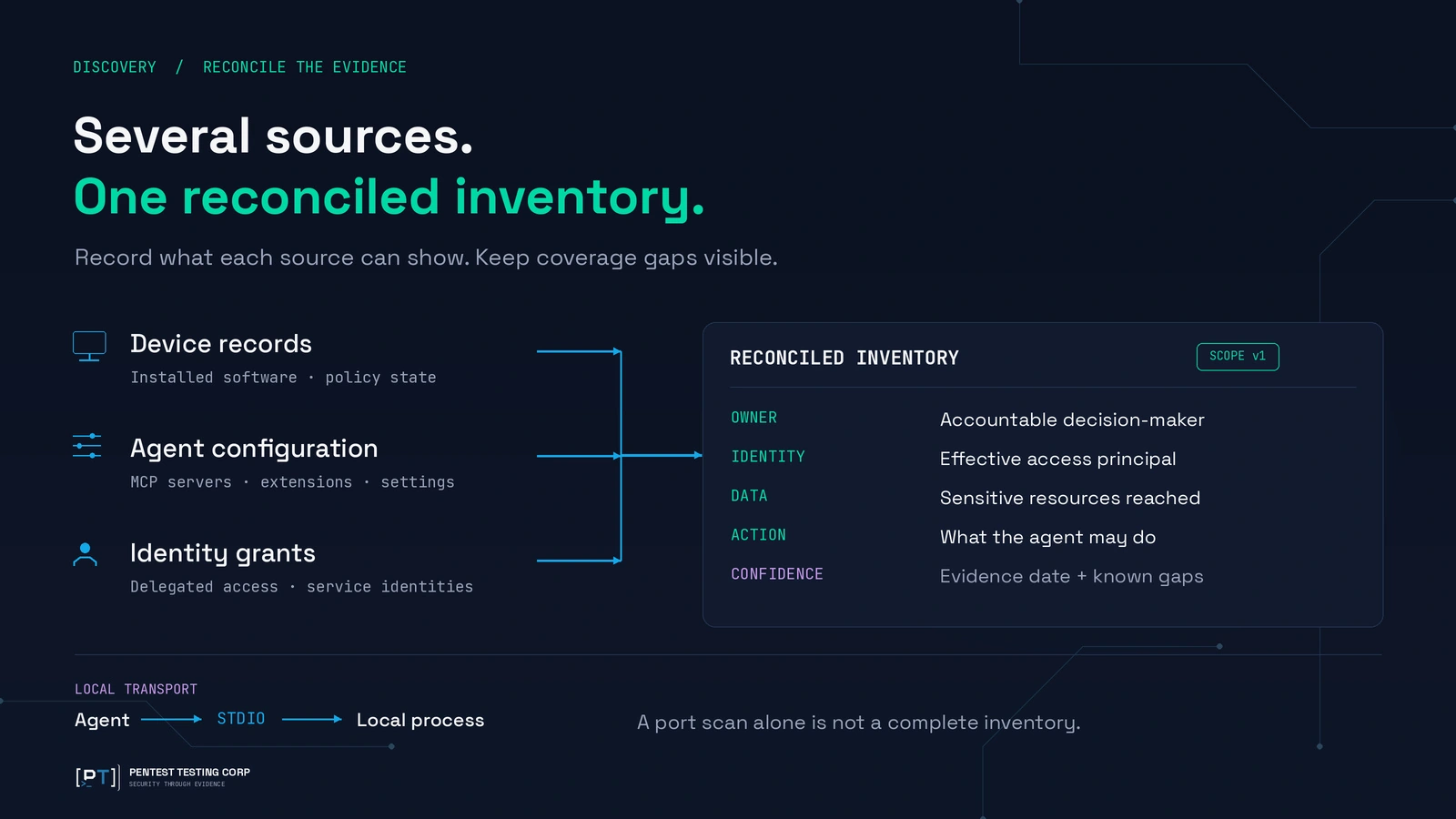
Existing controls contribute useful evidence. Device management can show enrollment and policy state. Endpoint detection can show selected process activity. Identity records can show granted access. What still needs reconciliation is whether the complete agent workflow fits the approved purpose. Ask the endpoint owner to produce that joined view before security commits to a test sample.
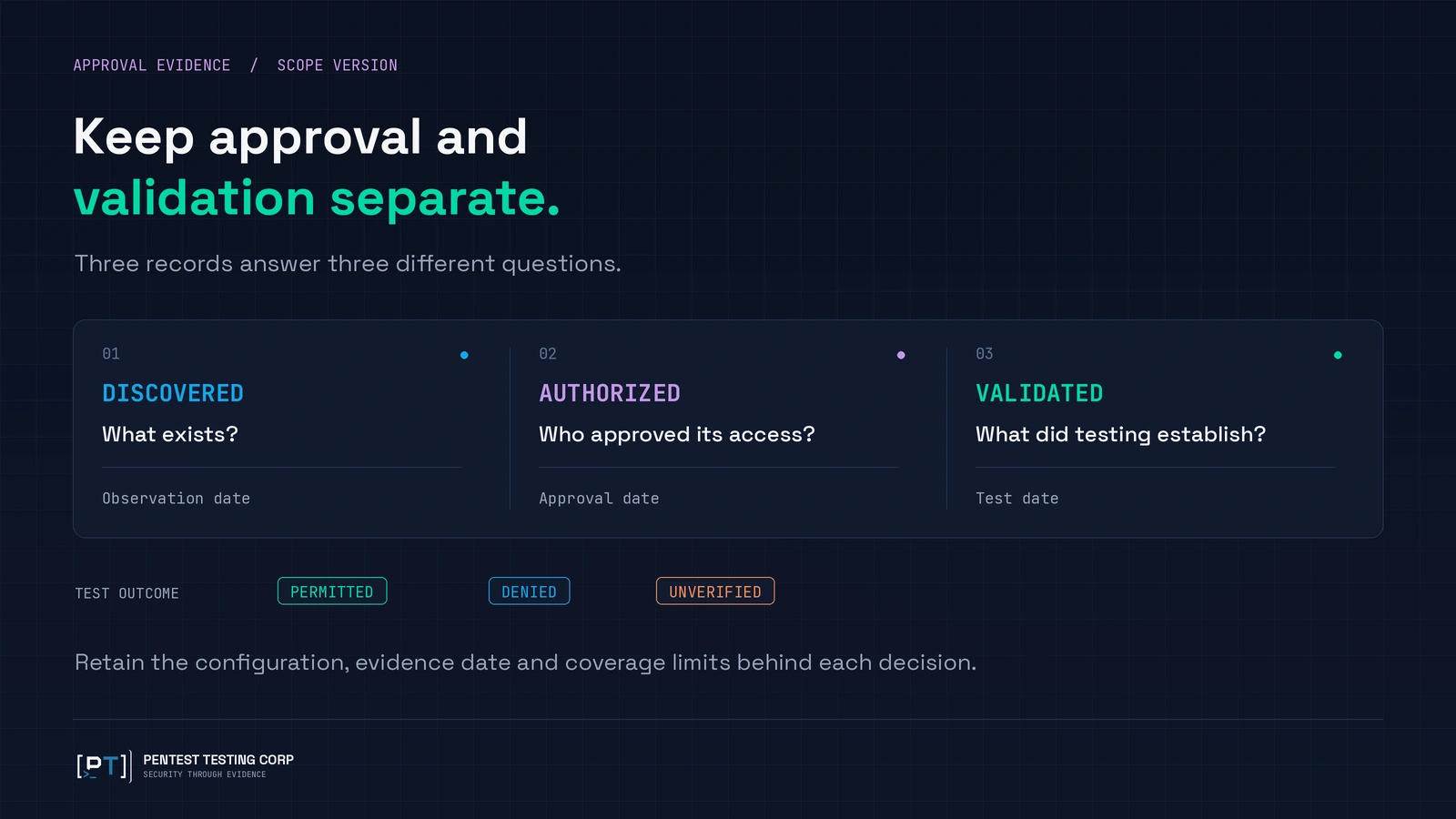
Keep three status fields separate: discovered, authorized and validated. Discovery establishes presence; authorization records a decision; validation provides evidence about specified controls. An approved product can have an unreviewed integration, and a discovered component can remain unclassified while its owner supplies missing context.
Build endpoint discovery from several evidence sources
Begin with the population you intend to cover: operating systems, business teams, managed devices, contractor access and relevant virtual or remote desktops. State the discovery period and collection limits. A report covering enrolled laptops should not imply coverage of unmanaged devices or developer environments it could not inspect.
Reconcile complementary sources rather than buying an inventory label and assuming completeness. The following table is a collection plan, not a claim that every management product exposes every field. Ask each owner what the available tooling can actually collect.
| Evidence source | Useful inventory signal | Limitation to resolve |
|---|---|---|
| Device and software management | Device owner, installed agent, version and policy assignment | Per-user packages, portable applications and unmanaged devices may be absent. |
| Endpoint activity records | Agent-launched processes, observed execution and selected connections | Offline devices, retention limits and sensor coverage restrict conclusions. |
| Agent and integration configuration | Registered MCP servers, extensions, project settings and tool definitions | Configuration shows declared access; validate effective access separately. |
| Identity and SaaS administration | Delegated grants, service accounts and connected business systems | Local credentials and inherited browser sessions need additional review. |
| Owner confirmation and workflow review | Business purpose, sensitive data and exceptional use | Self-reporting needs corroboration from deployment or activity evidence. |
A local MCP server need not present a listening network port. MCP supports a standard-input/output transport as well as HTTP-based transport, so network discovery alone cannot establish a complete local inventory. The official MCP transport documentation helps distinguish these deployment paths. Translate that distinction into collection requirements for endpoint and application owners.
Likewise, do not assume every local server uses the same authorization arrangement as a remotely hosted service. The MCP authorization guidance describes local STDIO credential approaches. For buyers, the implication is to record the credential source and responsible owner rather than accepting “MCP enabled” as an access-control description.
Use “shadow MCP server” for a server outside the organization's approved inventory or governance process. Its discovery warrants classification and review; it does not prove maliciousness or compromise. If there are separate signs of an incident, preserve relevant evidence and involve the incident owner before routine cleanup changes the environment.
After servers are identified, the MCP protocol-layer testing guide addresses their narrower assessment questions. Keep discovery coverage visible alongside those tests. A well-tested registered server cannot explain an unrecorded deployment elsewhere in the fleet.
Tie every record to an owner, identity and business action
An inventory becomes decision support when someone can approve, restrict or remove the access it describes. Assign an accountable business owner for each workflow and a technical custodian for its deployment. The employee using an assistant may be neither the owner of the underlying customer data nor the person authorized to accept its risk.
Use a stable record identifier and link it to the device or device group, user or service identity, agent configuration and integration records. Preserve evidence dates. An entry without a last-confirmed date is difficult to compare with a later permission change or assessment result.
At minimum, capture these connected fields:
- Deployment: agent, version, operating system, installation source, update path, configuration revision and endpoint population.
- Accountability: business purpose, accountable owner, technical custodian, approval state and exception expiry.
- Identity: user, delegated identity or service account; credential source; browser-session use; revocation owner.
- Resources: accessible folders, repositories, connected services, data classifications and external destinations.
- Authority: read, write, send, execute or administer; approval requirements; prohibited outcomes; recovery options.
- Assurance: evidence source, confidence, last observation, known exclusions, assessment status and next review trigger.
Record intended access, configured access and validated access separately. A team may intend an agent to summarize one project while a connector is configured for a wider repository. Testing determines the effective boundary for the selected configuration. Until then, mark the difference as unresolved.
For desktop agent permissions, include relevant file access, application control and authenticated session use. Access to ordinary business software can be consequential without local administrator privileges. An agent able to send information through a user's mailbox may create confidentiality or contractual exposure even when it cannot modify the operating system.
Where screen or browser operation is involved, computer-use agent security testing explains the action and session controls that deserve validation. The inventory should identify those workflows before the assessment starts, including the business applications reached through them.
Collect metadata before content. Store credential references rather than secrets, and resource classifications rather than unnecessary copies of files. Restrict access to the inventory itself: a detailed map of privileged identities, sensitive repositories and control gaps is security-relevant information.
Turn the inventory into a local AI agent security assessment scope
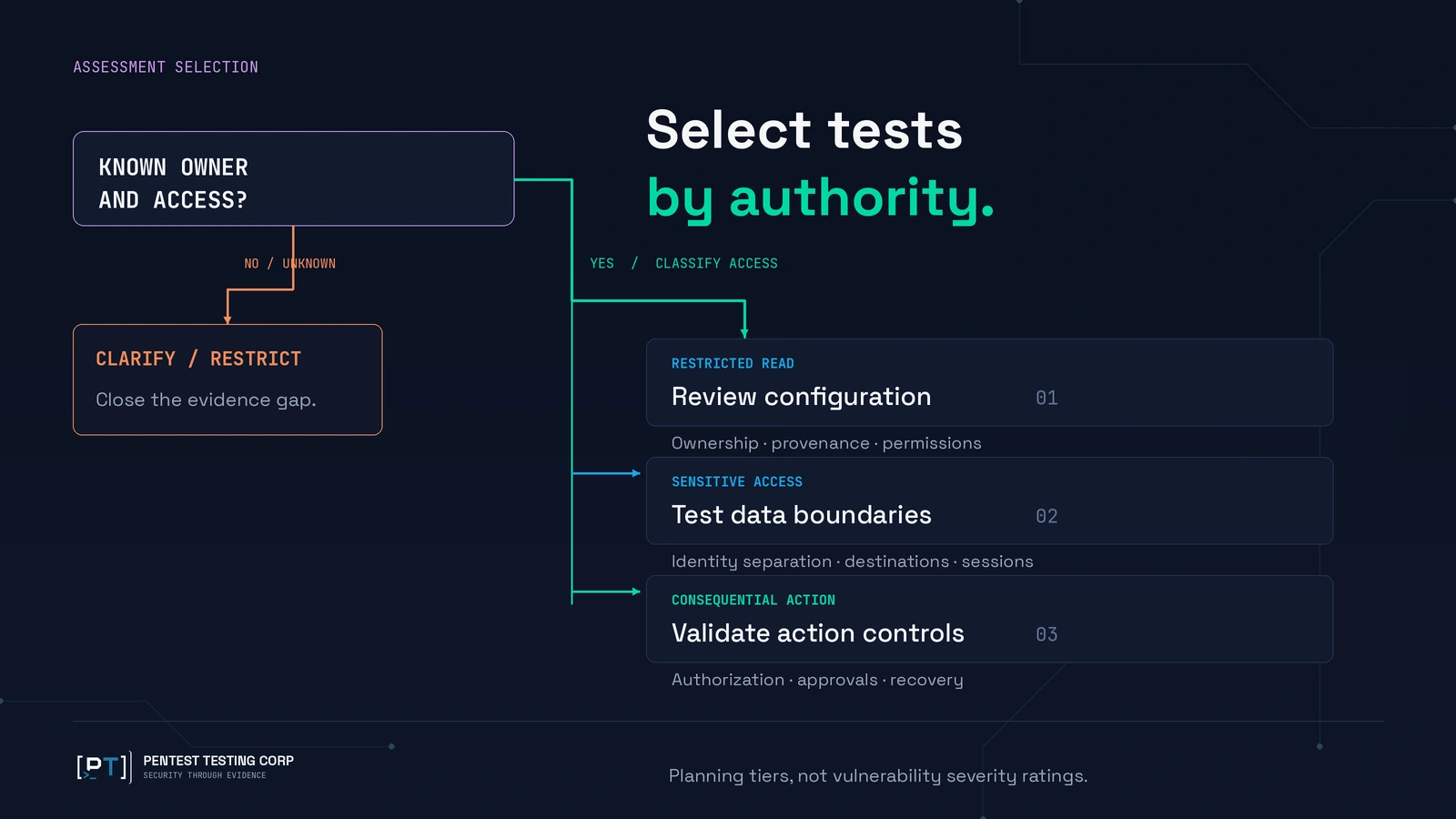
Prioritize what the deployment could affect, how independently it can act and how confidently its boundaries are known. Tool count is a poor substitute. One integration with broad customer-export authority can warrant more attention than several tightly restricted internal reference tools.
Use the following tiers as planning categories. They are not vulnerability severities, regulatory classifications or automatic acceptance rules. An unknown should increase the need for clarification; it should not silently become evidence of low exposure.
| Discovered profile | Initial assessment emphasis | Decision evidence |
|---|---|---|
| Restricted reading of non-sensitive material; no consequential actions | Ownership, provenance, configuration and permission review | Approved baseline and evidence that access remains bounded |
| Sensitive information, authenticated sessions or external sharing | Data access, identity separation, destinations and session lifecycle | Permitted and denied results for selected data and identity boundaries |
| Customer-record changes, code execution, financial or privileged actions | End-to-end authorization, approvals, containment and recovery | Traceable action evidence, tested restrictions and remediation status |
| Unknown owner, unclear credentials or incomplete visibility | Close discovery gaps; consider temporary access restrictions | Named owner and sufficient facts to classify or retire the deployment |
Select representative configurations and important exceptions
Group deployments only when the factors affecting authority are materially equivalent: runtime, policy, identity type, tools, data sensitivity and action rights. Sample a representative baseline, then deliberately include exceptions such as a privileged user, a different operating system, a project-specific connector or a locally changed policy. Document why each sample represents its group.
Separate discovery breadth from testing depth. The fleet can receive broad inventory collection while independent boundary testing concentrates on high-impact configurations. Report unobserved devices and untested groups explicitly. A sample result supports the configurations and conditions tested; it does not establish that every employee's installation behaves identically.
Write acceptance claims before selecting test cases
Useful claims describe outcomes: the agent can read the assigned project but cannot read a separate restricted workspace; the current identity can update its authorized records but cannot change another business unit's records; disabling the integration removes the access it was meant to remove. Attach each claim to an enforcement point and expected evidence.
Where filesystem, process or network restrictions are material, add sandbox boundary validation. Where the agent changes a business record, include the downstream authorization decision as well. Those are different boundaries, and both may matter in one workflow.
Agree safe accounts, synthetic data, test permissions, prohibited production actions and recovery arrangements before execution. Require permitted-workflow checks alongside denied-action checks. A restrictive configuration that prevents legitimate work can push users toward unmanaged alternatives and may require a different design.
Specify the deliverable: a versioned inventory, coverage statement, selected workflow matrix, validated findings, unresolved assumptions, remediation owners and retest conditions. Distinguish a blocked operation from a model refusal and from a result the assessor could not verify. Each supports a different leadership decision.
Hypothetical scenario: one approved assistant, three scopes
This scenario is illustrative and does not describe a client engagement. A professional-services firm approves a desktop assistant to summarize engagement notes. Endpoint records show a consistent application version across a pilot group, so the initial plan proposes testing one ordinary user.
Inventory reconciliation reveals three configurations. The first reads a dedicated folder containing approved reference material. The second has a local connector to a synchronized client directory. The third can operate a browser profile with access to the firm's customer portal. All share the same product name, but their business consequences differ.
The discovery does not establish that information has been disclosed or that a record has been changed improperly. It establishes that the proposed sample cannot represent the access leadership is about to approve. The second configuration needs data-boundary and destination evidence. The third needs identity, permitted-action and approval evidence.
The firm limits new integrations while owners classify the exposed resources. Testing uses synthetic client records and an authorized test account. If the agent attempts to reach a restricted record and an independent control denies it, record that boundary result. If access succeeds, document the authorization failure and affected scope. If supplier visibility prevents a conclusion, retain the limitation.
Leadership can then approve the narrow reference workflow, fund a restricted connector configuration and hold the customer-portal workflow until its material questions are resolved. The value comes from separating decisions that an application count had combined. Remediation effort follows the actual gap: a permission correction, a new identity arrangement or a redesigned workflow.
Map assessment evidence to governance and assurance
Framework mapping should explain why a record or test matters. It should not turn discovery into a claim of certification. Use the edition named in the assessment and retain the organization's own acceptance criteria.
NIST CSF 2.0 provides useful outcomes: GV.RR-02 addresses accountability; ID.AM-02 covers software, service and system inventories; ID.AM-03 covers authorized communications and data flows; ID.AM-05 supports prioritization by importance and impact. Apply them to the inventory's ownership, deployment, flow and priority fields.
The NIST AI RMF 1.0 adds AI context. GOVERN 1.6 concerns mechanisms for inventorying AI systems, while GOVERN 2.1 concerns documented responsibilities. An assessment can use GOVERN, MAP, MEASURE and MANAGE to connect ownership, workflow context, boundary evidence and treatment decisions. This is an application of a voluntary framework.
For the OWASP 2025 edition, LLM03:2025 Supply Chain supports examining component origins, versions and update dependencies. LLM06:2025 Excessive Agency concerns unnecessary functionality, permissions or autonomy. Apply these labels where the deployment or validated finding fits; an installed extension is not automatically a supply-chain vulnerability.
For SOC 2, discuss access evidence under CC6 and relevant risk-mitigation or supplier dependencies under CC9 using the AICPA Trust Services Criteria. The exact controls and evidence depend on the system and examination scope. Our discussion of how SOC 2 applies to AI risk provides additional context; neither an inventory nor a penetration test alone establishes SOC 2 conformity.
What leadership should decide before expanding access
Ask for a scope decision the business can maintain. Name the endpoint or platform owner responsible for discovery, the data owners who authorize access and the security owner who selects validation work. Give unresolved deployments a decision date and an interim operating boundary.
Approve which data classes and action types may remain in the pilot. Define what evidence is required before adding sensitive repositories, external communications, code execution or privileged business functions. Exceptions need an accountable approver, an expiry date and a condition for removal.
Budget discovery, testing and remediation as distinct workstreams. Existing endpoint evidence and standardized configurations can reduce collection effort. Multiple operating systems, unmanaged environments, user-specific connectors, shared identities and inaccessible supplier controls increase coordination and validation effort. Identity redesign or downstream authorization changes can take more work than adjusting an agent setting.
Schedule by readiness gates: confirm population and access; reconcile records and owners; approve test claims; validate selected boundaries; remediate and retest material failures. Request an estimate after the assessor reviews these inputs. A fixed fleet size does not establish a reliable timeline when configuration diversity remains unknown.
Make inventory maintenance part of endpoint operations. Reopen the scope when a change expands data, tools, identity permissions, autonomy or reachable business systems. For ongoing baseline and access-review work, discuss managed IT support for endpoint controls and explicitly agree the local-agent responsibilities.
The next decision should follow the discovered authority. Bring the device population, agent configurations, connected identities, sensitive resources and prohibited outcomes to scope an AI security assessment. A useful engagement establishes which deployments can proceed, which need narrower access and which still lack enough evidence for approval.
Frequently asked questions
Do personal devices belong in the discovery scope?
Include them when they can access relevant company systems, subject to authorized collection and applicable workplace rules. Where device inspection is unavailable, record the visibility gap and assess identity, application-access and data-sharing controls. Do not describe those devices as fully inventoried.
Can we begin when the inventory is incomplete?
Yes. Define a bounded first phase and prioritize known sensitive access. Keep unresolved populations and configurations visible in the coverage statement. Expand the assessment when discovery adds materially different authority or workflows.
Should we remove every unapproved local integration immediately?
Use a documented triage decision based on access, business dependency and incident indicators. Restriction may be appropriate while ownership is established. Where compromise is suspected, coordinate evidence preservation and containment with the incident owner before routine removal.
What if the supplier prohibits active testing?
Respect the testing restrictions, request deployment-specific assurance evidence and assess authorized customer-controlled boundaries. Record inaccessible supplier behavior as a limitation. Leadership can then decide whether restricted access, additional contractual evidence or another solution is necessary.
Do we need to retain employees' prompts for inventory?
Not by default. Start with deployment, identity, permission and activity metadata. If selected testing needs content, agree on a defined purpose, restricted access and a retention period, preferably using synthetic material. Avoid creating an unnecessary sensitive-content repository.
Can an older application pentest reduce this work?
It may provide reusable evidence for unchanged downstream controls. Compare its tested versions, identities, workflows and exclusions with the current deployment. Ask the assessor to identify the remaining endpoint, agent and integration gaps rather than assuming the earlier report covers them.