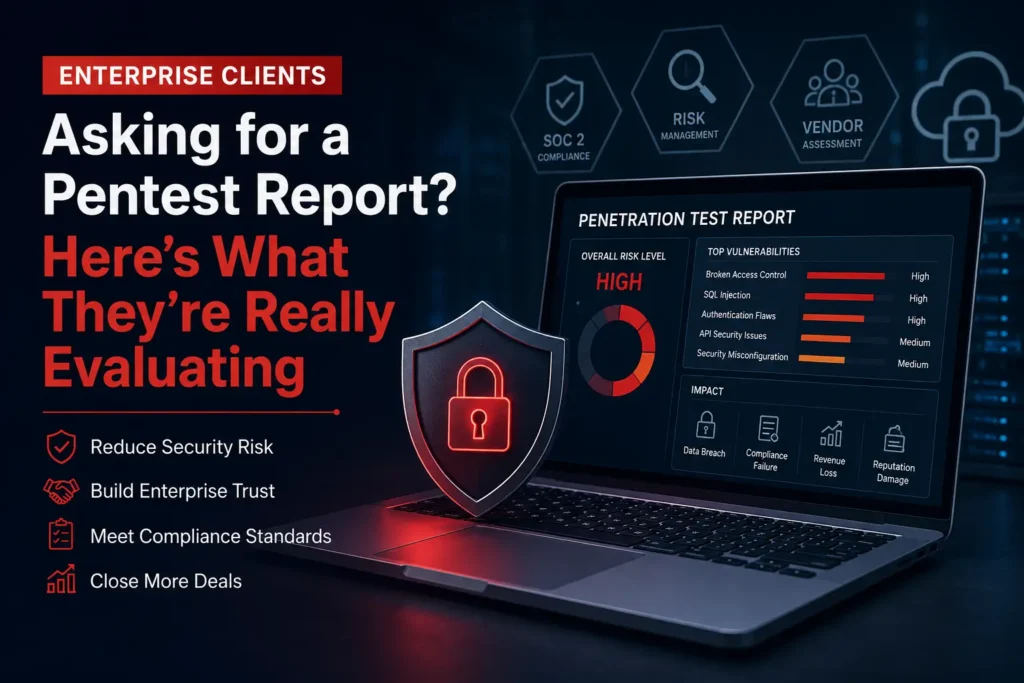
Enterprise Clients Asking for a Pentest Report? Here’s What They’re Really Evaluating
Enterprise buyers rarely ask for a penetration test report just to “check a compliance box.”
They’re evaluating whether your SaaS platform could become their next security incident.
If your company handles customer data, APIs, authentication workflows, or internal business operations, security reviews now directly influence procurement decisions. Security questionnaires, vendor risk assessments, SOC 2 requirements, and penetration testing reviews are often handled before legal contracts are finalized.
For many SaaS companies, deals stall because the pentest report doesn’t answer the questions enterprise security teams actually care about.
They want to know:
- Can attackers access customer data?
- Can APIs be abused?
- Are privilege boundaries enforceable?
- Was testing manual or just automated scanning?
- Did the testing simulate real attacker behavior?
- Were vulnerabilities validated properly?
This is where a proper vendor security assessment penetration test becomes critical.
A weak report creates doubt. A strong report builds trust and accelerates enterprise procurement.
If you want to quickly identify obvious weaknesses before an enterprise review, you can run a quick vulnerability scan to check your current exposure.
Why Enterprise Buyers Reject Pentest Reports
Many SaaS companies submit reports generated mostly from automated scanners.
That’s usually obvious to experienced security teams within minutes.
Enterprise buyers often reject penetration test reports because:
- No manual testing was performed
- APIs were barely tested
- Authentication workflows were ignored
- Business logic vulnerabilities were missed
- Findings lacked exploit validation
- Risk ratings were inconsistent
- Remediation guidance was generic
- The scope was too limited
Security teams reviewing vendor assessments already know automated tools can miss critical vulnerabilities.
According to OWASP Top 10, modern attacks frequently involve broken access control, insecure APIs, and authentication weaknesses that scanners struggle to detect reliably.
A pentest report is not just technical documentation anymore. A professional penetration testing report is part of your sales process.
The Real Risk Behind Weak Penetration Testing
Imagine a B2B SaaS platform serving enterprise finance customers.
The platform passes basic vulnerability scans. SSL is configured correctly. Dependency checks look clean.
But during manual testing, an attacker discovers an IDOR vulnerability in the API.
Changing a customer ID inside an API request exposes invoices belonging to other tenants.
No authentication bypass was required. No malware. No sophisticated exploit chain.
Just broken access control.
Now imagine this vulnerability being discovered after enterprise onboarding.
The result could include:
- Customer data exposure
- Regulatory reporting requirements
- Contract termination
- SOC 2 audit findings
- Revenue loss
- Reputation damage
This is exactly why enterprise procurement teams scrutinize vendor security assessment penetration test reports so carefully.
New Compliance Resource for Security Teams
If you're preparing for SOC 2, PCI DSS, HIPAA, ISO 27001, or GDPR audits, our latest guide breaks down exactly what organizations should validate before a penetration test begins.
Read: Compliance Penetration Testing Checklist
The article covers:
- Scope validation and asset inventory
- Authentication and access control testing
- API and web application security checks
- Cloud and infrastructure review points
- Evidence collection for compliance audits
- Common gaps auditors and pentesters frequently identify
This checklist is designed for SaaS companies, fintech platforms, healthcare organizations, and growing startups that need to reduce risk while meeting compliance requirements. It aligns with common testing methodologies including OWASP and industry-standard penetration testing practices.
How Attackers Exploit Common SaaS Weaknesses
SQL Injection Still Exists in Production Applications
SQL injection remains one of the most damaging vulnerabilities because it can lead directly to database compromise.
Attackers typically begin by identifying user-controlled parameters:
- Search fields
- Login forms
- API query parameters
- Filtering functionality
They inject malicious payloads to manipulate backend database queries.
A vulnerable application may unintentionally expose:
- Customer records
- Authentication data
- Internal configuration
- Financial information
In severe cases, attackers gain administrative database access.
Real-world penetration testing frequently uncovers SQL injection vulnerabilities hidden inside legacy endpoints, admin panels, or poorly secured APIs. In one assessment report, manual testing identified exploitable SQL injection across multiple application parameters with direct database access exposure.
This is why enterprise buyers expect comprehensive web application penetration testing rather than basic automated scanning.
IDOR and Broken Access Control Are Extremely Common
Broken access control is one of the most dangerous SaaS risks because it often bypasses traditional defenses entirely.
Attackers test whether changing identifiers inside requests exposes unauthorized data.
For example:
- User accesses
/api/customer/1001 - Attacker changes it to
/api/customer/1002 - Another tenant’s data becomes accessible
Many automated tools fail to identify this because exploitation depends on understanding application logic and user roles.
Enterprise environments are especially vulnerable when:
- Multi-tenant authorization is inconsistent
- APIs evolve rapidly
- Backend access rules differ from frontend controls
This category of vulnerability continues to rank among the most critical issues in the OWASP API Security Top 10.
Authentication Flaws Create High-Impact Exposure
Authentication weaknesses are frequently underestimated during development.
Attackers target:
- Weak session handling
- Predictable tokens
- Session fixation
- Missing MFA enforcement
- Password reset logic flaws
In many cases, attackers don’t “hack” accounts traditionally. They abuse broken authentication workflows already present in the application.
A real penetration test example identified session fixation vulnerabilities where session IDs remained unchanged before and after authentication, allowing attackers to hijack authenticated sessions.
For enterprise customers, authentication weaknesses immediately raise concerns around SOC 2 controls and access management requirements.
API Abuse Often Goes Undetected
Modern SaaS platforms rely heavily on APIs.
Unfortunately, APIs are also one of the least tested attack surfaces during rushed assessments.
Attackers commonly abuse APIs through:
- Excessive data exposure
- Rate limit bypass
- Privilege escalation
- Mass assignment
- Improper authorization
- Token abuse
APIs are difficult to secure because they evolve rapidly and frequently expose business logic directly.
This is why mature organizations now prioritize dedicated API security testing during vendor reviews.
Why Automated Tools Fail to Detect Critical Risk
Automated scanners are useful for identifying low-hanging issues.
But they cannot think like attackers.
They typically fail in areas involving:
- Business logic abuse
- Authorization chains
- Multi-step attack paths
- Tenant isolation
- Context-aware authentication
- Complex API relationships
For example, a scanner may confirm authentication exists without verifying whether privilege escalation is possible afterward.
It may detect endpoints but fail to understand whether data exposure violates tenant boundaries.
This creates dangerous false negatives.
Enterprise buyers know this. That’s why they often ask:
- Was testing manual?
- Were vulnerabilities exploited safely?
- Were APIs tested deeply?
- Did testers validate authorization controls?
If your report cannot answer those questions clearly, security reviewers lose confidence quickly.
How Professional Penetration Testing Reduces Enterprise Risk
Effective penetration testing goes far beyond vulnerability scanning.
A skilled tester:
- Thinks like an attacker
- Validates exploitability
- Chains weaknesses together
- Tests business logic manually
- Evaluates real-world attack paths
At professional penetration testing services providers, testing should include both automated and manual methodologies aligned with frameworks like OWASP, SOC 2, and modern SaaS attack models.
Manual testing helps uncover:
- Hidden authorization flaws
- API trust boundary failures
- Session management weaknesses
- Exploitable privilege escalation
- Realistic lateral movement scenarios
A quality pentest report should also provide:
- Clear business impact analysis
- Reproducible proof-of-concept evidence
- Remediation guidance
- Risk prioritization
- Executive summaries for buyers and auditors
If your organization is preparing for enterprise procurement reviews, you should perform a comprehensive penetration test before security questionnaires become blockers.
What Enterprise Buyers Look for in a Pentest Company
Manual Testing Capability
Enterprise security teams want evidence of human-led testing.
If the report reads like exported scanner output, credibility drops immediately.
Strong reports demonstrate:
- Exploit validation
- Real attack simulation
- Context-aware testing
- API workflow analysis
SaaS and API Experience
SaaS environments introduce unique risks:
- Multi-tenancy
- OAuth flows
- Role-based access control
- CI/CD integrations
- Cloud-native infrastructure
For multi-tenant products, “SaaS experience” should be visible in the test evidence, not just the provider's credentials. A strong assessment should prove cross-tenant isolation and role enforcement across representative objects and workflows. Our multi-tenant SaaS authorization testing guide explains the coverage matrix buyers should expect before review.
Your testing provider should understand these architectures deeply.
Reporting Quality
Poor reports create procurement friction.
Enterprise buyers expect:
- Executive summaries
- Technical detail
- Clear remediation guidance
- Evidence screenshots
- Severity prioritization
- Compliance alignment
Strong reporting can directly support SOC 2 and ISO 27001 audit preparation.
Compliance Alignment
Many enterprise customers require evidence supporting:
- SOC 2
- ISO 27001
- HIPAA
- PCI DSS
Your penetration testing process should align with those expectations.
You can review the official SOC 2 Trust Services Criteria to understand why independent security validation matters during vendor assessments.
Pentest Reports Influence Revenue More Than Most SaaS Teams Realize
Security reviews now impact:
- Enterprise procurement timelines
- Renewal discussions
- Vendor approval
- Partnership opportunities
- Cyber insurance requirements
A weak penetration test report can delay deals for months.
A strong report can accelerate trust.
Many SaaS founders focus heavily on feature development while underestimating how much enterprise security teams evaluate operational maturity through penetration testing documentation.
Your pentest report is often the first technical proof that your company takes security seriously.
Enterprise buyers are not simply asking whether you completed a penetration test.
They’re evaluating whether your organization understands real-world security risk well enough to protect their data.
A strong vendor security assessment penetration test demonstrates operational maturity, strengthens buyer confidence, and reduces friction during enterprise procurement.
If your team is preparing for SOC 2 reviews, enterprise onboarding, or customer security assessments, you can schedule a penetration testing consultation with Pentest Testing Corp to discuss your application, API, cloud, or SaaS security requirements.
🔐 Frequently Asked Questions (FAQs)
Find answers to commonly asked questions about the Vendor Security Assessment Penetration Test Guide.