What to Expect in a Professional Penetration Testing Report (With Sample)
When a buyer asks for a penetration testing report sample, they are rarely just checking formatting. They are trying to answer a more important question: will this report help us reduce risk, pass scrutiny, and justify the investment to leadership, auditors, or customers?
That matters because the issues that show up in real environments are rarely “just technical.” Broken access control, SQL injection, IDOR, and API abuse can expose customer data, trigger failed security reviews, and slow down deals. OWASP’s Top 10 remains a widely used baseline for the most critical web application risks, and SOC 2 examinations focus on controls relevant to security, availability, processing integrity, confidentiality, and privacy.
If you are evaluating a vendor, the report itself should tell you whether they understand your business, your compliance pressure, and the difference between a scanner output and a real assessment. You can also start with a quick health check using our Website Vulnerability Scanner, then compare that output with the depth you get from a manual engagement. Our assessments are manual-first, with clear remediation and audit-ready evidence, which is exactly the standard serious buyers should expect.
👉 7 Critical Vulnerabilities We Found in SaaS Applications (Real Case Studies)
A real-world breakdown of how SaaS platforms get breached and what most teams miss during security reviews.
The real problem: most reports are either too shallow or too noisy
Many security reports fail in one of two ways. They are too shallow, so they do not explain business impact. Or they are too noisy, so your engineers get a long list of low-value findings with no clear path to fix the issues that actually matter.
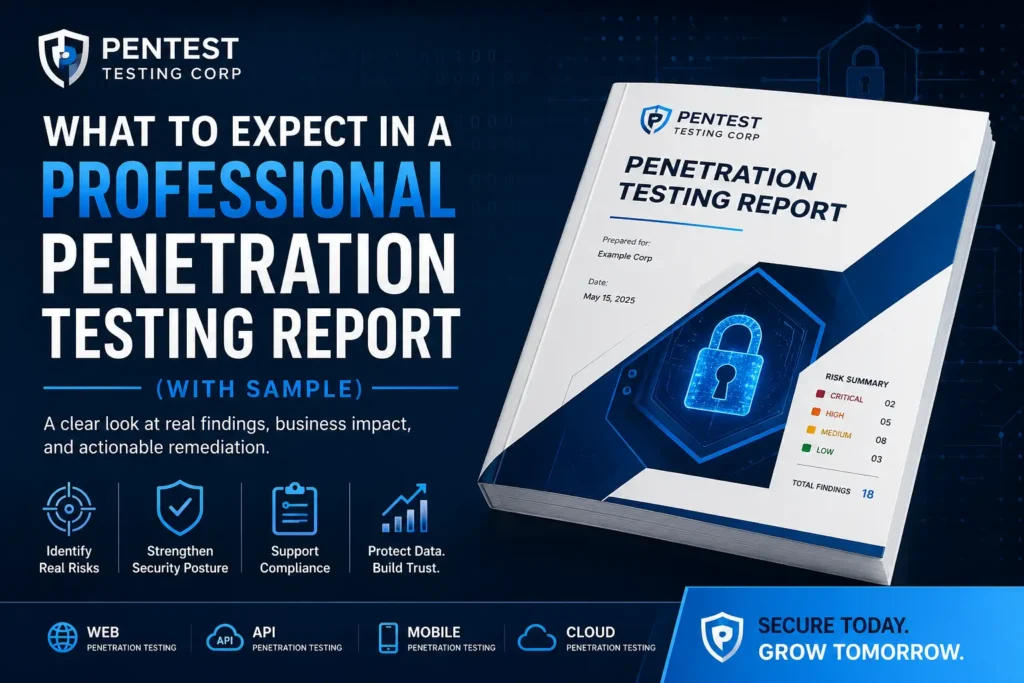
A professional report should do more than list vulnerabilities. It should help you understand what was tested, what was found, how it was exploited, what the impact could be, and what to do next. In Pentest Testing Corp’s sample report, the structure includes an executive-style breakdown, severity summary, and detailed finding sections with description, assessment type, affected application, impact, risk rating, recommendations, and proof of concept.
That structure is what makes a report useful for a CTO, a security lead, and a compliance owner at the same time.
The risk: what happens when the report is weak
A weak report creates operational drag. Developers do not know what to fix first. Leadership cannot tell whether the findings are serious. Compliance teams cannot use the evidence confidently. And procurement or enterprise buyers may ask for proof that you handled the issues properly.
That is where risk turns into lost revenue. A SaaS company can miss a security review, delay onboarding, or lose a renewal because the report did not demonstrate control maturity. A good penetration testing report sample should reduce uncertainty, not create more of it.
Real-world attack scenario: how a small flaw becomes a major incident
Imagine a multi-tenant SaaS platform with an admin dashboard, REST API, and customer portal. On the surface, it looks secure. The login works, the UI is polished, and basic scanners show only minor issues.
During testing, a human tester finds an IDOR in an API endpoint that returns another customer’s billing data when the object ID is changed. A second issue allows a low-privilege user to access an admin-only export function. A third flaw lets an attacker chain a weak SQL query into unauthorized data retrieval.
This is how real breaches happen. Not from one dramatic mistake, but from several smaller weaknesses that line up in the wrong order.
If your business depends on APIs, this is exactly why a focused API penetration testing engagement matters. If the issue is broader across the application, a web application penetration testing review gives you the depth needed to find abuse paths, access control failures, and workflow flaws.
How attackers exploit weaknesses like SQLi, IDOR, broken access control, and API abuse
Attackers usually do not start with the most obvious page. They probe the application for patterns: predictable IDs, weak authorization checks, error messages, hidden parameters, and endpoints that trust the client too much.
SQL injection can expose or alter database data when input is not handled safely. IDOR can let one customer access another customer’s records. Broken access control can expose admin functions to standard users. API abuse can bypass front-end controls entirely and hit backend endpoints directly.
A report is valuable when it shows the exploitation path clearly. That means evidence, affected endpoints, impact, and a practical fix. It should not just say “high risk.” It should explain why the risk is high in business terms.
Why automated tools miss critical vulnerabilities
Automated scanners are useful, but they are not enough.
They are good at finding known patterns, obvious misconfigurations, and some common injection issues. They are much weaker at understanding business logic, chained attack paths, authorization boundaries, tenant isolation, or whether a workflow can be abused in a way that matters to your business.
That is why a strong penetration testing report sample usually contains findings that a scanner would never explain well. A manual tester can follow the logic of your application, test how roles interact, and prove whether a weakness is actually exploitable. Our service emphasize finding issues such as authentication flaws, access control failures, business logic weaknesses, and API authorization problems, which are exactly the kinds of issues automated tools often underreport.
How penetration testing solves this problem
A proper penetration test turns vague concern into concrete evidence.
It helps you understand which assets are exposed, which weaknesses are exploitable, what data could be reached, and what should be fixed first. It also gives you a report that can be shared internally with engineering, leadership, and compliance teams.
If you are preparing for audits, sales security reviews, or customer due diligence, this is especially important. SOC 2 buyers often want to see that you are taking security seriously, and the AICPA describes SOC 2 as an examination of controls relevant to security, availability, processing integrity, confidentiality, and privacy.
What a professional penetration testing report should include
A serious report should be easy to navigate and hard to misunderstand.
It should start with an executive summary that states the overall risk level in plain language. Then it should show the scope of testing, the methodology, and the assets reviewed. After that, each finding should include a clear title, severity rating, affected component, impact, reproduction guidance, and recommendations.
The best reports also include proof. Screenshots, request/response examples, exploit traces, and retest status all help teams move from “we think there is a problem” to “we know what to fix and how to verify it.” Pentest Testing Corp’s sample report reflects this style by organizing findings into description, assessment type, affected application, impact, risk rating, recommendations, and proof of concept.
If you want a benchmark while reviewing vendors, you can compare against our sample penetration testing report and see whether the report structure is actually usable for engineering and compliance.
What to look for in a penetration testing company, especially for SOC 2
A SOC 2-focused buyer should look for more than a security logo or a generic checklist.
You want a team that explains findings in business language, maps issues to real risk, provides developer-ready remediation, and supports retesting. You also want evidence that they understand the difference between a compliance exercise and a real security assessment.
A strong vendor should be able to test your web app, APIs, mobile app, and cloud surface without turning the report into a wall of noise. Our service pages highlight our manual-first testing, clear remediation, optional retesting, and support for SaaS, fintech, and regulated environments.
For teams building toward SOC 2, that matters because security reviews are often judged on clarity, evidence, and responsiveness, not just whether a scan ran successfully.
Final CTA
If you are comparing vendors, ask for a real penetration testing report sample before you buy. The report quality will tell you a lot about the quality of the work.
For web, API, mobile, and cloud assessments that are designed for SaaS and compliance-minded teams, review our penetration testing services or request a security-focused quote. If you are preparing for SOC 2, enterprise due diligence, or a high-stakes launch, a manual assessment with clear remediation and retesting will give you far more value than a surface-level scan.
🔐 Frequently Asked Questions (FAQs)
Find answers to commonly asked questions about Professional Penetration Testing Report Sample.