

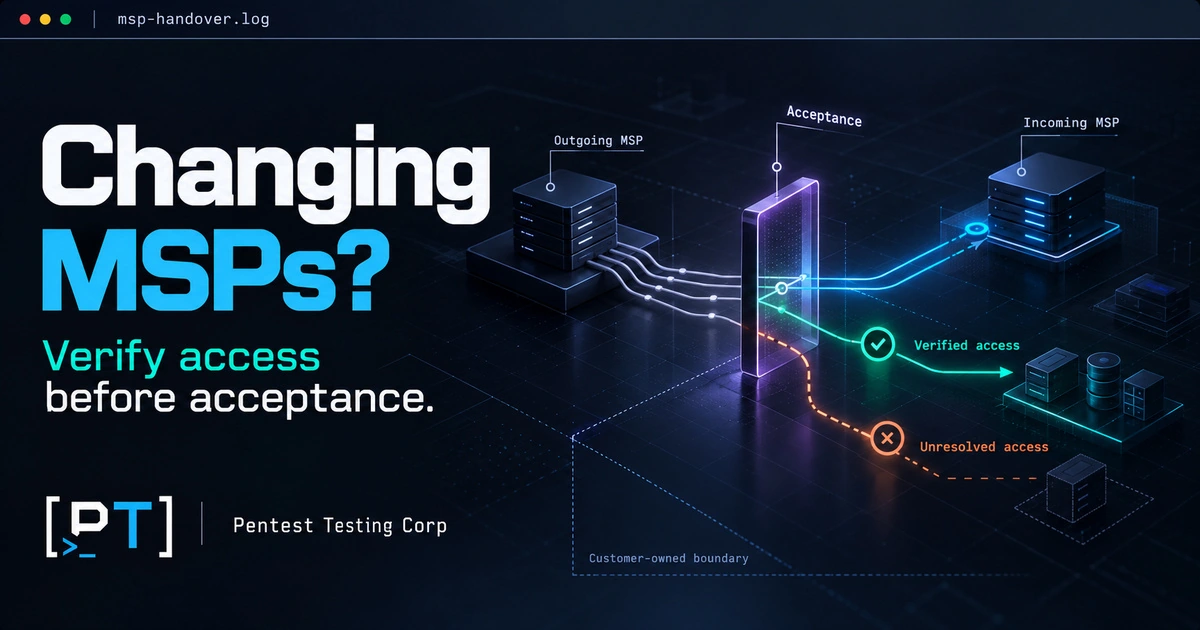
MSP Transition Security Checklist: Verify the Handover
Your COO has approved a new managed service provider. The outgoing supplier's contract ends on Friday, and the incoming team can already answer support tickets. Then someone asks who can recover the backup account, renew the public certificate, or disable the old provider's remote administration. The handover folder contains passwords and asset lists, but nobody has demonstrated those capabilities under the new ownership.
An MSP transition security checklist should turn that uncertainty into acceptance evidence. The business needs to know who retains administration, who can restore essential services, and who responds when a control fails during the change. A signed onboarding document cannot answer those questions by itself.
This guide covers the operational transfer between providers, including inherited access, recovery, DNS, monitoring, and unresolved work. Use it to agree on release conditions before the outgoing team becomes unavailable. The deadline comes from your supplier change; no new breach or regulatory announcement is needed to make the review worthwhile.
Start the MSP transition security checklist with named owners
A provider transition changes several relationships at once. Your organization is buying a new service, withdrawing authority from an existing supplier, and transferring knowledge about systems that must keep working. Those activities need a shared acceptance record. Otherwise, the outgoing team can finish its export while the incoming team still lacks the authority to operate what was exported.
Assign an internal transition owner with authority to coordinate procurement, IT, security, and business service owners. Name an operational lead from each provider. Record who can approve an outage, accept residual risk, and authorize emergency work. The incoming MSP should confirm precisely which responsibilities it accepts and when those responsibilities begin.
Employee offboarding is only one part of this process. An MSP can administer your environment through partner relationships, remote management tools, subcontractors, service accounts, and supplier-owned consoles. Disabling individual engineers' accounts does not establish that the provider relationship has ended.
Start with a register of business services and their dependencies. For each critical service, record the tenant or account owner, administrator, recovery contact, billing arrangement, renewal owner, backup location, and monitoring destination. Reconcile the outgoing inventory against records your organization can independently inspect. Mark missing evidence as unknown rather than assuming an empty field means no access exists.
Agree on what security-focused managed IT onboarding must cover before setting the final acceptance date. Keep discovery, transfer work, validation, and ongoing service responsibilities explicit in the scope. This also makes proposals easier to compare when one supplier includes recovery testing and another includes only account setup.
The joint MSP security guidance summarized by NSA recommends disabling unused accounts, enforcing MFA on MSP access, monitoring that activity, and defining security responsibilities in contracts. Those principles support a practical handover question: can each provider's remaining authority be explained and verified?
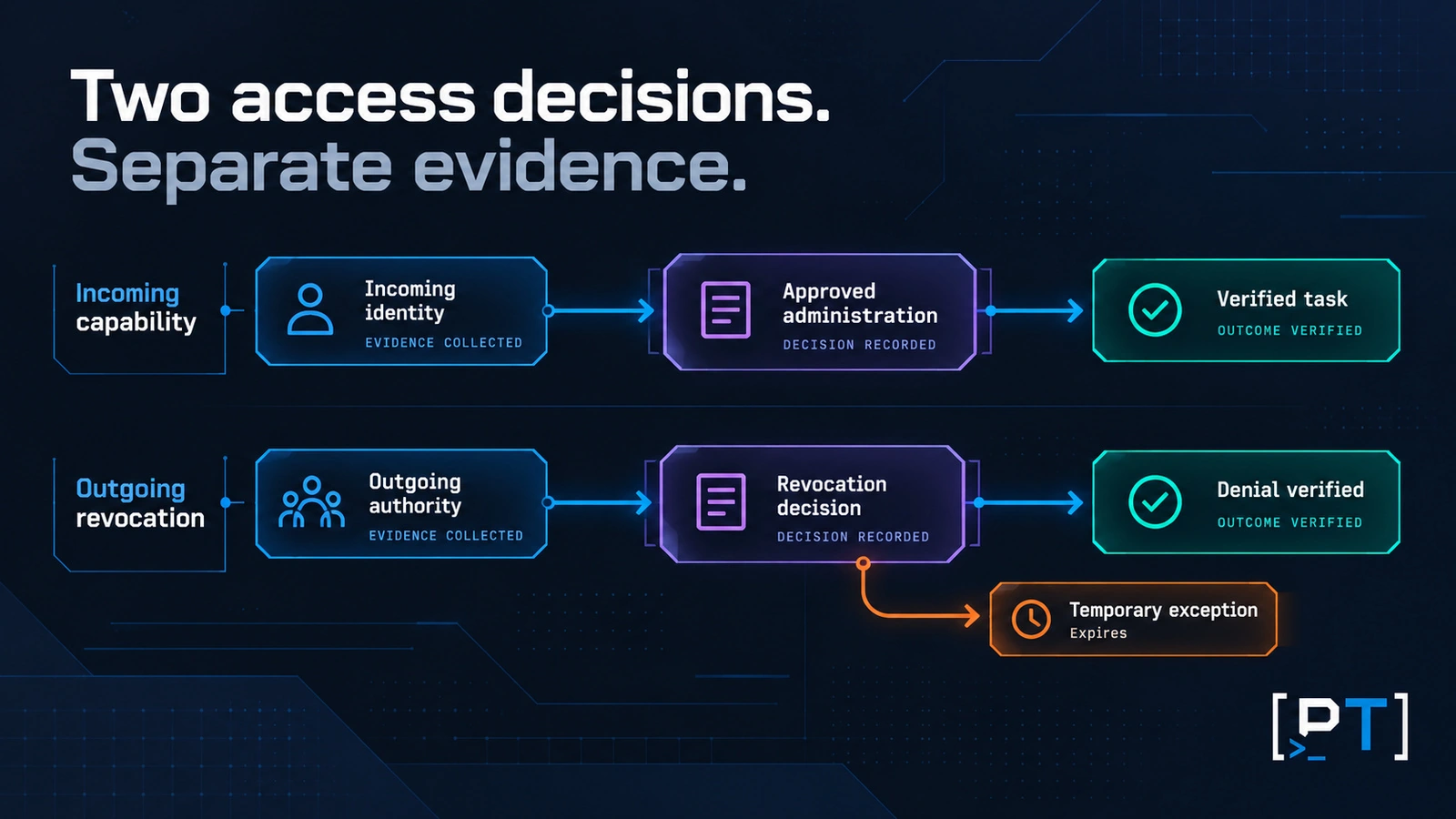
Validate inherited admin access and supplier access revocation
Ask for an access inventory organized by capability. Include identity administration, cloud subscriptions, network devices, endpoint management, remote monitoring and management tools, security consoles, backup administration, and application administration. A spreadsheet of named users can miss a partner grant that permits the outgoing supplier to assign new administrators.
Separate four decisions: which authority transfers, which access is removed, which credentials change, and which temporary dependencies remain. Record the system owner and expected end state for each. Where a console is shared across the outgoing MSP's customers, request customer-specific access and configuration evidence. You do not need or have authority to inspect other customers' environments.
Establish independent administration before removing the old path
The incoming team should demonstrate an authorized administrative task through its intended account, with the agreed authentication controls. Your organization should also retain an approved emergency recovery route that does not depend solely on either provider. Verify its custody, monitoring, and recovery procedure without placing secrets in the acceptance document.
Avoid transferring everyday administration by handing over one shared password. Named access improves accountability. Where a legacy system requires a shared credential, document that limitation, restrict its use, and assign custody and replacement responsibilities. Review recovery email addresses, registered authenticators, and support contacts alongside the password itself.
Verify the outgoing provider's authority has ended
Plan supplier access revocation around actual dependencies. Review delegated administration, remote support installations, privileged groups, connected applications, automation credentials, and retained sessions. A password change should not be treated as universal proof that every access mechanism has stopped working. The required checks depend on the platform and the credential involved.
Use authorized identities and bounded checks to establish the agreed outcome. Record when access changed, what was checked, and where verification was unavailable. Our guide to testing token revocation and surviving sessions explains the separate evidence questions around already issued access. Apply that distinction to the provider's integrations as well as its engineers.
If old access must survive briefly, list the exact purpose, privileges, approved users, expiry, monitoring owner, and final removal check. Broad administration should not continue under a vague rollback note. Any restoration of supplier access during an emergency needs a recorded authorization and a new expiry.
Prove backup ownership and a usable recovery path
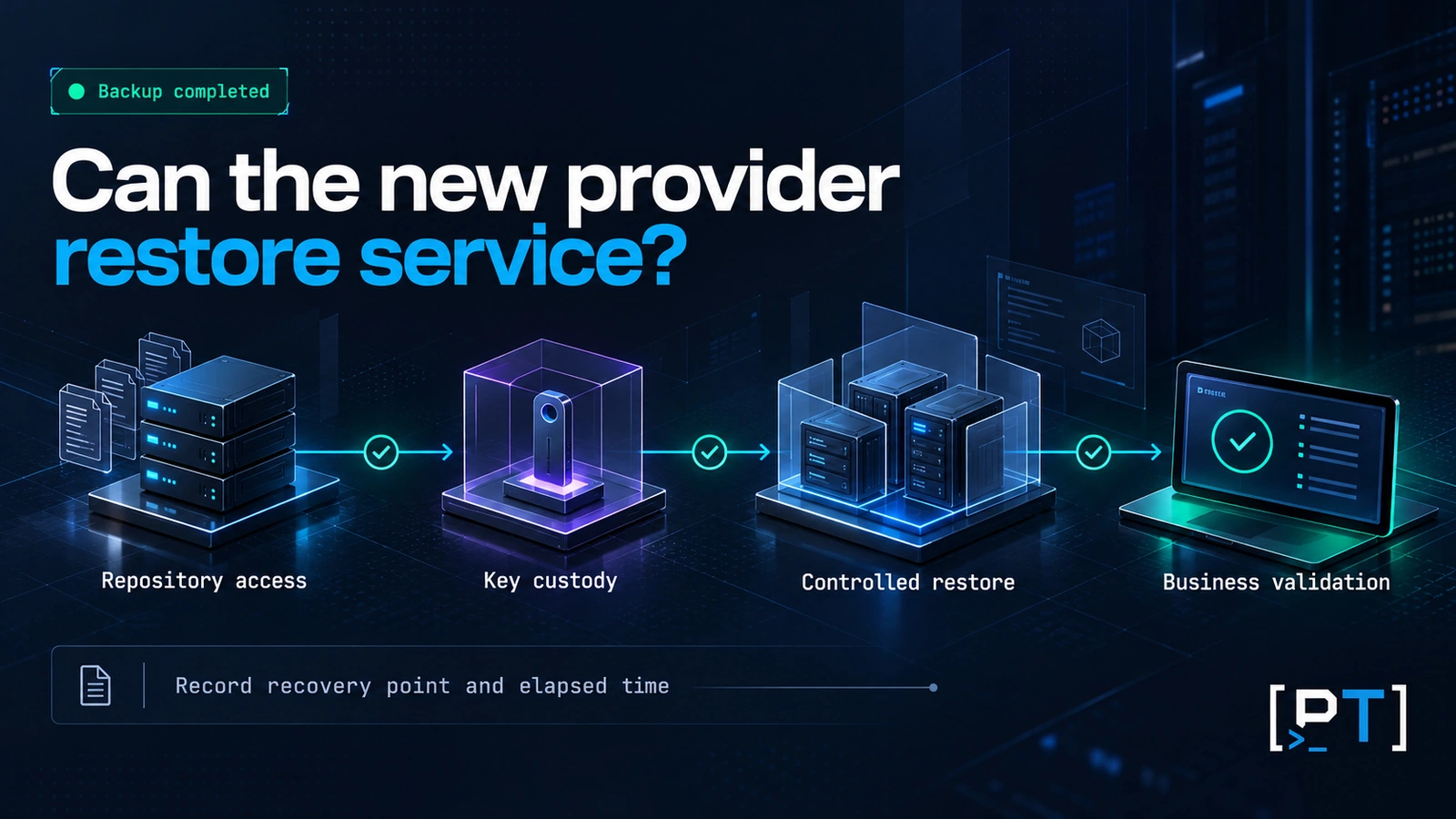
A successful backup notification establishes very little about the incoming provider's ability to recover your business. Recovery also depends on repository access, encryption material, retention settings, software entitlements, and knowledge of application dependencies. Each can sit under a different owner.
Identify the legal and commercial arrangements for backup repositories and licenses. A repository operated through the outgoing MSP's platform may require an export, a supported transfer, or replacement coverage. Establish these constraints before cancellation. Check who can delete recovery points, change retention, disable protection, and receive failure alerts.
Protect existing recovery options throughout the change. Avoid removing the old backup service until replacement protection and access to required historical recovery points are established. Where historical backups cannot transfer, document how they remain available, who can authorize restoration, and when that arrangement ends. The business owner must understand any resulting retention or recovery gap.
Ask for a representative restore under the incoming arrangement
Choose a business-relevant workload and an approved recovery point. Have the incoming team demonstrate recovery into a controlled destination, then ask the application owner to verify usability. Record the recovery point's age, elapsed restoration time, missing dependencies, and business validation. A restored file alone does not establish that a transactional application can resume service.
Compare the result with the business's recovery time objective, meaning how long it can tolerate an interruption, and recovery point objective, meaning how much recent data it can tolerate losing. If performance falls short, leadership needs a remediation decision or an explicit exception. Avoid replacing a measured result with the provider's generic recovery promise.
Keep the claim proportionate. A representative restore supports confidence in the tested workload and path. It does not prove every system, date, or failure mode will recover. Expand coverage for critical services and unusual dependencies, and record what remains untested. A transition prompted by suspected compromise needs a separate incident assessment before restored systems are trusted.
Transfer DNS certificates and renewal control
DNS, domain registration, hosting, and certificates often have different administrators. Your website can continue working after the handover even while an essential renewal depends on the outgoing provider's mailbox or payment method. That creates a delayed outage risk that routine helpdesk testing may never reveal.
Reconcile the registrar, authoritative DNS provider, hosting account, certificate management process, and relevant cloud services. Confirm the organization's entitlement to each asset and the incoming provider's authorized operational access. Update recovery contacts and renewal notifications through approved processes. Where the supplier owns a shared platform, agree on a supported migration rather than assuming the whole account can transfer.
Require evidence of account control and renewal responsibility. An observed DNS response shows the current published state; it does not prove your team can change the zone. A valid certificate shows present validity; it does not establish who can renew it. The acceptance record should distinguish those observations from administrative control.
Document dependencies before changing DNS or certificate automation. Mail delivery, remote access, customer authentication, and third-party integrations may rely on the same records or credentials. Set change windows and rollback criteria based on business impact. Obtain confirmation from the relevant service owners after changes.
For names or integrations being retired entirely, use the narrower checks in our SaaS supplier retirement guide. During an MSP handover, many services stay in production. Their acceptance condition is continued operation under the approved owner, with unnecessary supplier authority removed.
Include upcoming expirations and scheduled renewals in the handover record. A transfer is incomplete if the incoming provider can administer a service today but cannot explain its next renewal. Assign responsibility for escalation when a registrar, reseller, or platform vendor must approve the change.
Keep monitoring and open remediation work accountable
Two security consoles can be active while nobody owns the alert queue. Alternatively, the outgoing provider can uninstall its agents before the replacement coverage is working. Plan detection continuity as a specific workstream with agreed start and stop conditions.
Identify endpoint protection, remote management, log collection, alert routing, and incident escalation across the agreed asset inventory. Establish which historical records remain accessible and under what retention terms. Confirm whether incident response is included in the incoming contract, separately chargeable, or supplied by another party.
Validate a permitted, harmless test event through the intended process. Evidence should connect the source event to receipt, triage, and the designated escalation contact. A dashboard showing an enrolled endpoint supports a narrower claim than a demonstrated response workflow. Where relevant, exercise the agreed out-of-hours contact route without simulating a disruptive incident.
Coordinate security and remote management agent changes using vendor-supported procedures. Check licensing, platform compatibility, protection status, and monitoring after migration. Retaining duplicate tools indefinitely can leave unclear administrative authority; removing them too early can reduce coverage. Record the intended overlap and its end condition.
Carry open vulnerabilities, patch exceptions, unsupported systems, and unresolved incidents into the new service record. Preserve the original discovery date, business impact, deadline, and approval history. Changing providers should not silently reset overdue work or turn an inherited finding into an unowned ticket.
Our patch validation and exception evidence guide provides a useful structure for the records that should survive the transfer. Ask the incoming provider to reconcile those records against its own baseline assessment. Conflicting inventories or patch results need investigation before either is treated as authoritative.
For sensitive records, agree on controlled access and retention. Keep credentials out of exported tickets and reports. If an open incident requires evidence preservation, coordinate the handover with the incident owner before retiring accounts, deleting agents, or changing log storage.
Use an MSP transition security checklist acceptance matrix
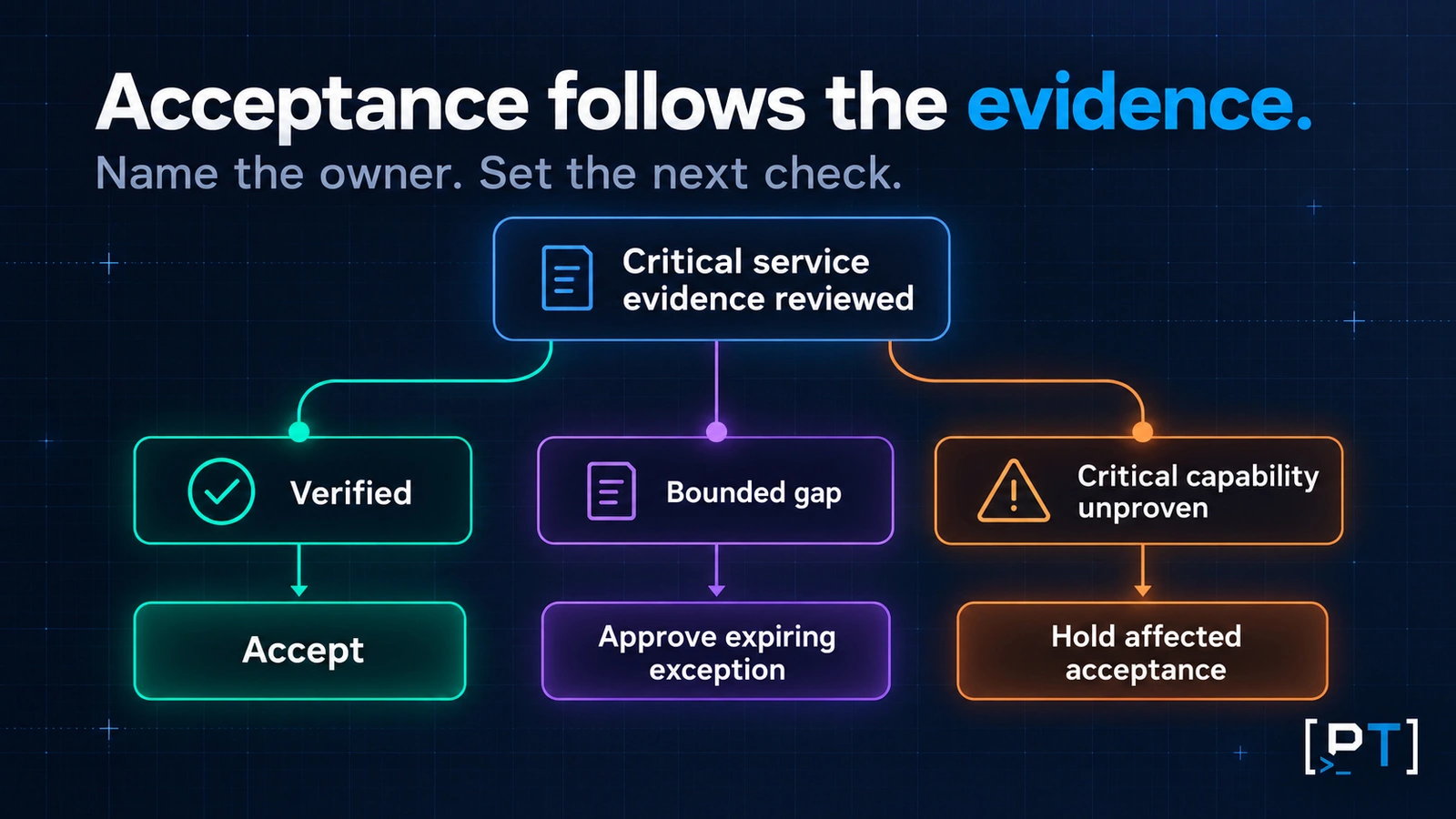
Make the matrix specific enough that another reviewer can understand the acceptance decision. Each row needs an asset or service reference, named implementer, internal approver, evidence location, observation time, and status. Use verified, failed, unverified, or approved exception. An unverified item should never appear as a successful check merely because nobody reported a problem.
| Workstream | Evidence required for acceptance | Decision if unresolved |
|---|---|---|
| Administration and recovery | Incoming administration demonstrated; organization-controlled emergency recovery verified. | Hold affected service acceptance if essential administration or recovery is unavailable. |
| Outgoing supplier access | Agreed account, delegation, remote-tool, and credential changes checked; retained access listed. | Remove unnecessary authority or approve a restricted, expiring exception. |
| Backups and restoration | Repository and key custody established; representative restore assessed against business objectives. | Maintain recovery coverage and escalate failed or unproven critical recovery. |
| DNS and certificates | Administrative control, recovery contacts, renewal ownership, and service continuity verified. | Retain controlled continuity arrangements until transfer or migration succeeds. |
| Monitoring and escalation | Asset coverage reconciled; approved event reaches the accountable responder. | Provide interim coverage and resolve the response gap before releasing the old service. |
| Open findings and exceptions | Existing risks retained with owner, deadline, evidence requirement, and approval history. | Assign responsibility and funding; escalate material overdue exposure. |
Store supporting evidence in a controlled location that your organization can retain after the supplier exits. Keep evidence references in the matrix rather than passwords, private keys, or unnecessary personal data. The acceptance summary should state the inventory covered, checks performed, limits, exceptions, and next review trigger.
Hypothetical scenario a completed handover with an untested restore
A professional services company changes MSPs before a contract renewal. The outgoing team exports its documentation and the incoming provider enrolls the workstations. A handover review then finds that the backup repository remains in the outgoing supplier's console, while the organization's recovery contact points to that supplier's mailbox.
No breach has been identified. The immediate problem is that a server failure could require assistance from a provider whose service has ended. Recreating the newest backup elsewhere would not automatically provide access to older recovery points needed for a historical restore.
The company holds acceptance of the backup workstream, agrees temporary repository access, and funds the supported transfer. The incoming provider completes a controlled restore, while the business owner verifies the recovered application. The exception closes after access and recovery evidence are recorded. This is an illustrative scenario, not a client case or a claim about measured frequency.
What leadership should decide before the handover ends
Approve the conditions for accepting each critical service before the cutover meeting. The internal service owner should confirm business usability, the incoming provider should acknowledge operational duties, and the authorized risk owner should approve material exceptions. A supplier's signature alone should not determine whether the organization accepts an unresolved exposure.
Set a clear threshold for holding acceptance. Examples include unavailable essential administration, unproven recovery for a critical workload, uncontrolled privileged access, or no accountable monitoring response. Less consequential documentation gaps may be eligible for a funded, expiring exception. The decision should reflect the affected service and credible business consequences.
Agree scope effort and the sequence of work
Request separate scope and cost assumptions for discovery, transfer, validation, and follow-up. Effort depends on tenant count, identity complexity, supplier-owned platforms, historical backup portability, disconnected devices, and outgoing-provider cooperation. Monthly support pricing does not establish the cost or duration of a transition project.
Sequence the work around evidence gates: establish the baseline before cancellation; demonstrate incoming capability before removing essential old paths; validate revocation and continuity during cutover; revisit deferred devices, scheduled jobs, and renewals afterward. These are planning stages, not a fixed delivery promise. Define the observation period around the dependencies actually present.
Use a targeted security assessment when records conflict or a critical access claim needs independent validation. A full penetration test may be appropriate for wider exposure, but it does not replace restore demonstrations, commercial transfers, or named operating responsibilities. Agree written authorization, permitted checks, maintenance windows, and stop conditions for production validation.
Connect the evidence to governance
The NIST Cybersecurity Framework 2.0 provides useful mapping: GV.SC-02 for supplier responsibilities; GV.SC-10 for activities after agreements end; ID.AM-04 for supplier service inventories; PR.AA-05 for access permissions; and PR.DS-11 for protected, maintained, tested backups. PR.PS-04 addresses log availability, while DE.CM-06 covers monitoring external provider activity.
This checklist applies those outcomes to a provider change; it is not a NIST-mandated handover procedure. For organizations using ISO/IEC 27001:2022, have the ISMS owner connect supplier and access evidence to the applicable risk treatment and Statement of Applicability. Completing the matrix does not establish certification or contractual compliance.
Keep inherited remediation moving through a named ownership and verification plan. Every exception needs a responsible person, approved interim protection, resources, deadline, and closure evidence. Review overdue items through the same leadership process used for other operational risks.
Before your outgoing provider becomes unavailable, discuss the scope of your managed IT transition with Pentest Testing Corp. Bring your service inventory, contract dates, known access gaps, and recovery requirements so the onboarding scope can define what must be demonstrated before acceptance.
Frequently asked questions
What if the outgoing MSP will not cooperate?
Escalate through your contract owner and the relevant platform vendors using documented ownership evidence. Separate recoverable administration from services that need migration or replacement. Restrict the incoming provider's acceptance to verified responsibilities, and obtain legal advice where contractual rights or asset ownership are disputed.
Must every endpoint be online at cutover?
Offline devices need a tracked deferred action. Record the last known management state, reconnect restrictions where appropriate, and the person responsible for verifying the new controls when the device returns. The acceptance statement should identify deferred devices and the resulting coverage limitation.
Can the incoming MSP approve its own transition work?
It can report completion and supply evidence, but your organization should retain acceptance authority. An internal service or risk owner should review consequential gaps. Independent validation is useful when provider incentives conflict or the business cannot directly verify a critical claim.
What should happen to provider-held copies of our documentation?
Agree on return, retention, and deletion obligations for documentation, ticket exports, configuration backups, and sensitive records. Distinguish records needed for legitimate retention from operational access that must end. Obtain appropriate supplier confirmation without assuming your organization can technically verify every retained copy.
Does a billing reseller change also transfer administrative access?
Treat billing, licensing, support entitlement, and administration as separate arrangements until verified. A commercial transfer can leave existing access grants unchanged, while access removal can occur before licensing moves. Ask the platform owner to confirm the supported sequence for your particular agreement.
How should we handle a handover failure outside business hours?
Preapprove escalation contacts, emergency decision authority, spending limits, and rollback conditions. The on-call team should know which provider is responsible at that moment. Record emergency access and changes, then review and revoke temporary permissions when the event is resolved.