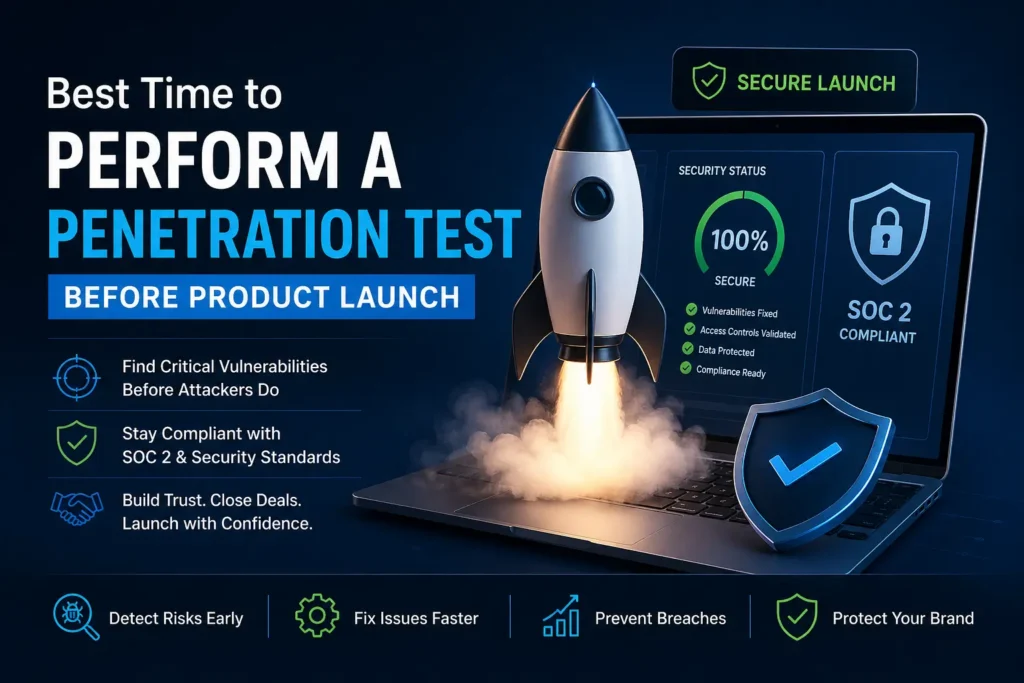
Best Time to Perform a Penetration Test Before Product Launch
Launching a SaaS product without proper security testing isn’t just risky. It’s often the reason deals fall through, audits fail, and breaches happen within weeks of going live.
If you’re asking “when to do penetration testing”, you’re already ahead of most founders. The problem is timing it wrong can be just as damaging as skipping it entirely.
Let’s break this down from a real-world, attacker-focused perspective.
The Problem: Launch Pressure vs Security Reality
Most teams prioritize shipping fast. Features get tested. Performance gets optimized. Security often gets pushed to “post-launch.”
That’s where things break.
Modern applications are full of high-risk entry points:
- APIs exposed to third parties
- Authentication flows under rapid iteration
- Role-based access logic that hasn’t been deeply validated
These aren’t theoretical risks. They’re exactly what attackers target first.
According to OWASP Top 10, vulnerabilities like broken access control, injection flaws, and authentication failures remain the most exploited issues in real-world breaches.
The Risk: What Happens If You Test Too Late
If penetration testing happens after launch, you’re already exposed.
Here’s what that looks like in practice:
- A client requests your SOC 2 report before signing
- Your security questionnaire reveals gaps
- A bug bounty researcher finds an IDOR vulnerability within days
- Your API gets abused due to weak authorization
The result isn’t just technical. It’s business-critical:
- Lost enterprise deals
- Failed compliance audits
- Customer churn due to trust issues
- Emergency incident response costs
If you haven’t assessed your exposure yet, start with a quick security check using a free scanner or vulnerability review before your release cycle tightens.
Real-World Attack Scenario (Pre-Launch Failure)
Let’s say your SaaS product includes an API endpoint:
GET /api/v1/users/{user_id}You assume authentication is enough.
An attacker logs in, changes user_id=1024 to user_id=1025.
Boom. Data exposure.
This is a classic IDOR (Insecure Direct Object Reference), part of broken access control. One of the most common and damaging vulnerabilities.
Now combine that with:
- Weak rate limiting → API abuse
- Poor input validation → SQL injection
- Misconfigured roles → privilege escalation
You don’t just have bugs. You have a breach waiting to happen.
How Attackers Actually Exploit Your App
Attackers don’t “scan randomly.” They follow patterns:
- Map endpoints (especially APIs)
- Test authentication and authorization boundaries
- Manipulate parameters and IDs
- Chain vulnerabilities together
For example:
- IDOR + weak auth = full account takeover
- SQL injection + exposed admin panel = database dump
- API abuse + no rate limits = service disruption
Over 70% of web application breaches map back to known vulnerability categories like these.
Why Automated Tools Miss Critical Issues
Most teams rely on scanners before launch. That’s not enough.
Automated tools:
- Detect known patterns
- Miss business logic flaws
- Fail to understand authorization context
- Cannot simulate attacker chaining
Example:
A scanner won’t tell you:
“A normal user can upgrade themselves to admin via this API flow.”
That’s exactly what a manual tester will find.
If you’re using tools like a vulnerability scanner from https://free.pentesttesting.com/, treat it as a first step, not a final assurance.
The Solution: When to Do Penetration Testing
Here’s the correct timing most high-performing SaaS teams follow:
1. Pre-Launch (Critical Window)
This is the best time to do penetration testing.
Why:
- Core features are stable
- Fixes are still manageable
- No real users are impacted yet
This is where you should run:
- Full
- Deep
2. Post-Major Changes
Any of these require retesting:
- New authentication system
- API restructuring
- Payment integration
- Role/permission updates
3. Compliance or Sales Trigger
If you’re targeting enterprise clients:
- SOC 2
- ISO 27001
- PCI DSS
You’ll need proof of testing.
SOC 2 specifically requires organizations to demonstrate that systems securely handle customer data and risks are properly managed.
If you’re close to launch and haven’t validated these risks, now is the point where a focused penetration test can prevent both security incidents and lost deals.
How Penetration Testing Actually Solves This
A proper pentest doesn’t just “scan.”
It:
- Simulates real attackers
- Tests business logic and workflows
- Identifies chained vulnerabilities
- Provides actionable remediation
At Pentest Testing Corp, this typically includes:
- Authentication and session testing
- Authorization validation (IDOR, privilege escalation)
- Injection testing (SQLi, command injection)
- API abuse scenarios
You don’t just get findings. You get a prioritized roadmap.
What to Look for in a Penetration Testing Company (SOC 2 Focused)
Not all pentests are equal.
If you’re preparing for SOC 2 or enterprise deals, look for:
- Manual testing (not just automated reports)
- Coverage aligned with OWASP standards
- Clear proof-of-concept for each vulnerability
- Remediation guidance your dev team can act on
- Experience with SaaS architectures and APIs
Avoid vendors who:
- Deliver generic scanner outputs
- Don’t test business logic
- Can’t explain risk in business terms
Before choosing a pentesting provider, make sure you review a real report. Here’s a professional penetration testing report sample that shows exactly what you should expect from a high-quality security assessment.
Final Thought: Timing Is the Difference Between Prevention and Damage
The best time to do penetration testing is before your product goes live, not after something breaks.
At that stage:
- Fixes are cheaper
- Risk is contained
- Trust is still intact
If you’re preparing for launch or SOC 2, now is the right time to validate your security posture.
Schedule a manual penetration test with https://www.pentesttesting.com/soc-2-risk-assessment-services/ and get a clear, actionable view of your real risk before attackers do.
🔐 Frequently Asked Questions (FAQs)
Find answers to commonly asked questions about when to Do Penetration Testing.