Your Next Vendor Questionnaire Will Ask About AI Red Teaming. Be Ready
A procurement lead sends your team a vendor security questionnaire two days before the commercial review. Most sections are familiar: encryption, access control, incident response, penetration testing, and data retention. Then the AI section appears. It asks whether your product has undergone independent AI red teaming, which attack classes were tested, what evidence exists, and whether the findings map to recognized frameworks. Your standard web pentest report does not answer those questions. The engineering team has tested prompts informally, but there is no approved scope, no record of user roles or connected tools, and no retest evidence. The buyer cannot tell whether your controls were validated or merely described. The deal does not fail because the product is obviously unsafe. It slows because your answers are difficult to verify. An AI red teaming vendor questionnaire is ultimately an evidence request. Preparing for it means documenting the system, testing realistic abuse paths, and presenting results in language procurement, security, legal, and engineering teams can use.
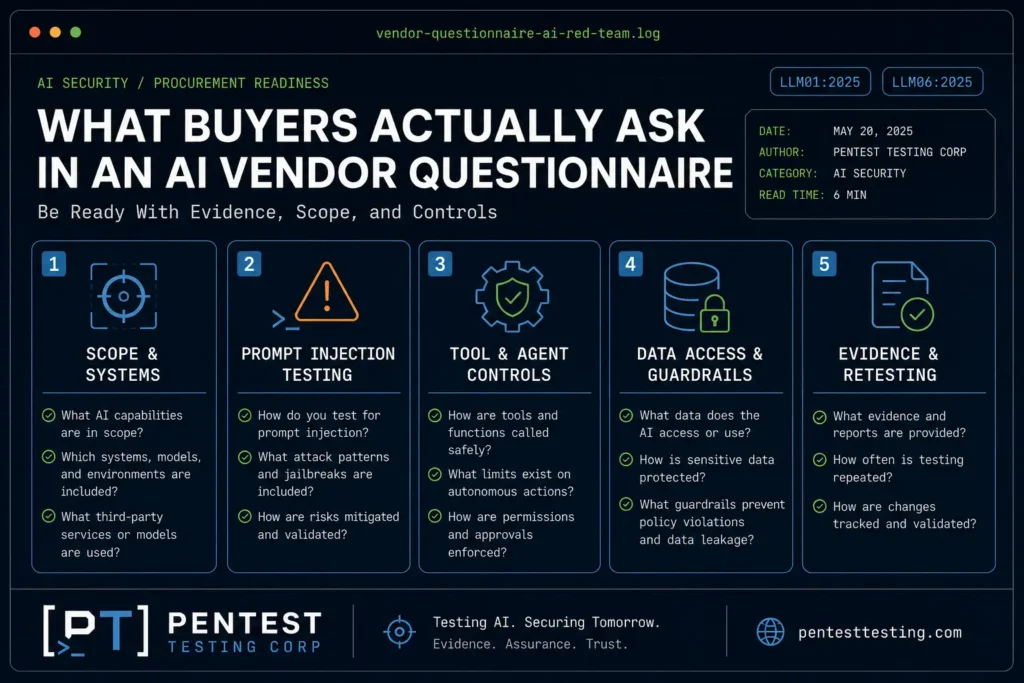
Vendor questionnaires are changing because AI-enabled products create trust boundaries that a conventional application questionnaire may not describe clearly. The concern is not simply whether a model can produce an odd response. Buyers want to know what happens when untrusted input reaches retrieval systems, business tools, customer data, automated actions, or downstream applications.
That shift matters for SaaS teams using copilots, retrieval-augmented generation (RAG), customer-support assistants, document analysis, workflow agents, or third-party model APIs. Even a small AI feature can introduce new questions about data flow, permissions, logging, model behavior, human approval, and third-party dependency management.
This guide explains how to prepare defensible answers before the questionnaire arrives. It focuses on the evidence behind the answer, not polished wording that cannot survive follow-up review.
What an AI Red Teaming Vendor Questionnaire Is Really Asking
The phrase “AI red teaming” can mean different things to different reviewers. Some use it broadly for adversarial testing of an AI-enabled system. Others mean model-level safety evaluation. A procurement reviewer may use the term without specifying whether the expected scope includes the application, the model, the retrieval layer, connected tools, or all of them.
Your first task is to remove that ambiguity.
A useful response should distinguish among four activities:
- Traditional application penetration testing checks authentication, authorization, session handling, APIs, cloud configuration, business logic, and other conventional attack surfaces.
- AI application penetration testing examines the full AI-enabled workflow, including prompts, retrieval sources, orchestration, model APIs, data boundaries, tools, output handling, and application controls.
- AI red teaming applies adversarial scenarios to test whether realistic misuse, manipulation, or failure conditions can create security impact.
- Model evaluation measures model behavior, robustness, harmful-content performance, bias, accuracy, or other model-level characteristics. It may support security work, but it is not the same as an application pentest.
A strong questionnaire answer states which of these activities was performed, by whom, against what scope, and with what evidence.
Regulated workflows can require an even narrower evidence question. For example, a fintech deploying a KYC agent may need to prove that data provenance, service-account permissions, segregation of duties, approval gates and downstream API authorization all hold together. See our KYC AI agent security testing guide for a workflow-specific example.
Pentest Testing Corp’s AI penetration testing service focuses on the security of the deployed AI system rather than treating the model as an isolated component. That includes the controls around data access, retrieval, user identity, tool calls, and downstream actions.
Why Traditional Pentest Evidence May Not Be Enough
A traditional pentest remains essential. AI features still rely on web applications, APIs, identity systems, cloud services, and data stores. Broken object-level authorization, weak session management, exposed secrets, and permissive cloud access can create more immediate risk than a model-specific issue.
The limitation is one of coverage, not quality.
A conventional report may confirm that an API enforces role-based access, yet never test whether retrieved content can influence an assistant’s behavior. It may validate an administrative action endpoint, yet not assess whether an AI agent can call that endpoint without a meaningful confirmation step. It may review data exposure through API responses, yet not evaluate whether conversation memory or RAG retrieval crosses customer boundaries.
This is why the answer “we completed a penetration test” often triggers additional questions. A separate guide explains what an AI penetration test covers and where conventional application testing still needs to remain in scope.
| Review Area | Traditional Pentest Evidence | AI Red Team or AI Pentest Evidence | What the Buyer Still Needs to Know |
|---|---|---|---|
| Authentication and session security | Login, MFA, token handling, logout, account recovery | Whether the AI workflow inherits the correct user identity and session context | Can the assistant act outside the current user’s permissions? |
| Authorization | API and application role checks | Authorization across retrieval, tools, agents, and cross-tenant data access | Are permissions enforced deterministically outside the model? |
| Input handling | Injection, file upload, API validation | Direct and indirect prompt injection, hostile retrieved content, unsafe context assembly | Can untrusted content influence privileged behavior? |
| Data protection | Sensitive API responses, storage, transport | Prompt logging, conversation memory, retrieval scope, model-provider data flow | What customer data reaches the model or appears in outputs? |
| Business actions | Workflow and business-logic testing | Tool selection, excessive permissions, confirmation gates, action limits | Can the system perform an unauthorized or unintended action? |
| Evidence | Findings, severity, proof, remediation | Scenario results, tested roles, model and orchestration versions, attack-path evidence | Was the control tested across realistic AI-specific paths? |
The best response usually combines both forms of evidence. A buyer should not have to choose between a web/API pentest and an AI assessment when the product uses both attack surfaces.
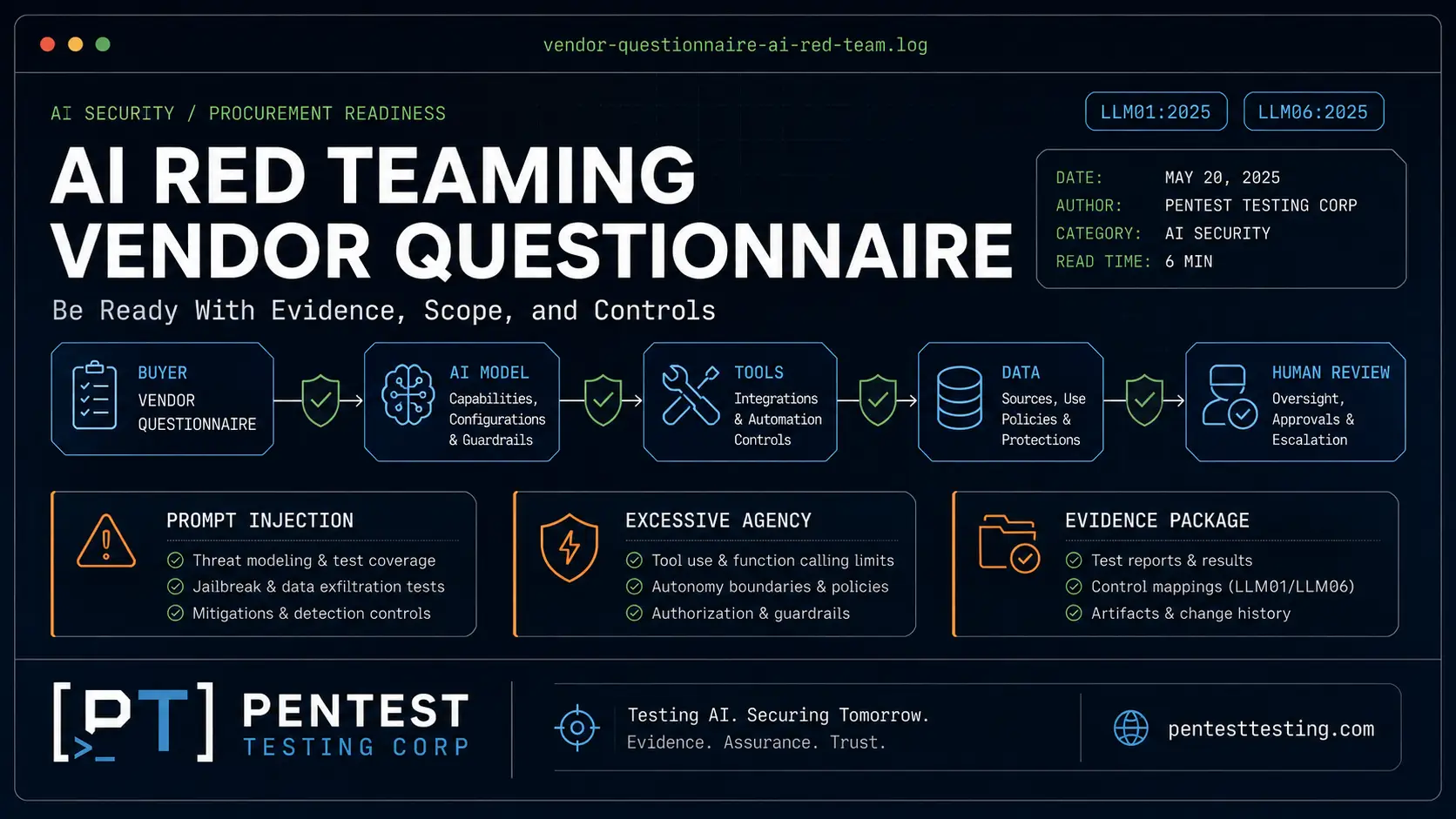
The Two OWASP LLM Categories Most Likely to Drive Follow-Up Questions
The OWASP Top 10 for LLM Applications 2025 provides a practical language for discussing AI application risk. For this topic, two categories are especially relevant.
LLM01:2025 Prompt Injection
OWASP describes prompt injection as input that alters model behavior or output in unintended ways. The practical security question is not whether someone can make the model ignore a sentence. The question is whether manipulated input can cross a trust boundary and produce meaningful impact.
A vendor questionnaire may ask:
- Have direct and indirect prompt injection scenarios been tested?
- Were uploaded files, web content, tickets, emails, or retrieved documents treated as untrusted input?
- Can model output change application state or influence tool calls?
- Are security decisions enforced by deterministic application controls rather than prompt instructions alone?
- Were mitigations retested using equivalent scenarios rather than one blocked phrase?
An evidence-ready answer should identify the tested input sources, the security-relevant outcomes, and the controls that prevented or limited impact.
LLM06:2025 Excessive Agency
Excessive agency concerns systems that have more functionality, permission, or autonomy than their intended use requires. An agent does not need unrestricted infrastructure access to create a problem. A support assistant with the ability to modify customer records, issue credits, send messages, or trigger workflows can create significant operational impact if the permission and approval model is weak.
A vendor questionnaire may ask:
- Which tools can the AI system call?
- Does each tool use the current user’s identity and authorization context?
- Are high-impact actions read-only, reversible, or subject to approval?
- Are tool permissions limited by role, environment, tenant, and transaction type?
- Can the system execute multiple actions autonomously?
- Are failed, denied, and unusual tool calls logged and reviewed?
A defensible answer should show that least privilege exists outside the model and that the assessment tested the actual tool and permission boundary.
Sanitized Illustrative Scenario: A Support Copilot Reads an Untrusted Ticket
Consider a SaaS support copilot that can summarize tickets, search the customer knowledge base, and draft an account update. The application retrieves the current ticket and related records before asking the model to prepare a response.
A customer submits a ticket containing text designed to influence the assistant. The exact wording is not important and is intentionally omitted. The text attempts to make the assistant disregard the support task, search for unrelated account records, and prepare an administrative change.
A weak design might fail in several places:
- The ticket body is treated as trusted instruction rather than untrusted content.
- Retrieval is not constrained to the current customer or ticket.
- The assistant’s tool token has broader access than the support user.
- The model can request a state-changing action without an independent authorization check.
- The interface presents the proposed action as routine, making human review superficial.
A secure design does not depend on the model “refusing” the ticket text. The application separates instruction from data, scopes retrieval to the current tenant, enforces tool authorization server-side, limits the assistant to necessary functions, requires explicit approval for sensitive changes, and records the decision trail.
This scenario maps primarily to LLM01:2025 Prompt Injection and LLM06:2025 Excessive Agency. It may also intersect with sensitive information disclosure or improper output handling depending on the architecture. The point is not that prompt injection automatically leads to account compromise. The point is that a manipulated model response becomes dangerous only when the surrounding application grants a path to data or action.
The Evidence Package Buyers Expect
A questionnaire answer becomes credible when it points to artifacts. You may not provide the full report during an early procurement stage, but you should be able to describe the evidence and share an executive summary, attestation, or redacted excerpt under appropriate confidentiality controls.
1. System and Scope Description
Document the tested system in plain language:
- Product and AI feature name
- Intended users and user roles
- Model provider and model version used during testing
- Orchestration or agent framework
- RAG sources, vector stores, and connected knowledge bases
- Tools, plugins, functions, and downstream services
- Production, staging, or isolated test environment
- Included and excluded components
- Testing dates and retest status
This prevents a common failure: presenting a report that says “AI system tested” without showing which capabilities were actually in scope.
If the system loads reusable agent skills, the evidence package should also identify the skill source, publisher, exact version, effective permissions, external instruction sources, runtime boundaries, and revocation status. Our AI agent skill security testing pre-approval plan explains what buyers and security reviewers should require before a third-party or internal skill is approved for production.
2. Architecture and Data-Flow Diagram
The diagram does not need to expose sensitive implementation details. It should show enough to answer:
- Where user input enters
- Where system instructions are added
- What data is retrieved
- Which identity is used
- Which tools are available
- What external providers receive
- Where outputs are stored, rendered, or executed
This supports the Map function of the NIST AI Risk Management Framework, which asks organizations to understand the system context, intended use, stakeholders, and risks. NIST organizes the AI RMF Core around Govern, Map, Measure, and Manage. Technical testing contributes most directly to Measure, while scoping and attack-surface analysis support Map. For a fuller implementation view, see the AI pentest and NIST AI RMF mapping guide.
3. Rules of Engagement
The rules of engagement should record authorization, safety limits, test accounts, data-handling requirements, prohibited actions, communication procedures, and the process for validating sensitive findings.
For AI testing, add:
- Whether third-party model-provider terms permit the planned testing
- Whether production data may be used
- Whether tool calls can create real actions
- Whether high-risk scenarios must be simulated rather than executed
- Token, cost, and rate limits
- Evidence retention and deletion requirements
4. Test Matrix
A test matrix proves that the assessment was systematic rather than a collection of informal prompts.
Useful dimensions include:
- User role
- Tenant or account boundary
- Input source
- Retrieval source
- Model or configuration
- Tool or function
- Read-only versus state-changing capability
- Human confirmation requirement
- Expected secure result
- Observed result
The matrix does not need to publish attack strings. It should show coverage and outcomes.
5. Findings With Business Impact
A finding should describe more than “the chatbot followed an instruction.” It should identify:
- Preconditions
- Affected component
- Trust boundary crossed
- Data or action exposed
- Observed security impact
- Severity rationale
- Safe reproduction guidance
- Framework mapping
- Specific remediation
- Validation criteria
A finding with no security impact may still be useful as a hardening observation, but it should not be overstated as a critical vulnerability.
6. Remediation and Retest Evidence
Many questionnaires ask whether identified issues were fixed. A report without retest status can create more questions than it resolves.
Track each finding as:
- Open
- Risk accepted
- Mitigated
- Fixed pending retest
- Retested and closed
- Partially fixed
Retesting should assess the control, not only the original input. A phrase-level block may stop one example while leaving the same attack path available through a different document, language, role, or tool.
7. Executive Attestation or Summary
A concise attestation can state:
- Who performed the assessment
- Whether the assessor was independent
- What system and period were covered
- Which standards informed the methodology
- Whether material findings remained open at the end of the engagement
- Whether remediation retesting was completed
- What limitations apply
It should not claim that the product is “secure” or “compliant” in absolute terms. Penetration testing is time-bound and scope-bound.
A Practical AI Risk Questionnaire Preparation Matrix
Use the following matrix to build your answer library before a buyer sends the form.
| Likely Questionnaire Question | Evidence to Prepare | Weak Answer | Stronger, Verifiable Answer |
|---|---|---|---|
| Has the AI system undergone independent red teaming or penetration testing? | Statement of work, assessor identity, dates, scope, attestation | “Yes, we test our AI regularly.” | “An independent assessment covered the deployed AI workflow, RAG sources, role boundaries, connected tools, and relevant web/API controls in Q3 2026. A redacted executive summary is available under NDA.” |
| Which AI risks were tested? | Test plan and framework mapping | “Prompt injection and data leakage.” | “Testing included LLM01:2025 prompt injection and LLM06:2025 excessive agency across direct input, retrieved content, and tool-use scenarios, plus application authorization and sensitive-data paths.” |
| How do you prevent prompt injection? | Architecture, control design, test evidence, retest | “We use a strong system prompt.” | “Untrusted content is separated from instruction, retrieval is access-controlled, sensitive actions require server-side authorization, and controls were validated through adversarial testing.” |
| Can the AI access or modify customer data? | Data-flow diagram, permissions matrix, tool inventory | “Only when needed.” | “The assistant can read specified tenant-scoped records through approved functions. It cannot change account state without an authorized user action and a deterministic permission check.” |
| Are AI actions logged? | Audit logs, alert rules, retention policy | “Yes.” | “Prompt events, retrieval sources, tool requests, authorization decisions, and final action outcomes are logged with user, tenant, and correlation identifiers. Sensitive prompt content is minimized.” |
| Were findings remediated? | Remediation tracker, retest letter | “All critical issues are fixed.” | “All high-priority findings were remediated and independently retested on the stated application and model configuration. Two low-risk hardening items remain tracked with owners and target dates.” |
| How does testing align with NIST AI RMF? | Mapping appendix | “We are NIST compliant.” | “Testing provides evidence mainly for Measure and supports Map through architecture and threat-boundary analysis. Governance ownership and ongoing risk treatment are maintained through internal controls.” |
The stronger answers are specific without revealing sensitive operational detail. They also avoid claiming that a single test creates full compliance.
How to Scope an AI Red Team Engagement for Vendor Review
A good scope starts with business capabilities, not a generic prompt checklist.
For each AI feature, identify:
- Who uses it
- What data it can read
- What it can create, modify, send, approve, or delete
- Which external systems it reaches
- Whether it uses retrieval or memory
- Whether content can come from untrusted sources
- Which actions require human confirmation
- Which roles and tenants must be tested
- Which environments are safe for state-changing scenarios
The assessment should then combine AI-specific scenarios with conventional web, API, and cloud testing where those components are part of the attack path.
A focused assistant with no private data and no tools requires less testing than a multi-tenant agent connected to CRM, billing, email, file storage, or administrative APIs. Scope should follow capability and impact.
The AI penetration testing engagement should produce reporting that a technical team can remediate and a buyer can review. That means architecture context, scenario coverage, validated findings, realistic impact, framework mapping, and retest evidence.
If the product includes an agent that operates browsers, files or business applications, add computer-use evidence to the vendor-review scope. That evidence should show how action authorization, credential isolation, human approval and rollback were tested before production; our computer-use AI agent launch guide defines those pass conditions.
Frequently asked questions
What is an AI red teaming vendor questionnaire?
An AI red teaming vendor questionnaire is a buyer or procurement assessment that asks how an organization tests AI-enabled systems for adversarial misuse, security weaknesses, data exposure, unsafe tool use, and control failure. It may request evidence such as scope, methodology, framework mapping, findings, remediation status, and independent retest results.
Is AI red teaming a compliance requirement?
There is no single universal requirement that makes AI red teaming mandatory for every organization. It may become a contractual, procurement, regulatory, or governance expectation depending on the sector, jurisdiction, customer, AI capability, and risk profile. Organizations should answer based on the standards and obligations that apply to their system rather than presenting red teaming as a universal certification.
Does a standard penetration test cover AI red teaming?
Not automatically. A standard pentest may cover the web application, APIs, identity, cloud, and data stores supporting an AI feature. AI red teaming adds adversarial testing of prompts, retrieved content, model behavior, tool use, autonomy, and AI-specific trust boundaries. The statement of work should say clearly which components are included.
What evidence should we provide during a vendor security review for AI?
Useful evidence includes an AI system and data-flow description, independent assessment scope, rules of engagement, framework mapping, executive summary, findings status, remediation plan, and retest attestation. Sensitive technical details can be provided under NDA or through a controlled review.
How should we answer questions about prompt injection?
Describe the security impact you tested and the layered controls that contain it. Relevant controls may include separation of instruction and untrusted content, access-controlled retrieval, deterministic authorization, least-privilege tools, human confirmation for sensitive actions, output validation, and logging. Avoid claiming that one prompt filter eliminates prompt injection.
How does AI penetration testing map to LLM01 and LLM06?
LLM01:2025 covers prompt injection, where input changes model behavior in unintended ways. LLM06:2025 covers excessive agency, where an AI system has too much functionality, permission, or autonomy. A realistic assessment tests whether manipulated or unexpected model behavior can reach data or actions because the application’s retrieval, authorization, or tool controls are insufficient.
AI pentest make us compliant with the NIST AI RMF?
No. An AI pentest can provide strong evidence for the Measure function and useful evidence for Map. Govern and Manage require organizational ownership, policy, prioritization, risk treatment, and ongoing oversight. The AI RMF is a risk-management framework, not a pass/fail certification.
How often should AI red teaming be repeated?
Repeat testing after material changes to models, system prompts, retrieval sources, tools, permissions, orchestration, data flows, or user roles. A regular cadence may also be appropriate for higher-risk systems or products with frequent releases. The interval should reflect change rate, capability, exposure, and contractual obligations.
If a buyer asks whether the latest production release is covered, the answer should be based on what changed, not the age of the report alone. See our AI pentest retesting after model and tool changes guide for a change-to-scope matrix you can use before making that representation.
Conclusion: Build the Evidence Before the Deal Depends on It
An AI red teaming vendor questionnaire is not mainly a writing exercise. It is a test of whether your organization understands the AI-enabled system, has validated realistic security boundaries, and can show what happened after findings were identified.
The strongest preparation combines conventional application security with AI-specific adversarial testing. It maps prompt injection to actual impact, treats agent permissions as an authorization problem, records the tested architecture and roles, and closes findings through retesting. It also states limitations honestly. No single assessment proves that an AI system is permanently secure or fully compliant.
Pentest Testing Corp’s AI penetration testing service evaluates the deployed workflow across prompts, retrieval, APIs, identity, tools, data access, and downstream actions, with evidence structured for engineering remediation and external security review.
Book a 30-minute scoping call to define the AI features, roles, retrieval sources, tools, and vendor-review evidence your next assessment should cover.