Agent-Actionable Mobile App Security Testing
A mobile product team is preparing its next iOS and Android release. Functional QA confirms that a customer can create an order, change a booking, share a record, and start a payment from the app. The security review confirms that the user interface hides restricted options. Then an OS-level assistant discovers the same actions, supplies parameters from a natural-language request, and invokes them without following the screens the team tested.
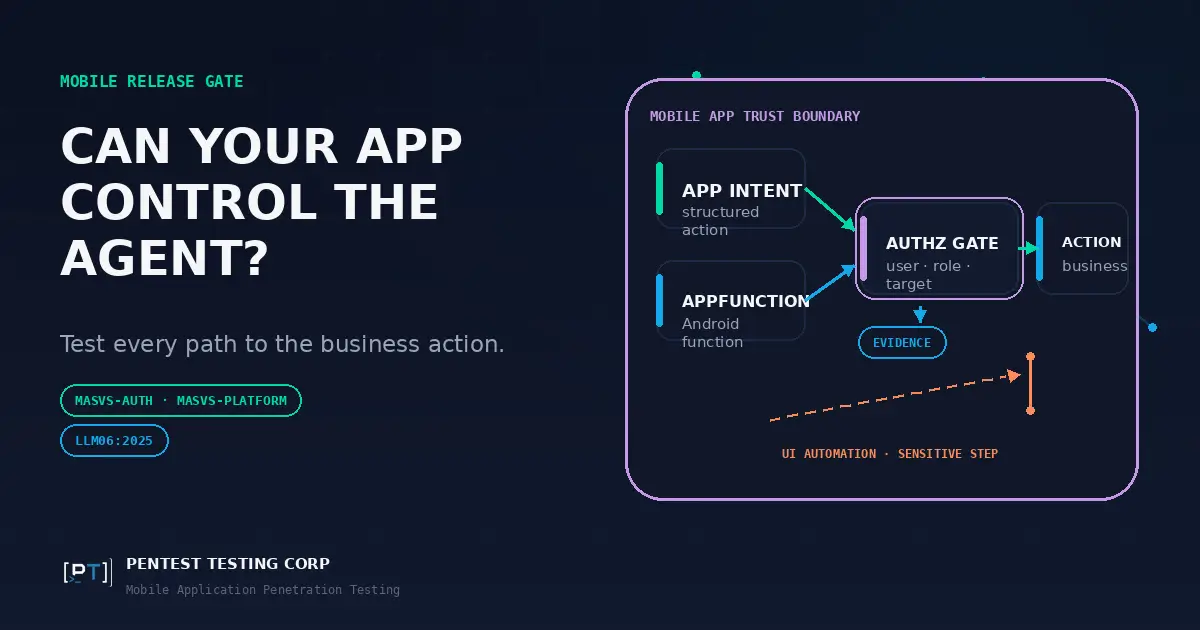
That is the decision behind agent-actionable mobile app security testing. Apple’s App Intents and Google’s AppFunctions make app capabilities more discoverable and executable through Siri, assistants, system experiences, and cross-app workflows. Android is also developing UI automation for apps without a dedicated integration. Users gain less friction, but a secure screen flow does not prove that the same business action is safe through a structured function or automated interface.
Before publication, leadership needs evidence that identity, authorization, confirmation, data boundaries, logging, cancellation, and recovery still hold across every supported action path.
Why agent-actionable mobile app security testing is now a release gate
Apple describes App Intents as the framework that exposes an app’s actions and content to Siri, Shortcuts, Spotlight, Widgets, and Apple Intelligence. Its WWDC26 material adds richer entity sharing, long-running actions, cancellation, process targeting, and first-party testing support. Google describes AppFunctions as an Android API that lets apps publish functions authorized callers can discover and execute.
These are not merely new voice shortcuts. They change how a business capability can be reached.
In a conventional mobile flow, a person opens the app, moves through screens, sees context, makes selections, and encounters the controls placed in that journey. In an agent-mediated flow, the operating system or an assistant may identify an action, resolve entities, populate parameters, and call the capability directly. On Android, UI automation may also operate apps that have not created an AppFunctions integration.
Google currently labels AppFunctions an experimental preview and says Gemini integration remains in private preview. The AndroidX release page listed 1.0.0-alpha11 on August 26, 2026, with no stable, release-candidate, or beta version. Early status reduces neither buyer responsibility nor the need to test. It increases the chance that APIs, caller behavior, device support, metadata, and control assumptions will change during a product cycle.
Apple’s live WWDC26 transcript describes the newest capabilities as part of its “2027 releases.” That is a useful reminder for release planning: security sign-off should be tied to the exact OS build, framework version, app build, device class, locale, and assistant configuration tested, not to a conference announcement alone.
For teams approaching an OS update or agent integration decision, the existing mobile app penetration testing scope should be extended to name these action surfaces explicitly. “iOS and Android included” is no longer sufficient wording if App Intents, AppFunctions, Siri actions, or UI automation are material to the product.
The new mobile action boundary
The risk is not that every assistant request becomes an exploit. The risk is that teams treat an agent as another interface while the system treats it as a caller with access to meaningful functions, entities, sessions, and business workflows.
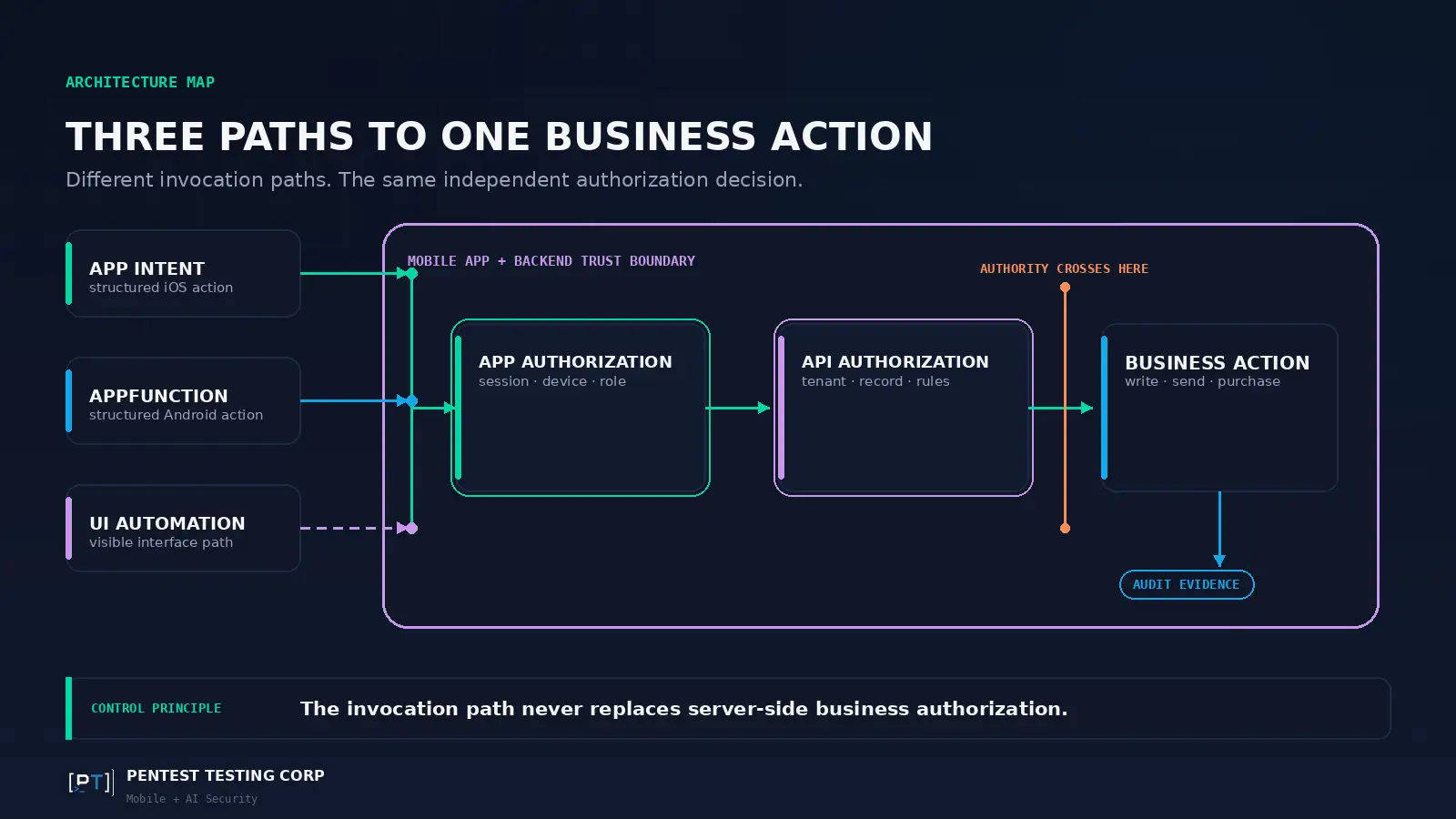
Four paths now matter:
- Structured iOS actions. App Intents can expose actions and entities across Siri, Shortcuts, Spotlight, Widgets, and Apple Intelligence. Relevant entities can be surfaced by context, while syncable entities can travel across devices. Long-running intents can continue in the background and should handle cancellation cleanly.
- Structured Android functions. AppFunctions publishes self-describing functions into an OS registry. A permitted caller can discover metadata, select a function, and execute it with parameters. Google notes that callers require the
EXECUTE_APP_FUNCTIONSpermission, but platform permission is only the outer gate. The app and backend still need to authorize the current user, resource, tenant, and transaction. - Mobile UI automation. Google says its UI automation framework is designed to operate generic tasks in installed apps even when no dedicated integration exists. It includes progress visibility, takeover, and alerts before sensitive tasks, but an app publisher still needs to know how its own controls behave when a machine drives the interface.
- Remote services behind the app. A local action commonly reaches an API, cloud service, payment provider, messaging system, or MCP server. The mobile agent path is only one part of the trust chain.
This distinction matters because structured actions and UI automation fail differently. A structured function can expose an overly broad capability, accept unsafe parameters, resolve the wrong entity, or inherit excessive authority. UI automation can misread context, bypass the user’s normal attention cues, select the wrong target, or behave differently after a layout change. Both paths may reach the same backend, where server-side authorization must remain the final control.
Teams already testing browser or desktop automation can use the principles in computer-use agent testing, but mobile scope must add OS registries, app lifecycle, device authentication, local data, platform permissions, background execution, deep links, and app-to-app interaction.
What agent-actionable mobile app security testing should prove
A useful assessment does not ask whether Siri or Gemini is “safe.” It asks whether the app and its services keep control when any approved agent, assistant, shortcut, automation layer, or adjacent app initiates a request.
Inventory and discoverability
The first deliverable should be an inventory of agent-reachable actions and entities for each platform and build. It should identify which capabilities are read-only, reversible writes, consequential writes, administrative actions, or irreversible operations. It should also record where each capability is advertised, suggested, indexed, donated, enabled, or disabled.
Unexpected discoverability is a security and product risk. An internal, deprecated, support-only, or high-impact action should not become available because metadata, annotations, schemas, shortcuts, or legacy handlers were included in a production build. The test should compare the approved action catalog with what the OS and authorized callers can actually discover.
Identity, session, and caller context
Testing should determine whose identity reaches the business action. The relevant principal might be the signed-in app user, a device user, an assistant, another app, a system process, or a backend service account. Those identities are not interchangeable.
The assessment should verify behavior after logout, role change, token refresh, account switch, device lock, biometric change, app reinstall, profile change, and remote revocation. Where an action crosses devices or uses stable entity identifiers, the app must not confuse “same entity ID” with “same authorized user.”
Authentication also needs to match consequence. Apple provides intent authentication policies and confirmation APIs, while OWASP MASVS-AUTH-3 calls for additional authentication around sensitive operations. Those mechanisms should support, not replace, server-side authorization. A user confirming “send” does not prove that the selected recipient, account, amount, tenant, or record is permitted.
For authentication lifecycle depth, see passkey lifecycle testing. Agent actions should be tested across enrollment, recovery, device replacement, and account-state changes rather than only against a happy-path signed-in session.
Parameter, entity, and business-rule enforcement
An agent may supply names, dates, identifiers, amounts, destinations, files, contacts, or other structured values. The app and backend must treat those values as untrusted inputs, even when the OS generated the invocation.
Testing should validate ownership, tenant, role, state, amount, rate, destination, environment, and workflow rules independently of the model or assistant. Read actions should return only the minimum data needed. Write actions should reject ambiguous, stale, cross-account, out-of-range, or policy-prohibited targets.
Entity resolution deserves special attention. A natural-language phrase may match several records. A stable identifier may refer to data synchronized across devices. A suggested entity may remain registered after its business relevance or authorization changes. The evidence should show that ambiguity leads to clarification or denial, not a convenient guess with customer impact.
Confirmation, preview, and step-up controls
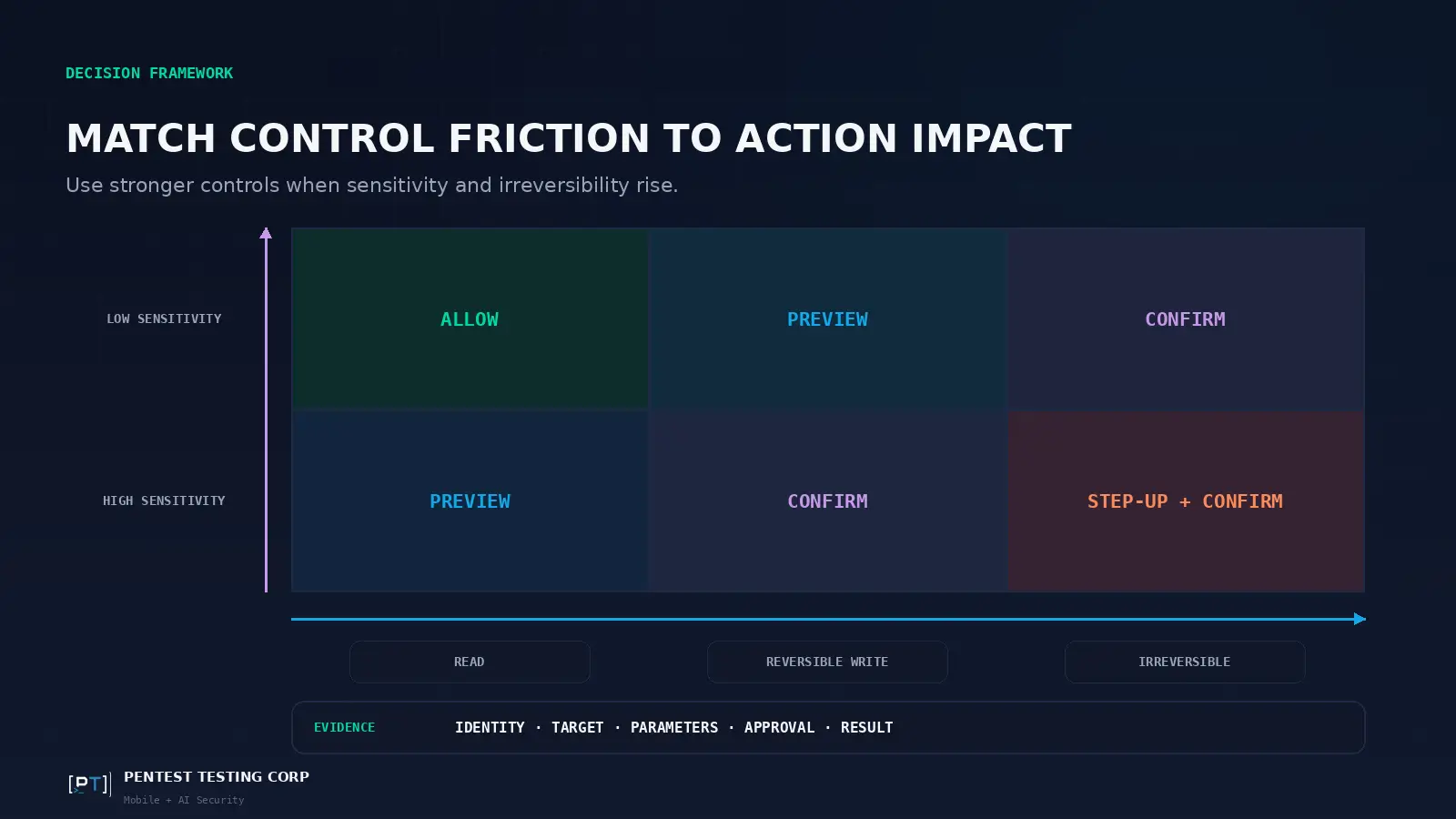
Confirmation should be proportional to impact. Requiring approval for every harmless read trains users to accept prompts automatically. Omitting confirmation for a purchase, external message, destructive edit, privilege change, sensitive disclosure, or irreversible action transfers too much authority to the agent.
For consequential actions, the person should see the material facts: action, target, account, amount, destination, data scope, and reversibility. Approval should occur after those details are fixed and before execution. If parameters can change after confirmation, the control is weak.
Background execution, cancellation, and recovery
Long-running and background actions need more than a progress indicator. Testing should confirm what happens on timeout, app termination, network loss, device lock, duplicate invocation, retry, cancellation, and partial completion. A canceled upload should not leave unintended public data. A retried booking should not create duplicates. A stopped workflow should have an attributable final state.
The product team should define whether each action is idempotent, reversible, compensating, or manually recoverable. Those properties shape both security severity and operational cost.
Logging and incident response
The audit trail should connect the originating user, device or session, calling surface, app action or function, material parameters, authorization result, confirmation event, backend request, outcome, and version. Logging only the assistant’s final sentence is not enough.
Security and support teams should be able to answer: What was requested? What was resolved? What was shown for confirmation? What actually executed? Under which identity? Which records changed? Can the action be reversed? Can that action path be disabled without waiting for a full app-store release?
This agent-specific work complements the conventional mobile app penetration testing methodology, including binary review, storage, IPC, deep links, runtime behavior, transport, authentication, and API authorization.
Buyer action-boundary test matrix
The matrix below is suitable for a statement of work, release-readiness review, or vendor-security discussion.
| Action boundary | What to test | Business failure if weak | Evidence leadership should receive |
|---|---|---|---|
| OS or assistant to action catalog | Exact action/entity inventory, enablement, metadata, deprecated paths | Unapproved capabilities become discoverable or callable | Platform-by-platform inventory and variance report |
| Caller to app session | Caller permission, signed-in identity, lock state, logout, account switch, revocation | An action runs under the wrong or stale user context | Positive and negative session-state results |
| Natural language to parameter | Ambiguity, type, range, destination, record and account selection | The correct function performs the wrong transaction | Parameter-boundary evidence and rejection outcomes |
| Entity to customer or tenant record | Ownership, tenant, stable ID, sync state, deletion and stale suggestions | Cross-customer disclosure or modification | Role and tenant test matrix with redacted proof |
| Action to sensitive operation | Reauthentication, step-up, preview, confirmation binding | A consequential action executes without meaningful consent | Confirmation capture tied to immutable action details |
| Background task to final state | Timeout, retry, duplicate, cancellation, partial completion | Duplicate charge, orphaned data, or inconsistent records | State-transition and recovery results |
| Mobile action to API or MCP tool | Token audience, scopes, backend authorization, service identity | A valid mobile session reaches excessive remote authority | End-to-end identity and authorization trace |
| Runtime to monitoring and response | Correlated logs, alerts, disablement, rollback, retention | The organization cannot reconstruct or contain misuse | Sample audit trail and response exercise evidence |
| UI automation to visible controls | Context changes, wrong target, interrupted flow, takeover and sensitive-step handling | An agent acts on misleading or stale UI state | Device/build-specific automation results |
If AppFunctions connects to remote MCP tools, the scope should also use the trust-boundary questions in MCP security testing. A local function and a remote tool may participate in one user request, but they do not automatically share the same identity, authorization, data, or logging controls.
Illustrative scenario: a legitimate action, the wrong account
Consider a hypothetical travel app that exposes “change booking” on iOS and Android. The action is legitimate, the user is authenticated, and the backend accepts a booking identifier plus a new date.
The customer has a personal booking and can also view a booking shared by an employer. The assistant interprets “move my Thursday trip to Friday,” resolves the employer-funded booking, and prepares the change. The confirmation screen says only “Change booking?” without showing the traveler, account, fare difference, or cancellation consequence. The backend verifies that the user can view the booking but does not separately verify permission to modify it.
No exotic exploit is required. Several reasonable-looking controls fail together: an ambiguous entity match, view access treated as edit authority, a weak confirmation, and incomplete logging that records the final date but not the assistant’s selected account context.
The possible consequences are a customer dispute, employer-policy breach, support cost, lost fare, privacy exposure, and a security-review finding. Remediation is concrete: separate view and modification permissions, constrain entity resolution to editable records, show material details before approval, recheck authorization at execution, make the operation safely repeatable, and correlate the agent request with the backend change.
This is a sanitized hypothetical scenario, not a client case and not a claim that a named platform behaves this way.
Existing controls can still miss this path. Functional QA proves expected actions work; scanners find known patterns; identity providers authenticate users; and platform permissions restrict callers. None alone proves that every agent-selected record, parameter, approval, and downstream action is appropriate for the current user and business context.
Framework mapping, evidence, scope, and timeline
Framework mapping should improve completeness and explain evidence. It should not imply that using a checklist makes an app secure or certified.
| Framework | Relevant area | Application to agent-actionable mobile apps |
|---|---|---|
| OWASP MASVS-AUTH-1 | Secure authentication and authorization protocols | Verify that app and backend preserve user, role, resource, and transaction authority across agent invocation. |
| OWASP MASVS-AUTH-2 | Secure local authentication | Validate device-lock and local-auth behavior where actions rely on device state. |
| OWASP MASVS-AUTH-3 | Additional authentication for sensitive operations | Require proportional step-up for financial, destructive, privileged, or sensitive actions. |
| OWASP MASVS-PLATFORM | Secure interaction with the mobile platform and other apps | Review action exposure, IPC, deep links, extensions, caller interaction, and OS-mediated execution. |
| OWASP MASTG | Test guidance and techniques | Select platform-specific static, dynamic, runtime, and interaction tests for the exact build. |
| OWASP LLM01:2025 Prompt Injection | Manipulated instructions or external content | Test whether untrusted content can alter an agent’s selection or parameters and reach a business-impacting action. |
| OWASP LLM06:2025 Excessive Agency | Excessive functionality, permission, or autonomy | Verify least agency, least privilege, confirmation, parameter limits, and independent enforcement. |
| OWASP ASI01 Agent Goal Hijack | Agent objective redirected by untrusted input | Assess whether an action path can be diverted from the user’s intended goal. |
| OWASP ASI02 Tool Misuse & Exploitation | Legitimate tools used in unsafe ways | Treat App Intents and AppFunctions as action tools whose safe use depends on authorization and business rules. |
| NIST AI RMF | Govern, Map, Measure, Manage | Record ownership and risk tolerance, map action paths, measure control performance, and manage findings and change. |
| NIST SP 800-63-4 | Digital identity lifecycle | Evaluate authentication, authenticator state, session, reauthentication, and recovery where identity assurance is material. |
For AI controls, this article intentionally maps to the requested 2025 OWASP LLM categories while also acknowledging the more agent-specific ASI categories. Teams should record the version used in the test plan because AI security guidance changes faster than many procurement cycles.
Recommended scope
A defensible engagement should include:
- the exact iOS and Android builds, OS versions, device classes, regions, languages, and account roles;
- an approved action and entity inventory for App Intents, AppFunctions, shortcuts, deep links, widgets, extensions, and relevant UI-automation paths;
- test accounts representing each role, tenant, subscription state, and sensitive workflow;
- authentication, authorization, parameter, entity, confirmation, background, cancellation, retry, logging, disablement, and recovery tests;
- the mobile-facing APIs and any remote MCP or agent services that enforce the real business action;
- negative tests for prohibited roles, records, values, destinations, and device or session states;
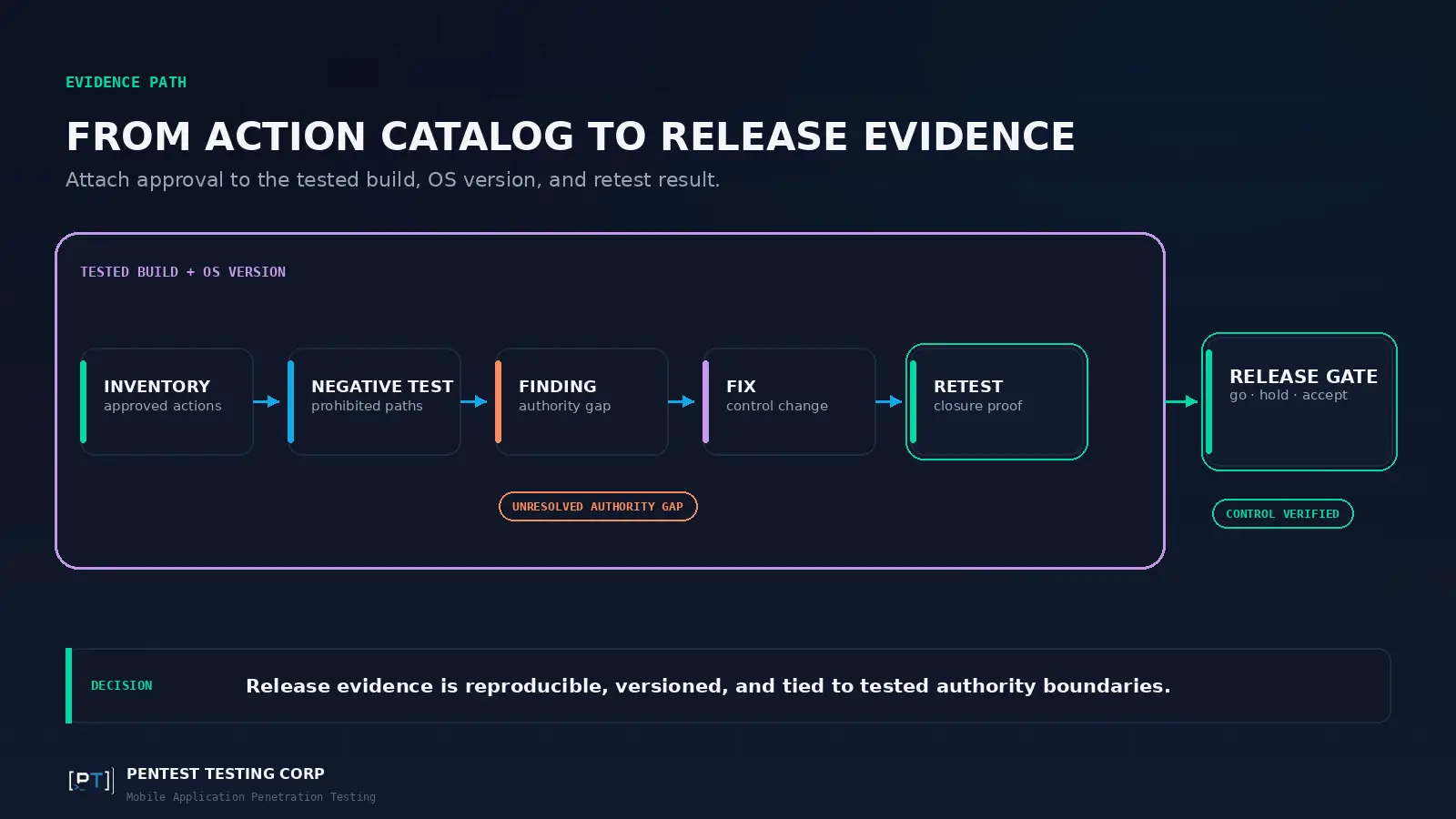
- a retest after launch-blocking findings are fixed and after a material OS, framework, action-catalog, permission, identity, or backend change.
Where the mobile app is only one component of a larger model-orchestrated product, pair the assessment with the AI penetration testing service so model behavior, context handling, remote tools, and multi-step agency are not left outside scope.
Timeline and effort
Pentest Testing Corp’s live mobile service page lists 7–10 business days for a typical single-platform assessment and 12–15 business days for dual-platform work. Agent-action scope can extend that estimate when the product has many actions, roles, tenants, integrations, regions, high-impact transactions, or device-specific automation paths.
For planning purposes, effort rises more with the number of action-role-state combinations than with the raw number of screens. Ten functions used by four roles across personal and business accounts create a broader authorization problem than a visually large app with one low-risk read action.
A buyer should expect an executive summary, action inventory, architecture and identity path, prioritized findings, redacted proof, affected builds and versions, business impact, remediation guidance, framework mapping, and retest status. A sample penetration testing report can help procurement and engineering agree the evidence format before testing begins.
What leadership should decide before publishing
The release meeting should produce explicit decisions, not a general statement that the platform provides security.
- Approved action catalog: Which actions and entities may an OS-level agent discover, suggest, read, or change on each platform?
- Authority ceiling: What is the most consequential action an agent may complete without a person, and which control outside the model enforces that limit?
- Confirmation standard: Which material details must be shown for purchases, messages, destructive changes, sensitive disclosures, and irreversible actions?
- Identity and tenant rule: How does the backend bind each action to the current user, role, account, tenant, and resource rather than trusting a model-selected identifier?
- Fallback position: If UI automation can operate the app without a structured integration, what sensitive steps must resist silent or ambiguous completion?
- Evidence threshold: Which findings block release, what proof is required for closure, and who accepts any residual risk?
- Change trigger: Which OS, framework, metadata, action, model, permission, API, or workflow changes require targeted retesting?
- Containment owner: Who can disable an action, revoke access, stop a rollout, reverse affected transactions, and lead incident response?
The practical decision is not whether to support agentic mobile experiences. It is whether the organization can prove that convenience does not outrun authorization, consent, and accountability.
If your next iOS or Android release exposes app actions to assistants, shortcuts, App Intents, AppFunctions, or UI automation, scope an agent-aware mobile application penetration test before publication. Pentest Testing Corp can align the test with the exact builds, action catalog, roles, APIs, and release deadline.
Frequently asked questions
Is App Intents or AppFunctions support automatically unsafe?
No. Both frameworks provide structured ways to integrate app capabilities with system experiences and agents. Risk depends on which actions are exposed, how parameters and entities are resolved, how identity and authorization are enforced, when confirmation or reauthentication occurs, and what evidence the implementation produces.
Do we need testing if our app has not implemented AppFunctions?
Potentially. Google is developing UI automation for generic tasks in installed apps, which may create an agent-operated path without a dedicated AppFunctions integration. The practical scope depends on supported devices, regions, app categories, assistant configuration, and the sensitive workflows in your app.
Is the OS permission enough to authorize an Android AppFunction?
No. The EXECUTE_APP_FUNCTIONS permission controls which callers can discover or execute functions at the platform layer. The app and backend must still decide whether the signed-in user may perform that action on that record, tenant, account, amount, destination, and workflow state.
Should every agent action require confirmation?
No. Low-risk, read-only, strongly authorized actions may not need extra friction. Confirmation and reauthentication should be reserved for actions where they materially reduce risk, such as purchases, external communications, sensitive disclosures, destructive changes, privilege changes, or irreversible operations.
Can normal mobile penetration testing cover this surface?
It can if the statement of work explicitly includes agent discovery, action invocation, entity and parameter handling, OS-mediated execution, UI automation, approval behavior, and end-to-end backend authorization. A generic mobile scope may omit these paths if they are not declared.
What builds and devices should be tested?
Test the exact release candidates, supported OS versions, representative device families, regions, languages, account roles, and assistant configurations that affect agent behavior. Record framework and library versions so results remain tied to a reproducible release baseline.
When should we retest agent-actionable mobile features?
Retest after remediation and after material changes to the OS, App Intents or AppFunctions definitions, action metadata, entity model, permissions, identity flow, approval logic, model or assistant behavior, APIs, MCP services, or high-impact business workflows.