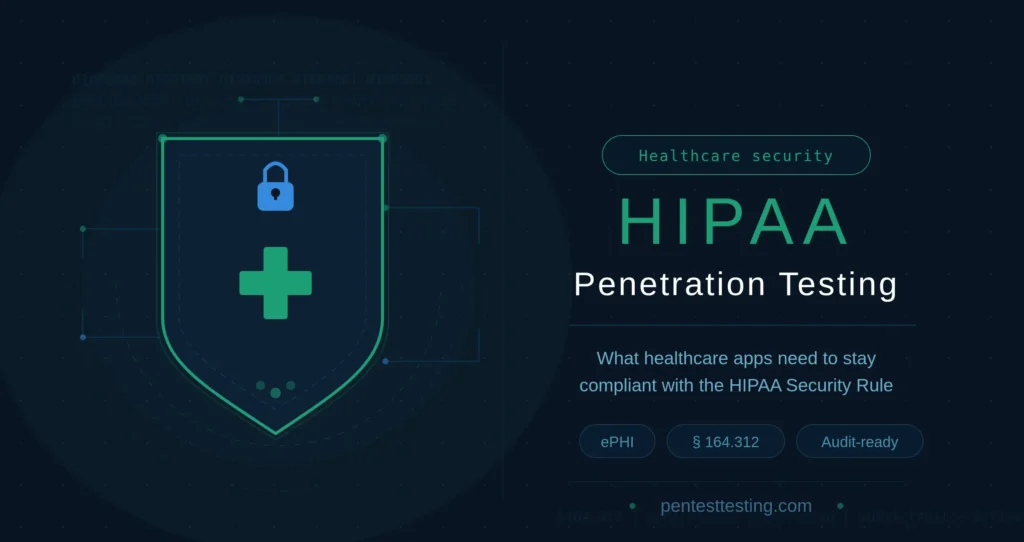
HIPAA Penetration Testing: What Healthcare Apps Need to Stay Compliant
Healthcare data breaches now cost an average of $10.93 million per incident, the highest of any industry for the thirteenth consecutive year, according to IBM's 2023 Cost of a Data Breach Report. Yet the most common cause isn't a sophisticated nation-state attack; it's unvalidated security controls that looked fine on paper and failed under real adversarial conditions.
HIPAA's Security Rule mandates technical safeguards for every system that touches electronic protected health information (ePHI). But mandating controls and proving those controls actually work are two different things. That gap is exactly what a properly scoped HIPAA penetration test closes.
At Pentest Testing Corp, we've conducted thousands of penetration tests across 257+ organizations globally, including healthtech platforms, EHR vendors, and healthcare SaaS companies. This guide gives CTOs, DevSecOps leads, and compliance officers a precise, compliance-mapped breakdown of what a HIPAA pentest covers, how it satisfies specific Security Rule requirements, and what your audit trail should look like when OCR comes knocking.
Why HIPAA Demands More Than a Vulnerability Scan
A vulnerability scanner reports what might be exploitable. A penetration test proves what is.
That distinction matters enormously under HIPAA. The Department of Health and Human Services (HHS) Office for Civil Rights (OCR) has consistently flagged the failure to conduct "adequate technical testing" as a root cause in enforcement actions. In 2023 alone, OCR recorded over 700 reported breaches affecting more than 500 individuals each, and the investigation findings repeatedly point to controls that were configured but never verified against real attack scenarios.
What the Regulation Actually Says
45 CFR § 164.308(a)(8) requires covered entities to implement a periodic technical and non-technical evaluation of security controls in response to environmental and operational changes. The HIPAA Security Series (published by HHS) explicitly names penetration testing as a mechanism for fulfilling this evaluation requirement.
This means a vulnerability scan, while useful, doesn't satisfy the intent of § 164.308(a)(8). Scanners enumerate weaknesses passively; they don't chain vulnerabilities, test business logic, or simulate what a credentialed attacker with time and motivation can actually accomplish inside your ePHI environment.
The Audit Risk Is Real
When OCR investigates a breach, they examine whether you:
- Conducted regular technical evaluations
- Documented your remediation activity
- Had evidence of tested, not just documented, controls
If your security program's only technical evidence is scanner output, that's a material gap an enforcement attorney will notice.
HIPAA Security Rule: Technical Safeguards You're Actually Accountable For
The Technical Safeguards standard lives in 45 CFR § 164.312 and breaks into five implementation categories. These aren't suggestions, they're addressable specifications with required or addressable implementation status, and each one has a direct relationship to what a penetration test validates.
§ 164.312(a)(1) - Access Control
Required: Unique user identification. Automatic logoff. Addressable: Encryption and decryption, emergency access procedures.
Pentest relevance: Can an attacker enumerate user accounts? Can sessions persist beyond timeout thresholds? Is access control enforced server-side or only in the UI layer?
§ 164.312(b) - Audit Controls
Required: Hardware, software, and procedural mechanisms to record and examine access/activity in systems containing ePHI.
Pentest relevance: Do audit logs capture privilege escalation, unauthorized access attempts, or ePHI exports? Can a tester tamper with or delete log entries?
§ 164.312(c)(1) - Integrity Controls
Addressable: Mechanisms to authenticate that ePHI has not been altered or destroyed in an unauthorized manner.
Pentest relevance: Can ePHI records be modified without detection? Are API endpoints validating data integrity on write operations?
§ 164.312(d) - Person or Entity Authentication
Required: Procedures to verify that a person or entity seeking access to ePHI is who they claim to be.
Pentest relevance: Can authentication be bypassed? Are multi-factor authentication implementations bypassable through token manipulation or session fixation?
§ 164.312(e)(1) - Transmission Security
Addressable: Encryption of ePHI in transit; integrity controls for transmitted ePHI.
Pentest relevance: Is TLS configured correctly? Are deprecated cipher suites in use? Can ePHI be intercepted through misconfigured endpoints or improper certificate validation?
Compliance Mapping: How Pentest Findings Satisfy Each Safeguard
The table below is the kind of artifact you want in your HIPAA documentation package, a direct mapping between Security Rule requirements and the pentest activities that validate them.
| HIPAA Technical Safeguard | CFR Reference | Pentest Activity | What We're Validating |
|---|---|---|---|
| Access Control | § 164.312(a)(1) | Authentication bypass, IDOR, privilege escalation | Server-side enforcement of access policies |
| Unique User Identification | § 164.312(a)(2)(i) | Account enumeration, credential stuffing | Uniqueness and isolation of user sessions |
| Automatic Logoff | § 164.312(a)(2)(iii) | Session token analysis, idle timeout testing | Session expiry enforcement on server |
| Encryption/Decryption | § 164.312(a)(2)(iv) | Data-at-rest inspection, key storage review | Encryption applied to ePHI storage |
| Audit Controls | § 164.312(b) | Log injection, log deletion, audit trail review | Tamper-resistance and completeness of logs |
| Integrity Controls | § 164.312(c)(1) | API fuzzing, mass assignment testing | Unauthorized ePHI modification prevention |
| Person/Entity Authentication | § 164.312(d) | MFA bypass, token forgery, SSO misconfiguration | Identity verification robustness |
| Transmission Security | § 164.312(e)(1) | TLS configuration audit, cipher enumeration | Secure transport of ePHI across all channels |
| ePHI Encryption in Transit | § 164.312(e)(2)(ii) | MITM simulation, certificate pinning testing | End-to-end encryption enforcement |
This mapping doesn't just satisfy auditors, it gives your development and DevSecOps teams a precise remediation target for every finding we produce.
What a HIPAA Healthcare App Pentest Actually Covers
Scope definition is where most healthcare pentest engagements go wrong. Teams test only the patient-facing portal and ignore the HL7 interface, the admin dashboard, or the third-party lab integration that actually moves the most sensitive data. Here's what a complete HIPAA-scoped engagement includes.
Web Application Layer
Patient portals, EHR interfaces, telehealth platforms, and admin consoles, all tested against the OWASP Top 10 with specific attention to broken access control (A01), cryptographic failures (A02), and injection vulnerabilities (A03) as they relate to ePHI endpoints. Our web application penetration testing methodology covers authenticated and unauthenticated attack surfaces.
API Layer (HL7, FHIR, and Custom APIs)
Modern healthcare applications are API-first. FHIR R4 endpoints, legacy HL7 v2 interfaces, and custom REST/GraphQL APIs all need specific testing for broken object-level authorization (BOLA), excessive data exposure, and insecure direct object references that could expose ePHI at scale. Our API penetration testing covers the full OWASP API Security Top 10.
Mobile Health Applications
iOS and Android mHealth apps: local data storage of ePHI, certificate pinning validation, inter-process communication, and backend API communication security. Our mobile app penetration testing guide breaks down the platform-specific attack surface in more depth, including iOS Keychain misconfigurations, ATS exceptions, and exported Android components that can expose ePHI if left unprotected.
Infrastructure and Cloud
AWS, Azure, or GCP environments hosting ePHI workloads: IAM misconfigurations, storage bucket exposure, logging gaps, network segmentation failures, and container security.
Third-Party Integrations
Business Associates (billing systems, pharmacy integrations, lab result feeds) connected to your environment introduce risk your internal controls can't fully govern. Lateral movement testing through these integration points is essential.
Step-by-Step: Our HIPAA Penetration Testing Methodology
This is the process we follow for every healthcare client. It's designed to produce findings that are both technically credible and directly usable in your HIPAA compliance documentation.
Step 1: Scope Definition and Rules of Engagement Define the exact systems, environments, and data flows in scope. Establish testing windows, emergency contact protocols, and data handling agreements, critical when test traffic may touch production ePHI systems.
Step 2: Threat Modeling Against ePHI Flows Map how ePHI moves through the application; creation, storage, transmission, access, and deletion. Identify the highest-impact attack paths before a single test is run. This step differentiates a targeted HIPAA engagement from a generic web app test.
Step 3: Reconnaissance and Information Gathering OSINT on exposed infrastructure, subdomains, API documentation leakage, and employee credential exposure. Establish what an external attacker already knows about your environment without touching a single system.
Step 4: Active Vulnerability Assessment Automated and manual enumeration of attack surfaces across web, API, mobile, and infrastructure layers. We map findings to HIPAA Technical Safeguard categories from the start, not in post-processing.
Step 5: Exploitation and Proof-of-Concept Development Attempt to exploit identified vulnerabilities under controlled conditions. Goal: demonstrate real-world business impact — specifically, whether ePHI can be accessed, modified, or exfiltrated. This is the phase that produces the evidence OCR auditors and BAA counterparties actually want to see.
Step 6: Privilege Escalation and Lateral Movement From an initial foothold (whether authenticated user, compromised API key, or network access), test whether an attacker can reach higher-value ePHI stores, administrative functions, or adjacent systems.
Step 7: Audit Log and Detection Validation Confirm whether your SIEM, audit logs, and alerting infrastructure detected the simulated attacks. A finding that went undetected by your logging stack is as important a deliverable as the vulnerability itself.
Step 8: Reporting with HIPAA Mapping Deliver a structured report with every finding mapped to the specific CFR section it violates or validates. Include CVSS scores, proof-of-concept evidence, business impact narrative, and prioritized remediation guidance written for developers, not auditors.
Step 9: Remediation Support and Retest Remain available during remediation. Conduct a focused retest to validate that fixes hold under the same attack conditions, then issue an attestation letter suitable for your HIPAA documentation file or Business Associate due diligence requests.
HIPAA Pentest vs. HIPAA Risk Assessment: Don't Confuse the Two
These two activities are frequently conflated; sometimes deliberately, to inflate the perceived scope of a cheaper engagement.
A HIPAA Risk Assessment (required by § 164.308(a)(1)) is a documentation exercise. You identify potential threats to ePHI confidentiality, integrity, and availability; estimate the likelihood and impact of each threat; and document mitigation measures. It's a structured interview and review process, not a technical test.
A HIPAA Penetration Test is an active technical exercise. We attempt to break your controls using the same tools and techniques a malicious actor would use. It answers the question the risk assessment cannot: "Do these controls actually work?"
You need both, and neither substitutes for the other. The risk assessment identifies theoretical gaps; the penetration test confirms or refutes them against live systems. Together, they satisfy OCR's expectation of a mature, defensible security program.
For organizations operating under NIST SP 800-66 (the NIST guide to implementing the HIPAA Security Rule), the combination of a documented risk assessment and a validated penetration test is the closest thing to an audit-proof security posture you can achieve.
Frequently Asked Questions about HIPAA Penetration Testing Guide
Conclusion
HIPAA compliance isn't a checkbox you mark and move on from. OCR enforcement patterns and the sheer cost of healthcare data breaches make clear that documented policies without validated controls are a liability, both legally and operationally. A properly scoped HIPAA penetration test bridges that gap: it turns your Security Rule technical safeguards from theory into evidence, and gives your compliance documentation the technical backbone it needs to hold up under scrutiny.
Pentest Testing Corp's team brings ISO/IEC 27001, Certified Ethical Hacker, Web Application, and API penetration testing credentials; along with real-world experience across 257+ global clients, to every healthcare engagement. We don't produce generic scanner output wrapped in a compliance label. Every finding we deliver maps to a specific CFR requirement, with the proof-of-concept evidence and remediation guidance your team can actually act on.
Ready to validate your ePHI security controls? Book a free scoping call and we'll map your environment to the right engagement scope within 24 hours.