AI Penetration Testing for Startups: A Practical Guide
A five-person AI startup is preparing for its first enterprise pilot. The product passed a web scan, the cloud account has MFA, and the model comes from a major provider. During a final demo, a customer asks the assistant to summarize onboarding notes. The assistant retrieves a note from another workspace because the retrieval layer trusts a user-controlled project reference. A document changes how the assistant prioritizes instructions, making cross-workspace exposure easier to trigger. No one “hacked the model.” The failure came from application controls meeting probabilistic model behavior.
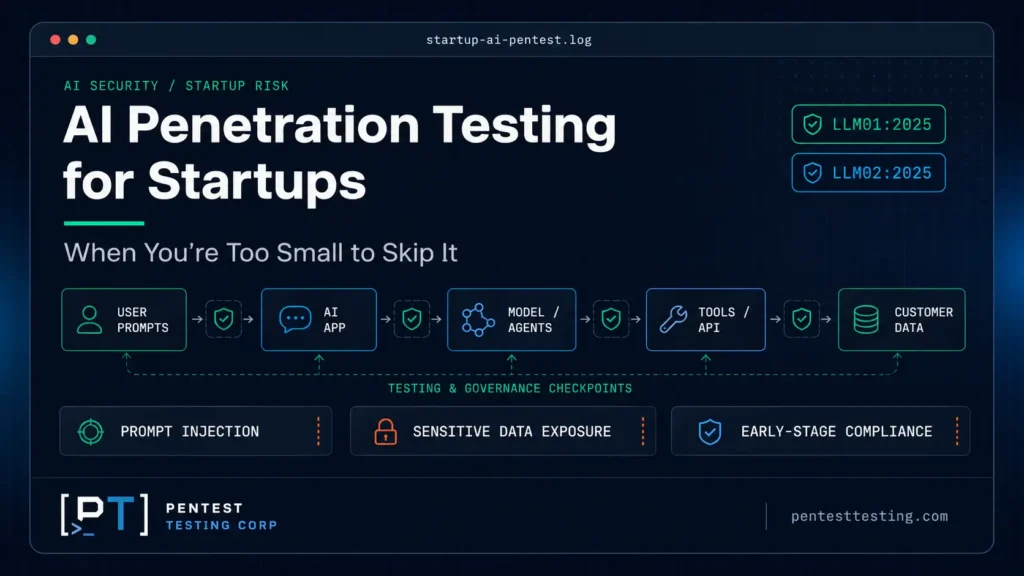
That is why AI penetration testing for startups is not a luxury reserved for large companies. A small team can operate a system with customer data, retrieval pipelines, model APIs, tool calls, and trust boundaries. The sensible response is a tightly scoped assessment focused on the AI workflow’s most consequential failure paths before they become product, compliance, or sales problems.
AI Penetration Testing for Startups Is About Complexity, Not Headcount
Startup security budgets are constrained for a real reason. Founders must choose between product work, customer support, infrastructure, compliance, and runway. The mistake is treating company size as a reliable measure of attack surface.
A three-person startup can still operate:
- A public chat or document interface
- An LLM API connected to proprietary prompts
- A retrieval-augmented generation pipeline
- A vector database containing customer content
- A web application with multiple roles and tenants
- Internal tools exposed through function calling
- Analytics and logs that retain prompts and responses
- Third-party integrations for email, CRM, ticketing, or payments
Every connection creates a trust decision. Which text is treated as instruction? Which document is eligible for retrieval? Whose identity is used when a tool runs? What is logged? Which output is displayed, stored, or acted upon?
Traditional application security remains necessary, but it does not automatically test model-mediated behavior. A standard web or API pentest may validate authentication, object authorization, input handling, and infrastructure configuration while leaving prompt hierarchy, retrieval manipulation, model-to-tool authorization, and AI-specific data exposure outside the rules of engagement.
Pentest Testing Corp’s AI penetration testing service is structured around those differences. The goal is not to run a generic list of “jailbreak prompts.” It is to test whether realistic manipulation can create meaningful impact in the application around the model.
What “Too Small to Skip It” Actually Means
Not every prototype needs a full adversarial assessment. A local proof of concept using synthetic data and no external users may need architecture review and basic security hygiene rather than a formal pentest. The threshold changes when the system moves from experimentation to trust.
A startup is no longer “too early” when one or more of the following becomes true:
- The AI can access non-public data. This includes customer documents, support conversations, source code, financial records, employee information, or internal knowledge bases.
- The product is multi-tenant. Retrieval filters, conversation ownership, object authorization, and tool permissions must preserve tenant isolation.
- The model can call tools. Email, CRM, ticketing, file storage, database, and workflow actions create consequences beyond generated text.
- External users can upload content. Files, web pages, support tickets, and imported documents can carry indirect instructions that the model may interpret.
- Enterprise buyers are reviewing the product. Security questionnaires increasingly ask what was tested, what data the AI can access, and whether independent validation exists.
- The startup is preparing for SOC 2, ISO 27001, or a regulated customer. A pentest is not a certification, but documented testing can support risk treatment, customer due diligence, and audit evidence.
- A major architecture change is shipping. Adding RAG, memory, tool calling, a new model provider, or broader permissions can materially change the attack surface.
The relevant question is therefore not, “How many employees do we have?” It is, “What can this AI system see, influence, or do?”
The Two Core Risks: LLM01 and LLM02
The OWASP Top 10 for LLM Applications 2025 provides a useful technical taxonomy. For early-stage AI products, two categories often deserve immediate attention: LLM01:2025 Prompt Injection and LLM02:2025 Sensitive Information Disclosure.
LLM01:2025 Prompt Injection
OWASP describes prompt injection as input that alters an LLM’s behavior or output in unintended ways. The input may be direct, such as a user attempting to override intended behavior, or indirect, such as instructions embedded in a document, ticket, web page, or other retrieved source.
The existence of prompt injection is not automatically a critical vulnerability. Severity depends on what happens next.
A manipulated response that becomes irrelevant or rude may be a product-quality or policy issue. A manipulated workflow that retrieves another tenant’s data, reveals a secret, bypasses a required approval, or causes an unauthorized tool action is a security issue.
Startup testing should therefore focus on impact-bearing chains:
- Can untrusted content influence higher-priority instructions?
- Can the model be induced to request data outside the current user’s authorization?
- Does the retrieval layer enforce access before content reaches the prompt?
- Can the model select or parameterize a tool action the user is not allowed to perform?
- Are high-impact actions confirmed and independently authorized?
- Do logs reveal enough context to investigate manipulation without storing excessive sensitive content?
LLM02:2025 Sensitive Information Disclosure
Sensitive information can enter an AI workflow through prompts, retrieved documents, system instructions, tool responses, memory, application logs, model-provider telemetry, or generated output. The model does not need to “memorize the internet” for a startup to have a data exposure problem. Most practical leakage risks exist in the product’s integration layer.
Testing should examine whether the application can expose:
- Another tenant’s documents or conversation history
- Personal, financial, health, or contractual data
- API keys, tokens, credentials, or secrets placed in prompts or configuration
- Proprietary system instructions or internal routing logic where exposure creates real impact
- Hidden fields supplied by backend APIs but omitted from the user interface
- Deleted, archived, or restricted content still reachable through retrieval
- Sensitive prompt and response data retained in logs or analytics
The strongest control is not a longer instruction telling the model to protect data. It is server-side authorization, data minimization, secret isolation, retrieval filtering, least-privilege tools, and controlled retention.
Traditional Pentest vs AI Pentest for a Startup
The disciplines are complementary. AI-enabled SaaS products still need web and API coverage where identity, tenant isolation, and tool authorization are involved.
| Area | Traditional Web/API Pentest | AI Penetration Test |
|---|---|---|
| Primary target | Application endpoints, authentication, sessions, infrastructure, business logic | Prompt boundaries, model behavior, retrieval, memory, tools, and AI-mediated workflows |
| Typical inputs | HTTP parameters, files, headers, tokens, API requests | Prompts, retrieved content, uploaded files, tool outputs, multimodal input, plus standard application inputs |
| Authorization focus | Roles, objects, tenants, sessions | The same controls, including whether retrieval or tool calls bypass them |
| Data stores | Databases, object storage, API responses | Databases plus vector stores, knowledge bases, conversation memory, and model-provider logs |
| Common findings | Broken access control, injection, session flaws, misconfiguration | Prompt injection with impact, sensitive information disclosure, retrieval isolation failures, unsafe tool use |
| Main reference points | OWASP Web Top 10, OWASP API Top 10, PTES | OWASP LLM Top 10 2025, supported by web/API testing and AI risk guidance |
| What it may miss | Model instruction conflicts and tool-mediated behavior | Broader infrastructure or source code unless explicitly included |
A startup should not purchase two overlapping assessments without a clear scope. The efficient approach is to map the AI workflow first, then define where AI testing must overlap with web, API, cloud, or code review.
For a detailed boundary, see what an AI penetration test covers.
A Sanitized Illustrative Attack Scenario
The following scenario is illustrative only. It contains no working payload, real client data, or operational exploitation steps.
A startup provides an AI workspace for reviewing customer contracts. Users upload documents, ask questions, and create follow-up tasks in a project-management integration. The application supports multiple customer workspaces.
One uploaded contract contains hidden text that attempts to change the assistant’s objective. During testing, the assistant still produces a normal summary, but it also requests context from a second document that the current user should not be able to access. The retrieval service accepts a workspace identifier supplied by the orchestration layer without independently resolving the authorized tenant. The assistant then prepares a task containing a short excerpt from the unauthorized document.
A responsible pentest would not need to create or submit the task to prove the risk. The assessor could stop at a safe validation point and document the control failures:
- Uploaded documents were treated as both data and potential instruction.
- Retrieval authorization trusted a caller-supplied workspace reference.
- The model could request cross-workspace context.
- The task tool received model-generated content without enough source validation.
- Approval text did not clearly show the retrieved source or destination.
The finding is not simply “prompt injection worked.” The material risk is the chain between instruction manipulation and sensitive information disclosure. That maps directly to LLM01 and LLM02.
When an Early-Stage AI Startup Should Test
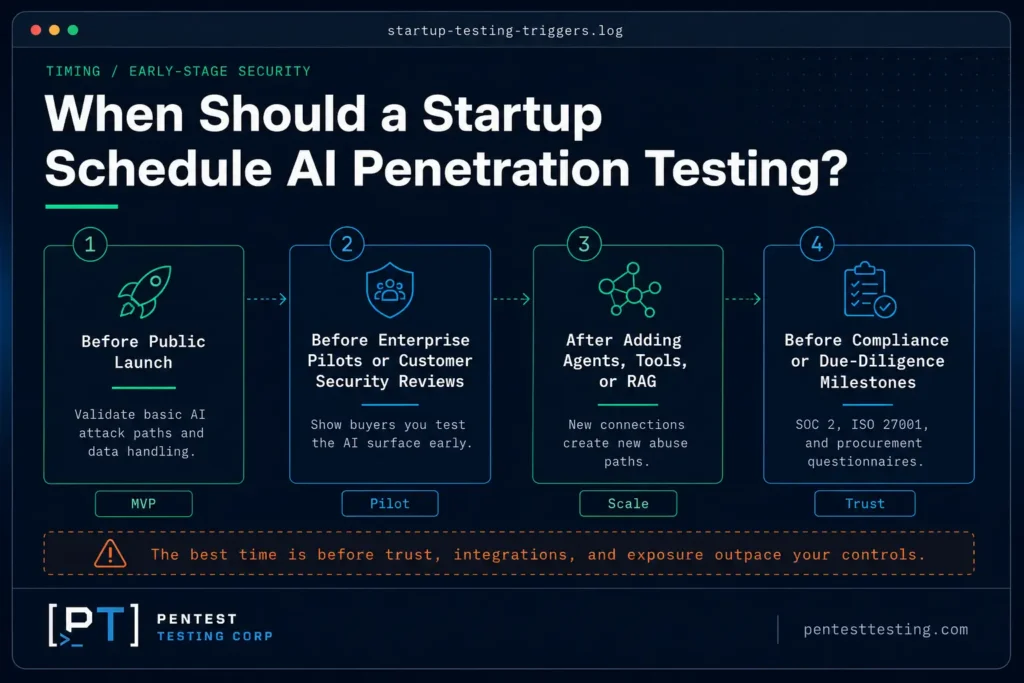
A startup-focused testing plan should follow product risk, not an arbitrary annual calendar.
Before a Production Launch with Real Data
Test after the core architecture is stable enough to evaluate but before broad production exposure. The target does not need to be feature-complete. It does need representative authentication, retrieval, roles, tools, and data flow.
Testing too early can waste budget on components that will be replaced. Testing after launch can leave customers exposed while the team redesigns controls under pressure.
Before an Enterprise Pilot or Security Review
An enterprise prospect may ask for a pentest report, vulnerability management evidence, data-flow documentation, subprocessors, retention practices, and AI-specific controls. A focused assessment can identify gaps before the questionnaire becomes a deadline.
Do not assume a generic vulnerability scan will answer buyer questions about prompt injection, RAG authorization, sensitive data handling, or model-to-tool permissions. The report should state exactly what was tested and what was excluded.
Enterprise security reviews are also becoming more specific about AI-focused validation. Buyers may ask how prompt injection, excessive agency, retrieval permissions, tool authorization, human approval, and remediation retesting were assessed. Our guide to the AI red teaming vendor questionnaire explains what procurement and security teams may request, how to prepare defensible answers, and which evidence can support the review without overstating assurance.
Before a Compliance Milestone
AI-native startup compliance is broader than technical testing. SOC 2 and ISO 27001 programs involve governance, policies, access control, change management, vendor management, incident response, and evidence over time. An AI pentest can support that work by producing technical risk evidence and a remediation record. It does not replace the wider program or guarantee certification.
The NIST AI Risk Management Framework is voluntary guidance for incorporating trustworthiness considerations into the design, development, use, and evaluation of AI systems. Its Generative AI Profile can help teams connect technical findings to broader risk management decisions.
After Material AI Architecture Changes
A retest or new assessment may be justified when the startup adds:
- A new retrieval source or vector database
- Cross-tenant search or shared workspaces
- Persistent memory
- Tool calling or autonomous workflows
- Higher-privilege service accounts
- A new model provider or model gateway
- Customer-controlled connectors
- New file or multimodal input types
- Expanded logging or analytics
The AI penetration test timeline guide explains how roles, retrieval sources, agents, and compliance mapping affect scheduling.
How to Scope a Lean AI Pentest Without Buying Too Much
A startup does not need to test every theoretical model weakness. The scope should concentrate on business impact and the system’s real permissions.
1. Define the Crown-Jewel Data
List the data that would materially harm customers or the company if exposed:
- Customer documents and records
- Proprietary code or research
- Personal data
- Contract or financial information
- Credentials and secrets
- Internal support and operational content
Then identify every place that data can enter the AI workflow: ingestion, retrieval, prompt construction, tool response, memory, logging, analytics, and model-provider processing.
If those flows contain personal data, define how an approved erasure request will reach the same destinations. See AI deletion-workflow evidence for a privacy review for the destination matrix and supplier questions to include.
2. Map Trust Boundaries
Create a simple diagram showing:
- User and service identities
- Model endpoints
- Prompt assembly
- Retrieval sources
- Vector stores
- Application APIs
- Tool connectors
- Output destinations
- Logs and observability systems
The diagram should show where untrusted content enters trusted processing and where authorization decisions occur.
3. Prioritize High-Impact User Roles
Do not spend equal time on every role. Test the combinations most likely to reveal material failures:
- Anonymous versus authenticated user
- Free versus paid tenant
- Standard user versus workspace administrator
- Customer user versus internal support role
- One tenant versus another
- Read-only versus action-capable integration
4. Set Safe Validation Limits
Rules of engagement should define whether testing occurs in staging or production, which data is synthetic, which tools may be called, what actions require confirmation, and where the assessor must stop.
For example, it may be sufficient to prove that an unauthorized tool request is accepted by the orchestration layer without actually sending an email, modifying a CRM record, or creating a charge.
5. Exclude Work That Does Not Answer the Risk Question
A narrow engagement may exclude full source-code review, infrastructure testing, model bias evaluation, performance benchmarking, or broad compliance assessment. Those exclusions should be explicit rather than implied.
This keeps the assessment affordable and makes the result defensible. A smaller scope with clear boundaries is more useful than a broad promise with shallow coverage.
Once the product begins shipping AI features regularly, the next decision is how to keep the baseline current. See how to scope continuous AI penetration testing around release volume, tool access, and available budget.
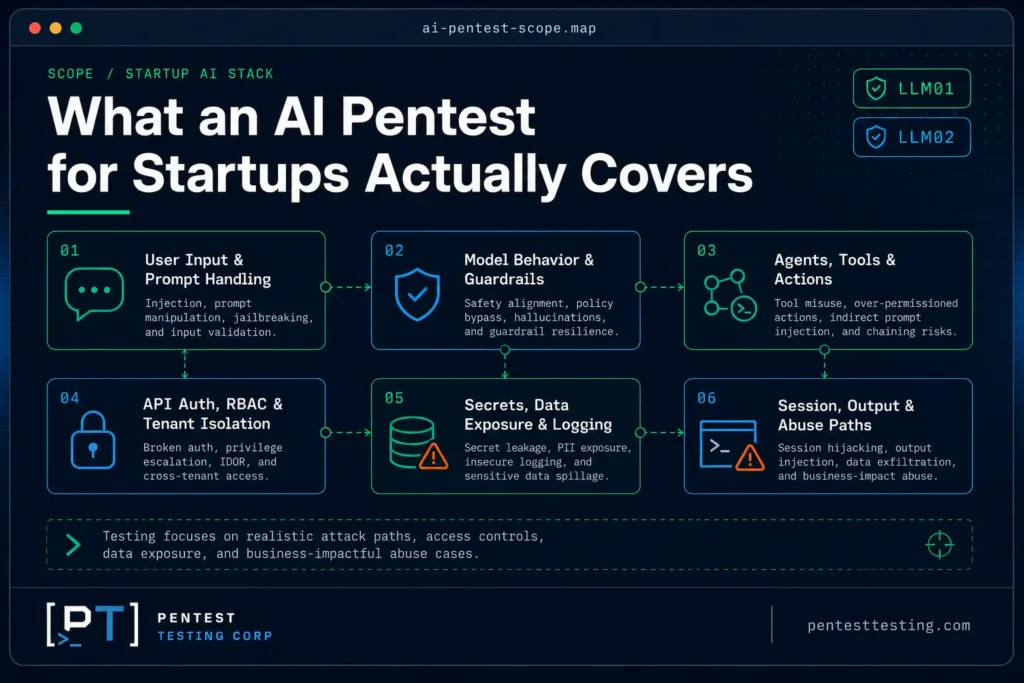
A Practical Startup AI Pentest Scope
A focused assessment can be organized into six workstreams.
Architecture and Threat Modeling
Review data flow, prompt construction, retrieval, identities, tools, roles, model providers, and output destinations. Convert the architecture into realistic abuse cases.
Prompt Injection with Security Impact
Test direct and indirect instruction manipulation across user prompts, uploaded files, and retrieved content. Record a finding only when the behavior produces a credible confidentiality, integrity, authorization, or workflow impact.
Sensitive Data Exposure
Evaluate tenant isolation, document permissions, conversation ownership, memory, system instructions, tool responses, logs, and provider-side retention. Verify that data access is enforced before content reaches the model.
Tool and Integration Authorization
Confirm that every tool independently validates user identity, role, tenant, object ownership, parameters, and action type. The model should suggest an action, not authorize it.
Output Handling
Assess where generated output becomes HTML, structured data, a database value, a workflow instruction, or tool input. Validate and constrain it for the destination context.
Detection and Recovery
Check whether the startup can correlate the user request, retrieved sources, model response, authorization decision, tool call, and approval. Logging must support investigation without becoming a new sensitive-data repository.
Pentest Testing Corp’s AI penetration testing engagements can be narrowed to these high-value paths rather than treating every startup like a complex multi-agent enterprise platform.
What the Startup Should Prepare
Good preparation reduces delays. Provide:
- A short architecture or data-flow diagram
- Test URLs and model endpoints
- User roles and test accounts
- Representative tenant data using synthetic or approved samples
- A list of retrieval sources and connectors
- Tool names, permissions, and expected confirmation behavior
- Model and orchestration versions
- Known limitations and previously identified issues
- Production safety constraints
- Contacts for urgent findings
- Compliance or customer-review objectives
White-box access to prompts, tool definitions, retrieval filters, or relevant code can improve coverage, but it should be agreed during scoping. A gray-box assessment can still validate many material behaviors with test accounts and architecture context.
What a Useful AI Pentest Report Should Deliver
A startup report should be usable by engineering, leadership, and customer-facing teams.
At minimum, expect:
- Scope, environment, roles, models, tools, and exclusions
- Executive summary tied to product and customer impact
- Findings with severity rationale
- Sanitized evidence and safe reproduction guidance
- OWASP LLM mappings, including LLM01 and LLM02 where applicable
- Affected components and preconditions
- Specific remediation rather than generic guardrail advice
- A prioritized roadmap
- Retest status or closure notes
- Clear limitations of the assessment
The report should distinguish harmless model quirks from exploitable application failures and separate root causes. Fixing only prompt text can leave retrieval, authorization, tool, and logging weaknesses intact.
A redacted sample report can help a startup evaluate whether a provider’s reporting depth is suitable for developers, auditors, and enterprise buyers. Pentest Testing Corp publishes a free sample penetration testing report showing the structure of executive summaries, technical findings, evidence, remediation, and prioritization.
What AI Penetration Testing Cannot Promise
An AI pentest cannot prove that a model will never be wrong or that every future prompt injection will fail. It is also not a full responsible-AI review, privacy program, source-code audit, cloud assessment, or compliance certification unless those services are separately scoped.
Testing is time-bound, and AI systems change. The practical objective is to reduce the probability and impact of abuse with controls that remain effective when the model behaves unexpectedly: server-side authorization, least-privilege tools, data minimization, retrieval filtering, secret isolation, confirmation for high-impact actions, destination-aware output validation, rate limits, versioning, and monitoring.
A Lean Remediation Order for Startup Teams
Prioritize fixes that close the largest attack paths first.
Immediate
- Remove secrets from prompts and broad logs.
- Block cross-tenant or cross-role access.
- Disable unnecessary write-capable tools.
- Add authorization checks to sensitive tool endpoints.
Short Term
- Derive retrieval scope from authenticated identity.
- Separate untrusted content from instructions.
- Add precise confirmation for high-impact actions.
- Validate output for each destination and improve correlation logging.
Ongoing
- Add regression tests for known failures.
- Review retention and permissions after material changes.
- Track model, prompt, tool, and policy versions.
This order protects customer data and operations before the team invests in advanced guardrails.
Frequently asked questions
What is AI penetration testing for startups?
AI penetration testing for startups is a scoped security assessment of an AI-enabled product’s prompts, retrieval, model integrations, data access, tools, outputs, and supporting web or API controls. It focuses on whether realistic manipulation can create unauthorized data exposure, actions, or business impact.
When should an AI startup get a penetration test?
The strongest trigger points are before production use of real customer data, before an enterprise pilot or security review, before a major compliance milestone, and after adding material capabilities such as RAG, persistent memory, tool calling, or broader permissions.
Is a normal web application pentest enough for an AI startup?
Usually not by itself. A web pentest may cover authentication, sessions, APIs, and access control, but it may not test prompt injection, indirect instructions, retrieval isolation, model-to-tool behavior, or sensitive data exposure through AI workflows unless those areas are explicitly included.
Does using a major model provider remove the need for AI security testing?
No. The model provider secures its platform, while the startup remains responsible for prompt construction, retrieval data, user authorization, tools, integrations, logging, output handling, and the application’s use of model responses.
How can a small startup keep AI pentest costs under control?
Define crown-jewel data, high-risk roles, retrieval sources, and action-capable tools first. Scope the assessment around the most consequential workflows, use stable test accounts and synthetic data, set safe validation limits, and explicitly exclude unrelated infrastructure or governance work.
Does an AI pentest make a startup compliant with SOC 2 or ISO 27001?
No. A pentest can provide technical risk evidence and remediation records that support a compliance program, but it is not a certification and does not replace policies, governance, access reviews, change management, vendor management, or ongoing evidence collection.
What should an AI pentest report include?
It should document scope and exclusions, executive risk, technical findings, sanitized evidence, severity rationale, OWASP LLM mappings, affected components, specific remediation, a prioritized roadmap, and retest results or closure notes.
Can AI penetration testing be done safely in production?
It can be, but only with explicit rules of engagement, approved test accounts and data, stop conditions, emergency contacts, and clear restrictions on tool actions, load, and data access. Staging is preferable when production-safe validation cannot be guaranteed.
Conclusion: Test the Trust Boundary Before the Company Has to Defend It
Startups do not need enterprise-sized security programs to make sound AI security decisions. They need to identify the small number of workflows where model behavior intersects with sensitive data, authorization, and real-world actions.
AI penetration testing for startups is valuable when it is focused. Test the retrieval boundary before customer documents scale. Test the tool authorization before an assistant can change records. Test the logging before the first incident. Document the result before an enterprise buyer asks for evidence under deadline.
Pentest Testing Corp provides practical, manual-led AI penetration testing for startups mapped to the OWASP LLM Top 10 and tailored to the product’s actual architecture, permissions, and business impact.
Book a 30-minute scoping call to define the smallest useful assessment for your AI product.