Backup Management Plane Isolation Testing
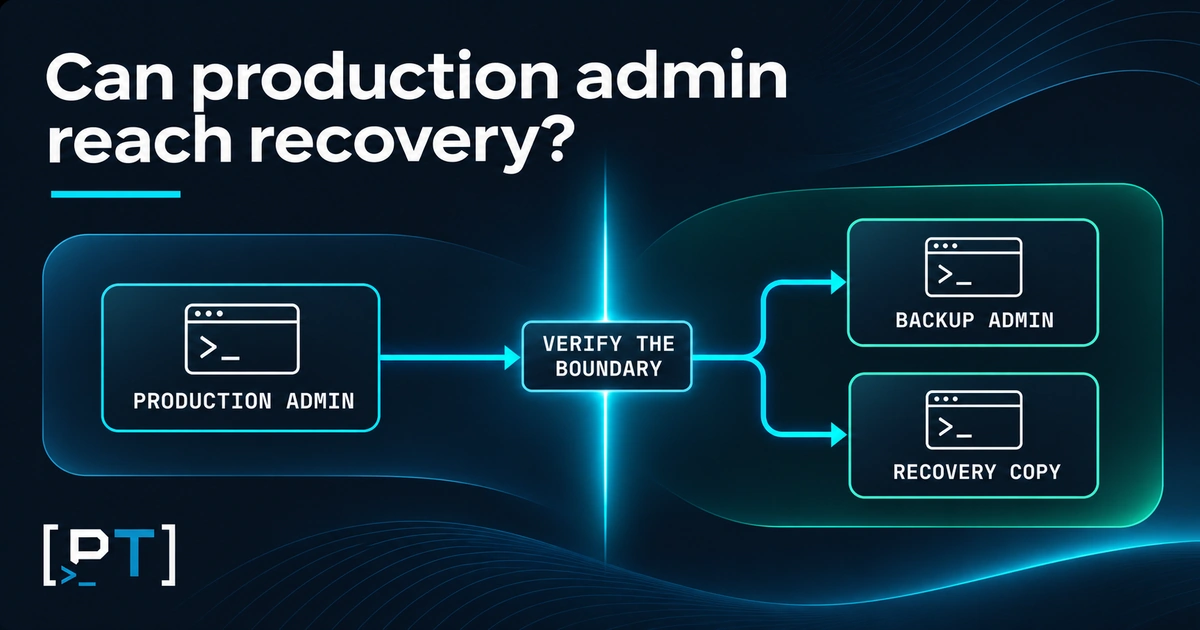
An IT director approves a backup-platform upgrade after a successful restore demonstration. The recovery copy is readable, the retention dashboard is green, and the supplier has enabled a protection feature. Before closing the change, the CISO asks a different question: if a production administrator’s identity is compromised tomorrow, can that identity take control of backup administration?
Backup management plane isolation testing examines that boundary before an incident. It tests the routes and authority connecting an assumed compromised position to the systems that govern recovery. A second username, a separate subnet, or an immutable copy can contribute protection, but each leaves questions about effective control.
The leadership decision is practical: can the named recovery estate remain independently administered when production access is lost or abused? Answering it requires agreed starting identities, safe evidence, and a recovery owner who can accept the result. A successful restore alone does not answer that access question.
Why backup administration belongs in the recovery risk decision
The management plane is the collection of interfaces and privileges that governs backup operations. It can include a console, administrative APIs, policy settings, repository administration, encryption-key management, and the infrastructure hosting those components. The backup data is only one part of the recovery dependency.
If one compromised administrative identity can influence both production and recovery, an incident may affect the two environments together. Depending on actual permissions and platform protections, unauthorized administration could interrupt future backups, change job settings, expose retained information, or delay access to recovery resources. None of those consequences should be assumed from a reachable login page. They require evidence about the authority actually available.
This matters financially because recovery commitments depend on more than storage capacity. Leadership may have approved a maximum tolerable outage based on a usable backup service. If the people responding to an incident cannot independently access its console, keys, or documentation, the recovery plan contains an unpriced dependency. Testing makes that dependency visible before downtime turns it into a business decision.
MITRE ATT&CK T1490, Inhibit System Recovery, describes adversary interference with recovery mechanisms. It provides a threat reference for discussing consequences; it is not an instruction to reproduce destructive actions during an assessment. The objective here is evidence of effective boundaries, obtained without damaging recovery capacity.
For a wider engagement, internal network penetration testing provides the relevant service context. Specify backup administration as a named objective. A general internal test does not automatically cover every recovery repository, cloud account, delegated provider, or emergency identity.
Commission this review when a backup redesign, directory consolidation, administrator change, or management-platform migration alters the boundary. The trigger is a changed dependency. There is no need to wait for a new vulnerability disclosure to ask whether production authority extends into recovery.
What backup management plane isolation testing must distinguish
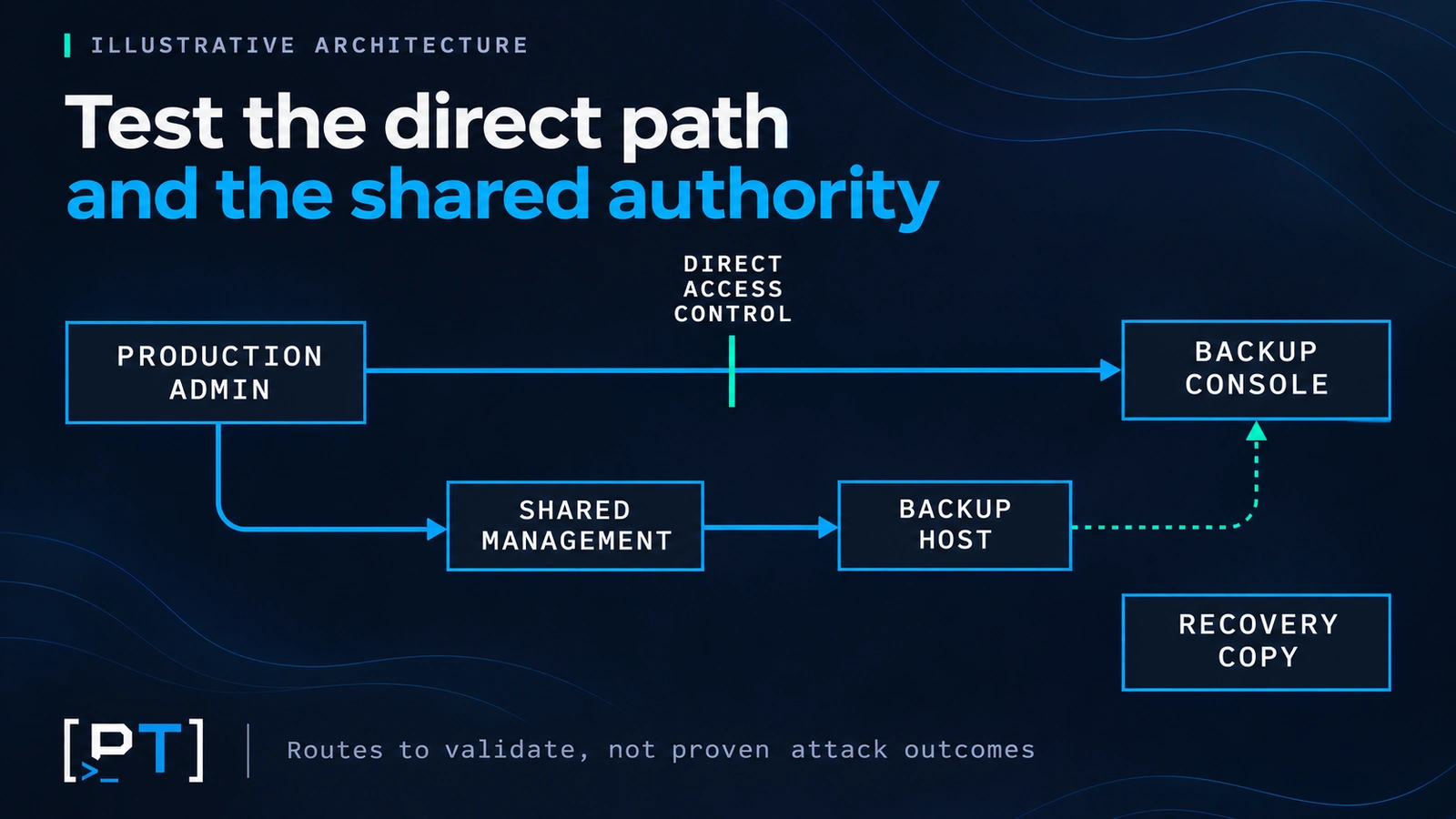
Buyers should separate reachability, authentication, authorization, and operational independence. A console that responds from a production network may still enforce appropriate access restrictions. Conversely, a blocked direct route offers limited reassurance if the same administrator controls an intermediary that can administer the backup server.
Authentication establishes the identity accepted by a service. Authorization determines what that identity may do. Independence asks whether control can be acquired indirectly, for example through a shared identity administrator, endpoint-management service, host platform, or account-recovery process. These layers require different evidence and often different remediation owners.
| Existing control | Useful protection | Question still requiring evidence |
|---|---|---|
| Separate backup username | Distinguishes routine operational accounts. | Can the compromised production authority reset, assign, or recover that account? |
| Management subnet | Restricts selected network paths. | Are alternate interfaces and shared management intermediaries equally restricted? |
| Multifactor authentication | Adds authentication assurance. | Are recovery methods, service identities, and existing sessions inside the assessed boundary? |
| Immutable retained copy | Can constrain changes to protected data under configured conditions. | Which assets and periods are protected, and what administration remains possible elsewhere? |
| Successful restore exercise | Shows a defined recovery operation worked under its test conditions. | Would authorized recovery still be available after losing production identity services? |
Describe immutability precisely. A retention lock may protect specified copies while leaving scheduling, account access, supporting infrastructure, or future backups under separate controls. Behavior depends on the product, configuration, privilege model, and protection state. Ask the assessor to verify documentation and deployed settings for your platform rather than importing another vendor’s claims.
Offline storage also needs an operational definition. Physically disconnected media, a logically isolated vault, and an online repository with restricted administration present different dependencies. Record when each copy is accessible, who can change that condition, and what supporting credentials are needed. The CISA #StopRansomware Guide recommends offline, encrypted backups and regular availability and integrity testing. Apply that guidance to the real recovery design.
Finally, keep the assessment’s purpose clear. Isolation evidence supports confidence in access separation. It does not establish that backed-up information predates an intrusion or that a restored application is safe to reconnect. Those later decisions belong in a ransomware restore readiness assessment.
Build a backup management plane isolation testing scope matrix
Begin with one business recovery objective and the assets needed to support it. An order-processing service might depend on database copies, application configuration, a catalog, encryption material, and independent operator access. Scope that collection explicitly. “Test the backup server” can leave the controls governing its host, storage, or cloud tenant outside the engagement.
Agree assumed footholds before testing. A standard employee account, a server administrator, a production directory administrator, and a supplier operator represent different authority. They should appear as separate scenarios with named privileges and exclusions. Starting with a privileged test identity is an authorized assumption, not evidence that the assessor demonstrated the preceding compromise.
| Assumed starting position | Boundary to assess | Safe proof requested | Acceptance owner |
|---|---|---|---|
| Production employee endpoint | Access to management interfaces | Recorded permitted and denied routes, with source and destination context | Network owner |
| Production server administrator | Backup console and service authority | Approved role inspection and non-destructive authorization checks | Backup owner |
| Production directory administrator | Backup identity administration and recovery | Evidence of who can assign roles or reset access, with inherited dependencies | Identity owner |
| Shared management operator | Hosting, remote administration, and orchestration | Documented effective control over supporting systems, with agreed stopping points | Platform owner |
| Supplier support identity | Delegation and emergency access | Approved entitlement review and access checks within supplier authorization | Supplier relationship owner |
| Authorized recovery operator | Independent access during production identity loss | Controlled access demonstration using the agreed recovery procedure | Recovery owner |
For each row, identify management interfaces, account or tenant boundaries, permitted locations, and the effect being prevented. Distinguish viewing metadata from changing policy, administering credentials, accessing backup contents, and controlling infrastructure. The assessment should not compress these permissions into a single “backup access” result.
Include identity-recovery dependencies such as recovery contacts and authentication administration where authorized. Include key custody, configuration backups, and documentation access when they are necessary to operate the named estate. A protected repository may remain unavailable if its recovery instructions and credentials depend entirely on the production environment being recovered.
Our guide to the internal pentest process explains the broader engagement structure. For this objective, procurement should additionally require the identity-by-path matrix, explicit prohibited actions, evidence standards, and recovery-owner acceptance criteria. Host count alone is an inadequate scope measure.
Agree safe proof points and usable evidence
Backup isolation testing must preserve the service it assesses. The rules of engagement should prohibit production deletion, retention reduction, disabling backup jobs, weakening protection settings, or interfering with encryption keys. Record other platform-specific hazards with the backup owner. A generic instruction to avoid disruption is too vague for a system whose settings may have delayed effects.
Use an evidence ladder. Begin with configuration and entitlement review, then agreed connectivity and authentication checks, followed by non-destructive authorization validation where appropriate. A disposable test object or representative isolated environment can support checks that would be unacceptable on production assets. Document how that environment differs from production before concluding.
Do not assume an interface labeled preview or dry run is harmless. Confirm its semantics in current platform documentation and with the owner. If the only available proof would affect real recovery resources, stop at the authorized boundary. Report the effective permission and supporting evidence as an exposure with a stated validation limit, rather than claiming a destructive outcome was demonstrated.
A useful result record names the assumed identity, source location, destination, requested capability, expected outcome, observed outcome, timestamp, and evidence reference. Include the relevant role and configuration context. A screenshot showing an error is weak evidence if the session was invalid or the destination was unavailable for unrelated reasons.
Denied-path evidence needs a control check. Confirm that the destination was healthy and that an appropriately authorized operator could complete the corresponding approved operation. Otherwise, an outage can look like successful isolation. Capture relevant enforcement logs where available, and distinguish intentional rejection from timeout, routing failure, or incomplete testing.
Where workloads span several zones, apply the same source-to-destination discipline described in segmentation testing across workload and management paths. The starting workload changes, but the buyer still needs evidence for the actual route and effective identity used.
Use clear statuses: verified allowed, verified denied, configuration-supported exposure, and not tested. Record partial coverage explicitly. These categories let a CISO distinguish a demonstrated access failure from an important permission concern that could not safely be exercised. Neither unknown coverage nor an inferred outcome should be represented as a passing test.
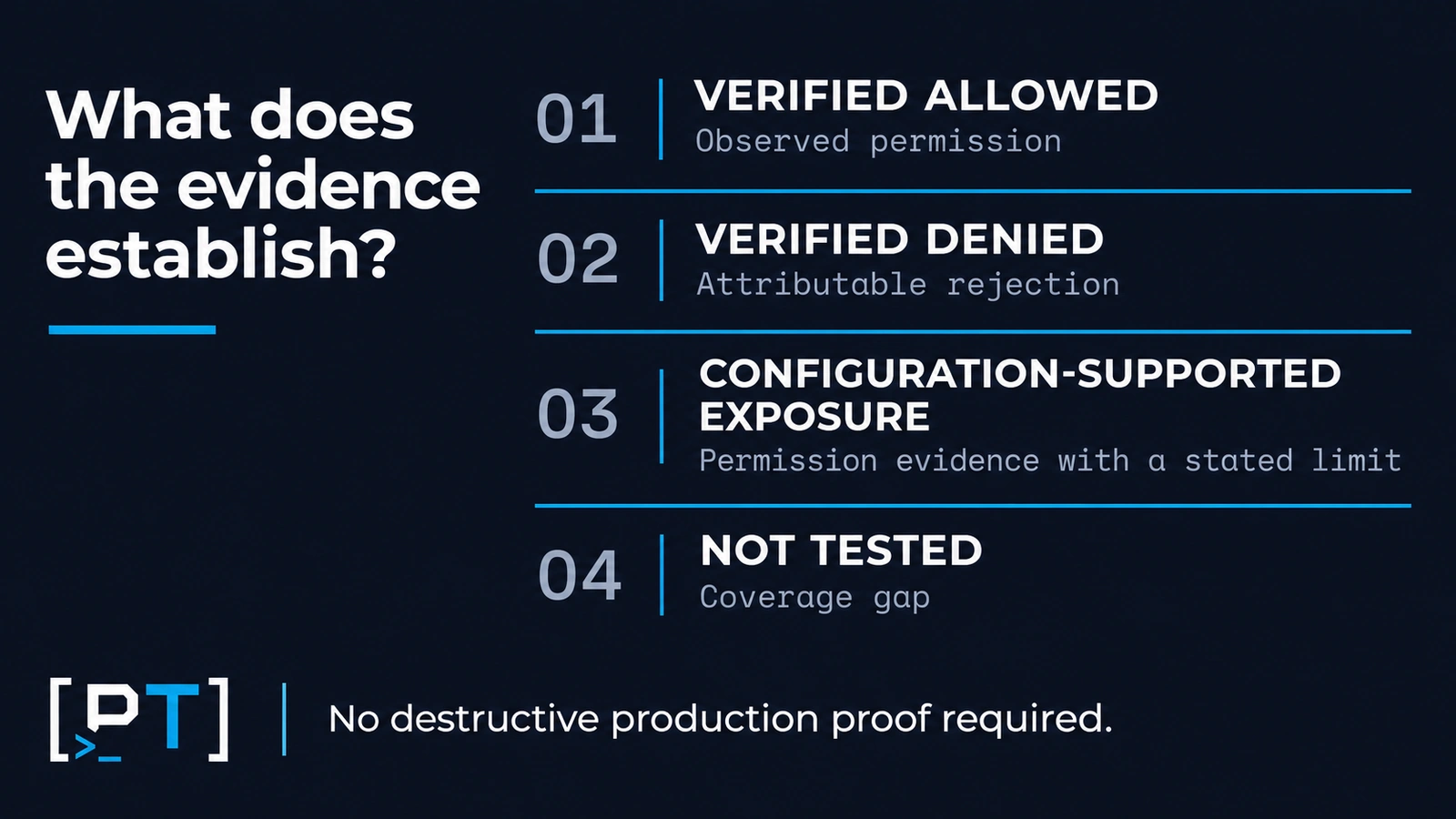
Agree stop conditions, an emergency contact, and observation of backup health during the window. Unexpected job failures, authentication lockouts, or service degradation should trigger the agreed pause and escalation. Preserve assessment records and relevant logs before cleanup. Close the window with the backup owner confirming that scheduled protection and authorized administration remain operational.
An illustrative scenario and the remediation decision
Illustrative scenario, not a client finding: a distributor keeps protected backup copies under a dedicated backup account. Its production and backup consoles use different usernames. Leadership therefore assumes a production administrator compromise would leave recovery independent.
A scoped review finds that a shared management service administers the host running the backup console. The production operations group controls that service. Direct access from the employee network is correctly denied, but the agreed entitlement evidence shows a separate management dependency crossing the boundary.
The assessor does not change backup settings or access customer records. The report identifies the shared service’s effective authority and the assets it controls. It states which consequences remain inferred and which permitted access was demonstrated. The business concern is the possibility of losing trusted administration of the recovery service, even while particular retained copies remain protected.
Leadership assigns the platform and backup owners to remove unnecessary shared authority, restrict the management route, and establish an independently controlled recovery-access procedure. The remediation ticket includes a retest of the original assumed identity and the alternate path. An authorized operator also demonstrates that ordinary backup administration still works.
The decision does not have to be “buy another backup platform.” Some findings can be addressed through role separation, removal of inherited grants, or management-path restrictions. Others require new administrative infrastructure or a different tenant or directory design. Price those options against the affected recovery services and operational support burden.
Prioritize by consequence and evidence. Authority over the only viable recovery route merits a different response from limited inventory visibility. Consider whether an exposure affects existing retained copies, future protection, confidential data, or the time needed to regain control. Assign separate actions when one observation affects several of those outcomes.
Supplier responsibilities deserve the same precision. A provider may operate the repository while your organization controls account recovery, billing, or keys. The MSP transition security checklist helps with ownership and handover questions. This assessment then tests the specific access separation that the agreed operating model promises.
Budget effort and map the evidence to assurance objectives
Assessment effort depends on the number of independent identity systems, management interfaces, network positions, repositories, and suppliers. A single platform with reliable documentation is easier to bound than a hybrid estate with inherited permissions and several recovery providers. Narrow the first engagement around a critical service if a complete inventory is not yet available.
Ask for separate scope assumptions for preparation, controlled validation, reporting, and retesting. Preparation includes permissions, named owners, current diagrams, and a platform-specific safety review. Validation depends on approved windows and operator availability. Reporting should connect evidence to recovery consequences and assign remediation ownership. Retesting needs its own agreed coverage after changes.
These are planning workstreams, not a fixed delivery promise. A quote should state what extends the schedule: missing authorization, inaccessible suppliers, undocumented accounts, or changes to the architecture during testing. Remediation can take longer than the assessment, especially when identity separation affects emergency access and support contracts.
For assurance reporting, the following is a recommended mapping to NIST CSF 2.0: PR.AA-05 concerns least privilege and separation of duties; PR.IR-01 addresses protection from unauthorized network and environment access; PR.DS-11 covers backup protection and testing. RC.RP-03 addresses checking restoration-asset integrity before use. Access-isolation evidence contributes to that broader recovery context but does not complete integrity validation. This mapping is not a certification or a claim that the framework mandates this exact assessment.
NIST SP 800-115 supports structured planning, testing, analysis, and mitigation. NIST SP 800-209 adds storage-security context, including isolation and restoration assurance. Use these references to organize objectives and evidence. Contractual obligations and sector-specific requirements still need their own interpretation and scope.
For an auditor, insurer, or customer, provide a bounded statement: which recovery estate was assessed, under which assumed identities, on what dates, with what exclusions and unresolved findings. Share sensitive topology and privilege evidence through controlled channels. A summary suitable for procurement should not expose the detailed administration map.
What leadership should decide
Name the recovery estate that must remain independently controlled, and the production compromises it should withstand. “Independent” should mean that the specified compromised authority cannot obtain unapproved recovery administration through the assessed direct or indirect paths. Document intentional dependencies and explain why they are acceptable.
Then approve three practical commitments: a recovery owner accountable for acceptance, coordinated testing windows with safe proof limits, and a funded route to fix consequential findings. Security can coordinate validation, but identity, platform, network, and backup teams may each own part of the boundary. A finding needs an accountable decision-maker across those teams.
Use a release decision of accept, accept with time-limited conditions, or hold the relevant change. Conditional acceptance should name the affected capability, compensating restriction, evidence gap, owner, expiry, and required retest. A green backup dashboard should not silently close an unresolved administrative dependency.
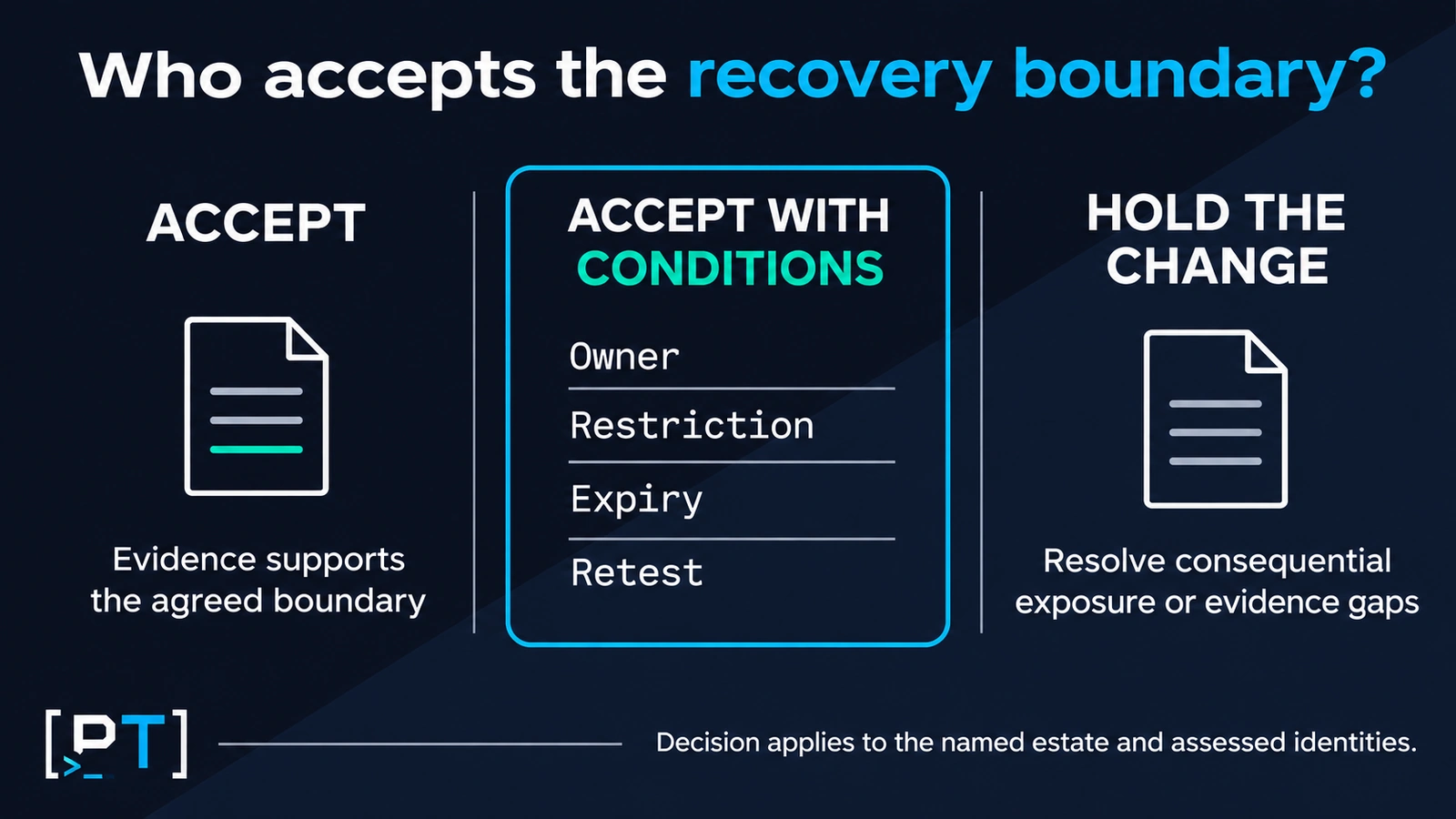
Retest after material changes to backup roles, identity federation, management connectivity, hosting, supplier access, or protection settings. Set any recurring review interval from business risk and change frequency. Keep the previous matrix so the next review can show what changed and whether the original denied paths still hold.
To scope the assessment, bring the recovery estate inventory, privileged-role map, management-path diagram, supplier responsibilities, and safe testing constraints. Discuss a backup isolation objective with Pentest Testing Corp and agree on the evidence your recovery owner needs before accepting the boundary.
Frequently asked questions
Can a small IT team maintain separate backup administration?
Yes, but separate accounts alone are insufficient. The same person may hold different roles while using distinct privileged access, protected credentials, and an independently governed recovery procedure. Where staffing prevents two-person approval, document the limitation and select compensating controls that can be tested.
Should every repository be tested in the first engagement?
Start with repositories supporting the highest-consequence services and any distinct administrative models. Sampling should represent meaningful differences in identity, hosting, protection settings, and supplier control. List omitted repositories explicitly; a result for one estate should not be generalized to all backups.
What if the backup provider will not permit active testing?
Agree a documented alternative using customer-side access checks, configuration evidence, provider attestations, and an approved representative environment where available. State which provider-controlled boundaries remain untested. Do not treat supplier documentation as equivalent to direct validation of your deployed access model.
Can this assessment validate the recovery time objective?
Only if timed recovery activities are separately included. Isolation testing can identify dependencies that threaten recovery time, but it does not measure a complete service restoration. Agree on recovery-performance validation as a distinct objective with business acceptance criteria and suitable operating conditions.
Does read-only access to backup metadata matter?
It can reveal system names, retention patterns, or recovery priorities, depending on the platform. Assess the information actually exposed and who needs it. Report that confidentiality concern separately from authority to change backup policy or affect retained copies.
Who should retain the detailed assessment evidence?
Assign a security or assurance owner and restrict access according to the sensitivity of the records. Agree retention, authorized recipients, and deletion arrangements in the engagement terms. Recovery and engineering owners should receive enough detail to remediate and verify their assigned boundaries.