Financial Services AI Agent Security: Test KYC Workflows
A fintech team is preparing to move a KYC agent from pilot to production. The agent can assemble entity records, read uploaded documents, query internal and third-party data, flag inconsistencies, and prepare an escalation for a compliance analyst. Functional testing says it works. The model provider has security documentation. The APIs already use authentication. None of that proves the production workflow is safe.
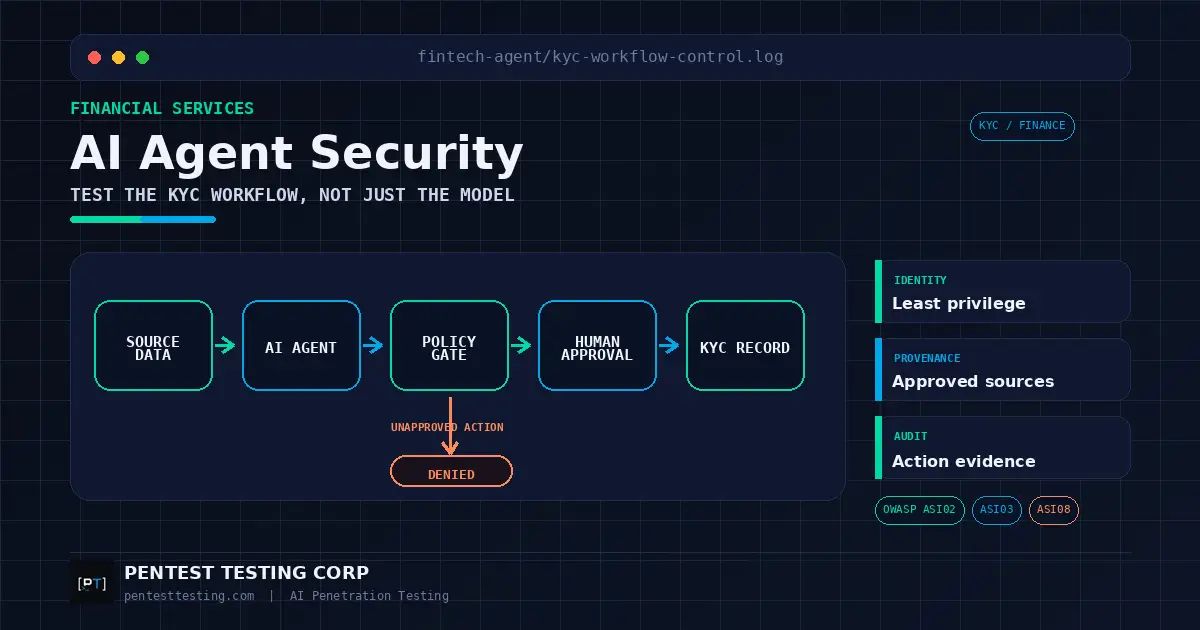
Financial services AI agent security becomes a different problem when the system can combine regulated data, inherited identities, connected APIs, business rules, and actions that influence KYC or financial records. Leadership needs evidence that the agent sees only approved data, acts only within delegated authority, preserves provenance, cannot bypass segregation of duties, and leaves an audit trail strong enough to reconstruct what happened.
That question is increasingly practical. Financial-services vendors now offer agents for KYC screening, reconciliation and month-end operations, while current guidance from OWASP, MAS, AWS and NIST is pushing governance toward authority, execution boundaries and evidence rather than model behavior alone.
Why Financial Services AI Agent Security Is a Workflow Problem
The security boundary of a conventional assistant may stop at generated text. A financial-services agent can have a much larger operating envelope. It may retrieve identity documents, query corporate registries, read sanctions or screening data, call an internal API, update a case, prepare a journal entry, route an exception, or initiate a downstream process.
The important distinction is not whether the system is called an “agent.” It is whether model-controlled reasoning can influence data access, tool selection, state changes or decisions that matter to the business.
Anthropic illustrated the direction of travel in May 2026 when it released financial-services agent templates for activities including KYC screening, general-ledger reconciliation and month-end close. Its reference architecture combines skills, connectors and subagents, with managed deployments supporting per-tool permissions, credential vaults and audit logs. The KYC template assembles entity files, reviews source documents and prepares escalations for compliance review.
That creates a useful security question for any financial organization evaluating similar technology: what must remain trustworthy even if the model misunderstands, is manipulated by untrusted content, or simply makes a poor decision?
The answer should live outside the model wherever the consequence matters.
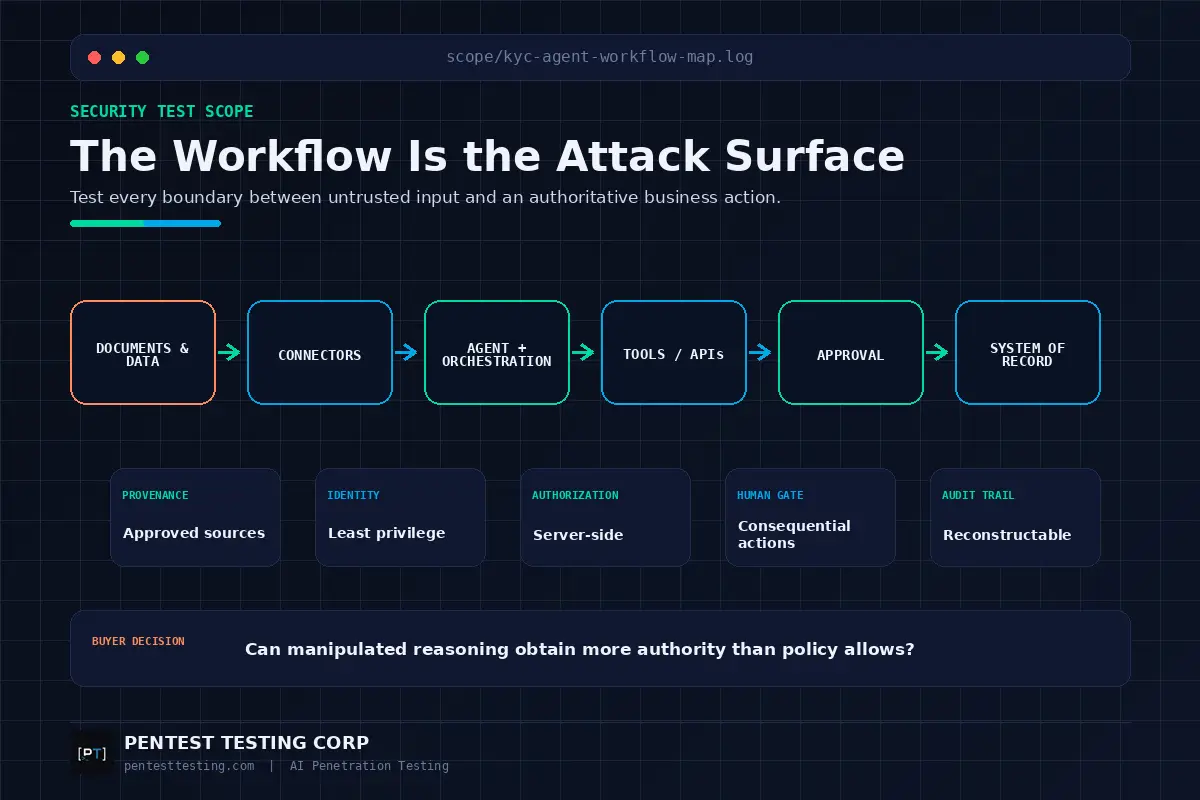
Server-side authorization should decide whether a tool call is permitted. Identity controls should determine whose authority the action uses. Business rules should enforce transaction and record boundaries. Approval logic should determine when a human must intervene. Audit infrastructure should record the evidence.
This is why AI penetration testing for agentic workflows needs to assess the deployed integration layer, not merely whether a model resists unusual prompts. The real attack surface includes the data, identities, tools, APIs, orchestration and downstream controls around the model.
Map the KYC and Finance Workflow Before Testing the Model
A meaningful assessment starts with a business-process map. For a KYC agent, that map should identify where information originates, which systems the agent can reach, what decisions it can influence, and where human accountability begins and ends.
The same principle applies to month-end agents. A system that only summarizes ledger anomalies has a different risk profile from one that can prepare journal entries, alter reconciliation status or interact with an ERP under a privileged service identity.
| Workflow layer | Question leadership needs answered | Evidence expected from testing |
|---|---|---|
| Source data | Can the agent distinguish approved records from untrusted, stale or manipulated content? | Source inventory, provenance checks, denied unapproved-source tests |
| Identity | Whose authority is used when the agent reads or changes a record? | Identity map, delegated-access tests, effective-permission results |
| Data connectors | Can one connector expose more KYC, customer or finance data than the task requires? | Connector scope, field-level exposure results, cross-boundary negative tests |
| Agent tools and APIs | Does tool discovery imply authority to execute every exposed operation? | Allowed/denied action matrix and downstream authorization evidence |
| Approval workflow | Which actions require analyst, manager or second-person approval? | Approval-gate tests, bypass attempts, escalation-path evidence |
| Record changes | Can the agent alter an official record outside its assigned mandate? | Write-boundary validation, rollback evidence, immutable change history |
| Audit trail | Can compliance or incident teams reconstruct why an action occurred? | Tool-call logs, policy decisions, source references, user/agent identity and timestamps |
This inventory is also what makes scoping efficient. Pentest Testing Corp's broader guide to what an AI penetration test should cover recommends defining user roles, APIs, retrieval sources, tools, service accounts, sensitive data, approval controls and logging before testing begins.
For financial workflows, add two more questions: which records become authoritative after the agent touches them, and what separation of duties must never be collapsed by automation?
Six Control Objectives to Test in KYC and Month-End Agents
1. Governed access and data provenance
A KYC agent may consume passports, corporate documents, beneficial-ownership records, screening results, internal case notes and third-party data. The concern is not simply confidentiality. The organization also needs confidence that the information driving a decision came from an approved source and was not silently substituted, mixed with another customer's data, or taken from an outdated record.
Testing should therefore verify that connectors enforce the intended data boundary, that tenant or customer separation survives the complete workflow, and that consequential outputs retain enough provenance to show which records influenced them.
A good control does not ask the model to “remember not to expose other customers.” It prevents unauthorized information from entering the model's usable context in the first place.
2. Agent identity and least privilege
Finance agents should not inherit broad human or administrator authority merely because doing so simplifies integration. The test should identify the effective permissions of every service account, token, delegated identity and connector involved in the workflow.
For SOC 2-scoped financial workflows, identity evidence must extend beyond the service account that executed the transaction. These SOC 2 agent accountability controls show how to preserve the requester, delegated authority, approval parameters, resulting change, and review evidence for privileged agent actions.
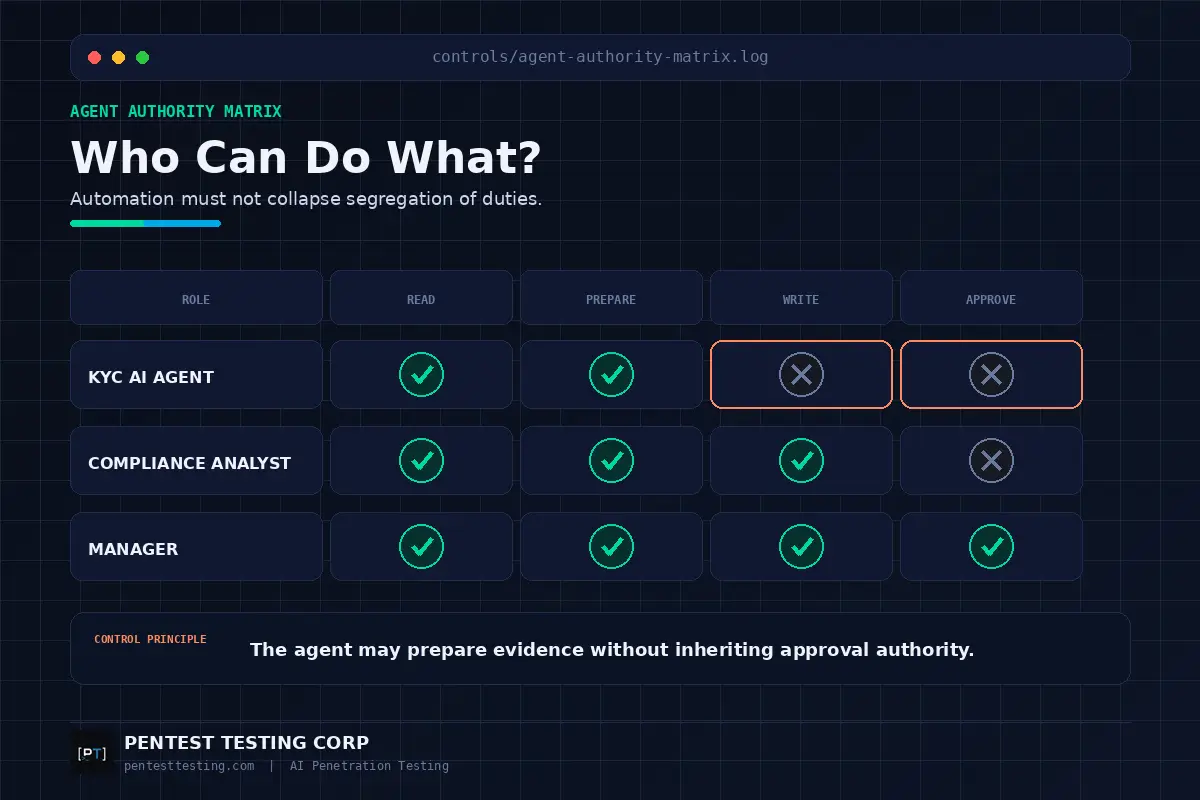
For a KYC screener, read access to source records does not automatically justify authority to approve a customer. For a month-end closer, the ability to prepare a journal entry does not automatically justify posting it.
OWASP's Agentic Top 10 captures this through ASI03: Identity & Privilege Abuse, while the current LLM Top 10 places excessive agency at LLM03:2026. The objective is the same from a buyer's perspective: the system should not be able to convert convenient access into unintended business authority.
For KYC or finance agents hosted on Google Cloud, see what the Agent Identity auth manager's GA changes about credential custody before assuming the broker model fits a regulated workflow.
3. Segregation of duties and approval gates
Automation can accidentally collapse a control structure that was safe when several humans performed different steps.
Consider a workflow in which one analyst assembles evidence, another reviews an alert, and a manager approves a high-risk disposition. An agent that can gather the data, interpret it, change the case status and approve the result may bypass the separation the process was designed to preserve.
Testing should confirm that high-impact decisions remain controlled by independent authorization logic. An approval gate should validate the exact action being proposed, not merely ask a human to approve a vague summary such as “complete this KYC case.”
The newest OWASP LLM guidance recommends explicit human confirmation before privileged, irreversible or externally visible actions and stresses that credentials and state-changing capability should be held in trusted application logic rather than entrusted to the model.
4. Resistance to instruction and tool misuse
KYC workflows process externally supplied content by design. Corporate filings, PDFs, email, uploaded identification documents and third-party records may all become agent context.
That creates a realistic distinction between data the agent should analyze and instructions the agent is permitted to follow.
Testing should examine whether untrusted content can redirect the workflow, influence tool selection, request data outside the case, alter the intended escalation path or otherwise cause a legitimate tool to be used outside its approved purpose.
This maps directly to OWASP ASI02: Tool Misuse and LLM01:2026 Prompt Injection. The business objective is not to prove that no model can ever be manipulated. It is to prove that manipulated reasoning cannot silently obtain additional authority.
5. Auditability, provenance and reconstruction
A final model response is not enough evidence for a regulated workflow.
Security, compliance and incident owners may need to determine which identity initiated a task, which documents were retrieved, what tool calls were proposed, which policy checks ran, who approved an action, what ultimately changed, and whether the same operation could be reproduced or reversed.
MAS's July 2026 Safeguards for Agentic Finance at Runtime initiative is particularly relevant here. It describes governance checkpoints around proposed actions and emphasizes verification and recording before agent tasks are executed.
For buyers, the design principle is straightforward: if the organization cannot reconstruct a consequential agent action after the fact, it does not yet have strong evidence that the workflow is governable.
6. Failure containment and rollback
Not every failure will look like a classic security exploit. An agent can be operating with valid credentials and still make a harmful sequence of otherwise legitimate calls.
Controls therefore need to limit cascading impact. OWASP identifies ASI08: Cascading Failures as an agentic risk because one incorrect signal or action can propagate through automated systems.
For financial workflows, testing should establish what happens when an agent receives contradictory records, loses access to a required system, repeatedly fails a reconciliation, exceeds a mandate, or attempts a sequence outside the normal process. High-impact workflows should have stop conditions, bounded retries, escalation routes and a clear recovery path.
What a Fintech AI Security Assessment Should Test
A standard model evaluation does not cover all of this. Neither does an API pentest on its own.
The useful scope is the complete path from input to business consequence.
| Assessment area | Security question | Typical business consequence if weak |
|---|---|---|
| KYC ingestion | Can untrusted or incorrectly attributed material influence the case outside policy? | Incorrect screening, weak provenance, investigation rework |
| Customer and tenant boundaries | Can one workflow access records belonging to another customer, entity or environment? | Confidentiality breach and unreliable case evidence |
| Agent/service identity | Are permissions narrower than the underlying connected account? | Privilege expansion and unauthorized actions |
| Tool/API authorization | Does every consequential operation revalidate identity, role and resource ownership? | Business-logic or authorization bypass |
| Approval gates | Can the agent bypass, reinterpret or self-satisfy required approval? | Segregation-of-duties failure |
| Finance write actions | Can a read/recommend workflow become a record-changing workflow? | Incorrect ledger or case changes |
| Logging | Are tool calls, policy decisions, approvals and changes attributable? | Weak audit evidence and slow incident reconstruction |
| Failure handling | Are retries, escalation and rollback bounded and tested? | Cascading operational errors |
Many financial agents reach their systems through APIs. Where the agent can invoke customer, identity, payment, ledger or case-management APIs, the AI assessment should be coordinated with API penetration testing for connected finance systems. That closes an important gap: an agent-side policy is not a replacement for server-side authorization in the downstream system.
The required effort depends less on the number of prompts than on integration depth. A read-only KYC assistant using one approved repository is a narrower assessment than a multi-agent workflow using several external data providers, an internal customer database, an orchestration layer, privileged APIs and write-capable finance tools.
For scoping purposes, leadership should inventory:
- production and staging environments;
- models and orchestration components;
- KYC, AML, finance and customer-data sources;
- connectors and downstream APIs;
- human, service and agent identities;
- roles and segregation-of-duties requirements;
- read, write, approve, submit and external-communication capabilities;
- high-impact or irreversible actions;
- logging and monitoring sources;
- regulatory, customer or audit deadlines; and
- material changes expected immediately after launch.
Framework Mapping and Audit Evidence
Framework mapping is useful when it turns a technical finding into an ownership or evidence decision. It should not be treated as proof of compliance.
| Framework | Relevant areas | What testing can contribute |
|---|---|---|
| OWASP Top 10 for Agentic Applications 2026 | ASI02 Tool Misuse; ASI03 Identity & Privilege Abuse; ASI08 Cascading Failures | Evidence that tool boundaries, agent identities, privilege constraints and failure containment behave as designed |
| OWASP LLM Top 10 2026 | LLM01 Prompt Injection; LLM02 Sensitive Information Disclosure; LLM03 Excessive Agency | Evidence around untrusted instructions, sensitive context and inappropriate action authority |
| NIST AI RMF | Govern, Map, Measure, Manage | System mapping, adversarial measurement, prioritized remediation and retest evidence |
| SOC 2 Trust Services Criteria | Security, availability, processing integrity, confidentiality and privacy where applicable | Technical evidence that can support management's wider control environment and auditor discussions |
| ISO/IEC 27001:2022 | Information-security risk management and protection of confidentiality, integrity and availability | Evidence supporting risk treatment and validation of relevant technical controls |
| PCI DSS v4.0.1 | Only where the agent stores, processes or transmits payment account data, or can affect systems in the cardholder data environment | Security-test evidence for the applicable payment-data environment, not a blanket KYC compliance claim |
NIST describes the AI RMF as voluntary guidance, organized around interconnected Govern, Map, Measure and Manage functions. A penetration test contributes most directly to mapping the deployed attack surface, measuring technical risk, and validating remediation. It does not by itself establish governance or demonstrate that an organization is “NIST AI RMF compliant.”
For teams building a formal evidence package, our guide to mapping AI pentest evidence to the NIST AI RMF explains those boundaries in more detail.
The same caution applies to SOC 2, ISO/IEC 27001 and PCI DSS. A security assessment can produce useful evidence for relevant controls, but its significance depends on the organization's system boundary, risk assessment and applicable compliance obligations.
PCI DSS should not be attached to a KYC agent merely because the organization is a fintech. PCI DSS v4.0.1 becomes relevant when payment account data or the cardholder data environment is actually involved.
What Evidence Should Survive Vendor Review or Audit?
A useful assessment should leave behind more than a list of model behaviors.
For a financial-services AI agent, leadership should expect an evidence package containing:
- a defined system and workflow boundary;
- models, tools, connectors, APIs and data sources in scope;
- identity and effective-permission mapping;
- allowed and denied action matrix;
- segregation-of-duties and human-approval tests;
- data-provenance and tenant-boundary results;
- sanitized evidence for validated findings;
- business impact and affected workflow;
- OWASP and relevant governance mappings;
- clear remediation ownership;
- retest criteria; and
- documented limitations and exclusions.
This is also why an AI red teaming vendor questionnaire should be treated as an evidence request rather than a writing exercise. A buyer may ask whether testing occurred, but the meaningful follow-up is what was tested, against which authority boundaries, with what results, and whether remediation was validated.
What Leadership Should Decide Before Production
Security teams can test a control, but leadership still has to choose the operating model.
| Decision | Lower-risk posture | Higher-risk posture requiring stronger evidence |
|---|---|---|
| Agent authority | Read-only or recommendation | Write, approve, submit, communicate externally or trigger transactions |
| Human involvement | Approval for each consequential action | End-to-end autonomous execution |
| Data access | One curated source with narrow fields | Multiple regulated, customer or external sources |
| Identity | Dedicated least-privilege principal | Shared or inherited privileged credentials |
| Failure impact | Easy to reverse with low downstream impact | Irreversible or propagates across financial systems |
| Evidence | Complete action and approval trail | Only final output or conversational history retained |
AWS has proposed a similar progression for regulated organizations: read-only systems, systems with prescribed agency requiring explicit human approval, and supervised end-to-end agents operating within predefined boundaries. That classification is useful because security effort should rise with actual authority rather than with how impressive the AI demonstration appears.
Leadership should therefore decide five things before go-live:
- Maximum authority: what is the most consequential action the agent can technically perform?
- Approval threshold: which actions cannot proceed without an independent human or deterministic policy decision?
- Evidence owner: who can prove what the agent did if compliance, an enterprise customer or incident team asks?
- Residual risk owner: who accepts a known limitation if it is not remediated before launch?
- Retest trigger: which changes to models, tools, connectors, identities, data sources or orchestration require security validation again?
The business exposure created by an unsecured AI agent grows as authority, data access and downstream connectivity increase. The important budgeting question is therefore not “How many prompts should we test?” It is “How much business authority are we placing behind probabilistic reasoning?”
A Sanitized Illustrative KYC Scenario
Hypothetical scenario, not a client case study: A fintech deploys a KYC assistant that can retrieve applicant documents, query an external screening provider, read internal case notes and prepare a risk disposition. Analysts must approve high-risk cases before status changes are committed.
During security testing, the team does not attempt to “break the model” as an isolated target. Instead, it validates the workflow boundary.
The assessment discovers that the agent itself cannot directly approve a case, which is good. However, its service identity can call a downstream case-management API method that changes the same status the approval workflow controls. The user interface requires approval, but the API trusts the agent's service account.
The weakness is therefore not simply “excessive agency.” It is a control inconsistency across the workflow. The remediation is to enforce the approval state and caller authorization server-side so that no model, service account or alternate client can bypass it.
After remediation, the retest should demonstrate both sides of the control: the permitted preparation workflow still succeeds, while unauthorized status transitions are denied regardless of how they are requested.
That denied outcome is stronger evidence than a screenshot showing that an approval button exists.
From Findings to an Audit-Ready Go-Live Decision
The output of financial services AI agent security testing should support a decision, not simply produce another security document.
For each material finding, the report should identify the affected workflow, authority involved, realistic business consequence, remediation owner, validation criteria and any framework relationship that helps the organization communicate the result.
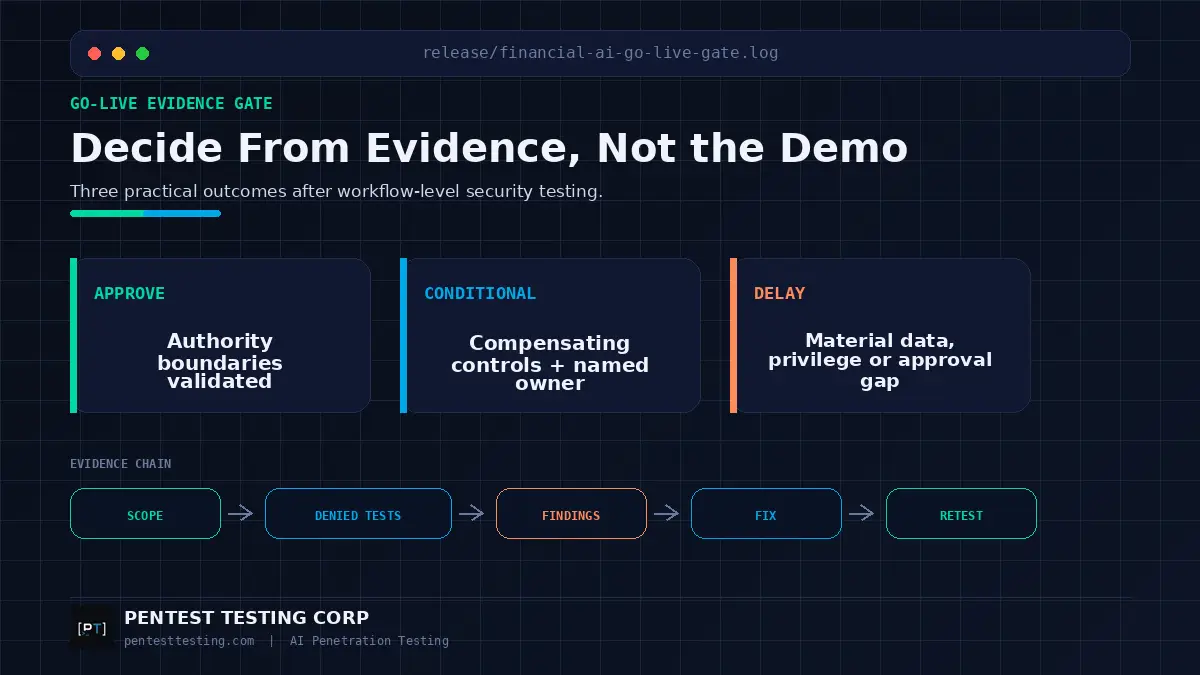
A practical go-live decision usually falls into one of three categories:
- Approve: material authority boundaries and evidence requirements were validated.
- Approve with conditions: remaining issues have compensating controls, named owners and time-bound remediation.
- Delay: a weakness could allow the agent to cross a material data, identity, approval or transaction boundary.
After remediation, retesting matters because blocking one observed input does not prove that the underlying control has changed. The validation should confirm that the authority boundary holds across equivalent users, data sources, connectors and action paths.
Organizations evaluating an assessment provider can review Pentest Testing Corp's sample penetration testing reports to understand the expected structure for findings, evidence, impact, remediation and retest results.
Financial agents can create significant efficiency in KYC, reconciliation and month-end operations, but the production decision should not rest on whether the model gives good answers. It should rest on whether the surrounding system constrains what the agent can see, what authority it can exercise, what requires approval, and what the organization can prove afterward.
If your team is preparing a KYC agent, finance automation pilot or regulated AI integration for production or enterprise review, scope a fintech AI and API security assessment with Pentest Testing Corp. The goal is to test the complete workflow before business authority moves behind the agent.
Frequently asked questions
What should be tested before deploying a KYC AI agent?
Test the complete workflow: data provenance, customer and tenant separation, agent identity, effective permissions, connectors, API authorization, tool use, human approval gates, record-changing actions, logging, escalation, rollback and retest criteria. Model behavior is only one part of the assessment.
Is a normal API penetration test enough for a financial AI agent?
Usually not by itself. API testing can validate authentication, authorization and business logic in connected services, while AI-agent testing examines how model-controlled reasoning, retrieved content, tools, identities and approval logic interact with those services. Complex financial agents often need coordinated AI and API coverage.
How does segregation of duties apply to AI agents?
An agent should not silently combine activities that organizational policy requires different people or roles to perform independently. If the agent prepares a KYC recommendation or journal entry, an independent authorization mechanism may still need to control approval or posting.
Which OWASP risks are most relevant to KYC and finance agents?
Relevant current categories include ASI02 Tool Misuse, ASI03 Identity & Privilege Abuse and ASI08 Cascading Failures from the OWASP Agentic Top 10, plus LLM01:2026 Prompt Injection, LLM02:2026 Sensitive Information Disclosure and LLM03:2026 Excessive Agency.
Can an AI penetration test prove SOC 2, ISO 27001 or PCI DSS compliance?
No. A penetration test can provide technical evidence that supports relevant controls and risk-management activities, but compliance depends on the organization's complete system boundary, policies, processes and applicable requirements. PCI DSS is relevant only when payment account data or the cardholder data environment is actually involved.
What audit evidence should a financial AI agent retain?
Evidence should be sufficient to attribute and reconstruct consequential actions. Depending on the workflow, that may include initiating identity, source data references, tool calls, policy decisions, approvals, state changes, timestamps, exceptions and remediation or rollback activity.
When should a financial-services AI agent be retested?
Retest after remediation and after material changes to models, prompts, orchestration, data sources, connectors, tools, APIs, identities, permissions, approval logic or high-impact business processes. Higher-authority production agents may also justify periodic reassessment.