Post-Quantum Cryptography Vendor Assessment: What Evidence Should Buyers Request?
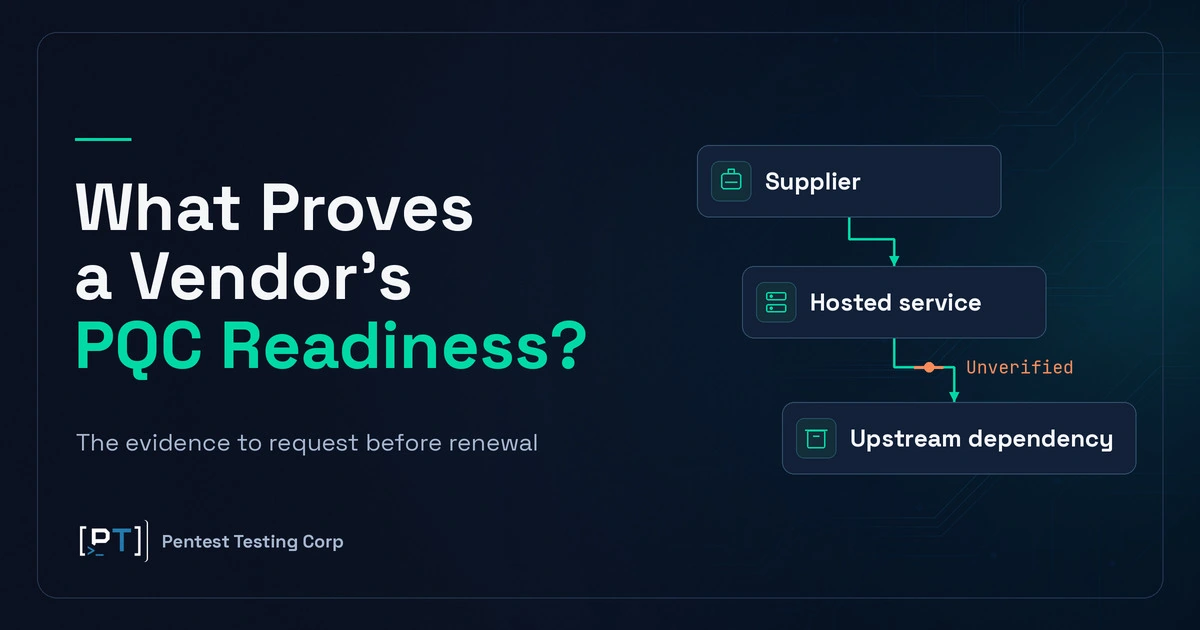
A supplier wants you to renew a three-year agreement for a platform that stores confidential customer records. Its account team says the product is “quantum ready.” The release note covers traffic from a browser to the vendor’s public edge. Your records also move through a managed file-transfer service, an export pipeline and a backup provider. The vendor hasn’t said which of those paths it can upgrade or when.
A post-quantum cryptography vendor assessment gives procurement a way to turn that promise into a decision. NIST finalized its transition guidance, IR 8547, on October 27, 2026. On November 5, the Australian Signals Directorate’s Australian Cyber Security Centre (ASD’s ACSC) announced updated guidance developed with CISA and NSA for procurement, renewals and ongoing assurance. If the agreement will outlast your next opportunity to change providers, ask the vendor to identify the dependencies it owns, produce evidence for the workflows you use and commit to a review date while you still have negotiating leverage.
What a post-quantum cryptography vendor assessment should prioritize
Start with what could still hurt the business years from now. Identify the data your supplier sends or receives, how long disclosure would remain damaging and where that data travels. A contractual retention period helps you find the records. The confidentiality period can extend beyond that retention date, particularly for health records, research, sensitive intellectual property or confidential customer correspondence. Ask the business owner to record why the duration matters and which loss would be material.
One concern is often called “harvest now, decrypt later.” An adversary could collect encrypted communications today and try to recover their contents later if a sufficiently capable quantum computer becomes available and the captured traffic depends on vulnerable public-key cryptography. The timing is uncertain. Start with long-lived information on exposed transmission paths and with suppliers that would take a long time to replace. NIST’s overview of IR 8547 explains why organizations may prioritize key establishment for sensitive data with long confidentiality needs.
Prioritize trust and continuity separately. Digital signatures can protect the authenticity of software updates, documents and credentials. A platform that signs updates for devices expected to stay deployed for years may warrant early review even if it handles little confidential data. Ask which systems will need to validate updates or signatures in the future, who can upgrade those systems and what happens to customers on an older version. A replacement that requires hardware refresh or customer downtime needs a different budget and decision date from a managed update.
Give your initial shortlist two filters. First, look for services with enduring confidentiality needs or functions you cannot readily replace. Then check which ones combine opaque upstream dependencies with long lead times or an imminent renewal. A scoped security risk assessment can help organize the data flows, ownership and business impact into an action list for procurement. Assign the highest priority to workflows where a material impact and a time-sensitive commitment coincide. Log the rationale so the next reviewer can reproduce the decision.
Trace cryptographic dependencies to their owners
Start with a few business workflows you can describe in plain language, such as a customer upload, a scheduled export or a signed update. Ask the supplier for a dated inventory excerpt covering your product, service tier, deployment model and regions. For each workflow, identify the service components in scope, the role cryptography plays, who operates it, who can change it and which evidence is available. A product-wide statement may omit a feature purchased as an add-on or a workflow outsourced to a subprocessor.
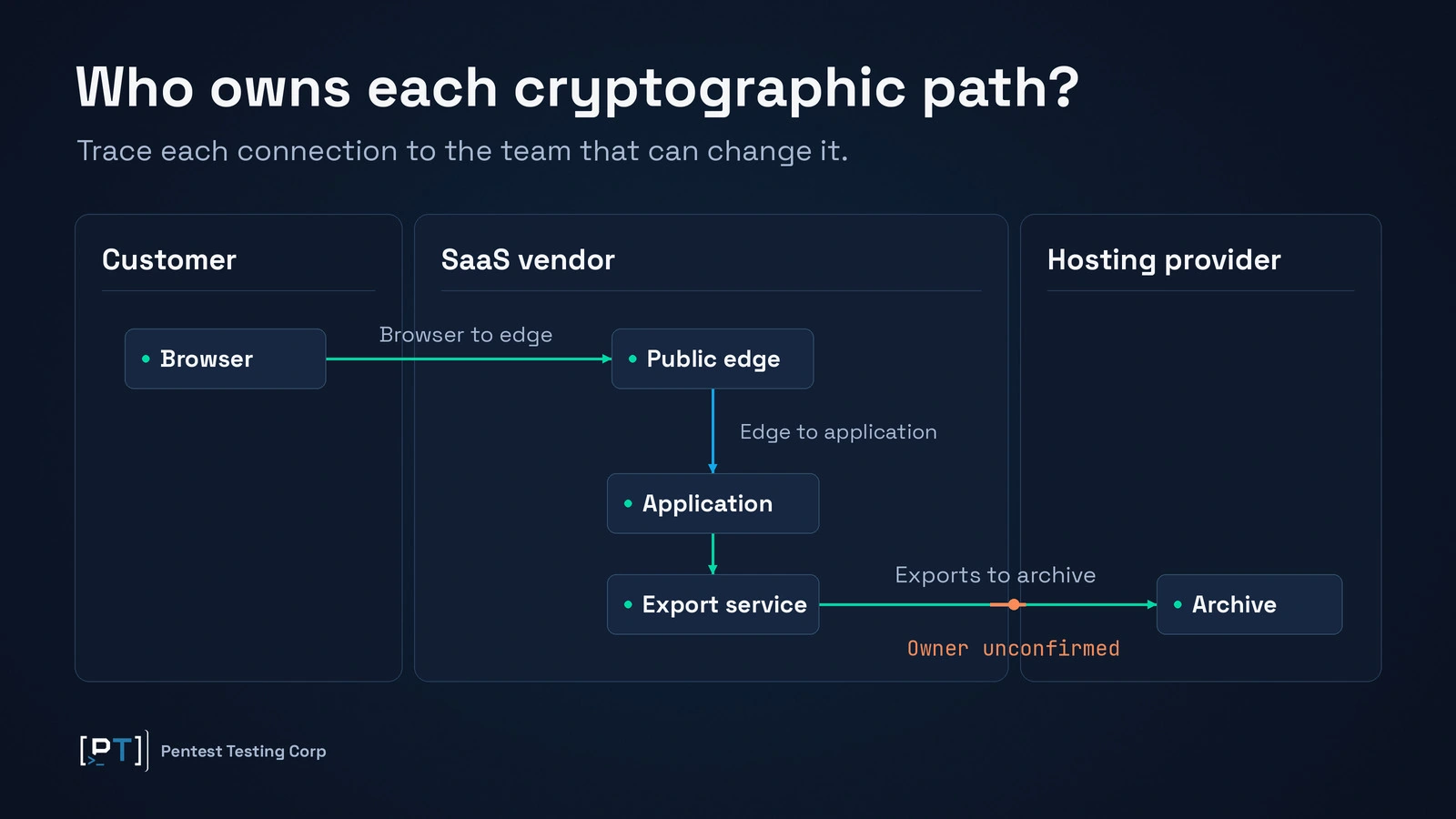
For a hosted application, trace the public connection, the path from the edge to the application and the transfer to any external archive. Ask where the protected connection ends and which party is responsible for the next segment. Include the customer integration wherever its team controls the configuration or upgrade window. Each path can have a different cryptographic dependency, owner and upgrade date.
Distinguish key establishment, signatures and protection at rest in the inventory. Key establishment is how systems agree on secrets used to protect connections. Signatures support authenticity and integrity. Storage protection raises separate questions about key management, exports, recovery and any public-key dependency in that workflow. A statement that backups are encrypted helps identify an existing control. Follow up on key handling and restoration before treating it as evidence that the backup workflow is ready for migration.
Use your existing supply-chain exposure and supplier inventory work to find critical integrations and upstream providers. Then identify which dependency each team can actually change. “Our cloud provider handles it” leaves the buyer without an accountable owner. Ask the vendor to specify the managed service it relies on, which changes its own team must deploy, and how it will get and communicate upstream milestones. Where contractual restrictions limit disclosure, a redacted dependency description can still identify the affected workflow and the team responsible for getting evidence.
Record unknowns explicitly. “Scope pending” is a usable status when it includes the workflow, an owner and an answer date. If an unknown affects a critical service and the vendor can’t name an owner, bring that gap into the renewal decision. Procurement can then ask for a shorter commitment, a contractual checkpoint or a workable alternative before leverage shifts.
Evidence to request in a post-quantum cryptography vendor assessment
Send the evidence request with your tenant or deployment model, regions, key integrations and decision deadline. Ask for links to dated, versioned evidence where possible. The joint ASD’s ACSC, CISA and NSA vendor guidance organizes questions around stages of transition. Use the matrix below to tie each response to a purchasing or risk decision. Prioritize the rows that matter to the workflows you selected.
| Ask about | Request this evidence | Decision it supports |
|---|---|---|
| Current cryptographic dependencies | A dated, product-specific inventory excerpt, with covered workloads, dependency owners and exclusions. | Establish which paths are understood and assign owners to gaps. |
| Vendor and upstream accountability | A responsibility map and the named team that tracks upstream releases and notifies customers of changes. | Determine who can deliver a change and who bears the schedule risk. |
| Migration milestones | A roadmap that identifies target releases and environments, dependencies, support overlap, decision dates and customer prerequisites. | Compare credible dates with renewal, product support and your own change windows. |
| Configuration and coverage | Release notes, a configuration statement for your edition or tenant and an exception list by workflow where coverage varies. | Distinguish a feature you can buy from a control enabled for the path you rely on. |
| Deployment and compatibility | Dated pilot or production evidence for relevant clients, integrations and failover paths, including any fallback and its intended limits. | Set acceptance criteria and understand where legacy operation would continue. |
| Continuity and commercial exposure | A migration runbook summary covering rollback, recovery, support or pricing dependencies and any export or transition constraints. | Estimate disruption, identify funding owners and assess whether an exit is feasible. |
Evaluate the quality of each artifact. A redacted test summary can support a buying decision if it names the tested release, environment, date, workflows and open limitations. A screenshot without a version or context gives you little basis for applying the result to your deployment. Ask the vendor to reconcile any difference between the scope of its evidence and your intended configuration. Where a document can only be viewed under NDA, record the scope confirmed, the reviewer, the date and what remains open in the procurement file.
Make responses comparable across vendors. Record each material requirement as evidenced, planned or unresolved, and attach the artifact and its applicable scope. A vendor who identifies a blocking upstream dependency and gives you a date for the next decision may give you more to work with than one that claims broad readiness. Make the next action explicit for each unresolved item so you can tell whether renewal depends on a document, a supplier decision or an actual deployment change.
If you have limited time before a notice deadline, request a minimum decision pack. Start with the known scope for the critical workflow, the top unresolved dependency, the team that owns it and the date it expects to provide usable evidence. Give procurement the contract’s decision deadline and the amount of time security will need to assess the response. A technical milestone after the notice date belongs in the commercial negotiation, even if the supplier can deliver before the current term ends.
Read the roadmap against your intended deployment
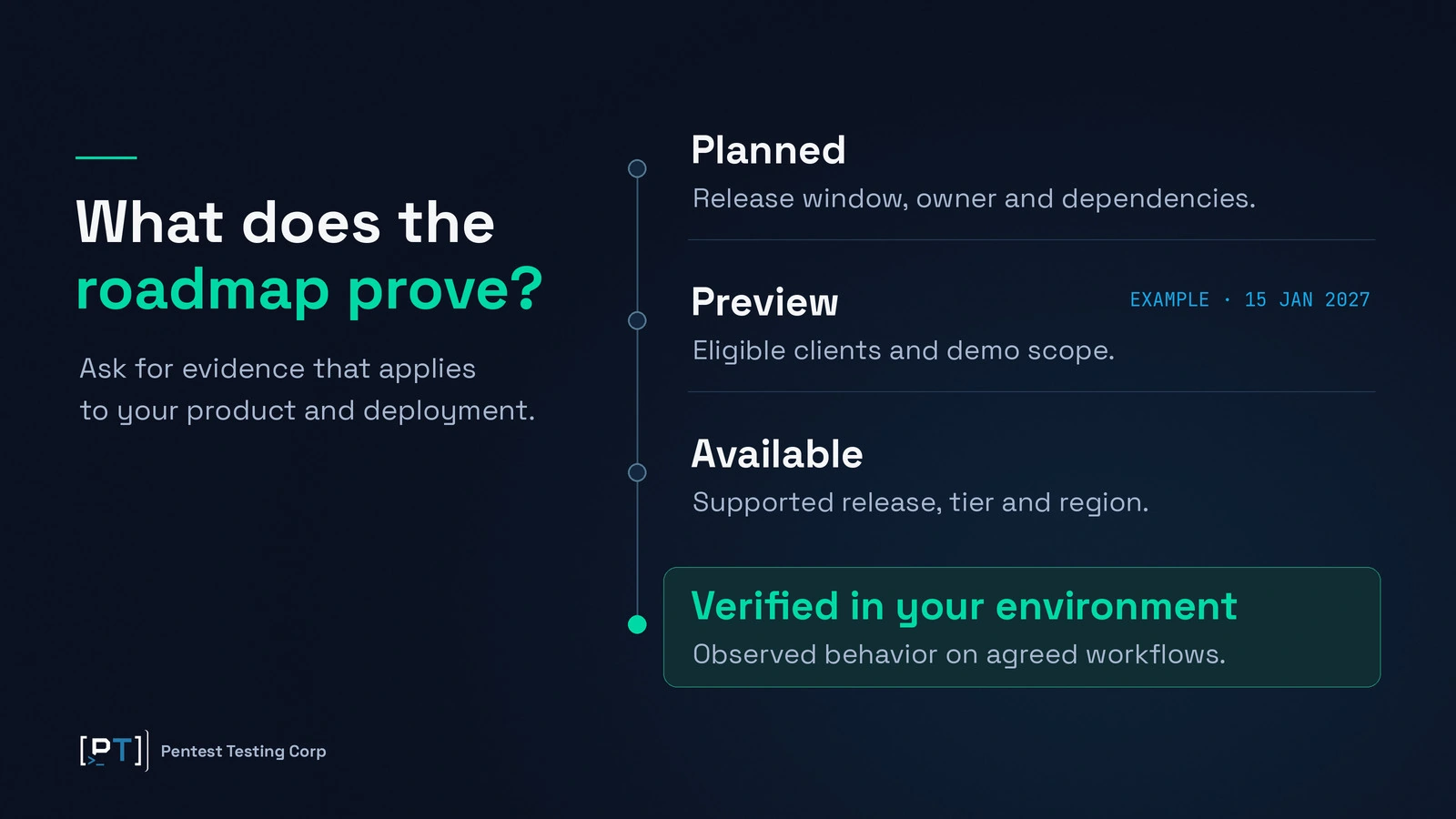
Roadmaps often put announcements, previews and production releases on a single timeline. Ask the supplier to label which milestone applies to you and what customer action it requires. Use four stages to keep the record clear.
- Planned. The vendor can identify a release window, an owner and dependencies. Track confidence and the next decision date.
- Preview. The feature can be evaluated under stated limits. Confirm eligibility, supported clients and what the vendor will demonstrate.
- Available. The feature is supported for a specific product, region or tier. Confirm how it is enabled and which paths are excluded.
- Verified in your environment. Evidence identifies the configured release, agreed workflows and observed behavior, including exceptions relevant to the renewal.
Where a vendor offers a hybrid mode, ask which workflows use it, under what conditions clients take a conventional path and how the customer learns that an exception occurred. Compatibility can justify a temporary exception. Give that exception an accountable owner, a review date and a defined scope. Keep current TLS hardening controls in place throughout the transition and review the downstream connections as well as the public edge.
Illustrative scenario. A claims processor is renewing a hosted document platform. The vendor demonstrates that a supported browser can reach the public edge using a hybrid mode. The automated transfer that sends claims files to an external archive uses a separately managed gateway, and its operator hasn’t committed to a migration release. The processor’s contracts require years of confidentiality. Procurement approves a shorter renewal with an evidence checkpoint for the archive path. The operations team budgets a pilot around month-end processing and checks what it would cost to move the archive integration if the supplier slips. The browser pilot supports one path. The renewal condition addresses the dependency that could force a later change.
Ask how long the vendor will support the versions you need during the rollout. For an embedded product or integration you manage, check whether older clients can remain supported while you move them in batches. If the answer depends on another vendor shipping an update, have the primary supplier identify the handoff and tell you what happens if it slips. This makes the action date for a contingency visible before the support window closes.
Set the scope for technical verification
Agree on which claim you need to verify before commissioning work. An architecture and evidence review can reconcile product documentation with the connections and integrations your team depends on. An authorized deployment test can observe whether selected connections use the intended mode and how the configured system behaves when an expected peer, region or service is unavailable. Define the environment, authorized paths, expected outcome, evidence, version and date. Include normal and failover behavior when both would carry the same sensitive workflow.
Use the test question to set the boundary of the conclusion. Observing the expected connection behavior on a single endpoint supports a statement about that endpoint and configuration at the time of the test. A broader claim calls for evidence across the corresponding clients and downstream paths. If the customer can see only the public interface, request vendor-side evidence for the segments it operates. Document the limit if evidence stops at the edge.
A conventional penetration test can assess exposure and configuration within its agreed scope. For guidance on coverage and reporting, see what enterprise buyers look for in a pentest report. Algorithm or implementation assurance calls for a separately scoped specialist review. If the procurement requirement is formal module validation, ask for the certificate number and check whether the module version, operating environment, approved mode and relevant services match the deployment. NIST’s Cryptographic Module Validation Program listings give buyers a place to verify the claim. A certificate applies to its stated module and scope. Request coverage evidence for the wider product separately.
Give the people authorizing the pilot a short acceptance record. Specify which client and release it covers, which workflow must continue during failover, and the conditions under which a temporary exception is allowed. Ask the tester or vendor to capture the result for those agreed cases and identify the evidence available to the buyer. If a compatibility issue interrupts the workflow, the business owner can then decide whether to accept a time-limited exception, widen the pilot or defer the change.
What leadership should decide before renewal
Give the decision maker a short record with the business impact, the affected workflow, the vendor’s latest evidence, the accountable internal owner and the next date you can act. Consider four outcomes. Record why the selected outcome aligns with your risk tolerance and when to revisit it.
- Approve. Current evidence covers the material workflows and remaining gaps fall within the organization’s defined tolerance.
- Renew with conditions. Preserve service continuity while the supplier commits to a named deliverable, date, evidence checkpoint and action if that date slips.
- Fund a pilot or specialist review. Use this when compatibility, recovery or an assurance requirement could change the renewal decision or implementation budget.
- Reduce dependency or prepare an exit. Assess replacement options when critical ownership is unclear, dates extend beyond your risk tolerance or the vendor can’t produce evidence adequate for a material requirement.
Build the effort estimate around three pieces of work. First, count workflows and suppliers for discovery and allow for a review cycle when responses are incomplete. Next, identify the customer-side changes needed for a pilot, including test environments, integration updates, maintenance windows and recovery checks. Finally, scope production migration separately. Devices that need replacement, legacy clients, upstream dependencies, constrained rollback and parallel support can change both cost and timing. Ask who funds each piece, including any product-tier change, and whom procurement will contact when a dependency slips.
Use NIST CSF 2.0 guidance on cybersecurity supply-chain risk management to place the record into an existing process. Under Govern, GV.SC-04 supports prioritizing suppliers by criticality and GV.SC-05 supports turning relevant requirements into agreements. GV.SC-06 covers due diligence before a formal relationship, and GV.SC-07 supports recording and monitoring supplier risk throughout the relationship. NIST IR 8547 provides transition guidance and supports U.S. federal migration planning. For a private-sector renewal, determine applicable obligations from your contracts, regulatory context and risk tolerance. Use your next renewal, support expiry and feasible deployment window to set internal decision dates.
Decide who can close the renewal condition. Procurement can confirm the vendor supplied a deliverable by the agreed date. Security or engineering should confirm that it covers the relevant deployment. The business risk owner should approve any residual exposure. Write these assignments into the decision record and keep links to the artifacts used for sign-off. That way a staff change or a supplier’s revised roadmap doesn’t erase the basis for the original decision.
Start with the supplier whose contract is coming up and whose data or trust functions would be hardest to move. If you need help defining the scope, book a discussion about your supplier risk assessment with Pentest Testing Corp. Bring the current supplier statement, the affected workflows and the date procurement needs a decision.
Frequently asked questions
What if the vendor shares evidence only in a screen-share?
Agree in advance on which artifacts it will show and who can attend. Record the reviewer, date, artifact version, product coverage and open questions. Ask the vendor to confirm your written summary so the decision can be reviewed later without requiring a copy of confidential material.
Is an SBOM enough to identify the vendor’s cryptographic dependencies?
An SBOM can identify components worth investigating. Pair it with a product-specific inventory that shows which services use those components for cryptography, how they are configured and where managed infrastructure supplies a separate function.
How should we handle a supplier with different release dates by region?
Record the regions that serve your production workloads and those used for disaster recovery. Get region-specific availability and test evidence. If deployment dates differ, document the resulting exception and decide whether to adjust the rollout, the renewal terms or the accepted risk.
Could we purchase multiple years and still preserve leverage?
Discuss dated evidence milestones, notice of material roadmap changes and commercially usable options if agreed conditions slip. Align those dates with any auto-renewal or cancellation notice so procurement has time to act on the evidence.
What should trigger a reassessment between renewals?
Reopen the relevant workflow when a vendor changes its hosting or a critical subprocessor, removes support for a client version, changes fallback behavior or misses a material milestone. Assign responsibility for those checks in normal supplier governance.
What if a supplier says PQC migration is entirely our responsibility?
Ask for the exact configuration and upgrade steps your team owns, the supported versions and the vendor’s prerequisites. Separate customer-managed settings from components the vendor or a subprocessor operates and confirm who can supply evidence for each.