HIPAA Remediation: Evidence for Closing Security Gaps
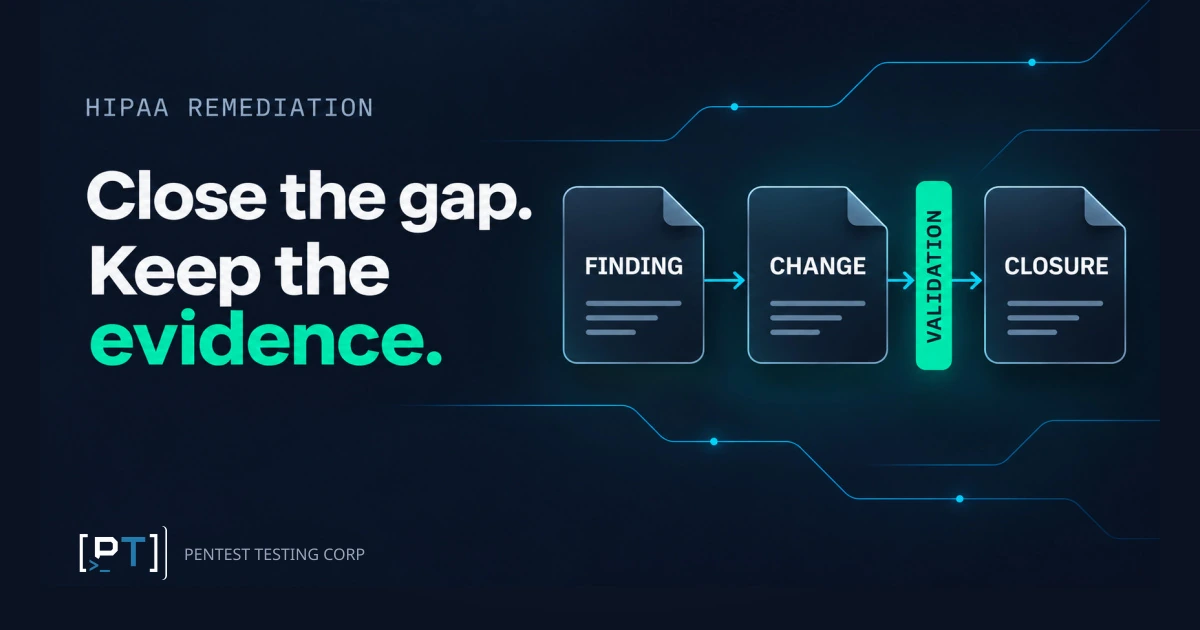
HIPAA remediation evidence should connect an identified risk to a safeguard decision, an implemented change, a validation result and an accountable sign-off. A completed engineering ticket proves that work happened. The closure record should explain why the remaining risk is reasonable and appropriate for the ePHI environment.
For a healthcare CTO, compliance lead or risk owner, that distinction affects funding, release approval and customer assurance. A configuration change may be straightforward. Replacing shared identities, redesigning access boundaries or changing a vendor relationship can require several teams and staged treatment. Set the evidence criteria before approving the work.
This guide explains how to make those decisions. It covers closing gaps identified through risk analysis, technical testing or operational change. If you already have findings and need implementation and validation support, see our HIPAA remediation services.
What does closing a HIPAA security gap mean?
A useful closure decision answers five questions: what ePHI risk was identified, what changed, where the safeguard now operates, how its operation was checked and who approved the outcome. Keep the original finding linked to its treatment record so a reviewer can follow the reasoning without reconstructing it from emails.
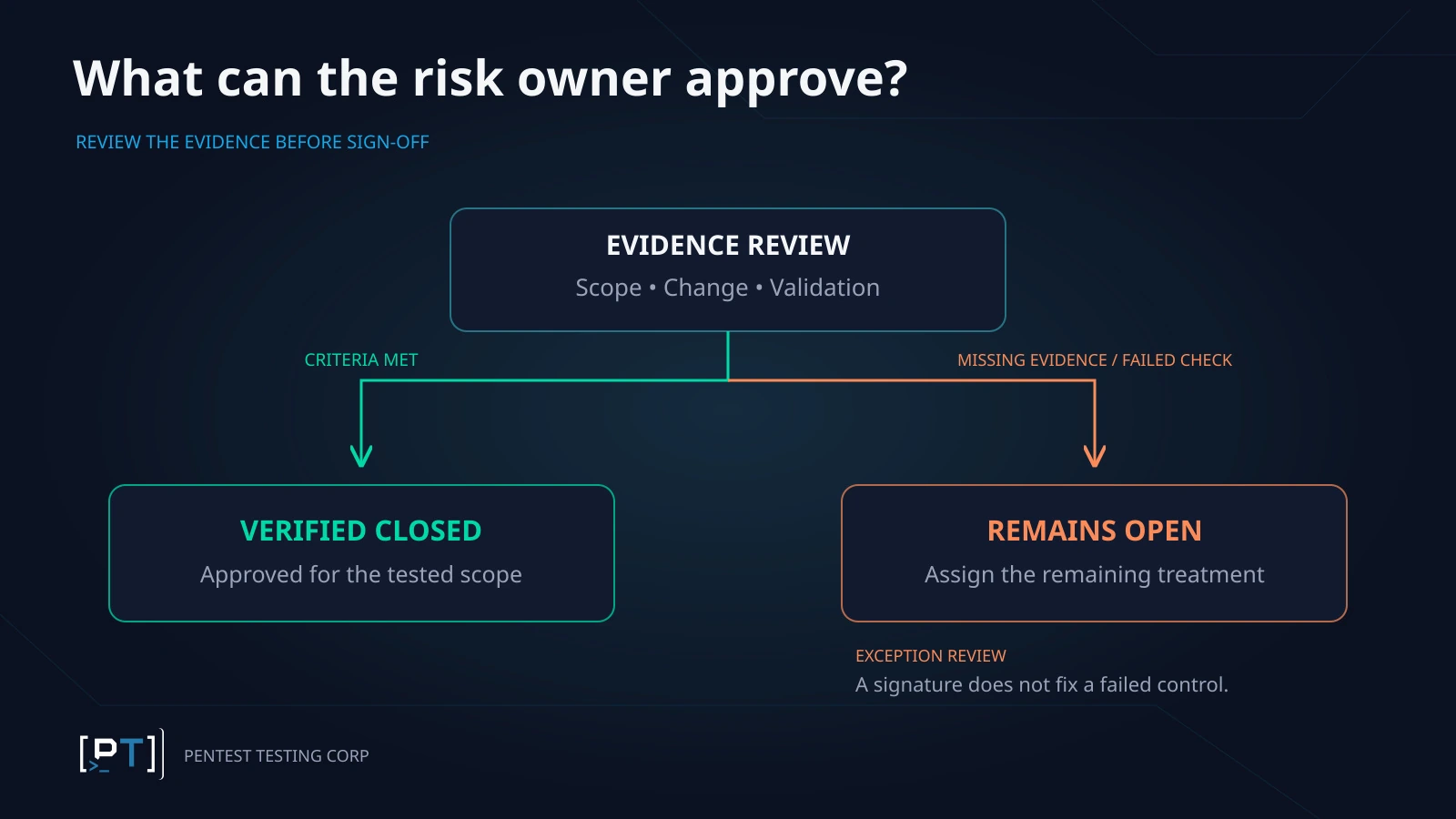
Use separate statuses for implementation complete, validation pending, verified closed and exception under review. A ticket can be complete while the underlying risk remains open. If validation covers one application but excludes a related export worker, record that boundary instead of extending the result to the whole platform.
These are recommended operating practices, not a prescribed HIPAA ticket format. They support clear decisions while preserving the difference between technical closure, organizational risk acceptance and an external review. None guarantees an auditor's acceptance or establishes organization-wide compliance.
Connect treatment to current Security Rule requirements
45 CFR 164.308 requires risk analysis and risk management, alongside periodic technical and nontechnical evaluation. A remediation backlog should therefore explain the risk being reduced and connect verification to the relevant evaluation scope. A penetration test can contribute technical evidence; it does not cover every administrative or physical safeguard.
Section 164.312 addresses access control, audit controls, integrity, authentication and transmission security. Map findings to the applicable provision accurately. For example, enabling application activity records relates to audit controls; evaluating whether those records are regularly reviewed also involves administrative procedures.
Under 164.306, addressable implementation specifications require an assessment. Implement them when reasonable and appropriate. Where implementation is not reasonable and appropriate, document why and implement an equivalent alternative measure if reasonable and appropriate. Addressable does not mean optional without analysis.
Current requirements and proposals: As of November 8, 2026, HHS continues to describe the Security Rule cybersecurity update as a proposed rule, with the current rule remaining in effect during rulemaking. Track proposed requirements separately from current obligations and contractual commitments. Don't present a proposed testing frequency or technology mandate as an existing universal requirement.
NIST SP 800-66 Rev. 2 provides practical HIPAA implementation guidance. NIST CSF 2.0 can help organize governance and risk outcomes. Neither replaces the regulation or makes a completed crosswalk proof that controls work.
Start with the affected ePHI workflow
Before accepting a fix, identify the systems, people and exchanges involved. Include production services, relevant endpoints, backup copies, vendor access and integrations within the finding's scope. Explain where ePHI enters, is stored, moves and leaves. An inventory assembled before a migration may no longer describe the actual exposure.
Record the asset identifiers, environment, application or configuration version and assessment date. If the finding came from a sampled review, preserve the sampling limit. Decide whether the same weakness might exist in other clinics, tenants or deployments and assign that investigation explicitly.
If the original risk analysis is missing or no longer reflects the environment, use a HIPAA risk assessment to establish the baseline. Fixing the most visible technical issue alone cannot establish that all relevant ePHI risks were identified.
Rank gaps by risk and treatment dependencies
Prioritize using likelihood and potential impact on ePHI confidentiality, integrity and availability. Add exposure, existing safeguards, clinical dependencies and the consequence of implementation failure. A technical severity score is useful input, but it doesn't explain whether an affected component can reach patient records or interrupt care.
Separate immediate containment from lasting treatment. Restricting a vendor account may reduce exposure while individual identities and access reviews are introduced. Keep both actions visible, with their own evidence and dates. Temporary containment should not silently become the final design.
Agree deadlines according to risk, available change windows and any applicable external commitments. Escalate blockers that exceed the owner's authority. A missing vendor capability or an unsupported clinical system may require procurement or leadership decisions before engineering can finish.
There is no universal 14-day closure promise. Estimate implementation, dependency resolution, validation and approval separately. For staged work, define the interim protection, the remaining exposure and the next decision date so progress can be assessed honestly.
Assign implementation, validation and approval
Each finding needs a named implementation owner who can deliver the change, a validator who can assess the agreed outcome and an authorized risk owner who can approve the decision. The compliance lead should coordinate safeguard mapping and documentation, while the service owner confirms operational impact.
The same small team may fill several roles. Record that arrangement and use a second review for significant findings where feasible. Independent retesting is particularly useful when the original issue involved authorization failures, connected weaknesses or an assumption that configuration alone cannot settle.
Agree who gathers evidence and maintains it after handoff. A tester may validate a specific technical path, but the organization remains responsible for the broader risk decision. Our pentest remediation ownership plan provides a general model for those responsibilities.
Define evidence criteria before making changes
Write a short acceptance statement for each finding. Describe the unwanted behavior, the expected safeguard and the observation that will demonstrate the outcome. Include legitimate workflows that must continue, especially emergency access and clinical availability where relevant.
| Gap | Implementation evidence | Validation evidence |
|---|---|---|
| Excessive access | Approved role changes and deployed authorization rules | Allowed and denied tests using representative roles |
| Incomplete activity records | Logging configuration and documented review responsibility | Traceable test events and a completed review record |
| Unverified recovery | Backup configuration and recovery procedure | Isolated restore exercise with recorded results and limits |
| Missing workforce process | Approved procedure and assigned responsibility | Sample execution records and follow-up on exceptions |
A signed policy establishes an approved instruction. It doesn't establish that staff followed it. Likewise, an encryption setting doesn't show that every relevant copy and transmission path is covered. Choose evidence that tests the specific claim being made.
Validate the operating safeguard
Retest against the original failure condition and the agreed scope. Record who tested, when, where, which version was deployed, the method used, the observed result and any limitation. Use synthetic records where possible and plan authorized testing so clinical operations remain available.
For access changes, check both permitted and prohibited behavior. Include existing sessions, background jobs or vendor connections when they are part of the finding. For logging, generate a known event and confirm that it reaches the expected destination with sufficient context for review.
For recovery, listing a backup archive's contents is not a completed restore exercise. Demonstrate recovery in an appropriate isolated environment and assess whether the restored application and data meet the agreed operational criteria. Retain failures and follow-up actions with the result.
A targeted scan can support validation of a relevant exposed component. Public website checks cannot verify internal ePHI authorization, workforce procedures or recovery capability. Choose the method according to the risk. Our HIPAA penetration testing guide explains the technical testing scope.
Illustrative example of a closure decision
Synthetic scenario, not a client finding: A healthcare portal allows a support role to retrieve a patient export after that role loses access. Engineering changes the download authorization check and marks the task complete. The risk owner requests evidence before closing the finding.
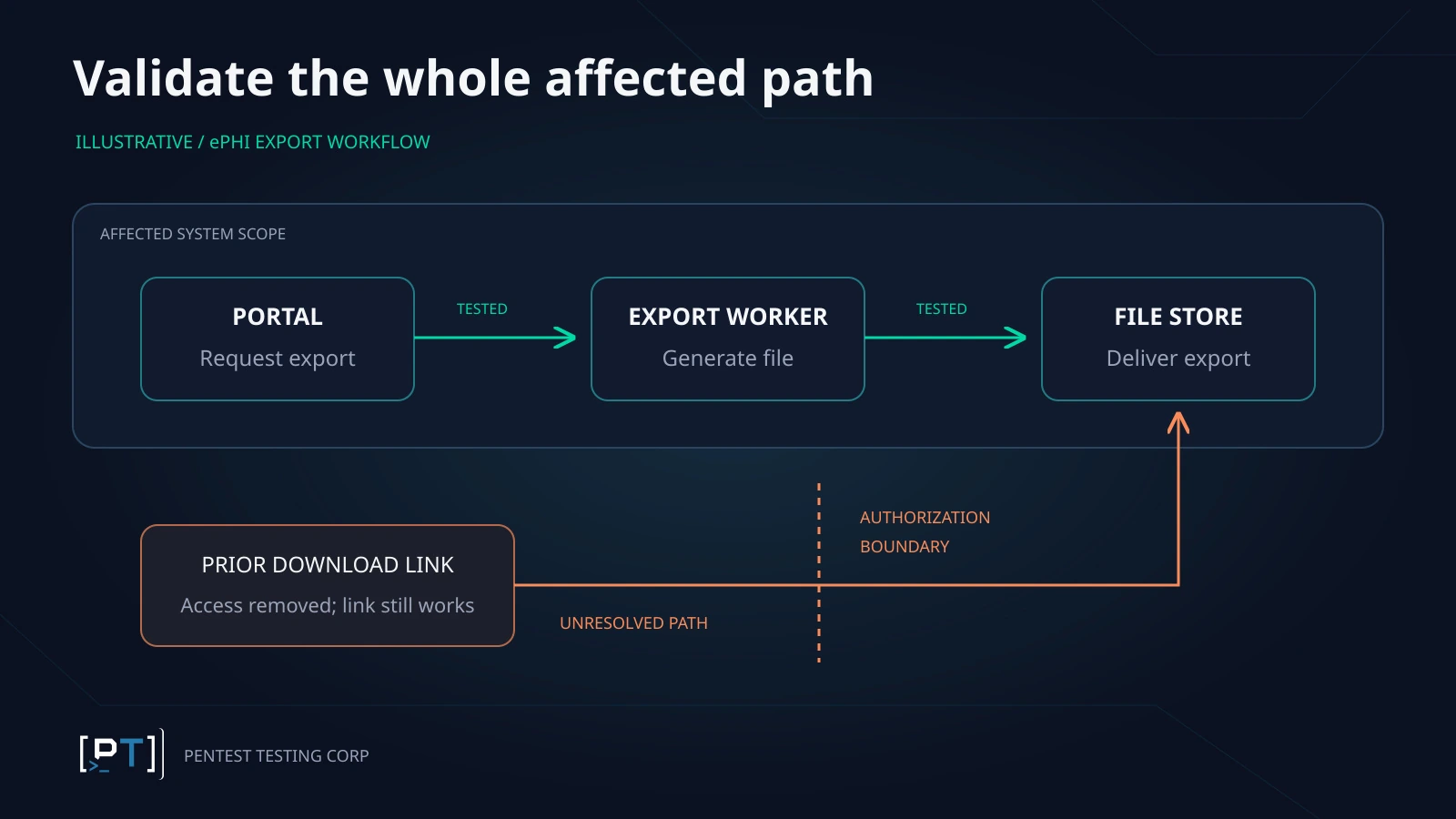
The agreed scope includes the portal, the export worker, generated files and existing download links. The implementation owner records the release and configuration changes. The validator uses synthetic patient records to check an authorized download, a revoked role, an existing session and a previously issued link.
Suppose new downloads are denied but an older link still works. Keep the finding open or record partial treatment, assign the remaining path and apply an appropriate interim restriction. A passing test on the new endpoint cannot justify closing an untested or failing delivery path.
Once the agreed paths pass, the validator records the results and limitations. The risk owner reviews the residual exposure and approves the scoped decision. This evidence supports closing one finding; it says nothing about unrelated safeguards.
Document residual risk and incomplete work
Some gaps require a staged response. An exception record should explain the unresolved condition, affected scope, interim safeguards, accountable approver, expiry or review date and the funded next step. Keep it linked to the original finding rather than hiding it in a separate spreadsheet.
A management signature does not waive a HIPAA obligation. Where the proposed treatment may leave a required safeguard unmet, involve the appropriate compliance and legal decision-makers. Record what remains unresolved and avoid a verified-closed label that implies successful remediation.
Revisit exceptions when a safeguard fails, a vendor changes, the ePHI scope expands or the review date arrives. Report overdue decisions alongside overdue implementation. Leadership needs to see blocked treatment and missing verification as well as completed tasks.
Keep a reviewable closure record
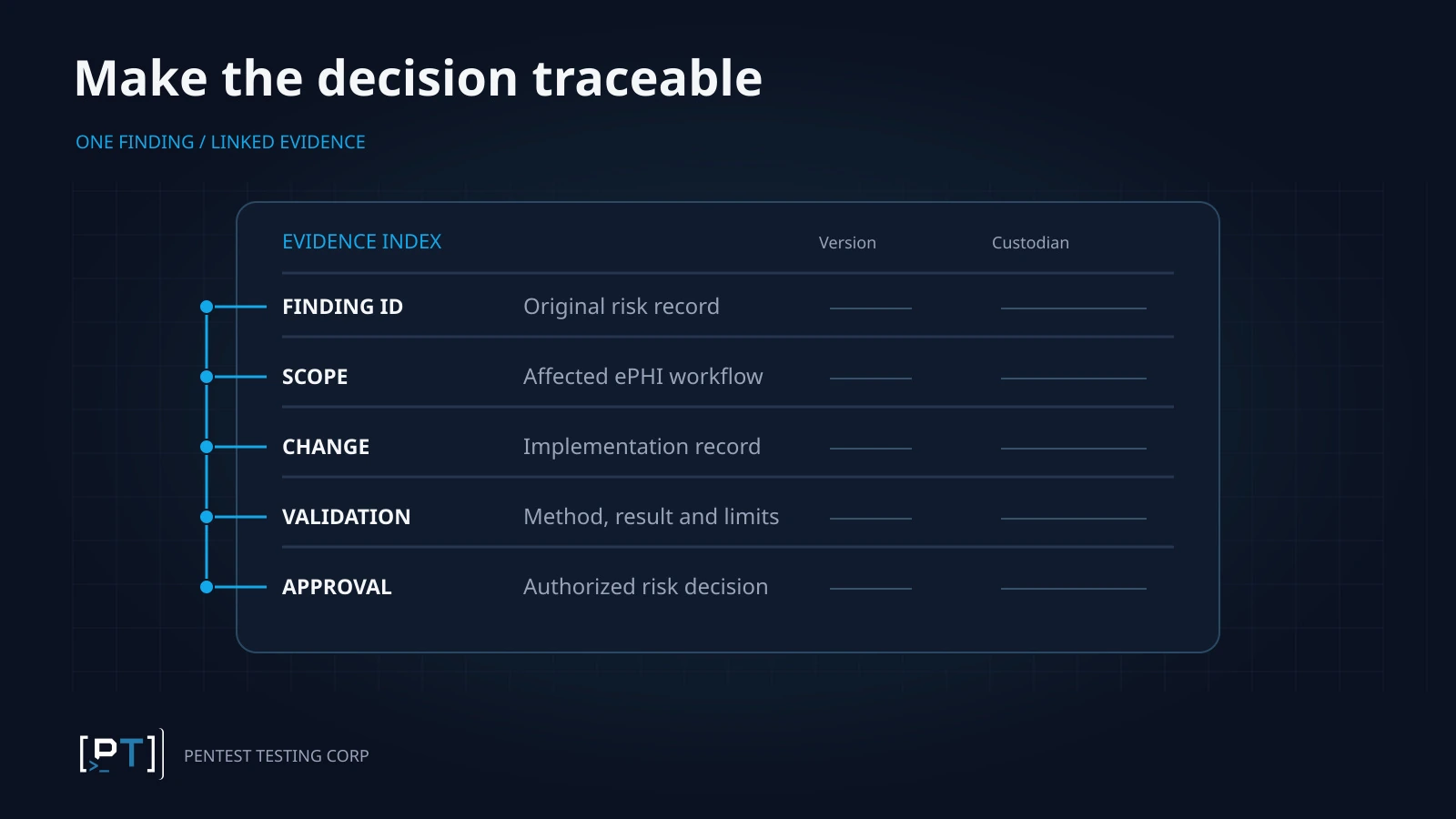
A practical evidence index links the finding ID, risk rationale, safeguard mapping, affected scope, treatment decision, change record, validation output, residual risk and approval. Add artifact dates, versions and custodians. The fleet patch coverage and exception evidence offers a supporting structure for patch-related gaps.
Store evidence with access controls and a defined retention schedule. Remove unnecessary patient identifiers, credentials and secrets from shared copies. Keep original records protected and make the relevant documentation available to the people responsible for implementing the procedures.
Section 164.316 requires specified Security Rule documentation to be retained for six years from creation or when it last was in effect, whichever is later. This is not a universal six-year retention rule for every operational log. Determine log retention through the applicable requirements, risk decisions and organizational policy.
Approve the treatment and evidence together
Before sign-off, confirm that the finding's scope matches the tested scope, the agreed evidence is accessible and any remaining work has an owner and review date. Update the risk register and relevant procedures. Reopen the decision when a material system change invalidates its assumptions.
Pentest Testing Corp can review your existing gap list, help scope implementation and validate agreed technical outcomes. Start with our HIPAA remediation and validation service. Share your finding categories, affected systems, accountable owners and decision deadline through an agreed secure channel so the work and evidence requirements can be scoped.
Frequently asked questions
What is HIPAA remediation evidence?
It is the linked record of an identified ePHI risk, the safeguard decision, implemented changes, validation results and authorized approval. The evidence should state its scope and any unresolved conditions.
Can every HIPAA gap be closed in 14 days?
No. Configuration changes, identity redesign, vendor dependencies, and clinical change windows require different effort. Set risk-based deadlines and keep interim protection separate from verified closure.
Does a passing penetration retest prove HIPAA compliance?
No. A retest supports conclusions about the tested technical scope. It does not establish compliance across all administrative, physical and technical safeguards or guarantee external acceptance.
Who should approve a remediation finding's closure?
An authorized organizational risk owner should approve the decision using implementation and validation evidence, with security, compliance and service owners involved as appropriate. Record any unresolved obligations separately.