AI Pentest Retesting After Model and Tool Changes
A product team closes the last high-risk finding from an AI penetration test on Monday. On Tuesday, engineering upgrades the model, rewrites the system prompt, changes retrieval filters, and adds a new tool to the agent. By Friday, leadership is still pointing to Monday's retest as proof that the production system is secure.
That is the evidence problem behind AI pentest retesting. A retest can prove that a specific fix worked against a defined system. It does not automatically prove that a materially changed AI workflow still has the same security posture. Models, prompts, retrieval pipelines, identities, permissions, tools, and orchestration all influence what the deployed system can see and do.
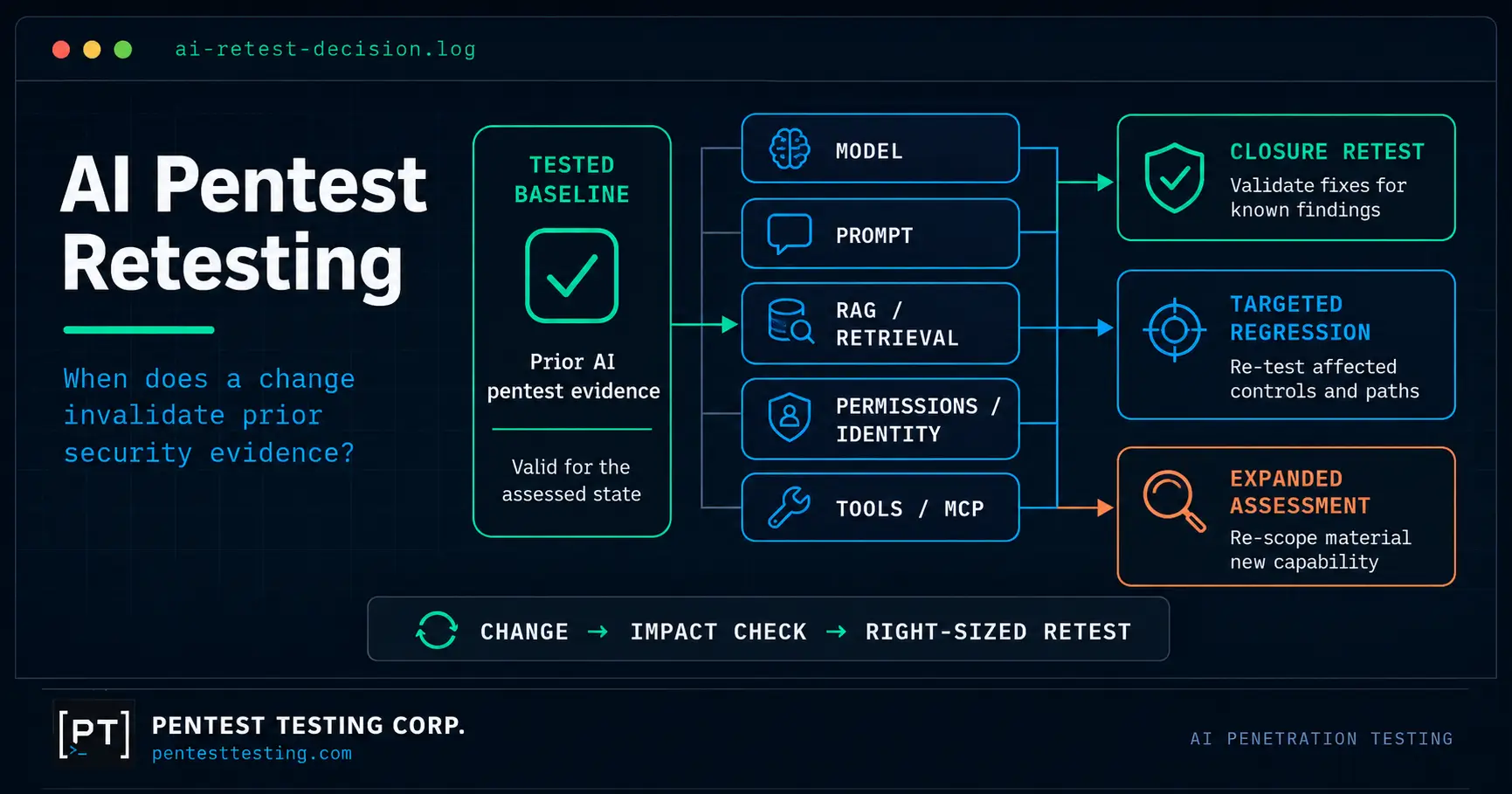
The practical question is not "Do we retest every release?" It is: which changes invalidate the security claims supported by the previous test, and how much new testing is needed to restore confidence?
AI Pentest Retesting Is About Evidence Validity, Not the Calendar
A penetration test is a point-in-time assessment of a defined scope. That matters more for AI-enabled products because part of the security boundary is behavioral and compositional. The same application code can produce a different risk profile when the underlying model changes, when the system prompt is rewritten, when new documents become retrievable, or when an agent receives another tool.
Pentest Testing Corp's AI penetration testing service scopes the deployed workflow across prompts, retrieval, APIs, identity, tools, data access, and downstream actions. That scope definition should also become the baseline for deciding whether later test evidence is still representative.
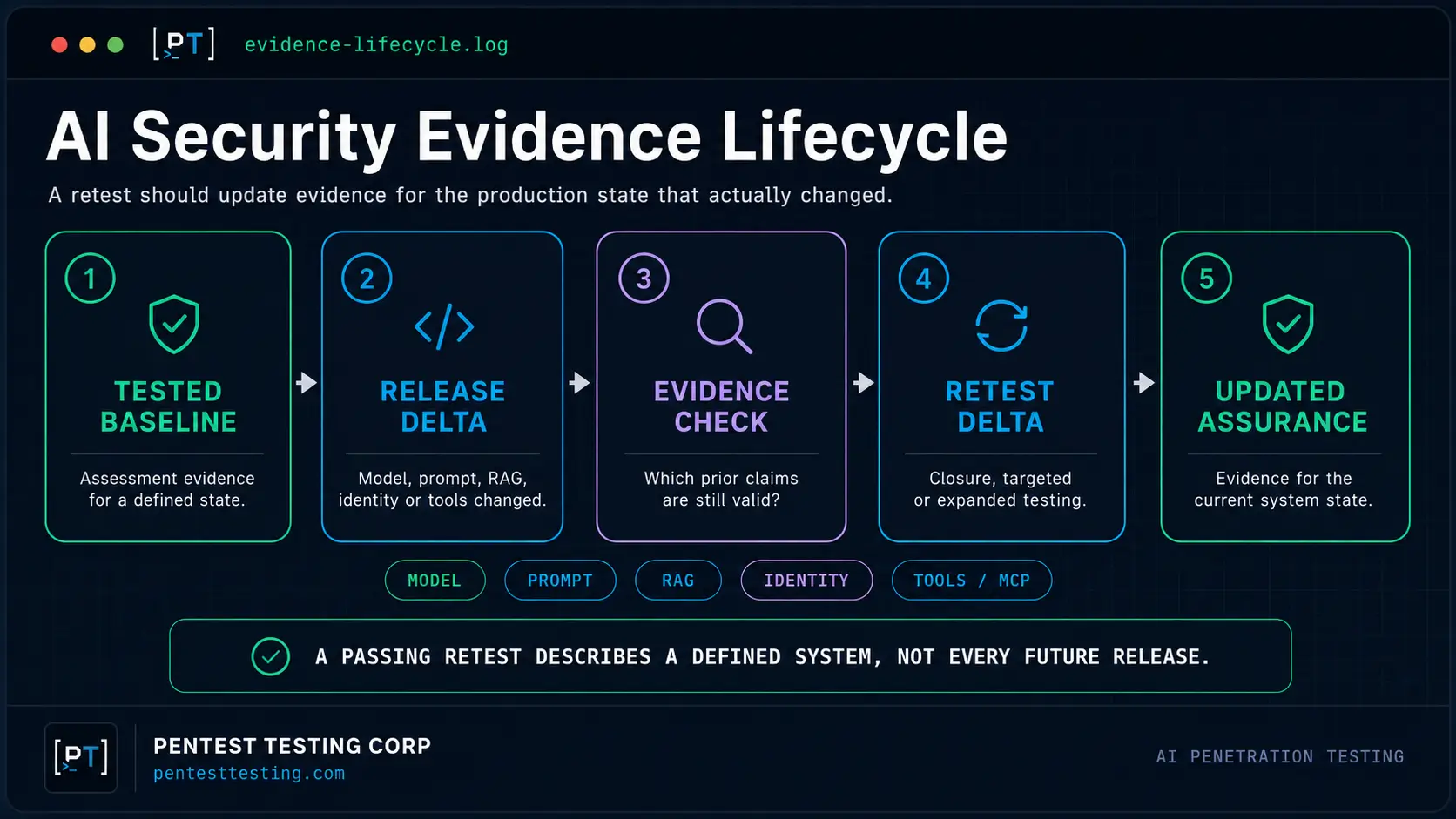
A useful baseline records more than the date of the test. At minimum, the security evidence should identify:
- Model provider, model/version or pinned deployment identifier where available
- System and developer prompt versions that affect security behavior
- Retrieval sources, embedding/retrieval architecture, and tenant filters
- Agent tools, functions, plugins, MCP servers, and relevant tool schemas
- User roles, service identities, OAuth scopes, API permissions, and approval gates
- Orchestration logic, delegation paths, memory/state behavior, and action limits
- Security-relevant output handling, guardrails, logging, and rollback controls
That record is the comparison point. When a release changes one of those elements, the team can ask whether the previous evidence still proves the same claim.
This is also why retesting should not be driven only by an annual date. NIST's AI Risk Management Framework Playbook connects post-deployment monitoring and change management with TEVV and recurring red-team activity. The practical consequence is straightforward: release governance should identify material AI changes and connect them to a testing decision.
Which Changes Invalidate Prior AI Pentest Evidence?
Not every change requires a new end-to-end assessment. The key is whether the change affects the attack surface, authority, data boundary, or security-relevant behavior that the earlier test relied on.
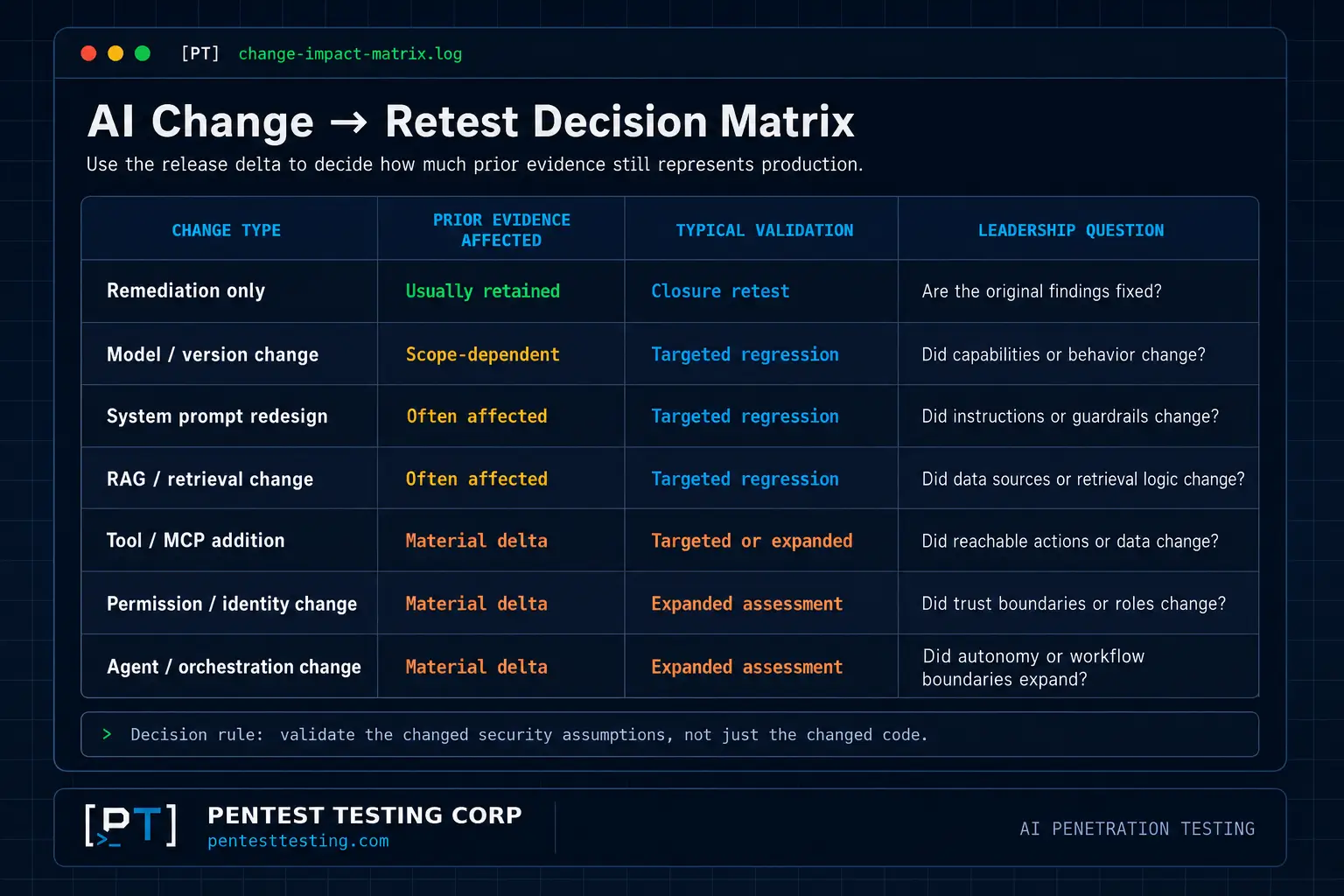
| Change | What prior evidence may no longer prove | Default testing decision | Leadership question |
|---|---|---|---|
| Remediation-only code fix with no architecture change | Whether the specific finding is closed and adjacent paths remain blocked | Focused closure retest | Did the fix close the original path without creating a nearby regression? |
| System/developer prompt redesign | Prompt-injection resistance, policy hierarchy, disclosure behavior, tool-selection boundaries | Targeted regression retest; broaden if the prompt changes authority or workflow | Did the new instruction hierarchy change what the model will reveal or attempt? |
| Model or provider/version upgrade | Behavioral assumptions, refusal boundaries, tool selection, output structure, prompt sensitivity | Targeted regression for low-impact changes; new/expanded assessment for material capability or behavior changes | Does the previous result still represent this model in this deployment? |
| New RAG corpus, retriever, embedding model, vector store, or tenant filter | Data isolation, indirect prompt-injection exposure, retrieval integrity, sensitive-data boundaries | Targeted regression if the trust boundary is unchanged; new/expanded assessment when data sources or isolation design change | Can the AI now retrieve data or instructions it could not reach before? |
| New tool, function, plugin, or MCP server | Excessive agency, authorization, parameter validation, approval controls, downstream impact | New or expanded assessment of the affected agent workflow | Has the agent gained a new way to read, write, send, approve, delete, or trigger something? |
| Permission, role, identity, OAuth-scope, or service-account change | Least privilege, tenant isolation, user-context propagation, revocation | New or expanded assessment of affected identity and action paths | Has the blast radius changed even if the model and prompts did not? |
| Orchestration, delegation, memory, or multi-agent change | Action sequencing, context boundaries, tool routing, persistence, loop limits | Usually targeted-to-expanded assessment depending on reach | Can the system now combine capabilities in a way the prior test never exercised? |
| Logging, confirmation, rollback, or guardrail change | Detection, containment, human approval, recoverability | Targeted validation plus affected abuse paths | If prevention fails, do the new controls still stop or contain the outcome? |
The table is a starting point, not an automatic rule. One model update may be operationally minor in a read-only summarization feature and material in an autonomous workflow that can modify financial, customer, or production records.
A strong change review therefore asks about effective capability, not just the ticket label. "Model upgrade" is too vague. The security owner needs to know whether the new deployment changes reasoning behavior, tool use, context handling, structured outputs, safety controls, or the system's ability to complete longer action chains.
Provider change logs show why that distinction matters. In August 2026, OpenAI documented updated GPT-5.6 variants that were distinct from the July deployments and published fresh prompt-injection evaluations. Anthropic's July 24 platform release introduced Claude Opus 5 with documented behavior changes and the ability to add or remove tools mid-conversation in supported configurations. These are not vulnerabilities by themselves. They are examples of why a model/version and tool inventory belong in the test baseline. See the official OpenAI GPT-5.6 August update and Anthropic Claude Platform release notes.
For teams that need a broader scope reference before deciding what changed, What Does an AI Penetration Test Cover? describes the AI-enabled workflow as the system under test rather than the model alone.
AI Pentest Retesting: Targeted Retest or New Assessment?
The cleanest way to decide is to start with the security claim you are relying on and work backward.
1. Did the change only address an existing finding?
If yes, and the model, prompts, retrieval sources, tools, identities, permissions, and orchestration are materially unchanged, a focused closure retest is usually appropriate. The objective is narrow: reproduce the original issue, confirm the expected denial or safe behavior, and test the most obvious adjacent regression paths.
If the remediation changed a shared control, such as authorization middleware, retrieval filtering, or a centralized agent policy layer, the retest should expand across the other workflows that depend on that control. A fix can close one finding and change behavior elsewhere.
2. Did the change add a new attack surface or capability?
A new tool, MCP server, external connector, upload path, retrieval source, privileged API, memory layer, or agent-to-agent delegation route is not simply a retest of the old system. It is new scope.
The assessment does not always need to restart from zero. Existing evidence for unchanged web, API, or AI components can still be useful. But the new capability needs threat modeling, surface mapping, abuse-path testing, and evidence of its authorization and containment controls. In practice, that is an expanded assessment, not a finding-closure retest.
3. Did the change alter authority or blast radius?
Treat changes to roles, service identities, OAuth scopes, tenant context, user delegation, approval requirements, or write permissions as high-sensitivity changes. These controls determine what a manipulated or mistaken model can actually do.
This is where OWASP LLM06:2025 Excessive Agency becomes operational. The risk is not merely that the model may choose an undesirable action. It is that the application gives the model too much functionality, permission, or autonomy for the task. If the release changes that authority, prior evidence about blast radius may no longer be valid.
4. Did the change alter the source of behavior?
A system-prompt rewrite, model upgrade, retrieval change, or new memory design can change which instructions the system follows and which information it uses. This is especially important for OWASP LLM01:2025 Prompt Injection and LLM07:2025 System Prompt Leakage.
A small wording change to a non-security prompt does not automatically justify a new engagement. A redesign that changes instruction hierarchy, tool-selection rules, data handling, hidden policy content, or approval logic does.
5. Can you still reproduce the old security baseline?
This is the final decision test. If the team cannot reliably state what was unchanged and reproduce the conditions under which the prior evidence was collected, it is difficult to defend a narrow retest.
When the baseline is unclear, the safer commercial decision is often to rescope before testing. That avoids paying for a "retest" that produces evidence too narrow for the system now in production.
For planning effort, our AI penetration test timeline guide explains how roles, retrieval, tools, integrations, and reporting needs affect duration. The same principle applies after a release: scope should follow changed risk, not the label attached to the change request.
What a Targeted AI Security Regression Retest Should Prove
A targeted retest should be small because the scope is stable, not because the team wants a smaller invoice or a faster sign-off.
The retest should produce evidence in five areas.
Confirm the original finding is actually closed
The tester should repeat the original security condition against the remediated deployment and show that the expected control now holds. For example, a prompt-injection finding should not be closed merely because one test phrase is blocked. The retest should verify the underlying control that was supposed to remove the impact, such as authorization, tool restriction, retrieval filtering, or approval enforcement.
Test adjacent regression paths
Security fixes often move behavior rather than remove it. A new retrieval filter may block one cross-tenant path but leave another query route unchanged. A prompt change may stop one instruction pattern while allowing the same unsafe tool action through a different conversation path.
Targeted regression testing therefore needs a small set of adjacent negative tests chosen from the original root cause and remediation design.
Verify the "unchanged" assumptions
If the retest is being treated as narrow, the report should record what was checked and found unchanged: model/version, prompts, tool inventory, permissions, relevant data sources, and orchestration. This turns an assumption into evidence.
Compare behavior where the system is probabilistic
AI testing cannot depend on one pass/fail sample when the behavior is variable. The retest should use repeatable test cases, representative contexts, and enough repetition to determine whether the security control is reliable under the agreed conditions. The objective is not to claim perfect determinism. It is to show that the remediation holds across the meaningful variants that motivated the finding.
Produce closure evidence that states its limits
A useful retest artifact should identify the deployment tested, findings retested, results, residual limitations, and any scope changes discovered during validation. It should not imply that unrelated features were reassessed.
That distinction matters during procurement and audit review. Our guide to the AI red teaming vendor questionnaire explains why buyers increasingly need scope, framework mapping, findings status, remediation, and independent retest evidence rather than a generic statement that "AI security was tested." Teams that want to see how reporting evidence is structured can also review Pentest Testing Corp's sample penetration testing reports.
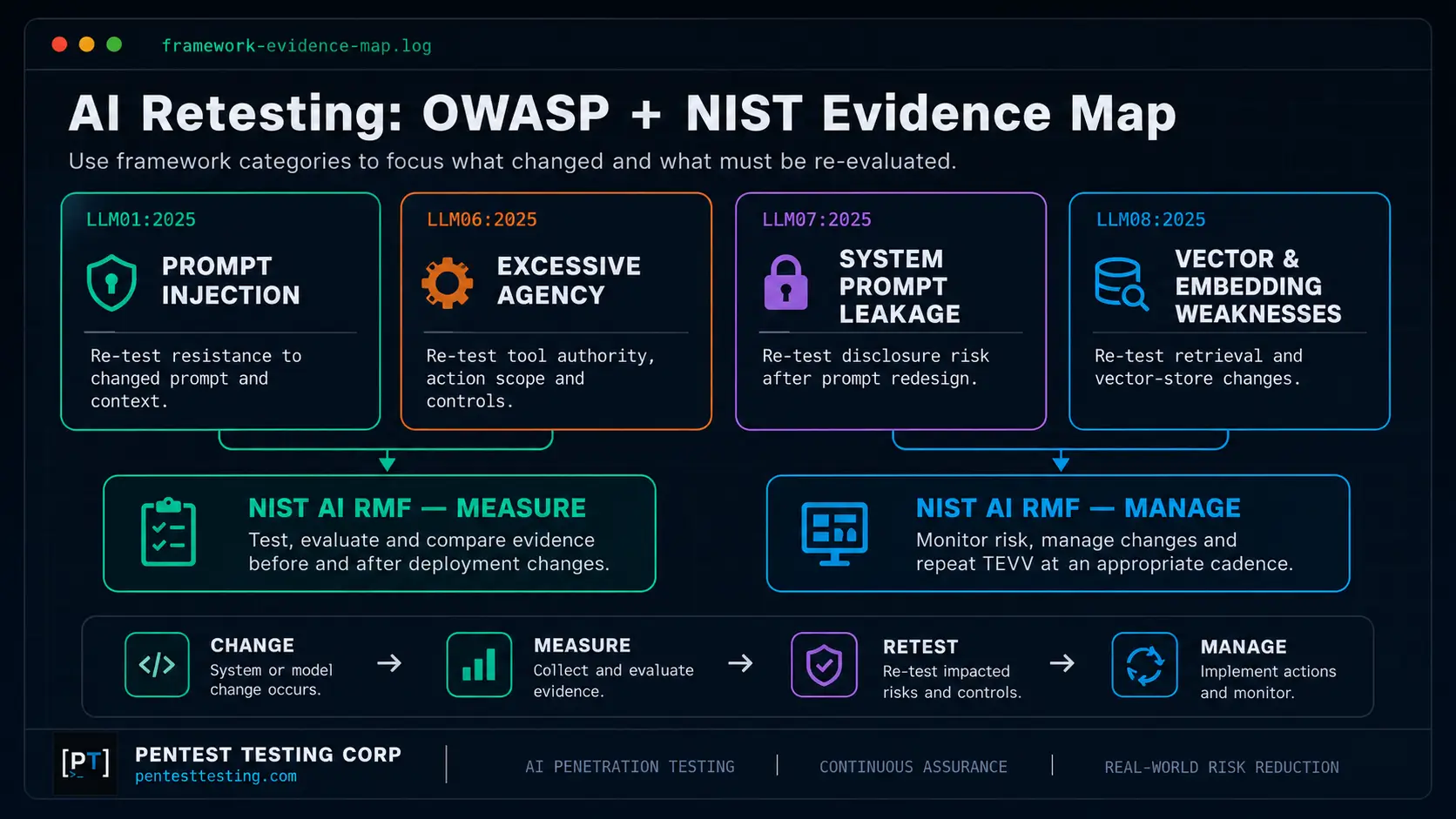
Framework Mapping: OWASP LLM Top 10 and NIST AI RMF
Frameworks help organize the decision, but they do not decide retest scope automatically.
OWASP LLM01:2025 Prompt Injection
Prompt injection risk can change when the model, system prompt, retrieval sources, external content paths, or tool interfaces change. A previous test may still prove that an application-level authorization control works, while no longer proving how the new model behaves when it encounters hostile or conflicting instructions.
That is why the retest decision should separate model-behavior evidence from deterministic control evidence. Server-side authorization that is unchanged may remain valid. A prompt-based guardrail that was materially rewritten may need new adversarial validation.
OWASP LLM06:2025 Excessive Agency
Tool and permission changes are among the strongest triggers for expanded testing. OWASP's guidance emphasizes minimizing extension functionality, permissions, and autonomy. If an agent gains a new function or broader downstream permission, the maximum impact of a successful manipulation changes even if the original prompt-injection behavior does not.
OWASP LLM07:2025 System Prompt Leakage
A system-prompt redesign can invalidate prior evidence about what internal instructions are exposed and how leaked instructions affect later abuse. More importantly, a new prompt can move security logic into text that should have been enforced by deterministic application controls. Retesting should therefore check both disclosure and downstream impact.
OWASP LLM08:2025 Vector and Embedding Weaknesses
Changes to vector stores, embedding models, retrieval logic, document sources, tenant filters, or ingestion rules can change which content the model can retrieve and which untrusted instructions can enter context. These are strong triggers for RAG regression testing and, when trust boundaries change, an expanded assessment.
NIST AI RMF: Measure and Manage
NIST's AI RMF Playbook gives the governance rationale for this change-based approach. Measure 1.1 includes testing methods and pre- versus post-deployment assessment. Manage 4.1 covers post-deployment monitoring, change management, TEVV, and red-teaming at a prescribed cadence.
For leadership, the useful interpretation is not "NIST requires a pentest after every model change." It does not say that. The useful interpretation is that AI risk evidence should be maintained as the system changes, with testing depth proportional to the risk introduced by the change.
For a deeper mapping of technical assessment evidence to Govern, Map, Measure, and Manage, see How AI Penetration Testing Maps to the NIST AI Risk Management Framework.
Hypothetical Scenario: The Fix Passed, Then the Agent Changed
Consider a hypothetical B2B support copilot. During its initial assessment, testing finds that an indirect instruction inside a retrieved support ticket can influence the model to request a customer-management action. The application blocks the action inconsistently because the tool receives a broad service credential.
Engineering remediates the issue by reducing the tool's permissions, enforcing tenant context server-side, and requiring confirmation for write actions. A focused retest confirms the original attack path is blocked and the expected authorization failures are logged. The finding is closed.
Two release cycles later, the product team makes three changes:
- It upgrades to a more capable model.
- It replaces the original customer-management function with an MCP server exposing several read and write operations.
- It changes approval logic so low-risk updates can run without human confirmation.
The old retest is still useful evidence that the original remediation worked in the earlier deployment. It is no longer sufficient evidence for the current claim that "the copilot cannot perform unauthorized customer changes."
Why? The effective authority changed. The tool surface changed. The model's tool-selection behavior may have changed. The approval boundary changed. Those changes affect the same impact path the original finding was about.
The right response is not to discard all earlier testing. Reuse the stable evidence, then commission an expanded assessment of the changed workflow: new MCP tool inventory, authorization, parameter handling, user and tenant context, prompt-injection paths that can reach those tools, confirmation logic, logging, and rollback.
This is the core distinction between closure evidence and current-system assurance.
For smaller teams that need to control scope, the same risk-based principle applies. The AI penetration testing for startups guide explains why testing depth should follow product complexity and real data/tool exposure rather than company size.
What Leadership Should Decide Before Shipping the Change
The retest decision should be part of release management, not an argument that starts after the release candidate is ready.
A lightweight governance rule can make the process defensible without turning every AI change into a security project.
| Release decision | Owner should record | Security outcome |
|---|---|---|
| No security retest | Why the change does not affect tested attack surface, authority, data boundary, or security behavior | Existing evidence remains applicable to the documented baseline |
| Focused closure retest | Finding IDs, remediation, unchanged baseline elements, adjacent regression checks | Evidence that specific findings are closed |
| Targeted regression retest | Changed component, affected security claims, linked workflows, regression scope | Evidence that a material but bounded change did not reopen relevant abuse paths |
| New/expanded assessment | New capability, tool, permission, data source, identity model, or architecture boundary | Fresh evidence for the changed attack surface and blast radius |
Leadership should require five things before relying on old evidence after an AI release.
First, name the change precisely. "Prompt update" or "model upgrade" is not enough. Record the security-relevant differences.
Second, identify the security claims affected. Examples include tenant isolation, read-only tool access, approval before external action, prompt confidentiality, restricted retrieval, or user-context propagation.
Third, assign a testing level. No retest, focused closure, targeted regression, or expanded assessment. The decision should be owned by a security or risk role, not buried in an engineering ticket without review.
Fourth, define evidence expiration conditions. A report does not need an arbitrary short shelf life, but it should state which future changes make the evidence non-representative. That is far more useful than saying "valid for one year" regardless of what ships during that year.
Fifth, check the commercial and audit dependency. If a customer, auditor, insurer, or board committee is relying on the report, the scope statement must match the system they are being asked to trust. A technically accurate old report can still create a governance problem if stakeholders assume it covers capabilities added later.
The goal is not continuous full-scope testing. It is continuous evidence discipline: know what was tested, know what changed, and buy only the amount of new validation needed to make the next security claim defensible.
AI pentest retesting works best when it is tied to material change rather than an arbitrary calendar or every code deployment.
A remediation-only change may need a focused closure retest. A system-prompt or retrieval change may need targeted security regression testing. A new model can require broader validation when it changes security-relevant behavior. New tools, MCP servers, permissions, identities, or agent capabilities often justify an expanded assessment because they change the attack surface or blast radius.
The decision becomes much easier when the original test records a usable baseline and release management records the changes that matter to security.
If your team has changed its model, prompts, retrieval layer, agent tools, permissions, or orchestration since the last assessment, Pentest Testing Corp can review the delta and determine whether a targeted AI retest is sufficient or whether the changed workflow needs a new scope. Request an AI penetration testing scope review or book a 30-minute scoping call.
Frequently asked questions
Does every model update require a new AI penetration test?
No. The decision should depend on whether the update changes security-relevant behavior, tool use, data access, output handling, or other assumptions from the previous assessment. A low-impact update may justify targeted regression testing. A material capability change in an agentic workflow may require an expanded assessment.
What is the difference between a retest and AI security regression testing?
A retest usually verifies that previously reported findings were remediated. AI security regression testing checks whether a later change, such as a model, prompt, retrieval, or tool update, has reopened relevant abuse paths or invalidated prior evidence even when no specific finding is being closed.
When is a targeted AI retest enough?
It is usually enough when the changed component is bounded, the trust boundaries and permissions are unchanged, the team can identify the affected security claims, and the previous baseline is still reproducible. The scope should include adjacent regression paths, not only the exact original test case.
Does changing the system prompt invalidate a previous AI pentest?
Potentially. A cosmetic wording change may not matter. A change to instruction hierarchy, security policy, tool-selection rules, data handling, approval logic, or hidden prompt content can alter prompt-injection and prompt-leakage behavior and should trigger targeted reassessment.
Does adding a new MCP server require a new assessment?
A new MCP server normally creates new attack surface because it adds tools, data access, credentials, parameters, or downstream actions. Existing evidence for unchanged components can still be reused, but the new tool boundary and affected workflows should be assessed as new or expanded scope.
How often should an AI system be retested?
There is no universal interval that fits every system. Retest after remediation and after material changes to models, prompts, retrieval, tools, permissions, identities, orchestration, or data flows. Higher-risk systems may also need a regular cadence based on release frequency, exposure, contractual obligations, and risk tolerance.
What evidence should we keep so future retesting stays efficient?
Keep the original scope, architecture/data-flow summary, model and prompt versions, retrieval sources, tool and permission inventory, roles and identities, finding evidence, remediation records, retest results, and a change log. That allows the next tester to distinguish what is unchanged from what needs fresh validation.