

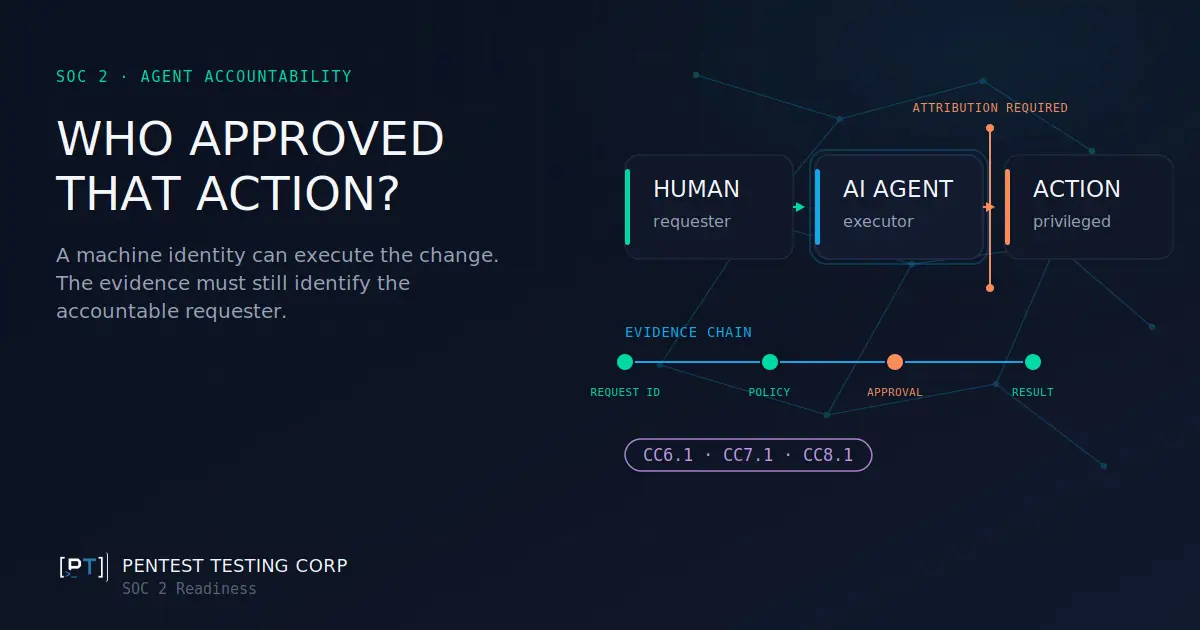
Who Approved That? AI Agent Accountability for SOC 2
A finance agent updates a customer’s payment terms at 2:14 a.m. The application log identifies the agent’s service account. The orchestration platform records a tool call. The ticketing system contains a change request from earlier that week. Yet when an auditor asks who requested this specific action, which authority the agent inherited, and whether the final change matched the approved intent, the evidence chain stops.
This is the practical AI agent accountability SOC 2 problem. A machine identity may explain what executed a transaction without showing the accountable human, approved workflow, policy decision, or business result behind it. For companies preparing for SOC 2 Type I or operating through a Type II observation period, that gap can weaken evidence for logical access, monitoring, and change management at the same time.
The answer is not to force a person to approve every low-risk automation. It is to design a traceable chain in which autonomous actions stay attributable, authorized, observable, and reviewable according to their impact.
The AI Agent Accountability for SOC 2 Evidence Gap
Traditional access-control evidence usually starts with a person: an employee authenticates, receives a role, performs an action, and leaves an audit record. AI agents complicate that model because several identities and decisions can sit between the person and the business system:
- a human requester or an upstream automated trigger;
- a user session, workload identity, or agent identity;
- an orchestration layer that selects a tool;
- a service account used by a connector;
- a policy engine or human approval gate; and
- a downstream application that records only the final credential.
Each component can work as designed while the combined record remains insufficient. A cloud audit log might say that billing-agent-prod changed a field. It may not preserve the human session that initiated the request, the exact delegated scope, the policy version evaluated at the time, or whether an approver saw the same parameters that were eventually executed.
This is a control-design issue, not simply a logging issue. More events do not solve it if the events cannot be correlated or if critical context never enters the record. A SOC 2 risk assessment and readiness review should therefore test the full requester-to-result path, including the design of the control and the evidence it produces in operation.
SOC 2 does not contain an “AI agent” criterion. The relevant question is how the organization’s stated controls meet the applicable Trust Services Criteria in its actual environment. The broad relationship is covered in our guide to how SOC 2 applies to AI risk. This article addresses the narrower question: can the company prove who or what authorized a privileged agent action and how that action was governed?
How AI agent accountability maps to CC6.1, CC7.1, and CC8.1
The AICPA Trust Services Criteria are outcome-oriented. They do not prescribe a specific agent logging format. Management defines controls appropriate to its commitments, risks, and system. The mapping below is therefore a practical control interpretation, not legal advice and not a claim that one artifact automatically satisfies a criterion.
| SOC 2 area | Accountability question | Evidence a reviewer should be able to inspect | Common failure |
|---|---|---|---|
| CC6.1: logical access | Was the action performed under an approved identity with only the required authority? | Human or system initiator, authenticated session, agent/workload identity, effective scopes, policy result, credential lifetime, and revocation status. | A shared privileged connector account hides the originating user and grants broader rights than the task needs. |
| CC7.1: detection and monitoring | Could the organization detect misuse, unexpected autonomy, or action outside the intended workflow? | Correlated activity events, alerts for sensitive actions, denied attempts, anomaly context, reviewer disposition, and incident linkage. | Logs show successful tool calls but omit denials, approval bypasses, policy version, or the business effect. |
| CC8.1: change management | If the agent changed software, infrastructure, configuration, data, or a controlled procedure, was the change authorized and traceable? | Approved change record, tested version, deployment identity, agent/tool configuration, parameter set, emergency-change handling, and post-change validation. | A ticket approves a general objective, while the agent executes materially different parameters or uses a newly changed tool. |
These criteria often intersect. If an agent uses a privileged identity to alter production configuration, CC6.1 frames who and what had access, CC7.1 frames how activity was detected and evaluated, and CC8.1 frames whether the change followed an authorized process. Splitting the evidence into three unrelated folders can make a single action impossible to reconstruct.
A useful design test is simple: select one high-impact action and ask an independent reviewer to follow it backward from the resulting business or system change. If the reviewer cannot reach the originating requester, approval basis, and policy decision without assumptions, the accountability chain is incomplete.
Why normal IAM, application logs, and tickets may be insufficient
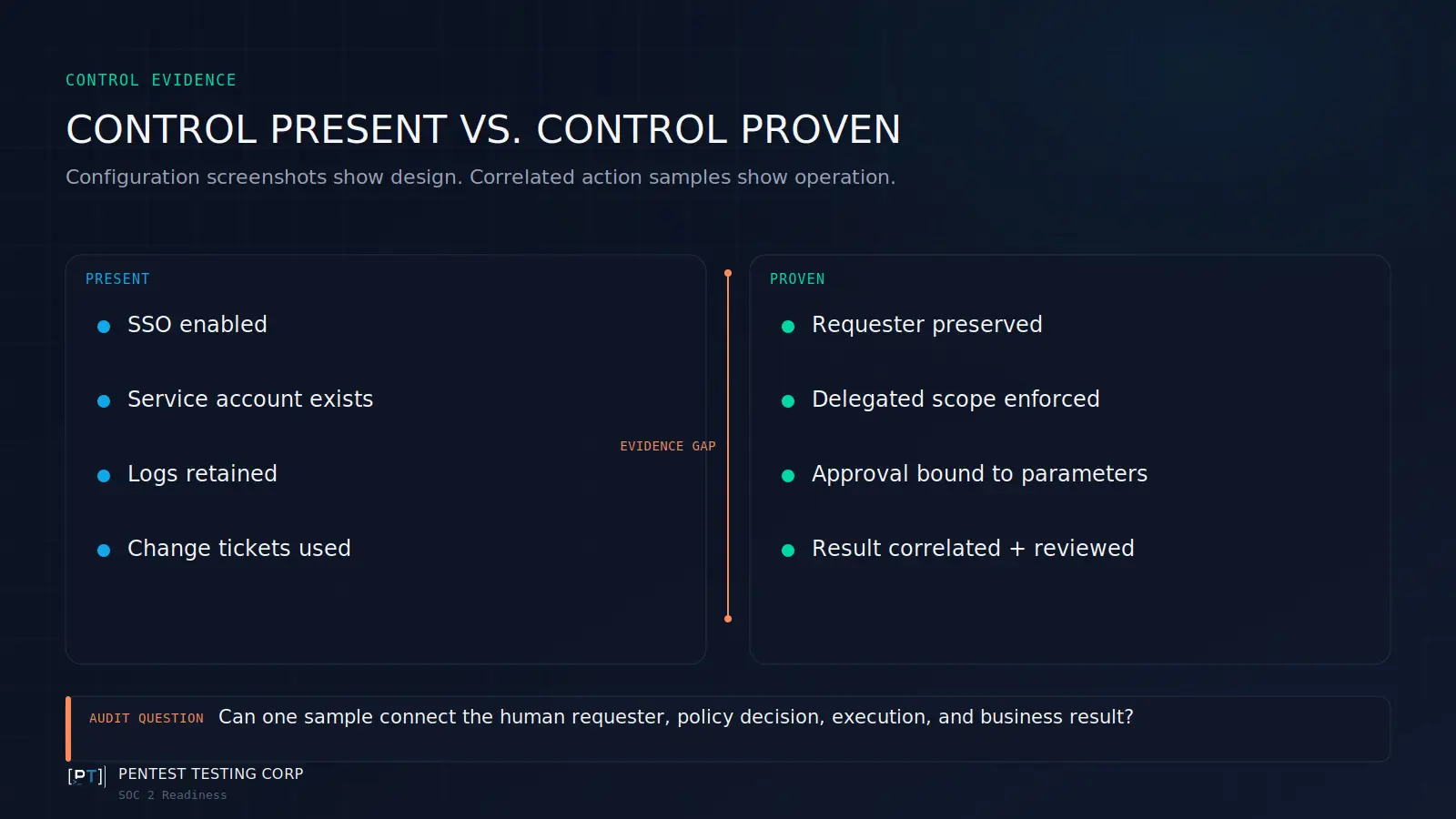
A service account identifies the executor, not necessarily the requester
Many agent integrations use a workload identity or shared service account. That can be appropriate, but the downstream system may see only that credential. If ten employees can ask the same agent to act, or if a scheduler can trigger it without a person, the service account alone does not establish accountability.
The control needs an immutable link between the initiating subject and the agent’s execution context. Where there is no human requester, the record should identify the approved automated trigger, its owner, and the policy that allowed it. “The AI did it” is not an ownership model.
A transcript is not an authorization record
Chat or reasoning transcripts can provide context, but they are not a reliable substitute for structured authorization evidence. They may contain sensitive data, be truncated, vary across model versions, or fail to show the effective permissions enforced downstream. Internal model reasoning should not be treated as the authoritative explanation for why an action was permitted.
Instead, record the security decision in structured form: authenticated subject, requested operation, protected resource, evaluated policy, decision, required approval, approved parameters, and correlation identifier. Keep conversational content only where retention, privacy, and investigation needs justify it.
A ticket proves intent only when it is bound to execution
A change ticket stating “update billing rules” does not prove that every later agent action was approved. The evidence should bind the approved object, environment, version, limits, and validity period to what executed. If a material parameter changes after approval, the system should require a new decision or route the exception for review.
Retention without integrity is fragile evidence
Long retention helps only if logs are complete, time-synchronized, access-controlled, and protected from unauthorized alteration. Evidence owners should know which system is authoritative for each field and how exports preserve integrity. The organization should also test whether revocation, incident response, and legal or contractual retention requirements can be met across vendors.
This is why agent accountability must extend beyond conventional IAM screenshots. Our discussion of AI agent identity security shows how delegated authority and effective downstream permissions need validation across the complete workflow.
What a defensible privileged-action evidence chain must prove
For a high-impact action, the evidence chain should answer seven questions. The exact implementation will differ by architecture, but the logical record should survive changes in model vendor, orchestrator, or tool protocol.
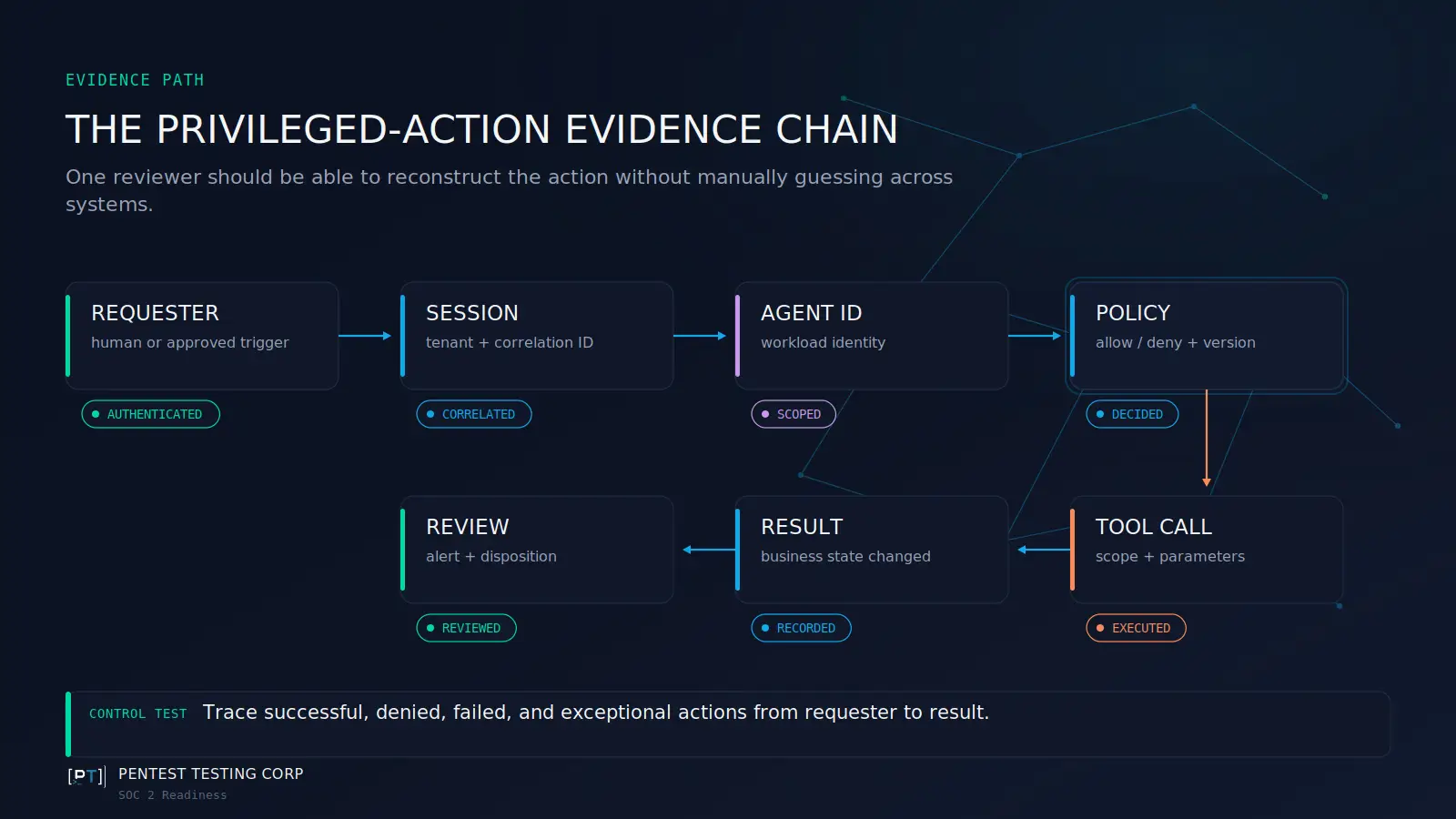
- Who or what initiated the request? Preserve the authenticated human subject or approved automated trigger, including tenant, session, and organizational owner.
- What was requested? Record a normalized action, target resource, intended outcome, and relevant parameters. Avoid relying solely on free-text prompts.
- Which agent and configuration handled it? Identify the agent, model or routing configuration where relevant, tool registry version, environment, and deployment version.
- What authority was delegated? Capture the effective scopes, resource boundary, credential type, validity period, and whether the downstream call used the requester’s context or a workload identity.
- Why was the action allowed? Record the policy decision, policy version, approval requirement, approver identity where applicable, and any exception.
- What actually happened? Correlate the tool call with the downstream result, affected object, before-and-after state where proportionate, and failure or rollback status.
- Who reviewed the outcome? For sensitive or exceptional actions, retain the monitoring alert, reviewer disposition, incident link, or periodic control review.
A common correlation identifier should connect these stages. It must not expose secrets, and access to the evidence should itself be controlled and logged. If different vendors generate separate identifiers, maintain a durable mapping rather than asking auditors or investigators to infer relationships from timestamps.
| Action tier | Example business impact | Minimum decision model | Expected evidence |
|---|---|---|---|
| Low | Read-only retrieval from an approved knowledge source | Pre-approved policy with least privilege | Requester/trigger, agent identity, resource scope, result metadata, and exception logging |
| Moderate | Create a draft, open a ticket, or update a reversible non-critical record | Policy approval plus limits and post-action review | All low-tier evidence plus parameters, before/after state, rate limits, and reviewer sampling |
| High | Change production access, release code, move funds, delete data, or alter a regulated decision | Independent human approval or equivalent formally approved control before execution | Bound approval, separation of duties, effective permissions, immutable result, alerting, and rollback/incident record |
Risk tiering prevents two expensive mistakes: applying manual approval to every harmless action, which encourages bypasses, and allowing blanket autonomy for high-impact actions, which concentrates risk in a system that may be difficult to investigate.
How AI Agent Accountability for SOC 2 Maps to OWASP and NIST
The frameworks serve different purposes. SOC 2 evaluates controls relevant to the organization’s system and commitments. OWASP describes application security risks. The NIST AI Risk Management Framework provides voluntary outcomes for managing AI risk. They should inform one control system rather than produce three disconnected checklists.
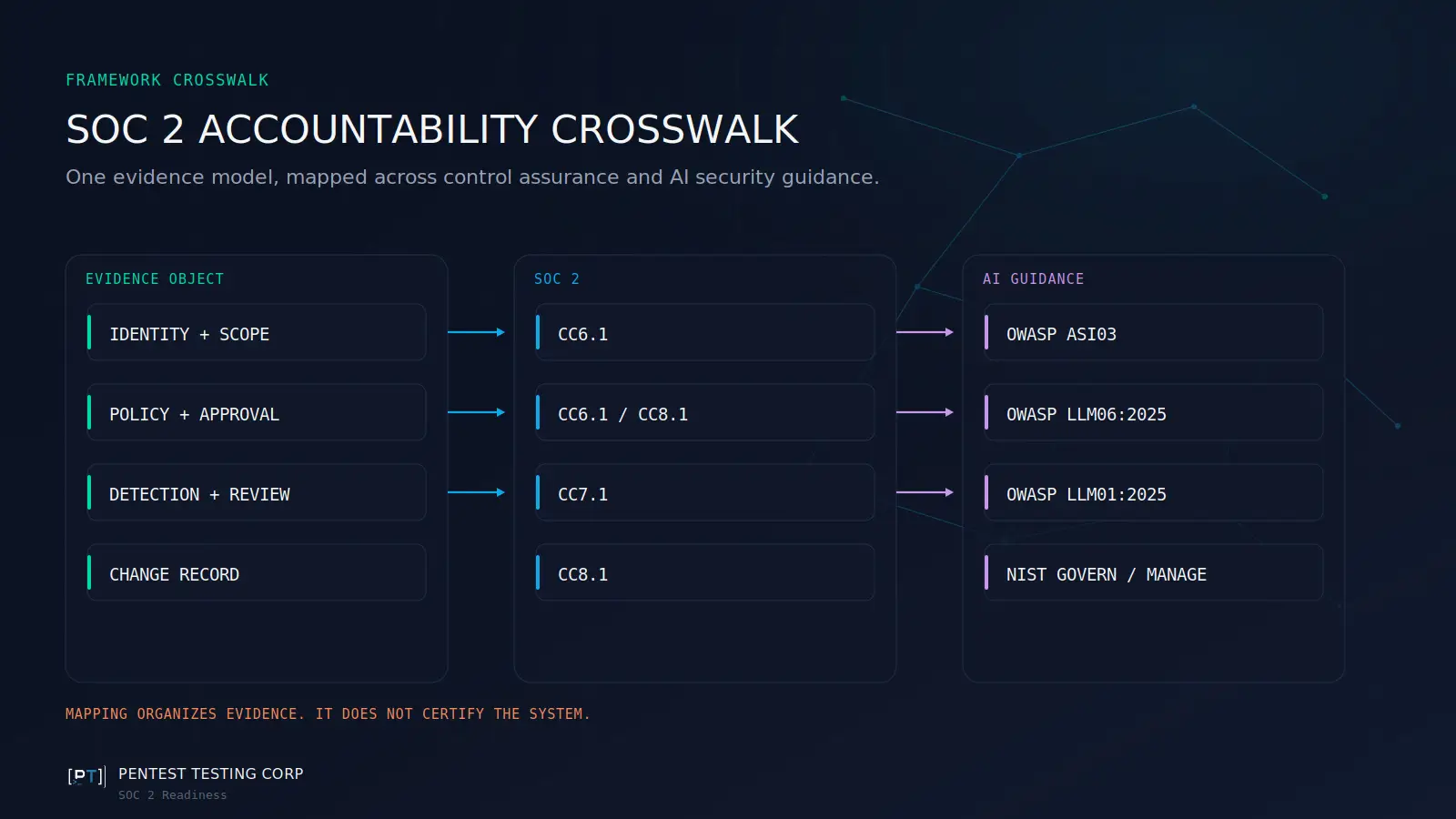
OWASP LLM06:2025 Excessive Agency is directly relevant. OWASP identifies excessive functionality, permissions, and autonomy as root causes and recommends minimizing permissions, executing extensions in the user’s context, requiring approval for high-impact actions, enforcing authorization in downstream systems, and monitoring extension activity. Those measures reduce both security exposure and evidentiary ambiguity.
OWASP LLM01:2025 Prompt Injection matters because manipulated input can influence an agent’s behavior. Accountability controls do not prevent prompt injection by themselves, but they can constrain what a compromised decision path can execute and preserve evidence for detection and response. Approval screens must display the actual action and parameters, not merely repeat an agent-generated summary.
OWASP ASI03: Identity & Privilege Abuse sharpens the agentic-system issue: agents may operate through delegated, chained, or overly broad identities. The control response is to bind actions to originating identity, restrict effective privilege, prevent confused-deputy behavior, and preserve identity context across tool boundaries.
In the NIST AI RMF, accountability belongs primarily in GOVERN: roles, policies, responsibility, and oversight must be defined. It also reaches MAP, because the organization must understand affected actors and workflow context; MEASURE, because the controls need testing and monitoring; and MANAGE, because gaps require prioritized remediation, ownership, and follow-up. NIST currently notes that AI RMF 1.0 is under revision, so teams should preserve outcome-based mappings instead of hard-coding their program to a vendor checklist.
Our AI pentest and NIST AI RMF mapping guide explains how assessment evidence can be organized across all four functions. For this SOC 2 use case, the central design objective is a control record that is understandable to engineering, compliance, and the independent auditor.
A hypothetical scenario: the action is logged, but not attributable
The following is an illustrative scenario, not a client case study.
A B2B payments platform deploys an operations agent to handle merchant requests. The agent can read account status, draft responses, and adjust selected configuration values within defined limits. A support manager asks it to correct a routing setting for one merchant. The agent interprets information from an attached document, calls an internal tool, and changes the production record.
The downstream database records the shared connector identity. The agent platform stores the conversation for 30 days. The ticket contains the manager’s initial request but not the final parameters. The approval interface displayed “apply recommended correction” without showing the target value. Two weeks later, a reconciliation exception prompts review.
The company can prove that a production credential changed the record. It cannot quickly prove that the authenticated manager requested that exact value, that the agent stayed within delegated limits, or that the approval covered the executed parameters. The technical change may have been reasonable. The evidence is still weak.
The business consequences are broader than one audit request:
- engineering spends days correlating logs from multiple systems;
- compliance cannot demonstrate consistent control operation during the Type II period;
- incident responders cannot distinguish misuse, model error, and authorized activity;
- management may need to narrow or suspend the automation until evidence improves; and
- customers reviewing the SOC 2 report may ask additional questions about privileged automation.
A stronger design would pass the authenticated requester and tenant context into the authorization layer, show exact parameters for approval, use a narrowly scoped workload token, assign one correlation ID across the workflow, record the policy version, and retain the resulting before-and-after state according to the evidence policy. Similar concerns become especially consequential in KYC, payment, and record-changing workflows, as described in our financial-services AI agent security guide.
How to test AI agent accountability before SOC 2 fieldwork
A document review can confirm that policies mention AI, privileged access, and change management. It cannot prove that identity and approval context survive a real multi-system workflow. Testing should combine control design review, evidence sampling, and safe technical validation.
Scope the actions that matter
Start with an inventory of agents, tools, connectors, identities, protected resources, and owners. Rank actions by business impact and reversibility. A read-only summarization agent does not need the same evidence or approval model as an agent that modifies production IAM, customer records, deployments, or financial instructions.
Sample complete transactions, not isolated screenshots
Select representative successful, denied, failed, and exceptional actions. Trace each one from request to business result. Confirm that timestamps, identities, tenant context, parameters, policy decisions, approvals, and outcomes correlate. A screenshot of an enabled logging setting is design evidence; sampled event chains are operating evidence.
Validate negative paths
Accountability is strongest when the system records what it refused as well as what it allowed. Testing should confirm that expired authority, revoked users, cross-tenant requests, altered parameters, missing approvals, unavailable policy services, and out-of-scope tools fail safely and generate usable records. This can be done without publishing exploit instructions or disrupting production.
Test change and revocation
Agent behavior changes when models, prompts, tools, policies, permissions, or orchestration logic change. Verify that material changes enter the approved change process and that old credentials, tool versions, and permissions are removed. Test whether emergency changes receive retrospective review and whether evidence collection continues during degraded operation.
Verify evidence ownership and retention
Name the owner of every evidence source. Define retention based on the audit period, incident response needs, contracts, privacy obligations, and system risk. Confirm that exports remain readable and that evidence can be produced within the audit team’s response window.
An AI penetration testing engagement can validate agent tools, authorization boundaries, delegated identities, and abuse paths. A SOC 2 readiness assessment then evaluates whether the surrounding policies, ownership, evidence workflow, and operating cadence support the criteria in scope. For many organizations, the two scopes work best together but produce distinct deliverables.
| Workstream | Typical owner | Relative effort | Useful output |
|---|---|---|---|
| Agent and privileged-action inventory | Engineering + security | Low to moderate | Scoped system map and action tiers |
| Identity and authorization redesign | IAM/platform engineering | Moderate to high | Delegated identity model and least-privilege policies |
| Correlation and evidence pipeline | Platform/SRE + security | Moderate | Requester-to-result audit trail |
| Approval and exception workflow | Product + control owner | Moderate | Risk-tiered decision gates and exception records |
| Control testing and audit packaging | Compliance + security assurance | Moderate | Control matrix, samples, findings, and remediation plan |
Actual cost and timeline depend on the number of agents, tools, environments, identity providers, vendors, and high-impact actions. The expensive work is usually not adding one more log sink. It is redesigning shared credentials, propagating identity context, binding approvals to execution, and collecting evidence consistently over the Type II observation period.
What leadership should decide before the next audit cycle
AI agent accountability crosses engineering, security, compliance, product, and operations. If leadership delegates it only to the team integrating the model, gaps will appear at organizational boundaries. Five decisions should be explicit.
- Which actions may be autonomous? Approve a risk-tiering model and define actions that always require independent human approval, separation of duties, or a different technical control.
- Who is accountable for non-human identities? Assign a named business owner and technical custodian for every production agent and service identity. Set review, rotation, and revocation expectations.
- What is the authoritative evidence chain? Decide which systems own requester identity, policy decision, approval, execution result, and change record. Fund the correlation layer needed to connect them.
- What changes trigger reassessment? Define when a new model, tool, permission, prompt, identity path, data source, or autonomy level requires review, focused retesting, or a full assessment.
- Who accepts residual risk and closes gaps? Separate remediation ownership from risk acceptance. Set deadlines and evidence requirements rather than allowing findings to remain in an informal backlog.
The operating model should be proportionate. Low-risk actions can rely on pre-approved policy and sampled review. High-impact actions need stronger preventive gates, clearer separation of duties, and more complete evidence. Leadership should approve that distinction before an urgent audit request or incident forces the decision.
For remediation governance after assessment, use a named owner, target date, acceptance authority, and closure evidence for every gap. Our pentest remediation ownership plan provides a practical structure that can be adapted to agent-control findings.
Build the evidence chain before the agent scales
An AI agent can have a valid service identity, pass authentication, and generate extensive logs while still leaving management unable to answer a basic question: who approved that action?
For SOC 2, the defensible answer is a connected record. It identifies the requester or approved trigger, the agent and effective authority, the policy and approval decision, the exact tool action, the resulting change, and the review outcome. It also proves that the control operated consistently, not only that the architecture diagram looked correct.
If privileged agents are entering production, your Type II observation window is underway, or an auditor has asked how AI actions are attributed, scope a SOC 2 readiness review with AI agent controls. Pentest Testing Corp can assess the control design, test the technical path, identify evidence gaps, and produce a prioritized remediation roadmap before fieldwork.
Frequently asked questions
Does SOC 2 require a human to approve every AI agent action?
No. SOC 2 is outcome-oriented and does not prescribe universal human approval for AI actions. Organizations should apply controls proportionate to risk. Low-impact actions may operate under pre-approved policy, while high-impact or irreversible actions may require independent approval or an equivalent formally designed control.
Is an agent service account enough to establish accountability?
Usually not by itself. It identifies the executing workload but may not identify the human requester, automated trigger, tenant, delegated authority, or approval behind a specific action. The evidence chain should preserve and correlate those elements.
Should we retain complete prompts and model reasoning for SOC 2?
Not automatically. Retain structured security and business evidence needed to explain the request, authorization decision, execution, and outcome. Full prompts may create privacy, confidentiality, and retention risks. Internal model reasoning should not be treated as the authoritative authorization record.
Can SIEM logs solve the AI agent accountability gap?
A SIEM can centralize and correlate events, but it cannot recover context that upstream systems never recorded. The workflow must be designed first to propagate identity, policy decisions, bound approvals, action parameters, and downstream results.
What evidence is most useful during a SOC 2 Type II period?
Useful evidence includes sampled requester-to-result action chains, access and permission reviews, policy decisions, approvals for sensitive actions, denied attempts, monitoring alerts and dispositions, change records, revocation tests, exceptions, and documented remediation.
How does OWASP ASI03 relate to SOC 2?
OWASP ASI03 addresses identity and privilege abuse in agentic systems. Its mitigations can inform technical control design for logical access, monitoring, and change workflows. It is not a SOC 2 criterion and does not replace the organization’s criteria-mapped control assessment.
When should an agent accountability review happen?
Review before a privileged agent reaches production, before SOC 2 Type I design testing, before or early in a Type II observation period, and after material changes to tools, permissions, identities, models, orchestration, or autonomy.