Pentest Scope Exclusions: Questions Before You Sign
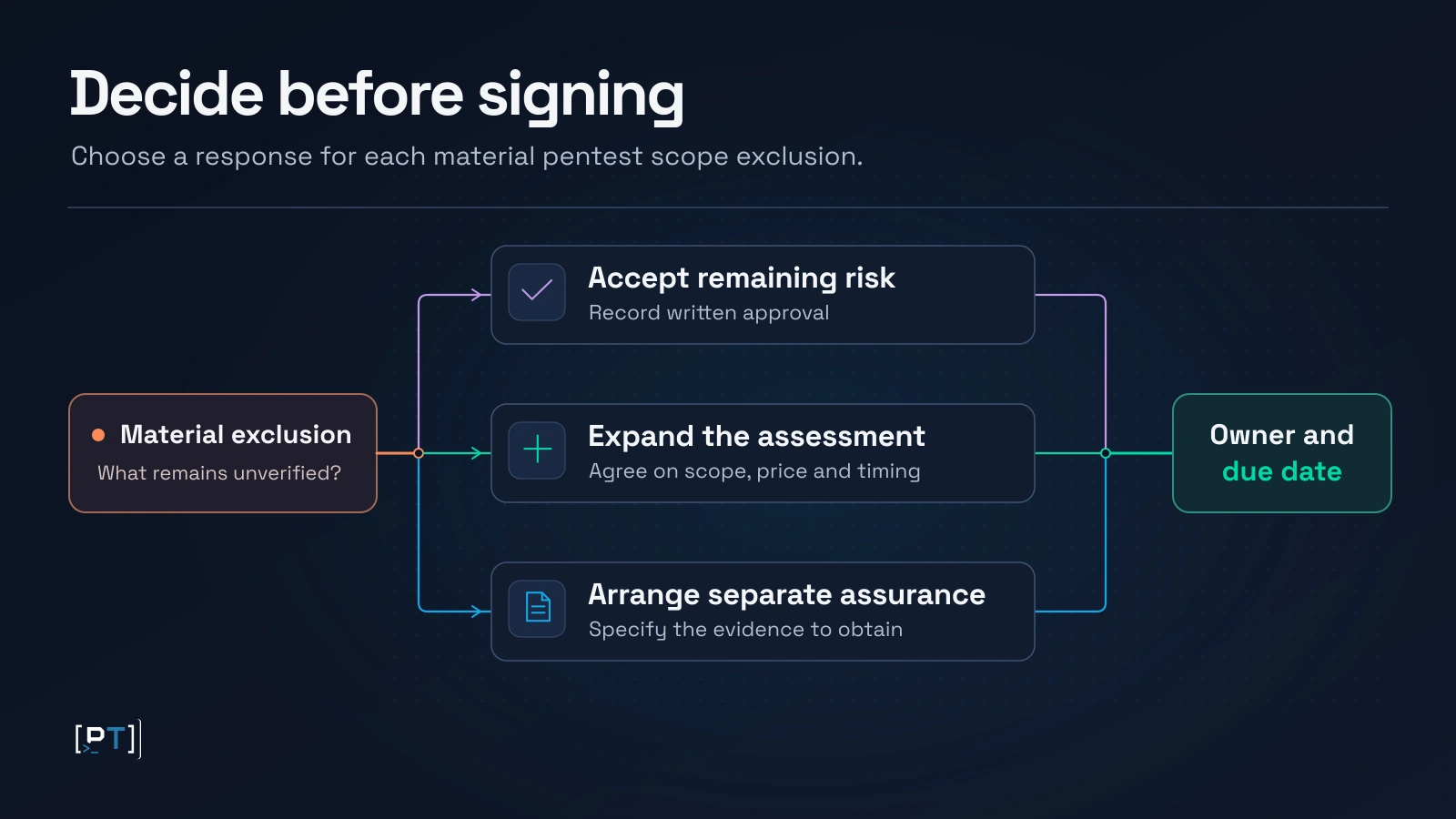
Compare pentest scope exclusions against the evidence your client needs before you sign. For every material gap, decide whether to accept the remaining risk in writing, fund additional testing, or agree on separate evidence. Give each decision an owner and a deadline before committing to coverage in a client proposal.
Hypothetical example. An agency gets two quotes for a SaaS penetration test. Both say “web application and API.” One covers staging with a standard account. The other includes the production partner API, billing administrators, and two test tenants. The SaaS company’s enterprise prospect wants evidence that one customer can’t access another customer’s billing exports. Even the broader quote leaves a question open if the API creates an export but a separate service controls who can download it. The agency needs that answer before it prices the engagement and promises evidence to the client.
What do pentest scope exclusions leave unverified?
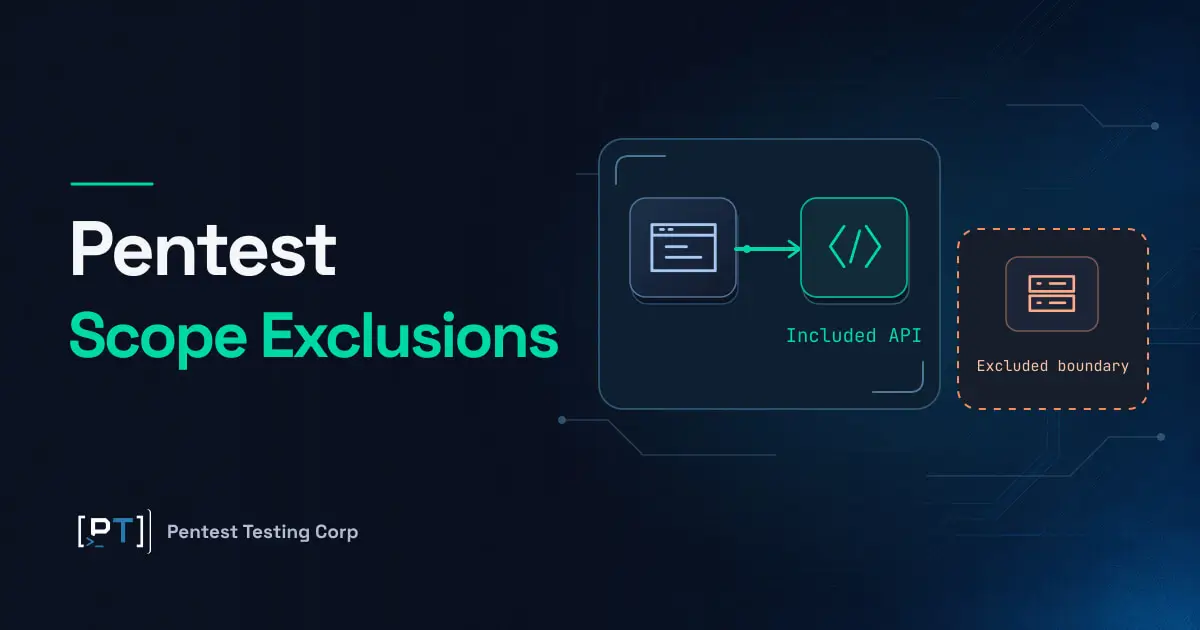
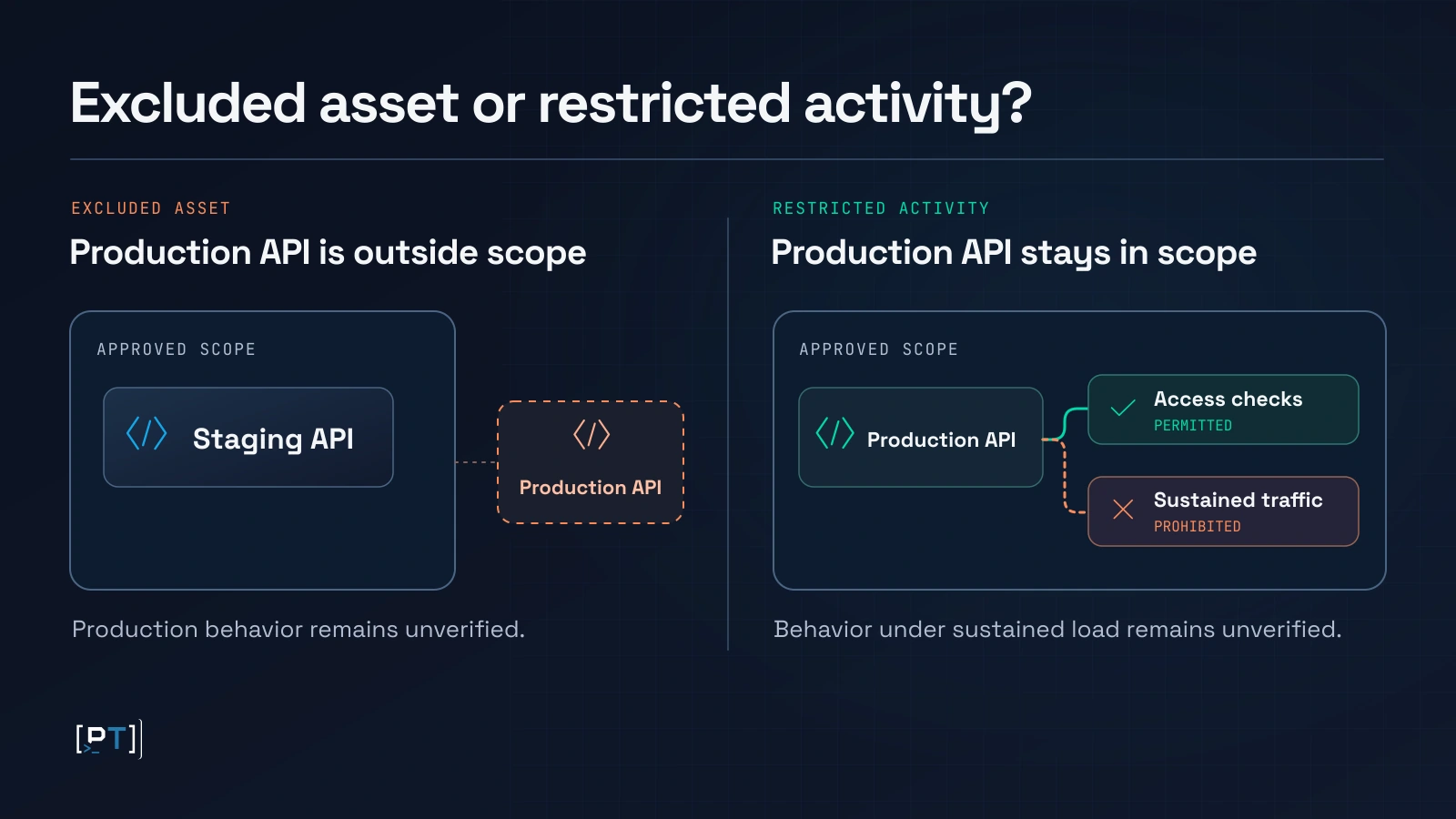
Pentest scope exclusions identify assets, environments, roles, workflows, or activities the assessment omits. Each exclusion limits what conclusions you can draw. If the production API is excluded, the report can describe what happened in staging and any evidence reviewed about production. If the production API is included but sustained traffic is prohibited, the report can still show the results of permitted access checks. Its behavior under sustained load remains open.
Ask the provider to reconcile three records. The statement of work lists the agreed scope, deliverables, fee, and change terms. The rules of engagement define authorized activities, environments, windows, restrictions, and stop conditions. The coverage matrix shows which business questions those commitments will answer. Put the same scope version on all three so the agency, client, and assessor can work from one set of commitments.
Also separate proposed exclusions from prerequisites. “Supplier-managed infrastructure excluded” is an intentional boundary. “Billing administrator account to be provided before kickoff” is a dependency. If the account fails to arrive, record the planned checks as blocked and tell the client what evidence will be missing. When an agency is selling the assessment under its brand, use the white-label penetration testing partnership to discuss these boundaries before confirming the end-client quote.
Which pentest scope exclusions need a decision?
An exclusion is material when knowing about it could change a decision to award the contract, launch a service, or accept risk. Write the buyer’s requirement first. For example, “The customer needs evidence of billing export isolation for production partner accounts.” Then identify the environment, tenants, roles, and workflow the assessment needs to cover. A row that says only “billing API” leaves too much for the buyer to infer.
| Proposed exclusion or restriction | What remains unverified | Accountable owner | Decision and evidence to request |
|---|---|---|---|
| Production API excluded. Staging included. | Whether the live gateway and identity settings enforce the same boundaries. | Platform security owner | Review current production settings and documented environment differences. Price controlled production verification if the buyer requires direct evidence. |
| Billing administrator and second tenant omitted. | Whether privileged billing actions and exports are restricted to the intended role and tenant. | Product owner | Price coverage for representative roles and two approved test tenants. Specify the export workflows the report must address. |
| Direct testing of supplier-operated identity excluded. | Whether the relevant supplier controls apply to the service in use. | Supplier risk owner | Review scoped supplier evidence and assess the authorized, client-controlled integration. Obtain permission before adding supplier-side testing. |
| Sustained production traffic prohibited. API remains in scope. | Whether limits and recovery behavior hold under sustained demand. | Service reliability owner | Agree on a separate controlled resilience exercise or review relevant existing evidence. Record the remaining production uncertainty. |
| Legacy API version excluded pending retirement. | Whether anyone can still use that version to reach customer data during the overlap. | API service owner | Request dated retirement or access evidence. If the API remains reachable and material, price it into an authorized assessment. |
Assign each live row an ID, a named owner, a decision date, and an acceptance criterion. The owner should be able to obtain the evidence or sponsor the work. The client’s designated approver should sign off on material residual risk. Ask for a written explanation whenever a vendor marks a row “limited.” See the guide to multi-tenant SaaS authorization coverage for what tenant, role, object, and action coverage can establish.
What should the rules of engagement authorize?
For each consequential workflow, identify the permitted activity, approved environment, available accounts, testing window, and stop conditions. A rule protecting live records or service availability may be appropriate. Ask the assessor to explain which claim the restriction leaves open and what narrower evidence can still be collected. NIST SP 800-115 provides assessment planning guidance and an example rules-of-engagement template.
Confirm who can authorize testing at each boundary. The agency may arrange delivery, the SaaS company may control the application, and a supplier may operate part of the underlying service. Record the applicable provider terms and any permission needed for the agreed activity. Hold pending items outside active testing until authorization is documented. Budget time for approvals, account provisioning, synthetic data, and any production change window. Those dependencies can affect delivery even when the proposed checks are narrowly scoped.
If the client adds an API late, ask for a written change that identifies the asset and roles, authorizing party, fee, schedule, and expected report evidence. Use the white-label penetration testing agreement guide to align these commitments across the parties.
How do you compare two pentest proposals?
Give both providers the same inventory and buyer questions. Ask them to mark each row included, limited, excluded, or pending approval or access. For included rows, ask what the final report will show. For limited or pending rows, ask which prerequisite or restriction affects their ability to answer the buyer’s question. A blank row warrants clarification before award.
In the billing export example, quote A can support a staging claim within the provisioned role. Quote B can support broader production and tenant coverage, subject to authorization and actual access. Ask both providers to identify who controls the finished download and whether the quoted work covers that boundary. If it remains unspecified, compare a base quote plus a separately priced extension, with a deadline tied to the enterprise review. The enterprise vendor security review guide helps translate the reviewer’s questions into deliverable requirements.
Compare price and schedule once you know which evidence each quote buys. Adding a base URL and adding distinct privileges, integrations, or production windows create different work. Request the incremental fee, the access needed, and any impact on delivery for each material addition. If an item needs separate assurance, include the time to obtain and evaluate that evidence in the decision schedule.
What should leadership decide before signing?
Record one written decision for every material gap. The assessor can explain what was omitted and what evidence could address it. The agency can coordinate scope and price. The client’s authorized risk owner should sign off on residual risk within the authority delegated to them.
- Accept the remaining risk. Record the unanswered question, the basis for acceptance, who approved it, and the expiry date or condition that reopens it. Check whether the intended recipient permits an exception when the gap affects a stated procurement requirement.
- Expand the assessment. Add the boundary where direct verification is needed. Approve access, pricing, delivery impact, and expected evidence in writing. Make the client-facing commitment contingent on any outstanding approval.
- Arrange separate assurance. Name the artifact or follow-up assessment, who will supply it, who can accept it, and when it is due. State whether purchase or launch depends on that review.
Check the fit of any alternate evidence. A staging result supports the tested staging build. Its relevance to production depends on what you can establish about configuration, deployment, and identity differences. A supplier report can support a service-specific claim when the service, controls, period, and exceptions align with what the client uses. If the buyer needs proof of live behavior, agree explicitly on what evidence will satisfy that requirement.
NIST CSF 2.0 Govern provides a governance reference. GV.SC-05 addresses supplier requirements in agreements, GV.SC-06 covers due diligence before formal supplier relationships, and GV.SC-07 covers assessing and monitoring supplier risk. Teams using ISO/IEC 27001:2022 and its companion ISO/IEC 27002:2022 controls guidance can carry supplier-related gaps into their risk assessment and treatment records. For API scope, OWASP API1:2023 and API5:2023 help distinguish access to individual records from access to privileged functions. Record which buyer requirement each assessed boundary supports.
What should the final report say about exclusions?
Agree before award on how the report will identify assessed assets, environments, dates, roles, restrictions, scope changes, and blocked checks. Ask for the same material limits to appear in any executive summary or customer-facing confirmation used for procurement. In a redacted Pentest Testing Corp SaaS/API sample, the scope names an unauthenticated external phase and credentialed work with three provisioned privilege levels. Use the penetration testing sample reports to discuss report structure and ask for that level of specificity for your own roles and workflows.
If the agency plans to share an extract later, agree upfront on which coverage facts must remain visible. Keep the details that affect the recipient’s decision, including an omitted environment or an unavailable role. The customer-facing report redaction guide covers that post-delivery release decision.
Frequently asked questions
Does an included retest cover endpoints or roles omitted from the original scope?
Only if the statement of work explicitly includes that additional coverage. A finding retest ordinarily verifies a fix for a reported issue. Ask the provider to confirm which new endpoints, roles, or environments it will assess, what evidence you’ll receive, and whether there’s an additional fee.
Can an attestation letter cover an excluded system?
An attestation about the pentest should state what was assessed and preserve material exclusions. If the buyer needs assurance about an excluded system, agree on separate evidence for that system and ask the buyer to confirm it will meet their requirement.
Does testing representative tenants cover every tenant configuration?
The results directly support the configurations assessed. Ask which configurations were sampled and why they represent the purchased deployment. If enterprise tenants use different identity settings or administrative permissions, ask whether those differences warrant a separate coverage row.
Review your scope before you commit
Bring the proposed exclusions, pending permissions, and client evidence deadline to request a white-label scope review. Confirm what should be included in the base quote and record who owns each remaining gap before the agency promises coverage.