AI Agent Approval Replay Testing for High-Impact Actions
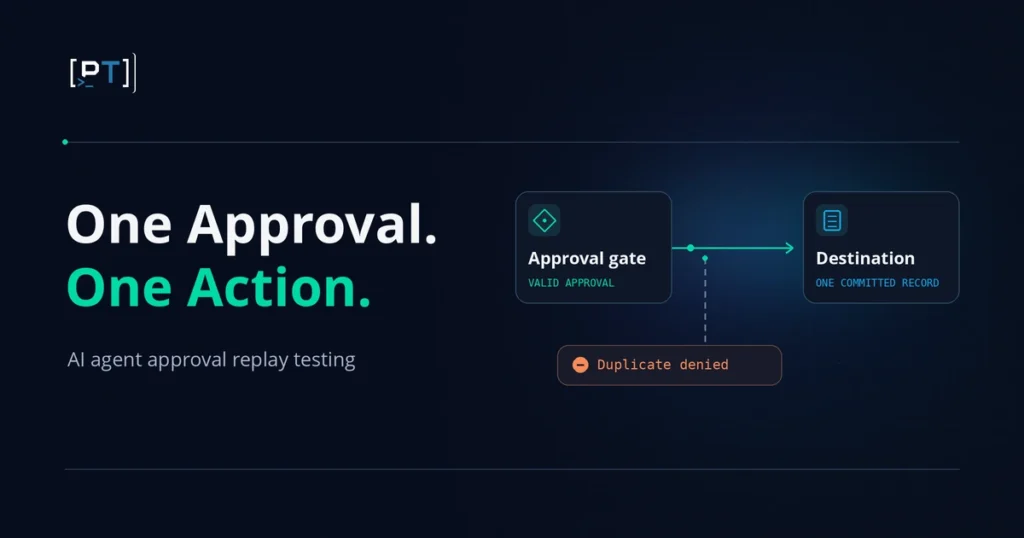
Release an AI agent that can move money, change access or delete records only when you can connect each consequential outcome to a valid approval for that exact action. AI agent approval replay testing asks whether one approval can authorize an altered action or create a second business effect. The evidence should reach the system that actually changed. If the team can show only that an approval was clicked or that a tool reported success, leadership still has an open release decision.
Picture a billing agent that prepares a customer credit. A finance manager approves one credit for a specified amount and invoice. The billing provider records it, but its response arrives too late for the agent to see it. A second credit would create a real accounting discrepancy even if the user interface showed only one approval. This is a hypothetical scenario. The same decision applies when an agent grants production access, deletes a set of customer records or sends a message outside the organization.
Can one AI agent approval be used twice?
A single-use approval should authorize one specific action for a defined initiating identity, under the applicable policy and within a defined time window. Once the system accepts that action for execution, the approval should be unavailable for a new action. It can still serve as evidence for the original operation while the team resolves its outcome. People reviewing a release should be able to tell whether a later update refers to that original operation or to a second business effect.
Two controls answer different questions. Action authorization says whether the proposed operation is allowed, including who requested it, who approved it and what the approved operation covers. Idempotency protects the business result when processing the same logical operation more than once, within the guarantees of the systems involved. A duplicate-prevention feature can protect the ledger while an approval control is still flawed. Equally, an approval can be correctly consumed even if the destination later records an unintended additional effect. Both results matter to the release decision.
Where approval can lose its meaning
An approval screen helps a person understand what they are authorizing. Execution controls carry that decision into the application or provider that holds the authority to change state. For a credit, the reviewer should recognize the recipient or account, invoice, amount, currency and business context. For a privilege change, the reviewer needs the target identity, role, environment and any approved duration. If a material field changes, the original approval should cease to be valid for the proposed change.
The initiating identity, approver and executing service may be three different parties. A shared execution identity can be legitimate if the system preserves the requester and tenant context and enforces the applicable decision. A service account entry on its own leaves the control owner unable to explain why the effect was permitted. Teams whose agent acts through an authenticated browser can use our guide to security testing for computer-use agents to review the wider session and authorization boundaries.
When the approval portal, worker and destination belong to different teams, define the handoff between them during AI penetration testing for agent workflows. The authorization owner should be able to explain which approvals are valid and when they become unavailable. The destination owner should be able to explain what the business system recorded and how it distinguishes one logical operation from another. Agree who can interpret both records when the result is in doubt.
What AI agent approval replay testing should prove
Use a synthetic approval-state matrix to agree on the expected business outcome before reviewing evidence. The example below uses a fictional customer credit and invented records. The destination count is the number of new credits associated with the reviewed operation. Engineering and finance should agree on what counts as a committed credit and when that count can be trusted. An assessor can then report the authorization verdict and the recorded destination effect separately.
| Approval state or action condition | Expected authorization outcome | Expected destination evidence |
|---|---|---|
| Valid approval for the exact action | One execution is authorized for the intended requester and approved details. | One committed credit matches the approved invoice, amount and account. |
| Material details or initiating identity differ | The existing approval does not authorize the proposed action. | Zero new credits for the changed action. Any earlier valid credit remains separately attributable. |
| Approval expires before execution is authorized | The pending action cannot proceed on that approval. | Zero new credits for the expired action. |
| Approval has already been consumed | No new action is authorized. Status can reference the original operation where permitted. | No additional credit. The original outcome is identifiable. |
| Concurrent processing for one approved action | Only one processing path can claim execution authority for the approved operation. | At most one credit appears. If the action is reported as completed, there is one matching committed credit. |
| Destination outcome is temporarily unknown | The same operation remains traceable while its status is resolved. | The authoritative record eventually confirms the original effect or its absence. Uncertainty remains visible until resolved. |
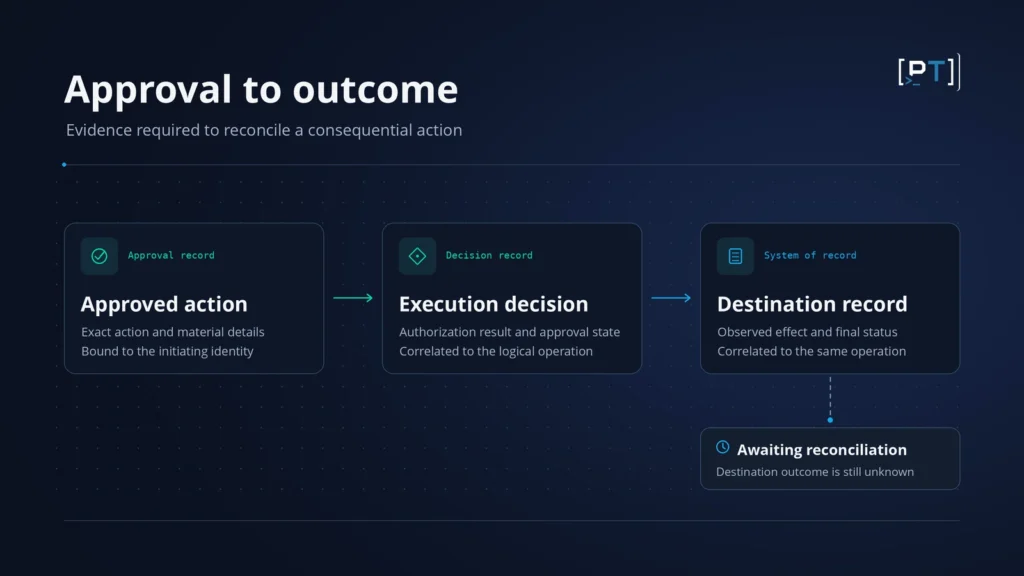
Set a policy for genuinely indeterminate outcomes. The application should be able to keep an action pending while the destination completes processing or provides a usable record. An operator who sees an unresolved credit needs enough context to determine whether it already exists and whether the customer has been notified. A status such as “awaiting reconciliation” gives operations a distinct queue to own. Agree on who reviews that queue and what happens when a case exceeds the business’s acceptable resolution window.
Read the authorization and destination columns together. A system may stop the duplicate credit at the provider even though it granted execution authority twice. That protects the example ledger entry and still leaves an authorization issue that could affect another connector. A second system may show a clean approval record but lack enough provider evidence to establish how many credits were committed. Record that result as unverified. Build the release decision around the evidence available for each action, destination and environment.
Which actions belong in scope?
Start with the consequential action the team is preparing to ship. Rank candidates by financial value, data sensitivity, access granted, external visibility and ease of recovery. A mistaken internal draft may require little cleanup. A bulk deletion can affect customer obligations and recovery workload. An incorrectly granted production role may expose sensitive systems until someone revokes it. Name the operation, the actual destination and the authorized roles for the first assessment. Extend coverage to other actions where they use a different approval mechanism, processing path or provider guarantee.
Ask for an inventory of the pieces that can change the result. Typical boundaries include the interface shown to the approver, the application that stores approval state, background processing, the connector and the system of record. Include scheduled execution and manual recovery if they use the same authority. Document the point at which the policy requires approval to remain valid. A pending request may expire before any authorization to execute has been granted, while a credit that the provider has already committed can still require reconciliation after expiry.
Where policy requires independent approval, identify who prepares, approves and commits the change. The same service identity may be involved in preparation and execution, so the team needs evidence that an independent approval remains enforceable at the decision point. The guide to segregation of duties in financial-services AI agents gives a broader view of this ownership question. For a credit or payout, finance should also define who resolves an uncertain outcome and who can authorize a compensating action.
What evidence should a reviewer ask for?
Ask for a review packet that an independent person can follow from the destination back to the authorization. For a completed credit, the record should identify the requester and approver, show the material details approved, establish when the operation acquired execution authority, and confirm the actual ledger entry. It should identify the applicable policy, the executing identity and the owner who can resolve an exception. Use correlated references and the minimum data necessary to make the decision. A billing walkthrough does not require full customer records or raw approval credentials.
A denial should have evidence as well. An understandable decision record and the absence of an additional destination effect together show how the control behaved. If the provider cannot produce an authoritative outcome immediately, retain the unresolved status and identify who will follow it to closure. For regulated or audit-scoped workflows, agree on access and retention with the evidence owner. Our guide to privileged-action evidence for SOC 2 covers the wider evidence chain. A single assessment outcome supports a specific control assertion. Evidence of operation across an audit period requires separate coverage.
Define what the assessor should report when the evidence conflicts. If the application says a credit failed and the provider says it settled, the provider’s authoritative record determines whether the money moved. The application evidence still matters for explaining how the discrepancy arose and whether someone can see and resolve it. Record the disagreement, its owner and the final disposition so a later reviewer can understand why the action was released, held or remediated.
What drives remediation effort and release timing?
Work out where the change belongs before assigning it to the AI team. A guardrail policy can stop a disallowed proposal, while approval state determines whether the exact authorized action can reach execution. If the scope also includes a detection policy operating in monitor or block mode, the AI guardrail enforcement guide explains what that separate control should demonstrate. Procurement can use the distinction to ask whether a vendor provides approval evidence, destination evidence or both.
Effort rises when several systems contribute to a single outcome. If one application owns the decision and the destination already supplies a reliable record of each logical operation, remediation may center on binding the approval and exposing evidence. Distributed workers, a third-party billing provider or a recovery path owned by another team can broaden the work. Decide who owns approval state, who owns destination records and how operations staff resolve ambiguous outcomes before estimating the fix. A change to the approval screen can make consent clearer while leaving those engineering dependencies in place.
When the destination is operated by a third party, ask whether the evidence will be available in the environment under review and how long it can be retrieved. Confirm who can obtain it during an incident. If the only accessible record is a connector summary, the team should make that dependency explicit before estimating assessment effort. Resolving the gap may require provider participation, improved correlation or a decision to limit the action’s rollout.
Plan assessment time separately from remediation and retest. Have representative synthetic records, named owners, access to the destination evidence and a clear definition of success before the review opens. If the environment skips the processing or provider behavior that matters, record that coverage gap. After changes, reassess the affected authorization and destination outcomes together. Evidence from a previous connector or workflow version should be carried forward only where the relevant behavior and assumptions still apply.
How OWASP and NIST frame the control
OWASP LLM06:2025 Excessive Agency is the primary mapping because approval and downstream enforcement constrain the authority an agent can exercise. LLM01:2025 Prompt Injection is relevant when untrusted content can influence the action the agent proposes. Meaningful approval limits what that changed proposal can accomplish. Separate controls address the risk of the model following untrusted instructions.
The OWASP Transaction Authorization Cheat Sheet supports binding approval to the operation and enforcing it at execution. The AI Agent Security Cheat Sheet applies approval and independent enforcement to agent workflows. OWASP API6:2023 is relevant where a downstream API exposes a sensitive business flow that can be used excessively. Use the NIST AI Risk Management Framework to assign owners, map the action and its impact, measure the controls and manage residual risk. These frameworks support scoping and governance decisions. The organization defines the release criteria for its workflow.
Frequently asked questions
Can one approval cover a batch of AI agent actions?
Yes, if policy allows batch approval and the approver can see exactly what the batch covers. For a batch of customer credits, show the invoices, amounts and total before execution. Require a fresh approval for material changes to the batch, and record outcomes for each item so a partial completion can be reconciled.
What if the approver loses authority while an action is queued?
For high-impact actions, define whether the approver must still have authority when execution begins. If policy requires current authority, pause the queued action and route it for a fresh decision by an eligible approver. Record the reason for the pause so operations can distinguish it from a processing failure.
Does reversing a completed action require a separate approval?
Treat a reversal as a distinct operation and apply the policy for that action. For example, a corrective ledger entry may need its own approval or may fall under a predefined recovery policy. Link the original and corrective records so a reviewer can account for both business effects.
What leadership should decide before release?
First, decide which actions require single-use approval and document who can approve each one. Assign responsibility for the decision, the execution boundary and the destination result. Write down the effect the business is authorizing, the conditions that require a fresh decision and the evidence required to close an exception. Give the control owner enough authority to keep the action disabled when that evidence is missing.
Hold the high-impact action if the team cannot attribute every observed effect to one valid approval, reject materially different actions, or account for the result when execution is uncertain. A limited release can preserve useful capabilities such as preparing a draft for human review while keeping the state-changing action disabled. Restore execution once the affected paths have been retested and the owners can explain the observed outcome using the underlying records.
To define the release gate for one consequential tool action, request an AI assessment scope review. Bring the action, the approval roles and the destination that will confirm the business effect.