AI Chat Sharing Security Testing Before Release
A CTO is reviewing an AI assistant’s new collaboration feature before launch. A customer can share a conversation with colleagues, include supporting files, and download a polished report. The demonstration works. Then the security reviewer asks whether a former colleague can still open yesterday’s attachment, whether the link includes later answers, and what happens to an export already downloaded. The release checklist has no agreed answers.
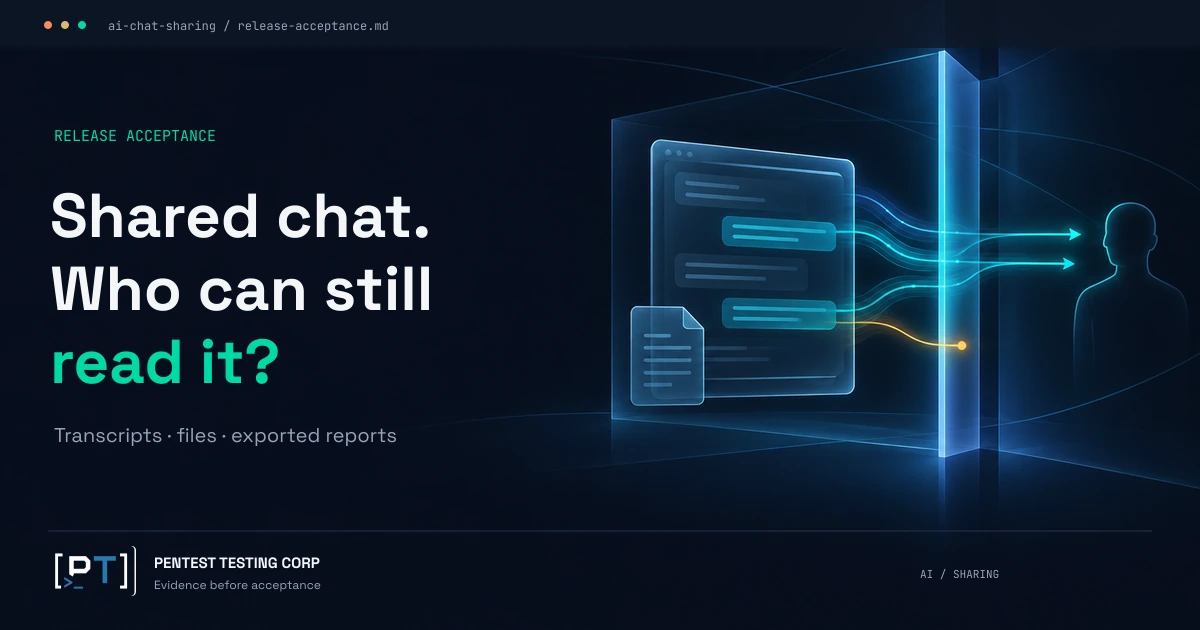
AI chat sharing security testing verifies who can read retained conversations and associated files throughout that lifecycle. The relevant boundary extends from the original user to each permitted recipient, delivery service, and retained copy. A correct answer generated for an authorized user can still be distributed to an unauthorized audience.
Before release, leadership needs an explicit sharing policy, evidence that transcripts and attachments enforce it, and an accurate account of revocation limits. These decisions affect customer confidentiality, enterprise procurement, remediation effort, and what the product can safely promise.
Define the audience before testing the share button
“Shareable” is a feature description. It does not define who should receive access. Named recipients, a selected project, an entire workspace, and anyone holding a link are different audiences. Each requires a deliberate product decision, particularly when an assistant summarizes customer documents or internal operational records.
Start with the allowed data classes and the narrowest audience that serves the business purpose. A customer-facing product might permit named external recipients for approved reports while restricting internal analysis to a project team. If public links are unnecessary, excluding them reduces the number of exposure paths that engineering must secure and support.
Separate permission to read from permission to share. A user may be authorized to inspect an internal document without being allowed to redistribute its contents. Likewise, a workspace administrator’s ability to manage accounts should not silently imply permission to publish every employee’s private conversation. Specify which role can create, widen, renew, and revoke a grant.
| Sharing model | Leadership decision | Required evidence |
|---|---|---|
| Named recipients | Which identities qualify, and can recipients reshare? | Intended recipients succeed; other users and forwarded-link recipients are denied. |
| Project or team | Does membership grant access automatically? | Membership addition and removal produce the approved access changes. |
| Workspace | Is the whole tenant an acceptable audience? | Other tenants and excluded roles remain outside the boundary. |
| Anyone with the link | Is possession-based access acceptable for this data? | Public-link behavior is clearly disclosed; expiry and withdrawal match the approved policy. |
| Downloaded export | May information leave the managed application? | Export permission, contents, delivery, and copy-retention limitations are documented. |
The policy also needs to define the shared version. A snapshot contains an approved point-in-time selection. A live conversation can disclose later additions. A user who shares an answer today may append confidential context tomorrow without realizing the audience persists. Test the chosen behavior and make it visible before sharing.
Scope AI penetration testing for the collaboration workflow around these decisions. The assessment should connect intended audiences to observable allowed and denied outcomes. For the surrounding application, use the broader tenant and role authorization checks to identify boundaries shared with non-AI features.
AI chat sharing security testing must follow attachments
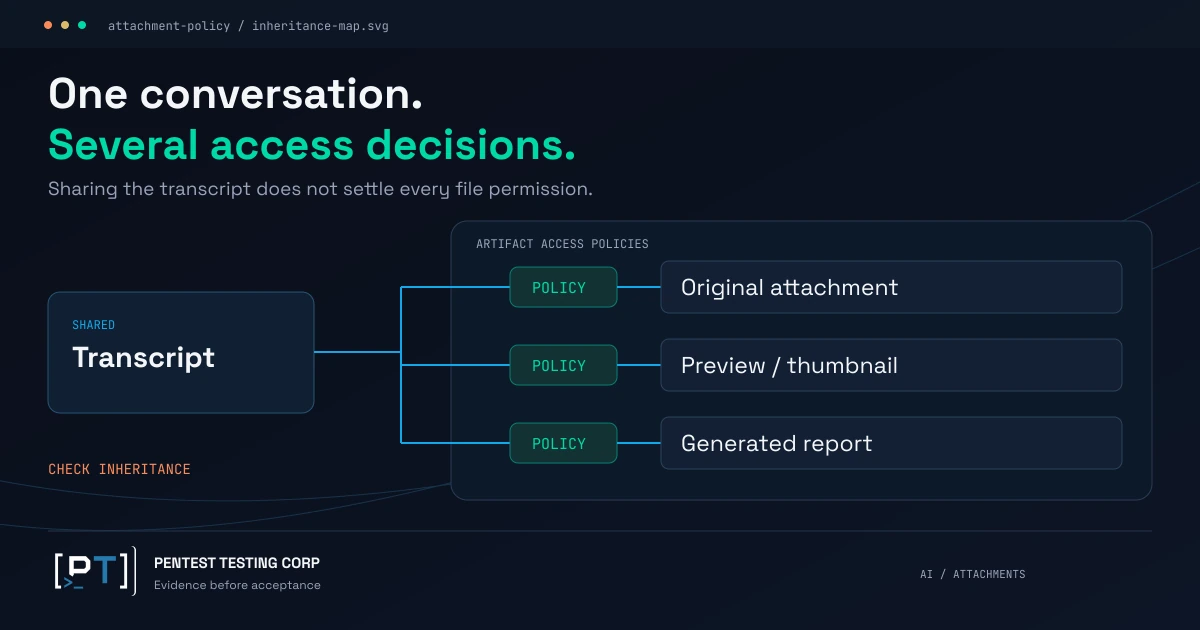
A shared transcript can be correctly restricted while its attachments remain accessible through a different delivery path. Uploaded originals, generated PDFs, images, spreadsheets, previews, and thumbnails may be separate objects with separate access decisions. The user sees one conversation; the implementation may involve several services and retained artifacts.
Decide how attachment authorization relates to the transcript. Sharing a summary should not automatically expose the entire source file unless that is the approved behavior. A recipient might be allowed to read a generated answer while a cited document remains restricted. Alternatively, the product may intentionally package selected attachments into a shared report. Either design needs explicit rules and testing.
Include secondary representations. A denied original file is insufficient protection if its preview reveals a confidential page or its extracted text remains in an accessible export. Filenames, document titles, embedded charts, and citation labels can also disclose sensitive context. Evaluate the actual information returned rather than treating every successful or failed download as equivalent.
Some systems deliver files using storage links issued for a limited period. Amazon S3’s presigned URL documentation describes time-limited access using the signing principal’s credentials. In a product using that pattern, removing an application share grant does not, by itself, establish that previously issued storage access has stopped. Verify the configured delivery behavior and its accepted exposure window.
Permission to retrieve source material is another boundary. Security testing of the RAG retrieval layer addresses what information reaches generation. Sharing acceptance asks whether the retained answer and selected files may subsequently reach a different audience. Passing either assessment does not establish the other result.
A hypothetical release failure
Consider a fictional B2B advisory platform. An employee shares an AI-generated project summary with a named customer contact. The customer may read the summary, but the internal costing workbook should remain private. The shared page hides that workbook. Its generated PDF nevertheless includes the workbook’s original download reference, and the delivery service accepts it without the recipient restriction.
The observed consequence would be access to internal commercial information, potentially creating a customer dispute and a confidentiality review. It would not establish that every tenant or every file was exposed. The release owner needs the affected artifact classes, reachable audience, access duration, and evidence sufficient to define the actual scope.
A durable fix may require changes to export packaging and file delivery, alongside the sharing interface. Retesting should confirm the intended customer can still read the approved summary, the private source remains unavailable, and earlier delivery references no longer exceed the agreed access policy.
Separate conversation exports from revocable hosted access
A hosted share link, an application-generated report awaiting download, and a file saved to a recipient’s device have different control boundaries. Treating them all as “the export” creates misleading product promises. Identify who controls each copy and which action actually changes its availability.
For hosted content, specify what expiry and revocation mean. Does withdrawal stop new reads immediately, after a defined propagation period, or only when a previously issued access token expires? Does it affect every shared version and attachment? Can an administrator withdraw access if the original owner has left? Set measurable requirements before testing begins.
Check established access as well as a new visitor. An open browser tab may already contain legitimately retrieved text. A subsequent refresh or attachment request creates a new access decision. Distinguish content already received from fresh delivery after permission removal; a screenshot of an old tab alone cannot prove a continuing server-side authorization failure.
Exports also introduce delayed processing. The requester may lose permission while a report is queued, generating, or awaiting collection. Leadership should decide which state changes cancel the work, restrict retrieval, or require a fresh authorization decision. The worker’s broad service permissions must not silently substitute for the recipient’s entitlement.
Review delivery destinations and notifications. An email attachment may leave the application’s control, while an email containing a restricted download link can still disclose a sensitive title in its preview. External collaboration previews, content-delivery caches, and retained generated objects belong in scope where the architecture uses them. State their actual behavior rather than assuming they all retain the same information.
Once a permitted recipient downloads an ordinary file, withdrawing the hosted link cannot recall that file. OpenAI’s sharing guidance similarly distinguishes stopping link access from removing copies another person has already saved. This illustrates a boundary to evaluate, not a universal specification for other products.
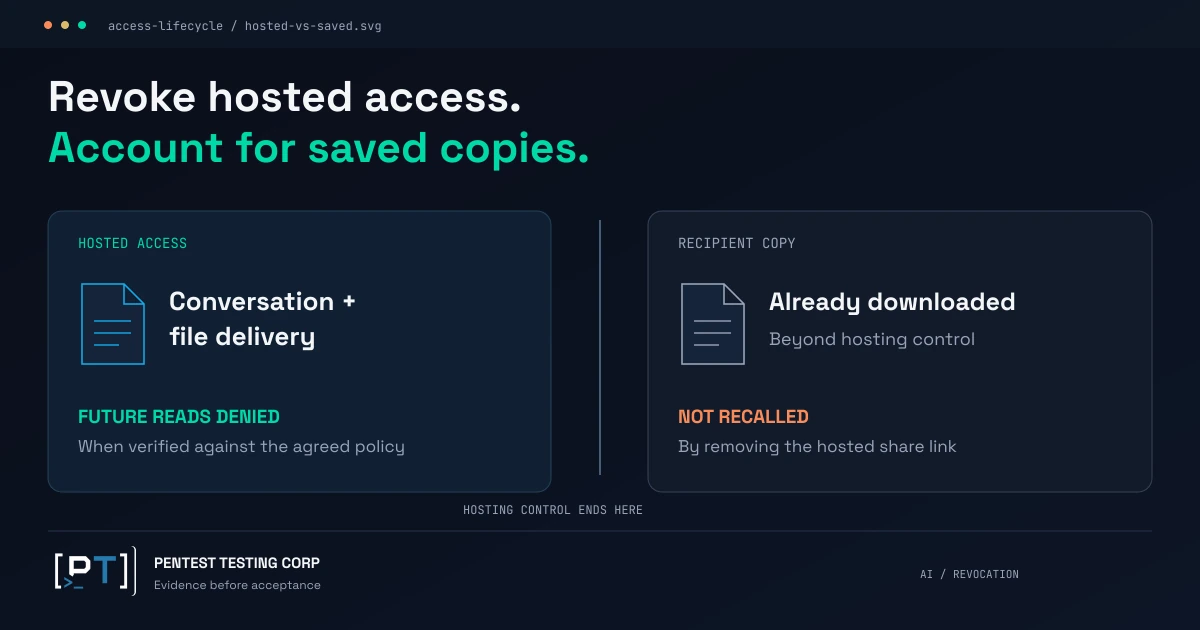
Use precise interface and contract language. “Stop future access through this link” is supportable when tested. “Remove every copy everywhere” requires capabilities that ordinary sharing controls do not provide. Watermarks, labels, and recipient notices may support governance, but they are not proof of technical recall.
Deletion is a separate decision. Revoking a recipient’s access can leave the underlying conversation retained for its authorized owner. Where an approved privacy request requires removal of personal data, follow a distinct AI data erasure verification workflow. Do not represent a permission change as completion of an erasure obligation.
Scope AI chat sharing security testing around state changes
A useful scope describes audiences, artifacts, actions, and transitions. An endpoint count does not capture whether the same report behaves differently before sharing, after a recipient leaves, or after the owning tenant is suspended. Prioritize combinations that change entitlement or expose consequential information.
Provision representative identities in at least two independent test tenants where tenant isolation is relevant. Include an owner, permitted recipient, same-tenant non-recipient, external recipient where supported, and relevant administrator or support role. Add an unauthenticated visitor for public-link decisions. Use synthetic conversations and files whose permitted audience is known.
| Transition or boundary | Expected result to agree | Evidence to retain |
|---|---|---|
| Grant created | Only the approved audience receives the selected content. | Audience, content version, allowed read, and representative denied reads. |
| Audience widened or reshared | Only authorized roles can expand distribution. | Role decision, resulting audience, and blocked unauthorized expansion. |
| Attachment opened separately | File and preview access follows their explicit policy. | Transcript, original, preview, and generated-file results. |
| Membership or role removed | Future reads stop within the approved window. | Change time, previously issued delivery path, and observed denial time. |
| Export completes after access changes | Completion and collection respect the approved transition policy. | Job state, requesting identity, recipient identity, and delivery outcome. |
| Link expires or is revoked | Hosted access and dependent artifacts stop as specified. | Expiry or revocation event and fresh post-change access observations. |
| Conversation changes or ownership transfers | Shared scope and accountable ownership remain intentional. | Snapshot or live behavior, successor owner, and surviving grants. |
Test permitted use alongside denial cases. A release that prevents every share may avoid disclosure while failing the collaboration requirement. The acceptance pack should show the intended recipient completing the approved task and the excluded audience failing to obtain the protected content.
Agree on the assessment environment, production differences, third-party permissions, safe proof points, and stop conditions. Synthetic data can demonstrate an authorization failure without copying customer conversations into a report. If staging differs materially from production delivery, identify the configuration evidence or bounded production validation needed to support the launch decision.
The wider AI penetration test scope helps determine whether retrieval, tool actions, or other AI workflows need separate coverage. For this feature, include API authorization testing wherever endpoints, background jobs, and artifact delivery enforce sharing decisions.
Effort grows with distinct audiences, artifact classes, export formats, delivery services, and permission transitions. A single shared authorization service may simplify remediation. Several independent workers, caches, and storage paths may require coordinated engineering changes. Request a scoped estimate after those dependencies are visible, and reserve time for fixes and retesting before committing the launch date.
Require evidence that supports the release claim
A useful result states which identity could access which artifact, under which grant, in which environment and content version. It records the expected outcome, observed outcome, relevant timestamps, and business consequence. It also identifies untested paths and dependencies. “Sharing tested” is too broad to support a procurement answer.
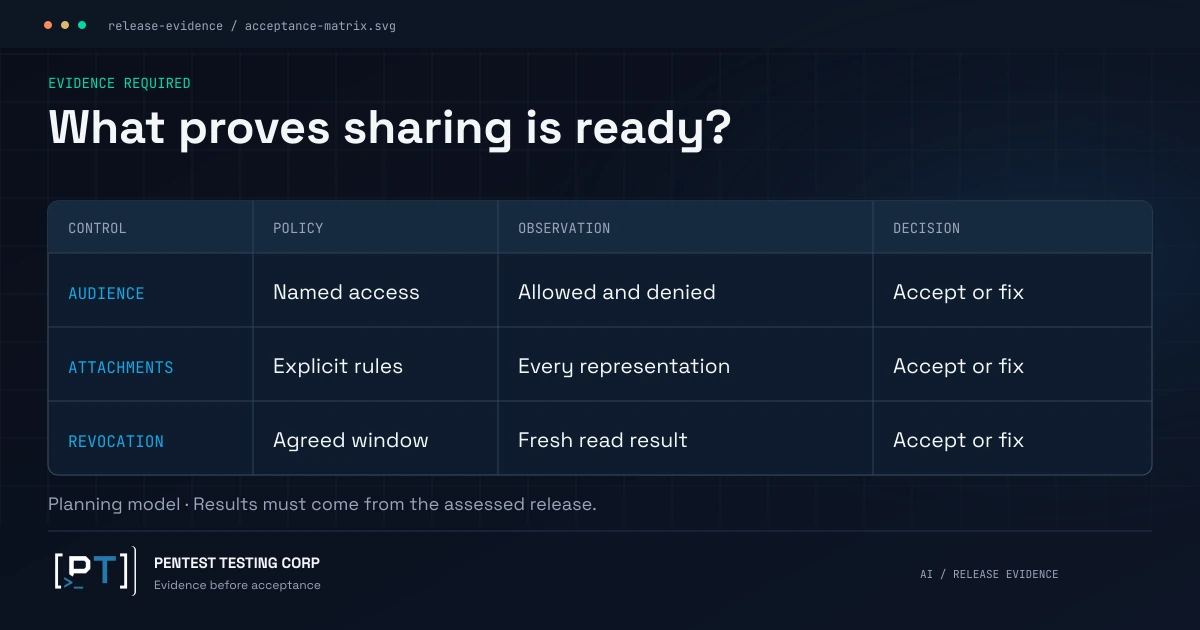
Retain evidence for grant creation, audience changes, relevant reads or downloads, expiry, and withdrawal where those events are available. Correlate events across the application, export worker, and delivery layer. Restrict the evidence itself: raw share tokens and working delivery links can confer access, while full transcripts can recreate the confidential dataset in the testing folder.
Pentest Testing Corp’s approved redacted SaaS/API sample includes F-API-02, a conversation-access finding involving missing participant checks. It illustrates why a valid login is insufficient evidence that a user may read a particular conversation. This was a SaaS/API finding, not an AI-client finding or proof about AI sharing features generally.
Map the failure to the control that actually failed
OWASP LLM02:2025 Sensitive Information Disclosure provides relevant context for sensitive information exposed through an AI application. A retained answer can contain protected information even when generation was authorized. Identify the actual sharing or delivery failure rather than attributing every disclosure to model behavior.
LLM05:2025 Improper Output Handling applies when generated output is unsafely rendered or passed downstream. For example, a shared HTML transcript introduces a rendering boundary distinct from recipient authorization. Use this mapping when that output-handling weakness exists; an ordinary unauthorized file read does not automatically belong in LLM05.
Use API1:2023 Broken Object Level Authorization for unauthorized access to a conversation, export, or attachment object. Use API5:2023 Broken Function Level Authorization when a role can invoke a sharing administration function it should not have. These classifications help assign remediation to the appropriate enforcement point.
The voluntary NIST AI RMF Playbook supports an organizational approach: GOVERN ownership and sharing policy; MAP recipients and artifact destinations; MEASURE allowed and denied outcomes; and MANAGE remediation and residual limitations. This is a practical application of its four functions, not a certification claim.
NIST CSF 2.0 offers complementary cybersecurity outcomes for access control, data protection, and monitoring. Align the evidence with the organization’s selected controls. A focused feature assessment does not establish organization-wide compliance or settle contractual and privacy obligations without the responsible reviewers.
What leadership should decide before release
The release owner should approve a short decision record identifying permitted audiences, eligible data, attachment rules, shared-version behavior, export rights, and the withdrawal window. Assign one accountable product owner and named engineering owners for every enforcement layer. Security should assess whether the evidence matches those decisions; privacy and commercial owners should review customer-facing commitments.
Prioritize failures by demonstrated reach and consequence. Cross-tenant disclosure of confidential content or unauthorized public distribution should normally block the affected sharing path until corrected and retested. A narrower release may remain possible, such as named-recipient sharing with downloads disabled, provided the remaining controls are independently supported by evidence.
An accepted limitation needs an owner, duration, affected data classes, and customer-language review. If delivery cannot meet the promised revocation window, revise the design or the promise before launch. Internal risk acceptance should not be used to waive obligations owed to customers or individuals.
Plan support and incident handling as well. Administrators should be able to identify relevant grants, withdraw hosted access, preserve necessary activity records, and distinguish observed delivery from unknown recipient copying. A download event can support a statement about delivery; absent or incomplete logs cannot prove nobody accessed the content.
Reassess when the product changes audience models, adds export formats, moves storage, or changes how attachments inherit permissions. Ownership changes and supplier exits are useful triggers too. Where an integration or provider is retired, combine share-grant review with supplier offboarding validation so retained reports do not remain an unmanaged exception.
Before the collaboration feature ships, require an answer to one concrete question: who can obtain each retained artifact now, and what evidence proves access changes when permission changes? Scope an AI conversation sharing assessment around the audiences, delivery paths, and release evidence your product needs.
Frequently asked questions
Can we launch sharing before offering downloads?
Yes, if the release scope supports that restriction across the interface, APIs, and background workflows. A hosted-only launch can reduce distribution paths, but it cannot prevent recipients from manually copying content they can legitimately read. Confirm the restriction meets the customer’s actual collaboration requirement.
Does single sign-on make shared links private?
SSO identifies a signed-in user. The application still needs to decide whether that identity belongs to the permitted audience. Ask how guest accounts, multiple workspaces, and removed members affect a specific grant rather than treating successful authentication as permission to read everything.
Is a long, unpredictable link enough for confidential reports?
It may support a deliberately chosen possession-based sharing model, but it does not identify the recipient or prevent forwarding. For confidential reports, leadership should assess whether named access is required and ensure the interface accurately describes what holding the link permits.
Should public-link expiry be mandatory?
That depends on data sensitivity and business purpose. If public sharing is permitted, choose a default duration and renewal authority that fit the exposure. Expiry should be tested across dependent files and delivery paths rather than assumed from a date displayed in the interface.
What should we give an enterprise customer after testing?
Provide a sanitized scope summary, audience and artifact coverage, material findings, remediation status, retest results, and relevant limitations. Exclude working access links and unnecessary conversation content. Describe exactly which release and environment the evidence covers so the customer can judge its relevance.
Does every change require a full AI penetration test?
No. A focused reassessment may suit a bounded change to sharing policy or delivery. Broader testing is appropriate when the change also affects retrieval, identity, model integrations, or tool authority. Define the changed trust boundaries first, then select coverage proportionate to them.