OWASP Top 10 2025: What Security Teams Need to Do Right Now
Introduction
In 2023 alone, web application attacks accounted for over 26% of all data breaches globally, according to Verizon's Data Breach Investigations Report. The attack surface has never been larger, AI-generated code, microservices sprawl, third-party dependencies, and aggressive DevOps release cycles have turned "ship fast" into "expose fast."
The OWASP Top 10 exists precisely because organizations need a shared, data-driven language for what matters most. It's not perfect, no single list can capture every threat, but it's the closest thing the industry has to a consensus on where attackers consistently win.
The 2025 edition isn't a cosmetic refresh. Several new categories reflect genuinely new attack surfaces, and some familiar entries have been restructured to reflect how exploitation has evolved. If your security program is still benchmarked against the 2021 list, you have gaps. This post breaks down what changed, what it means for your architecture, and the concrete steps your team needs to take before those gaps become incidents.
What Is the OWASP Top 10 2025?
The OWASP Top 10 is a community-driven, data-informed list of the most critical web application security risks. Maintained by the Open Web Application Security Project (a nonprofit foundation), it's built from vulnerability data contributed by hundreds of organizations, covering millions of applications tested across real-world environments.
The list serves multiple audiences. For developers, it's a checklist of vulnerabilities to avoid during design and implementation. For security teams, it's a minimum baseline for penetration testing and threat modeling. For CTOs and security leads, it's the conversation framework you use when prioritizing budget and engineering effort.
What it is not: a comprehensive vulnerability taxonomy, a compliance certification, or a guarantee that addressing these 10 categories makes you secure. It's a starting point, but an extremely well-researched one.
The 2025 edition incorporates data from a broader contributor pool than previous years, with stronger representation from cloud-native architectures, API-heavy applications, and AI-integrated platforms. That context matters, because it means the categories reflect what's actually being exploited right now, not just what was interesting a few years ago.
What Changed from 2021 to 2025
The 2021 list was a significant departure from 2017, it introduced Insecure Design as a standalone category and merged several older entries. The 2025 list continues that evolution.
Key Structural Changes
The most significant shifts involve how injection vulnerabilities, access control failures, and supply chain risks are framed. The 2025 edition more explicitly distinguishes between different injection types and elevates supply chain and dependency risks to a higher priority position than they held in 2021.
AI and LLM-specific risks are acknowledged in supplementary OWASP guidance (see the OWASP Top 10 for LLM Applications), though the core web application list addresses the server-side attack surface that AI applications share with traditional apps.
Quick Comparison Table
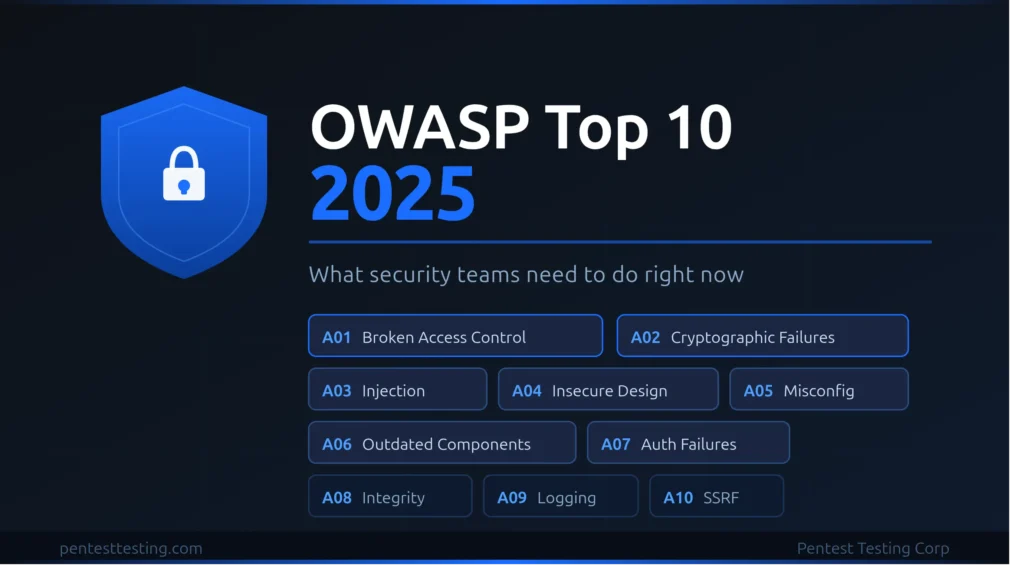
| Category | 2021 Position | 2025 Position | Change |
|---|---|---|---|
| Broken Access Control | A01 | A01 | Unchanged - still #1 |
| Cryptographic Failures | A02 | A02 | Unchanged |
| Injection | A03 | A03 | Narrowed scope, SQL/OS/LDAP separated |
| Insecure Design | A04 | A04 | Broader coverage added |
| Security Misconfiguration | A05 | A05 | Cloud-native context added |
| Vulnerable & Outdated Components | A06 | A06 | Supply chain emphasis strengthened |
| Identification & Auth Failures | A07 | A07 | MFA bypass coverage expanded |
| Software & Data Integrity Failures | A08 | A08 | CI/CD pipeline risks emphasized |
| Security Logging & Monitoring Failures | A09 | A09 | Detection gap context added |
| Server-Side Request Forgery (SSRF) | A10 | A10 | Cloud metadata attack patterns updated |
The rank order stability at the top tells you something important: Broken Access Control has been the dominant vulnerability category for years because it's both pervasive and difficult to catch through automated scanning alone. If your organization hasn't run manual access control testing recently, that's where to start.
OWASP Top 10 2025: All 10 Categories Explained
A01 – Broken Access Control
Still the top risk, and for good reason. 94% of applications tested by OWASP contributors showed some form of access control failure. The attacks range from simple IDOR (Insecure Direct Object Reference), where changing an ID in a URL exposes another user's data, to privilege escalation via JWT manipulation and path traversal attacks.
At Pentest Testing Corp, broken access control is the single most consistently found vulnerability across our web application penetration testing engagements. Organizations tend to underinvest in this area because it requires deep business logic understanding that automated scanners can't replicate.
What to do: Implement deny-by-default access policies, enforce ownership checks server-side, and log access control failures with alerting on repeated denied access attempts.
A02 – Cryptographic Failures
Formerly "Sensitive Data Exposure," the rename to Cryptographic Failures is meaningful, it focuses attention on the root cause rather than the symptom. Weak encryption algorithms, improper key management, missing TLS, storing passwords in reversible formats, and reusing initialization vectors all fall here.
What to do: Audit data classification to identify what's truly sensitive. Enforce TLS 1.2+ across all connections, use strong key derivation functions (bcrypt, Argon2) for passwords, and eliminate MD5/SHA-1 in any security-sensitive context.
A03 – Injection
SQL injection remains relevant, but injection has expanded to cover OS command injection, LDAP injection, template injection (SSTI), and increasingly, prompt injection for AI-integrated applications. The 2025 framing acknowledges that any interpreter that accepts user-controlled input is a potential injection surface.
What to do: Parameterized queries for SQL, input validation at the boundary, output encoding for rendering contexts. For SSTI, audit any template rendering that includes user-supplied content.
A04 – Insecure Design
Introduced in 2021 and strengthened in 2025, this category is about architectural flaws rather than implementation bugs. A feature that allows unlimited password reset attempts isn't a coding error, it's a design failure. Threat modeling during the design phase is the primary defense here.
What to do: Integrate threat modeling into sprint planning for new features. Use attack trees to think adversarially before code is written. Security champions embedded in development teams make this scalable.
A05 – Security Misconfiguration
The cloud era has dramatically expanded the misconfiguration attack surface. Exposed S3 buckets, over-permissive IAM roles, default credentials, verbose error messages, and enabled debug endpoints all sit under this category. The 2025 edition specifically calls out misconfigured cloud service policies and API gateways.
What to do: Infrastructure as Code (IaC) scanning, CIS benchmarks for cloud workloads, and periodic configuration audits. Disable everything that isn't needed, default-deny, not default-allow.
A06 – Vulnerable and Outdated Components
Supply chain attacks have made this category significantly more critical in practice. The SolarWinds, Log4Shell, and XZ Utils incidents illustrated how a vulnerable dependency can compromise thousands of downstream systems simultaneously. The 2025 edition places greater emphasis on software bill of materials (SBOM) management and transitive dependency risks.
What to do: Implement dependency scanning in CI/CD (Dependabot, Snyk, or similar), maintain an SBOM for all production applications, and establish a patch SLA for known CVEs, no more than 30 days for critical, 14 for actively exploited.
A07 – Identification and Authentication Failures
Credential stuffing, broken session management, missing MFA, and insecure password reset flows. The 2025 edition expands coverage of MFA bypass techniques, including SMS OTP interception, OTP fatigue attacks, and session fixation post-authentication.
What to do: Enforce MFA on all privileged and customer-facing accounts using TOTP or hardware keys. Implement account lockout with exponential backoff. Regenerate session tokens on authentication events.
A08 – Software and Data Integrity Failures
This category covers insecure deserialization and, more prominently in 2025, CI/CD pipeline integrity. If an attacker can modify your build pipeline, inject a malicious dependency, or compromise an auto-update mechanism, the integrity of every deployment is at risk.
What to do: Sign build artifacts, verify dependency checksums, implement branch protection rules, and restrict who can modify pipeline configuration files. Treat your CI/CD infrastructure with the same security posture as production.
A09 – Security Logging and Monitoring Failures
You can't respond to what you can't detect. The 2025 edition emphasizes not just whether logs exist, but whether they're centralized, tamper-resistant, and actually generating alerts. The average dwell time for an attacker in an enterprise environment before detection is still measured in weeks or months for many organizations.
What to do: Centralize logs in a SIEM with retention policies aligned to your incident response requirements. Define alert thresholds for authentication failures, privilege escalation events, and data access anomalies. Test detection coverage regularly.
A10 – Server-Side Request Forgery (SSRF)
SSRF moved up to A10 in 2021 as cloud environments made internal metadata services (AWS IMDSv1, GCP metadata endpoint) prime targets. In 2025, the category reflects more mature attack chains, SSRF is increasingly used as a pivot point for credential theft and lateral movement, not just information gathering.
What to do: Allowlist outbound request destinations, block requests to internal IP ranges and cloud metadata endpoints at the application layer, and avoid exposing URL-fetching functionality without strong controls.
OWASP Top 10 vs OWASP API Security Top 10
These are two separate lists, and conflating them is a common mistake that leaves significant gaps in coverage.
| Dimension | OWASP Top 10 (Web App) | OWASP API Security Top 10 |
|---|---|---|
| Primary target | Web applications | REST, GraphQL, SOAP APIs |
| Latest edition | 2025 | 2023 |
| Top vulnerability | Broken Access Control | Broken Object Level Authorization (BOLA) |
| Authentication focus | Session management, MFA | API key management, JWT weaknesses |
| Unique categories | SSRF, Insecure Design | Mass Assignment, Unrestricted Resource Consumption |
| Tooling overlap | DAST scanners, Burp Suite | Postman, Burp, custom scripts |
| Testing approach | Browser-based, authenticated flows | API endpoint enumeration, fuzz testing |
If your product exposes APIs, and most modern applications do, you need coverage against both lists. BOLA alone (API1:2023) accounts for a disproportionate share of API breaches because it's functionally invisible to scanners that don't understand your business logic.
Our API penetration testing practice at Pentest Testing Corp tests against both frameworks simultaneously, which is the only way to get a realistic picture of your actual attack surface. Shofiur holds an API Penetration Testing certification specifically because API security requires a distinct methodology from traditional web app testing.
How to Test Your Application Against OWASP Top 10 2025
Step-by-Step Testing Process
Step 1: Scope Definition Define what's in scope, authentication flows, business logic, API endpoints, admin interfaces, third-party integrations. Be explicit. Vague scope produces vague findings.
Step 2: Reconnaissance Map the application's technology stack, frameworks, third-party components, and external integrations. Identify the data flows, trust boundaries, and privileged functions before touching a single input field.
Step 3: Automated Baseline Scan Run a DAST scan (OWASP ZAP, Burp Suite Pro) to capture low-hanging fruit, reflected XSS, missing security headers, known CVEs in detected components. This is not your primary testing method; it's a baseline.
Step 4: Manual Authentication Testing (A07) Test session lifecycle, creation, maintenance, termination, and fixation. Attempt MFA bypass via OTP reuse, parallel session exploitation, and password reset token prediction.
Step 5: Access Control Testing (A01) Systematically test every function and object against every role. IDOR testing requires a multi-account setup. Test horizontal and vertical privilege escalation across all authenticated surfaces.
Step 6: Injection Testing (A03) Test all input vectors, form fields, URL parameters, HTTP headers, JSON bodies, file uploads. Cover SQL, OS command, LDAP, template, and XML injection depending on the technology stack.
Step 7: Business Logic Testing (A04) This requires understanding the application's intended functionality deeply. Test sequences of operations out of order, negative values, boundary conditions, and race conditions in stateful workflows.
Step 8: Infrastructure and Configuration Review (A05) Review cloud configurations, server headers, error responses, exposed endpoints, and default credential usage. Cross-reference against CIS benchmarks and cloud provider security best practices.
Step 9: Component Analysis (A06) Enumerate all third-party dependencies and check against vulnerability databases (NVD, Snyk DB). Identify transitive dependencies that may not be visible in package manifests.
Step 10: Reporting and Prioritization Document findings with evidence, business impact, exploitability rating, and remediation guidance. Prioritize by risk, not just CVSS score, a medium-severity IDOR on a payment endpoint is more critical than a high-severity finding in a low-traffic admin panel.
Building a Remediation Roadmap
Finding vulnerabilities is step one. Getting them fixed before the next pentest is where most programs break down.
Prioritization Framework
| Risk Level | CVSS Range | SLA Target | Examples |
|---|---|---|---|
| Critical | 9.0–10.0 | 48 hours | RCE, authentication bypass, data exposure |
| High | 7.0–8.9 | 7 days | IDOR affecting sensitive data, SSRF with metadata access |
| Medium | 4.0–6.9 | 30 days | Broken access control on low-sensitivity data, missing MFA |
| Low | 0.1–3.9 | 90 days | Missing security headers, verbose error messages |
| Informational | N/A | Next sprint | Configuration best practices, defense-in-depth suggestions |
Structural Remediation Steps
Organizations that consistently reduce their OWASP exposure share a few common practices. They run developer security training at least annually, specifically covering the categories most relevant to their stack. They integrate static analysis (SAST) into CI/CD so injection and deserialization flaws get caught before code is merged. They treat penetration testing as a recurring program, not a one-time audit.
The NIST Cybersecurity Framework provides useful structure for operationalizing these practices across Identify, Protect, Detect, Respond, and Recover functions. OWASP Top 10 maps most directly to the Protect function, but the findings from a thorough pentest will inform all five.
For organizations in regulated industries, financial services, healthcare, e-commerce, the remediation roadmap should also account for compliance timelines. PCI DSS 4.0, for instance, requires specific controls that directly address several OWASP categories, including Broken Authentication and Cryptographic Failures.
We offer web application security hardening services at Pentest Testing Corp designed specifically to implement and verify remediation against OWASP-identified findings. It's the logical next step after a penetration test, and it's where the real risk reduction happens.
Conclusion
The OWASP Top 10 2025 reflects where attacks are actually landing. Broken Access Control has held the top position for years because it's difficult to catch through automation and easy to overlook in a fast-moving development environment. The supply chain emphasis in A06, the expanded CI/CD coverage in A08, and the updated SSRF guidance in A10 all point to a threat landscape that's evolved significantly since most organizations last reviewed their architecture.
The question isn't whether your application has OWASP Top 10 vulnerabilities, statistically, it almost certainly does. The question is whether you find them before attackers do.
With over 257 clients served globally and 6,000+ validated vulnerabilities across web, API, mobile, and cloud environments, Shofiur and the team at Pentest Testing Corp bring practitioner-led expertise to every engagement. We don't just run scanners and generate reports, we test the way attackers think, document the way engineers can act, and help you build a remediation roadmap that's actually executable.
Book a free scoping call and let's talk about where your application stands against OWASP Top 10 2025.