ISO 27001 Pentest Risk Acceptance: Test Before Renewal
Your CISO is preparing the next ISO 27001 review when an exception appears in the register: a high-risk pentest finding, accepted until the next release. Engineering says the workaround still applies. The control owner has a configuration screenshot. Nobody has checked whether a new integration bypasses that workaround.
ISO 27001 pentest risk acceptance becomes a leadership decision at this point. The question is whether the business can still justify carrying the remaining exposure, under current conditions, for a defined period. A previous signature answers what was approved then. It does not establish what is safe to approve now.
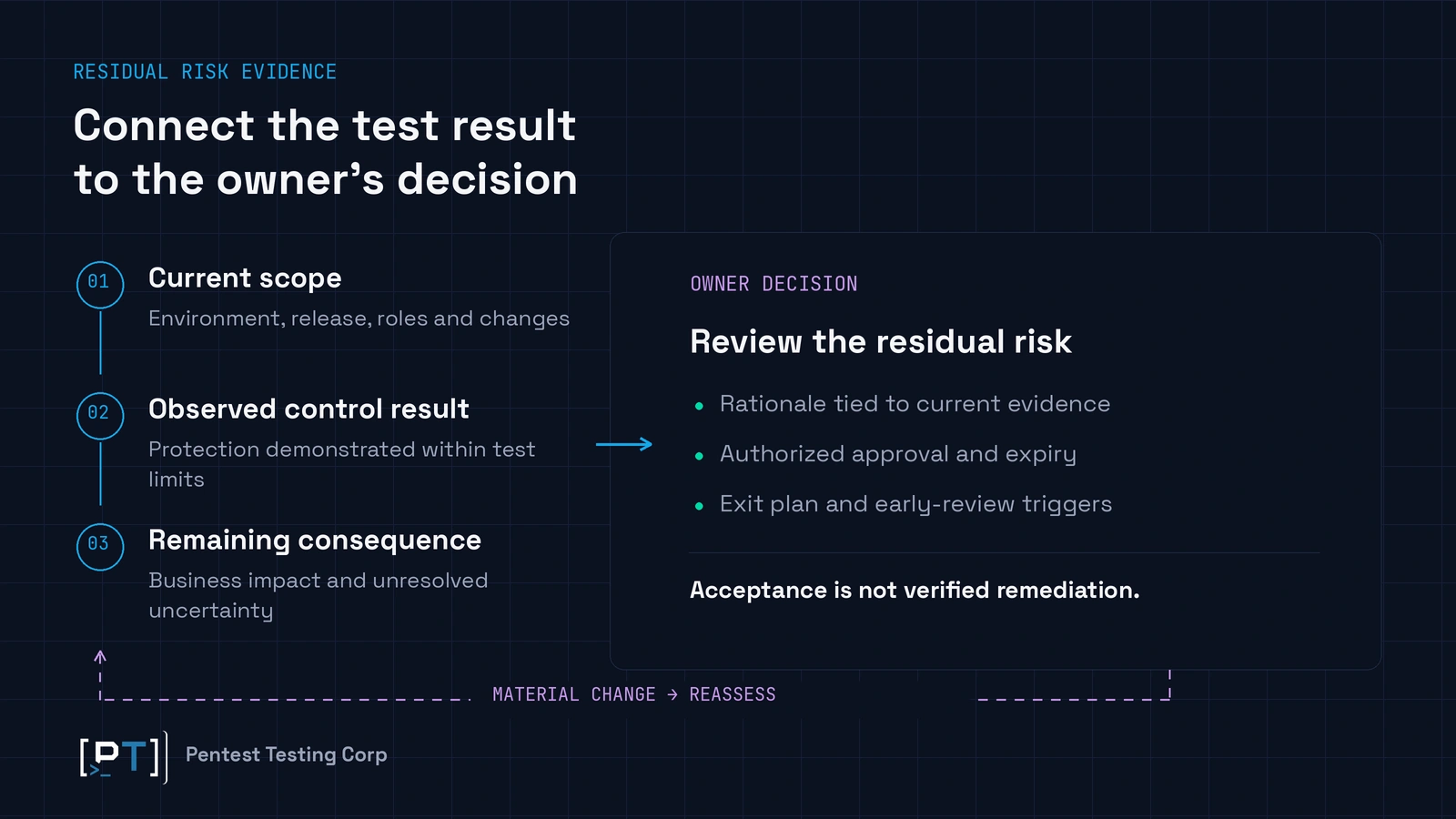
Before renewing the exception, connect its original assumptions to current control evidence, business impact, and approval authority. This guide provides a practical way to choose between renewed acceptance, expiry, reopening treatment, or verified closure. It applies to exception reviews before surveillance or recertification, and whenever a material change makes the old rationale unreliable.
What ISO 27001 pentest risk acceptance approves
Risk acceptance records an authorized decision to retain risk. For a deferred pentest finding, that decision should identify the affected business activity, remaining consequences, basis for acceptance, responsible owner, and conditions that would require another review. A remediation delay explains a constraint; it does not establish that the resulting exposure is acceptable.
The ISO/IEC 27001:2022 standard remains the relevant ISMS requirements edition, with Amendment 1:2024 addressing climate action changes. The standard uses an organization-specific risk management approach. It does not impose a universal annual penetration test on every organization.
The ISO/IEC JTC 1/SC 27 Journal 2025, Issue 1 explains the connection between acceptance criteria, treatment, risk-owner approval, and residual risk. It also discusses clause 8.2: reassessment at planned intervals and when significant changes are proposed or occur. These points connect the risk criteria and assessment process in clause 6.1.2 with treatment and residual-risk approval in clause 6.1.3. The journal supports interpretation; the standard remains the requirements source.
Keep three outcomes separate. Accepted means the authorized owner has approved retaining the stated risk. Verified remediated means testing supports that the specified vulnerable condition was corrected within the tested scope. Certification is a separate conformity assessment decision made through the certification process. None of these outcomes automatically establishes the others.
For an upcoming review, ISO 27001 risk assessment support can help connect technical findings with the risk methodology, treatment plan, and residual-risk decision. The scope should say explicitly whether it includes validation of deferred findings and compensating controls.
This article recommends time-limited exceptions as a governance practice. It does not claim that ISO 27001 prescribes a particular exception duration, ticket workflow, or approval template. Set those through your own policy and applicable obligations. Internal approval also cannot waive a legal requirement or change a customer contract.
Recheck the assumptions before extending an exception
Start with the reason the finding was accepted. Perhaps access was limited to an internal network, only a small support team held the relevant role, or sensitive records were excluded from the workflow. Each statement is an assumption about exposure. If it has changed, the earlier residual-risk assessment may no longer describe the business.
Compare the previous decision with the current environment. Review changes to public reachability, user roles, identity providers, data sensitivity, customer populations, integrations, and operational dependencies. A finding can retain its original technical severity while its business consequences increase. Conversely, removing an affected capability can reduce exposure, provided the removal is verified.
Do not reduce the rating simply because an exception exists. Preserve the original finding and its technical assessment. Record the current business-risk assessment separately, using the approved methodology, with a clear explanation of how verified controls affect likelihood or consequence. An unexplained change from high to low makes the decision harder to defend.
A useful review asks four questions: What could happen now? What stops or limits it? What evidence supports that answer? Who has authority to carry what remains? If a response depends on an untested claim, record that dependency instead of treating the claim as established protection.
For example, a web application firewall may help with certain request patterns. Its presence alone does not demonstrate that it prevents a business-logic authorization failure. Monitoring may shorten investigation time while leaving the initial disclosure possible. Match each claimed benefit to the particular loss scenario.
Keep the decision connected to the unified risk register so it remains visible across assurance activities. The register should point to the latest evidence and preserve earlier decisions. Replacing the old approval with a new date erases the history needed to explain repeated deferral.
Include cumulative dependencies. Several individually accepted findings may rely on the same gateway, support procedure, or monitoring team. Failure of that shared safeguard could invalidate multiple decisions together. Review that combined exposure before approving another extension.
Scope ISO 27001 pentest risk acceptance testing
A useful validation scope tests the acceptance rationale. Begin with the original finding, affected assets, business impact, and controls credited with reducing risk. Define the conditions under which those controls must operate and the evidence needed for a decision. This keeps the engagement focused while making its boundaries explicit.
NIST SP 800-115 provides guidance for planning technical assessments, analyzing findings, and developing mitigation strategies. Apply that planning discipline through written authorization, agreed scope, safe test conditions, reporting requirements, and clear limitations. It does not provide a certificate that an exception is acceptable.
Test the specific protection being claimed
If network restrictions justify the exception, validate that the relevant service is restricted from the agreed access positions. If a role restriction is the safeguard, assess whether the relevant user and service roles are actually constrained. Where a vendor operates the control, identify what can be independently checked and what depends on supplier evidence.
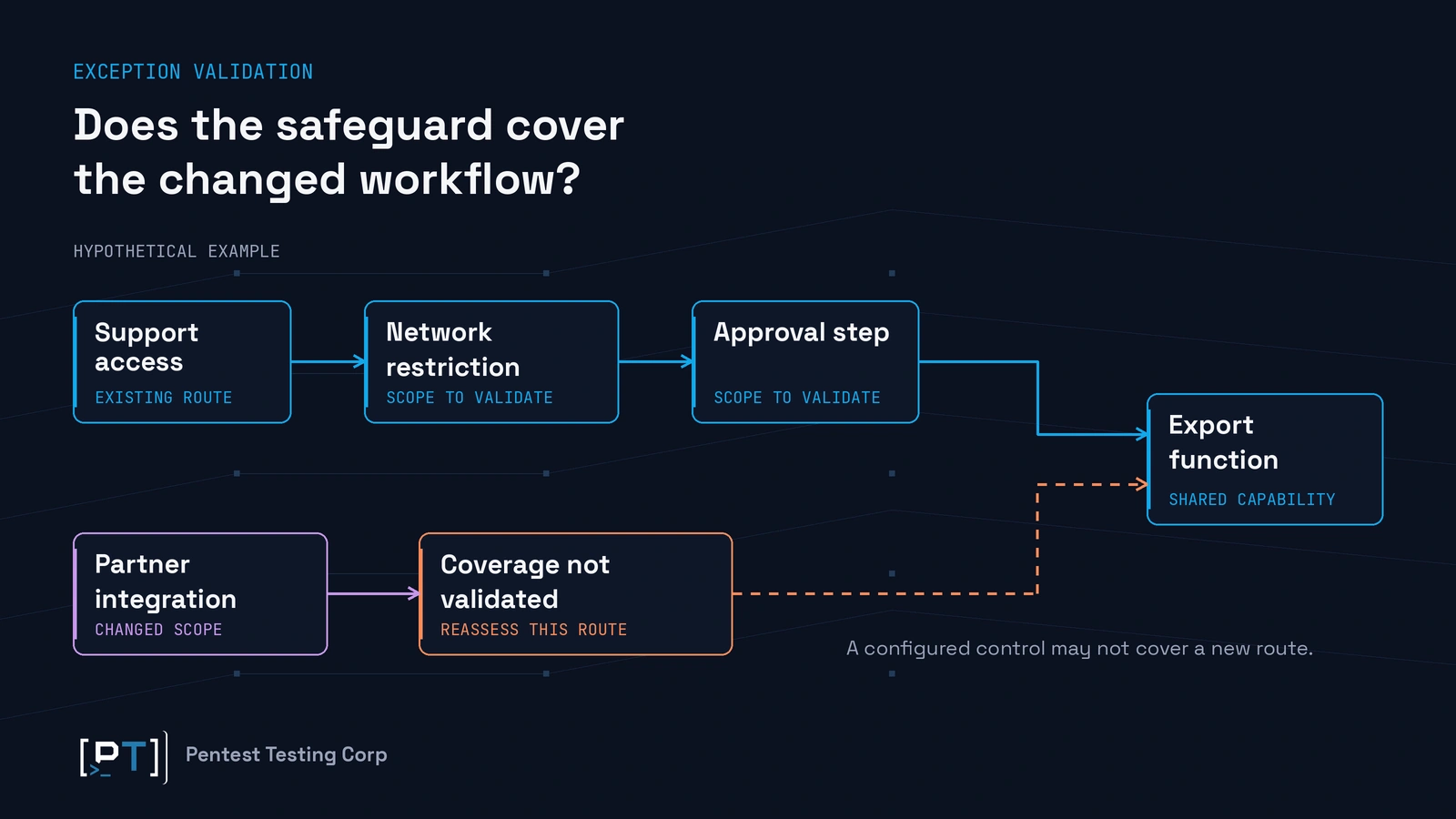
Confirm that the safeguard covers the affected workflow, including relevant alternate interfaces and recent changes. A control protecting the main web route may not cover a background integration. The buyer decision is whether the protection applies everywhere the acceptance depends on it, within a clearly stated assessment boundary.
Separate prevention from detection and response
A preventive control should demonstrate the restriction it claims to enforce. A detective control should demonstrate that the relevant event produces usable evidence and reaches an accountable team. Response validation should establish whether that team can take the agreed action within the organization's required window. These are different claims and should receive separate results.
For a risk involving immediate disclosure, an alert after the event does not undo disclosure. It may still improve containment or investigation. Credit it for the benefit established by evidence, and leave the remaining consequence visible to the risk owner.
Agree what the assessment will not establish
Record environment differences, unavailable roles, untested supplier components, and production restrictions. A staging result should identify the evidence supporting its relevance to production. If that comparison is unavailable, retain the uncertainty. Tests that were blocked or excluded should not appear as successful validation.
The final scope should distinguish an original-finding retest, compensating-control validation, and broader reassessment. A focused review may be appropriate for an unchanged workflow. A new identity architecture or expanded service boundary can justify a wider assessment. Scope follows the decision and changed exposure, rather than the age of the report alone.
Use an exception decision matrix
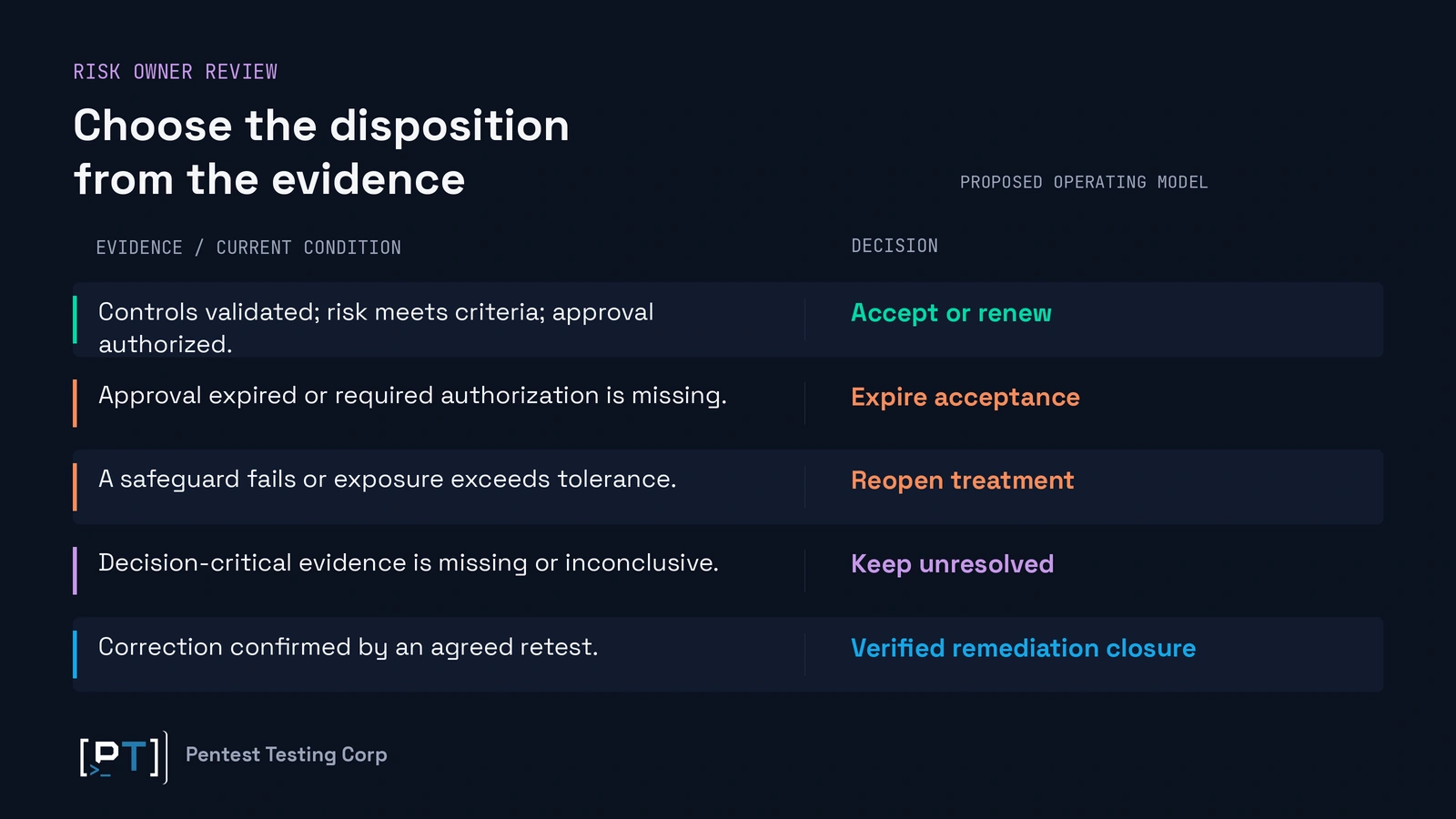
Choose the disposition after reviewing evidence. Treat the following matrix as a proposed operating model, adapted to your policy. It gives each status a clear meaning so engineering, compliance, and leadership do not interpret the same green dashboard differently.
| Current condition | Decision | Record and next action |
|---|---|---|
| Controls validated; residual risk meets approved criteria; owner has authority | Accept or renew for a defined period | Record rationale, evidence, approval, review date, expiry, and early-review triggers. |
| Approval has expired or required authorization is missing | Expire the acceptance | Escalate the unresolved exposure and apply the policy response; do not silently extend approval. |
| Control fails, exposure changes materially, or residual risk exceeds tolerance | Reopen treatment | Assign containment and remediation owners, resources, and a new validation gate. |
| Decision-critical evidence is unavailable or testing is inconclusive | Keep unresolved and escalate | Record uncertainty, evidence needed, interim restrictions, and the accountable decision-maker. |
| Correction is implemented and an agreed retest confirms the outcome | Close as verified remediated | Attach the retest scope, result, date, remaining limitations, and closure authorization. |
Expiry ends the approval period; it does not fix the vulnerability or automatically shut down the service. Your policy must define the operational consequence, including escalation, restriction, or an authorized emergency decision. Avoid an automated shutdown rule that has never been assessed for business continuity.
Reopening treatment likewise does not mean discarding every existing safeguard. Keep effective restrictions while addressing the gap. The immediate decision may be to disable one capability, narrow access, or bring forward a planned engineering change rather than suspend an entire product.
A conditional acceptance needs special care. If a control must already operate for risk to fall within tolerance, a promise to implement it later is not evidence of the lower-risk state. Assess the current exposure and obtain the appropriate decision for that exposure, with interim measures and a deadline.
Do not let audit proximity determine the outcome. A review deadline can justify faster coordination and a narrower, well-defined assessment. It cannot turn failed protection into a successful control result. Keep the outcomes visible in board-level governance metrics so expired approvals and unresolved decisions reach leadership.
Build an evidence checklist the risk owner can review
An exception package should explain the decision without requiring its reader to reconstruct an engagement. Assemble evidence around the finding and approval record, with restricted access to technical artifacts. Use the following checklist as the acceptance review's completion gate.
- Finding and business context: original report reference, affected activity, relevant assets, credible consequences, and reason remediation is deferred.
- Current scope: environment, release or configuration reference, tested roles, access positions, dependencies, and relevant changes since the last approval.
- Control claims: each safeguard, its owner, the protection claimed, and whether it prevents, detects, or supports response.
- Validation evidence: assessment date, assessor, agreed conditions, observed outcomes, artifact references, and untested or inconclusive areas.
- Residual-risk rationale: the approved assessment method, effects credited to tested safeguards, remaining consequences, and significant uncertainty.
- Decision authority: named risk owner, authority or escalation route, approval date, and confirmation that obligations were considered.
- Time limits and triggers: next review, expiry, early-review events, monitoring responsibilities, and action if a required safeguard stops working.
- Exit plan: remediation dependency, delivery owner, planned milestone, retest requirement, and conditions for ending the exception.
Evidence should distinguish a configured control from an observed result. A screenshot can establish a setting at a particular time. A validation record explains what that setting did under defined conditions. Operational records help establish whether the safeguard continues to function between assessments.
Keep the package proportionate. A short decision summary can link to a restricted technical annex instead of circulating sensitive evidence to every reviewer. Preserve timestamps, document versions, and stable references under your retention rules. Do not include live credentials or unnecessary customer records in an approval ticket.
Use sample penetration testing reports to review the structure of finding documentation. An exception decision still needs its own current control evidence and owner approval; a sample report cannot establish either for your environment.
Before sign-off, ask someone outside the delivery team to read the summary. They should be able to identify the remaining business consequence, the evidence supporting acceptance, and the event that ends it. If those points are buried in attachments, improve the summary.
Illustrative scenario: a restricted export gains a new route
Hypothetical scenario, not a client case study. A SaaS business defers correction of an authorization weakness in a legacy export function. Its temporary safeguards restrict the function to a support network and require a second employee to approve exports. The risk owner approves a short exception while engineering replaces the component.
Before renewal, the product team adds a partner integration. The original approval still describes a support-only workflow. A focused reassessment finds that the integration can initiate the same export without passing through the existing approval process. The original network restriction remains configured, but the acceptance rationale no longer covers every relevant route.
The business consequence is potential disclosure of customer records through the newly introduced workflow. The review does not need to claim a confirmed breach to establish that the previous decision requires reconsideration. It needs to show that a protection credited with reducing exposure does not cover the changed scope.
The risk owner declines a routine extension, restricts the new integration's export capability, and reopens treatment. Engineering receives a funded task to correct the authorization boundary. A subsequent retest assesses the original finding and the relevant integration route before any remediation closure is recorded.
The existing risk register remediation plan can organize the reopened work. The acceptance review contributes a different decision: whether the business is still entitled, under its approved criteria and obligations, to defer that work.
If the integration route had been unavailable for assessment, the report should have recorded that limitation. It would not have been reasonable to describe the workaround as validated across the whole workflow. Leadership would then decide how to restrict or escalate the unresolved exposure.
What leadership should decide before the next renewal
Leadership needs a clear recommendation and enough evidence to challenge it. Ask the risk owner to present the proposed disposition, remaining consequence, relevant uncertainty, business rationale, and exit plan. Then make the approval consistent with delegated authority. A delivery manager's responsibility for a deadline does not automatically include authority to accept the associated risk.
Approve the boundary and the resources
Decide which capabilities and exposure levels can continue during deferral, which require restriction, and what would force escalation. Confirm who maintains each compensating control. If a safeguard depends on manual review, establish whether staffing and operating hours support the protection being claimed.
Connect the eventual fix to delivery ownership and funding. The guide to pentest remediation ownership helps assign that work. Repeated acceptance without a credible delivery path deserves a management decision about architecture, resources, or continued operation.
Commission evidence proportional to the decision
Cost and effort depend on the number of distinct findings and workflows, environments, roles, supplier dependencies, and control claims. Rechecking one unchanged restriction is different from reassessing a newly exposed service. Request a scope-specific estimate that identifies preparation, assessment, reporting, stakeholder review, and any follow-up testing.
Schedule the review early enough to act on a failed result. Work backward from the approval deadline, allowing for access setup, evidence gaps, remediation decisions, and sign-off. The audit date should not be the first day the team discovers that its exception evidence is incomplete.
Track decisions, not just accepted totals
The NIST CSF 2.0 provides useful governance outcomes: GV.RM-02 addresses appetite and tolerance; GV.RR-02 addresses responsibilities and authority; ID.RA-06 covers risk responses; and ID.RA-07 addresses changes and exceptions. This is a practical alignment, not equivalence with ISO certification requirements.
Report expired approvals, repeated extensions, failed safeguards, and decision-critical evidence gaps. Explain which business activities are affected. A falling count of open tickets is misleading if unresolved findings were merely relabeled as accepted.
Before signing the next extension, require a current rationale, relevant validation, authorized ownership, and a defined end condition. If those are missing, identify the restriction or escalation needed now. Discuss an ISO 27001 exception reassessment with Pentest Testing Corp to define the residual risk and compensating-control evidence your decision requires.
Frequently asked questions
Can we accept a finding from another testing provider?
Yes, provided your decision process has enough reliable information about the finding and current exposure. Obtain the original scope, evidence, affected versions, limitations, and any retest results. If those are incomplete, commission clarification or targeted validation rather than assuming the report describes today's environment.
What happens if an exception expires during an audit?
Apply your documented expiry and escalation process, preserve the actual dates, and explain the current status accurately. Avoid backdating approval. An authorized decision may establish new conditions going forward, but it does not change whether the earlier approval period had already ended.
Can one approval cover several related findings?
It can, if your policy permits it and the owner has authority over the combined exposure. Keep finding-level traceability, control dependencies, and individual exit conditions. A grouped approval should not hide a finding whose impact, evidence, or required treatment differs materially from the others.
Does cyber insurance remove the need for control validation?
No. Insurance may transfer certain financial consequences under its terms. It does not establish that a safeguard works or remove operational and customer impacts. Review coverage conditions with the relevant adviser and retain a separate technical basis for any claimed reduction in exposure.
How should a vendor's patch delay affect acceptance?
Document the dependency, available restrictions, support position, and replacement options. A vendor's estimated release date is a planning input, not evidence that current risk is acceptable. Set a decision point if the release slips, and determine what evidence will be required after deployment.
Will a validation report guarantee certification renewal?
No. It supports a defined technical and risk decision within its scope. Certification considers the applicable ISMS requirements and evidence through a separate assessment process. Keep the report's conclusions bounded and discuss relevant audit evidence expectations with your certification body.
Should customer security questionnaires describe accepted findings as fixed?
No. Answer according to the question, contractual duties, and approved disclosure process. Distinguish unresolved findings with accepted residual risk from verified remediation. Have security and the relevant commercial or legal owner review material statements so customers receive an accurate description without unnecessary sensitive detail.