HIPAA AI Medical Scribe Security Testing: What a Healthcare Pentest Must Cover
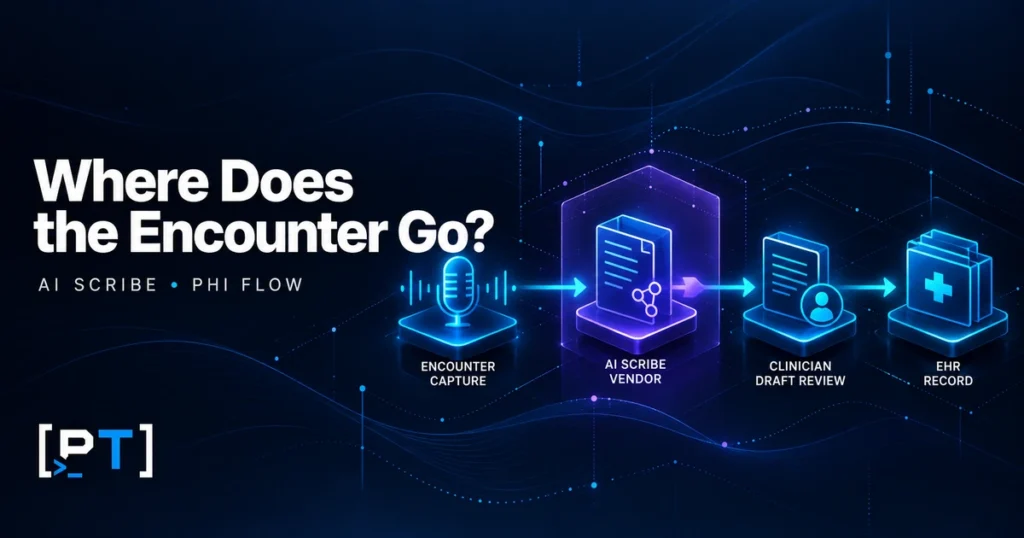
A practice group is ready to roll out an ambient AI scribe across 40 clinics. The vendor has supplied a security questionnaire and a business associate agreement. Clinicians will approve draft notes before entering them into the electronic health record (EHR). At the final review, the CTO asks a narrower question: where do encounter audio, transcripts, draft notes, support copies, and failed uploads actually go, and can one clinician or vendor account reach another patient’s encounter?
That is the decision HIPAA AI medical scribe security testing should help answer. A signed agreement and a secure model provider matter, but neither shows that the full recording-to-EHR workflow enforces the intended access boundaries. The assessment must follow electronic protected health information (ePHI) through the application, vendor services, integrations, and evidence systems that handle it.
The timing is practical. As organizations add scribing to clinical workflows, an earlier risk analysis may no longer describe the system now in use. In a September 17, 2026 HIPAA settlement unrelated to AI scribes, HHS OCR specifically required the organization to identify where ePHI is located and how it enters, flows through, and leaves its systems. That is a useful test of whether a proposed scribe deployment has been adequately mapped, although the settlement itself establishes no scribe-specific rule.
Why an AI scribe changes the HIPAA assessment boundary
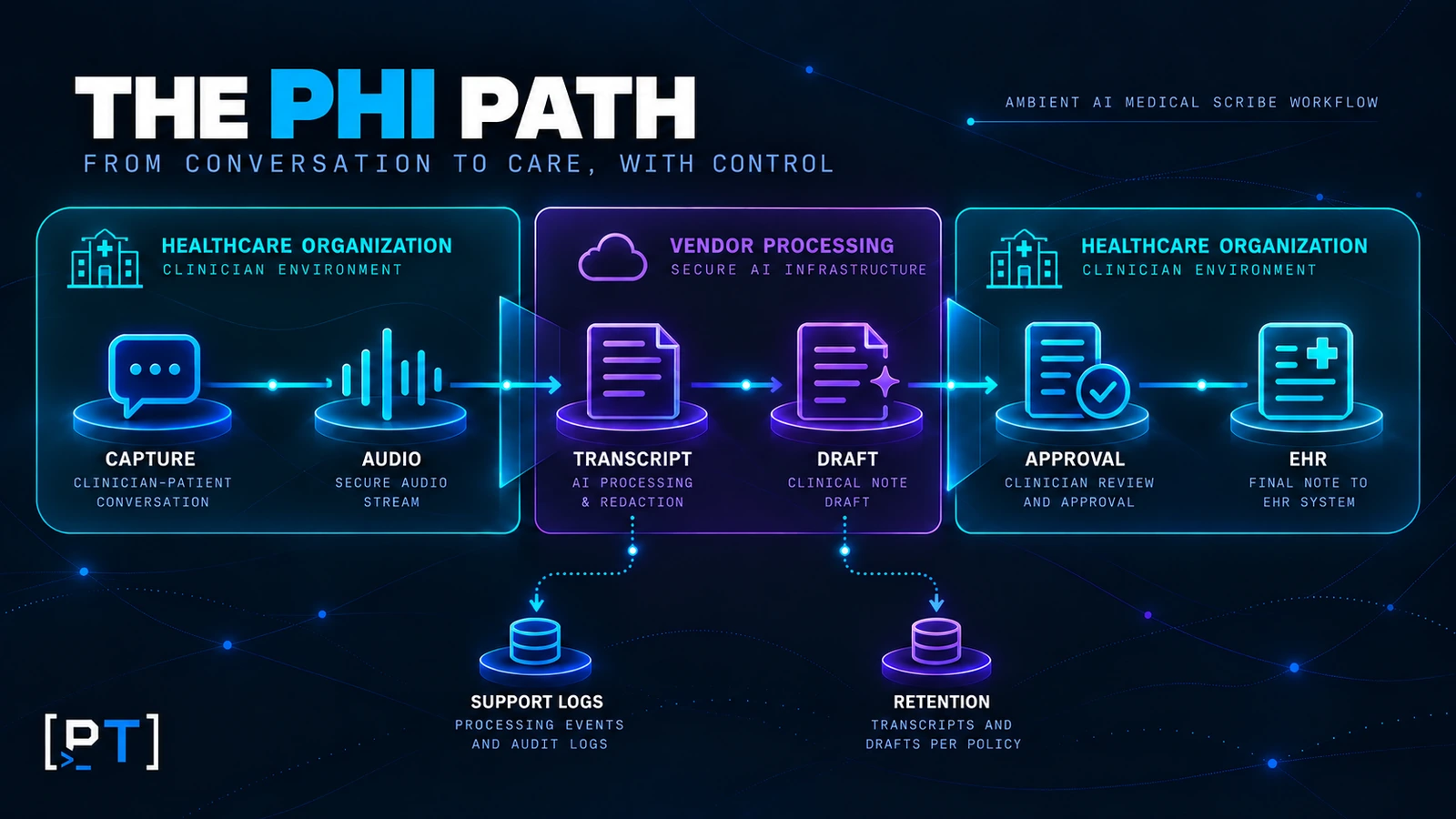
An ambient scribe may turn a conversation into recorded audio, a transcript, a generated draft, structured note fields, and an EHR entry. Depending on the product, those artifacts can pass through a mobile device or browser, an application backend, speech processing, a model service, vendor storage, an EHR integration, support tooling, and operational logs. The actual architecture varies. Procurement should obtain the vendor’s real data-flow description rather than assume every product follows the same route.
The HIPAA Security Rule protects ePHI maintained or transmitted electronically. Its risk analysis requirement calls for an accurate and thorough assessment of potential risks and vulnerabilities to the confidentiality, integrity, and availability of that information. HHS describes risk analysis as an ongoing process and does not prescribe a universal annual interval. Adding a scribe that creates new ePHI flows is therefore a sensible reason to revisit the documented analysis, even if the organization completed a review earlier in the year.
Start with a HIPAA risk assessment and technical evaluation that identifies the affected systems, responsible parties, safeguards, and evidence gaps. The penetration test then validates selected technical assumptions within that larger analysis. It cannot, by itself, determine that the entire organization complies with HIPAA or resolve every privacy, clinical safety, and contracting question.
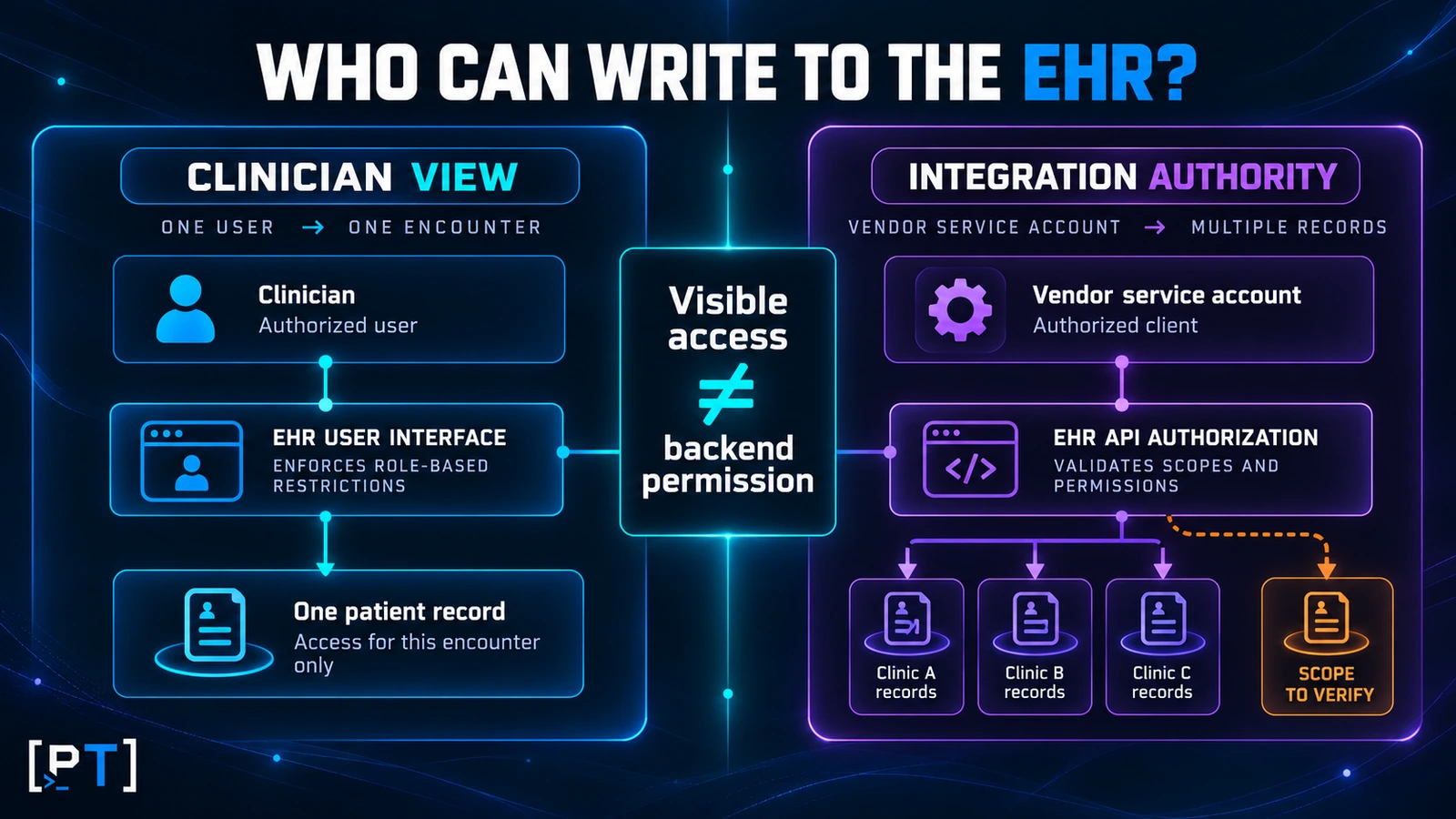
For a healthcare buyer, the first scope decision is whether the tool merely suggests text for a clinician to review or can also create, amend, transmit, or finalize records through an integration. Write access changes the potential consequence of a permission error. It also changes what the tester must prove about approval, attribution, and recovery.
Map the PHI path before commissioning the test
A meaningful scope starts at capture and ends only when the organization can account for every retained copy. The map should include normal use, interrupted encounters, canceled recordings, failed EHR writes, support access, backups, and deletion. It should distinguish what the practice controls from what the scribe vendor or its subcontractors control. A diagram that stops at “sent securely to the vendor” leaves the largest evidence questions unresolved.
| PHI location or handoff | Buyer question | Evidence to request or validate |
|---|---|---|
| Capture device and session | Who can start, pause, resume, and associate a recording with a patient? | Role design, session behavior, device-storage description, and test results for session mix-ups. |
| Audio, transcript, and generated draft | Which services process each artifact, and how long does each copy remain? | Versioned data-flow diagram, retention schedule, deletion behavior, and vendor evidence. |
| Model and supporting services | What information reaches each provider or subprocessor, and under which permitted uses? | Service inventory, applicable agreements, processing description, and configuration evidence. |
| Clinician workspace | Can staff see only the encounters and drafts their roles permit? | Role matrix and controlled access tests across patients, clinicians, sites, and practice groups. |
| EHR integration | Can the integration read or write beyond the intended patient, encounter, or note state? | Integration permissions, approval sequence, audit events, and safe test cases. |
| Logs, support, backups, and exports | Are sensitive copies created outside the expected clinical record? | Logging samples with synthetic data, support-access controls, backup and export inventories. |
Use synthetic patients and approved test accounts for active testing. Arrange the testing window, EHR sandbox or equivalent, allowable actions, and escalation contacts before the engagement. A production test that accidentally changes a live clinical record would defeat the purpose of a controlled assessment.
Data minimization also belongs in the map. Ask what information each processing stage needs, whether optional context is necessary, and what the vendor retains to provide support or improve its product. A claim that “the model does not train on your data” answers only one question. It does not explain whether audio is stored, whether transcripts appear in diagnostic logs, or whether support staff can retrieve a draft.
What HIPAA AI medical scribe security testing must prove
The scope should combine conventional application and API testing with checks tailored to generated content and clinical workflow. A scoped AI penetration testing service can examine the model-facing boundaries and tool permissions, while the surrounding application and EHR integration still need ordinary access-control and configuration testing. Ask for one coordinated scope and report, with clear ownership for each surface.
1. Encounter and patient isolation
Test whether a clinician, delegate, administrator, or support user can retrieve or alter an encounter outside their assigned scope. Include cases involving two patients with similar identifiers, clinicians moving between sites, shared devices, reassigned staff, and a session that remains open after a role change. The business consequence is straightforward: a draft or recording associated with the wrong person can expose PHI or contaminate a clinical record. The expected evidence is a set of authorized and denied outcomes tied to the role matrix, not a generic statement that authentication exists.
2. Recording and artifact custody
Check where audio and transcripts are stored, who can replay or download them, and what happens after a clinician discards a draft. Review whether temporary files, exports, support attachments, and logs follow the documented retention policy. Some of this can be directly tested in the organization’s environment; vendor-controlled storage may require configuration review, contractual evidence, and a vendor-facilitated demonstration. The report should say which conclusions were observed and which depend on supplied assurance.
3. Model output and untrusted content
Clinical speech, imported context, and retrieved records can contain text the application should treat as data rather than operating instructions. The tester should evaluate whether untrusted content can redirect the scribe’s behavior or cause inappropriate disclosure in a draft or downstream action. This is a bounded evaluation of the implemented system, not a promise that every possible model response has been ruled out. Clinician review remains a critical clinical control, but the assessment should verify how the product marks drafts, requires approval, and records edits.
4. EHR write authority and approval
Determine whether the integration can act only for the right patient, encounter, clinician, and permitted operation. Test the distinction between drafting, saving, signing, and submitting, where those states exist. If the product proposes orders, codes, referrals, or patient instructions, those functions need explicit scope and approval checks; they should not be treated as ordinary note text. Where an action fails or is reversed, the audit trail should let an authorized reviewer reconstruct what the system attempted and what actually changed.
5. Logging, detection, and recovery
Verify that relevant events connect the user, patient or test record, vendor identity, action, approval, time, and result. Check that security personnel can investigate an unusual export or cross-site lookup without exposing full encounter content in broadly accessible logs. The organization should also demonstrate how it disables an integration, revokes credentials, corrects an erroneous note through its clinical process, and preserves evidence if an incident is suspected. A test finding is easier to act on when its owner and recovery path are known.
For wider application expectations, the HIPAA penetration testing guide explains how technical validation fits alongside healthcare security documentation. In the scribe engagement, require the report to name every excluded vendor component and explain how its risk was otherwise evaluated. An exclusion should be a visible decision, not an invisible gap.
Map findings to HIPAA, OWASP, and the NIST AI RMF carefully
Framework mapping makes a report easier to use, provided each framework keeps its proper role. The HIPAA Security Rule supplies the applicable safeguard and risk-analysis context for regulated entities. OWASP describes classes of AI application risk. NIST’s voluntary AI Risk Management Framework organizes governance and lifecycle evidence through Govern, Map, Measure, and Manage. None of those mappings turns a single penetration test into a HIPAA compliance determination.
| Test observation | Relevant reference | Decision supported |
|---|---|---|
| PHI appears in an unauthorized draft, response, export, or log. | OWASP LLM02:2025, Sensitive Information Disclosure; HIPAA confidentiality and access-control analysis. | Restrict the data path, validate patient and role isolation, and reassess affected copies. |
| Encounter text can change the assistant’s intended behavior. | OWASP LLM01:2025, Prompt Injection. | Separate untrusted content from instructions and test whether approval and access controls contain the outcome. |
| An AI-connected workflow can use more EHR authority than its task needs. | OWASP LLM06:2025, Excessive Agency; OWASP ASI03:2026, Identity and Privilege Abuse, where agentic delegation actually exists. | Narrow integration permissions and require meaningful approval for consequential actions. |
| The organization cannot identify retained audio, vendor access, or tested safeguards. | HIPAA Security Rule risk analysis and evaluation; NIST AI RMF Map, Measure, and Manage. | Update the system inventory, obtain vendor evidence, assign risk ownership, and retest the relevant controls. |
Use the ASI03 agentic category only when the scribe has an agent-like identity or delegated tool access. A product that produces a draft without autonomous tool use still deserves testing, but labeling every scribe an “agent” obscures its real permissions. Likewise, a clinical quality review of note accuracy and a cybersecurity penetration test answer different questions; both may be needed before deployment.
For teams that need to place findings into governance records, the guide to mapping AI pentest evidence to the NIST AI RMF explains the connection between test observations and risk-management functions. Keep legal interpretation and clinical safety sign-off with the appropriate internal specialists.
Make vendor review testable, not questionnaire-only
A vendor’s assurance package is useful input, especially where the buyer cannot directly test vendor infrastructure. Ask the vendor to identify its processing locations, subprocessors, applicable business associate arrangements, permitted uses, retention periods, access paths, incident-notification process, and deletion or return process. HHS explains that a cloud provider creating, receiving, maintaining, or transmitting ePHI for a covered entity or business associate generally requires an appropriate business associate agreement. The precise contracting chain and facts should be reviewed by counsel and the organization’s privacy team.
Request a current architecture diagram and a role-permission matrix that match the version being purchased. Clarify whether the vendor’s security report covers the scribe application, mobile capture, model integration, EHR connector, and support environment or only its corporate systems. Ask what happens when the model, transcription provider, EHR connector, or retention setting changes. An assurance report with a broad title can have a narrow tested boundary.
Contracting should make testing and incident response feasible. The buyer needs an agreed method for testing its own tenant and integration, a path to request vendor-facilitated validation, and defined contacts for urgent findings. It should be able to obtain relevant activity records after an incident and understand which party investigates each segment of the workflow. These are procurement and operational questions alongside the technical test.
The broader HIPAA AI risk assessment sprint offers a way to inventory multiple AI uses and assign remediation. For this purchase, keep the evidence tied to the particular scribe, version, integration, clinic roles, and planned rollout. A general AI policy is not a substitute for that system-specific record.
Illustrative scenario, not a client case: A multisite practice buys a scribe whose EHR connector uses a service account with access across all clinics. The clinician interface shows only assigned appointments, so a normal demonstration appears properly restricted. In a controlled test, however, an integration request associated with a synthetic encounter is accepted under the broader service account’s authority. The practice pauses wider rollout, limits the connector’s permissions, asks the vendor to correct the patient-and-site authorization check, and retests both the permitted and denied cases. The immediate cost is a short deployment delay; the benefit is evidence about a boundary that the interface demonstration did not test.
Plan the assessment, evidence, and rollout gate
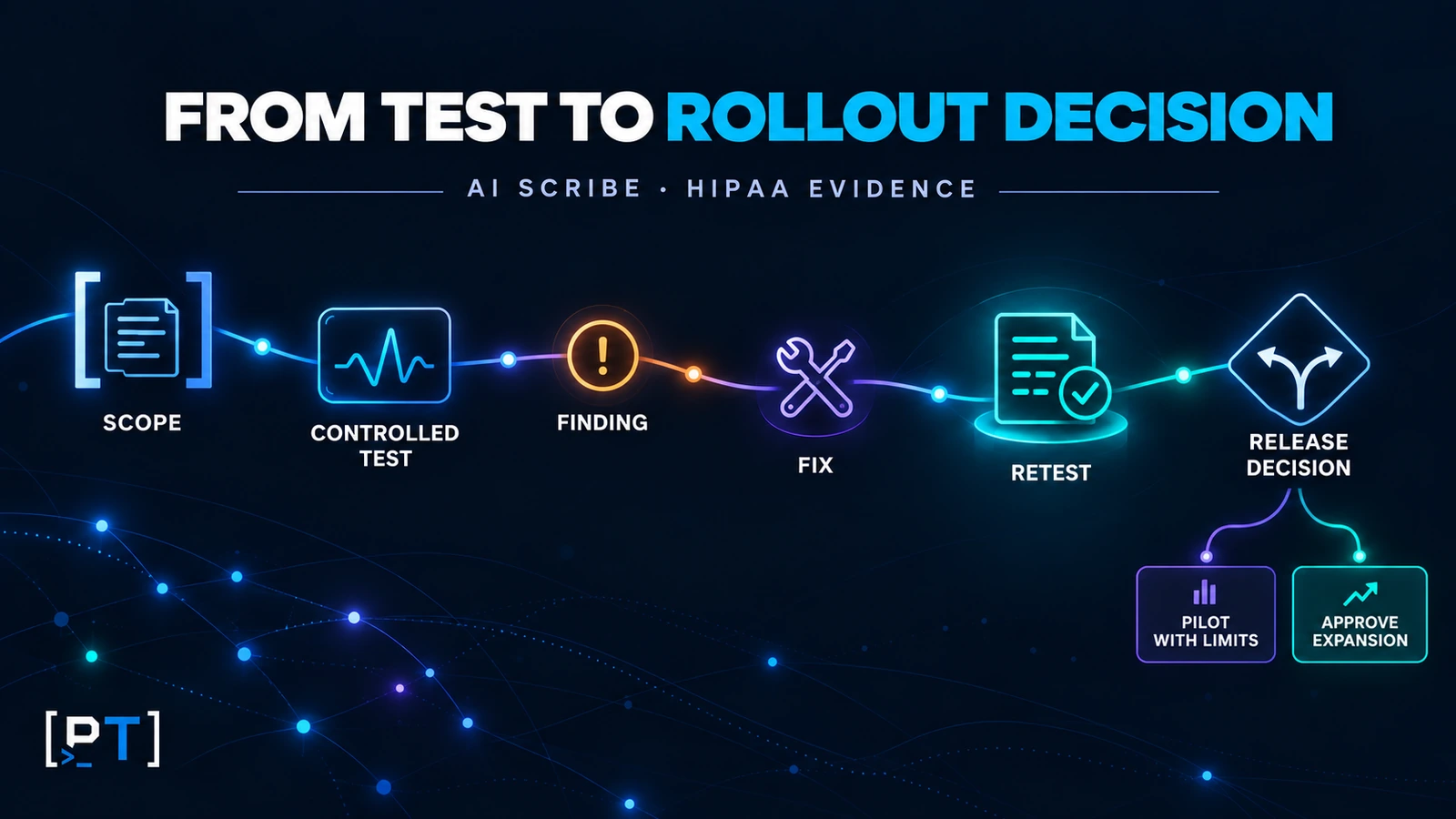
A buyer should commission the work while the EHR sandbox, vendor technical team, and clinical owner are available. The first phase is a scope workshop: enumerate artifacts and integrations, agree on synthetic records, define roles, and identify components that require vendor cooperation. The next phase validates the data path and permissions. Reporting should separate observed findings, configuration gaps, vendor claims awaiting proof, and issues outside the permitted test boundary. Remediation and targeted retesting follow before the affected feature or site expands.
Effort depends on the number of EHR connections, sites, user roles, capture clients, vendor-controlled components, and write capabilities. A draft-only pilot with one EHR connector has a smaller test matrix than a multisite deployment that generates codes, orders, and patient instructions. A fixed quote should state its assumptions and exclusions; a generic “AI pentest” line item is insufficient for budgeting. Pentest Testing Corp’s live HIPAA service page lists engagements from $5,500, while its AI penetration testing page lists engagements from $9,500. Those are separate service starting points, not a promised combined price for this workflow.
Ask for a report containing the tested system version, scope and exclusions, PHI-flow map, role matrix, controlled evidence, business impact, prioritized fixes, responsible owner, and retest status. Supporting material should use synthetic records or appropriately sanitized evidence. The organization should retain a decision record explaining any residual risk it accepts and any vendor evidence it could not independently verify.
The guide to what an AI penetration test covers can help procurement distinguish model behavior, application security, retrieval, integrations, and tool permissions during scoping. Once the scribe’s actual architecture is known, remove irrelevant test items and add the clinical handoffs that matter.
What leadership should decide before deployment
The approval meeting needs named answers to five questions:
- Boundary: Do we have a current map of every place encounter ePHI is created, processed, retained, exported, and deleted?
- Authority: Have we validated patient, clinician, site, vendor, and EHR permissions against the real workflow?
- Clinical control: Which outputs remain drafts, who approves them, and can an automated action change the record before that approval?
- Evidence: Can we investigate a disputed access or incorrect write using connected, appropriately protected logs?
- Release gate: Which findings block rollout, who accepts residual risk, and what changes require targeted retesting?
A reasonable outcome may be to approve a limited pilot with restrictions while a vendor supplies missing evidence. A cross-patient authorization finding or uncontrolled EHR write deserves a different decision. The point of testing is to make that distinction with observed evidence and clear ownership, while the privacy, legal, clinical, and security teams make their respective determinations.
If you are evaluating or renewing an ambient scribe, scope a HIPAA-aligned risk assessment and technical evaluation around its actual PHI path. Include the AI application and EHR integration in the testing request so the proposal can identify what will be validated directly and what requires vendor cooperation.
Frequently asked questions
Does HIPAA require an AI medical scribe penetration test by name?
No. The Security Rule does not prescribe an “AI scribe pentest.” A properly scoped test can provide technical evidence for the organization’s risk analysis and evaluation of safeguards, but the appropriate assessment method depends on its systems and risks.
Should testing happen before a pilot or before the full rollout?
Map the PHI flow and resolve basic vendor and contracting questions before the pilot handles real ePHI. Test the configured application and integration before expansion. If the pilot is the first realistic environment for some controls, define its limits and test those controls before wider release.
Can a vendor’s SOC 2 report replace testing our EHR integration?
No. Review its scope and period for useful vendor assurance, then assess the permissions, configuration, and workflow created by your particular integration. The two forms of evidence answer different questions.
What if the vendor will not permit direct testing?
Test the components you control under agreed rules, request a vendor-facilitated demonstration or independent evidence for its components, and record the untested boundary as a decision item. Do not describe vendor systems as tested when they were not.
Do we need to retain encounter audio to investigate an incident?
Not automatically. Set retention according to the organization’s documented clinical, legal, privacy, and security needs. Confirm that the selected period and access controls allow appropriate investigation without retaining more sensitive material than necessary.
When should a scribe be retested?
Retest a remediated finding and consider targeted regression testing after a material change to the EHR connector, role model, capture client, model workflow, vendor processing path, or autonomous capability. Document why a change did or did not affect the tested boundary.
Can an AI scribe pentest establish that generated notes are clinically accurate?
No. Security testing can assess permissions, workflow integrity, and whether approval controls operate as designed. Clinical validation must assess note quality, omissions, and the safety of the organization’s review process.