AI Trace Data Access Testing: Who Can Read Prompts and Tools?
A SaaS company is preparing to let its observability supplier troubleshoot an AI support assistant. Product permissions already keep customer cases separate. In the observability console, however, one trace can show the user’s request, the model’s answer and the data sent to a case-management tool. The supplier asks for support access, and engineering wants to enable exports for incident review. The CTO now has three decisions to make about the same records: what the platform should capture, who can read it and where copies can go.
AI trace data access testing gives those decisions a basis in evidence. A trace groups the steps of an AI request so operators can diagnose failures and understand performance. If those steps carry payloads, the tracing system becomes a sensitive data store with its own readers and permissions. Before rollout, ask the team to demonstrate where the data goes and what each approved role can actually see or take with it.
AI trace data access testing starts with the copies
Start with one production-shaped workflow and follow the content that helps an engineer explain a failure. A prompt may contain a customer’s description of a problem. The response may quote a private record. Tool arguments, the values an assistant passes when asking another system to act, may contain account identifiers, payment references or confidential text. Tool results and error details can contain information that never appeared in the customer-facing answer. In a multi-step trace, a summary can look clean while an individual step retains the original content.
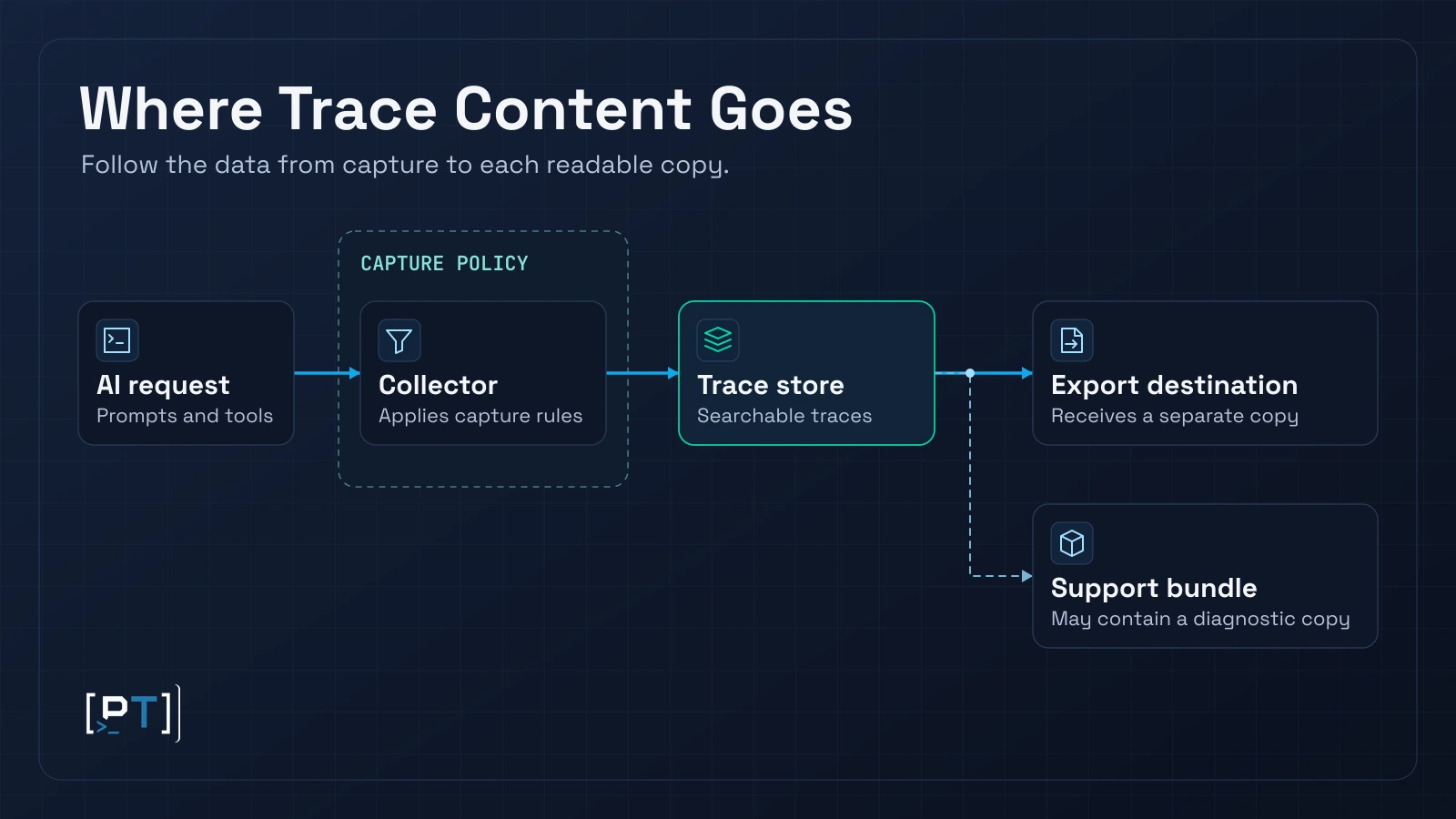
Ask engineering for an inventory that begins at capture and ends at each readable destination. Depending on the deployment, that can include the application’s instrumentation, a collector, the observability platform, a search index, an evaluation dataset and a support bundle. Include any incident attachments, storage destinations and provider-controlled copies relevant to the workflow. For each, record the fields, purpose, owner, tenant or project boundary, environment, reader roles, export authority and retention. Record which systems can hold original values and where the evidence is still missing.
Decide which diagnostic questions engineers actually need to answer. Latency, failure status, model version, tool name and a suitably scoped correlation identifier can often establish where something broke. A production prompt body needs its own documented purpose. Treat supposedly harmless metadata as reviewable too. A project label, conversation identifier or error reason can identify a customer or reveal a confidential workflow when combined with other records.
When you scope an AI penetration test, name the collector, console, supplier access and export destinations separately. The contract or statement of work should say which teams can provide access and evidence for each. The guide to broader AI penetration test coverage can help place telemetry alongside the product’s model, tools and APIs.
Build a telemetry access and disclosure matrix
Give each role a separate answer for three operations: discover a trace, view its sensitive content and export a copy. Discovery includes search matches, previews and titles. Content access covers the full trace and its individual steps. Export covers anything that can deliver a durable copy outside the console, including scheduled jobs and support attachments. Write the expected outcome for each role, project or tenant, data class and destination. Then require the observed outcome alongside it.
The matrix below illustrates a starting policy. It assumes a multi-tenant SaaS team with internal engineering, limited vendor support and a managed incident destination. Adjust the expected outcomes to your real duties and commitments. When several customer tenants share one observability project, require evidence at the customer boundary as well as the project boundary.
| Role or route | Approved access | What must stay protected | Evidence to request |
|---|---|---|---|
| On-call engineer | Find traces and view approved diagnostic metadata for assigned production projects. | Raw prompts, responses and tool values. Other projects and any customer content outside the role’s remit. | Expected and observed search, preview and trace-detail results for the assigned and excluded scopes. |
| Incident lead | See specific approved fields for one incident during a recorded access window. | Unrelated traces, unrestricted downloads and continued content access after expiry. | Approval reference, named recipient, scope, expiry and post-expiry results for tested routes. |
| Supplier support | Use sanitized diagnostics by default, with any content exception scoped to a case and time window. | Other tenants, unapproved project access and transfer to additional recipients. | Supplier access record, scope and duration, contractual position and any retained support copy. |
| Scheduled export identity | Send approved fields for a defined dataset to a controlled incident store. | Raw payloads, unapproved destinations and records outside the approved tenant or project set. | Export configuration, destination permissions and a representative exported artifact. |
| Workspace administrator | Manage membership and configuration under a named administrative role. | Unreviewed content access, silent policy changes and unapproved export enablement. | Effective administrative capabilities, decision records and audit events for changes to sensitive access. |
| Recipient of an exported copy | Read the approved artifact within the receiving system and its access period. | Access by further recipients and onward copies outside the approved purpose. | Destination reader list, access and retention settings, and an accountable owner for onward distribution. |
Check each surface against its own approval. A search result can reveal that a sensitive event happened even when the full trace is restricted. An automated export can reach a new reader group that never had access to the console. A support bundle may package attachments as well as the fields shown in a preview. Ask the owner of each surface to define what disclosure would change a buyer’s release decision, then document the allowed and restricted outcomes at that surface.
Include named human roles, group memberships, service identities and supplier operators. Confirm how emergency elevation works, who can change the access policy and which controls apply to the export identity after the initiating user leaves or loses access. An export job can have its own authority. The recipient system also has its own rules, which matter after the file has been delivered. Use AI conversation sharing and export testing if the product also provides customer-facing transcript links or downloads.
Separate redaction from visibility
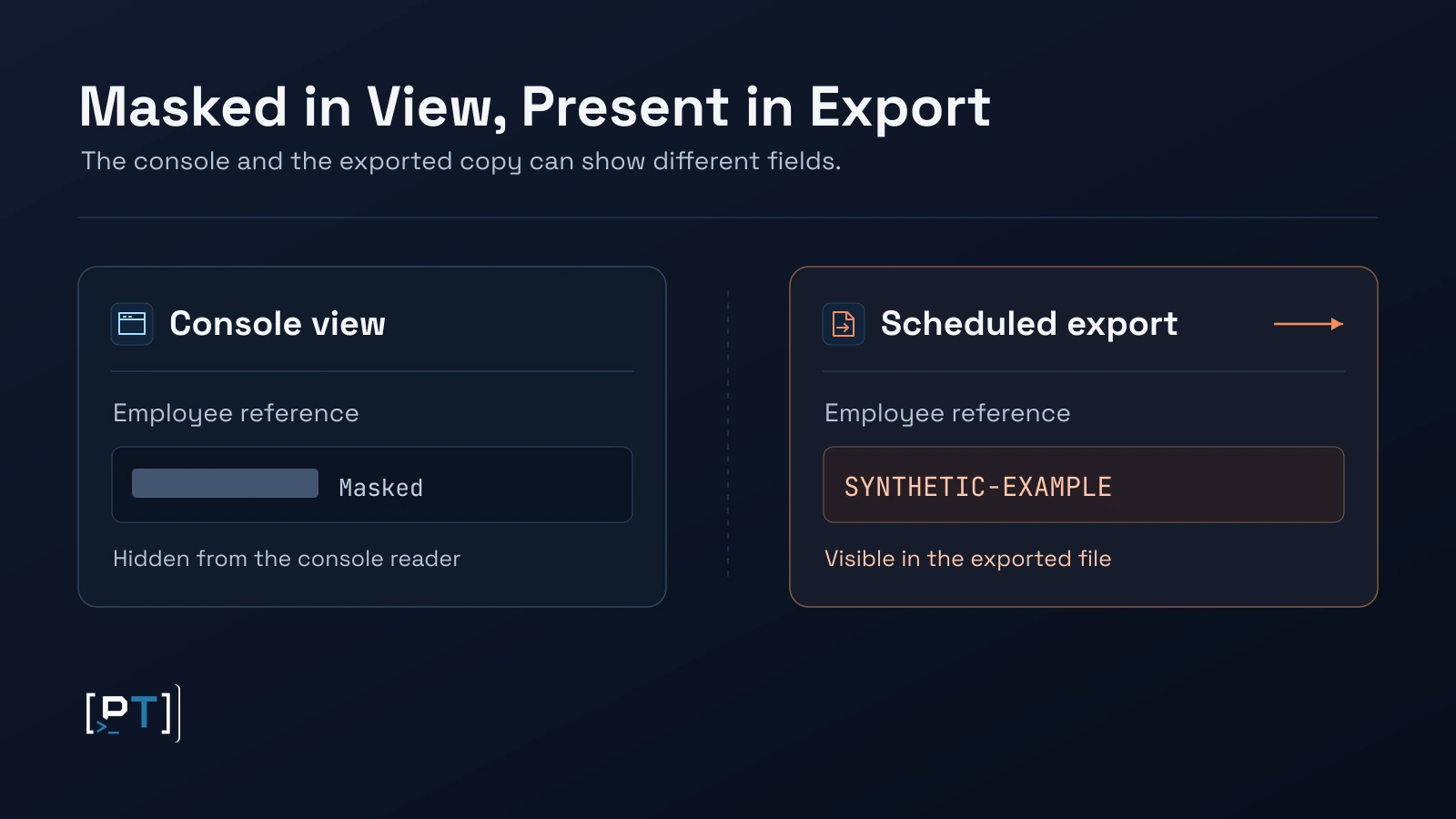
A console can mask a field while the original value still sits in storage or appears in an export. Redaction removes or transforms the content at a defined point. Visibility controls limit what a reader can see at a particular interface. Document both. If the company promises that a raw value never reaches the supplier, ask for evidence that it was omitted or transformed before crossing that boundary. If the policy permits restricted raw retention, identify that store, its readers and its expiration rule.
Prefer a short list of fields approved for routine ingestion and export. Where engineering relies on filtering patterns, verify representative content that is harder to classify, such as free text containing a customer reference, nested tool values and error details. Ask for coverage of the workflows that matter to the release, including failures, optional debug capture and any legacy ingestion route still in use. For a diagnostic exception, agree the owner, the window, the fields, the destination and the evidence that capture returned to normal. A test should also show that the redacted trace still supports an agreed troubleshooting task.
The OpenTelemetry GenAI span conventions illustrate the design distinction by treating several content-bearing fields as opt-in and discussing storage outside the trace through separate references. A reference can still lead to sensitive content. If your platform stores payloads separately, include access to the referenced object and any copy created when that reference is resolved. Confirm what the deployed instrumentation actually emits, since a convention describes an approach and implementations vary.
Hypothetical scenario. A support assistant for a payroll SaaS product puts an employee reference in a tool argument. The observability console hides the argument for ordinary engineers. A scheduled incident export includes the original field and delivers it to a shared folder whose reader group includes implementation contractors. The data was legitimately used in the product, but the team granted wider access when it copied the trace. The release owner suspends that export, scopes the historical copies and asks privacy and vendor management to review actual recipients. Approval to restore the route requires a representative export containing only allowed fields and evidence that the destination’s reader group is restricted.
Check existing records as well as new events, especially when a supplier adds a redaction control or the application enables a new collector configuration. A change can apply prospectively while previous copies remain accessible. Assign a disposition owner and date for the historical set, including governed exceptions such as incident preservation. When privacy authorizes removal, the AI data erasure testing guide covers how to verify the agreed outcome across retained destinations.
Scope AI trace data access testing around proof
Make the first assessment small enough to finish and broad enough to support the release decision. Provide a representative workflow, trace and export inventory, expected role matrix, two representative tenant or project contexts where isolation matters, and a named contact for the observability supplier. Use synthetic trace content and approved test identities. It should be possible to demonstrate that an authorized reader can use the expected diagnostic data and that a lower-privilege or out-of-scope reader receives the expected restriction. Include the paths the team depends on for rollout and incident response.
Ask for evidence that can survive an enterprise review. A useful record identifies the evaluated environment and policy version, role and access state, tenant or project, surface, expected outcome, observed result, and any destination artifact. Use redacted evidence and a correlation reference that links the relevant records without carrying the restricted payload itself. Keep administrative actions and export events attributable to named users or service identities. When a control objective asks who approved a privileged agent action and what actually happened, see agent action accountability for SOC 2 for the related structured approval and execution evidence.
For an export, inspect the artifact that arrives and record who is entitled to open it in the receiving system. A screenshot of the export settings can support that result, but it says little about a previously configured job or a destination with inherited permissions. Agree whether the assessment covers routine downloads, scheduled feeds, incident handoffs and connected evaluation systems. If a route is disabled for launch, document the control that keeps it disabled and identify who may enable it.
Separate results the team observed directly from those supported by supplier evidence. For vendor-operated support or provider-side telemetry, request a dated description of the applicable deployment, roles, emergency access, available customer audit records and how the vendor handles exported copies. Where permitted, ask for a supervised demonstration of the agreed support workflow. Record which assertions the supplier evidence supports and the decisions that remain open. If the requested access is essential and a high-impact boundary cannot be evidenced, scope approval around the lower-risk configuration the team can verify.
Effort rises with the number of distinct observability products, collectors, role models and destinations. One application and one managed export can often be treated as a focused workstream. Multiple SDKs, tenant models, legacy projects or supplier approval chains widen it. Legacy copies can add remediation work even if the new route is easy to correct. Quote and schedule against a named inventory. Plan for access and supplier evidence first, controlled validation second, and targeted retesting after changes. Schedule a decision checkpoint before enabling raw production capture or broad supplier access.
Map the exposure to the right controls
Use OWASP LLM02:2025 Sensitive Information Disclosure to frame the impact of confidential AI content becoming available to an unintended reader. Use LLM07:2025 System Prompt Leakage where tracing retains internal instructions. Determine whether those instructions contain credentials, sensitive business logic or operational details, and establish how independent access controls hold. The trace store’s authorization should be assessed as a distinct application or API control.
For trace query and export APIs, OWASP API1:2023 Broken Object Level Authorization is relevant when a reader has a legitimate function but should only access particular projects, traces or tenant records. API5:2023 Broken Function Level Authorization applies when an operation such as bulk export or managing export destinations is reserved for a privileged role. Record both the affected data scope and the action that was allowed. The distinction can determine whether remediation belongs in tenant scoping, privileged role design or both.
The NIST AI Risk Management Framework provides a governance structure. Use Govern to assign responsibility for capture policy and supplier access, Map to identify destinations and affected parties, Measure to evaluate the role and export assertions, and Manage to decide what to remediate, restrict or accept. Where the GDPR applies and the traces contain personal data, Articles 5 and 32 of the regulation provide relevant principles for data minimization, storage limitation, confidentiality and risk-appropriate security measures, including regular evaluation of their effectiveness. Have the privacy owner determine how those duties apply in context and retain the decision with the evidence.
What leadership should approve
Approve the minimum set of production telemetry that has a named purpose, a known owner and evidence of effective access controls. Make a separate decision on raw content, supplier access and every export route that carries sensitive fields. It may be reasonable to approve metadata-only tracing for rollout while holding back raw capture or a new destination until its controls are proven.
- CTO or platform owner. Approve the capture fields, environment boundaries and diagnostics the team can still perform with restricted content. Fund changes at the earliest boundary where an unnecessary copy is created.
- CISO or security owner. Approve ordinary and elevated roles, export separation, time limits and verification criteria. Hold deployment when unauthorized tenants or readers can receive sensitive records through an intended production route.
- Privacy and procurement owners. Approve supplier access conditions, applicable retention decisions and any constraints on onward sharing. Attach the agreed alternative when provider internals cannot be directly verified.
- Release or operations owner. Record the decision for each route, the remaining exposure, the owner and expiry for any exception, and the retest or review trigger. Reopen the decision after a material change to capture, access groups, supplier privileges or exports.
Route remediation according to what the evidence shows. Extra payload collected before it is needed points toward capture policy. An unexpected reader in the trace platform points toward authorization. A compliant dataset landing in an overly broad folder points toward destination ownership. Assigning the work at the point where the boundary failed makes it easier to fund and retest. For a release exception, record which customer or operational commitment it affects and how the business will meet that commitment during the exception window.
Put the decision in terms someone can check later. For example, on-call engineers may use failure metadata for their projects, supplier support receives sanitized diagnostics, and the scheduled incident export delivers approved fields to a named restricted store. Tie each clause to an evidence reference. Add the effective date and the role authorized to reopen the decision after a change.
If you are onboarding an observability platform, widening support permissions or switching on production prompt capture, bring your telemetry inventory, role matrix and export routes to discuss an AI telemetry assessment with Pentest Testing Corp.
Frequently asked questions
Can a synthetic trace represent a real production workflow?
Yes, if it uses representative instrumentation, field types, access policies and destinations. Document any configuration differences between the test environment and production and decide which assertions require separate confirmation before release.
Do we need to evaluate sampled traces if only a small share is collected?
Yes. Sampling reduces volume. The sampled records can still contain sensitive material. Ask whether error traces, escalated sessions or targeted debug runs receive different treatment, since capture may be concentrated in those cases.
What if a supplier’s support team uses a subcontractor?
Ask which organization can receive trace data, who authorizes that access, and whether the subcontractor can retain a copy or send it onward. Ask procurement and privacy to review applicable terms and request evidence that the described controls cover the actual support workflow.
Can we keep trace content in an evaluation dataset?
Decide whether evaluation needs the original content and who will run or review it. A dataset can introduce new readers, reuse and retention. Treat it as a separate destination with its own approved fields, permissions and owner.
How should we handle production debugging during a critical incident?
Use an agreed emergency process with a named approver, documented purpose, minimum necessary fields, scoped recipients and an expiry. Reconcile the access and any resulting artifacts after the incident according to the incident and retention decisions.
When should we retest after fixing an export issue?
Retest when the fixed route can produce a representative artifact in its intended configuration. Include the receiving system’s permissions and separately establish what happened to historical files. Record the date the fix became effective so reviewers can interpret earlier artifacts correctly.