Continuous AI Penetration Testing PTaaS: Scope It Around Releases
Your engineering team releases an AI assistant update every Thursday. One release changes retrieval filters; the next adds a support-ticket tool; the following one changes which customer records the assistant can summarize. Procurement has a penetration test report from the spring, but an enterprise buyer now asks what has been tested since that report. The CTO can show deployment logs and automated checks. Neither establishes whether the current assistant still respects customer boundaries or whether its new tool can act beyond the user’s authority.
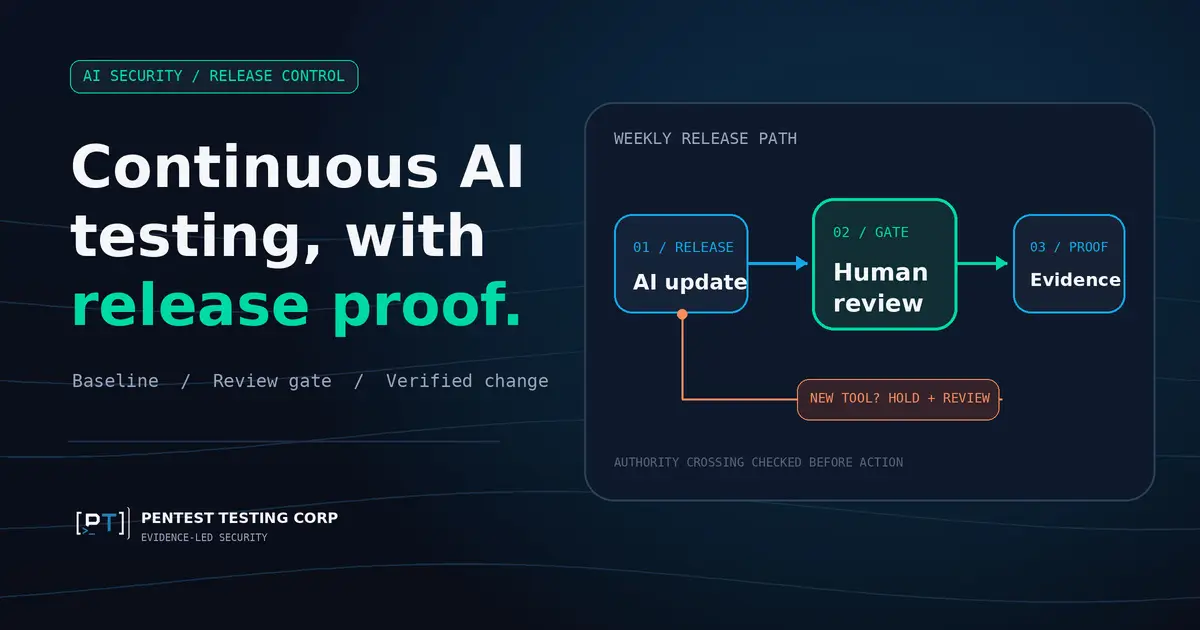
That is the purchasing problem behind continuous AI penetration testing PTaaS. A standing engagement can connect independent testing to a fast release cycle, provided the contract states what is continuously monitored, what receives human testing, when a release pauses, and what evidence is delivered. “Continuous” should describe a dependable process, not imply that every possible AI behavior is tested every minute. This guide gives CTOs, CISOs, and VPs of Engineering a practical way to scope that process, compare proposals, and decide how much testing capacity their product actually needs.
Why a recurring engagement may fit a weekly AI release cycle
A traditional penetration test evaluates a defined system during a defined window. That report remains valuable: it records scope, tested assumptions, findings, and remediation. Its limits become visible when the deployed AI workflow changes faster than the organization can commission separate assessments. A new retrieval source can change which information reaches the model. A new integration can add a business action. An identity or permission change can alter whose authority an agent uses. Even when each release looks small in a product backlog, the combined security assumptions may no longer match the original report.
Recurring testing is useful when three conditions coincide: the product changes frequently, the changed components can affect data or actions, and leadership needs current evidence for release approval or customer review. The goal is not to buy a fresh full-scope penetration test for every deployment. It is to maintain a tested baseline, identify meaningful differences, route them to the right level of review, and preserve an honest statement of what has and has not been assessed.
Call the model “PTaaS” only after defining its service boundaries. A portal full of scanner results, a reserved block of expert testing time, and a managed program with release triage are different purchases. All may have a place, but they produce different evidence and place different work on your team. For an AI product that can retrieve customer records or invoke tools, the contract should say who assesses model-mediated behavior, who reviews the surrounding web and API controls, and who decides that a change exceeds the standing scope.
Automated checks still matter. They can flag known regressions, confirm that expected permissions remain configured, and give engineers fast feedback. They cannot, by themselves, establish that an untrusted document will never influence an assistant’s decisions or that a tool’s authority matches a user’s intent in every business context. Treat automation as one evidence stream and reserve human-led work for the boundaries where business impact depends on context.
What Continuous AI Penetration Testing Should Cover
Start with a baseline of the current production workflow, not a generic list of prompts. Record entry points, user and service identities, tenant boundaries, retrieval sources, model and prompt versions, connected tools, approval steps, output destinations, and sensitive data classes. Include the application and API controls that determine what the AI can actually see and do. The AI penetration testing scope should name the workflows and trust boundaries that matter to the product, rather than promising blanket coverage of an undefined “AI system.”
The baseline should yield a risk-ranked test inventory. For example, a read-only FAQ assistant and an agent that can edit customer records should not consume identical manual testing capacity. The latter needs closer attention to identity, tool permissions, confirmation steps, transaction limits, and the evidence trail for each action. If the initial assessment identifies control gaps, arrange ownership and remediation support for closing and verifying findings before allowing a recurring dashboard to make unresolved exposure look routine.
Define four layers in the statement of work:
- Baseline assessment: A manual review of the named AI workflows and their supporting web, API, identity, and data-access boundaries. It produces a report and a record of the versions and assumptions tested.
- Release intake and triage: An agreed method for notifying the testing team about changes to models, prompts, retrieval, tools, permissions, roles, integrations, or sensitive data flows. Each change receives a documented testing decision.
- Recurring validation: Automated regression checks where they are dependable, targeted human testing of selected changes, and scheduled broader reviews of accumulated drift. The contract must state the included capacity.
- Remediation and evidence: Finding ownership, verification of fixes, current-scope statements, exceptions, and reports usable in customer or audit discussions.
Write exclusions just as clearly. Third-party foundation-model internals, every supplier integration, source-code review, cloud configuration, and all production tenants should not be assumed included because the proposal says “AI PTaaS.” Testing against live customer data or action-taking tools needs explicit safeguards and authorization. If a new capability crosses an excluded boundary, there should be a change-order path with a decision owner and an estimate before work begins.
Scope also needs an exit condition. Define how the organization receives its reports, test inventory, evidence, open findings, and version history if it changes providers. A recurring service should make future reassessment easier even if the commercial relationship ends.
Choose an AI pentest cadence with a decision matrix
Set the Continuous AI Penetration Testing Cadence
A sensible cadence combines event-driven review with reserved testing capacity. Calendar frequency alone cannot describe risk: a quiet month may need little targeted work, while one release that grants an agent write access may require a substantial assessment. The team should agree on a risk classification for each change, the response expected before release, and the maximum time an important change can wait for human review. For individual triggers, the companion guide explains which AI changes invalidate earlier evidence. The matrix below turns those triggers into a recurring service arrangement.
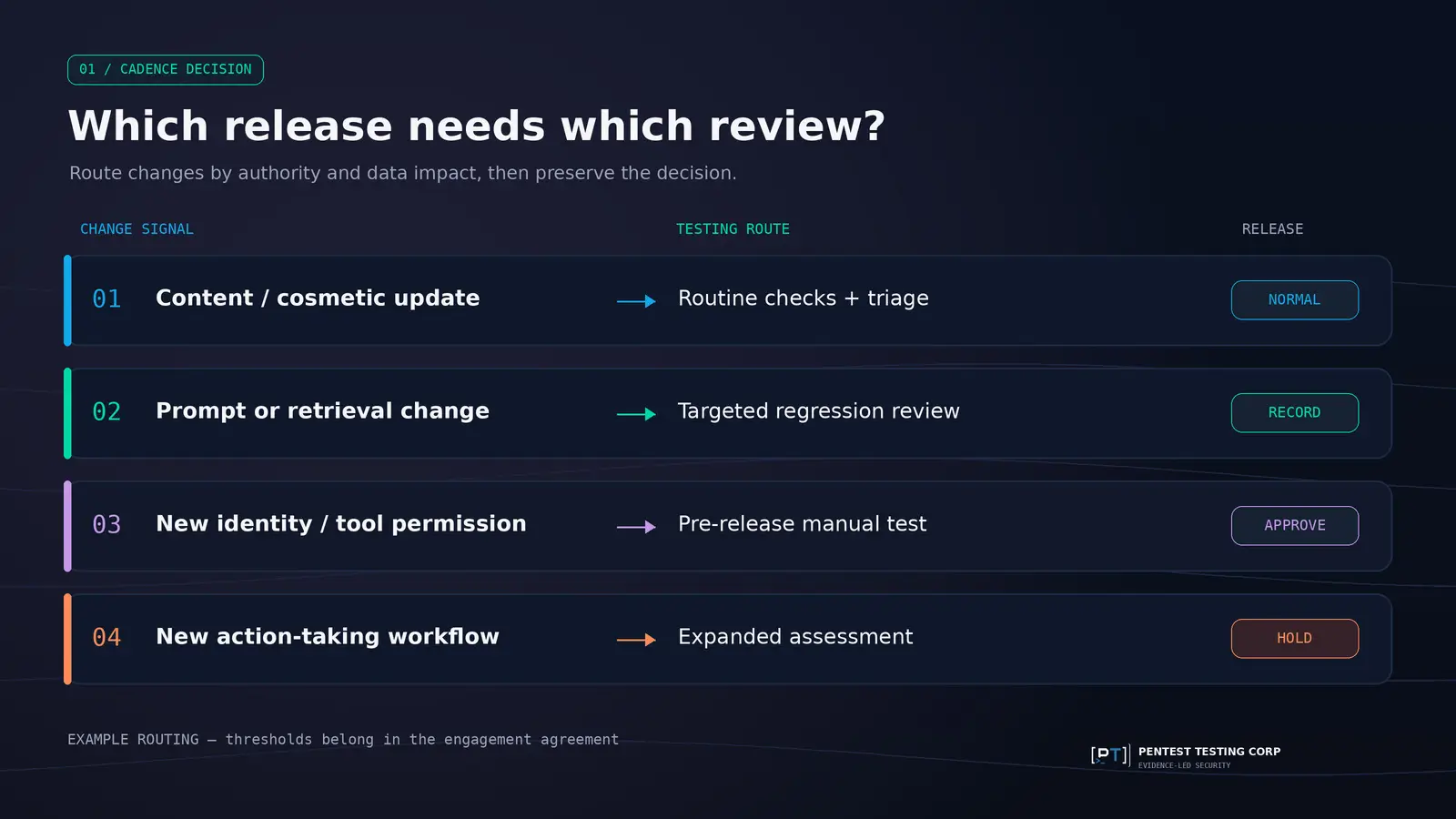
| Release or condition | Suggested testing route | Release decision and evidence |
|---|---|---|
| Copy, styling, or non-security configuration with unchanged AI authority and data access | Routine automated checks and recorded change triage | Normal approval; retain the reason manual testing was not selected |
| Prompt, model, or retrieval update within previously tested boundaries | Relevant regression checks plus targeted human review when behavior or data selection materially changes | Ship under the agreed risk tolerance; record tested versions and any residual uncertainty |
| New tenant role, data source, identity path, or tool permission | Pre-release manual boundary testing with related application and API checks | Require named security approval or a documented exception before exposure |
| New action-taking workflow or substantially changed architecture | Expand the baseline and run a scoped assessment of the new workflow | Hold the high-impact capability until agreed acceptance criteria are met |
| Fix for a validated finding | Independent retest of the finding and adjacent regression paths | Close only with evidence; track any partial fix or risk acceptance |
Define Continuous AI Penetration Testing Release Gates
For each testing route, agree who can hold a release, who can approve an exception, and what evidence is required before deployment. A new high-impact tool or permission should not pass simply because automated checks completed; the named security owner must record the manual review or risk decision.
This is a planning example, not a universal release rule. A low-impact model swap in one product could be consequential in another if it changes tool-selection behavior or handles regulated information. Triage should account for the workflow’s actual permissions, the sensitivity of its data, the reach of the affected feature, contractual commitments, and whether rollback is practical.
Reserve periodic time to inspect accumulated changes even when no single release triggered a larger review. A monthly review of the change inventory and a quarterly examination of the highest-impact workflows may be a useful starting proposal for a weekly-shipping team. They are not prescribed by OWASP or NIST. Adjust them to observed change volume, findings, system criticality, and the capacity purchased. Record postponed reviews so the program does not quietly drift from its baseline.
The service-level terms matter as much as the frequency. Ask how quickly the provider acknowledges a material change, how much notice a pre-release review requires, what happens when several teams request testing in the same week, and whether urgent work displaces planned reviews. A promise of “on-demand testing” without response times or reserved capacity is difficult to operate against a real release calendar.
Integrate testing into CI/CD without pretending the pipeline is a pentester
The integration should be simple enough that release teams use it. A change record or ticket identifies the affected workflow, version, data access, tool permissions, and planned deployment time. Automated checks run in the pipeline or a controlled test environment. A risk rule routes selected changes to the security owner and, where needed, the external tester. The release record then links to the result, approved exception, or pending review. This creates a traceable answer to “what was tested before this capability went live?”
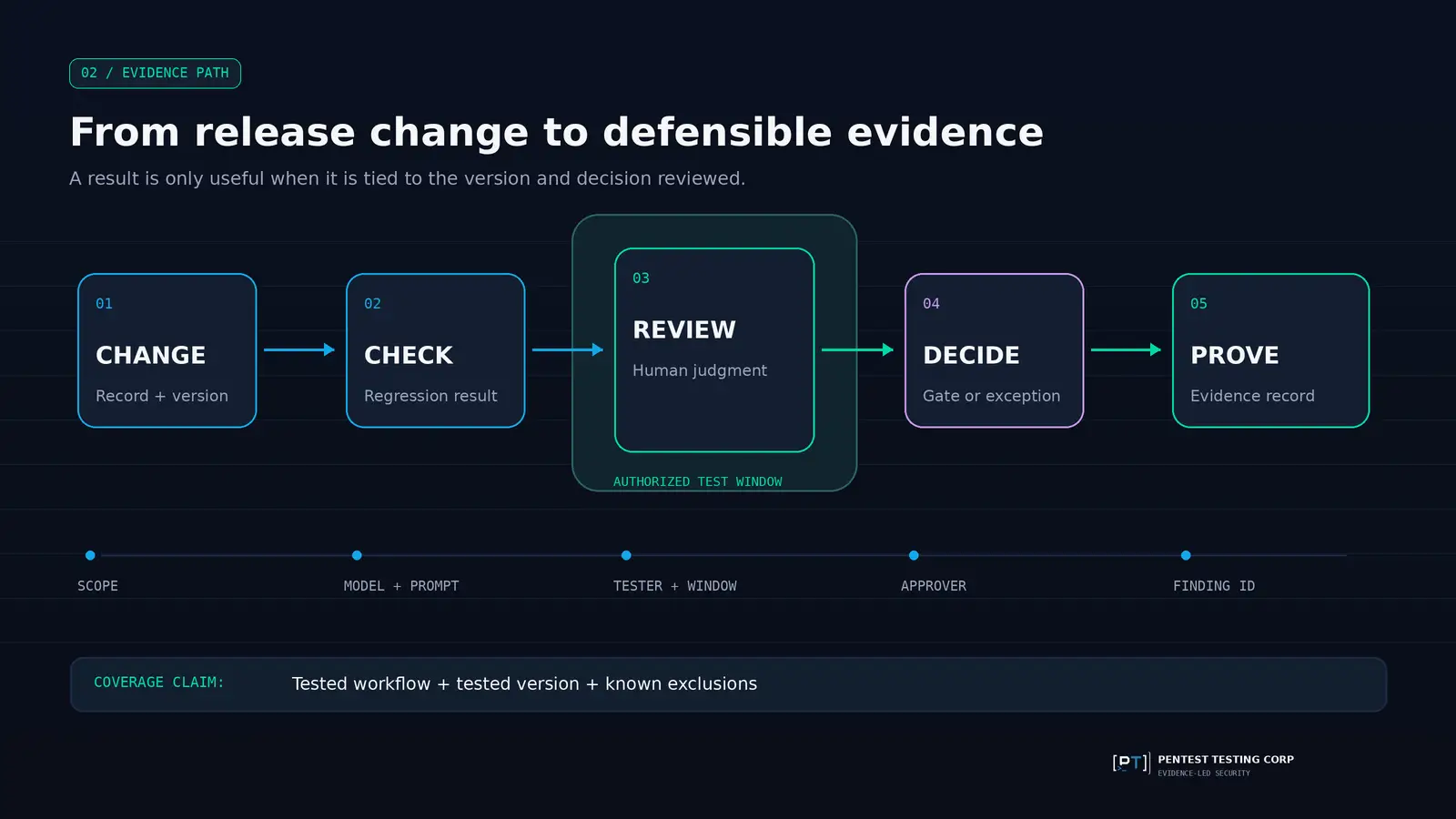
Choose a small number of meaningful gates. A known high-severity authorization regression, a failed tenant-isolation check, or a new high-impact tool without required review can block promotion. A noisy model-response check should usually generate triage rather than an indiscriminate deployment failure. Define who can override each gate, for what reason, for how long, and where that decision is recorded. Otherwise, teams will bypass controls that repeatedly stop safe releases without explaining risk.
Keep manual testing out of the fiction of an instantaneous build step. It needs a usable environment, representative roles and data, authorization to exercise relevant actions, and time to assess context. The provider can receive release notifications and feed findings into the same ticketing system, but its substantive work happens within an agreed review window. Plan the baseline AI penetration test timeline before setting a recurring cadence; an incomplete baseline makes later “regression” claims unreliable.
For each assessed release, preserve a compact evidence record: scope and exclusions; application, model, prompt, tool, and retrieval versions; test environment; automated results; manual reviewer and test window; finding IDs; severity and business impact; fix owner; retest outcome; and release decision. Redact or restrict customer data and sensitive prompts in shared copies. The record should distinguish a successful check from untested behavior, especially when a supplier changed a model outside your release cycle.
NIST’s AI Risk Management Framework Core provides a useful organizing language: Measure covers assessment and monitoring of risk, while Manage concerns response, tracking, and post-deployment change management. The framework is voluntary; mapping a PTaaS workflow to it helps explain decisions but is not a compliance certificate. NIST’s Secure Software Development Framework also supports integrating security practices into the development lifecycle. Neither document dictates that every AI release receive a full manual pentest.
Keep expert testing where business context changes the answer
Two OWASP categories show why an AI testing program needs more than generic scanning. LLM01:2025 Prompt Injection concerns inputs that can alter intended model behavior, including content encountered through external sources. LLM06:2025 Excessive Agency concerns harmful actions enabled by excessive functionality, permissions, or autonomy. The impact of either depends on the specific information and tools connected to the application. A model response that is merely awkward in one product can be consequential in a workflow that edits records or sends messages.
Automate stable assertions: expected access denials, tool allowlists, approval requirements, known regression cases, logging, and the handling of previously validated findings. Have a human investigate whether a changed workflow can cross a trust boundary under realistic conditions, whether apparent model behavior actually produces a business action, and whether a control still works across relevant roles and tenants. Findings should describe observed impact under the tested conditions. They should not claim that one successful or unsuccessful prompt proves universal safety or compromise.
Use a disciplined test process for the human portion: agreed rules of engagement, risk-based test design, safe validation, reporting, and retest. The Penetration Testing Execution Standard’s engagement and reporting structure is useful here, while AI-specific cases should be selected for the product rather than copied mechanically from a framework list. Ask the provider to show how it separates confirmed findings, plausible risks requiring more investigation, and behaviors that are expected under the product design.
Hypothetical scenario: A B2B support platform uses an assistant to summarize tickets and draft responses. Its quarterly assessment covered a read-only workflow. Six weeks later, a release lets the assistant create a refund request through an internal tool. Automated checks confirm that the endpoint requires authentication, but the release-intake rule flags a new financial action. During authorized manual review in a test tenant, the team finds that the workflow can submit a request without the approval step leadership expected. The company pauses that capability, narrows the tool permission, documents the fix, and commissions a targeted retest. The relevant business result is avoiding an unapproved transaction path and having defensible evidence for the next customer review. This is an illustration, not a client engagement or a claim about a particular product.
A useful program also reports what it did not establish. If the tester lacked access to a third-party integration, if a model version changed after the test, or if one tenant role was unavailable, the report should state that limitation. This protects leadership from treating a narrow result as a general assurance statement.
Price the engagement by capacity, scope, and evidence
There is no credible single PTaaS price for every AI system. The number of workflows, release volume, connected tools, test environments, manual review days, and evidence requirements all affect effort. Pentest Testing Corp’s live AI service page lists a starting price for a scoped AI penetration testing engagement; it does not publish a recurring AI PTaaS rate. Obtain a proposal for the standing model rather than multiplying a one-time starting figure by twelve or assuming retests cover every future feature.
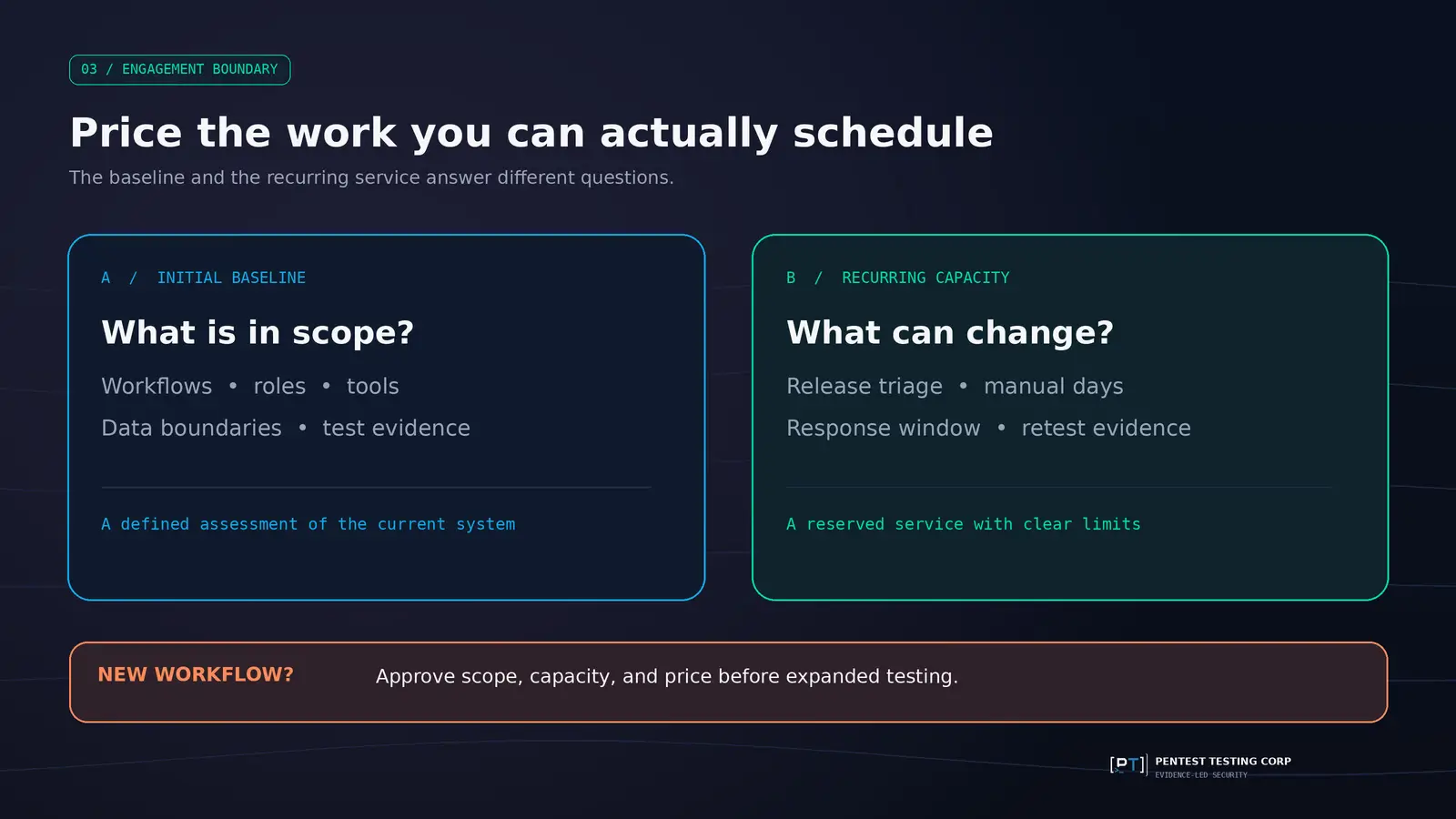
A reviewable proposal separates a one-time baseline from the recurring service. The recurring portion can reserve a defined amount of analyst capacity, a monthly change-triage meeting, a specified number or class of targeted reviews, finding verification, and reporting. State whether unused capacity rolls forward, when overflow is quoted, how urgent requests are priced, and what counts as a new assessment. These are commercial options to negotiate, not claims about a currently advertised package.
| Item | Question to put in the proposal | Common budget risk if omitted |
|---|---|---|
| Initial baseline | Which workflows, roles, tools, environments, and reporting outputs are included? | Recurring checks are built on an incomplete picture. |
| Reserved manual capacity | How many review days or work units are available, and with what response time? | “Continuous” coverage competes with other customers’ schedules. |
| Change intake and expansion | Who classifies releases and approves work beyond the baseline? | Frequent change orders or silently untested features. |
| Retest and reporting | Which fixes are verified, how often are reports issued, and what evidence is retained? | Tickets close without independent proof or usable customer evidence. |
| Urgent work and termination | What are the escalation terms, data-handling terms, and evidence handover terms? | Unplanned fees and loss of the testing history. |
Compare the cost with the work it displaces. An engineering team will still own fixes, change descriptions, access to test environments, and release decisions. External testing adds independent assessment and verification; it does not become a substitute product-security owner. Request a sample report and ask the questions to ask an AI pentest provider about manual depth, scope exclusions, evidence, and how conclusions are reviewed. A low subscription fee is poor value if every meaningful tool or tenant change is billed as a separate full engagement.
What leadership should decide before buying PTaaS
First, identify the business outcomes that justify recurring testing. Are you trying to approve weekly releases safely, shorten the time between a material change and independent review, demonstrate current coverage to an enterprise customer, or reduce the backlog of unverified fixes? Choose two or three measurable outcomes. A dashboard count of tests run is less useful than knowing how many material changes received a testing decision before release and how long high-risk findings remained open.
Second, name the internal owners. Product or engineering should supply the change inventory and implement fixes. Security should classify risk and maintain the test plan. A release authority should approve holds and documented exceptions. A compliance or procurement owner may need a versioned evidence package for customer requests. If your team is still establishing the first assessment, the startup AI assessment scope offers a smaller starting point. Once findings arrive, assign owners to pentest remediation, so a recurring service does not become a recurring list of the same open issues.
Third, approve the service boundary and the release policy together. List the workflows in scope; define material changes; set manual capacity and response windows; identify which failures hold a release; and assign exception authority. Agree on safe testing conditions, especially where production data or action-taking integrations are involved. Record how the provider will report coverage gaps and when accumulated changes require a new baseline.
Finally, set a review point. After the first operating period, compare promised capacity with actual release volume, material changes reviewed, findings verified, time to decision, and customer evidence requests. Expand, reduce, or redirect the program based on those results. A good PTaaS contract should be adjustable when the product’s risk and release pattern change.
Frequently asked questions
Does PTaaS mean a human tests every AI deployment?
No. The agreement should state which deployments receive automated checks, documented triage, targeted human testing, or a broader assessment. Claiming every weekly release gets a full manual pentest requires capacity and time many teams don't have.
Can our existing bug bounty replace a standing AI pentest engagement?
A bug bounty can bring useful outside reports, but its coverage and timing depend on researcher interest and its rules. If leadership needs a named scope, scheduled review, authorized test accounts, and evidence by a release date, purchase those outcomes explicitly.
What if our model provider updates the model without our deployment?
Keep provider and model-version changes in the change inventory. If the update could affect output, retrieval, tool selection, or safety assumptions, run the agreed checks and consider targeted human review. The necessary response depends on the provider’s change controls and the authority your application gives the model.
Should the testing provider have production access?
Only where production behavior is necessary to answer a scoped question and the organization has approved safe methods, access limits, data handling, and rollback arrangements. A representative isolated environment is often preferable for action-taking tests. Document any differences that limit the conclusion.
How should an enterprise buyer read a continuously updated report?
It should identify the baseline, the latest reviewed versions and workflows, the period covered, open findings, retest outcomes, and material exclusions. Do not present a historic report date as proof that later capabilities were independently assessed.
When should we commission a new baseline instead of consuming recurring review time?
Consider a new baseline when the architecture, customer-data boundary, agent autonomy, integration set, or business purpose changes enough that the original workflow inventory no longer describes the system. The provider should explain the expansion before using recurring capacity for a fundamentally new assessment.
Can PTaaS demonstrate compliance with the NIST AI RMF?
It can supply evidence for an organization’s Measure and Manage practices, such as testing, tracking, and response to changes. The AI RMF is voluntary and wider than penetration testing. A PTaaS report alone does not establish conformity with every part of the framework or satisfy a separate audit obligation.
Conclusion: buy a decision process, not a frequency label
For a team shipping AI features weekly, the useful question is not “How often can we run a pentest?” It is “How will each meaningful change receive the right review before we rely on the previous evidence?” A practical standing engagement starts with a defined baseline, routes releases by risk, reserves human attention for consequential boundaries, verifies fixes, and shows leadership exactly what the current evidence covers.
If you are comparing recurring testing models, bring your release cadence, workflow inventory, tool permissions, and latest findings to a scoping discussion. Pentest Testing Corp can review the AI assessment boundary and the remediation and verification work needed to close risk. Ask for a written proposal that specifies cadence, capacity, exclusions, and evidence before calling the arrangement continuous.