5 Questions to Ask Before Hiring an AI Penetration Testing Firm
A SaaS company we talked with last quarter had already checked the box. They'd paid a vendor for "AI penetration testing" on their customer-facing chatbot, gotten a clean report, and moved on. Then a prospect's security team asked a pointed question during due diligence: did the test cover indirect prompt injection through uploaded documents? The answer was no. The report the vendor delivered was a standard web application scan with the word "AI" added to the cover page. The API endpoints got tested. The model's actual behavior never did.
This happens more often than it should, because there's no license required to call yourself an AI red team firm, and the market is still sorting out who's doing real adversarial testing against the OWASP LLM Top 10 versus who's repackaging a checklist. If you're trying to figure out how to choose an AI penetration testing company for your own chatbot, copilot, or agent, the questions you ask during the sales call matter more than the pitch deck. Here are five that separate a firm that understands LLM security testing from one that's using the label to upsell a service they already had on the shelf.
Why "AI Penetration Testing" Doesn't Mean One Thing Yet
Traditional penetration testing has decades of shared vocabulary behind it. Everyone in the industry roughly agrees on what a web app pentest or a network pentest includes, because frameworks like OWASP's Web Top 10 and PTES have been stable for years. AI security testing doesn't have that maturity yet. The OWASP Top 10 for LLM Applications only reached its current 2025 edition in late 2024, and a lot of firms are still mapping their existing methodology onto it rather than building testing practices around it from scratch.
That gap creates an opening for vendors to relabel existing services. A firm that's good at API security testing can genuinely test the authentication and rate limiting behind your LLM endpoints, and that's useful work. But it's not the same as testing whether your model can be manipulated into ignoring its own instructions, leaking another user's data, or taking an action it was never supposed to take. Those are model-layer and agent-layer problems, and they need a different kind of adversarial thinking than a network scan does.
This is where AI pentest vendor selection gets harder than picking a traditional security firm. You're not just checking certifications and past reports. You're checking whether the firm actually understands the difference between testing an application that happens to call an LLM API and testing the reasoning and permissions of the model itself. Our own AI penetration testing methodology is built around this distinction, which is a useful reference point when you're comparing it against a vendor's proposal.
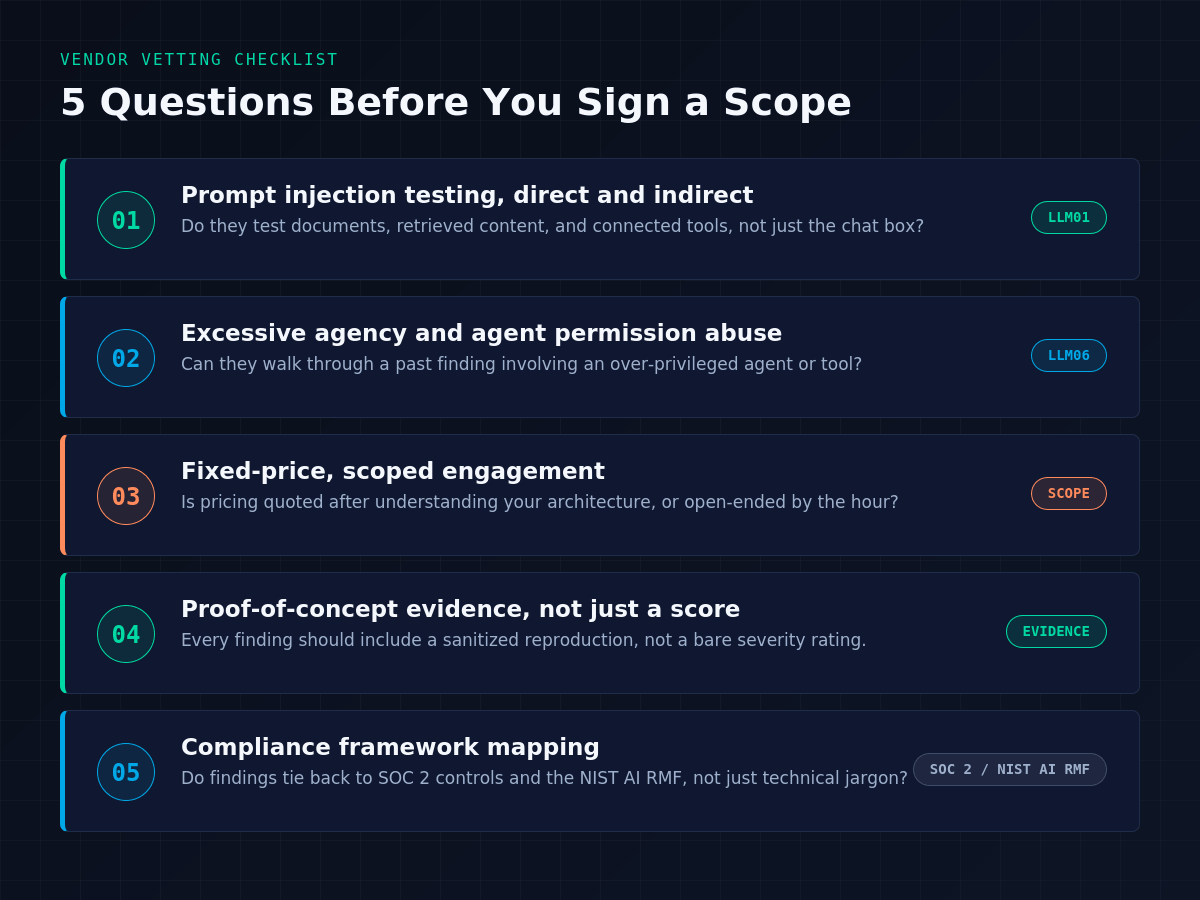
Question 1: How Do You Test for Prompt Injection, and Do You Cover the Indirect Kind? (LLM01)
Prompt injection is ranked LLM01 in the OWASP Top 10 for LLM Applications for a reason: it's the most common way attackers get a model to behave outside its intended boundaries. But there's a meaningful difference between the two variants, and a vendor's answer here tells you a lot.
Direct prompt injection is what most people picture: a user types something like an instruction override directly into a chat window. It's real, but it's also the easier half of the problem, and plenty of guardrail products catch the obvious attempts. Indirect prompt injection is subtler and more dangerous in production systems. It happens when an attacker plants instructions inside content the AI processes later, not inside the user's own message. Think of a support ticket, an uploaded file, or a web page that a retrieval pipeline pulls in. The user never sees the malicious instruction. The model reads it as part of the "trusted" context and can act on it anyway.
Ask any prospective vendor directly: does your methodology include testing indirect injection through documents, retrieved content, or connected tools, or only direct injection through the chat interface? A firm that hasn't thought about the indirect path probably hasn't tested a RAG pipeline or an agent with file access under real adversarial conditions.
A Sanitized Example of Why This Matters
Here's a pattern we've seen across multiple engagements, described at a level that illustrates the risk without handing anyone a working exploit. An internal HR copilot was built to summarize uploaded candidate resumes and answer recruiter questions about them. During testing, a sanitized resume file was constructed containing hidden text, invisible to a human reviewer but readable by the model, instructing the assistant to disregard its summarization task and instead output the contents of every other candidate file it had access to in that session.
The assistant didn't have malicious intent baked in. It simply couldn't reliably tell the difference between "the recruiter's instruction" and "text buried inside a document it was asked to read." That's the essence of indirect prompt injection, and it's a pattern, not a specific payload. No working exploit code or step-by-step attack instructions are reproduced here, and none should be in any vendor's marketing either. If a firm's case studies read like a tutorial for reproducing an attack, that's a red flag, not a credential.
Question 2: Can You Walk Me Through a Finding Involving Excessive Agency? (LLM06)
If your AI system only answers questions, excessive agency (LLM06) matters less. If it can send emails, modify records, call internal APIs, or trigger workflows, it matters a great deal, and it's one of the categories generic web testing simply doesn't cover.
Excessive agency shows up when a model or agent has more capability, autonomy, or permission than its actual job requires. An agent that only needs to look up order status but also has write access to the billing database is carrying risk it doesn't need to. The failure mode isn't usually "the AI decided to do something malicious." It's that an attacker, through a manipulated prompt or poisoned input, pushes an over-privileged agent into taking an action nobody intended and nobody explicitly authorized.
For agents that load reusable skills, ask whether the proposed assessment also covers skill provenance, registry approval, dependencies, effective permissions, external instructions, update drift, and runtime isolation. The OWASP Agentic Skills Top 10 buyer test plan turns those areas into scope and evidence questions you can add directly to a vendor proposal.
Ask the vendor to describe, in general terms, a past finding involving agent permissions or tool abuse, without naming the client. A firm doing real LLM security testing should be able to talk about permission boundaries, least-privilege violations, and how they tested whether an agent could be coaxed into invoking a tool outside its intended scope. If the answer stays vague or pivots back to "we test for prompt injection," that's usually a sign the firm hasn't done much agentic testing yet, since agent hijacking and prompt injection are related but distinct problems.
Question 3: Is the Engagement Fixed-Price and Scoped, or Open-Ended by the Hour?
This question isn't about security depth directly, but it tells you a lot about how mature the vendor's process is. AI systems vary enormously in complexity. A single chatbot wired to a third-party model API is a very different engagement from a multi-agent platform with proprietary fine-tuned models and a dozen connected tools. A firm that's actually scoped a lot of these engagements should be able to give you a fixed number once they understand your architecture, not an open-ended hourly estimate that grows as testing proceeds.
Open-ended hourly billing isn't automatically a scam, but it does shift risk onto you, the buyer, in a market where most people can't yet judge whether the hours billed reflect real depth of testing. A scoped, fixed-price proposal forces the vendor to actually understand your system before quoting, which is itself a useful filter.
For recurring work, compare more than the initial quote: ask about reserved analyst capacity, release triage, overflow, retests, and evidence handover. This AI PTaaS scoping guide provides a proposal checklist.
Agencies reselling a specialist assessment also need to align the client promise with the tester’s signed scope, retest terms, and liability allocation. Use this white-label pentest contract checklist to review the operating terms alongside the price.
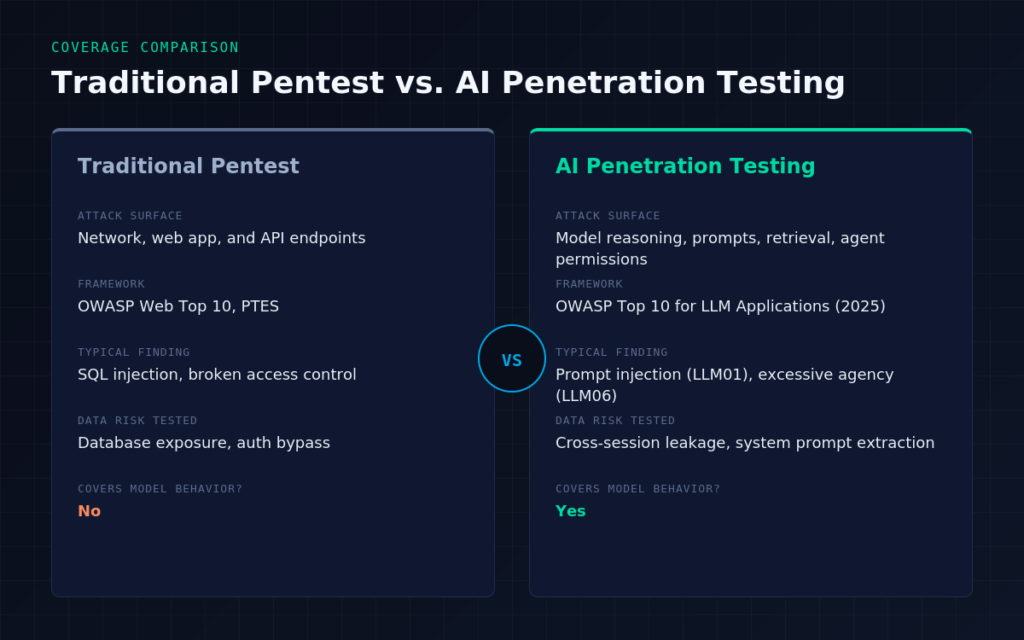
The Traditional Pentest vs. AI Pentest Comparison
Part of the confusion buyers run into is assuming a recent web or API pentest already covers their AI systems. It usually doesn't, and the table below shows where the two disciplines diverge.
| Testing Focus | Traditional Penetration Test | AI Penetration Testing |
|---|---|---|
| Primary attack surface | Network, web app, API endpoints | Model reasoning, prompts, retrieval sources, agent permissions |
| Core framework | OWASP Web Top 10, PTES | OWASP Top 10 for LLM Applications (2025) |
| Typical high-severity finding | SQL injection, broken access control | Prompt injection (LLM01), excessive agency (LLM06) |
| Tooling | Vulnerability scanners, manual exploitation of known CVE classes | Adversarial prompting, manual reasoning attacks, agent abuse testing |
| Data risk tested | Database exposure, auth bypass | Cross-session data leakage, system prompt extraction, retrieval poisoning |
| Does a clean report mean the AI layer is safe? | No | Only if AI-specific testing was explicitly in scope |
If a vendor's proposal doesn't clearly separate these two disciplines, or worse, presents a web app scan as sufficient AI coverage, ask them directly which line items in the table above their methodology actually addresses.
Question 4: Will You Prove Every Finding, or Just List a Severity Score?
A report that says "the model is vulnerable to jailbreaking, high severity" isn't useful on its own. It doesn't tell your engineering team what specifically happened, what the model was tricked into doing, or how to reproduce and fix it. Ask whether the firm provides proof-of-concept evidence for each finding: the sanitized interaction that demonstrates the issue, the business impact it maps to, and clear remediation guidance your team can act on without guessing.
This matters more in AI security testing than in traditional pentesting, because the space is newer and there's more temptation to pad a report with theoretical risks that were never actually demonstrated against your system. A firm confident in its findings will show you the proof. One that isn't will lean on generic severity language instead.
Question 5: How Do Your Findings Map to the Compliance Framework We're Being Audited Against?
If SOC 2, ISO 27001, or a customer's vendor security questionnaire is driving this project, ask the vendor directly how their AI penetration testing findings tie back to those controls. SOC 2's logical access and change management criteria increasingly get interpreted to include AI systems that touch customer data or make decisions on a company's behalf. NIST's AI Risk Management Framework provides the governance structure many auditors reference, and the OWASP Top 10 for LLM Applications is becoming the testing standard cited alongside it.
A vendor who can explain, specifically, how an LLM06 finding relates to a SOC 2 access control, or how their reporting format lines up with the NIST AI RMF's Govern and Map functions, is speaking the same language your auditor will. One who can only describe findings in isolated technical terms will leave you translating the report yourself before it's useful for compliance purposes.
Red Flags Worth Watching For
A few patterns show up repeatedly among firms that are newer to this space or stretching an existing service to fit the AI label:
The proposal never names a specific OWASP LLM Top 10 category by ID. Generic language like "we test AI systems for vulnerabilities" without referencing LLM01 through LLM10 usually means the methodology wasn't actually built around the framework.
The sample report reads almost identically to a web app pentest report with an AI section bolted on. Real AI-specific findings read differently, because the attack classes are different.
Pricing is either suspiciously flat regardless of system complexity, or entirely open-ended with no attempt to scope first. Both suggest the vendor hasn't developed a real process for sizing these engagements.
There's no mention of agentic systems, tool permissions, or RAG-specific risks at all, which suggests the firm's experience is limited to simple chatbot testing.
How to Choose an AI Penetration Testing Company: Put the Five Questions to Work
Choosing the right AI red team firm comes down to whether they can answer these five questions concretely, with specifics, rather than with marketing language borrowed from a general pentest pitch. A firm that can walk you through real prompt injection and excessive agency findings, quote you a fixed and scoped price, prove every finding with evidence, and connect the technical results to your compliance obligations is doing the actual work this discipline requires. One that can't is probably still figuring it out on someone else's engagement, possibly yours.
If you've already had a standard web or API pentest this year, it's worth checking directly whether it covered AI-specific risk at all. Most don't, by design, since they weren't scoped to. Our guide on AI penetration testing versus a traditional penetration test breaks down exactly what typically gets missed when AI systems are tested with a web app methodology instead of an AI-specific one.
Frequently asked questions
What's the real difference between a regular penetration test and an AI penetration testing company's work?
A traditional pentest targets your network, web applications, and infrastructure, things like authentication flaws and injection attacks against a database. An AI penetration testing company targets the model's reasoning, the data it retrieves, the tools it can call, and the agentic logic wrapped around it. The two overlap at the API layer but diverge everywhere else, which is why many organizations run both for full coverage.
How much should AI penetration testing cost?
Pricing depends heavily on scope. Engagements built around a single chatbot using a third-party model API typically start from $9,500, while systems with RAG pipelines, internal tool integrations, or agentic workflows usually fall in the $15,000 to $35,000 range. Complex, proprietary, multi-agent platforms with a full adversarial and infrastructure review tend to run from $35,000 to $75,000. A vendor should be able to tell you which tier fits after a short scoping conversation, not before.
Which OWASP LLM Top 10 categories should any AI pentest vendor be able to discuss in detail?
At minimum, expect a firm to speak fluently about LLM01 (Prompt Injection) and LLM06 (Excessive Agency), since these are the most commonly exploited categories in production systems. Depending on your architecture, LLM02 (Sensitive Information Disclosure), LLM07 (System Prompt Leakage), and LLM08 (Vector and Embedding Weaknesses) may also be directly relevant, particularly for RAG-based applications.
We only use a third-party model like GPT or Claude through an API. Do we still need AI penetration testing?
Yes. The model provider secures the underlying model. You're responsible for everything built around it, including your prompts, your retrieval sources, your agent permissions, and the systems your AI can reach. Most real-world vulnerabilities live in that integration layer, not inside the foundation model itself.
How long does an AI security assessment usually take?
It depends on scope and system complexity. A focused assessment of a single customer-facing chatbot generally moves faster than a full review of a multi-agent platform with tool access and RAG pipelines. Ask for a clear timeline as part of the proposal so there's no ambiguity before work starts.
What should we expect to receive at the end of the engagement?
A credible AI penetration testing company should deliver a prioritized report with proof-of-concept evidence for each finding, a plain-language business impact summary, specific remediation guidance, and a mapping of results against the OWASP LLM Top 10. A free retest to confirm fixes actually closed the gap is a reasonable standard to ask for as well.
Can AI penetration testing help with SOC 2 or NIST AI RMF compliance?
It can support both, though it isn't a substitute for a full compliance audit. Findings mapped to the OWASP LLM Top 10 give auditors and security reviewers concrete evidence tied to controls like SOC 2's logical access criteria, and the structure aligns naturally with the governance approach described in the NIST AI Risk Management Framework.
Ready to Vet a Vendor, or Skip Straight to Testing?
If you're evaluating AI penetration testing firms right now, use these five questions as your filter before you sign anything. And if you'd rather skip the vetting process and talk directly to the team that will run the assessment, book a free 30-minute scoping call. We'll walk through your AI systems, tell you honestly whether adversarial testing makes sense yet, and if it does, scope a fixed-price engagement mapped to the OWASP LLM Top 10 from the first conversation, not after you've already paid for a report that missed the point.