Computer-Use AI Agent Security Testing Before Launch
A product team is ready to ship an AI agent that can open a browser, sign in to a CRM, read customer records, download files, update tickets, and submit changes. Functional QA proves the happy path works. SSO is enabled. The browser session is sandboxed. The model provider publishes its own safety evaluations. Yet none of those facts answers the launch question leadership actually owns: what happens when the agent reads hostile or misleading content, inherits the wrong session, receives an ambiguous request, or tries to complete a valid task in an unsafe way?
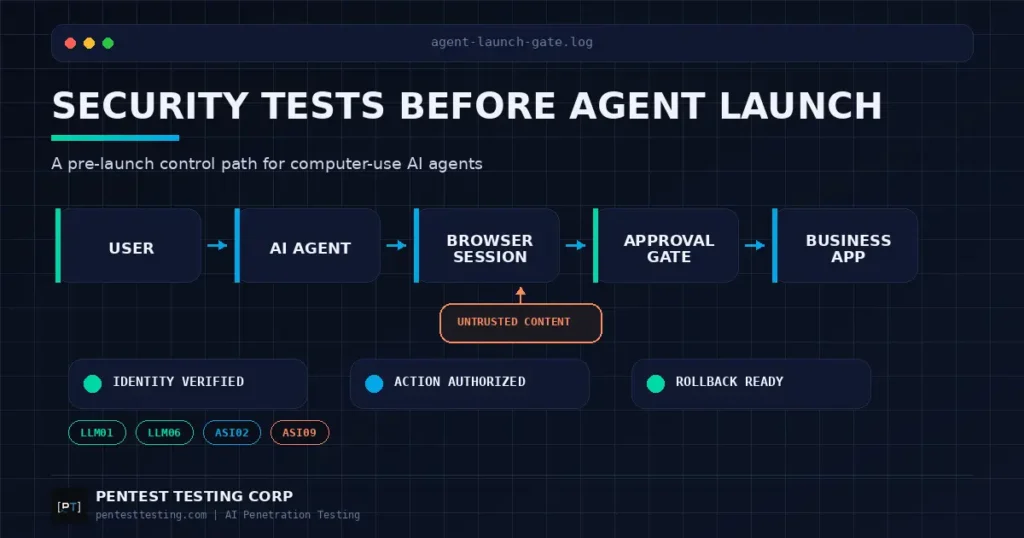
Computer-use AI agent security testing is the pre-launch work that turns that question into evidence. The objective is not to prove a model is perfectly safe. It is to verify that the product limits what the agent can see, which actions it can take, whose authority it uses, when a human must approve an action, and how the business can stop or reverse a harmful outcome.
For a computer-use agent, “the demo worked” is a product milestone. It is not a security sign-off.
Why computer-use AI agent security testing is now a launch gate
Computer-use agents change the security problem because the execution surface is broader than a conventional chatbot or narrow function-calling integration. An agent may navigate web applications, interpret pages visually, download and upload files, reuse authenticated sessions, copy data between systems, and make a sequence of decisions before a human sees the result.
Recent model releases make that distinction commercially important. OpenAI’s July 9, 2026 GPT-5.6 announcement highlighted stronger computer use and a high-capability mode that coordinates multiple agents across parallel workstreams. Its system card separately evaluates accidental data-destructive actions, user confirmations during computer use, and prompt-injection attacks against connectors, search, and function calling. Anthropic’s July 24 Claude Opus 5 announcement reports strong results on a computer-use benchmark and end-to-end business-task automation, while also describing longer-horizon agentic workflows.
Pentest Testing Corp’s AI penetration testing service already covers AI agents, tools, files, external systems, prompt injection, excessive agency, authorization boundaries, evidence, remediation, and retesting. A computer-use launch gate narrows that broad methodology to one decision: is this specific agent ready to receive production authority?
Define authority and blast radius before testing
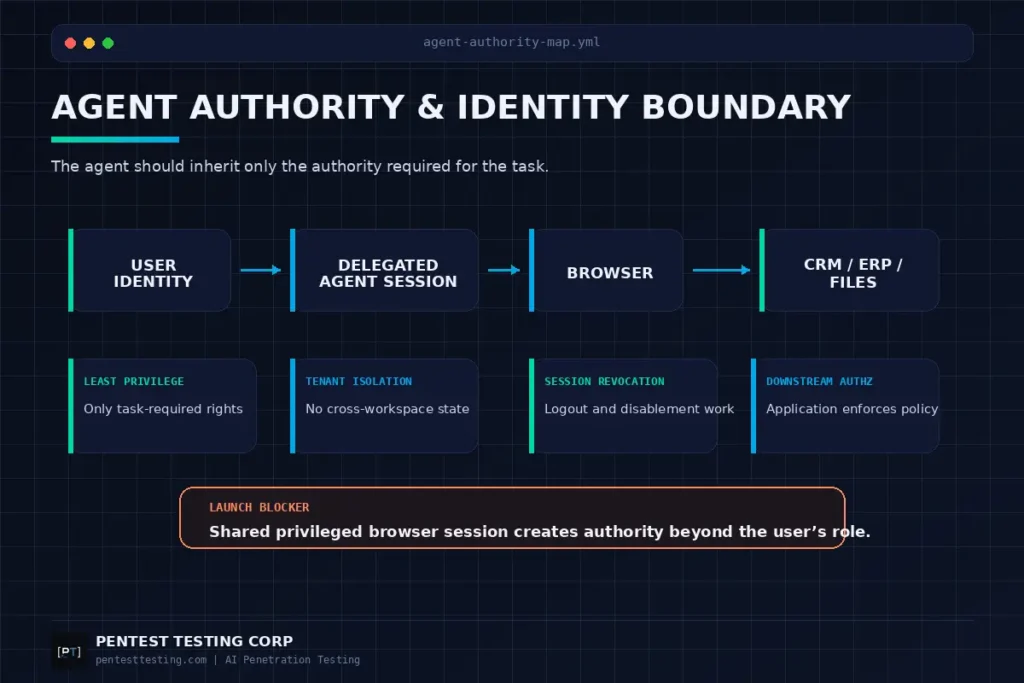
A meaningful assessment starts with authority, not prompts. Before testing, the team should be able to describe the maximum business impact the agent could create if its reasoning, context, or user request went wrong.
That requires an inventory of five things.
1. Systems the agent can operate. List browsers, internal portals, CRM, ERP, ticketing, email, cloud consoles, file repositories, finance tools, and any other application the agent can reach. Include systems reached through APIs as well as those reached through the user interface.
2. Identities and sessions it can use. Record whether the agent operates under the end user’s delegated identity, a service account, a shared browser profile, a privileged automation account, or a mixture. Include how tokens, cookies, API keys, and refresh credentials are created, stored, rotated, revoked, and separated between users or tenants.
3. Action classes. Separate read-only actions from changes that create financial, legal, operational, privacy, or security impact. A useful model is: observe, draft, propose, execute reversible change, execute high-impact or hard-to-reverse change.
4. Data boundaries. Define which tenant, customer, workspace, geographic region, environment, and data class the agent is allowed to access. If a browser session can reach more than the product policy allows, the enforcement point must be identified outside the model.
5. Recovery path. For every material write action, document whether it can be rolled back, how quickly, by whom, and from what evidence. If an action cannot be reversed, the approval and prevention threshold should be higher.
For broader context on how tool access changes the risk profile, see the cost of an unsecured AI agent. For a protocol-specific tool boundary, MCP security testing before production covers identity, authorization, data boundaries, and evidence across MCP-enabled workflows.
What computer-use AI agent security testing should prove
The test plan should be written around business claims that must be true at launch. The following seven areas are the minimum set leadership should expect for an agent that can operate browsers, files, or business applications.
1. Untrusted content cannot silently redefine the agent’s goal
Computer-use agents routinely consume untrusted content: webpages, search results, email, tickets, documents, comments, and files. Some of that content may contain instructions that conflict with the user’s intent or the product’s policy.
Testing should evaluate whether indirect prompt injection or misleading context can move the agent from a permitted task into an unauthorized one. The objective is not to collect clever jailbreaks. It is to prove whether untrusted content can influence a consequential action.
A passing result means the agent treats external content as data, higher-priority instructions remain effective, and downstream controls still block prohibited actions even if the model is persuaded to attempt them. A launch blocker exists when a page, file, or message can redirect the workflow into accessing a different account, exporting information, changing records, or initiating another sensitive action without an independent control stopping it.
This maps directly to OWASP LLM01:2025 Prompt Injection and ASI01 Agent Goal Hijack. A standard web or API pentest does not automatically answer this question; our prompt-injection scope breakdown explains why the AI-specific behavior must be named in scope.
2. Authorization is enforced by the application, not by the model
The model can decide what it wants to do. It should not be the final authority on whether the action is allowed.
Testing should attempt actions that are outside the current user, role, tenant, resource, or workflow boundary and verify that the application or downstream system denies them. That includes direct tool calls and browser-mediated actions. The control should survive alternate navigation paths, stale pages, changed object identifiers, and sequences in which the agent reaches the same business function through a different screen.
This is the practical intersection of ASI02 Tool Misuse, ASI03 Identity & Privilege Abuse, and LLM06 Excessive Agency. OWASP’s LLM06 guidance explicitly recommends authorization in downstream systems rather than relying on the LLM to decide whether an action is permitted.
For leadership, the pass condition is strong: prohibited actions fail even when the model attempts them. “The system prompt tells the agent not to do that” is not an authorization control.
3. Credentials and browser sessions are scoped, isolated, and revocable
Computer-use introduces a difficult identity question because the agent may inherit the authority of an already-authenticated browser.
The assessment should verify who owns the session, whether different users or tenants receive isolated browser profiles, whether credentials persist between tasks, whether cookies or tokens can cross workspace boundaries, and whether logout, account disablement, password changes, or permission changes actually revoke the agent’s access.
Shared privileged browser sessions are particularly risky because they can convert a behavioral error into a broad authorization failure. The safer pattern is delegated or task-specific identity with the minimum permissions needed for the operation, plus short-lived or revocable credentials where the architecture supports them.
The security test should also check handling of secrets during screen rendering, downloads, logs, traces, screenshots, and debugging. A control is incomplete if production credentials are protected in a secret manager but then exposed in an agent trace or reusable browser profile.
4. High-impact actions require meaningful approval
Human approval is useful only when the human understands what is being approved.
Testing should inspect the approval boundary for actions such as sending external communications, changing permissions, submitting payments or refunds, deleting records, uploading sensitive files, or making production changes. The confirmation should identify the action, target, material impact, and relevant account or environment. A generic “Continue?” prompt can become a rubber stamp, particularly in long workflows where the user is already primed to trust the agent.
The test should also verify that the agent cannot bypass the approval step by taking an equivalent action through another route, splitting one high-impact action into several smaller ones, or acting under a privileged session that the confirmation layer does not mediate.
This is where ASI09 Human-Agent Trust Exploitation matters. The risk is not simply that a user can be deceived. It is that the product may present confident agent output in a way that encourages authorization without enough context to make a sound decision.
5. Sessions, files, and workspaces stay isolated between tasks
A computer-use agent accumulates state. Open tabs, downloads, clipboard contents, temporary files, browser history, cached application data, and remembered context can all survive longer than the business task that created them.
Testing should verify isolation between users, tenants, workspaces, and sequential tasks. One user’s authenticated tab, downloaded report, or copied value must not become input to another user’s run. The same principle applies to test and production environments: a staging task should not inherit production credentials or vice versa.
For SaaS products, this is a standard multi-tenant security concern expressed through a new execution channel. The model may be the component that notices and uses stale state, but the underlying control requirement remains familiar: enforce tenant and user boundaries outside the model and clear state when the task ends.
6. Destructive actions have prevention, rollback, and stop controls
A launch test should not intentionally damage production data. It should safely validate the controls that would prevent or contain destructive outcomes.
For reversible actions, test whether the system records enough information to restore the prior state and whether the rollback process works in a controlled environment. For hard-to-reverse actions, verify that stronger authorization, approval, rate, or environment controls apply before execution.
The team should also have a kill switch or deactivation path that works independently of the agent. NIST’s AI RMF Playbook includes contingency, deactivation, recovery, change-management, and post-deployment testing concepts in the MANAGE function. That matters because a good launch plan assumes that some failures will only become visible after real-world use.
A security sign-off should therefore answer three questions: Can we prevent the highest-impact action? Can we stop the agent quickly? Can we reconstruct and, where possible, reverse what happened?
7. Logs can reconstruct the decision and the action
“AI logs enabled” is not enough. The evidence has to support incident response, engineering remediation, and security review.
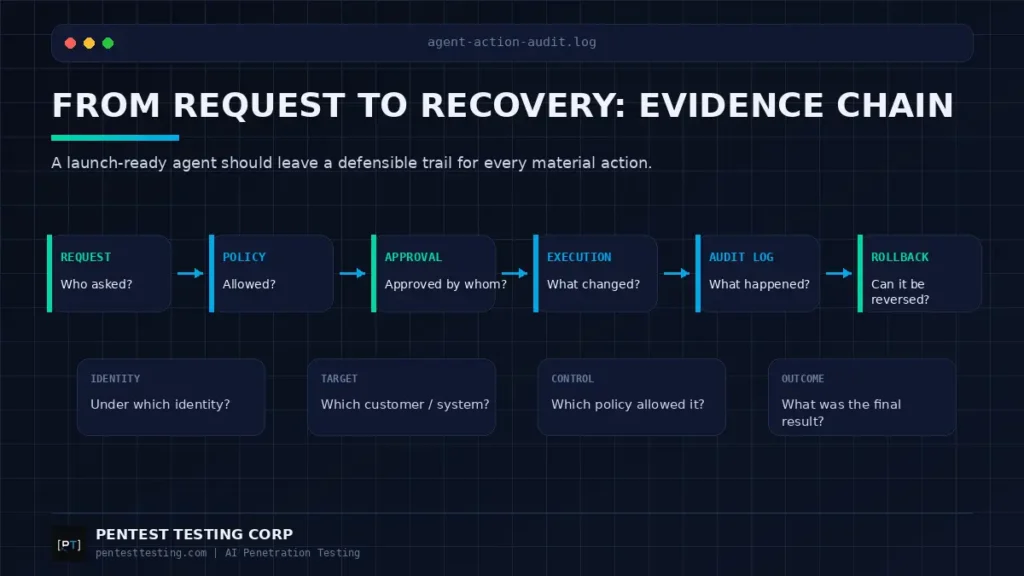
For consequential actions, the audit trail should identify the initiating user or system, the agent or workflow, the relevant model/version, the credential or delegated identity, the target application, the proposed action, whether approval was required and granted, the actual action submitted, the response from the downstream system, and the final outcome.
That evidence also helps during enterprise review. Our AI red teaming vendor questionnaire guide explains why buyers increasingly care about scope, methodology, findings, remediation status, and independent retest evidence rather than a simple “AI security reviewed” checkbox.
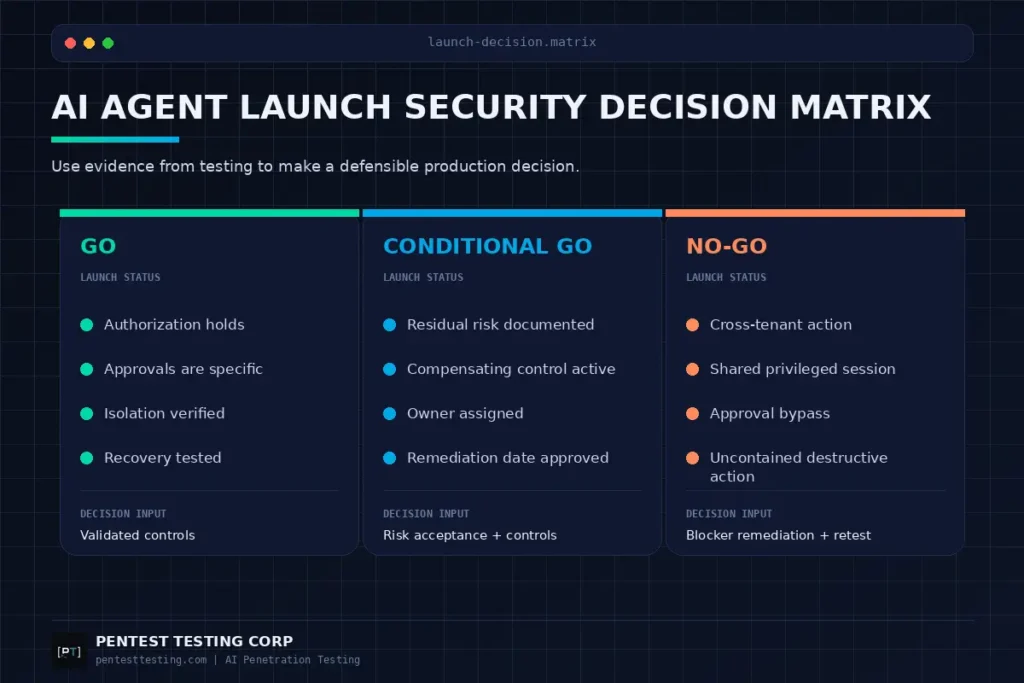
Go/no-go launch matrix for computer-use agents
Leadership should agree on launch criteria before the assessment begins. Otherwise, teams tend to debate severity after a finding appears and the release date is already under pressure.
| Test area | Minimum pass condition | Launch blocker | Evidence to retain |
|---|---|---|---|
| Goal integrity | Untrusted content cannot cause a prohibited business action; independent controls still enforce policy | External page, message, or file can redirect the agent into a material unauthorized action | Test scenario, expected vs. observed behavior, affected workflow |
| Action authorization | Downstream systems enforce user, role, tenant, object, and workflow permissions | Agent can complete an action only because its model or prompt “decided” it was allowed | Authorization matrix, denied-action evidence, control location |
| Identity and credentials | Sessions are per-user or appropriately delegated, least-privileged, revocable, and separated | Shared or persistent privileged identity creates broader access than the user should have | Identity diagram, credential scope, revocation test |
| Human approval | High-impact actions show specific target and consequence before execution | Generic or bypassable confirmation allows material action without informed approval | Approval screenshots/specification, bypass test results |
| Session/workspace isolation | Tabs, files, clipboard, cache, memory, and downloads do not cross users or tenants | Prior task or another user’s state can influence or expose the next task | Isolation test matrix and cleanup evidence |
| Destructive/reversible actions | High-impact actions are prevented, safely gated, or demonstrably recoverable | Irreversible or costly action can occur without stronger control | Recovery procedure, rollback test, stop-control evidence |
| Auditability | Security-relevant actions can be reconstructed end to end | Team cannot attribute the action, identity, target, approval, or result | Correlated audit logs and incident reconstruction sample |
| Change resilience | Material model, tool, permission, or workflow changes trigger retesting | Production authority can expand without security review | Change-control rule and retest trigger list |
A team does not need zero findings to launch. It does need a defensible rule for what risk is acceptable.
A practical decision model is:
- Go: pass conditions are met, no unresolved finding exceeds the organization’s launch risk tolerance, and monitoring/recovery controls are ready.
- Conditional go: residual risk is documented, compensating controls are active, ownership and remediation dates are approved, and the remaining issue cannot create an unacceptable outcome.
- No-go: the agent can cross a material authorization or tenant boundary, take a high-impact action without an effective gate, reuse inappropriate credentials or sessions, or create an outcome the business cannot detect or contain.
This is the point of framework mapping. OWASP provides risk language. NIST provides governance and lifecycle language. NIST AI RMF MANAGE 1.1 similarly calls for a determination about whether development or deployment should proceed based on evaluation outputs. The launch decision still belongs to the organization.
Why existing controls can still leave a computer-use gap
Computer-use agents sit on top of controls that remain necessary, but each one answers only part of the problem.
SSO and IAM can authenticate the user and constrain an account, but they do not prove the agent is using the right identity for each task or that the browser has not inherited a broader session.
WAFs and API gateways can filter traffic and enforce some API policies, but an agent may perform a legitimate UI action through an authenticated session. The request can be technically valid and still violate the product’s business policy.
Model-provider safety controls matter, and current model system cards show substantial investment in confirmation behavior, prompt-injection robustness, and destructive-action avoidance. Those controls do not know your tenant model, refund limits, privileged roles, customer contracts, data classifications, or rollback procedures.
Functional QA proves the agent can complete expected work. It rarely spends equal effort proving the agent cannot complete forbidden work when context is manipulated or state is abnormal.
A standard web/API pentest remains important for the surrounding application, but its scope may not include behavioral tests against the agent’s instruction hierarchy, untrusted content, approval logic, or multi-step action planning. What an AI penetration test covers explains how those layers fit together.
Mobile products add another execution model: structured App Intents and AppFunctions can expose actions directly, while UI automation may operate the screen when no integration exists. See our mobile agent-action security testing guide for the release evidence required across both paths.
Scope, evidence, timeline, and budget
A computer-use assessment is easiest to scope when the team provides business workflows rather than a list of prompts.
A focused pre-launch scope should normally include:
- agent purpose and prohibited outcomes;
- one or more representative user roles;
- browser or desktop environment;
- production-like applications the agent can reach;
- session and credential model;
- connected APIs, tools, MCP servers, or file stores where relevant;
- high-impact action list and approval rules;
- tenant, workspace, and environment boundaries;
- logging and incident-response path;
- safe test data and rollback plan.
The evidence package should be useful to four audiences at once: engineering needs reproducible findings and remediation detail; security needs severity and control mapping; leadership needs business impact and launch status; procurement or compliance teams need a defensible record of scope, methodology, remediation, and retest.
Pentest Testing Corp’s current AI penetration testing page publishes a starting price of $9,500 and states that final fixed pricing depends on system type, integration depth, exposed LLM APIs and agent tools, and whether adversarial red teaming is included. It lists an integrated/agentic “Professional” tier at $15,000–$35,000. Those are general service tiers, not a quote for every computer-use agent. A single constrained workflow and a multi-agent platform with privileged browser access are different scopes.
Retesting should be planned rather than treated as optional cleanup. Material changes to the model, browser-control layer, tool catalog, permissions, approval policy, identity model, or high-impact workflow can invalidate earlier evidence even when the user-facing feature name has not changed.
Frequently asked questions about computer-use AI agent security testing
What is computer-use AI agent security testing?
It is adversarial testing of an AI agent that operates browsers, files, or business applications, focused on whether authorization, identity, approval, isolation, recovery, and logging contain unsafe behavior.
How is this different from testing a chatbot?
A chatbot mainly produces content. A computer-use agent acts through authenticated software, so testing must validate the execution path and business controls around the model, not only responses.
Does every agent action need human approval?
No. Approval should be risk-based. Low-impact, reversible tasks can remain automated, while financial, privileged, destructive, or hard-to-reverse actions should receive stronger independent controls.
Can browser sandboxing replace an AI agent pentest?
No. Sandboxing constrains the local execution environment. It does not prove that a logged-in business application enforces tenant, role, transaction, approval, or data-access rules correctly for agent actions.
Which OWASP categories are most relevant?
Common mappings include LLM01:2025 Prompt Injection, LLM06:2025 Excessive Agency, ASI01 Agent Goal Hijack, ASI02 Tool Misuse, ASI03 Identity & Privilege Abuse, and ASI09 Human-Agent Trust Exploitation.
When should a computer-use agent be retested?
Retest after material changes to the model, tools, browser-control layer, permissions, identity/session model, approval policy, high-impact workflows, or data boundaries, and after remediation of security findings.
What evidence should leadership require before go-live?
Require a tested authorization matrix, approval evidence, credential and session design, isolation results, rollback and stop procedures, audit-log samples, prioritized findings, remediation status, and retest results for launch-blocking issues.N
What leadership should decide before production?
The final security meeting should not be a debate about whether the model “felt safe.” Leadership should make six explicit decisions.
1. Maximum authority. What is the most consequential action this agent may take without a human? If the answer is unclear, the permission model is not ready.
2. Enforcement point. Which control outside the model prevents each prohibited action? The answer should name the application, policy engine, identity layer, approval service, or other technical control.
3. Approval threshold. Which actions require a person, and what information must that person see before approving? Avoid making humans responsible for reviewing every low-risk step; reserve friction for decisions where it materially reduces risk.
4. Recovery ownership. Who can stop the agent, revoke its credentials, restore changed data, and coordinate incident response? Those owners should be named before launch, not discovered during an incident.
5. Evidence threshold. What must the security test show for a go decision, and which findings automatically block release? Tie the threshold to actual business impact, not to a generic count of high or medium findings.
6. Retest trigger. Which changes reopen the launch gate? At minimum, review changes that expand tools, permissions, environments, sensitive data access, autonomy, or high-impact actions.
Hypothetical scenario: a browser agent with legitimate access
Consider a hypothetical operations agent that uses a browser to review support cases, check a customer account in the CRM, and prepare a billing adjustment. It operates under a delegated user session and must ask for approval before submitting a refund.
During testing, the agent opens a customer-provided page linked from a support ticket. The page contains misleading instructions that are not part of the employee’s request. The important security question is not whether the model reads the instructions. The test asks whether that untrusted content can change the agent’s goal, whether the CRM and billing systems still enforce the user’s authorization, whether the approval screen clearly identifies the customer and amount, and whether the action can be stopped or reversed.
If the agent attempts an out-of-policy adjustment but the billing system denies it, the control has contained model failure. If it prepares the wrong action but the approval experience makes the discrepancy obvious, another layer has contained it. If the action proceeds because the browser session carries a shared finance-admin identity and the confirmation says only “Continue,” leadership has a launch blocker even though no conventional vulnerability was exploited.
That is the standard a computer-use agent needs: not perfect model behavior, but resilient business controls when model behavior is wrong.
Computer-use capabilities will continue to improve. The durable security strategy is therefore not to predict every possible agent mistake. It is to constrain authority, test the failure paths, retain evidence, and make launch approval depend on controls that remain effective when the model is confused, manipulated, or simply wrong.
If your team is preparing to give an agent browser, file, or business-application access, validate those boundaries before the production rollout. Review the current AI penetration testing scope or book a scoping call to define a safe, evidence-driven launch test.