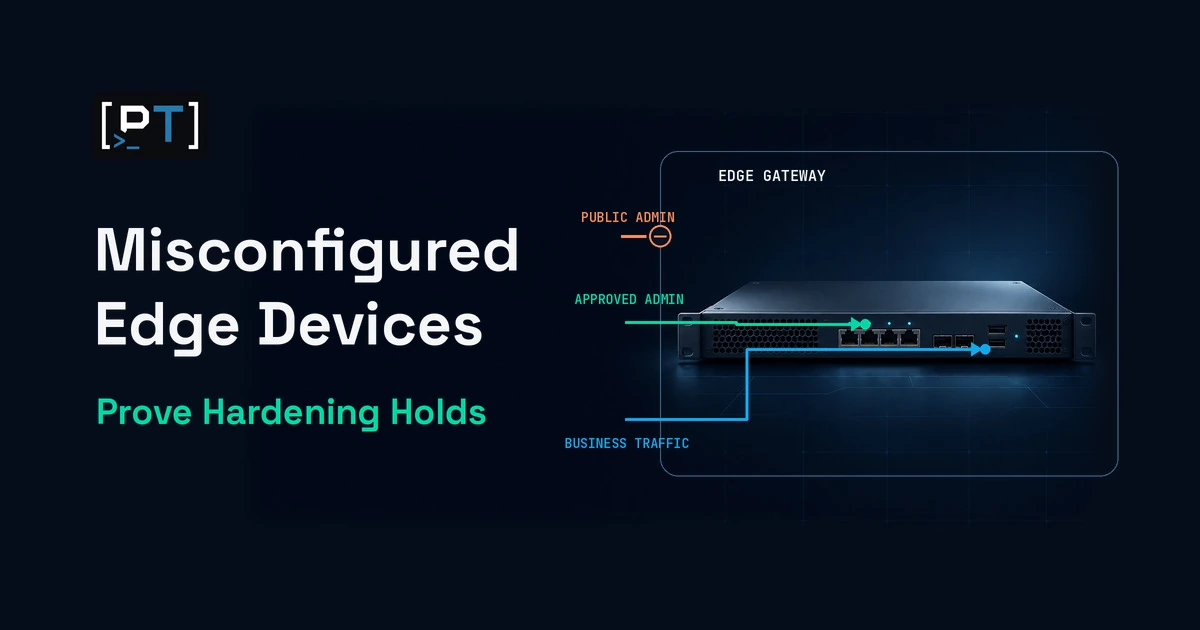
Misconfigured Edge Devices: Prove Hardening Holds
Misconfigured edge devices can leave a firewall, router or VPN appliance’s management interface reachable from the internet while customer services appear to be working normally. After an emergency restriction or appliance replacement, ask for evidence that public users can still use the intended services, authorized administrators can still manage the device, and everyone else is denied at the agreed boundary.
Use this guide to approve a hardening change, document a temporary exception, or scope external network testing when a vendor route or failover interface remains uncertain. Start with a list of approved management routes. Then require an observed result for each route that should work and each route that should be denied.
Why misconfigured edge devices expose admin interfaces
In November 2026, Barracuda reported vulnerabilities in certain products for which successful exploitation required access to an affected administrative interface. Its November 9 update reported observed exploitation affecting a small number of organizations. On November 10, CISA announced that it had added CVE-2026-116606 and CVE-2026-111560 to its Known Exploited Vulnerabilities Catalog. The vendor provides product-specific remediation guidance, including patches and restrictions on administrative reachability. Barracuda advisory and CISA’s November 10 KEV bulletin.
The example gives infrastructure owners a concrete question to ask after a change. Who can still reach the administrative interface? A login screen may show that a restricted management service is reachable even when the person viewing it cannot sign in. If policy requires denial before that screen, the observed reachability fails the policy. Treatment decisions still depend on the affected product, firmware and vendor guidance.
Define the management boundary and its owner
To find misconfigured edge devices, assign an infrastructure owner to compare the asset record, current network design, and approved change. Give each appliance or cluster a record covering its purpose, business owner, environment, site, public service endpoints and administrative endpoints. Map each administrative interface to the network or access service that should enforce the restriction. Confirm whether management is device-local, centralized, outsourced to a vendor or split across those paths.
List applicable alternate routes with enough detail to distinguish them in the evidence. Examples include an older public hostname, a secondary WAN address, IPv6, a management API, a standby appliance and a vendor support path. For a cluster, identify which roles the scope covers and whether the approved window permits evaluating the alternate state. Record routes owned by hosting or telecom providers and ask those owners to confirm the part of the boundary they control.
Record the business traffic that should stay public, including the user-facing VPN entry point where applicable. Assign a service owner to confirm availability and an acceptance authority to decide on any unresolved management exposure. The same person can hold both roles where responsibilities are explicit. Keep retired routes on the scope record until their status is confirmed, then record the disposition and supporting evidence.
Approve exact administrator routes
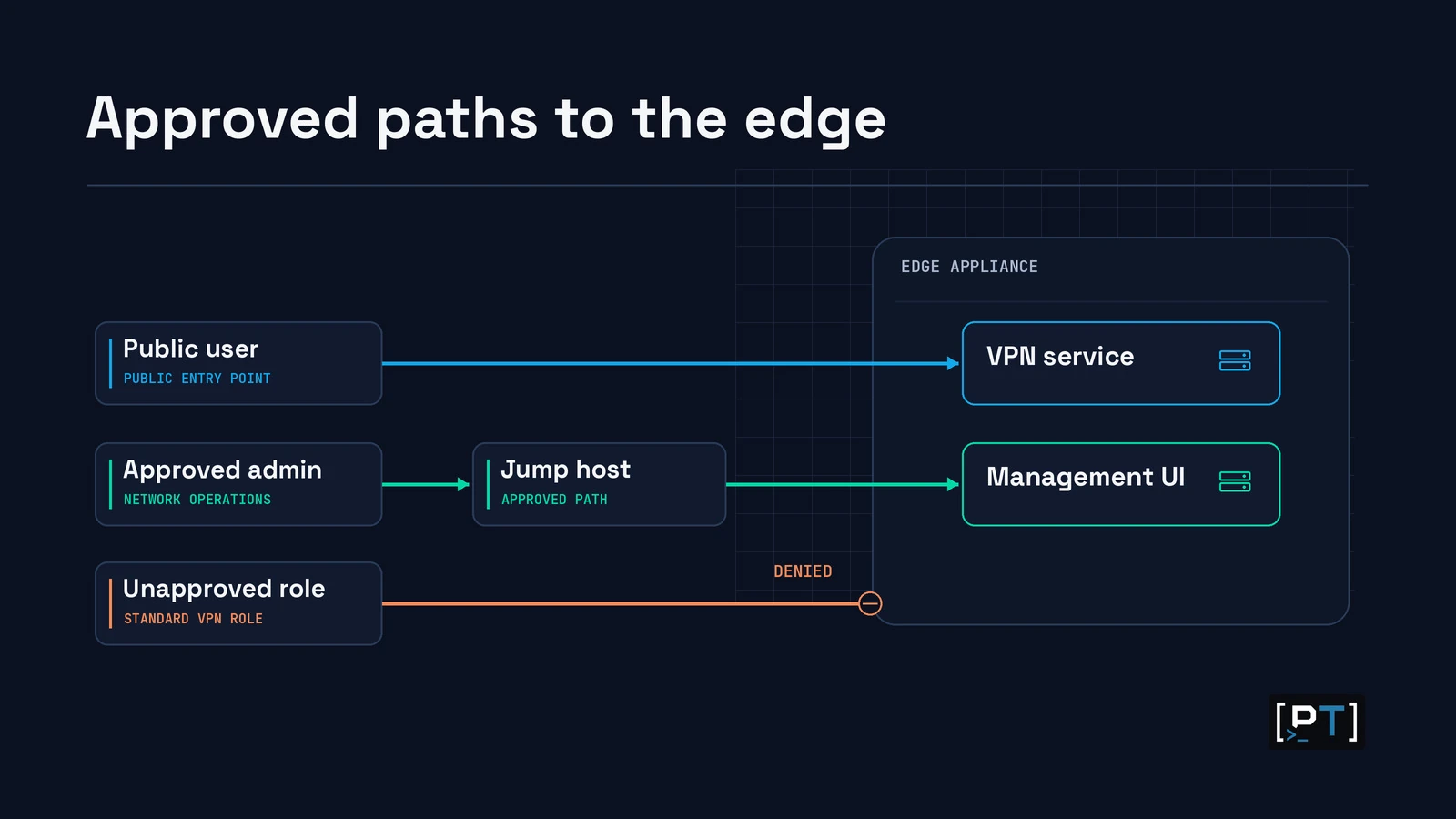
For every permitted route, specify the expected origin, access method, identity or role, target interface, authorized management activity and time window. A practical entry could describe a named network operations role connecting from a managed workstation through the corporate VPN and an approved jump host to read device health. Record where authentication and authorization are enforced. VPN access by an ordinary employee should yield the denial defined for that role.
Ask whether any managed vendor or emergency route changes the expected result. For time-limited support, name the sponsor, approval window, permitted role, access logging and person responsible for removing access. Where a route is deliberately public, record the exposure as an explicit policy choice and document the protective controls and expiry agreed by the risk owner. Review each approved path alongside the corresponding denied paths before authorizing the assessment.
External-access acceptance matrix
When reviewing misconfigured edge devices, use one matrix row for each route, device, or role with a different expected outcome. The example below assumes public management is prohibited and a named administrative path is approved. Adapt it to your environment before testing. Agree on the evidence for each row and the decision that follows if the result is unexpected.
| Route and vantage point | Expected outcome | Evidence to retain | If the result differs |
|---|---|---|---|
| Public internet to restricted management | The administrative service is denied at the agreed control point. | Timestamped result, tested destination and vantage point, plus enforcing-control evidence where available. | Hold closure if management responds. Mark ambiguous results inconclusive pending corroboration. |
| Public internet to approved business service | The intended public service still works within the agreed availability criteria. | Representative service check and owner confirmation during the change window. | Escalate to the service owner and apply the agreed rollback criteria. |
| Approved VPN or jump route with a named administrator | The approved role can complete a scoped, read-only administrative check. | Expected role and route, successful observation and associated access record. | Hold sign-off on the permitted route and restore authorized administration safely. |
| Standard VPN role or unapproved origin | Management is denied at the point required by policy. | Role-specific result and available control logs tied to the same interval. | Review the access grant and retest after correction. |
| Standby, secondary uplink or alternate interface | The same approved policy holds in every tested state. | Device role, interface, address family and observed result for each state. | Record untested states and condition acceptance on a scheduled check. |
| Vendor or emergency support route | Access is available only within the approved scope and window. | Linked approval, authorized access record and evidence the grant ends when expected. | Assign an owner to contain unexpected reachability and verify closure. |
A pass means the observation supports the agreed outcome for that row. A fail means the observed behavior violates the approved boundary or prevents required access. Use inconclusive when the evidence cannot distinguish enforcement from an offline target, a collection gap or an untested route. Track each inconclusive row with an owner and next verification date. If the organization accepts a temporary exception, record the approval as a separate decision with an expiry and follow-up.
Validate the change from agreed vantage points
Agree on the external vantage point, permitted administrative path and any standard-role comparison before the change window. Confirm scope, asset ownership, the test window, production restrictions, named contacts and stop conditions. Set a pause point for an unexpected service interruption, administrative lockout or signs of active compromise. Use a scoped read-only action for the positive check so the result confirms usable access with minimal production impact.
A timeout alone may reflect an outage or a routing problem. Check that the expected service or device state was present during the test, then correlate the observation with available enforcement evidence. Logs from a firewall, jump host or access platform can help identify where a decision was enforced. Where control logs are missing, capture the reason and record how it affects confidence in the outcome. Planned and observed results should be easy to compare later.
For an appliance under incident handling, coordinate the scope and timing with the incident owner before validating reconnection. For a patch-driven change, use the approved patch-verification evidence for runtime closure. Validate the management boundary separately when the release decision also depends on who can reach the device. Edge device forensics and reconnection decisions and post-patch external exposure validation.
Record the acceptance decision and check for drift
Maintain a baseline of the approved routes and responsible owners. Attach the baseline version, change ticket, test time and time zone, vantage point, target and device state, expected and observed result, and sanitized evidence reference to each acceptance decision. If available, retain the relevant configuration change and control events so a later reviewer can connect the policy to the observed behavior. Restrict access to sensitive records and avoid exposing management endpoints or credentials in a broadly distributed approval note.
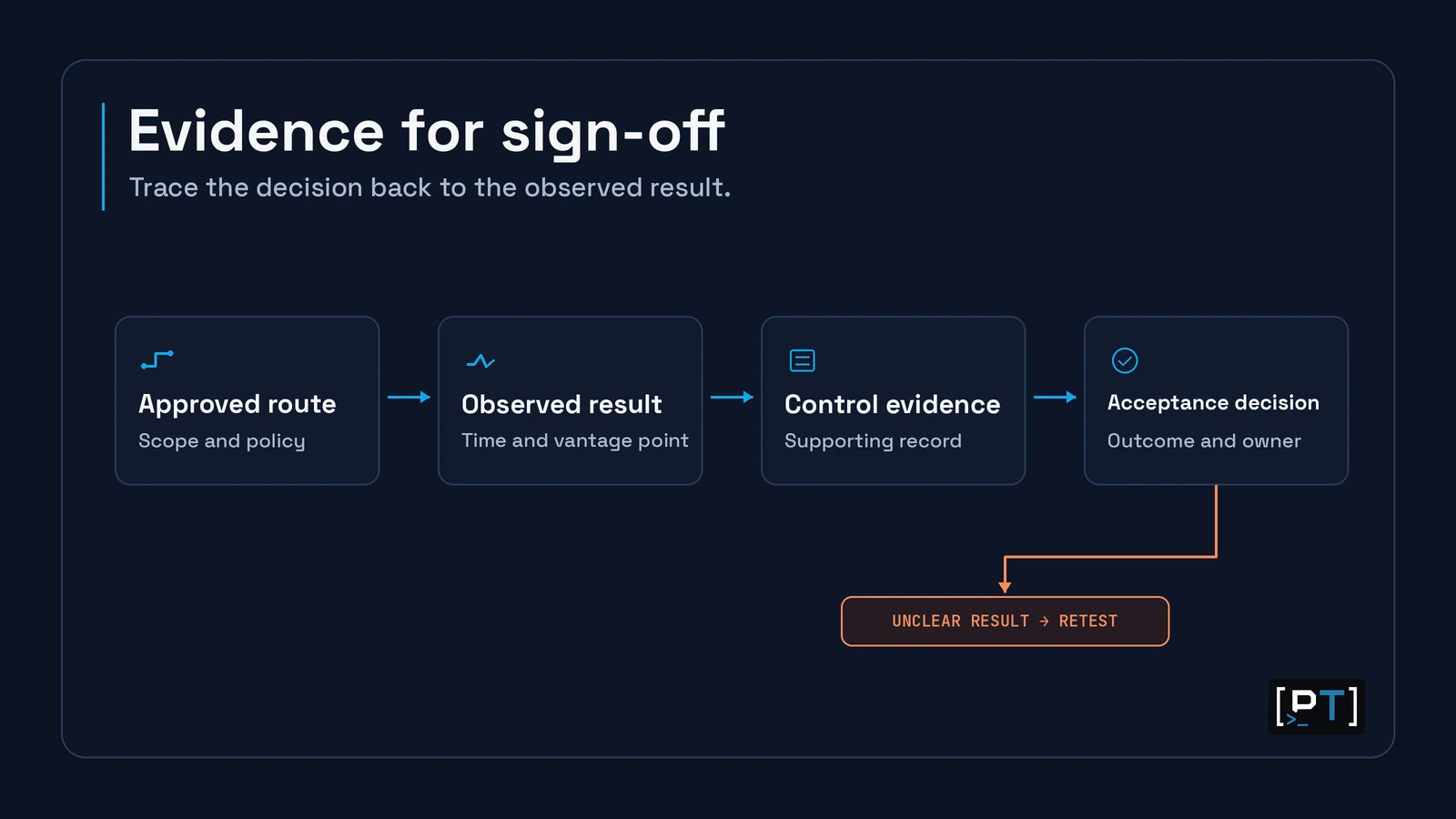
Nominate an owner for drift and define what triggers another check. Common triggers include a firewall or routing change, a firmware upgrade, a vendor access change, a restore, an appliance swap and planned failover. Choose a periodic review interval based on how often the edge changes and what happens if access is restored unintentionally. Decide which signals, such as an unexpected route change or management-policy edit, should prompt review and how the operations team will record its response.
NIST CSF 2.0 provides a vocabulary for this work. Protect covers access control and platform configuration management, while Detect covers continuous monitoring, including monitoring networks and network services. OWASP Top 10 A02:2025 describes security misconfiguration in web applications. Its principles around repeatable secure configuration and unnecessary features are relevant to web-based administration, alongside the appliance vendor’s guidance. NIST CSF 2.0 and OWASP A02:2025 Security Misconfiguration.
Illustrative decision after an appliance replacement
A company replaces a branch gateway. Its public VPN remains available, the approved jump route lets the network team perform a read-only check, and the primary public management path is denied. The backup link belongs to a third party, and the owner cannot validate the standby path during the change window.
The team records passes for the three observed results and leaves standby validation inconclusive. The risk owner allows temporary operation under a dated exception and assigns the provider and infrastructure owner a joint follow-up. Closure depends on validating the standby path and updating the record. Where an old appliance remains temporarily in service, use the EOL network device replacement playbook to track the migration and the expiry of temporary controls.
Scope external network testing around the open decisions
For a quote, share the number of devices and sites, the interfaces and administrative routes, the scope of IPv4 and IPv6, any provider dependencies, and the failover states and windows you need covered. Note where you have usable configuration or log records and which acceptance decisions remain open. Scope and coordination effort depend on those details and on how many roles must be exercised. Where the unresolved question concerns restrictions after VPN entry or within the management network, add internal network and segmentation testing as a separate scope item.
Pentest Testing Corp can assess externally reachable management paths and document results against the agreed acceptance criteria. Explore external network penetration testing or request a scoped quote for edge-device exposure validation.
Frequently asked questions
Does an internet-facing VPN mean the appliance’s admin interface is exposed?
Public VPN access and appliance administration are separate paths. Check that the intended VPN endpoint works and that the admin interface follows the approved access policy from each relevant vantage point.
Is an unreachable management interface proof the hardening worked?
Unreachability supports acceptance when the evidence identifies the target, device state and control that enforced the restriction. A timeout with uncertain cause is inconclusive.
When should we repeat an edge-device hardening check?
Repeat it after changes that can affect management reachability, such as a firewall rule change, firmware upgrade, vendor access change, restore or failover. Use a risk-based interval for periodic checks.
Can we accept hardening before every alternate route is verified?
The risk owner can document conditional acceptance with a defined scope, temporary controls, an expiry and a scheduled verification. Record the unverified routes as inconclusive until evidence supports closure.