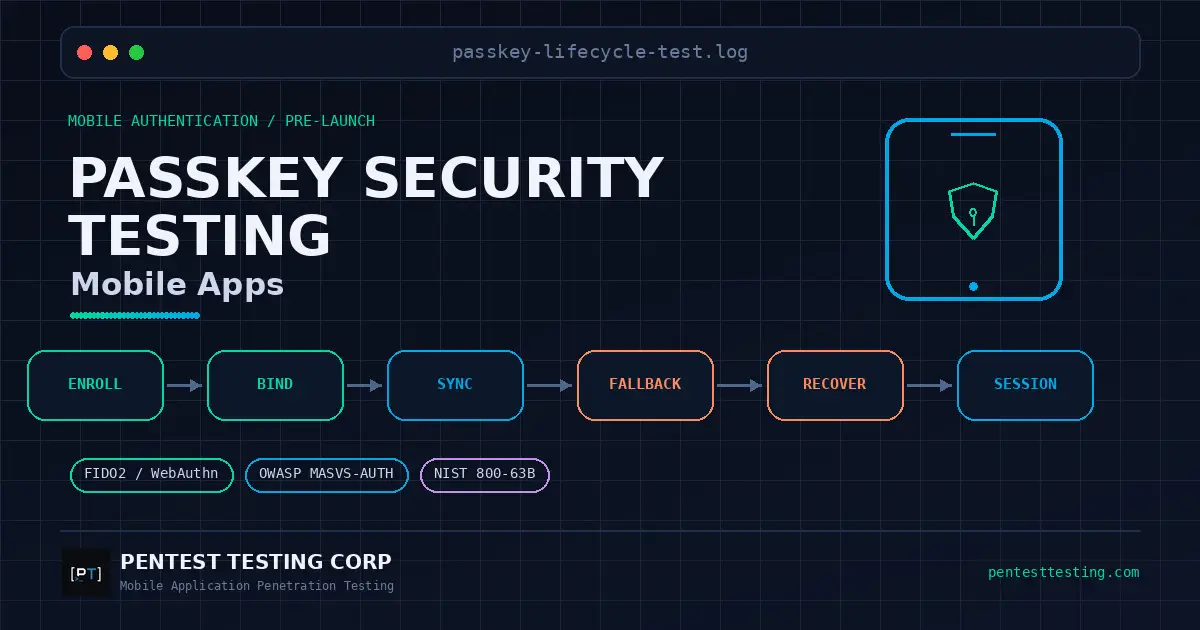
Passkey Security Testing for Mobile Apps
A mobile product team is preparing a passkey-first login for its next iOS and Android release. The cryptography is standards-based, the sign-in flow looks cleaner than passwords, and the launch is supposed to reduce phishing risk. But the security review asks a harder question: what happens when a user changes phones, restores credentials, adds another device, loses access, falls back to a password, or asks support to recover the account?
That is where passkey security testing for mobile apps becomes a product-risk exercise rather than a cryptography review. Passkeys can provide phishing-resistant authentication because the credential is bound to the relying party, but a mobile account still has an enrollment process, recovery flow, session model, device ecosystem, backend API, and often weaker legacy login methods.
For a CTO, CISO, mobile product lead, or identity owner, the goal is therefore not to prove that WebAuthn works. It is to prove that the entire account lifecycle remains as strong as the passkey promise.
Why Passkey Rollouts Still Need Security Testing
Passkeys change a major part of the authentication threat model. Instead of asking a user to send a reusable secret such as a password, WebAuthn uses public-key credentials scoped to a relying party. Google's passkey guidance describes passkeys as a safer alternative to passwords, while the current WebAuthn Level 3 specification defines public-key credentials that are scoped to the relevant relying party.
That is a substantial improvement over passwords. It does not, however, make the account lifecycle automatically secure.
Most mobile products do not move from "password" to "passkey only" in one release. They run a transition period. Existing users may retain passwords. Some users authenticate through federated identity. Recovery may still use email, SMS, support verification, backup codes, or an identity provider. A mobile app can also create a valid passkey and then issue a conventional bearer session to the app. If that session is mishandled, the strength of the sign-in ceremony will not protect the rest of the session.
Passkey security is not only credential security. It is enrollment security, account-binding security, recovery security, fallback security, session security, and lifecycle governance.
For organizations preparing an iOS or Android release, our mobile app penetration testing service covers authentication, session handling, backend APIs, device-specific behavior, and the mobile controls around those workflows. A passkey rollout should be scoped as a focused authentication lifecycle inside that broader assessment, not as a single "WebAuthn works" test.
What Passkey Security Testing for Mobile Apps Must Prove
A useful mobile passkey assessment should answer business questions that can be turned into launch criteria.
1. Enrollment: who is allowed to add a passkey?
The first risk is not breaking a passkey. It is binding a legitimate passkey to the wrong account or allowing an attacker-controlled session to add a new authenticator.
Testing should establish whether creating or adding a passkey requires the right level of existing trust. A recently authenticated low-assurance session should not automatically gain the same authority as a strongly verified account state. High-risk accounts may need step-up verification before a new authenticator is registered.
The buyer question is simple: what evidence proves that a new passkey was attached by the legitimate account holder?
2. Account and relying-party binding: is the credential tied to the intended service?
Passkey security depends on correct relying-party and application association. On Android, Google's current Credential Manager prerequisites require Digital Asset Links for passkeys so the application and web relying party are correctly associated. Apple similarly uses Associated Domains to connect an app to the service for which passkeys are used.
A pentest should validate the deployed associations, expected domains, production and non-production boundaries, and whether account identifiers are mapped correctly at the backend. This matters when organizations operate multiple brands, regional domains, staging environments, white-label apps, or several mobile applications against one identity platform.
The business consequence of a binding error can range from failed sign-in and support cost to credential registration against an unintended environment.
3. User verification and sensitive actions: what does the app actually trust?
Passkeys often use the device's screen lock, biometric, PIN, or pattern to authorize use of the credential. The server receives a cryptographic authentication result rather than the user's biometric data.
Testing should verify that the relying party enforces the expected verification policy and that the mobile app does not substitute a purely local "biometric success" flag for server-side authorization. Sensitive operations such as payout changes, recovery changes, administrator actions, or adding another authenticator may still require additional verification even after normal sign-in.
The leadership question is whether the product's highest-risk actions inherit the intended assurance level or quietly drop to a weaker local control.
4. Session continuity: what happens after successful passkey sign-in?
Most mobile apps still create sessions, access tokens, or refresh tokens after passkey authentication. Those artifacts need the same scrutiny as any other authenticated session.
Testing should cover session issuance, token storage, expiry, refresh behavior, logout, account disablement, device removal, password change where passwords still exist, and recovery events. If an account is recovered or a device is declared lost, leadership should know whether previously issued sessions remain usable and for how long.
Our broader API penetration testing methodology is relevant here because the backend, not the mobile UI, ultimately decides whether an authenticated session can access account data and privileged functions.
5. Fallback and downgrade: can users bypass the stronger path?
A passkey rollout can be phishing-resistant at the primary login screen and still expose users through "Use another method."
That is why fallback deserves its own test objective. The assessment should identify every alternative route into the account, including legacy passwords, email links, SMS codes, federated login, backup codes, support-assisted recovery, and device-transfer flows. The purpose is not to remove every fallback. It is to verify that each alternative matches the risk of the account and cannot silently downgrade a passkey-protected user to a materially weaker path.
Pentest Testing Corp's guide to risk-based authentication hardening discusses passkeys as a phishing-resistant option for higher-risk authentication. The same principle should be applied in reverse: once a user has stronger authentication, fallback policy should not erase that gain.
Passkeys reduce one major phishing path, but they do not remove every identity-flow risk. Our OAuth redirect abuse incident guide illustrates why adjacent sign-in, authorization, and redirection paths still require their own controls.
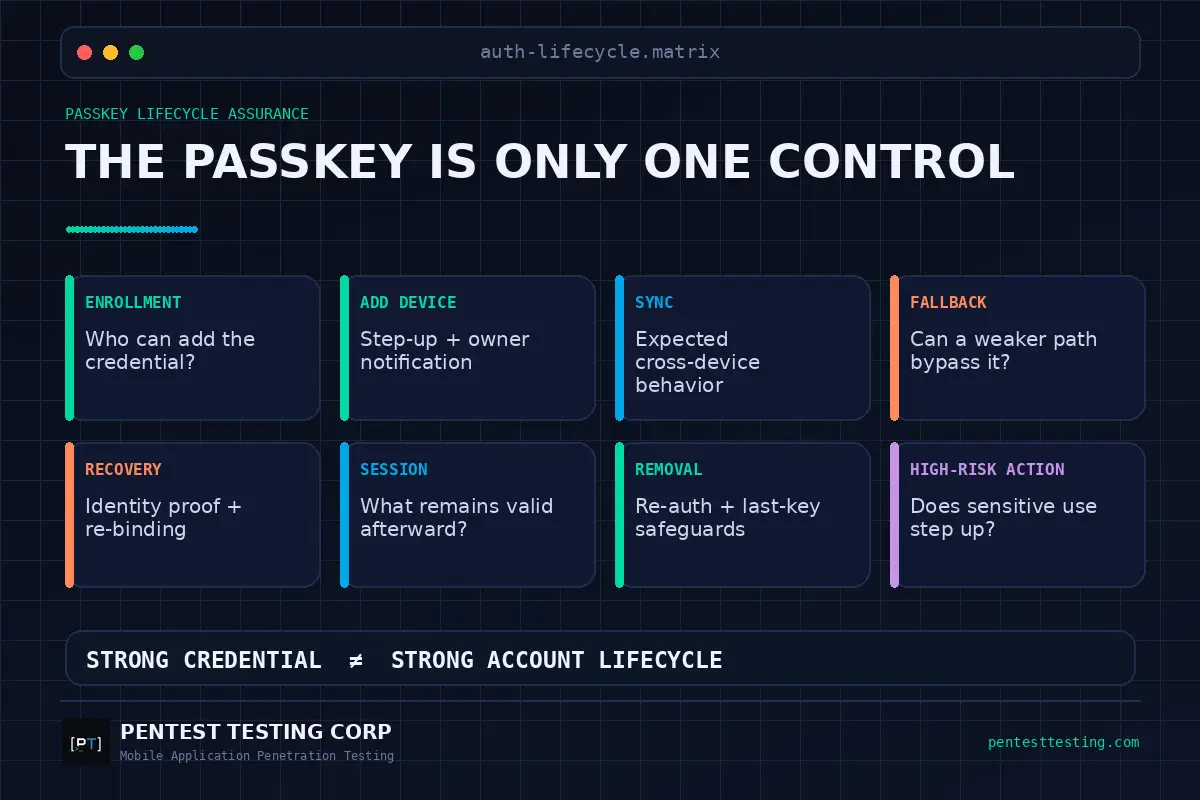
Passkey Lifecycle Test Matrix: Enrollment, Sync, Fallback, and Recovery
The most useful way to scope a passkey pentest is by lifecycle event rather than by one login screen.
| Lifecycle area | What the assessment should validate | Buyer evidence to request | Typical remediation effort |
|---|---|---|---|
| Initial enrollment | Existing-session assurance, user verification, account binding, duplicate or unauthorized registration controls | Registration evidence, server validation, audit event | Low to medium if policy changes are isolated |
| Add another device/passkey | Step-up requirements, notification, credential inventory, account-owner visibility | Authenticator list, new-device alert, server-side record | Medium when account settings need redesign |
| Synced credential use | Expected cross-device behavior, provider transitions, account association, risk policy | Cross-device test results across supported platforms | Low to medium, depending on platform support |
| Device-bound use | Device policy, hardware-backed expectations where required, loss/replacement process | Device policy and authenticator metadata | Medium to high for higher-assurance requirements |
| Fallback login | Strength of password, OTP, federation, backup-code, or alternative login path | Downgrade matrix showing which routes remain available | Medium if legacy authentication must be retained |
| Account recovery | Identity verification, waiting periods where appropriate, notification, re-binding, abuse resistance | Recovery event logs and proof of new authenticator binding | Medium to high because support and identity flows may change |
| Session continuity | Session or token behavior after logout, recovery, device removal, role change, and account disablement | Session invalidation results and server logs | Medium when token architecture needs changes |
| Passkey removal | Reauthentication, last-authenticator safeguards, notification, remaining recovery options | Removal logs and account-state evidence | Low to medium |
| High-risk actions | Whether sensitive changes require step-up even after normal sign-in | Transaction-level evidence and policy mapping | Medium, depending on business workflow |
| Rollback/downgrade | Behavior when the feature is disabled, old app versions connect, or rollout flags change | Release/version matrix and regression results | Medium if old clients remain supported |
This matrix turns a vague request for a "passkey pentest" into a testable security scope. It also helps procurement and security reviewers understand what evidence they will receive.
Hypothetical scenario: the passkey is strong, recovery is not
Consider a hypothetical fintech app that introduces passkeys for all new users. Primary sign-in is correctly implemented. A user cannot be tricked into using that passkey on an unrelated phishing domain.
The same account, however, still supports an older recovery route designed before the passkey rollout. Recovery verifies control of an email account and then lets the user establish a new login method. The recovered account also leaves existing mobile sessions active.
No one has "broken WebAuthn." The failure is architectural: the organization marketed a phishing-resistant sign-in while account recovery and session revocation remained at the previous assurance level.
The realistic consequences could include account takeover, payment-profile changes, sensitive-data access, customer support escalation, and difficult audit questions about whether the stronger authentication control was consistently enforced.
A good assessment reports this as a lifecycle and control-design problem, then separates the fixes: strengthen recovery, revoke or re-evaluate sessions after recovery, notify the account owner, and add regression tests so future login changes do not reopen the downgrade path.
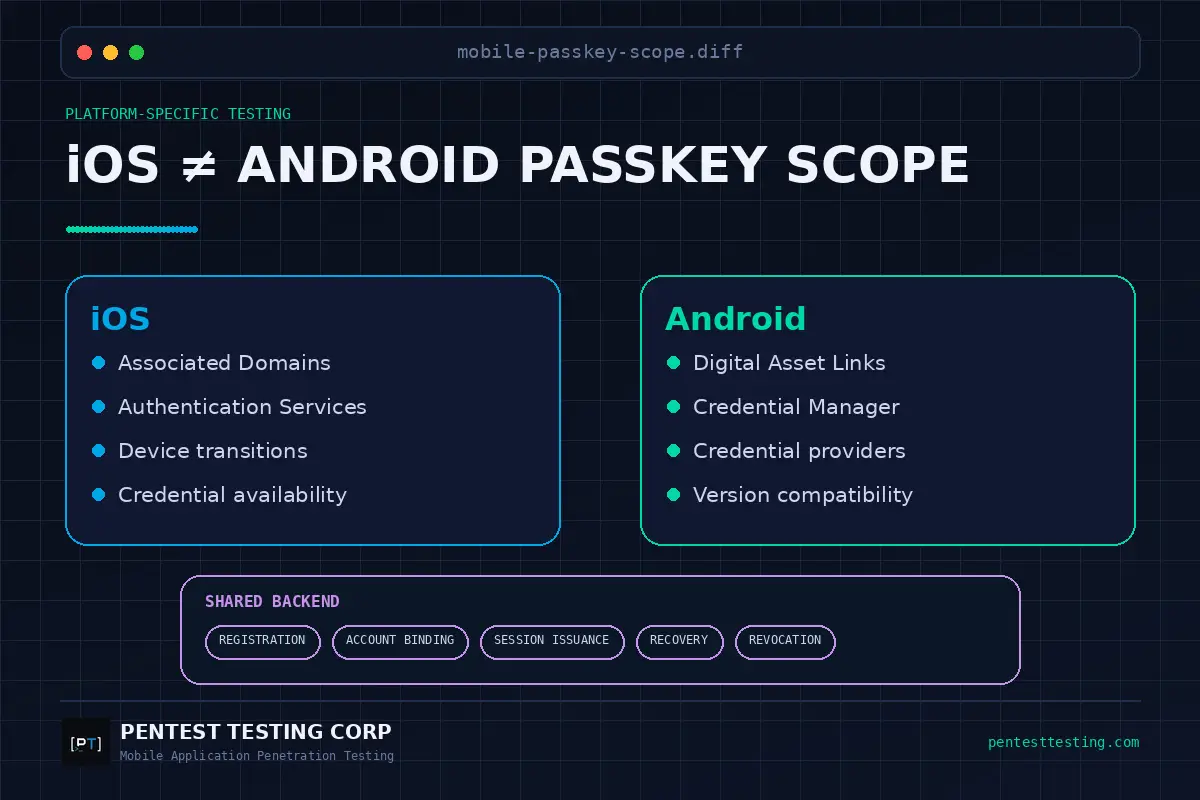
iOS vs Android Passkey Testing Scope
Passkeys are standardized, but the mobile implementation environment is not identical across iOS and Android. This is why a dual-platform rollout should not be treated as one test repeated twice.
The Mobile App Penetration Testing Guide: iOS vs Android explains the wider platform differences. For passkeys specifically, buyers should make sure the scope covers the following platform-dependent areas.
Android
Android's Credential Manager provides a unified interface for passkeys, passwords, and federated credentials. Because the supporting libraries and authentication ecosystem continue to change, regression testing should be tied to meaningful authentication-library or platform changes rather than only an annual calendar date.
A passkey-focused Android assessment should validate Digital Asset Links, expected relying-party associations, supported OS versions, credential-provider behavior, cross-device or restore scenarios that are part of the product design, old-app-version behavior, and the transition between passkey and non-passkey credentials.
The purpose is not to test Google's cryptography. It is to validate how the product integrates Android identity components with its own account and backend logic.
iOS
On iOS, the scope should validate the app's Associated Domains configuration, relying-party expectations, Authentication Services integration, supported OS/device scenarios, credential addition and removal behavior, and how the app reacts when a passkey is unavailable or the user changes devices.
If the same account can authenticate through the website and the native app, the test should also confirm that web and app identity states stay consistent. A secure web passkey flow should not coexist with a weaker mobile recovery path, and the reverse is equally true.
Shared backend
The highest-value passkey tests often converge on the backend: who can register an authenticator, what account it is bound to, how challenges and assertions are validated, what sessions are issued, and what happens after recovery or credential removal.
For products that also expose a browser login, admin portal, or support console, relevant authentication and session paths may need parallel web application penetration testing rather than being treated as outside the mobile scope.
Framework Mapping and Evidence a Buyer Should Expect
Framework mapping should make the assessment more defensible, not turn it into a checklist exercise.
OWASP MASVS-AUTH is the primary mobile mapping. MASVS-AUTH-1 addresses secure authentication and authorization protocols and relevant best practices. MASVS-AUTH-2 addresses secure local authentication according to platform practices. MASVS-AUTH-3 addresses additional authentication for sensitive operations. OWASP's current Mobile Application Security project pairs MASVS with the MASTG and MASWE for testing guidance and weakness enumeration.
Sensitive operations may now be initiated outside the app’s normal screen flow through App Intents, AppFunctions, or OS-level assistants. Our guide to agent-actionable mobile app security testing explains how to validate step-up authentication, action confirmation, entity selection, and backend authorization across those paths.
For a passkey rollout, those controls support questions about whether the mobile client uses the identity protocol correctly, whether local device authentication is trusted appropriately, and whether critical actions receive extra protection.
FIDO2/WebAuthn provides the public-key authentication and relying-party model that can make properly configured passkey authentication phishing-resistant. Testing should validate the product's use of those properties without claiming to re-audit the standard itself.
NIST SP 800-63-4 and SP 800-63B are useful where an organization needs assurance-level reasoning. NIST's current guidance incorporates syncable authenticators, requires AAL2 services to offer a phishing-resistant authentication option, and treats account recovery as a distinct lifecycle event. NIST also notes that cloud-based sync and recovery become part of the authenticator threat model.
For buyers, the report should therefore show more than "passkey login succeeded." Useful evidence includes:
- supported platform and version matrix;
- enrollment and re-enrollment results;
- relying-party and app-association validation;
- user-verification policy results;
- fallback and downgrade matrix;
- recovery and lost-device scenarios;
- session invalidation and continuity results;
- high-risk action and step-up checks;
- audit-event coverage for add, remove, recover, and reset actions; and
- clear severity, business impact, remediation ownership, and retest status.
If a vendor security review is driving the work, the broader question is whether the resulting evidence can be handed to a customer or auditor without a second technical exercise. Mobile authentication scope should therefore be documented clearly enough to show which platforms, identity paths, recovery methods, backend components, and regression conditions were actually validated.
How to Scope Passkey Security Testing for Mobile Apps: Timeline, Cost, and Retesting
Passkey testing should be scoped around product architecture, not a generic number of test cases.
At minimum, the scoping conversation should identify:
- iOS, Android, or both;
- native app, mobile web, and browser login surfaces;
- relying-party domains and environment boundaries;
- new enrollment and existing-user migration paths;
- whether passkeys are synced, device-bound, or both in the supported population;
- every fallback and recovery route;
- backend identity and session services;
- privileged or high-risk actions that require additional assurance;
- minimum supported OS and app versions;
- identity providers, credential providers, and relevant third-party integrations; and
- compliance or enterprise-review evidence required at the end.
Pentest Testing Corp's current mobile service page lists 7–10 business days for a single-platform assessment and 12–15 business days for dual-platform testing. It also notes that custom authentication, device binding, or advanced cryptographic flows can require additional time. The company's current penetration-testing directory lists mobile application pentesting for a single platform from $8,000, with more complex or bundled environments quoted after scoping.
For a passkey implementation, the main drivers of effort are usually not the cryptographic primitives. They are the number of account states, recovery methods, supported platforms, test roles, backend services, and downgrade combinations that must be exercised.
A focused pre-launch test can be efficient when the team provides stable builds, representative accounts, identity architecture, supported-device requirements, and a clear recovery policy. Testing becomes more expensive when the assessment has to discover undocumented fallback routes, reconcile different web and mobile identity behavior, or repeat large parts of the test after late product changes.
Retesting matters. Authentication changes frequently touch multiple systems, and a fix to recovery or device binding can create a new regression elsewhere. Closure evidence should confirm that the original weakness is fixed and that the passkey, fallback, and recovery paths still behave as intended.
Teams evaluating budget and deliverables can review current penetration testing pricing and sample penetration testing reports before scoping.
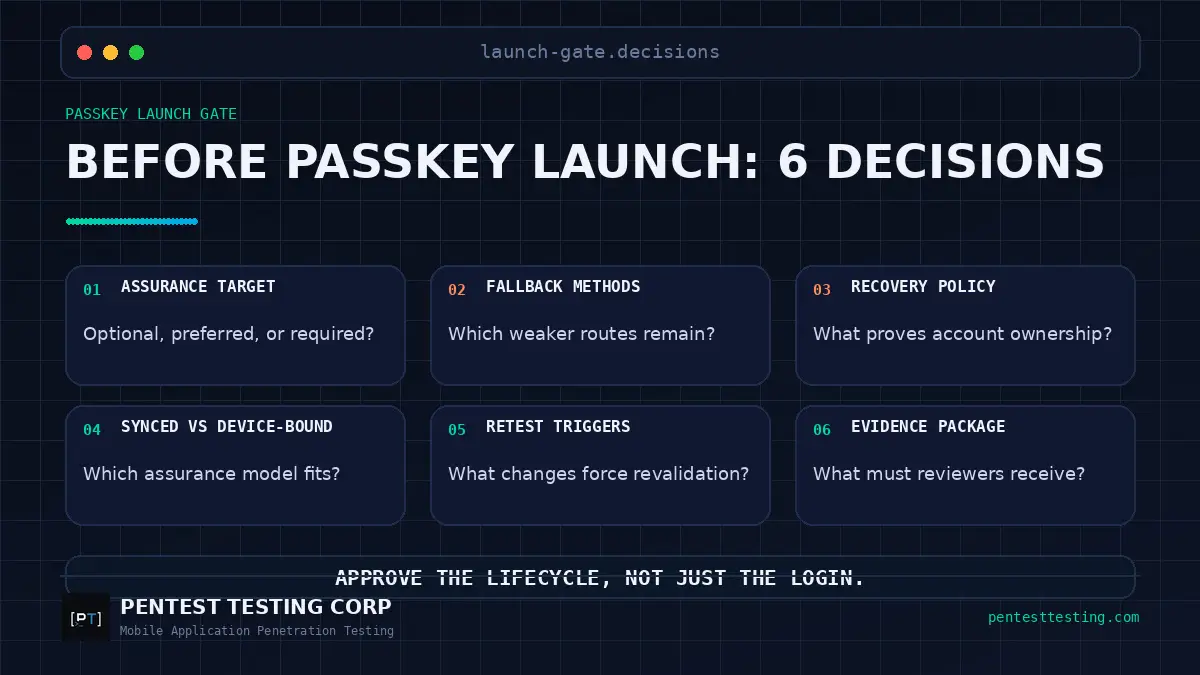
What Leadership Should Decide Before Launch
A passkey launch should not be approved on the statement "we use WebAuthn." Leadership needs explicit decisions about the surrounding account model.
Decide the target assurance level. Are passkeys an optional convenience feature, the preferred sign-in method, or the required method for specific users and actions? The answer changes how strict fallback and recovery must be.
Decide which fallback methods remain. Every retained method should have an owner, a business reason, and a risk rating. Legacy options should not survive indefinitely simply because removing them was deferred.
Decide the recovery policy before launch. Recovery is not a customer-support detail. It is part of the authentication control. Define who can initiate it, what proof is required, what notifications occur, what sessions are invalidated, and how new authenticators are bound.
Decide whether synced passkeys meet the use case. NIST permits syncable authenticators for scenarios up to AAL2 when the relevant requirements are met. AAL3, however, requires a non-exportable private key, so syncable authenticators do not meet AAL3's non-exportability requirement. If device-bound or hardware-protected credentials are required for a subset of users, define and test that population separately.
Decide which events trigger retesting. A sensible trigger list includes major login redesigns, changes to recovery, new identity providers, new credential-manager integrations, supported OS changes, device-binding changes, and significant backend session changes.
Decide what proof procurement or auditors will receive. A launch can be technically sound and still fail a vendor review if the organization cannot show scope, methodology, affected platforms, findings, remediation, and closure evidence.
Passkeys can materially reduce password and phishing exposure, but the security claim should match the whole account lifecycle. The strongest launch decision is not "the passkey works." It is "enrollment, device transitions, fallback, recovery, sessions, and downgrade paths were independently tested, and we have evidence for the result."
If your team is preparing an iOS or Android passkey rollout, Pentest Testing Corp can scope the authentication lifecycle as part of a mobile application penetration test. For a focused pre-launch discussion, book a scoping call.
Frequently asked questions
Are passkeys secure enough to replace passwords in a mobile app?
Passkeys can provide a major security improvement because they use public-key credentials and are designed to resist phishing. Whether they safely replace passwords for your product still depends on enrollment, recovery, fallback, session handling, device policy, and the assurance required for sensitive actions.
What is the biggest passkey risk a penetration test should look for?
There is no single universal issue, but one of the most important categories is assurance downgrade: the primary passkey flow is strong while a weaker recovery, legacy password, OTP, support, or session path can still take over the same account. Testing should compare every route into and through the account.
Do synced passkeys make a mobile app less secure?
Not inherently. Properly configured synced passkeys can remain phishing-resistant, and NIST SP 800-63-4 incorporates syncable authenticators for appropriate assurance scenarios. They have a different threat model from non-exportable, device-bound credentials because the sync provider and its recovery process become relevant. NIST does not permit syncable authenticators at AAL3 because AAL3 requires a non-exportable authentication key.
Should we test iOS and Android separately?
Yes. The identity standard is shared, but app association, credential APIs, OS behavior, supported versions, and recovery or migration experiences differ. The shared backend can be tested once where appropriate, but each mobile client needs platform-specific validation.
Does passkey testing require source code?
Not always. A black-box or gray-box assessment can validate the deployed authentication lifecycle, app behavior, backend APIs, fallback, recovery, and session handling. Architecture notes or source access can improve efficiency when the scope includes complex device-binding or custom identity logic.
How long should passkey testing take?
For a full mobile assessment, Pentest Testing Corp currently lists 7–10 business days for one platform and 12–15 business days for both iOS and Android. A focused passkey review may fit within that engagement, but complex recovery, multiple identity providers, device-bound credentials, or many account roles can extend the scope.
When should a passkey implementation be retested?
Retest after remediation and after material changes to enrollment, account recovery, fallback methods, credential-provider integration, device-binding policy, session architecture, or supported platform behavior. If authentication is a critical control, release-triggered retesting is often more useful than relying only on an annual schedule.