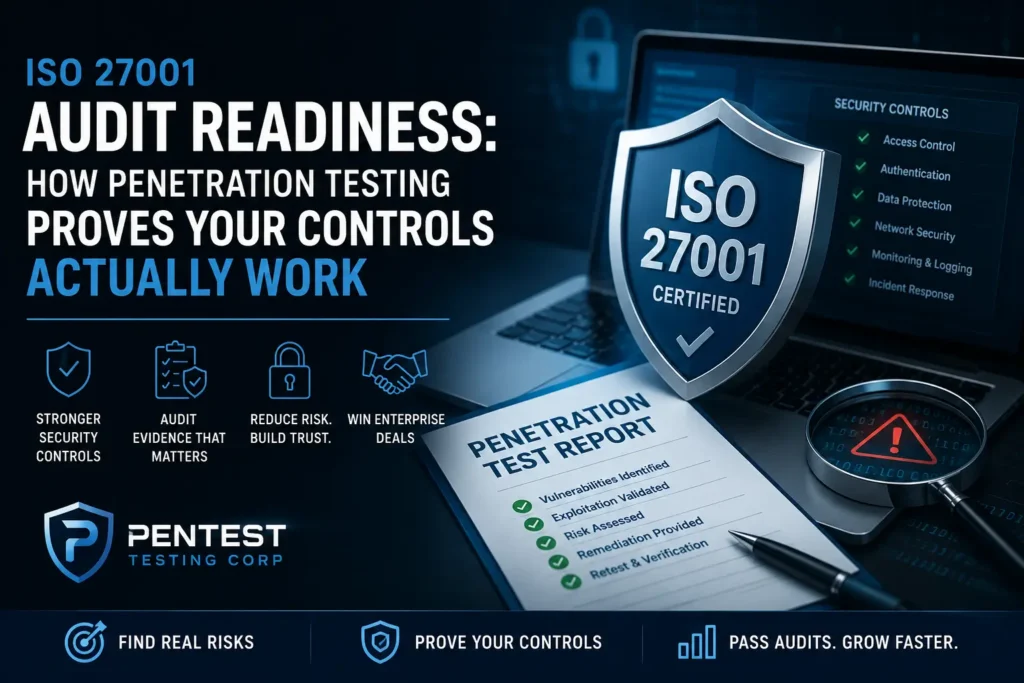
ISO 27001 Audit Readiness: How Penetration Testing Proves Your Controls Actually Work
ISO 27001 is not just about having policies, screenshots, and a neat control matrix. It is about proving your security controls work under pressure. ISO/IEC 27001 defines requirements for an information security management system, and SOC 2 focuses on controls relevant to security, availability, processing integrity, confidentiality, and privacy. Buyers, auditors, and enterprise procurement teams increasingly want evidence of effectiveness, not just evidence that a control exists.
That is where ISO 27001 penetration testing audit evidence becomes valuable. A strong pentest gives you proof that authentication, authorization, session handling, API controls, and error paths were tested by a human who tried to break them, not just a scanner that checked for known signatures. If you want a quick first pass before the deeper work, you can run a quick vulnerability scan and see whether obvious exposure is still sitting in front of your audit.
The real problem: controls look good on paper and fail in production
Most audit gaps do not happen because teams ignore security. They happen because teams confuse documentation with validation. A company can have access control policies, secure coding standards, and review checklists, yet still ship a broken authorization path, a weak API object check, or an injection issue in a high-value workflow. OWASP’s Top 10 exists because these kinds of web risks remain common and material, and OWASP’s API Security Project exists because APIs create their own class of exposure, especially around object-level authorization and broken authentication.
For SaaS founders and CTOs, the business risk is direct. A control that cannot survive real attack traffic can still lead to breach exposure, failed security reviews, delayed deals, and audit remediation work that lands right before a renewal or enterprise launch. That is why teams preparing for audits often need both a web assessment and API security testing before they can claim the controls are working in practice.
The risk: auditors ask for proof, not promises
ISO 27001 and SOC 2 buyers do not just want your policy names. They want evidence that the controls were tested, that issues were found, that risks were remediated, and that the testing was relevant to the actual system in scope. AICPA describes SOC 2 as a report on controls at a service organization relevant to security, availability, processing integrity, confidentiality, or privacy. That is exactly why “we have a scanner” is not the same as “we verified our controls work.”
In practice, this means audit-readiness evidence should show real exploitation paths, clear remediation steps, and retest confirmation. If your current evidence package stops at screenshots and policy docs, it will usually feel thin when a customer’s security team asks the harder question: “Show me how you know this control actually stops abuse.” A good starting point is professional penetration testing services that produce validation evidence, not just issue lists.
Real-world attack scenario: how a small flaw becomes an audit problem
Imagine a B2B SaaS platform with a clean-looking login page, a polished customer portal, and an API that powers the frontend. The team has MFA, a password policy, and a WAF. On paper, the controls look strong. In reality, one API endpoint exposes another customer’s invoice data when an attacker changes an object ID. That is a classic authorization failure, and OWASP calls out broken access control and API object-level authorization issues as core security risks.
Here is how an attacker usually moves:
First, they create a normal account and map the application. Then they inspect requests in the browser or mobile client and notice predictable IDs in URLs or JSON bodies. They replay a request with a different ID. If the backend does not enforce authorization on that object, they get data they should never see. In a more serious version, they may enumerate user records, view invoices, modify account settings, or access internal configuration endpoints. That is how IDOR and broken access control become revenue and trust problems, not just technical findings.
The same pattern applies to SQL injection. An attacker finds a parameter that reaches the database unsafely, then uses it to extract data, bypass logic, or pivot into deeper access. OWASP still treats injection as a major category because the impact is high even when the root flaw looks small. Authentication flaws are similar: weak session handling, missing rate limits, token confusion, and broken reset flows can let an attacker impersonate a user or bypass access checks entirely.
At that point, you are no longer discussing a theoretical compliance gap. You are looking at an evidence problem, a breach problem, and possibly a sales problem. This is the moment to test your application for real-world vulnerabilities before an auditor, customer, or attacker does it first.
Why this happens: automated tools miss what humans exploit
Automated scanners are useful, but they are not enough for audit evidence. They can identify missing headers, known CVEs, exposed files, and some injection indicators. They are far less reliable at judging workflow abuse, authorization boundaries, chained issues, race conditions, or whether a “low severity” issue becomes critical when combined with another weakness. That is why manual testing still matters in serious compliance work.
A scanner also cannot fully understand business logic. It does not know that a refund should only happen after shipment, that a user should never be able to assign themselves admin privileges, or that a billing API should reject cross-tenant object access even when the request is syntactically valid. It may report a clean pass and still miss the one issue that matters most. For APIs, the complexity is even higher because object identifiers, tokens, and business workflows are often distributed across several services and clients. OWASP’s API project specifically highlights how APIs expose endpoints that handle object identifiers and create wide attack surfaces for authorization issues.
How penetration testing solves the evidence gap
A proper penetration test gives you evidence that the control was exercised under realistic attack conditions. The difference is simple: a scanner detects patterns, while a pentester validates exploitation path, impact, and fixability. That is what auditors and enterprise buyers really want to see.
For ISO 27001 audit readiness, the useful output is not just “found vulnerabilities.” It is evidence that your access control, authentication, secure SDLC, and monitoring controls were actually challenged. A strong report should show the attack path, the affected asset, the business impact, and what changed after remediation. If you need a benchmark for what that looks like, review a professional penetration testing report sample and compare it against your current audit pack.
For SaaS teams, this usually means testing three layers together. Web testing checks the user interface and server-side logic. API testing checks authorization, object access, and token handling. Cloud testing checks exposed services, misconfigurations, and trust boundaries. That combined view is what turns pen testing into compliance evidence instead of just a security checkbox. If your platform depends heavily on APIs, API security testing should be part of the scope, not an afterthought.
Buyer guidance: what to look for in a pentest company for ISO 27001 and SOC 2
Not every provider will give you evidence that holds up in an audit or a sales review. When you evaluate a vendor, focus on four things.
First, ask whether they do manual-led testing or rely mostly on tools. For compliance work, manual validation matters because it proves exploitability and business impact. Second, review the reporting quality. You need executive summary, technical reproduction, remediation guidance, and retest support. Third, check whether the provider understands compliance context. ISO 27001 and SOC 2 teams need findings that map cleanly to controls and audit evidence. Fourth, look for SaaS experience, because multi-tenant systems, role-based access, and API-heavy architectures create risks that generic test shops often miss.
At Pentest Testing Corp, this is exactly why the process should connect security findings to business outcomes. A good engagement should help you reduce audit friction, de-risk enterprise deals, and show buyers that your controls have been tested realistically. For teams that want deeper coverage across web, API, mobile, and cloud, our penetration testing services are built to find exploitable issues, not just generate scan output.
Enterprise buyers are no longer satisfied with basic vulnerability scans or automated reports. If your SaaS company is going through vendor security reviews, this guide explains what enterprise clients actually evaluate in a penetration test report and why weak assessments can delay or kill deals.
Read more: Enterprise Clients Asking for a Pentest Report? Here’s What They’re Really Evaluating
What auditors and enterprise buyers actually want to see
The most useful audit evidence usually answers five questions. What was tested? What was found? How was it exploited? What was the business impact? Was it fixed and retested? If your report answers those clearly, it becomes useful for audit readiness, customer due diligence, and internal risk reviews.
That is why the final deliverable matters as much as the testing itself. A polished but shallow report helps nobody. A clear report with exploit proof, severity reasoning, and remediation steps helps security, engineering, compliance, and sales at the same time.
Final Note
If you need audit-ready proof that your controls do more than look good in a policy doc, schedule a penetration testing consultation and turn your ISO 27001 evidence into something auditors and enterprise buyers can trust.
🔐 Frequently Asked Questions (FAQs)
Find answers to commonly asked questions about ISO 27001 Penetration Testing Audit Evidence Guide.
..