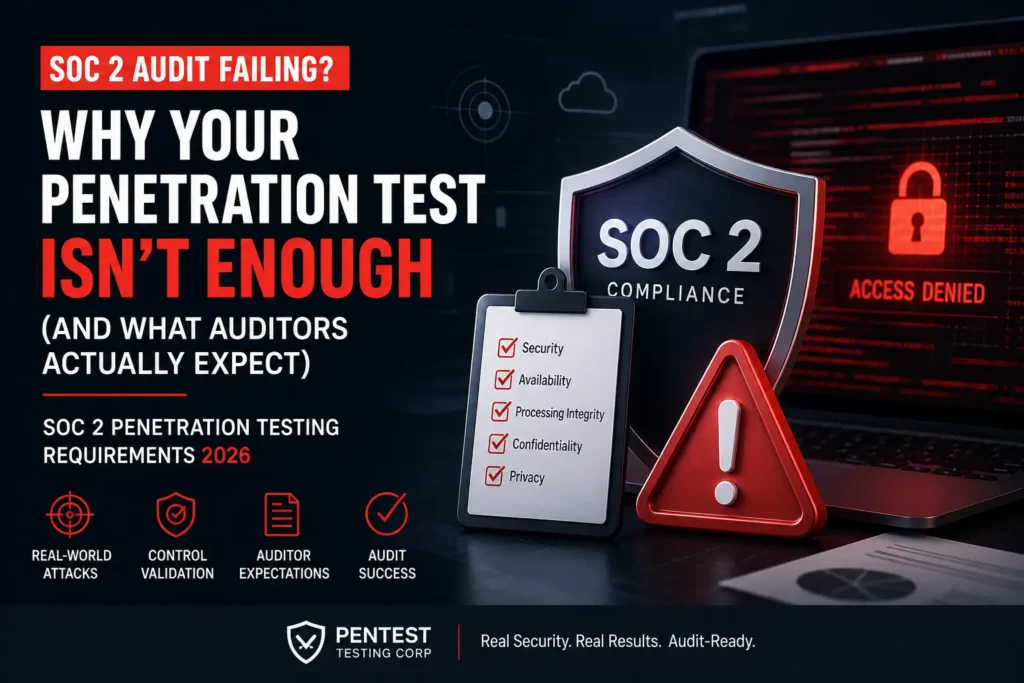
SOC 2 Audit Failing? Why Your Penetration Test Isn’t Enough (and What Auditors Actually Expect)
You Did a Pentest… So Why Are You Still Failing SOC 2?
You invested in a penetration test. You got a report. You assumed you were ready for audit.
Then the auditor pushes back.
This is happening more often in 2026 than most SaaS founders expect. Deals get delayed, compliance timelines slip, and security teams scramble to “fix” something they thought was already done.
Here’s the uncomfortable truth:
Most penetration tests don’t align with SOC 2 expectations.
SOC 2 isn’t about having a report. It’s about proving your controls actually work under real-world conditions.
And auditors are getting stricter.
In fact, SOC 2 doesn’t explicitly mandate pentesting, but auditors now treat it as essential evidence that your controls are effective, especially under Trust Services Criteria like CC4.1 and CC7.1.
Preparing for a PCI audit or QSA review? Our PCI DSS 4.0.1 penetration testing requirements guide explains Requirement 11.4 scope, segmentation testing, correction and retest evidence.
Quick Reality Check
Before going deeper, it’s worth validating your current exposure.
Run a quick security check using a free vulnerability scanner.
It won’t replace a pentest, but it’ll highlight obvious gaps early.
The Real Problem: Misaligned Penetration Testing
Most companies fail because their pentest:
- Is too generic
- Focuses only on automated scans
- Doesn’t map to SOC 2 Trust Services Criteria
- Lacks exploitation proof and remediation validation
SOC 2 is principle-based. It doesn’t give you a checklist. Instead, it requires you to prove your systems are secure in practice, not just in documentation.
That’s where most pentests fall short.
What Risk Looks Like in the Real World
Let’s make this concrete.
Scenario: SaaS Platform with “Clean” Pentest Report
- Login protected with MFA
- API endpoints documented
- Basic scanning shows no critical issues
Everything looks fine.
But here’s what a real attacker does:
1. Broken Access Control (IDOR)
An attacker changes a user ID in an API request and accesses another customer’s data.
2. API Abuse
No rate limiting. Attacker enumerates thousands of records.
3. Chained Exploit
A low-risk misconfiguration + weak authorization → full account takeover.
4. Data Exfiltration
Sensitive data gets exposed without triggering alerts.
This is exactly why manual testing matters.
Automated tools won’t chain vulnerabilities. Attackers will.
How Attackers Actually Exploit These Weaknesses
Attackers don’t think in terms of “vulnerabilities.” They think in attack paths.
Here’s how typical exploitation unfolds:
- Start with recon (public endpoints, APIs, subdomains)
- Identify weak entry points (auth flaws, exposed endpoints)
- Exploit SQL injection or logic flaws
- Escalate privileges through broken access control
- Move laterally across systems
- Extract sensitive data silently
This is why frameworks like the OWASP Top 10 still emphasize issues like:
- Broken Access Control
- Injection flaws
- Security misconfigurations
These aren’t theoretical risks. They’re the most exploited vulnerabilities in real breaches.
Why Automated Tools Miss Critical Issues
Most “SOC 2 pentests” in the market are actually:
- Vulnerability scans
- Automated tools with minimal manual validation
That’s a problem.
Because automated tools:
- Don’t understand business logic
- Can’t simulate real attacker behavior
- Miss chained vulnerabilities
- Generate false positives and false confidence
SOC 2 auditors know this.
They expect real-world validation, not just tool output.
What SOC 2 Auditors Actually Expect in 2026
Here’s where most companies get caught off guard.
Auditors aren’t asking:
“Did you run a scan?”
They’re asking:
“Can you prove your controls work under attack?”
In 2026, that means:
- Scope aligned to your SOC 2 boundary
- Manual penetration testing (not just automated)
- Proof of exploitation (not theoretical findings)
- Clear mapping to Trust Services Criteria
- Remediation + retesting evidence
Without this, your pentest may be rejected.
Even worse, outdated reports outside the audit window can invalidate your evidence entirely.
Once you have a report in hand, the next question is who owns closing each finding. Our 30-day pentest remediation ownership plan gives SOC 2 teams a role-by-role closure model auditors can follow.
Where Most Pentests Fail (And Cost You Deals)
From real audit failures, common issues include:
- Testing only the website, not APIs or cloud
- Ignoring authentication flows
- No validation of access controls
- Missing retest after fixes
- Reports with no business impact explanation
The result?
- Failed SOC 2 audits
- Delayed enterprise deals
- Lost customer trust
- Increased breach risk
⚠️ Risk Check:
If your current pentest didn’t include manual exploitation and retesting, you’re likely exposed.
You can review a SOC 2–aligned assessment approach here:
👉 https://www.pentesttesting.com/
Or explore specialized services like:
- web application security testing
- API penetration testing
These are the areas auditors focus on most.
How Proper Penetration Testing Solves This
A SOC 2–aligned penetration test does more than find vulnerabilities.
It answers critical questions:
- Can attackers actually exploit this?
- What’s the real business impact?
- Are controls working as intended?
- Have vulnerabilities been fully fixed?
For multi-tenant SaaS, one of the clearest ways to make that evidence specific is to document which tenant and role boundaries were actually exercised. Our multi-tenant SaaS authorization testing framework shows how BOLA, BFLA, object ownership, exports, background jobs, and retesting can be structured before an enterprise or audit review.
A proper engagement includes:
- Deep manual testing
- Real attack simulation
- Exploitation proof
- Clear remediation steps
- Retesting validation
This is what transforms a pentest into audit-ready evidence.
What to Look for in a SOC 2-Focused Penetration Testing Company
Not all providers are equal.
When selecting a partner, look for:
- Experience with SOC 2 audits
- Ability to map findings to Trust Services Criteria
- Manual testing capability (not tool-only)
- Clear, executive-level reporting
- Retesting included
- Coverage across:
- Web applications
- APIs
- Cloud environments
Also, auditors strongly prefer independent third-party testing for credibility.
Final Takeaway: A Pentest Isn’t Enough. Proof Is.
If your penetration test doesn’t demonstrate:
- Real-world exploitation
- Control effectiveness
- Remediation validation
…it won’t satisfy your auditor.
And it won’t protect your business.
Ready to Get This Right Before Your Audit?
If you’re preparing for SOC 2 or recovering from a failed audit, now is the time to fix this properly.
Get a manual, SOC 2–aligned penetration test with remediation and retesting support.
Or schedule a consultation to review your current report before your audit window closes.
🔐 Frequently Asked Questions (FAQs)
Find answers to commonly asked questions about SOC 2 Penetration Testing Requirements 2026.