30-Day Multi-Tenant SaaS Breach Containment Blueprint
If you run a B2B multi-tenant SaaS, you’re one sloppy access check away from a cross-tenant data leak—and a regulator-facing incident.
At Pentest Testing Corp, we see “tenant drift” all the time: apps that started life with clean tenant boundaries but slowly accumulated edge-cases, admin shortcuts, and legacy integrations across web, API, and cloud surfaces.
This guide gives you a 30-day multi-tenant SaaS breach containment sprint you can drop into your roadmap:
- Map where tenant boundaries actually live (not just in your architecture diagram).
- See how broken access control and IDOR become multi-tenant incidents.
- Run a Week-by-Week tenant isolation & RBAC hardening plan with code examples.
- Produce SOC 2 / ISO 27001 / HIPAA / GDPR–ready evidence that fits into your existing risk register and remediation flows.
Throughout the post, we’ll link to deeper fix-first playbooks from our Cybersecurity Insights & News hub.
Want an audit-friendly way to close actively exploited vulnerabilities fast? Use our CISA KEV remediation sprint playbook: https://www.pentesttesting.com/cisa-kev-remediation-sprint-in-30-days/
1. Map Where Tenant Boundaries Really Live
Most “multi-tenant SaaS breach containment” plans fail because they only look at the primary database. Real tenant boundaries live across:
- Primary relational DB (row-level
tenant_idororg_id). - Object storage (buckets, prefixes, folders).
- Search indexes (Elasticsearch, OpenSearch, Meilisearch).
- Analytics & BI (data warehouses, telemetry, dashboards).
- Logs & traces (central logging, SIEM, APM, error trackers).
- Caches & queues (Redis, message brokers, background jobs).
Your first job is to build a tenant boundary map that your engineers and auditors can both understand.
1.1 Model tenants explicitly in the database
Start with an honest data model:
-- tenants table
CREATE TABLE tenants (
    id           UUID PRIMARY KEY,
    slug         TEXT UNIQUE NOT NULL,
    name         TEXT NOT NULL,
    created_at   TIMESTAMPTZ NOT NULL DEFAULT now()
);

-- example multi-tenant table
CREATE TABLE accounts (
    id          UUID PRIMARY KEY,
    tenant_id   UUID NOT NULL REFERENCES tenants(id),
    email       CITEXT NOT NULL,
    role        TEXT NOT NULL,
    created_at  TIMESTAMPTZ NOT NULL DEFAULT now()
);

-- any table that contains customer data should be tenant-scoped
CREATE TABLE invoices (
    id          UUID PRIMARY KEY,
    tenant_id   UUID NOT NULL REFERENCES tenants(id),
    account_id  UUID NOT NULL REFERENCES accounts(id),
    amount_cents BIGINT NOT NULL,
    currency    TEXT NOT NULL,
    created_at  TIMESTAMPTZ NOT NULL DEFAULT now()
);
Now add PostgreSQL Row Level Security (RLS) to codify tenant isolation:
ALTER TABLE accounts ENABLE ROW LEVEL SECURITY;
ALTER TABLE invoices ENABLE ROW LEVEL SECURITY;

-- assume we set app.current_tenant_id per request
CREATE POLICY tenant_isolation_accounts ON accounts
  USING (tenant_id = current_setting('app.current_tenant_id')::uuid);

CREATE POLICY tenant_isolation_invoices ON invoices
  USING (tenant_id = current_setting('app.current_tenant_id')::uuid);
This pushes multi-tenant SaaS breach containment down into the data layer instead of relying on every query to “remember” the tenant_id filter.
1.2 Find tables that silently ignore tenants
Quick SQL to list tables in public that don’t have a tenant_id column:
SELECT t.table_name
FROM information_schema.tables t
WHERE t.table_schema = 'public'
  AND t.table_type = 'BASE TABLE'
  AND NOT EXISTS (
    SELECT 1
    FROM information_schema.columns c
    WHERE c.table_schema = t.table_schema
      AND c.table_name   = t.table_name
      AND c.column_name  = 'tenant_id'
)
ORDER BY t.table_name;
By the end of Week 1, you want a list of:
- Tenant-aware tables (with
tenant_id+ RLS). - Tenant-adjacent tables (logs, configs) where cross-tenant access is acceptable but must be explicitly justified.
- Tenant-ignored tables that need redesign or de-scoping.
2. How BAC & IDOR Become Cross-Tenant Breaches
Most real-world multi-tenant SaaS breaches we see are just Broken Access Control (BAC) and IDOR in a tenant context:
- “Global admin” endpoints that skip tenant checks.
- Per-object checks that trust user-supplied IDs.
- Background jobs that process cross-tenant data with no isolation.
2.1 Insecure vs secure tenant-scoped endpoint (Node.js / Express)
Insecure version (classic IDOR):
// GET /api/invoices/:invoiceId
app.get("/api/invoices/:invoiceId", async (req, res) => {
  const { invoiceId } = req.params;

  // ❌ no tenant or ownership check
  const invoice = await db("invoices").where({ id: invoiceId }).first();

  if (!invoice) return res.sendStatus(404);
  return res.json(invoice);
});
An attacker can enumerate invoiceId across tenants and exfiltrate data.
Secure version with tenant isolation + RBAC:
// tiny helper for authorization failures
class ForbiddenError extends Error {}

// central auth context from your JWT/session
function getAuthContext(req) {
  return {
    userId: req.user.sub,
    tenantId: req.user.tenant_id,
    roles: req.user.roles || []
  };
}

function requireRole(roles, needed) {
  if (!needed.length) return true;
  return needed.some((r) => roles.includes(r));
}

// GET /api/tenants/:tenantId/invoices/:invoiceId
app.get("/api/tenants/:tenantId/invoices/:invoiceId", async (req, res, next) => {
  try {
    const { tenantId, invoiceId } = req.params;
    const auth = getAuthContext(req);

    if (!auth.tenantId || auth.tenantId !== tenantId) {
      throw new ForbiddenError("Tenant mismatch");
    }

    const invoice = await db("invoices")
      .where({ id: invoiceId, tenant_id: tenantId })
      .first();

    if (!invoice) return res.sendStatus(404);

    // basic RBAC: only finance / admins can read invoices
    if (!requireRole(auth.roles, ["tenant_admin", "finance_read"])) {
      throw new ForbiddenError("Missing invoice read permission");
    }

    return res.json(invoice);
  } catch (err) {
    if (err instanceof ForbiddenError) return res.sendStatus(403);
    return next(err);
  }
});
Key ideas for multi-tenant SaaS security:
- Tenant in the URL + ROW filter:
tenant_idis both part of the route and the DB predicate. - RBAC sits on top of tenant isolation (never instead of it).
- Forbidden by default whenever the tenant or role context is missing.
3. 30-Day Multi-Tenant SaaS Breach Containment Sprint
Here’s the 30-day sprint we recommend to engineering/security leaders who need fast multi-tenant SaaS breach containment and tenant isolation hardening.
Week 1 (Days 1–7): Inventory trust boundaries & tenant mapping
Goal: one consistent, code-backed map of every place tenants live in your system.
- Create a
tenant_assets.yml
- id: db-main
  layer: "database"
  tech: "postgres"
  description: "Primary app database"
  tenant_boundary: "tenant_id + RLS"
  owner: "platform_team"

- id: s3-invoices
  layer: "object_storage"
  tech: "s3"
  description: "PDF invoice exports"
  tenant_boundary: "s3 key prefix 'tenants/{tenant_id}/...'"
  owner: "finops"

- id: es-logs
  layer: "search"
  tech: "opensearch"
  description: "Centralized log index"
  tenant_boundary: "mixed-tenant, controlled via Kibana RBAC"
owner: "observability_team"- Auto-discover references to
tenant_idin your codebase (Python helper)
import os, re, json

TENANT_PATTERNS = [
    re.compile(r"tenant_id"),
    re.compile(r"org_id"),
    re.compile(r"account_tenant"),
]

matches = []

for root, dirs, files in os.walk("."):
    dirs[:] = [d for d in dirs if d not in {".git", "node_modules", ".venv"}]
    for fname in files:
        if not fname.endswith((".js", ".ts", ".py", ".rb", ".go")):
            continue
        path = os.path.join(root, fname)
        try:
            text = open(path, encoding="utf-8").read()
        except Exception:
            continue
        for pat in TENANT_PATTERNS:
            for m in pat.finditer(text):
                matches.append(
                    {"file": path, "pattern": pat.pattern, "index": m.start()}
                )

print(json.dumps(matches, indent=2))- Join DB reality + code reality into one map and store it in Git as an auditable artifact—this is the start of your tenant isolation evidence pack.
When you’re done, you should know:
- Which services are tenant-aware.
- Which ones are pretending to be.
- Where multi-tenant SaaS breach containment is currently just a slide, not reality.
Week 2 (Days 8–14): Implement strict tenant scoping & RBAC
Goal: hard guarantees that every sensitive path includes tenant isolation + RBAC.
2.1 Enforce tenant context early in the request lifecycle
Example Express middleware:
function tenantGuard(req, res, next) {
  const auth = getAuthContext(req);

  if (!auth.tenantId) {
    return res.status(401).json({ error: "Missing tenant context" });
  }

  // pin tenant ID on request for downstream handlers
  req.tenantId = auth.tenantId;

  // optional: set Postgres app setting for RLS
  req.pgClient.query("SET app.current_tenant_id = $1", [auth.tenantId])
    .then(() => next())
    .catch(next);
}

// apply globally to API routes
app.use("/api", tenantGuard);
Now every handler can rely on req.tenantId and database RLS to support multi-tenant SaaS breach containment.
2.2 Normalize RBAC checks
Create a simple RBAC helper used everywhere:
const PERMISSIONS = {
  "invoices:read":   ["tenant_admin", "finance_read"],
  "invoices:write":  ["tenant_admin", "finance_admin"],
  "users:invite":    ["tenant_admin"],
};

function assertPermission(auth, permission) {
  const allowedRoles = PERMISSIONS[permission] || [];
  if (!allowedRoles.some((r) => auth.roles.includes(r))) {
    throw new ForbiddenError(`Missing permission: ${permission}`);
  }
}
Use it consistently:
app.post("/api/tenants/:tenantId/invoices", async (req, res, next) => {
  try {
    const auth = getAuthContext(req);
    if (auth.tenantId !== req.params.tenantId) {
      throw new ForbiddenError("Tenant mismatch");
    }
    assertPermission(auth, "invoices:write");

    const { amount_cents, currency } = req.body;
    const invoice = await db("invoices")
      .insert({
        tenant_id: auth.tenantId,
        amount_cents,
        currency,
      })
      .returning("*");

    res.status(201).json(invoice[0]);
  } catch (err) {
    if (err instanceof ForbiddenError) return res.sendStatus(403);
    next(err);
  }
});
By the end of Week 2, every sensitive endpoint should:
- Resolve tenant context from signed claims, not user input.
- Use a common RBAC helper (no one-off
if (role === 'admin')). - Delegate per-row isolation to RLS or equivalent data-layer guard wherever possible.
Week 3 (Days 15–21): Pentest tenant breakout paths & log decisions
Goal: systematically try to break tenant isolation and log each cross-tenant path as a formal risk.
If the immediate driver is an enterprise contract or security questionnaire rather than incident containment, the testing scope should also document exactly which tenant, role, object, export, and privileged-function boundaries were validated. See our pre-review SaaS authorization testing guide for the buyer-facing coverage and evidence model.
3.1 Attack playbook: tenant breakout tests
Design test cases such as:
- Replace
tenantIdroute param with another tenant’s ID. - Swap resource IDs (
invoiceId,userId) across tenants. - Replay admin endpoints with regular user tokens.
- Abuse background jobs: can one tenant’s export include other tenants?
Simple Python harness to fuzz IDs:
import requests
from uuid import uuid4

API_BASE = "https://your-saas.example.com/api"
TOKENS = {
    "tenant_a_user": "Bearer ...",
    "tenant_b_user": "Bearer ...",
}

def get_invoice_ids(token):
    r = requests.get(f"{API_BASE}/invoices", headers={"Authorization": token})
    r.raise_for_status()
    return [inv["id"] for inv in r.json()]

def try_cross_tenant_read(attacker_token, victim_invoice_id, victim_tenant_id):
    r = requests.get(
        f"{API_BASE}/tenants/{victim_tenant_id}/invoices/{victim_invoice_id}",
        headers={"Authorization": attacker_token},
    )
    return r.status_code, r.text[:200]

tenant_a_invoice_ids = get_invoice_ids(TOKENS["tenant_a_user"])
victim_invoice = tenant_a_invoice_ids[0]

status, body = try_cross_tenant_read(
    TOKENS["tenant_b_user"],
    victim_invoice,
    victim_tenant_id="TENANT_A_UUID_HERE",
)

print("Cross-tenant read status:", status)
print("Body snippet:", body)
You want 403/404 everywhere, never a successful cross-tenant read.
3.2 Log each finding as a risk item
Feed every cross-tenant path into your risk register in a structured way. For example:
- id: MT-001
  asset: "Billing Service"
  description: "Invoice read endpoint allows cross-tenant access via IDOR."
  likelihood: 4
  impact: 5
  frameworks: ["SOC 2", "ISO 27001", "GDPR"]
  category: "Access Control"
  status: "Open"
  owner: "appsec_team"
Our post on 5 Proven Steps for a Risk Register Remediation Plan shows how to convert these risks into a sprint-ready remediation board with JSON/YAML and simple automation.
If you need help formalizing this into a compliant risk assessment, engage our Risk Assessment Services for HIPAA, PCI, SOC 2, ISO, and GDPR.
Week 4 (Days 22–30): Fix critical paths, retest, and package evidence
Goal: close the worst tenant isolation gaps, retest them, and assemble an evidence pack auditors will trust.
4.1 Prioritize the top 10–20 tenant isolation risks
Use a simple risk score:
def risk_score(likelihood, impact, regulator_weight=1.0):
    return likelihood * impact * regulator_weight

# tenant breakout in production SaaS → high score
score_breakout = risk_score(5, 5, regulator_weight=1.4)  # 35.0
This is the same approach we use in our risk-register remediation playbook and supply-chain attack surface sprint articles.
4.2 Capture before/after evidence for each fix
For each high-risk item:
- Screenshot or export of pre-fix failed tests (cross-tenant read/write).
- Code snippet or config showing the fix.
- Screenshot/log of post-fix successful 403/404 on cross-tenant attempts.
- Reference to any supporting pentest or scanner report.
A typical Pentest Testing Corp penetration testing report includes an executive summary, scope, methodology, a vulnerability matrix (with OWASP/CWE mapping), and detailed technical findings plus remediation steps—perfect to attach as evidence.
4.3 Package the “Tenant Isolation Evidence Pack”
Create a simple structure in your repo or evidence storage:
evidence/
  tenant-isolation/
    01-tenant-assets.yml
    02-rls-policies.sql
    03-api-authorization-diff.md
    04-cross-tenant-tests-before.json
    05-cross-tenant-tests-after.json
    06-risk-register-tenant-isolation.yml
    07-pentest-report-tenant-isolation.pdf
This becomes your multi-tenant SaaS breach containment dossier for SOC 2 / ISO 27001 / HIPAA / GDPR and even NIS2 incident-reporting timelines.
4. Use the Free Website Vulnerability Scanner as a Quick Win
Before you even start the 30-day sprint, you can grab a quick external view of your SaaS surface.
Our Website Vulnerability Scanner at free.pentesttesting.com gives you a fast snapshot of exposed web vulnerabilities—with no signup required—right from the homepage call-to-action.
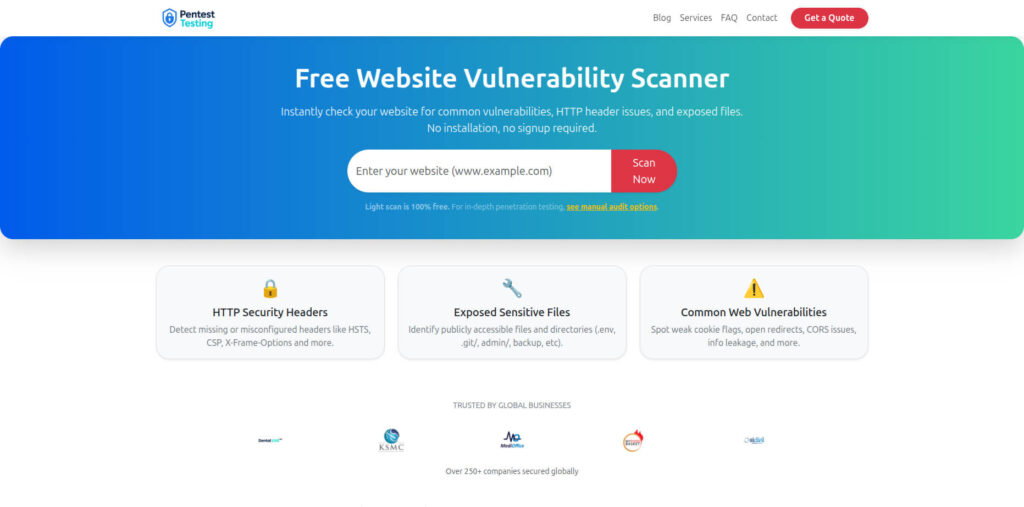
Sample report screenshot from the tool to check Website Vulnerability:
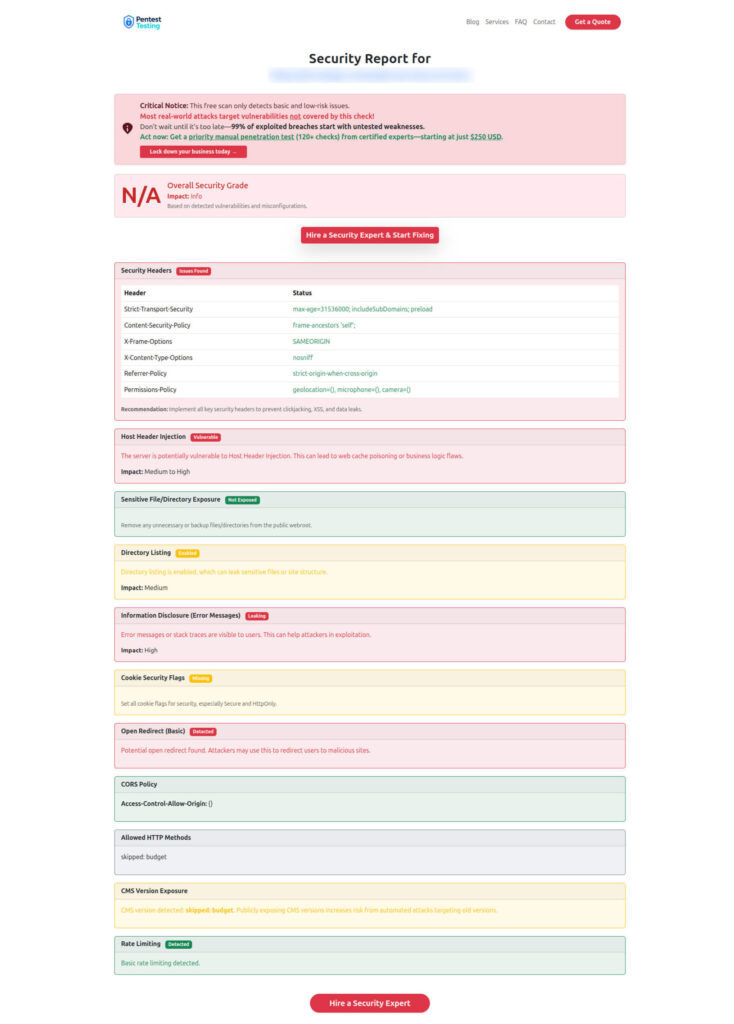
- How findings are grouped by severity (Critical/High/Medium/Low).
- How each issue includes a description, impact, and remediation guidance.
- How the report can be attached directly to your risk register and remediation board.
These visuals reinforce that your multi-tenant SaaS breach containment plan starts with real, testable evidence, not just theory.
5. Where Pentest Testing Corp Fits in Your Tenant Isolation Roadmap
Multi-tenant SaaS breach containment is not a one-off project. It plugs naturally into your existing pentest and compliance cadence:
- Targeted Web & API pentests
Use our Web Application Penetration Testing Services and API Pentest Testing Services to validate real exploitability of tenant isolation and RBAC flaws—not just discover them. - Cloud & infrastructure context
Multi-tenant SaaS often sits on shared cloud primitives. Our Cloud Pentest Testing helps ensure IAM, VPC design, and storage controls don’t quietly undermine tenant isolation at the infrastructure level. - Risk assessment & remediation sprints
Feed all cross-tenant risks into our Risk Assessment Services, then use our Remediation Services to execute a structured, fix-first plan with evidence your auditors will accept. - Ongoing PTaaS cadence
Once your 30-day tenant isolation sprint is complete, roll it into a recurring Pentest Testing as a Service (PTaaS) model so every new feature, migration, and acquisition is tested for tenant breakout risks on a continuous basis. - Token lifecycle validation
See our SaaS token theft penetration testing guide for testing OAuth and session revocation alongside tenant isolation.
For additional context around risk-registers, supply-chain attack surface, NIS2 reporting, and AI governance, cross-link to these recent articles:
- EU AI Act SOC 2: 7 Proven Steps to AI Governance
- 5 Proven Steps for a Risk Register Remediation Plan
- 60-Day Sprint to Shrink Your Supply-Chain Attack Surface
- NIS2 Reporting Drill: 24h/72h/1-Month Proven Evidence Kit
They complement this multi-tenant SaaS breach containment blueprint with broader risk, supply-chain, and regulatory strategies.
🔐 Frequently Asked Questions (FAQs)
Find answers to commonly asked questions about Multi-Tenant SaaS Breach Containment & Tenant Isolation.