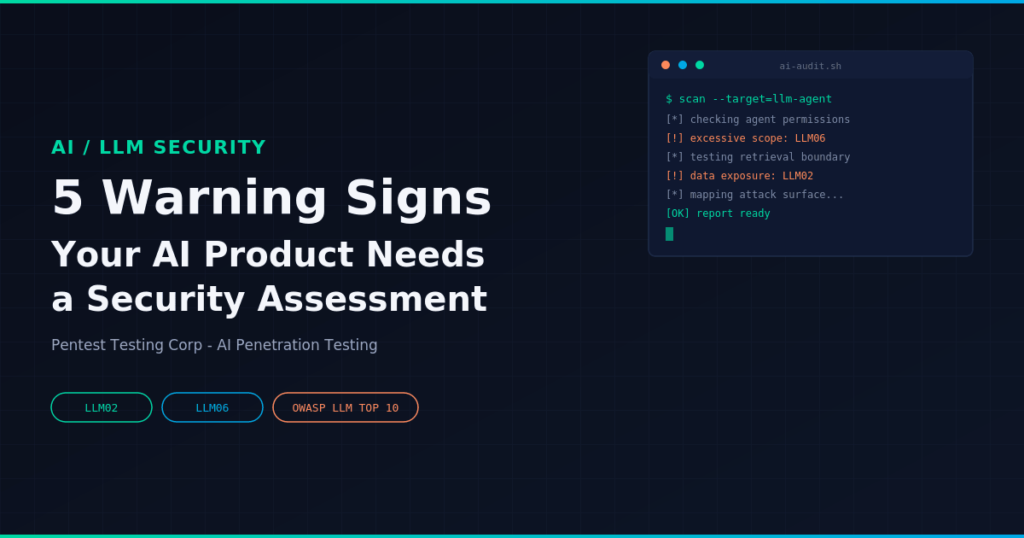
5 Warning Signs Your AI Product Needs a Security Assessment
A support engineer at a mid-size SaaS company once watched their AI assistant hand a customer someone else's invoice history. Nobody had hacked anything in the traditional sense. The customer just asked a slightly unusual follow-up question, and the model, eager to be helpful, pulled context it should never have surfaced. No alert fired. No WAF rule tripped. The team found out three days later, from the customer.
That's the uncomfortable part of AI risk. It rarely announces itself the way a SQL injection or an open S3 bucket does. It shows up as a slightly-off answer, a feature that works "well enough" in demos, or an integration nobody fully mapped out. By the time it's obvious, it's usually already happened.
This post walks through five concrete warning signs that your AI product is carrying more risk than your team realizes, mapped to the OWASP LLM Top 10 (2025), and what an AI security assessment actually checks for once you've spotted them.
Why AI risk hides in plain sight
Traditional application security has decades of tooling built around known attack patterns: injection, broken auth, misconfigured access control. Scanners catch a lot of it automatically. AI systems don't play by the same rules. A language model doesn't have a fixed set of inputs to fuzz. It has language, and language is infinitely flexible, which means the attack surface is really the model's judgment, not just its code.
That's why AI vulnerabilities tend to surface through behavior rather than error codes. The system doesn't crash. It just does something it shouldn't, and because it "worked," nobody questions it until the wrong person notices.
We see this pattern often enough across client engagements that it's worth naming explicitly. Below are the five signs that consistently precede a serious finding once we get a team in for a proper AI penetration testing engagement.
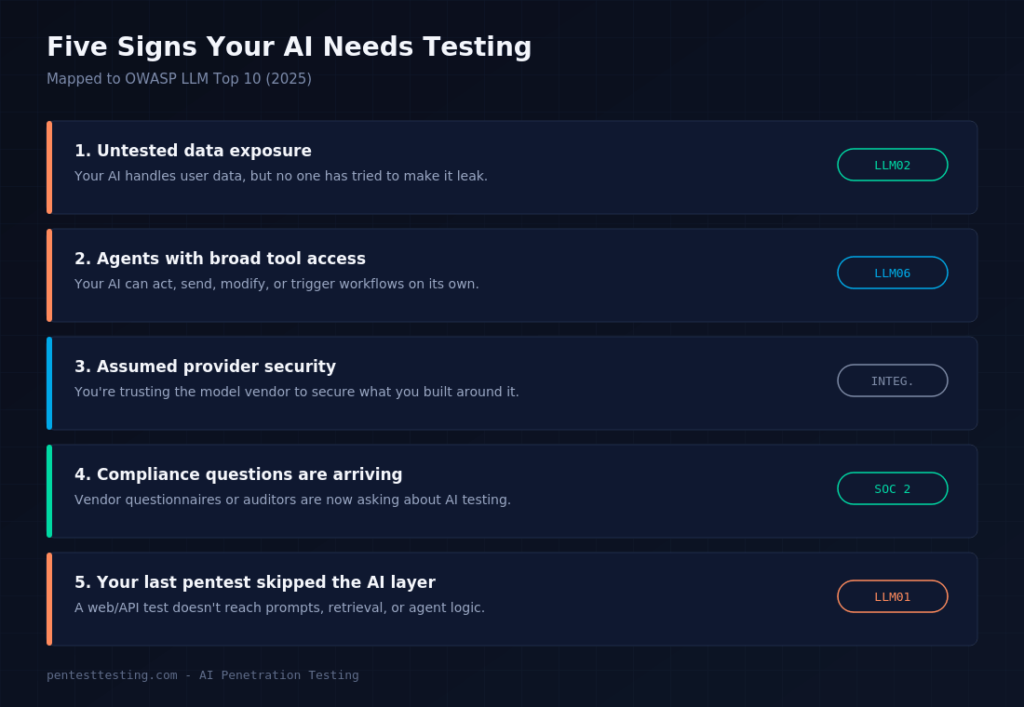
Sign 1: Your AI handles user data but nobody's tested what it can be tricked into revealing
This is the most common gap we find, and it maps directly to LLM02: Sensitive Information Disclosure in the OWASP LLM Top 10 (2025).
If your chatbot, copilot, or AI agent has access to customer records, account details, internal documents, or anything pulled from a database or knowledge base, the question isn't whether it can leak that data under normal use. It's whether a sufficiently creative prompt can get it to leak data it was never supposed to surface, including another user's information.
Ask yourself honestly: has anyone actually tried to make your AI say something it shouldn't, on purpose, under controlled conditions? "We tested the happy path and a few edge cases" is not the same thing as adversarial testing. Models are remarkably good at being coaxed into helpfulness that crosses a boundary nobody drew clearly enough.
Illustrative scenario (sanitized, non-working): Picture a support chatbot built on a retrieval-augmented generation (RAG) pipeline pulling from a shared knowledge base that includes ticket histories. A tester asks the bot to "summarize recent issues similar to mine" using language vague enough that the retrieval layer pulls in a few tickets from other accounts, and the model, doing its job, summarizes the lot. No credentials were stolen, no exploit was run. The retrieval boundary was just never enforced at the data layer. We've seen variations of this pattern across multiple unrelated engagements, almost always because access control was assumed to live "somewhere upstream."
Sign 2: Your AI can take actions, not just generate text
If your AI assistant can send emails, modify records, trigger workflows, call internal APIs, or invoke any tool on your behalf, you've moved from a chatbot to an agent, and the risk profile changes substantially. This is LLM06: Excessive Agency, and it's one of the fastest-growing categories we test for, simply because agentic features are shipping faster than the permission models around them.
The warning sign here is specific: agents are frequently given broader tool access than any single task requires, because scoping narrow permissions for every possible user request is tedious. "Just give it API access to the CRM" is a lot easier to implement than building a permission layer that matches exactly what the agent needs for each action. That convenience is exactly what an attacker exploits, by manipulating the agent into using capabilities it has but shouldn't use for the task at hand.
A reasonable gut check: if someone fed your AI agent a malicious instruction hidden inside a document it processes, an email it reads, or a calendar invite it parses, what's the worst action it could take with the tools it currently has access to? If the answer makes you uncomfortable, that's the sign.
That's not a hypothetical worth losing sleep over in the abstract. We broke down exactly what a hijacked agent can do once it holds real tool access in AI Agent Hijacking Business Risk: A Breakdown, including how one compromised instruction can turn into a drained payment queue or a quiet data export nobody catches for days.
Sign 3: You've integrated a third-party LLM API and assumed the provider secures it
A surprising number of teams treat "we use OpenAI" or "we use Claude" as a security answer. It isn't, and it was never meant to be. Model providers secure the model itself, but everything you build around it, your prompts, your retrieval sources, your agent permissions, your API connections, and the systems your AI can reach, is on you.
This matters because the integration layer is consistently where real vulnerabilities live, not inside the foundation model. A provider's content policy doesn't stop someone from extracting your system prompt through clever phrasing. Their rate limiting doesn't prevent prompt injection delivered through a support ticket your AI happens to read. If your security review of your AI feature stopped at "we picked a reputable vendor," that review didn't actually cover the parts you're responsible for.
Sign 4: You're answering vendor security questionnaires or prepping for a compliance audit that now mentions AI
Compliance frameworks have started catching up to where the technology already is. SOC 2 trust service criteria around logical access and change management increasingly apply to AI systems touching customer data, and the NIST AI Risk Management Framework is becoming a standard reference point for governance expectations around AI deployments.
If a customer's vendor security questionnaire has started asking "have you conducted security testing specific to your AI/LLM features," or your auditor has started asking how your AI assistant's data access is controlled, that's not a hypothetical future requirement. It's a present-tense gap. "We haven't done that yet" is a harder answer to give with each passing renewal cycle, and increasingly it's the kind of answer that stalls a deal or an audit sign-off rather than just raising an eyebrow.
Sign 5: Your last security assessment didn't actually test the AI layer
This one catches teams off guard the most. Plenty of companies have a recent, perfectly good penetration test on file, and assume it covers their AI feature because the AI feature lives inside the same web application. It usually doesn't.
A standard web or API pentest is built to catch things like broken authentication, SQL injection, and insecure direct object references. None of that touches whether your model can be manipulated through its prompt, whether it leaks data through its outputs, or whether an agent built on top of it can be pushed into taking unauthorized actions. Those are model-reasoning and agent-logic problems, not HTTP-layer problems, and most traditional testing scope simply doesn't reach them.
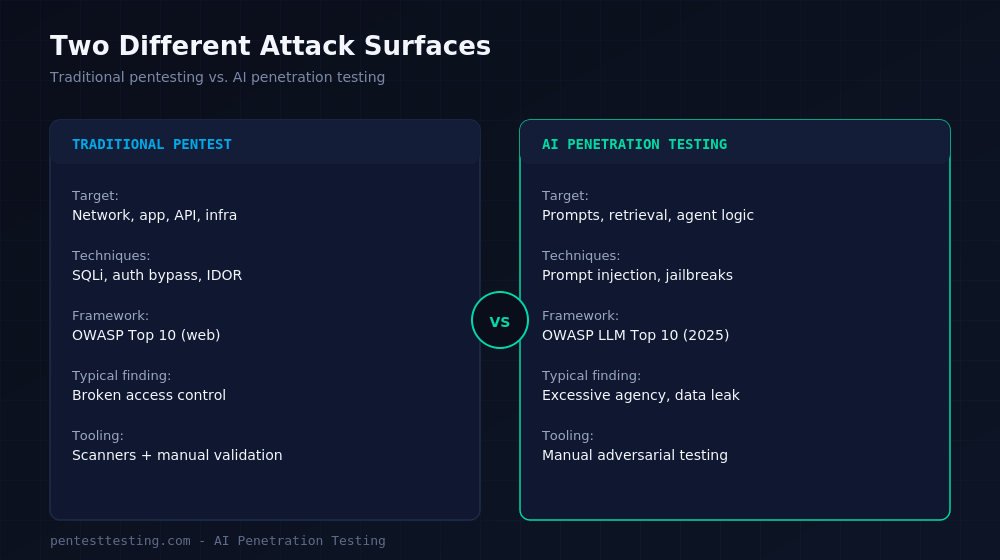
| Traditional Penetration Test | AI Penetration Testing | |
|---|---|---|
| Primary target | Network, application, API, infrastructure | Model behavior, prompts, retrieval, agent logic |
| Core techniques | SQL injection, auth bypass, IDOR, misconfig | Prompt injection, system prompt extraction, jailbreaks, retrieval poisoning |
| Tooling approach | Automated scanners + manual validation | Manual adversarial testing, largely non-automatable |
| OWASP framework | OWASP Top 10 (web) | OWASP LLM Top 10 (2025) |
| Typical finding | Broken access control, injection flaws | Excessive agency, sensitive data disclosure via outputs |
| Best fit | Any web/API surface, including AI front-ends | Chatbots, copilots, RAG systems, AI agents |
If you've only ever run the left column against a product that includes the right column's attack surface, you have a real, unaddressed gap. Most clients run both for full coverage, not because either one is incomplete on its own, but because they answer fundamentally different questions.
What an AI security assessment actually checks for
A properly scoped AI penetration testing engagement doesn't just probe whether your model can be jailbroken in isolation. It examines the system as attackers would actually approach it: the prompts your application constructs, the data your retrieval layer pulls in, the permissions your agents carry, and the path from a malicious input to a real-world consequence.
That generally means structured testing across the categories most relevant to your architecture. Chat-only products lean heavily on LLM01 (Prompt Injection) and LLM02 (Sensitive Information Disclosure). RAG-based systems add retrieval and embedding risks. Agentic products that call tools need deep coverage of LLM06 (Excessive Agency), because that's where a manipulated model turns into a real action taken against your systems.
The deliverable isn't a list of theoretical risks. It's proof. Every finding comes with reproduction steps and evidence that a vulnerability is real, not speculative, along with remediation guidance specific enough for your team to act on without guessing.
How engagements are typically scoped
Pricing depends on what's actually in scope, how deeply the AI integrates with your systems, and whether adversarial red-team testing is included. Most engagements fall into one of three tiers.
| Tier | Price Range | Best For |
|---|---|---|
| Starter - LLM Baseline Evaluation | From $9,500 | Teams using third-party model APIs (OpenAI, Anthropic, etc.) with limited backend integration. Covers prompt injection, output manipulation, system prompt leakage, and data exposure. |
| Professional - Integrations & Agentic Abuse | $15,000–$35,000 | Applications with active plugins, internal tools, and RAG pipelines. Covers permission boundaries, agent abuse, and indirect injection through retrieved content. |
| Enterprise - Adversarial & Full Pipeline Review | $35,000–$75,000 | Proprietary ML models and complex agentic systems. Includes deep training-data exposure review, advanced adversarial testing, and full infrastructure pentesting. |
A short scoping call is usually enough to figure out which tier actually fits your system, rather than guessing from a price list. You can see the full breakdown of what each tier covers on the AI penetration testing services page.
What to do if you recognize two or more of these signs
If you read through this list and found yourself nodding at more than one, that's not a reason to panic, but it is a reason to move before something forces your hand. A few practical next steps:
Inventory what your AI can actually access and do. Not what it's supposed to do, what it's technically capable of doing given its current permissions and data connections. This alone surfaces a surprising number of gaps before any formal testing starts.
Separate "we tested it" from "we adversarially tested it." QA testing for functionality and adversarial testing for security are different disciplines with different goals. Most teams have done plenty of the first and none of the second.
Get a baseline before your next audit cycle or vendor questionnaire forces the question. Testing on your own timeline, before a deal or an audit depends on the answer, gives you room to fix what's found without a deadline breathing down your neck.
Scope the engagement to your actual architecture. A chatbot with no backend access needs different testing depth than a multi-agent system wired into your CRM and internal tools. Getting the scope right up front keeps the engagement focused and the pricing predictable.
Frequently asked questions
How do I know if my AI product actually needs a security assessment, or if it's low risk enough to wait?
If your AI touches customer data, has access to internal systems or tools, or is customer-facing in any capacity, it carries real risk regardless of how simple the feature feels. The deciding factor isn't how advanced your AI is; it's what it can access and what it can do on someone's behalf.
We already ran a penetration test on our web application. Doesn't that cover our AI chatbot?
Usually not. A standard web or API pentest targets HTTP-layer issues like broken authentication and injection flaws. It doesn't test whether your model can be manipulated through prompts, whether it leaks data through its outputs, or whether an agent can be pushed into unauthorized actions. Those require testing methodology built around the OWASP LLM Top 10 specifically.
What's the difference between LLM02 and LLM06, and why do both matter?
LLM02, Sensitive Information Disclosure, covers your AI revealing data it shouldn't, PII, internal records, another user's information. LLM06, Excessive Agency, covers your AI taking actions it shouldn't, because it has broader tool access or permissions than the task actually requires. A chat-only product needs to worry most about the first. An agentic product that calls tools or APIs needs to worry seriously about both.
How long does an AI security assessment take?
It depends on scope. A focused assessment of a single chatbot with limited integration moves relatively quickly. A full assessment of a multi-agent system with tool access and RAG pipelines takes longer, since there's simply more attack surface to map and test. You'll get a clear timeline as part of the proposal, before any work starts.
What happens after the assessment finds something?
You receive a prioritized report with reproduction steps and evidence for each finding, along with specific remediation guidance your team can act on. A remediation walkthrough and a free retest are typically included, so the engagement doesn't end with a PDF nobody has time to operationalize.
Is this only relevant for companies building their own AI models?
No, and this is a common misconception. Most companies we work with aren't training models. They're SaaS teams who've added a chatbot, wired in an LLM API, or built a copilot on top of an existing product. The integration layer, your prompts, your data connections, your agent permissions, is where most real-world vulnerabilities actually live, regardless of whether you trained the underlying model.
These are the signs your AI Product needs a security assessment, before it's too late
Every one of the five signs above describes a gap that's already there, quietly, before anything goes wrong publicly. The companies that get ahead of it are the ones who treat AI security testing as a normal part of shipping AI features, not a reaction to a near-miss or a customer complaint.
If two or more of these signs sound familiar, it's worth a short conversation before it becomes a longer one. Book a 15-minute scoping call and we'll help you figure out exactly what needs testing and what it'll actually cost to do it properly. You can also review the full methodology and engagement tiers on our AI penetration testing page.