How Much Does an AI Penetration Test Cost? Pricing and Scoping Guide for 2026
A SaaS company we'll call out anonymously here added a support chatbot backed by a third-party LLM API in early 2026. Nothing fancy: answer questions, pull order status, escalate to a human when needed. Three months later, a customer found they could get the bot to retrieve another tenant's order history just by phrasing a request the right way. No malware, no exploit kit, just language doing what language does to a model that trusted it too much. That's the gap an AI penetration test exists to find before a customer, or worse, an attacker, finds it for you.
If you're reading this, you've probably already had the budget conversation internally and now need a number to bring back. The honest answer is that AI penetration testing cost depends on what you've actually built, not on a flat industry rate. This guide breaks down the variables that move price, gives you real 2026 ranges by engagement tier, and tells you exactly what to have ready before you request a scoped quote.
Why AI Pentest Pricing Doesn't Work Like a Web App Quote
Traditional web application penetration testing has settled into fairly predictable pricing. Count the endpoints, estimate the user roles, check the authentication complexity, and most firms land in a similar range for similar scope. AI systems break that model.
A single chatbot wired to one third-party model API is a different animal entirely from a multi-agent platform with tool access, a RAG pipeline pulling from a live vector database, and a fine-tuned model trained on proprietary data. Both get called "AI penetration testing." The pricing gap between them can be five to eight times wider than anything you'd see between two web apps of comparable size.
This isn't padding or vendor inconsistency. It reflects genuinely different attack surfaces. A static web app has a knowable set of inputs and outputs. An LLM-based system has a reasoning layer that behaves differently depending on phrasing, context window, retrieved content, and what tools it can invoke. Testing that thoroughly, the way our AI penetration testing methodology is structured to do, takes more time, more manual technique, and more expertise than running an automated scanner against a REST API.
The scope of what's being tested generally maps to the OWASP LLM Top 10 (2025), collectively covering everything from prompt injection (LLM01) and sensitive information disclosure (LLM02) through excessive agency (LLM06) and unbounded consumption (LLM10). Whether all ten categories apply, and how deeply, depends entirely on your architecture. That's the real driver behind why a quote can't be generic.
The Five Variables That Actually Move Price
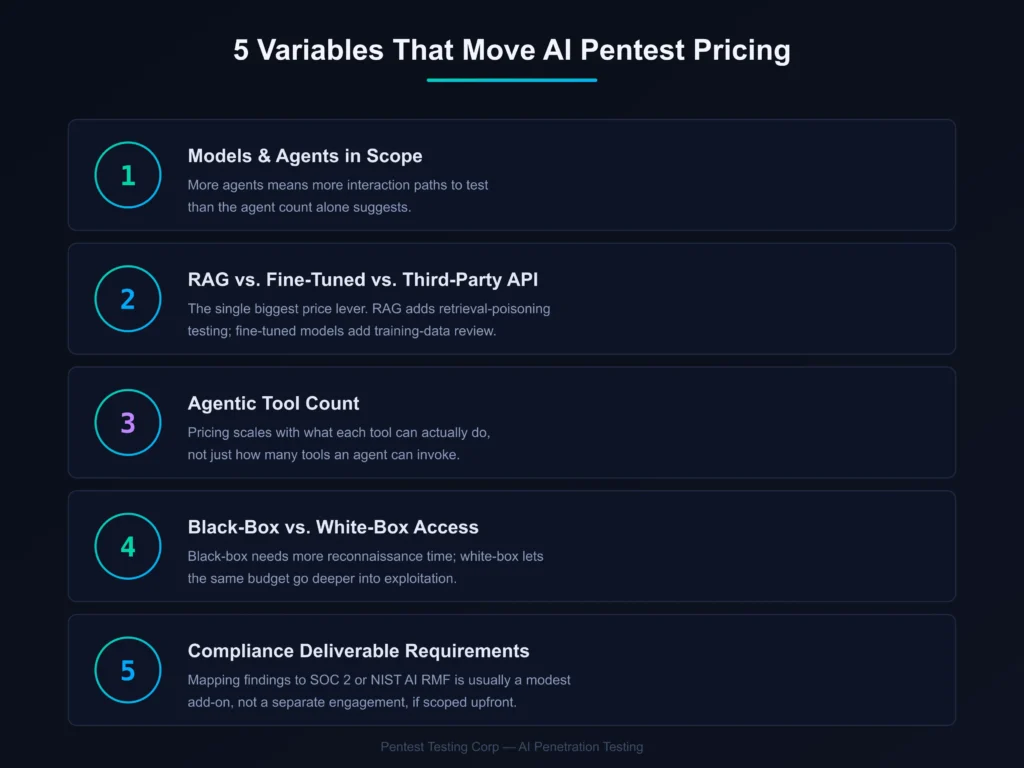
Every AI security assessment quote, whatever firm you're talking to, gets built from roughly the same set of inputs. Get clear on these before your scoping call and you'll cut a week off the back-and-forth.
1. Number of Models and Agents in Scope
A single chatbot answering one type of question is a contained test. A platform running multiple specialized agents that hand off tasks to each other, each with its own tool access, multiplies the attack surface. Testers have to map how agents communicate, whether one agent's output can manipulate another's behavior, and where permission boundaries actually hold under adversarial pressure versus where they're assumed to hold. More agents means more interaction paths to test, and interaction paths grow faster than the agent count itself.
2. RAG, Fine-Tuned, or Third-Party API Model
This is probably the single biggest price lever. A system that just calls GPT, Claude, or another provider's API with limited backend logic sits at the lower end of LLM pentest pricing. You're testing the integration layer: prompts, output handling, what the application does with what the model returns.
Retrieval-augmented generation (RAG) systems add a vector database and a retrieval pipeline to the mix. A RAG pentest cost runs higher because testers need to assess retrieval poisoning, cross-tenant data exposure in shared vector stores, and what happens when untrusted content (a malicious PDF, a poisoned support ticket) enters the knowledge base and gets retrieved into a response later. That's a structurally different test than probing a stateless API call.
Fine-tuned or proprietary models sit at the top. Now there's training data integrity to consider, potential data and model poisoning (LLM04), and the question of what the model has memorized that it shouldn't have. This tier typically pulls in more specialized testing time and, in some engagements, a deeper review of how training data was sourced and handled.
3. Agentic Tool Count
Every tool an agent can invoke (sending email, querying a database, hitting an internal API, modifying records) is a potential excessive agency (LLM06) finding waiting to happen. A read-only agent that summarizes documents has a small blast radius if it's manipulated. An agent that can send messages, approve transactions, or modify customer data on someone's behalf has a large one. Pricing scales with both the number of tools and what each tool can actually do, not just how many there are.
4. Black-Box vs. White-Box Access
Black-box testing, where testers interact with the system the way an external attacker would, with no source code or architecture documentation, takes longer because the team has to map the attack surface from the outside before they can attack it. White-box access, where testers get system prompts, architecture diagrams, and ideally some code-level visibility into how outputs get handled downstream, lets testing go deeper faster because less time goes into reconnaissance and more goes into exploitation.
Neither approach is universally "better." Black-box more closely simulates a real external attacker. White-box typically surfaces more findings per hour of testing because the team isn't guessing at architecture. Most engagements land somewhere in between: grey-box, with partial documentation and some access. Whichever you choose affects both price and what kind of assurance you walk away with.
5. Compliance Deliverable Requirements
If you need a report that explicitly maps findings to SOC 2 Trust Service Criteria or the NIST AI RMF, because an auditor or an enterprise customer's vendor security questionnaire requires it, that's additional structured work on top of the technical findings themselves. It's usually not a massive price jump, but it's rarely zero, and it's worth specifying upfront so it's priced into the original quote rather than added as a change order later.
2026 Pricing Tiers: What You'll Actually Pay
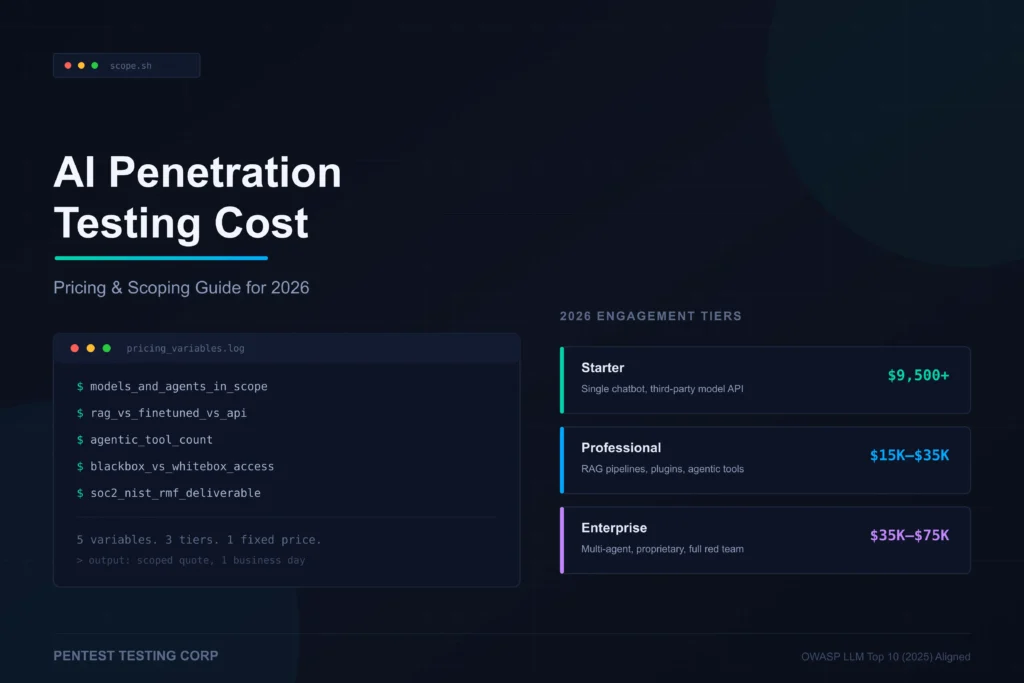
Here's how engagements tend to break down in practice. These are illustrative ranges, not a substitute for a scoped quote, but they should keep you from getting wildly anchored in either direction during vendor conversations.
| Tier | Typical System Profile | Price Range | What's Covered |
|---|---|---|---|
| Starter | Single chatbot or assistant on a third-party model API (OpenAI, Anthropic, etc.), limited backend integration | $9,500+ | Prompt injection, output manipulation, system prompt leakage, basic data exposure checks |
| Professional | AI application with active plugins, internal tool access, and/or a RAG pipeline | $15,000–$35,000 | Permission boundary testing, agent abuse, indirect injection via retrieved content, API access control review |
| Enterprise | Multi-agent platform, proprietary or fine-tuned models, complex agentic workflows | $35,000–$75,000 | Deep training-data exposure review, advanced adversarial testing, full infrastructure pentest around the AI layer |
A few things worth noting about these numbers. First, they're fixed-price ranges, not hourly estimates. A firm doing this properly should be able to give you an exact number once scope is confirmed, not a "time and materials, we'll see how it goes" arrangement. Open-ended hourly billing on AI engagements tends to run long, because reasoning systems behave unpredictably and testers can chase rabbit holes that don't map to a fixed deliverable.
Second, the jump from Starter to Professional is usually about integration depth, not raw system count. A company with three simple chatbots on the same API can sometimes test cheaper than a company with one chatbot that has database write access and a RAG pipeline. Complexity, not headcount of AI features, is what drives cost.
Third, full adversarial red team testing, where testers actively try to chain findings into a worst-case scenario rather than just confirming individual vulnerabilities exist, generally sits at the upper end of whichever tier you're in. If your board or your insurer specifically wants red team coverage rather than a standard assessment, say so during scoping. It changes both the price and the report structure.
Curious what these engagements actually turn up once testing starts? We pulled together aggregated findings from 30+ AI chatbot and agent penetration tests we ran this year, covering how often system prompts leaked, how often content policy got bypassed, and just how common excessive agency turned out to be in agentic deployments.
A Sanitized Example: Why Scope Changes the Number
Here's an illustrative scenario, not a real client engagement, that shows how the same starting point can land in two different tiers depending on what gets added.
A mid-sized fintech company builds a customer-facing assistant on a third-party model API. In its initial form, the assistant answers account questions using data pulled directly from the customer's own session, no broader database access, no ability to take actions. That's a clean Starter-tier engagement: test the prompt boundaries, confirm the model can't be coaxed into revealing another session's data, check that the system prompt can't be extracted and used to bypass guardrails.
Three months later, the same company adds a feature: the assistant can now initiate a password reset and pull transaction history from a connected database to answer "did this charge go through" questions. That single addition moves the engagement into Professional tier territory. Now testers need to assess whether the assistant can be manipulated into resetting the wrong account's password (excessive agency, LLM06), whether transaction queries can be tricked into pulling cross-account data, and whether the database connection itself introduces injection risk that didn't exist when the bot was read-only.
Nothing about the company's risk tolerance changed. The architecture did, and the test scope had to follow it. This is the most common reason a quote that felt accurate six months ago no longer reflects what needs testing today: features get added faster than security scope gets revisited.
Traditional Pentest vs. AI Pentest Pricing Logic
| Factor | Traditional Web/API Pentest | AI Penetration Test |
|---|---|---|
| Primary driver of cost | Number of endpoints, user roles, authentication complexity | Model type (API vs. RAG vs. fine-tuned), agentic tool count, integration depth |
| Access model impact | Moderate (black-box adds time, less dramatically) | Significant (black-box vs. white-box can shift scope substantially given reasoning opacity) |
| Automation coverage | High; scanners cover a meaningful share of baseline checks | Low; most substantive findings require manual adversarial testing |
| Typical entry price | Often lower for small apps with limited scope | Generally starts higher due to manual-testing requirements even at small scale |
| Compliance mapping | Usually a standard add-on (SOC 2, PCI DSS controls) | Increasingly requested but less standardized; OWASP LLM Top 10 mapping is becoming the reference point |
If you've already run a standard web or API pentest this year, it's worth checking whether it actually touched your AI layer at all. Most don't, because the testing methodology is different.
What to Have Ready Before You Request a Quote
The fastest way to get an accurate fixed-price proposal is to walk into the scoping call with these answers ready. Vendors can give rough verbal ranges without all of this, but an exact number depends on it.
- A list of every AI system you want tested, even briefly: chatbot, internal copilot, agent, document processor. One line each is fine.
- What each system is built on: a named third-party model API, a fine-tuned model, or a RAG setup with a vector database.
- What each system can access or do: read-only, or can it write to a database, send messages, call other APIs, take actions on a user's behalf?
- How many distinct tools or functions an agent can invoke, if you're running anything agentic.
- Your preferred access model: are you comfortable handing over system prompts and architecture docs (white-box), or do you want a pure external attacker simulation (black-box)?
- Whether you need a compliance-mapped deliverable, and to which framework: SOC 2, NIST AI RMF, ISO 27001, or a specific customer questionnaire.
- Your timeline, since a tight deadline ahead of an audit or a customer renewal can affect scheduling, though it shouldn't affect the price itself.
Bring that list to a scoping call and most firms, including ours, can turn around a fixed-price proposal within a business day.
Getting an Accurate Number
Rough ranges are useful for budgeting conversations internally, but they're not a substitute for a scoped quote against your actual architecture. The fastest path from "I think this costs somewhere between $15K and $50K" to a number you can put in a purchase order is a short conversation about what you've actually built.
Book a 15-minute scoping call and we'll walk through your AI systems, confirm which tier you fall into, and send a fixed-price proposal, no sales pressure, no hourly billing surprises later. You can also see the full methodology and tier breakdown on our AI penetration testing services page.
Frequently asked questions about AI Penetration Testing Cost.
How much does AI penetration testing cost in 2026?
Engagements typically start from $9,500 for a single chatbot on a third-party model API with limited integration, and range up to $75,000 for enterprise multi-agent systems with proprietary models and full adversarial testing. The exact number depends on model type, agent count, and access level, so a scoping call gives a far more accurate figure than any flat industry number.
Is LLM pentest pricing different from RAG pentest cost?
Yes. A straightforward LLM integration (calling a third-party API with limited backend logic) generally costs less than a RAG pentest, because RAG systems require testing retrieval poisoning, vector database exposure, and how untrusted retrieved content can manipulate output. RAG pricing usually lands in the Professional tier rather than Starter.
Does black-box testing cost more than white-box testing?
Often, yes, because black-box testing requires more reconnaissance time to map the attack surface before exploitation can begin. White-box access, where testers receive system prompts and architecture documentation, lets the same budget go further into deeper exploitation rather than discovery. Some firms price these similarly and let scope hours absorb the difference; ask directly during scoping.
What's included in a SOC 2 or NIST AI RMF-mapped deliverable?
A compliance-mapped report explicitly ties each technical finding to relevant control language, such as SOC 2's logical access criteria or a function within the NIST AI RMF, so the report can be handed directly to an auditor or used to answer a vendor security questionnaire. This is typically a modest additional cost on top of the base technical assessment, not a separate engagement.
How long does it take to get a quote after a scoping call?
Most firms doing fixed-price AI penetration testing, including Pentest Testing Corp, can turn around a proposal within one business day of a scoping call, provided you've come prepared with the basics: system list, model type, access scope, and compliance requirements.
Can I scope just one AI feature instead of my whole AI footprint?
Yes, and it's a common starting point. Many companies test their highest-risk or most recently launched AI feature first, then expand scope in a follow-up engagement once budget or compliance timelines allow. Just be specific about what's included so the quote reflects that narrower scope accurately.