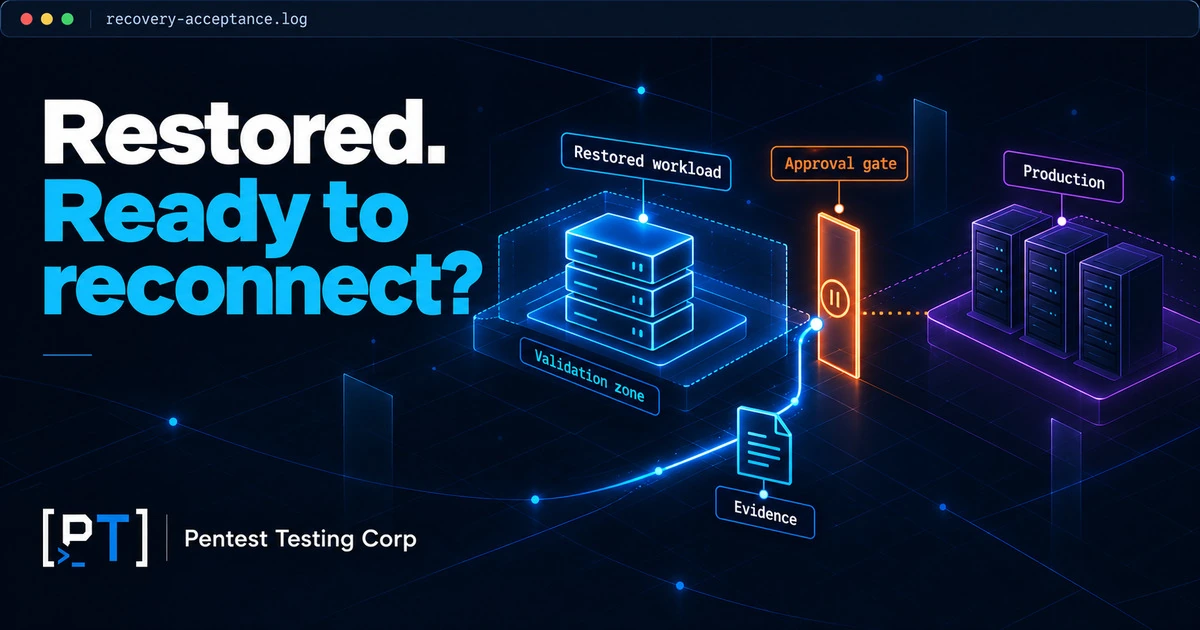
Ransomware Restore Readiness Assessment: Before Reconnecting
The restore dashboard shows success. Your order platform starts, the database opens, and operations wants access restored before the next shift. Yet the incident team has not established whether the backup predates the intrusion, whether privileged access remains compromised, or whether yesterday’s transactions survived. The outage is visible; the remaining exposure is harder to measure.
A ransomware restore readiness assessment gives the incident owner an evidence-based basis for deciding whether a defined service can reconnect, needs restrictions, or must remain isolated. It examines the restored workload, its identities, its dependencies, and the business records it will use.
The objective is a defensible recovery decision under pressure. That means preserving evidence before changes where feasible, validating the controls that matter for the proposed connection, and documenting uncertainty. No assessment can prove that every compromise has been found. Leadership needs to know what was checked, what remains unknown, and which conditions would stop recovery.
What a ransomware restore readiness assessment must cover
Start with a business service and its intended operating mode. “The server is restored” leaves important questions unanswered: which users may connect, which systems may exchange data, who can administer it, and whether it can issue payments, change records, or trigger customer communications. A narrow reconnection can still expose a powerful integration.
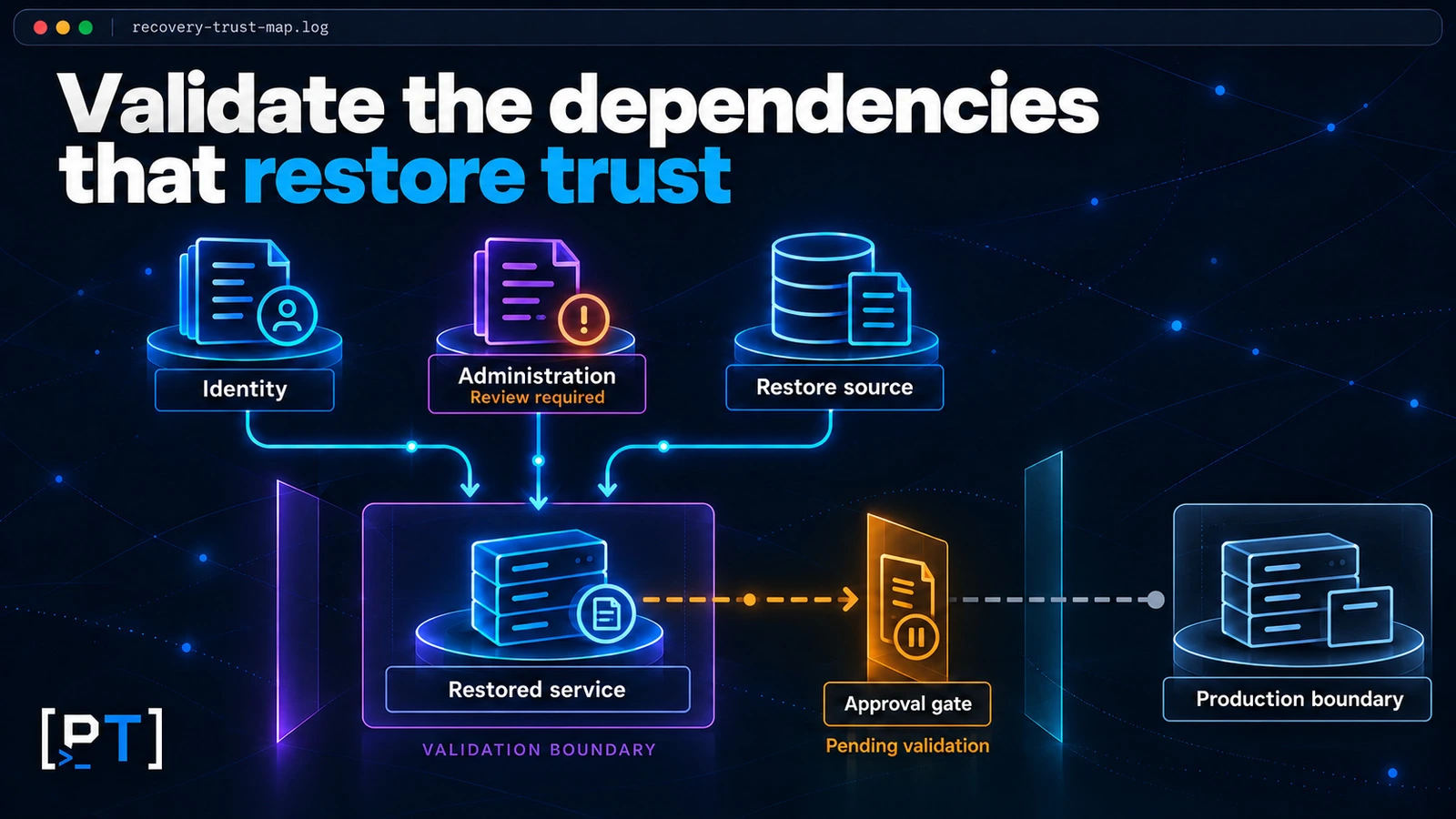
Ask the recovery team to identify the application, data stores, identity services, management tools, backup infrastructure, and external connections supporting that service. Include third-party administrators and shared dependencies. A recovered application can inherit risk from an unrecovered directory, deployment system, or remote-management platform.
Separate three decisions: whether restoration assets are suitable to use, whether the restored service is ready for its proposed exposure, and whether incident recovery can formally end. These decisions require different evidence and may occur at different times. Opening a restricted service does not close the investigation.
NIST CSF 2.0 distinguishes backup validation in RC.RP-03, restored-asset validation in RC.RP-05, and criteria-based recovery closure in RC.RP-06. NIST SP 800-61r3, finalized in April 2025, adds incident-response recommendations aligned with that framework. These are useful reference points for organizing a decision record; they do not certify an environment as clean.
Where the compromise scope or recovery evidence is unclear, our digital forensic analysis and incident response services provide a starting point for scoping investigation and containment support. Ask explicitly for recovery validation objectives, the systems covered, and the expected decision deliverable. A general investigation scope should not be assumed to include every recovery check.
Preserve evidence and define the limits of confidence
Recovery changes the environment being investigated. Rebuilding a host, replacing an account, or reconnecting an application can remove artifacts or introduce new activity into the timeline. The incident lead should coordinate preservation and operational recovery so the team understands what evidence a proposed change could affect.
Preservation should be proportionate to the incident and directed by qualified responders. Relevant records may include endpoint evidence, identity and cloud audit logs, backup administration history, network telemetry, and the recovery action log. Document collection times, sources, handlers, integrity checks, and storage access. Keep protected originals separate from working copies.
Chain of custody records how evidence was collected, transferred, and protected. Hash verification supports checking that captured bytes have not changed since hashing. Neither establishes that a source system was trustworthy before acquisition, nor guarantees legal admissibility. Explain those limits when presenting evidence to leadership.
Immediate containment may be necessary to prevent further harm. Do not delay urgent safety or containment action solely to complete ideal evidence collection. Record what was done, why it was necessary, who authorized it, and which evidence could not be preserved. Our guide to building an evidence-referenced breach timeline explains the broader investigation workflow.
The recovery decision also needs a coverage statement. List the systems reviewed, the period covered, the telemetry available, and any exclusions. “No malicious activity identified in the reviewed records” is different from “no malicious activity occurred.” Missing historical logs can prevent the team from bounding intrusion dates even when current monitoring works.
Use that uncertainty to select a safer operating mode. An unresolved gap affecting an isolated reporting copy may permit restricted use. The same gap affecting the identity authority for production systems can justify a hold. Avoid treating every unknown as equally important or letting an unqualified green status hide a consequential blind spot.
Validate backup integrity, restore provenance, and business data
A backup completion message establishes a limited operational fact. Before relying on the selected restore point, ask what was captured, which backup chain it depends on, whether it is readable, and who could have changed it. Include the backup management plane and the credentials used to administer it.
The selected backup must be assessed against the suspected intrusion window, rather than only the encryption time. If unauthorized access started earlier, an older-looking restore point may still contain malicious changes. Where that window cannot be bounded, record the uncertainty and evaluate rebuilding from trusted installation sources while restoring separately validated business data.
Immutability and offline storage can protect retained copies from particular changes or access paths. They do not establish that the data was uncompromised when captured. Likewise, a matching checksum confirms consistency with a reference, whose trustworthiness still matters. Backup integrity includes provenance, protection, readability, and suitability for the recovery purpose.
Use an isolated recovery environment for validation appropriate to the affected service. The isolation boundary must account for administration, identity, storage, monitoring, and outbound connections, not simply a network label. Avoid allowing validation activity to send real payments, duplicate customer messages, or synchronize unreviewed changes into production.
The CISA #StopRansomware Guide emphasizes tested backups, prioritized recovery, and preventing reinfection during restoration. Apply that guidance through documented checks for the actual environment. A backup scan or successful boot should be one input to the decision, alongside investigation and functional evidence.
Establish the actual data-loss boundary
Record the timestamp of the restored data and the latest trustworthy transaction evidence available elsewhere. Compare that boundary with the business’s recovery point objective, which is its target tolerance for data loss. The target does not establish what was recovered in this incident.
Have the business owner reconcile high-impact records across dependencies: orders against payments, inventory against shipments, or service activity against billing. A database can be internally consistent while disagreeing with a payment provider or a downstream application. Those mismatches can create refunds, duplicate fulfillment, and financial reporting errors after reconnection.
Document records requiring reconstruction, exceptions that remain unresolved, and transactions that must stay suspended. Any recovery of missing records from affected systems needs its own validation and evidence handling. “Data available through Tuesday” is a more useful operational statement than “backup restored successfully.”
Restore trust in identities, management access, and persistence controls
Restoring application files does not resolve every way an attacker could regain access. The assessment should consider accounts, sessions, application credentials, administrative tooling, and unauthorized configuration changes relevant to the incident. The business consequence is straightforward: a rebuilt workload can be exposed again through an access path outside its disk image.
Require an identity recovery record that shows which affected or exposed credentials were addressed, which sessions or delegated permissions needed action, and which administrative paths were reviewed. The exact response depends on the platform and compromise evidence. Password changes alone should not be treated as proof that every form of access has ended.
Our Google Workspace investigation guide on OAuth abuse and token persistence illustrates why delegated access deserves separate investigation. For the current incident, ask responders to verify the relevant provider’s revocation behavior and the application dependencies before approving the recovery sequence.
Use trusted administrative access for recovery work. If the management device, remote-support platform, or identity provider is suspected, establish an approved alternative before using it to administer rebuilt systems. Otherwise, the same trust problem can follow the team into the recovery environment.
Persistence review should be guided by the intrusion evidence and the restored service’s role. Relevant areas can include unauthorized accounts, application integrations, startup configuration, remote-management access, and security-policy changes. Leadership needs the coverage and results of that review, rather than a catalogue of every possible technique.
Check that incident-related weaknesses have been remediated or that their access paths remain effectively blocked for the proposed operating mode. Verify security agents, logging, and alert routing after restoration. A rebuilt system with stale configuration or a silent monitoring agent may look healthy while providing less protection than the recovery plan assumes.
If directory-wide privileges, backup administration, or centralized management were compromised, expand the recovery scope accordingly. Those systems influence the trust of multiple workloads. A narrow application check cannot reasonably authorize broad production reconnection through dependencies whose integrity remains unresolved.
Ransomware restore readiness assessment: reconnect or hold
Use a service-specific acceptance checklist before the approval meeting. Each item should carry a result, evidence reference, owner, and unresolved limitation. The table below is a recommended decision aid, not a claim that every organization has identical recovery requirements.
| Decision area | Evidence to request | Reason to hold or restrict |
|---|---|---|
| Evidence preservation | Acquisition records, protected exports, custody records, documented collection gaps. | Planned changes would remove important evidence without an agreed preservation or exception decision. |
| Restore source | Backup identity, timestamps, chain dependencies, access history, validation results. | Unreadable data, suspected tampering, or unresolved compromise affecting the selected restore point. |
| Workload and persistence | Build provenance, incident-focused review, remediation records, outstanding findings. | Active malicious behavior or an unresolved persistence path affecting the proposed service. |
| Identity and administration | Credential and session response records, privilege review, trusted management access. | Compromised access remains usable or recovery still depends on untrusted administration. |
| Business-data integrity | Actual recovery point, reconciliation results, transaction exceptions, owner acceptance. | Material uncertainty could cause incorrect payments, records, fulfillment, or safety decisions. |
| Visibility and containment | Working telemetry, alert-routing check, connection restrictions, isolation authority. | The team cannot observe the service or enforce its approved containment boundary. |
| Recovery governance | Named approver, permitted operating mode, rollback plan, review deadline. | No accountable decision owner or no workable way to stop the recovery wave. |
Use three decision states. Hold means the service stays outside the proposed production connection while a material blocker is addressed. Reconnect with restrictions authorizes a narrower operating mode with explicit boundaries. Reconnect for the approved scope means the evidence meets the criteria for that defined service and exposure. It is not a statement that the entire organization is free of compromise.
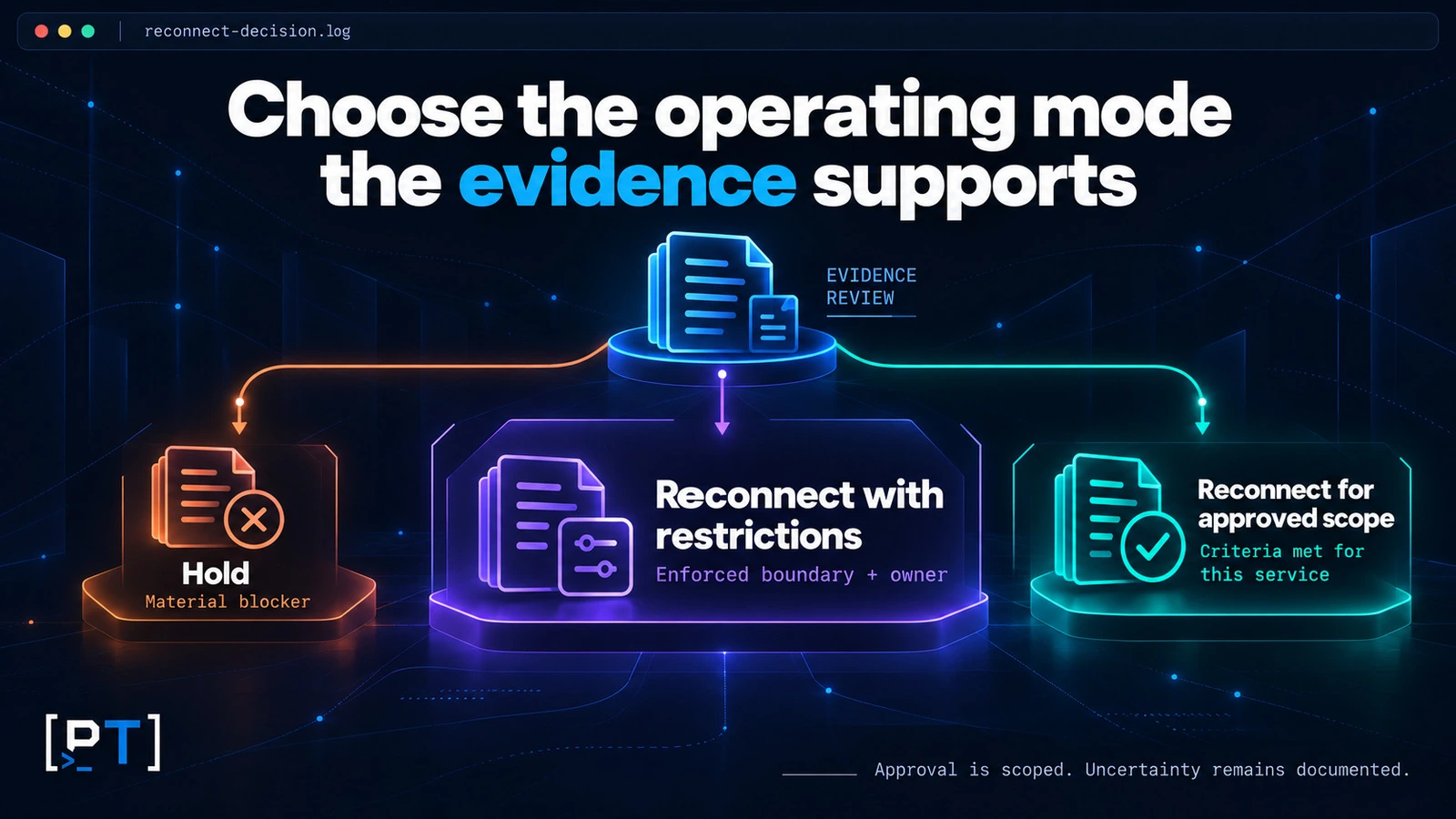
Restrictions must change exposure in a meaningful, enforceable way. Examples include a reporting-only copy, a limited user population, or disabled outbound integrations. Read-only access still involves authentication, application execution, and data exposure; it needs assessment too. Record why the chosen restriction contains the particular unresolved risk.
Reconnect in controlled waves based on business priorities and dependency readiness. Before expanding a wave, confirm the monitoring results, application behavior, and reconciliation status expected by the plan. Select observation periods around meaningful business cycles and the investigation findings. There is no universal waiting period that establishes cleanliness.
Define stop conditions before reconnection: a new unexplained privileged login, renewed malicious activity, loss of essential telemetry, a failed boundary check, or a material reconciliation error. Assign someone who can isolate the service promptly. A rollback plan also needs to address legitimate transactions created after reopening, so recovery does not cause a second data-loss event.
Where visibility is incomplete, distinguish the historical gap from a current monitoring failure. Our forensic readiness and log-retention guide helps teams plan the evidence sources needed for future decisions. During active recovery, identify the gap honestly and decide whether current controls can support the limited operation being proposed.
What leadership should decide, fund, and sign
The approval meeting should produce an explicit operating decision. The incident lead presents the compromise assessment and uncertainties. IT explains restoration and dependencies. The service owner confirms functional behavior and data reconciliation. The authorized executive or risk owner decides whether the residual exposure is acceptable within the organization’s delegated authority.
Agree who can approve exceptions and who can stop a recovery wave. Where relevant, involve privacy, legal, insurance, and supplier representatives in decisions affecting their obligations. Their involvement should be proportionate to the incident; an internal reconnection approval should not be described as regulatory approval or insurance acceptance.
A hypothetical recovery decision
Illustrative scenario, not a client engagement: a distributor restores its ordering platform while warehouse staff work from a manual backlog. Functional tests pass. However, the restored order database stops before the latest payment records, and an integration credential available during the intrusion has not been replaced.
Reopening all integrations could create duplicate fulfillment or leave an exposed access path in use. The incident owner holds automated order processing, approves a separately validated reporting copy for reconciliation, and assigns credential remediation and payment matching to named owners. Full processing remains blocked until those conditions are met.
The example shows why a readiness assessment can authorize useful limited operations without overstating confidence. The decisive evidence concerns business actions and trust dependencies, alongside the restored software.
Scope the effort around the decision
Cost and elapsed time depend on the number of trust boundaries and the quality of available evidence. A bounded workload with reliable logs presents a different task from an incident involving identity infrastructure, backup administration, multiple locations, and missing historical records. Data reconstruction can require substantial business-owner effort even after technical recovery succeeds.
Ask a provider to separate urgent triage, recovery validation for named services, deeper investigation, and follow-up monitoring in its scope. Specify access requirements, evidence availability, dependencies, deliverables, and escalation conditions. Request an initial decision checkpoint after evidence review rather than assuming a fixed turnaround or a universal “clean certificate.”
Keep the decision packet concise enough for an executive to use. Include the approved service and operating mode, evidence index, completed checks, blockers, actual recovery point, data exceptions, residual risks, owners, monitoring arrangements, stop conditions, and next review time. Technical appendices should support the decision without obscuring it.
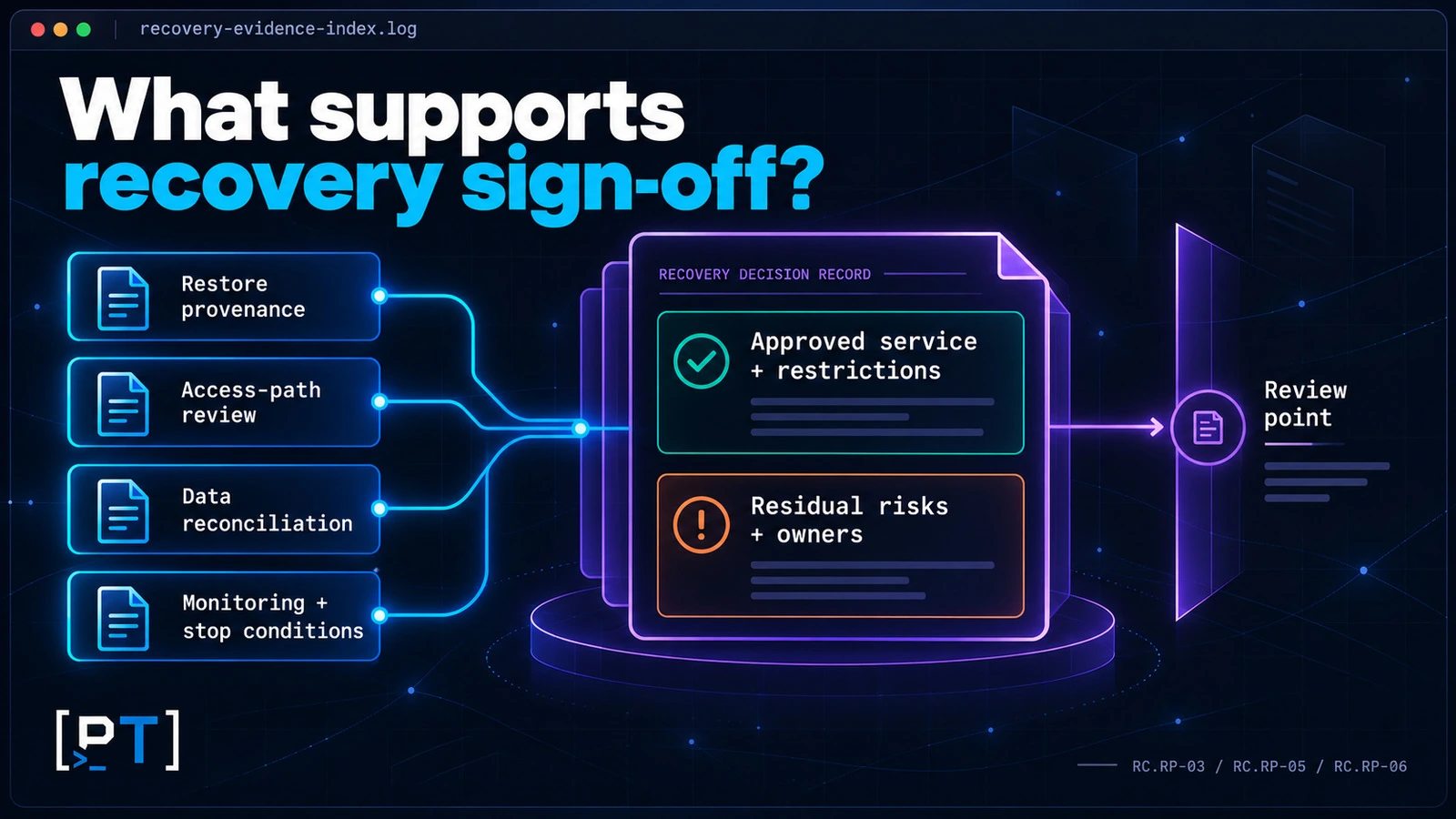
Suggested sign-off wording is: “We authorize the specified service to operate within the documented restrictions, based on the evidence reviewed as of the recorded time. The listed uncertainties and residual risks remain assigned to their owners. This approval will be reconsidered if a stop condition occurs or new evidence changes the assessment.”
Service availability does not resolve a possible data breach. Continue assessing access and exfiltration, and coordinate applicable notifications with qualified advisers. Our extortion breach playbook addresses that parallel response. Recovery messaging should describe restored capabilities accurately without implying that confidentiality impact has been ruled out.
Frequently asked questions
Can our managed service provider perform the assessment?
It may be able to, depending on its forensic capability, access, and involvement in the incident. Request named responsibilities, evidence-based conclusions, and a clear distinction between restoration work and validation. Consider an independent review where the provider’s own management infrastructure or actions are within the suspected compromise scope.
What if we have no usable backup?
The decision shifts toward rebuilding from trusted sources and assessing recoverable business data. Preserve affected material for qualified analysis and evaluate available recovery options with responders. State which records cannot be recovered or validated. The absence of a backup does not make an untrusted system suitable for production.
Does a decryptor make recovered files trustworthy?
Successful decryption does not establish the integrity of the operating environment or resolve stolen access. Validate recovered data for its business purpose and assess affected systems separately. Any decryption work should be coordinated with evidence preservation and performed within an approved recovery process.
Can we reopen while the final forensic report is unfinished?
A defined service may be approved before the final report if its recovery criteria are met and the responsible owner accepts the documented residual risk. Preserve the interim evidence and rationale. New findings may change the decision, so reopening needs monitoring, stop conditions, and a scheduled reassessment.
Should we commission a penetration test before reconnecting?
A conventional penetration test does not replace incident-focused investigation and recovery validation. Targeted checks may help verify remediation or access boundaries when responders judge them appropriate. Scope those checks around the incident, operational stability, and evidence preservation; schedule broader assurance testing when the environment can support it.
What should we tell customers asking whether recovery is complete?
Use approved language that distinguishes restored service availability from continuing investigation and unresolved data questions. State meaningful restrictions and the next update point where appropriate. Coordinate contractual and legally required communications with the responsible advisers, and avoid assurances that exceed the evidence available.
Make the next connection an evidence-based decision
Before reconnecting a restored service, require an answer to four questions: is the restore source suitable, are the relevant access paths controlled, can the business trust the recovered records, and can the team observe and stop the proposed operation? Record the answer for the scope actually approved.
If restoration is complete but those answers remain uncertain, request DFIR triage and discuss recovery validation with Pentest Testing Corp. Bring the incident timeline, affected services, backup details, identity concerns, and the decision you need to make. Agree the validation scope before treating any investigation output as authorization to reconnect.