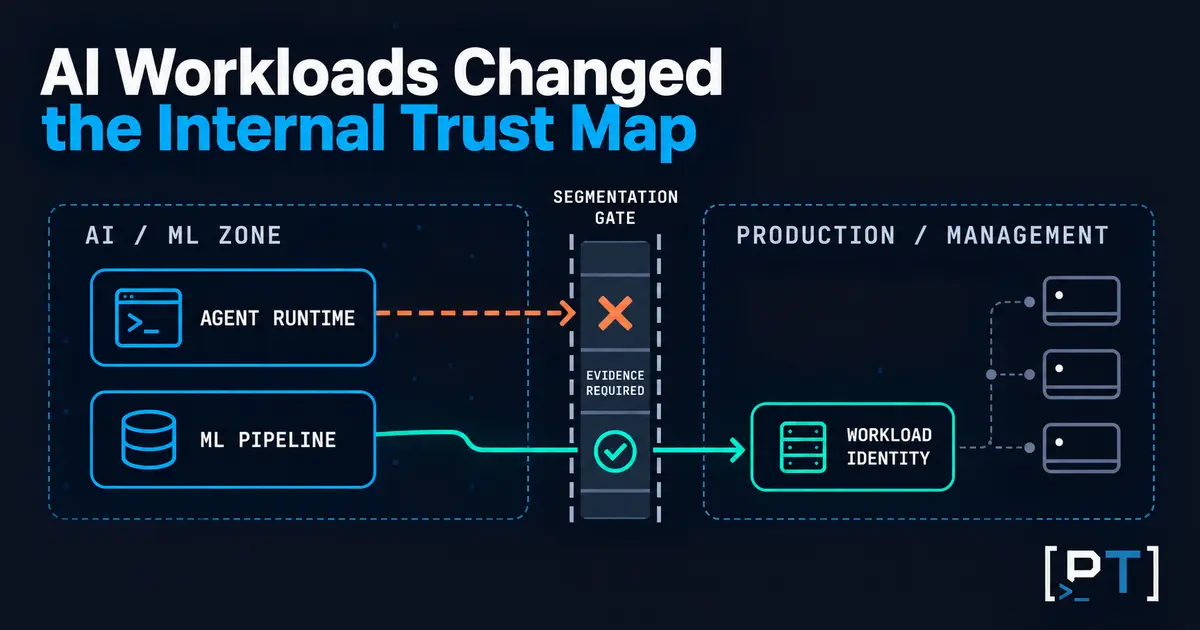
Internal Network Segmentation Testing for AI Workloads
Internal network segmentation testing becomes a leadership priority when AI workloads begin connecting to production data, operational tools, and internal services. Consider a CTO who approves an internal AI assistant that can query product documentation, inspect operational dashboards, and trigger selected support workflows. The rollout passes functional testing, the agent has a dedicated identity, and the model endpoint sits in a private subnet. The team assumes the existing VLANs will contain any security problem. But has anyone tested that assumption from the AI workload’s actual network position?
Three months later, an architecture review reveals a different question: if the agent runtime, an ML pipeline worker, or one of its service accounts were compromised, which internal systems could it actually reach? The answer is unclear because the network rules were designed for employees, application servers, and static integrations, not autonomous services that call tools, retrieve data, and cross cloud and on-premises boundaries.
Internal network segmentation testing for AI workloads closes that evidence gap. It does not ask whether a diagram shows separate zones. It tests whether identity, network, and application controls jointly prevent an AI-related foothold from becoming access to source code, production data, management systems, backups, or other high-value assets.
Why AI workloads break old segmentation assumptions
Traditional segmentation models often begin with a familiar set of actors: employee endpoints, servers, administrators, and service accounts attached to well-understood applications. AI and ML deployments add more actors and more connection paths. Model-serving endpoints call retrieval stores. Orchestrators invoke tools. Training pipelines pull code, data, packages, and secrets. Agents authenticate to APIs on behalf of themselves, a user, or both. Observability platforms ingest prompts, tool results, and operational metadata.
None of those components is inherently unsafe. The issue is that each one creates a new trust relationship. A firewall rule may permit the runtime to contact a broad server segment because the application team needed rapid integration. A shared service account may retain permissions from a proof of concept. A pipeline worker may reach both development and production resources. A tool connector may rely on a long-lived token that can be used outside its intended workflow.
This is why passing a cloud configuration review is not the same as proving containment. NIST SP 800-207, Zero Trust Architecture, states that trust should not be granted solely because an asset or account is inside a particular network location. Authentication and authorization should occur before access to a resource is established. In practical buyer terms, a “private” subnet is a location, not a security outcome.
The growing use of first-class agent identities reinforces this point. Google Cloud now documents dedicated agent identities and identity-aware service perimeter rules. These controls can improve least-privilege enforcement, but configuration alone does not prove that legacy routes, inherited roles, shared credentials, or downstream services cannot bypass the intended boundary. For a post-deployment review, an internal network penetration test should validate the effective path from the AI workload to each sensitive destination, including routes that appear only after an identity or token is compromised.
Teams that are still defining the identity model should also review AI agent identity security. Identity design and network segmentation solve different parts of the same problem: who the workload is, what it may request, and where the request can travel.
Build the AI segmentation scope around business paths
A useful scope begins with business consequences, not a host count. Leadership should identify the AI-enabled workflows that can read sensitive information, change business records, deploy code, initiate communications, or influence customer-facing decisions. The testing team can then trace the systems and identities that make each workflow possible.
At minimum, the scope should identify:
- AI runtimes and orchestrators: model-serving systems, agent platforms, inference services, workflow engines, and tool gateways.
- ML engineering systems: notebooks, experiment tracking, model registries, feature stores, CI/CD runners, training workers, and artifact repositories.
- Non-human identities: service accounts, workload identities, agent identities, managed identities, API tokens, and delegated user credentials.
- Data paths: retrieval indexes, object storage, databases, message queues, telemetry, prompt logs, and training datasets.
- Management paths: hypervisor or cluster administration, cloud control planes, identity systems, secrets managers, backup consoles, and network-device administration.
- Hybrid connections: VPNs, private links, peering, SD-WAN, bastion services, and routes between cloud AI environments and on-premises systems.
Scope should also name the starting positions that matter. A compromised AI runtime is different from a low-privileged employee endpoint. A stolen pipeline token is different from a standard domain user. An internal test that starts only from a generic workstation may miss the permissions and routes unique to the AI environment.
For most organizations, three starting positions provide useful evidence: access from the AI workload segment without credentials, access with a low-privileged workload or agent identity, and access with a realistically compromised CI/CD or ML service account. These are controlled assumptions, not predictions about how an attacker will enter. They let leadership compare the blast radius of network access, identity access, and combined access.
If the concern also includes prompt injection, unsafe tool selection, model output handling, or agent behavior, combine the network scope with the AI penetration testing service. The internal network engagement proves containment after a foothold or credential compromise; the AI engagement tests whether model and agent behavior can create that condition.
What internal network segmentation testing should prove
The objective is not to demonstrate that traffic can cross every permitted route. It is to establish whether a realistic foothold can reach a business-significant asset, acquire stronger authority, or use a trusted service as a bridge. Testing should be controlled, pre-approved, and designed around evidence rather than disruption.
Network enforcement
Testers should validate east-west reachability between AI zones, user networks, development systems, production services, management planes, data stores, and backup environments. The assessment should compare observed access with the approved architecture. Unexpected access matters even when the destination rejects authentication, because open routes expand the number of systems exposed to stolen credentials or future configuration drift.
Identity and service-account containment
Network controls should be tested together with the identity attached to the workload. A service account may be permitted to authenticate broadly even when the runtime should use only one downstream API. Conversely, a tightly scoped identity can still be placed in a segment that reaches sensitive administrative interfaces. Testing should show what changes when credentials are present, replayed from another host, expired, rotated, or denied.
This is also where SaaS token theft penetration testing becomes relevant. If the business is concerned about tokens that work outside their intended device, workload, or network context, the test should explicitly verify binding and conditional-access assumptions.
Trusted intermediaries and application-layer boundaries
Tool gateways, API proxies, message brokers, job schedulers, and shared databases can become bridges between otherwise separated networks. The test should determine whether these intermediaries preserve the original caller’s identity and authorization context or collapse many callers into one over-privileged backend identity.
Network separation does not replace object- and tenant-level authorization. If multiple customers share an application or data service, multi-tenant SaaS authorization testing should verify that the backend enforces tenant boundaries even when requests originate from a trusted internal service.
Detection and response evidence
A segmentation test should also establish whether defenders can see attempted boundary crossings. Useful evidence includes source workload identity, destination, policy decision, protocol, timestamp, and the business operation involved. A generic “connection denied” log is less useful if the team cannot distinguish an AI agent from a human user or correlate the event with a tool call.
A buyer-facing segmentation test matrix
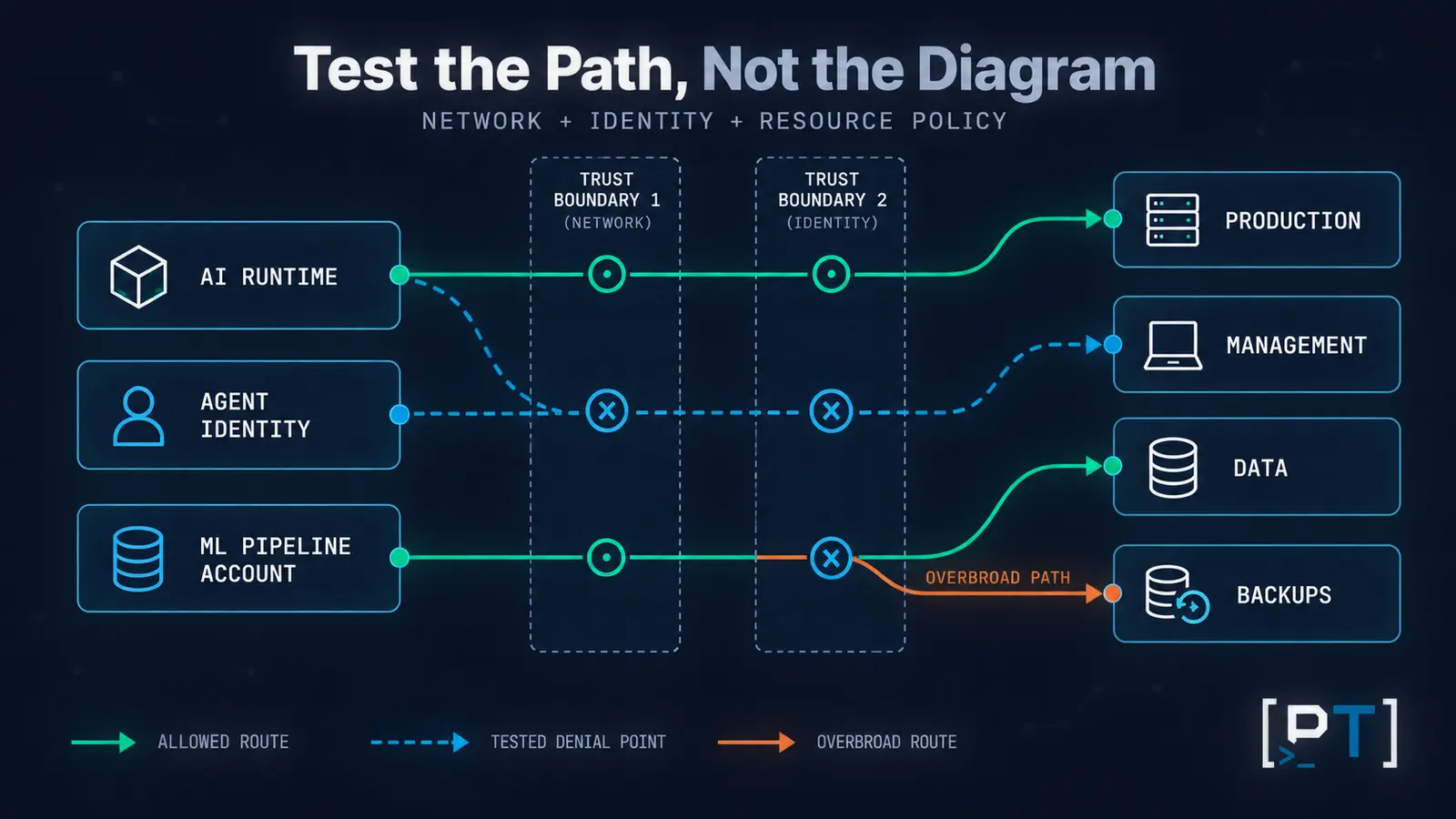
The following matrix translates architecture components into testable buyer questions. It is a scoping baseline, not a universal checklist.
| Starting position | Boundary to validate | Business consequence if weak | Evidence leadership should receive |
|---|---|---|---|
| AI runtime with no usable credentials | AI subnet to production, management, backup, and user zones | A software flaw becomes broad internal exposure before identity controls are tested | Observed allow/deny paths mapped against the approved architecture |
| Low-privileged agent or workload identity | Tool, API, database, and secrets-manager access | The agent performs actions or reads data outside its approved workflow | Resource-level access results, policy source, and least-privilege gaps |
| Compromised ML pipeline service account | Development-to-production and pipeline-to-control-plane separation | Build or training access becomes code deployment, model replacement, or production access | Validated privilege chain, affected assets, and the first control that should have stopped it |
| Compromised experiment tracking or model-management service | Application service to cloud metadata, object storage, registries, and internal APIs | An application-layer weakness exposes credentials or opens a wider cloud path | Controlled reachability and identity-impact proof without retrieving unnecessary sensitive data |
| Employee endpoint with access to AI administration | User network to orchestration, model, and tool-management interfaces | A phished employee session changes tools, data sources, or agent permissions | Role and network-path findings, MFA or conditional-access behavior, and admin-plane exposure |
| Third-party connector or tool integration | Connector to internal services and customer data | A supplier or integration compromise inherits excessive internal trust | Permitted destinations, authentication context, egress restrictions, and logging coverage |
The experiment-tracking row is not theoretical architecture trivia. The MLflow SSRF to cloud credentials analysis explains how an AI platform weakness can change from an application issue into an identity and cloud-access problem. Segmentation testing asks the next question: if that identity is obtained, which internal and cloud-connected resources remain reachable?
Map segmentation evidence to NIST, CIS, and OWASP
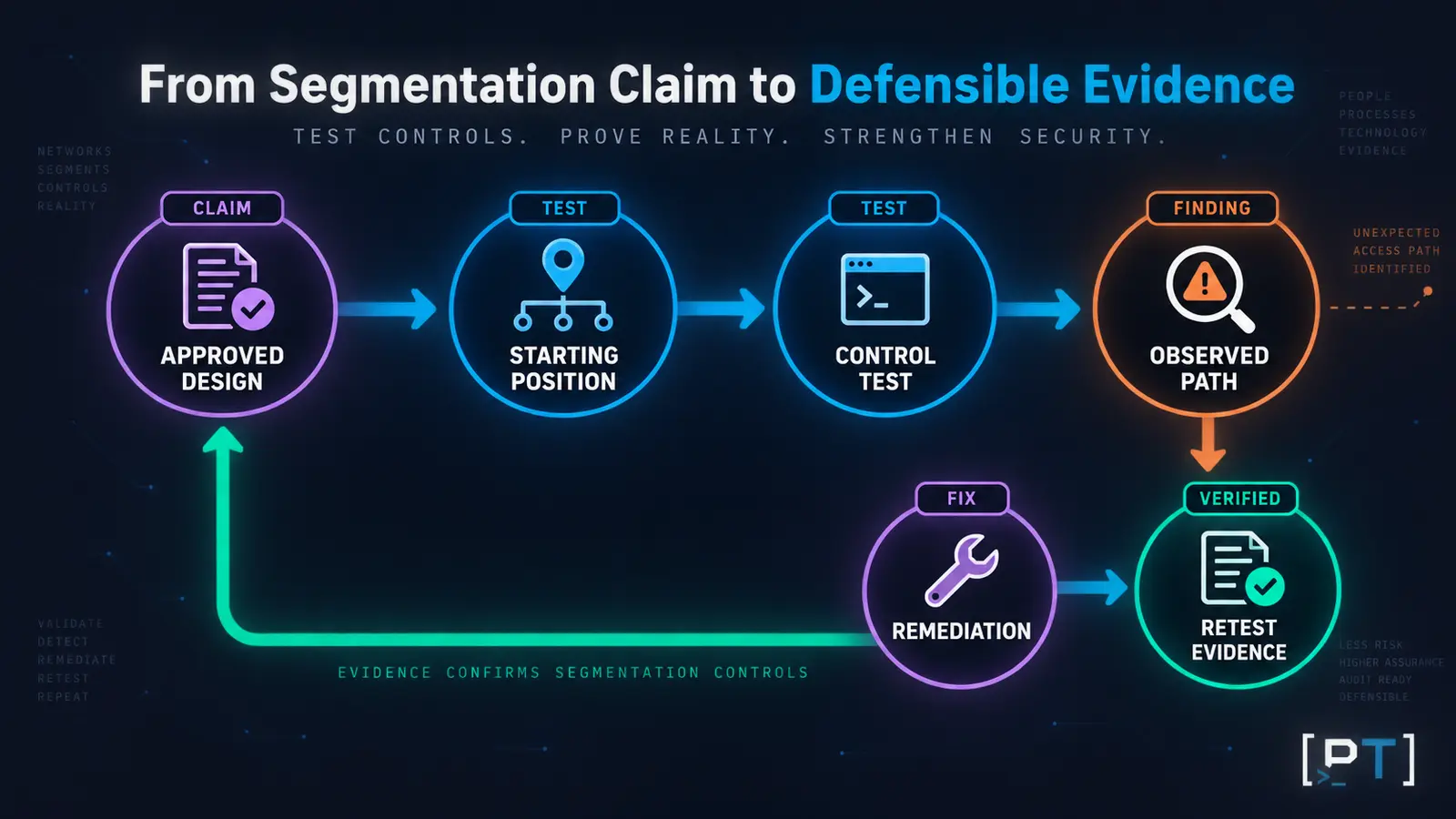
Framework mapping should make the report easier to use, not imply that one penetration test certifies the environment.
- NIST SP 800-207, Zero Trust Architecture: supports resource-focused, identity-aware access decisions without implicit trust based on network location. The test validates whether those principles survive real routing, credential, and service interactions.
- NIST SP 800-115: provides guidance for planning technical security tests, analyzing findings, and developing mitigation strategies. It supports a repeatable test plan, agreed rules of engagement, evidence handling, and retest process.
- CIS Control 12, Network Infrastructure Management: addresses active management of network infrastructure. Segmentation findings reveal where rules, routes, remote administration, or device configurations do not match the approved design.
- CIS Control 13, Network Monitoring and Defense: focuses on maintaining network monitoring and defense. The engagement should verify whether attempted AI-workload boundary crossings generate useful, attributable telemetry.
- OWASP Top 10 for Agentic Applications 2026: ASI02 Tool Misuse is relevant when an agent can use an approved tool in a damaging or out-of-scope way. ASI03 Identity & Privilege Abuse applies when agent or workload identities have excessive or transferable authority. ASI08 Cascading Failures applies when one compromised component or action propagates across connected agents, tools, or infrastructure.
- OWASP Top 10 for LLM Applications 2025: LLM06 Excessive Agency is relevant when an LLM-enabled system receives more functionality, permissions, or autonomy than necessary. LLM02 Sensitive Information Disclosure is relevant when reachable systems or tool responses expose data beyond the business purpose.
The key leadership distinction is between control design and control effectiveness. A firewall rule, IAM policy, or zero-trust diagram is evidence that a control was designed. A constrained, authorized test that shows the denied path, attributable log event, and absence of a viable bypass is stronger evidence that the control works under realistic conditions.
What evidence, effort, and timeline should buyers expect?
A useful deliverable connects each technical observation to a business asset and a remediation decision. Leadership should expect an executive summary, a tested segmentation map, validated attack or access paths, risk-rated findings, evidence of control behavior, prioritized remediation, and a retest plan.
The report should distinguish among four outcomes:
- Blocked as intended: the path was denied by the expected control and the denial produced usable telemetry.
- Blocked, but fragile: access failed, but only because of a secondary control, an unavailable credential, or an undocumented dependency.
- Permitted by design, but overbroad: the connection is authorized, yet its destination range, protocol, identity, or available action exceeds the stated business need.
- Exploitable path validated: a controlled chain reached a higher-value system or authority and requires remediation.
Most internal network penetration tests on the verified service page run five to ten business days, with smaller defined scopes sometimes completing in three to five days and complex multi-site or multi-domain environments taking longer. An AI-focused scope can remain efficient when the organization supplies a current network diagram, identity inventory, data-flow map, approved starting accounts, and a list of prohibited actions before kickoff.
Effort rises when cloud and on-premises routes are managed by different teams, identity ownership is unclear, production testing windows are narrow, or AI assets are not recorded in the CMDB. These are useful scoping signals, not reasons to delay. They indicate that discovery and evidence reconciliation need explicit time in the engagement.
If the primary risk crosses into cloud-native IAM, metadata services, managed AI platforms, or control-plane access, add cloud penetration testing. The internal network test should not claim full coverage of provider-native controls unless those systems and permissions are included in the rules of engagement.
What leadership should decide before commissioning the test?
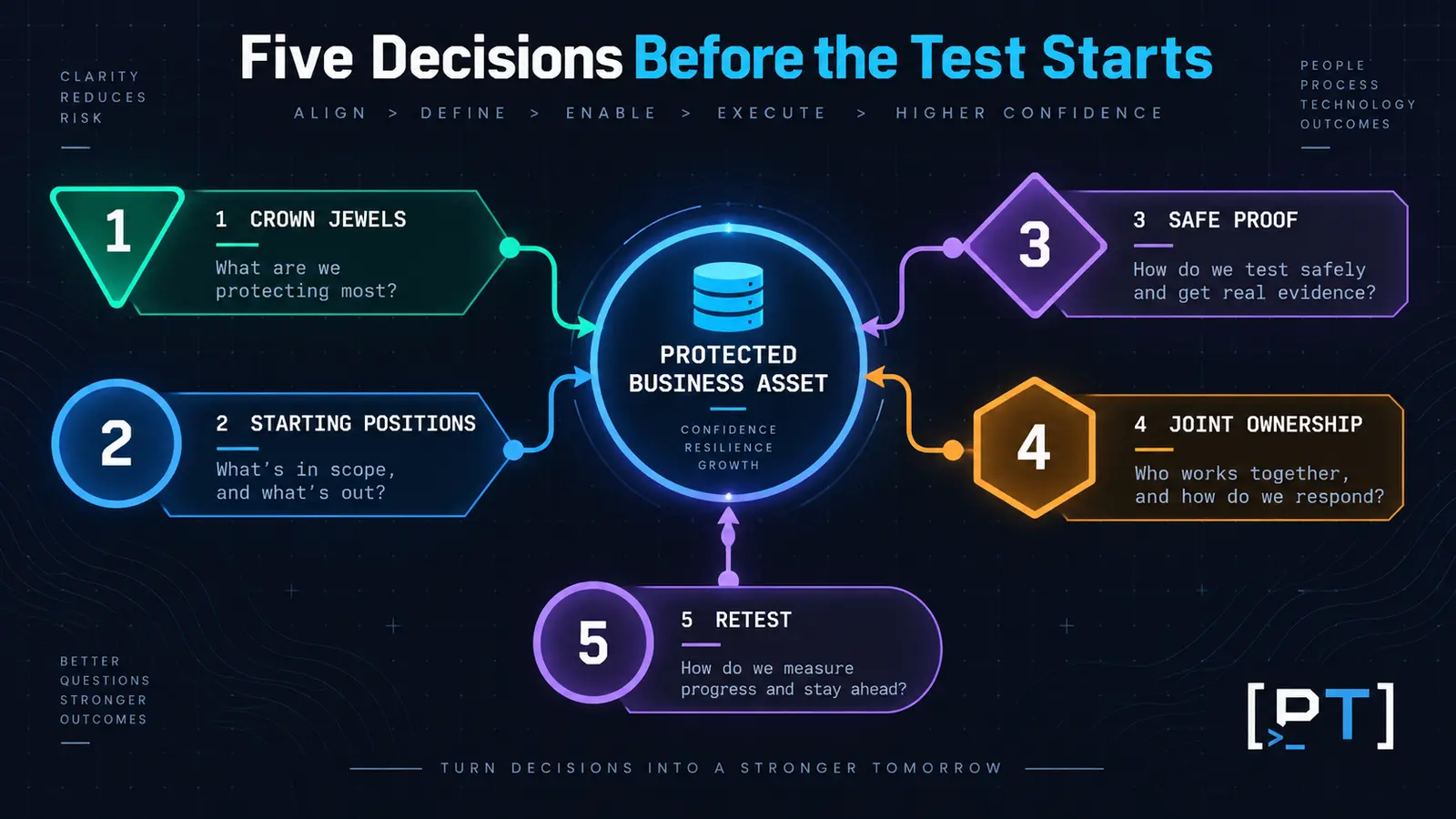
Five decisions determine whether the engagement produces actionable evidence or only another list of reachable ports.
- Define the crown-jewel outcomes. Name the business actions and data that must remain protected: production deployment, customer records, model artifacts, secrets, backups, identity administration, or payment operations.
- Choose realistic starting positions. Include an AI workload, an agent or service identity, and a pipeline or engineering context where relevant. Do not rely only on a standard employee workstation.
- Set safe proof boundaries. Decide which actions may be validated, which require simulation, and which systems are out of bounds. For sensitive environments, proof can stop at confirmed authorization or controlled access without extracting real data.
- Assign joint ownership. Network, cloud, identity, ML platform, security operations, and application owners may each control one part of the path. A finding cannot be closed reliably if no one owns the full chain.
- Commit to retesting. Rule changes can close one route while opening another. Identity reductions can break production workflows and be quietly reversed. Retesting confirms that the intended boundary holds after remediation.
The best trigger is a significant change: a new agent or ML platform entering production, a new hybrid connection, a major identity redesign, acquisition integration, an internal architecture review, or an incident that raised lateral-movement concerns. Annual testing may support governance, but change-driven validation is more closely aligned with the moment segmentation assumptions are most likely to become outdated.
Illustrative scenario: a pipeline identity crosses the wrong boundary
The following scenario is hypothetical and sanitized. It does not describe a client engagement.
A B2B SaaS company deploys an internal ML pipeline that trains models from product telemetry. The worker runs in a cloud-connected AI segment and uses a service account to read training data, retrieve build artifacts, and publish approved models. To accelerate the launch, the infrastructure team permits the segment to reach a broad internal server range through an existing private connection.
During an authorized segmentation test, the assessor begins with the permissions and network position of the pipeline worker. No destructive action is performed. Testing shows that the worker can reach a legacy deployment service outside the documented AI data flow. The service accepts the same identity through an inherited role, and its audit trail records only the shared backend account, not the originating workload.
The business impact is larger than “one extra open route.” Compromise of the pipeline could create a path from training operations to production deployment, while weak attribution would make it difficult to distinguish a legitimate model publish from unauthorized activity. The remediation therefore has three owners: network engineering narrows the route, identity engineering removes the inherited role, and the platform team updates logs to retain the originating workload identity.
A retest verifies all three conditions: the legacy destination is unreachable from the AI segment, the service account cannot invoke the deployment function from another context, and the denied attempt generates an attributable alert. That evidence is far more useful to leadership than a diagram showing two separate network zones.
If this scenario began with suspected compromise of a router, firewall, or private-connectivity appliance, the response sequence would change. Teams should preserve edge-device evidence before rebuilding, contain the incident, and then use segmentation testing to prove the corrected architecture.
Frequently asked questions
Is an AI workload segmentation test different from a standard internal pentest?
Yes. The core internal-testing methods remain relevant, but the starting identities, trust paths, and high-value assets change. The scope should include agent or workload identities, ML pipelines, model and artifact systems, tool gateways, retrieval stores, and cloud-to-on-premises routes rather than testing only employee and Active Directory paths.
Can a vulnerability scan prove network segmentation?
No. A scan can identify reachable services from one observation point, but it does not usually prove how reachability changes with workload credentials, delegated tokens, trusted intermediaries, or application-layer authorization. Segmentation validation combines network observations with controlled identity and access testing.
Should we test production AI infrastructure?
Production testing can be appropriate when rules of engagement define safe techniques, testing windows, stop conditions, prohibited actions, communication channels, and rollback ownership. Where production impact cannot be tolerated, validate the highest-risk paths in a representative environment and separately confirm that production policies match.
Do dedicated agent identities eliminate lateral-movement risk?
No. Dedicated identities improve attribution and least-privilege design, but they do not automatically correct broad network routes, inherited roles, shared backend identities, exposed management interfaces, or weak downstream authorization. Their effective permissions and allowed paths still need validation.
How often should AI workload segmentation be retested?
Retest after material architecture or identity changes, deployment of new tools or connectors, major network-policy changes, acquisitions, or relevant incidents. A periodic test may support assurance, but event-driven testing is important because AI integrations and non-human permissions can change faster than the annual audit cycle.
What access does a testing provider need?
Typical inputs include approved network access, architecture and data-flow diagrams, asset and identity inventories, low-privileged test accounts, logging contacts, testing windows, and written rules of engagement. Administrative credentials are not always required; the agreed starting position should reflect the risk leadership wants to measure.
Will this test cover prompt injection and unsafe agent behavior?
Only if those areas are explicitly included. Internal segmentation testing measures reachability, privilege paths, and containment. Prompt injection, unsafe tool use, excessive agency, and model-specific behavior belong in a coordinated AI penetration testing scope.
What is the clearest success criterion?
For every high-risk path, the team should be able to show that access is limited to the intended workload, identity, destination, protocol, and business action; that bypass attempts fail safely; and that security operations can attribute and investigate the attempt.
Prove the boundary before an incident tests it
AI infrastructure does not make network segmentation obsolete. It makes simplistic segmentation assumptions easier to outgrow. The relevant unit of trust is no longer just a subnet or a user. It is the combination of workload, identity, requested resource, tool, and business action.
Leadership does not need proof that every internal connection is impossible. It needs evidence that the paths capable of changing production, exposing sensitive data, compromising identities, or disabling recovery are deliberately constrained, monitored, and retested after change.
To validate the blast radius of your AI runtimes, ML pipelines, service accounts, and hybrid connections, scope an internal network penetration test. Pentest Testing Corp can align the engagement with your architecture review, post-deployment assurance, or incident-driven concern and provide a fixed-price scope based on the assets, identities, and trust boundaries that matter.