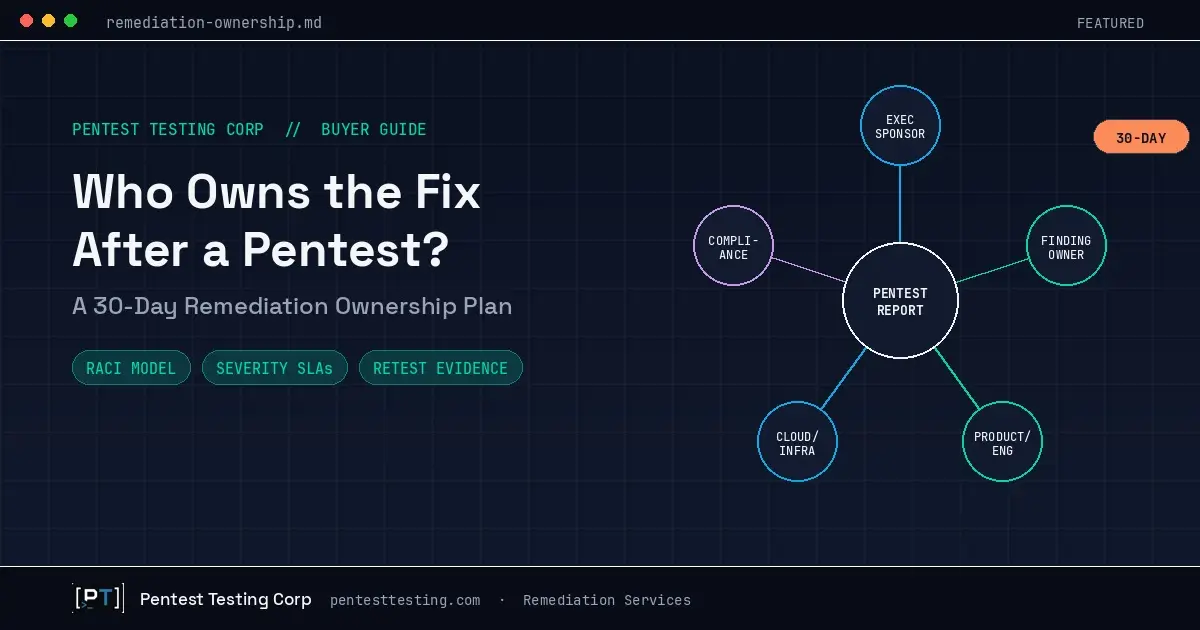
Who Owns the Fix After a Pentest? A 30-Day Remediation Ownership Plan
A pentest report lands in a shared inbox on a Tuesday afternoon. Twenty-two findings, three of them critical, a PDF nobody has fully read by Friday. The CISO forwards it to engineering. Engineering assumes security will file tickets. Security assumes the report itself is the ticket. Three weeks later, nothing critical has shipped, the retest window from the original engagement is closing, and the next SOC 2 evidence request is asking for proof that findings were fixed and validated, not just acknowledged.
This isn't a testing problem. The reports that stall almost never stall because the findings were unclear. They stall because nobody owns the fix. This guide gives CTOs, CISOs, VPs of Engineering, and compliance leads a RACI-based, 30-day model for assigning pentest remediation ownership, setting evidence gates, and getting to a retest that actually closes the loop.
Why Pentest Remediation Ownership Breaks Down in the First Week
A pentest report is not a to-do list. It's a technical document written for people who understand exploit chains, and most of the people who need to act on it don't. The gap between "here are 22 findings" and "here is who fixes finding #7 by what date" is where remediation programs quietly die.
Three patterns show up repeatedly:
Ownership by default, not by design. Without an assigned owner, findings gravitate to whoever is easiest to reach, usually the person who received the report, not the person who can actually fix the issue. A cloud misconfiguration lands on an application engineer's backlog. An authorization flaw in checkout code lands on the infrastructure team. Neither can close it, so it sits.
No shared definition of "urgent." Security reads "critical" as drop everything. Product reads the same word against a release calendar and a support queue. Without a pre-agreed severity SLA, every finding becomes a negotiation instead of a decision.
The retest window gets treated as a formality. Most fixed-price engagements include a retest, but that window has a shelf life. Teams that spend three weeks arguing about ownership often burn the retest window arguing, then pay for a second engagement to prove what a single retest inside the original window would have shown for free.
None of this reflects on the technical quality of the testing. It reflects the absence of an operating model that survives the handoff from tester to owner. The next section builds that model: a five-role RACI framework, sized for how findings actually move through a mid-market or enterprise organization, that plugs directly into Pentest Testing Corp's remediation services the moment a team needs more hands than a 30-day window allows.
The RACI Model: Five Roles Every Pentest Remediation Plan Needs
A pentest remediation plan needs five roles, not a committee. Smaller teams can combine two or three of these in one person; larger teams should keep them separate so no single person is both implementing and approving a fix.
- Executive Sponsor (CISO, CTO, or VP Engineering) — Accountable for the plan overall. Signs off on any finding that gets an exception instead of a fix. Removes resourcing blockers when a Critical finding competes with a product deadline.
- Finding Owner / Triage Lead — Usually security or GRC. Responsible for normalizing the report into tracked tickets within 48 hours, assigning severity-based deadlines, and running a short weekly checkpoint. This role doesn't fix anything directly; it keeps the plan honest.
- Product/Engineering Owner — Responsible for application-layer fixes: authentication, authorization, business logic, input handling. Almost always the team that owns the affected codebase, not a general "security engineering" function unless one exists.
- Cloud/Infrastructure Owner — Responsible for configuration-layer fixes: IAM policies, network segmentation, exposed storage, patch levels on managed services. On smaller teams this overlaps with the Product/Engineering Owner; on larger teams it's DevOps or platform engineering.
- Compliance Owner — Responsible for mapping each closed finding to the framework evidence an auditor will ask for later (SOC 2, ISO 27001, PCI DSS, HIPAA), and for flagging when a finding touches regulated data or an existing audit commitment.
AI-agent findings may require a separate evidence owner because engineering can correct permissions while compliance still lacks a requester-to-result audit trail. The AI-agent evidence ownership model identifies the identity, authorization, monitoring, approval, and change-management records that must remain attributable after remediation.
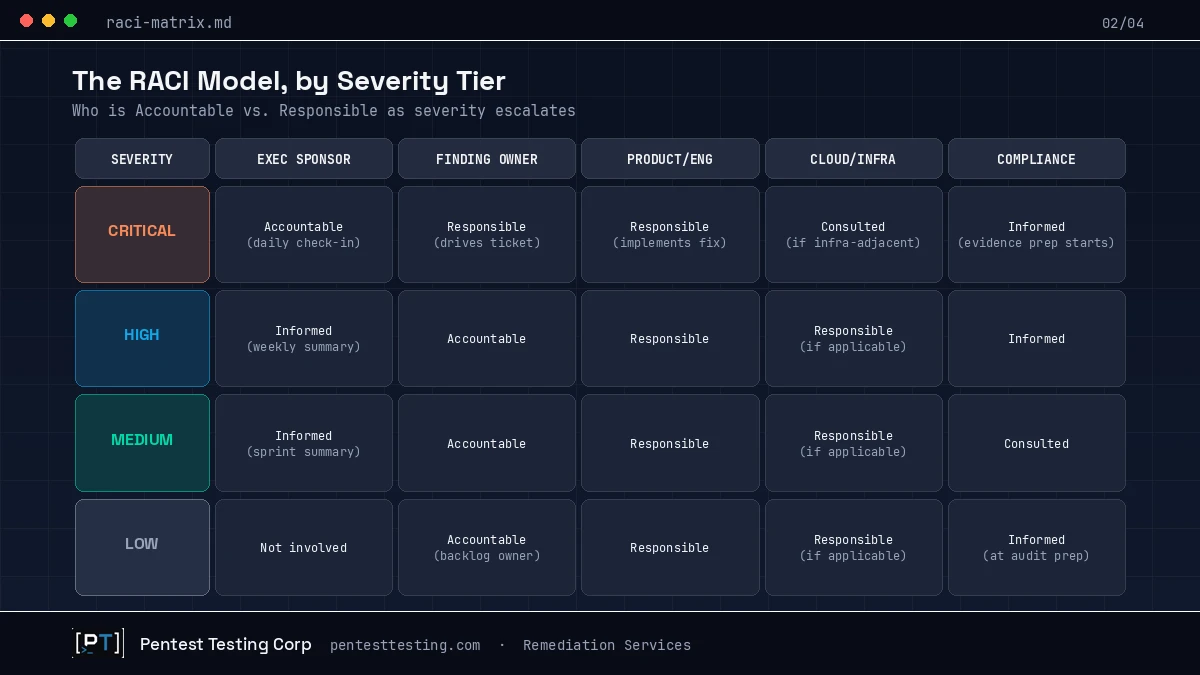
The table below shows how responsibility shifts by severity. Critical and High findings compress the Executive Sponsor's role from informed to actively accountable for the deadline; Medium and Low findings let that sponsor step back to a periodic check-in.
| Severity | Executive Sponsor | Finding Owner | Product/Eng Owner | Cloud/Infra Owner | Compliance Owner |
|---|---|---|---|---|---|
| Critical | Accountable, daily check-in | Responsible, drives ticket | Responsible, implements fix | Consulted if infra-adjacent | Informed immediately, evidence prep starts |
| High | Informed, weekly summary | Accountable | Responsible | Responsible if applicable | Informed |
| Medium | Informed, sprint summary | Accountable | Responsible | Responsible if applicable | Consulted |
| Low | Not involved | Accountable, backlog owner | Responsible | Responsible if applicable | Informed at audit prep |
If your organization's fastest-moving exposure is a CISA KEV-listed CVE rather than a full pentest report, a technical version of this cadence already exists: our 30-day CISA KEV remediation sprint covers the day-by-day execution playbook this ownership model is designed to sit above.
The 30-Day Plan: From Report Delivery to Verified Closure
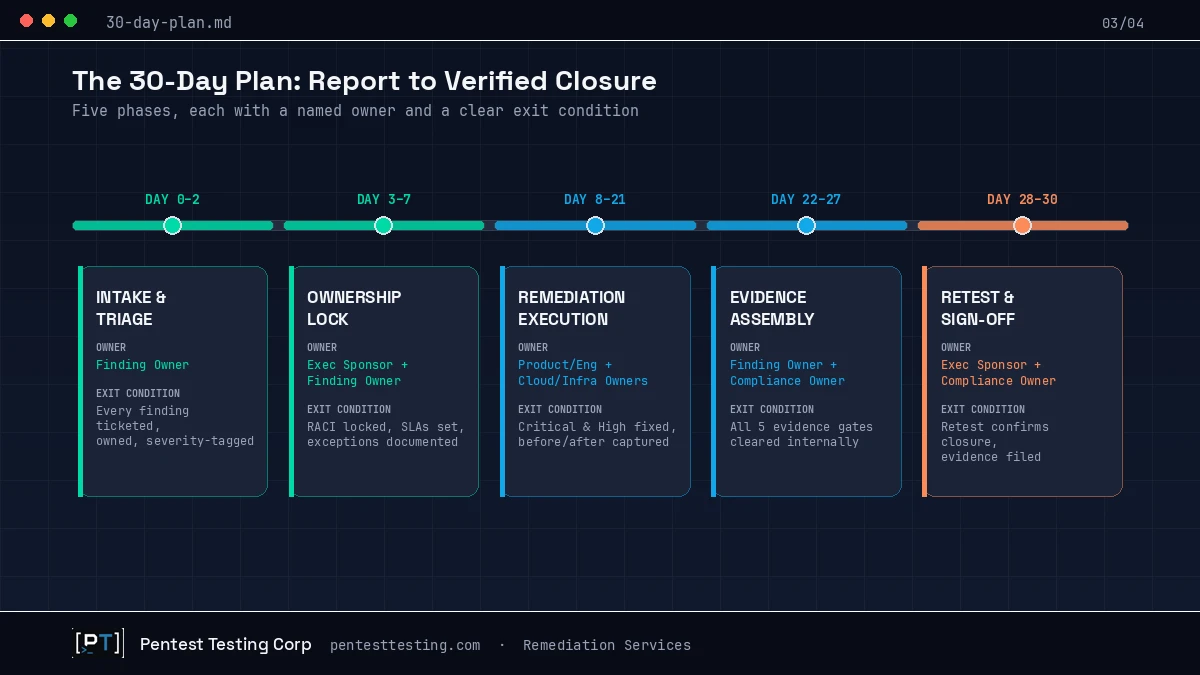
Break the 30 days into five phases, each with a clear exit condition.
| Phase | Days | Primary Owner | Exit Condition |
|---|---|---|---|
| Intake and triage | 0–2 | Finding Owner | Every finding has a ticket, a tentative owner, and a severity tag |
| Ownership lock and SLA assignment | 3–7 | Executive Sponsor + Finding Owner | RACI locked, deadlines set, exceptions documented |
| Remediation execution | 8–21 | Product/Eng and Cloud/Infra Owners | Critical and High findings fixed with before/after evidence captured |
| Evidence assembly and validation | 22–27 | Finding Owner + Compliance Owner | All five evidence gates cleared internally |
| Retest and sign-off | 28–30 | Executive Sponsor + Compliance Owner | Retest confirms closure; evidence filed |
Days 0–2: The Finding Owner logs every item from the report into whatever tracking system the team already uses (Jira, Linear, GitHub Issues), tagged by severity and affected system. No fixing happens yet.
Days 3–7: Ownership moves from tentative to confirmed. Each ticket gets a deadline based on a severity SLA the organization has agreed to in advance, a common baseline being Critical in 7–10 days, High in 14–21 days, Medium in 30–45 days, with Low tracked but not gated. The Executive Sponsor signs off on the plan once, not on every ticket.
Days 8–21: Critical and High findings get fixed first. This is where most of the calendar goes, and it's the one phase this article won't turn into a technical walkthrough: how a given finding gets fixed is an engineering decision, not a project-management one. What matters here is that each fix references its ticket and captures before/after evidence as it ships, not after the fact.
Days 22–27: Before requesting a retest, the Finding Owner and Compliance Owner walk through the evidence gate checklist below. Anything missing gets fixed here, not during the retest window.
Days 28–30: The retest confirms the vulnerable condition is actually gone, not just that a ticket says done. Once confirmed, the Executive Sponsor signs off, and the Compliance Owner files the closure evidence.
For larger remediation programs anchored to a full compliance risk assessment rather than a single pentest report, a longer version of this cadence is worth reviewing: our 12-week fix-first compliance remediation blueprint extends the same logic across HIPAA, PCI DSS, SOC 2, ISO 27001, and GDPR findings simultaneously.
Evidence Gates: What "Closed" Should Require Before You Retest
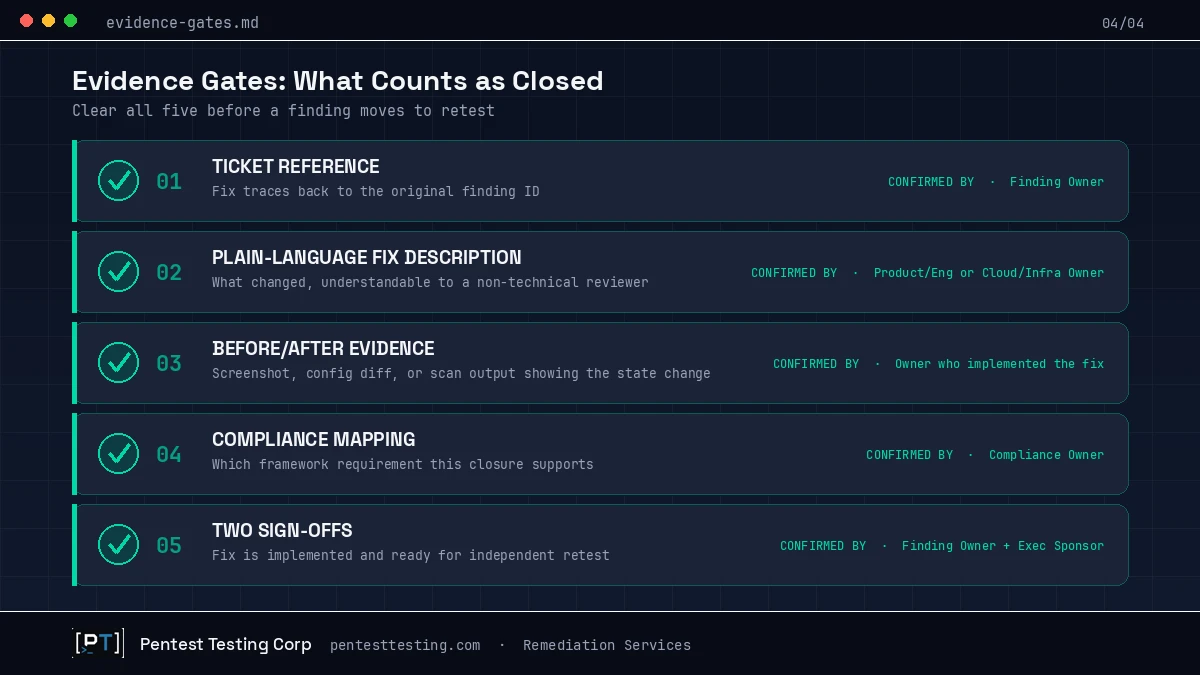
"Closed" should mean something specific, not "we think we fixed it." Before a finding moves from remediation to retest, it should clear five gates:
| Gate | What It Proves | Who Confirms It |
|---|---|---|
| Ticket reference | Fix traces back to the original finding ID | Finding Owner |
| Plain-language fix description | What changed, understandable to a non-technical reviewer | Product/Eng or Cloud/Infra Owner |
| Before/after evidence | Screenshot, config diff, or scan output showing the state change | Owner who implemented the fix |
| Compliance mapping | Which framework requirement this closure supports | Compliance Owner |
| Two sign-offs | Fix is implemented and ready for independent retest | Finding Owner + Executive Sponsor |
Where a product issue also raises CRA reporting questions, track reporting and remediation ownership together. See how to test a CRA reporting workflow for awareness records, corrective-measure availability and reporting-deputy continuity.
Skipping any of these doesn't just create audit risk. It's the single most common reason a "closed" finding reappears in the next engagement, because the fix addressed the symptom a scanner flagged rather than the underlying exploitation path. For a deeper look at that specific gap, our guide to proving a patch actually closed the exposure walks through what a targeted retest validates that a rescan or a ticket status never can.
If your team wants a reference point for how findings, severity, and retest fields are typically structured in the report itself, Pentest Testing Corp's sample penetration testing report shows the format your evidence package should mirror.
Illustrative Scenario: A Report That Sat for Three Weeks
The following is a labeled hypothetical, not a specific client engagement.
A 140-person fintech SaaS company received a pentest report ahead of its annual SOC 2 Type II renewal. The report flagged one Critical finding (an IDOR allowing cross-tenant data access) and four High findings, including a misconfigured cloud storage bucket. The report went to the security lead, who forwarded it to engineering leadership with no assigned owner and no deadline.
Three weeks passed. The Critical finding sat in a shared Slack channel, referenced twice, actioned by no one specifically, because the engineer who could fix the tenant-isolation logic was mid-sprint on a client-facing feature and no one had told them this took priority. The retest window in the original statement of work was 30 days from report delivery. By the time ownership got sorted out, 18 of those days were gone.
Applying the RACI model above, the company named an Executive Sponsor (the VP of Engineering), assigned the Critical finding directly to the tenant-isolation code owner with a 7-day SLA, and had the Compliance Owner start mapping the fix to SOC 2 CC7.1 evidence the same week. The Critical finding and all four High findings were fixed, evidence-gated, and retested within the remaining 12 days. The retest report became part of the SOC 2 evidence package with three weeks to spare before the audit window closed.
Where This Maps to NIST, ISO 27001, SOC 2, and PCI DSS
A remediation ownership plan isn't just internal hygiene. It's also the operating evidence most major frameworks expect auditors to look for, even though none of them mandate the exact RACI model in this guide. This section is a general mapping, not legal or audit advice; confirm current requirements with your QSA, auditor, or counsel for your specific scope.
| Framework | Control / Requirement | What It Expects |
|---|---|---|
| NIST CSF 2.0 | ID.RA-01, ID.RA-06 | Vulnerabilities identified, validated, and recorded; risk responses chosen, prioritized, planned, tracked, and communicated |
| ISO 27001:2022 | Annex A 8.8 | Documented process for identifying, evaluating, and correcting technical vulnerabilities, owned by a named role |
| SOC 2 | CC7.1, CC7.4 | Detection and monitoring of vulnerabilities; a defined program for responding to identified incidents |
| PCI DSS v4.0.1 | Requirement 11.4.4 | Exploitable vulnerabilities found during penetration testing must be corrected, and testing repeated to verify the correction |
| CISA KEV | Not a private-sector mandate | Increasingly used by boards, insurers, and enterprise customers as an SLA benchmark for internet-facing findings |
NIST CSF 2.0 addresses this most directly under the Identify function. A named Finding Owner and a documented severity SLA are close to a direct implementation of ID.RA-06. ISO 27001:2022 Annex A 8.8, Management of Technical Vulnerabilities, expects a documented process covering identification, risk evaluation, and corrective action, typically owned by a named role such as the Head of IT or CISO; auditors reviewing this control commonly ask for the same ticket-to-closure trail this plan produces by design.
SOC 2 Common Criteria CC7.1 covers detection and monitoring of vulnerabilities; CC7.4 covers responding to identified incidents through a defined program. Neither control specifies a remediation deadline, but auditors reviewing a Type II period routinely expect evidence that findings were triaged, assigned, and closed within a consistent, defensible timeframe, exactly what this plan's evidence gates produce. PCI DSS v4.0.1 Requirement 11.4.1 is the most explicit of the group: exploitable vulnerabilities and security weaknesses found during penetration testing must be corrected, and testing must be repeated to verify the correction. A QSA reviewing this requirement wants the retest evidence Days 28–30 produce, not a closed ticket alone.
For payment environments, see our PCI DSS 11.4.4 correction and repeat-test evidence guide for the records that connect ownership to verified closure.
For teams where SOC 2 is the specific audit driving this timeline, what SOC 2 auditors actually expect from a pentest goes deeper into the evidence bar auditors apply in 2026.
What Leadership Should Decide Before the Next Report Lands
The plan above only works if four decisions are made before the next pentest report arrives, not during the scramble after it does.
- Who is the named Executive Sponsor for pentest remediation? Not a team, a person, with the authority to reassign resourcing when a Critical finding competes with a roadmap commitment.
- What severity SLA will you actually enforce? Write it down, get sign-off from engineering leadership, and treat exceptions as documented decisions, not silent slippage.
- Is your retest included in the original engagement, and when does it expire? Confirm the window with your testing provider before the report lands, not after ownership disputes have already eaten into it.
- If an agency arranged the assessment, confirm that its client-facing retest promise matches the testing subcontractor’s signed terms. Our guide to the white-label penetration testing agreement covers that contract boundary, evidence custody, and escalation before work begins.
- What evidence bar counts as "closed"? Decide this once, as a standing policy, so the Finding Owner and Compliance Owner aren't negotiating it finding-by-finding under deadline pressure.
Organizations that answer these four questions in advance turn every future pentest report into a 30-day operating cycle instead of a fire drill. Organizations that don't tend to relearn the same lesson with each new report: the testing was never the bottleneck.
Where Pentest Testing Corp Fits Into Your 30-Day Plan
A remediation ownership plan gets your organization organized. It doesn't add engineering capacity, close a specific misconfiguration, or run the retest. That's where structured remediation support helps: Pentest Testing Corp works alongside your named owners to implement technical and policy fixes across HIPAA, PCI DSS, SOC 2, ISO 27001, and GDPR scope, then verifies closure with the same manual testing approach used in the original engagement.
If your last pentest report is still sitting without an assigned Executive Sponsor, that's the first fix, before any ticket gets touched.
Book a 30-minute call to walk through your last report and get the RACI assignments and retest window scoped before your next audit deadline.
Frequently asked questions
Who should own penetration test remediation inside our organization?
Ownership should split across five roles, not sit with one person: an Executive Sponsor who's accountable for the plan, a Finding Owner who triages and tracks it, a Product/Engineering Owner and Cloud/Infrastructure Owner who implement fixes, and a Compliance Owner who maps closures to audit evidence.
How long should we take to fix critical and high findings after a pentest?
There's no universal deadline, but many organizations use a baseline of 7–10 days for Critical findings and 14–21 days for High findings, with Medium and Low findings tracked on a longer cycle. The specific numbers matter less than having them written down and enforced consistently.
What's the difference between a fixed finding and a verified-closed finding?
A fixed finding has a code change or configuration update applied. A verified-closed finding has been retested by an independent tester who confirmed the specific exploitation path no longer works, with evidence documented for later review.
Do we need a separate retest, or is it included in our pentest engagement?
Most fixed-price pentest engagements include a retest within an agreed window after report delivery. Confirm that window with your provider before the report lands, since ownership disputes early in the 30 days are the most common reason teams burn through it.
How do we handle findings we can't fix within 30 days?
Document a formal exception: the reason, any compensating control in place, the risk owner who accepted it, and a review date. An undocumented delay looks identical to negligence to an auditor; a documented exception with a compensating control does not.
What evidence do auditors expect for pentest remediation?
Most frameworks expect a consistent trail from finding to closure: a ticket reference, a description of the fix, before/after proof, a named owner, and retest confirmation. PCI DSS 11.4.1 is explicit about requiring repeat testing to verify correction; SOC 2 and ISO 27001 auditors expect similar proof even where the control language is less specific.
Should the same team that built the vulnerable system also verify the fix?
They can implement it, but closure sign-off should involve someone outside that implementation chain, ideally an independent retest. Self-verification is the most common reason a finding gets marked closed and then reappears in the next assessment.