Web Application Penetration Testing: Complete 2026 Guide
Why Web Application Penetration Testing Can't Be Skipped in 2026
Web applications are the primary attack surface for modern breaches. According to Verizon's 2024 Data Breach Investigations Report, web application attacks account for over 60% of all confirmed data breaches, a figure that has held steady for five consecutive years. Yet a surprising number of engineering teams still treat security testing as a checkbox exercise done once before a major release, rather than an ongoing, structured discipline.
If you're a CTO, DevSecOps lead, or security manager, you've likely seen the consequences: a vulnerability scanner gives your app a green checkmark, and three months later, a researcher finds a critical IDOR flaw that the scanner never touched. This guide is for practitioners who want to understand what a rigorous web application penetration testing engagement actually looks like, what gets tested, how it's tested, and what a credible vendor should deliver.
We'll walk through the OWASP-aligned methodology we use at Pentest Testing Corp, the full testing checklist, and what separates a genuine manual web pentest from glorified automated scanning.
What Is Web Application Penetration Testing?
Web application penetration testing is a structured, adversarial assessment of a web application's security posture. A skilled tester, acting as a malicious attacker, attempts to discover and exploit vulnerabilities across the application's authentication, authorization, business logic, data handling, and API layers.
The goal is not simply to generate a vulnerability list. The goal is to demonstrate exploitability: to prove that a flaw can be leveraged to exfiltrate data, escalate privileges, bypass controls, or cause a denial of service, with real proof-of-concept evidence.
What It Is Not
- Not a vulnerability scan. Scanners enumerate known signatures. They miss logic flaws, chained exploits, and novel attack vectors by design.
- Not a code review. Penetration testing validates runtime behavior. It complements but doesn't replace secure code review.
- Not a one-time event. A web pentest is a point-in-time assessment. Applications change. APIs expand. New features introduce new risk. Testing must be periodic.
Who Needs It
| Organization Type | Common Driver |
|---|---|
| SaaS companies pre-enterprise contract | Customer security questionnaire / SOC 2 Type II |
| Fintech / healthtech startups | PCI DSS, HIPAA, regulatory mandate |
| E-commerce platforms | PCI DSS scope, brand reputation |
| Government contractors | FedRAMP, CMMC, FISMA compliance |
| Any company post-breach | Remediation validation, board-level assurance |
OWASP Web Pentest Methodology: The Framework That Matters
The OWASP Web Security Testing Guide (WSTG) is the most widely referenced framework for web application security testing. Version 4.2, the current release, defines 12 test categories covering over 90 individual test cases. Credible pentest vendors build their methodology around it, not as a rote checklist, but as a structured baseline that ensures systematic coverage.
At Pentest Testing Corp, our OWASP web pentest process maps to the following core test categories:
OTG-INFO: Information Gathering
Before touching a single input, testers collect intelligence: exposed server banners, technology fingerprinting, directory and file enumeration, web application firewall detection, and analysis of HTTP headers. This phase determines the attack surface and informs subsequent testing phases.
OTG-CONF: Configuration and Deployment Management Testing
Misconfigured web servers are responsible for a disproportionate share of critical findings. This covers HTTP methods (is TRACE or PUT enabled?), transport security, cookie attributes, cross-domain policy files, and cloud storage misconfigurations, the S3 bucket left open to the world that a scanner will never flag because it requires business context to interpret.
OTG-AUTHN: Authentication Testing
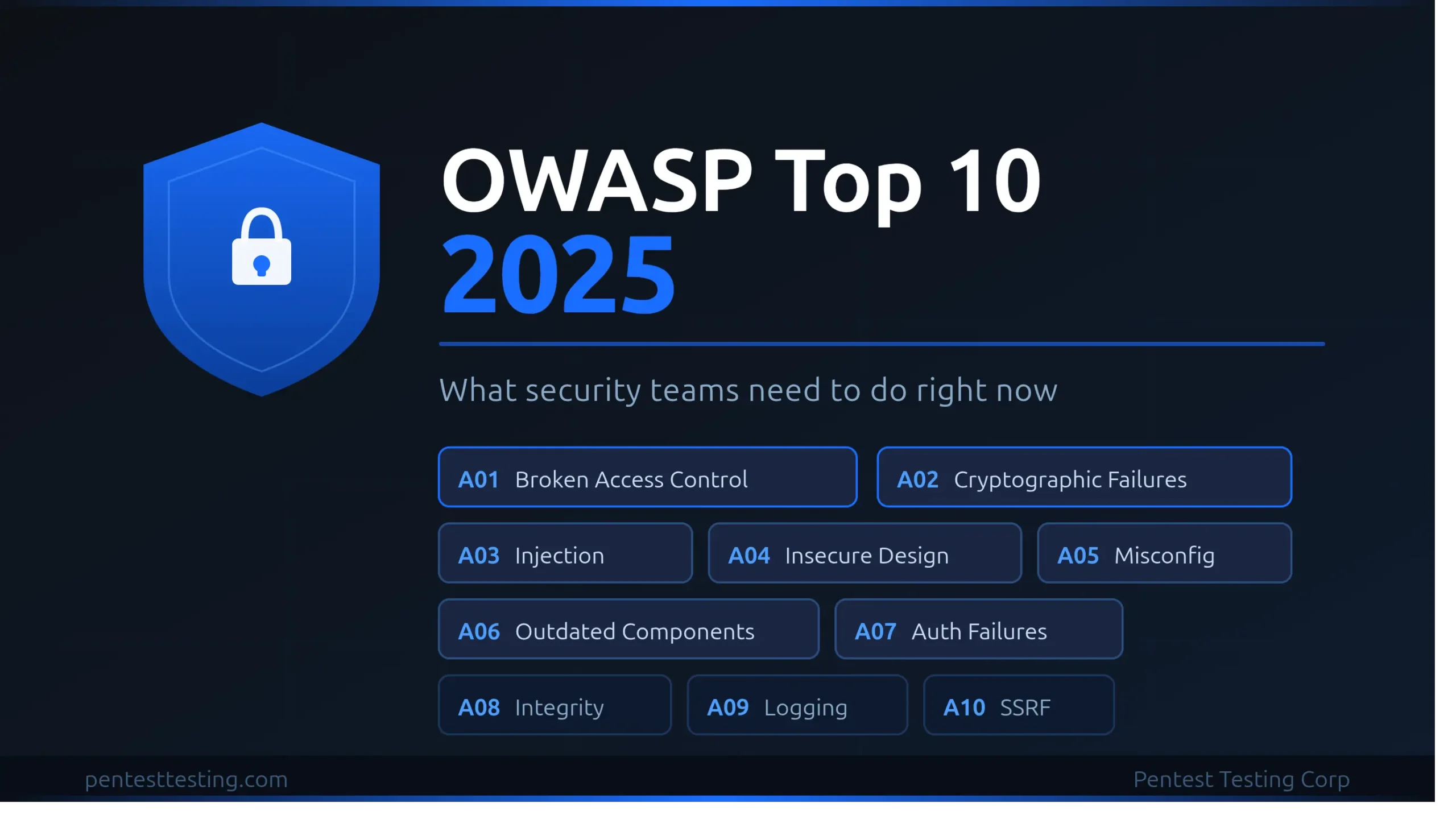
Authentication weaknesses remain in OWASP's Top 10 for a reason. Testing covers brute force protections, default credentials, credential exposure in transit, multi-factor authentication bypass, remember-me token analysis, and password reset flow abuse. We test every authentication mechanism in scope, including SSO integrations and OAuth flows.
OTG-AUTHZ: Authorization Testing
Authorization flaws, insecure direct object references, privilege escalation, function-level access control failures, are the most common class of high-severity findings we validate. These require a manual web pentest approach; no scanner can reason about your application's intended access model.
OTG-SESS: Session Management Testing
Weak session token entropy, improper session expiration, CSRF vulnerabilities, session fixation, this category is often underweighted in vendor scopes. We analyze session lifecycle from creation through termination.
OTG-INPVAL: Input Validation Testing
The largest WSTG category. Covers SQL injection, Cross-Site Scripting (reflected, stored, DOM-based), XML injection, LDAP injection, command injection, template injection (SSTI), HTTP header injection, and open redirect. We test both server-side and client-side validation controls.
OTG-BUSL: Business Logic Testing
This is where manual expertise separates a pentest from a scan. Business logic flaws, price manipulation, workflow bypass, race conditions, feature abuse, require understanding what your application is supposed to do and then systematically testing every way it can be made to behave differently.
Step-by-Step Web App Pentest Process
A professional web app security testing engagement follows a defined lifecycle. Here's exactly how a rigorous engagement is structured:
Step 1: Scoping and Pre-Engagement
Define the target application(s), authentication credentials to be provided, testing environment (production vs. staging), testing hours, and out-of-scope items. Agree on rules of engagement. A scoping call typically takes 30–45 minutes and produces a signed Statement of Work.
Step 2: Reconnaissance and Information Gathering
Passive and active enumeration of the target. Technology stack identification, subdomain enumeration, API endpoint discovery, JavaScript file analysis, and public threat intelligence review. Duration: 2–4 hours for a medium-complexity application.
Step 3: Automated Baseline Scanning
Run authenticated and unauthenticated scans using industry tools (Burp Suite Pro, OWASP ZAP) as a baseline. Automated scanning surfaces the easy wins and ensures no obvious vulnerability class is missed. This is the starting point, not the deliverable.
Step 4: Manual Testing, Authentication and Authorization
Manual review of all authentication flows, session management, and access control enforcement. Testers create multiple user accounts at different privilege levels and systematically test every function for horizontal and vertical privilege escalation.
Step 5: Manual Testing, Input Validation and Injection
Every user-controlled input, form fields, HTTP headers, JSON parameters, GraphQL queries, file upload handlers, is tested for injection vulnerabilities. Context-aware payloads are used; generic scanner payloads are augmented with application-specific logic.
Step 6: Business Logic and Application-Specific Testing
Tester maps the application's core business workflows and attempts to subvert them. Examples include: skipping payment steps, manipulating quantity or price parameters, abusing coupon/referral systems, exploiting rate limit gaps, and testing multi-step workflow integrity.
Step 7: API Security Testing
For applications with REST or GraphQL APIs, dedicated API security testing is performed — including authentication bypass, excessive data exposure, mass assignment, lack of resource and rate limiting, and improper function-level authorization. See our API Penetration Testing service for details on API-specific methodology.
Step 8: Findings Validation and Proof-of-Concept Development
Every finding is validated manually. A vulnerability is only reported when exploitability is confirmed with evidence: a screenshot, a crafted request/response pair, or a functional proof-of-concept. No theoretical findings without validation.
Step 9: Reporting
A full technical report is delivered within 2–3 business days of test completion. Report includes executive summary, risk-rated findings (CVSS v3.1 scored), detailed reproduction steps, and specific remediation guidance, not generic advisories copied from a CVE database.
Step 10: Remediation Support and Retest
We include a free retest window (typically 30 days) to validate that identified vulnerabilities have been correctly remediated. A remediation attestation letter is issued upon successful close-out.
Web App Pentest Checklist: What a Rigorous Engagement Covers
Use this web app pentest checklist to evaluate whether a vendor's scope is comprehensive or incomplete.
| Test Category | Key Test Cases | Manual Required? |
|---|---|---|
| Information Gathering | Tech fingerprinting, exposed files, WAF detection | Partially |
| Authentication | Brute force, credential stuffing, MFA bypass, reset flow abuse | Yes |
| Authorization | IDOR, privilege escalation, BOLA, BFLA | Yes |
| Session Management | Token entropy, CSRF, session fixation, cookie flags | Yes |
| SQL Injection | Error-based, blind, time-based, OOB | Partially |
| XSS | Reflected, stored, DOM-based | Partially |
| Business Logic | Workflow bypass, price manipulation, race conditions | Yes |
| API Security | OWASP API Top 10, mass assignment, excessive exposure | Yes |
| File Upload | Extension bypass, malicious file execution, path traversal | Yes |
| Cryptography | Weak TLS, insecure cipher suites, certificate validation | Partially |
| Security Headers | CSP, HSTS, X-Frame-Options, Referrer-Policy | No |
| Third-Party Integrations | OAuth flows, SAML assertions, webhook security | Yes |
When a web application and native mobile clients share the same identity backend, authentication review should also cover mobile passkey lifecycle behavior. See our passkey security testing for mobile apps guide for the enrollment, recovery, fallback, device-transition, and session checks that should be added to a passkey-enabled product.
Any vendor who claims to perform a full web application penetration testing engagement without manual testing of authorization and business logic should not be trusted. Those categories cannot be automated.
Manual Web Pentest vs. Automated Scanning: What You Actually Get
This is the conversation that matters most for CTOs signing off on security budgets.
What Automated Scanners Find Well
Automated tools are effective at identifying well-known, pattern-based vulnerabilities: missing security headers, known CVEs in outdated software components, basic reflected XSS, and SQL injection in obvious input fields. They're fast, repeatable, and cheap to run continuously.
What They Consistently Miss
A manual web pentest is necessary to find the vulnerabilities that actually cause breaches:
- IDOR and broken object-level authorization: Requires understanding relationships between objects in your data model
- Business logic flaws: No scanner knows what your checkout flow is supposed to do
- Second-order injection: Where input is stored safely but executed unsafely later in a different context
- Authentication chaining: Where two low-severity weaknesses combine into a critical exploit
- GraphQL introspection abuse and batching attacks: Most scanners have limited GraphQL coverage
- JWT algorithm confusion attacks: Requires cryptographic reasoning, not signature matching
- Race conditions: Requires concurrent request timing that scanners rarely implement correctly
Cost vs. Risk Reality
| Approach | Annual Cost (est.) | Critical Vuln Detection Rate |
|---|---|---|
| Automated scanning only | $5K–$20K | ~40% of critical findings |
| Automated + manual pentest (annual) | $15K–$40K | ~85% of critical findings |
| Continuous manual pentest program | $40K–$100K+ | ~95%+ of critical findings |
Estimates based on industry benchmarks and internal client data. Detection rates reflect findings confirmed as exploitable.
For most growth-stage companies, an annual manual web pentest with a mid-cycle automated scan is the right balance of cost and coverage. For companies handling payments, PII at scale, or operating in regulated industries, we recommend a semi-annual cadence. See our Web Application Penetration Testing service page for current engagement pricing.
Explore our updated 2026 guide on API security testing, where we break down real-world attack vectors, authentication flaws, and modern API risk patterns.
How to Evaluate a Web App Security Testing Vendor
There's no shortage of vendors claiming to offer "comprehensive" web app security testing. Most are selling automated scans with a PDF wrapper. Here's how to cut through the noise:
Questions That Separate Real Pentesters From Report Factories
1. Can you describe your methodology for testing authorization flaws?
An acceptable answer explains how they create multi-role test accounts, map access control matrices, and test each function for IDOR and privilege escalation. An unacceptable answer mentions Burp Suite and moves on.
2. What's your process for testing business logic?
They should ask questions about your application's business workflows during scoping. If they don't ask, they won't test it.
3. Do you include proof-of-concept exploits in your report?
Every critical and high finding should have a validated PoC. Reports without PoCs are often based on scanner output, not manual testing.
4. What does your retest process look like?
A vendor who charges full price for retests is not aligned with your interest in being secure, they're aligned with finding more billable work.
5. Who actually performs the test?
Many vendors sell engagements and then subcontract to freelancers. Ask specifically whether the tester who performs the assessment is a full-time employee and holds relevant certifications (OSCP, CEH, GWAPT, BSCP).
Certifications Worth Noting
| Certification | Issuer | Relevant For |
|---|---|---|
| OSCP | Offensive Security | Broad offensive testing competence |
| BSCP (Burp Suite Certified Practitioner) | PortSwigger | Web-specific, hands-on exam |
| GWAPT | GIAC | Web application penetration testing |
| CEH | EC-Council | Baseline ethical hacking knowledge |
| CREST CRT / CCT | CREST | UK/enterprise-recognized web testing |
At Pentest Testing Corp, every web application engagement is performed by a certified tester with a minimum of three years in hands-on offensive security. Our network penetration testing team follows the same standard.
Conclusion
Web application penetration testing done right is not a box to check, it's a technical discipline that requires skilled human judgment, structured methodology, and honest reporting. Automated scanners have their place in a security program, but they cannot replace a trained tester reasoning about your application's specific business logic, access control model, and API behavior.
The OWASP WSTG remains the most rigorous publicly available framework for structuring a web pentest. Pair it with a manual-first approach, validated PoCs, and a clear retest cycle, and you have a defensible, repeatable security program.
If you're evaluating vendors, use the checklist and questions in this guide to separate genuine manual testing from scan-and-report operations. The difference in findings quality, and ultimately your risk exposure, is substantial.
Ready to find out what's actually exploitable in your web application?
Book a free scoping call, no sales pitch, just a technical conversation about your application and what a rigorous engagement would cover.